Trauma as Restricted Development
How Overwhelm Limits the Capacity for Safety, Contact, and Vitality
Written by Dirk Marivoet, founder of Core Strokes®
This article offers a deeper exploration of how Core Strokes® understands trauma as a developmental and embodied process. It builds on the foundational perspective outlined in the Core Strokes® Approach & Methods.
How Core Strokes® Relates to Other Somatic Trauma Approaches
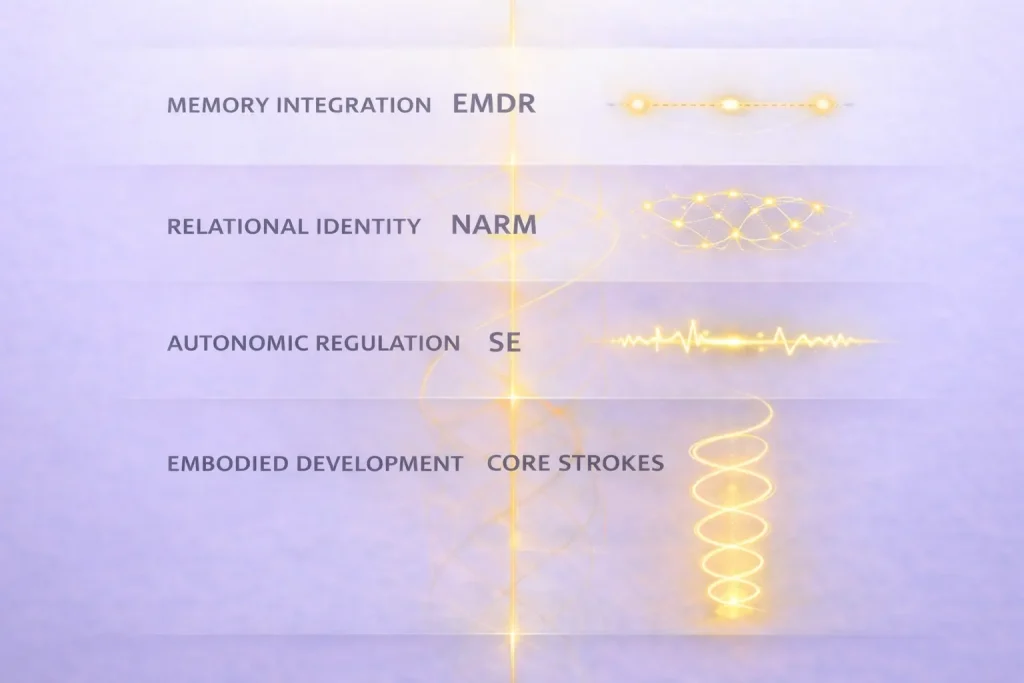
Many people today are familiar with established trauma therapies, such as EMDR, Somatic Experiencing, or the NeuroAffective Relational Model. These approaches have helped thousands of people process overwhelming experiences and reconnect with their inner resources.
Core Strokes® stands in dialogue with these methods — and also takes a different perspective.
Eye Movement Desensitization and Reprocessing (EMDR)
EMDR (Eye Movement Desensitization and Reprocessing) primarily works with traumatic memories — past experiences that continue to intrude into the present through images, emotions, or bodily reactions. It helps the brain integrate these memories so they no longer automatically trigger overwhelm, panic, or shutdown.
EMDR can be very effective when distress is clearly linked to specific events and memories that remain “stuck” in the nervous system.
Somatic Experiencing (SE)
Somatic Experiencing focuses mainly on shock trauma — experiences that overwhelm the nervous system, such as accidents, medical procedures, or sudden threats. It helps the body gradually come out of fight, flight, or freeze so a basic sense of safety can return.
SE helps the body:
- settle excessive activation
- complete interrupted survival responses
- return to a basic sense of safety
This approach can be especially helpful when the nervous system remains caught in survival mode after overwhelming events.
NeuroAffective Relational Model (NARM)
NeuroAffective Relational Model focuses primarily on developmental trauma — the impact of growing up without enough safety, attunement, or support. It helps people understand how early relational patterns shaped their sense of self and supports the recovery of agency and connection in the present.
NARM helps people:
- understand how early experiences shaped their identity
- reconnect with agency and choice
- work with shame and relational patterns
It is especially helpful for long-standing relational difficulties.
Where Core Strokes® Is Different
Core Strokes® does not ask first:
“Is this shock trauma, developmental trauma, or a traumatic memory?”
Instead, it asks:
“How is this experience living in the body right now — in breath, tissue, posture, and relationship?”
Core Strokes® starts from a simple observation:
our capacity to live, feel, and relate develops over time.
We do not learn safety, connection, intensity, or rest all at once — these capacities emerge gradually, through lived experience.
When the environment is supportive, these capacities can unfold and integrate. When it is overwhelming, unpredictable, or lacking, the body adapts by prioritizing survival — and some capacities may remain underdeveloped, restricted, or disconnected.
Breath reflects this developmental process. As we grow, breath naturally takes on different qualities that support different ways of being in the world. At some moments, breath supports grounding and safety. At others, it supports receiving, exploring, expressing intensity, yielding, or resting.
Core Strokes® describes these recurring qualities as breath phases — not as techniques, but as developmental capacities that remain available throughout life.
When essential experiences are overwhelming, absent, or disrupted at key moments in development, access to certain breath phases becomes limited. From this perspective, trauma is understood not only as dysregulation or unresolved memory, but as restricted access to specific ways of breathing, feeling, and being in contact.
Breath as a Developmental Organizer
In Core Strokes®, breath is not just something we regulate — it is something that organizes and expresses how we live in our body.
From the beginning of life, breathing develops in close interaction with our environment, our body, and our relationships. The way we breathe both reflects and shapes how safe we feel, how easily we receive support, how freely we explore, and how much intensity we can stay present with. Over time, these breathing patterns become familiar ways of inhabiting the body.
Different qualities of breath are therefore closely linked with different life capacities, something that becomes clear when we notice how breathing naturally changes in different situations.
- When breath settles downward and slows, the body often moves toward safety and grounding.
- When breath softens and widens, it tends to support receiving care and contact.
- When breath becomes lighter and more mobile, it often accompanies curiosity and action.
- When breath deepens and charges, it can carry intensity and vitality without overwhelm.
- When breath lengthens and releases, it commonly coincides with surrender and rest.
Breath is not a technique that produces these states.
It is a living pattern through which developmental capacities are expressed, organized, and made accessible in the body.
When these breathing qualities are supported through experience, they remain available and flexible. When they are overwhelmed, interrupted, or missing at key moments in development, breath may adapt by tightening, collapsing, or becoming restricted.
In such cases, people may feel stuck, overwhelmed, disconnected, or unable to stay present in relationship — not because something is “wrong,” but because certain ways of breathing and being were never fully supported to develop.
Fascia: How Experience Becomes Embodied
Core Strokes® also works directly with fascia — the connective tissue that gives shape, tone, and continuity to the body.
Fascia is understood as a place where life experience settles over time. Early stress, shock, or lack of support does not only affect the nervous system — it also shapes:
- how dense or collapsed the body feels
- how easily movement and breath flow
- how safe it feels to receive touch or closeness
By working gently and precisely with fascial qualities, Core Strokes® can reach experiences that are too early, too implicit, or too deeply embodied to be accessed through words or memory alone.
Working with Intensity — Without Forcing or Avoiding It
Some approaches calm intensity quickly. Others avoid it altogether.
Core Strokes® takes a different path:
it helps people learn how to stay in contact while energy increases — without pushing, collapsing, or dissociating.
This is especially important for people who:
- feel overwhelmed by strong emotions
- struggle with relational intensity
- have complex or borderline patterns
- alternate between collapse and over-activation
In Core Strokes®, intensity is not treated as a problem to eliminate, but as a vital life force that needs structure, pacing, and relational support in order to be lived safely and meaningfully.
A Relational and Developmental Approach
In Core Strokes®, the practitioner’s presence is not secondary — it is part of the work.
Breath, touch, timing, and contact are not neutral tools applied to a client. They form the relational environment in which regulation becomes possible. Many forms of trauma originate in moments where support, attunement, or contact were missing or overwhelming. For that reason, regulation does not happen only inside one person — it emerges between bodies, through shared rhythm, pacing, and presence.
Rather than following a fixed protocol, Core Strokes® work unfolds moment by moment. The practitioner listens continuously to how the client’s system is responding and adapts accordingly, guided by:
- the quality and rhythm of breath
- the responsiveness of tissue
- relational signals such as closeness, distance, or hesitation
- the client’s developmental readiness in that moment
This allows the work to remain both safe and alive — supporting growth without forcing, and contact without overwhelm.
In Short
- EMDR helps integrate traumatic memories so past events no longer dominate the present.
- SE helps restore basic nervous system safety after shock.
- NARM helps resolve how early relational wounds shape identity, agency, and connection.
- Core Strokes® builds on these perspectives by working with how safety, relationship, and vitality are developmentally organized in the body — through breath, fascia, and relational presence as one continuous process.
Core Strokes® is not a technique.
It is a developmental map of embodied regulation, supporting people in reclaiming the full range of breathing, feeling, connecting, and resting that make a lived life possible.
Part of the Core Strokes Trauma Series
This article is part of an ongoing series exploring trauma as a developmental and embodied process within the Core Strokes® framework.
The series examines how trauma restricts access to core capacities — and how these capacities are restored through different dimensions of embodied experience:
Trauma as Restricted Development — how overwhelm limits access to safety, contact, and vitality
Breath and Trauma — how breathing capacity organizes safety and regulation
Fascia and Trauma — how experience becomes embodied in tissue
Intensity as Capacity — meeting strong activation without overwhelm
Relationship as a Developmental Capacity — how regulation emerges in contact
Together, these texts describe how safety, vitality, and contact are restored through breath, fascia, intensity, and relational presence as one integrated developmental process.
You can also experience these principles directly in:
Frequently Asked Questions About Somatic Trauma Therapy and Core Strokes®
Below you’ll find clear answers to common questions about somatic trauma therapy, complex PTSD (C-PTSD), attachment trauma, and the Core Strokes® developmental framework.
Closing Perspective
Core Strokes® is a developmental somatic framework rooted in breath, fascia, and relational regulation.
It does not simply treat trauma.
It restores embodied capacity.From that restoration, integration unfolds.
And from integration, relational maturity becomes possible.