🌬 The Energetic Breath Cycle
A Developmental and Phenomenological Map of Breath, Regulation, Fascia, and Embodied Participation
By Dirk Marivoet, Founder of Core Strokes® · Body Psychotherapist · Somatic Researcher · Author
What is the Energetic Breath Cycle™
The Energetic Breath Cycle™ describes how breathing participates in the organization of embodied life.
Within Core Strokes®, breath is approached not merely as a physiological function, but as a living organizer of regulation, emotional responsiveness, movement, fascial continuity, energetic activation, and relational participation.
The model explores recurring phases through which the organism negotiates openness and protection, activation and settling, expression and containment, surrender and renewal.
Rather than prescribing how someone should breathe, the Energetic Breath Cycle™ offers a way of recognizing how breathing already organizes experience — moment by moment, relationship by relationship, phase by phase.
Developed within the Core Strokes® framework, the model expands upon the Natural Energetic Cycle articulated by Jack W. Painter and integrates developmental psychology, somatic psychotherapy, fascia-informed observation, Reichian energetic principles, autonomic regulation, and phenomenological embodiment into one coherent developmental map.
The Energetic Breath Cycle™ therefore functions both as a clinical compass and as a developmental framework for embodied transformation.
Breath, Regulation, and Embodied Participation
Within Core Strokes®, breathing is inseparable from embodied participation.
How we breathe influences how safely we can remain open, how much intensity we can metabolize, how coherently we can remain present, and how fully we can participate within relationship and life itself.
Breathing continuously interacts with fascia, posture, movement, autonomic regulation, emotional organization, energetic responsiveness, and relational contact. The Energetic Breath Cycle™ therefore describes not only breathing patterns, but changing capacities for participation across sensation, emotion, activation, contact, surrender, and rest.
Within therapeutic contexts, these processes unfold relationally. Regulation develops through attunement, pacing, grounding, emotional responsiveness, and therapeutic presence. Breathing rhythms reorganize not in isolation, but within a stable interpersonal field capable of supporting continuity and safety.
The Pulsatory Nature of Life
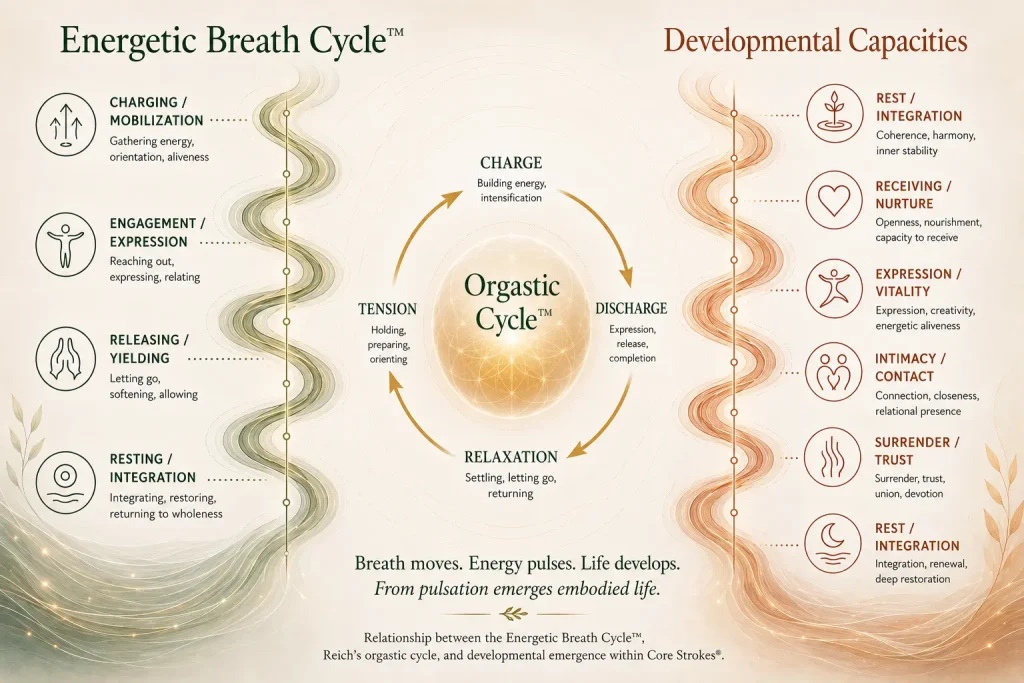
The Energetic Breath Cycle™ is deeply connected to the pulsatory principles originally described by Wilhelm Reich through the orgastic cycle of tension, charge, discharge, and relaxation.
Within Core Strokes®, these pulsatory movements are expanded into a developmental spiral describing how embodied life organizes through recurring movements of activation, expression, surrender, integration, and restoration.
The cycle therefore reflects not merely respiration, but the organism’s changing relationship to vitality, openness, contact, pleasure, differentiation, intensity, and rest.
Breath as Our First Story
Breathing begins before language.
Long before thought, interpretation, or identity, the body already expands, contracts, receives, protects, reaches, and settles. Breath becomes one of the organism’s earliest expressions of participation within life.
Over time, developmental experience shapes how this participation unfolds. Safety, attunement, overwhelm, interruption, nourishment, trauma, and relationship all influence how breathing organizes throughout the body.
In this way, breath does not stand alone. It continuously weaves together with fascia, movement, emotional responsiveness, energetic activation, and relational experience. The body remembers these histories not only psychologically, but organizationally — through breathing rhythms, movement tendencies, tension patterns, and relational participation itself.
Why a Breath Cycle?
Breathing practices exist within many traditions, including yoga, meditation, martial arts, psychotherapy, and trauma therapy.
What distinguishes the Energetic Breath Cycle™ is not the use of breath itself, but the integration of multiple dimensions of embodied organization into one developmental map.
The model brings together developmental psychology, fascia-informed observation, somatic psychotherapy, autonomic regulation, Reichian energetic principles, and phenomenological observation into a unified understanding of how embodied participation organizes throughout life.
Rather than teaching people how to breathe, the Energetic Breath Cycle™ explores how breathing already organizes protection, openness, continuity, activation, emotional expression, and relationship.
Breath does not move mechanically in a straight line.
It unfolds as a living spiral.
The Energetic Breath Cycle™ describes this spiral as a recurring rhythm of participation through which embodied life continuously reorganizes itself.
The Nine Phases of the Energetic Breath Cycle™
Each phase reflects a healthy developmental capacity of the organism. When developmental conditions become overwhelming, intrusive, fragmenting, or insufficiently supportive, these same phases may organize into protective or distorted forms.
The phases are not rigid categories, but living movements within embodied experience.
🌱 Grounding & Receiving
- Secure Breath
Safety, grounding, support, and embodied settling
→ Distortion: Fragmented Breath
🔗 Explore Secure Breath → - Nurturing Breath
Receiving, nourishment, bonding, and emotional softening.
→ Distortion: Needy Breath
🔗 Explore Nurturing Breath →
🌿 Movement & Expression
- Exploring Breath
Curiosity, outward reach, experimentation, and developmental expansion
→ Distortion: Inflated Breath - Free Breath
Flexible participation balancing autonomy and connection
→ Distortion: Conflicted Breath - Excited Breath
Vitality, eros, play, activation, and expressive aliveness.
→ Distortion: Interrupted Breath
🔗 Explore Excited Breath →
✨ Integration & Rest
- Orgastic Breath
Fusion, pulsation, surrender, and embodied wholeness
→ Distortion: Dissociated Breath - Ecstatic Breath
Resonance, clarity, luminosity, and expanded coherence.
→ Distortion: Illusory Breath - Surrendering Breath
Yielding, trust, belonging, release, and embodied weight.
→ Distortions: Overextended / Collapsed Breath - Resting Breath
Integration, metabolization, restoration, and completion
→ Distortions: Exhausted / Anxious Breath
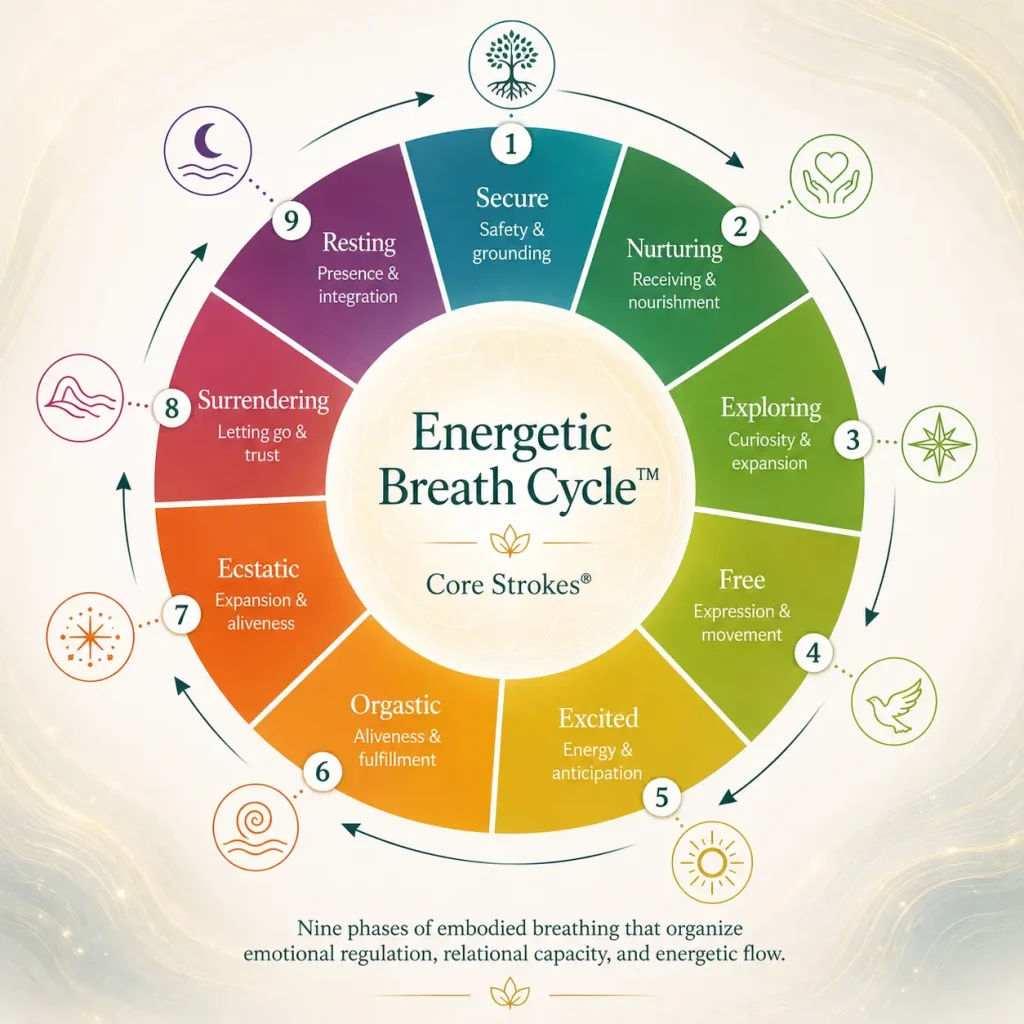
Each healthy phase of the Energetic Breath Cycle™ corresponds to a Soul Texture™ that expresses the integrated potential of that phase. When developmental participation becomes restricted or interrupted, the same phase may organize through characteristic distortions that later become visible within the Shadow Soul Textures™ framework.
Together, these models describe how breathing, fascia, emotional life, and relational participation may organize along a continuum from survival adaptation toward increasing coherence.
How to Use This Map
The Energetic Breath Cycle™ is not a rigid developmental ladder.
People may recognize themselves strongly within one phase, move fluidly between several phases, or experience different phases depending on relationship, emotional responsiveness, developmental history, and available regulation.
These maps are not intended for self-diagnosis. They are invitations to observe how breathing organizes experience, where participation flows more freely, where it becomes restricted, and how these patterns may gradually reorganize over time.
Begin where something feels familiar, resonant, alive, or gently challenging.

This diagram illustrates how nine phases of breath correspond with distinct qualities of fascial organization, energetic movement, and emotional expression within the Core Strokes® framework.
Breath and Fascia — Two Languages of One Story
Within Core Strokes®, breath and fascia are deeply interconnected.
Breathing influences tissue hydration, vibration, movement propagation, energetic responsiveness, and pressure distribution throughout the organism. At the same time, fascial organization influences breath amplitude, continuity, resonance, mobility, and emotional responsiveness.
Fascia is therefore approached not as passive wrapping tissue, but as a responsive organizational medium participating in movement, continuity, protection, adaptation, and embodied regulation.
Breath animates fascia.
Fascia shapes breath.
Together they participate in the organism’s ongoing negotiation between openness and protection, continuity and interruption, activation and settling, relationship and withdrawal.
The Breath Cycle as Practical Compass
For practitioners, the Energetic Breath Cycle™ supports assessment, pacing, regulation, relational attunement, movement exploration, and trauma-informed therapeutic process.
For individuals, it offers a framework for recognizing recurring patterns of activation, fragmentation, inflation, collapse, grounding, vitality, and emotional regulation.
Rather than framing symptoms as isolated dysfunctions, the model explores how protective organizations emerge through interrupted developmental participation.
Breath as Developmental Journey
Each phase echoes recurring developmental themes within human life.
Secure Breath reflects grounding, support, and early safety. Nurturing Breath relates to bonding, receiving, and emotional nourishment. Exploring Breath supports curiosity, movement outward, and developmental expansion. Free Breath organizes flexibility between differentiation and connection.
Excited Breath expresses vitality, eros, play, and expressive participation. Orgastic and Ecstatic Breath explore surrender, resonance, unification, and expanded coherence. Surrendering and Resting Breath support release, metabolization, restoration, and renewal.
These capacities are never simply “outgrown.” They continue organizing embodied life throughout adulthood.
Healing often involves restoring flexibility and continuity between phases rather than remaining fixed within one defensive organization.
Breath, Participation, and Coherence
Within Core Strokes®, the Energetic Breath Cycle™ describes recurring capacities for embodied participation throughout life.
As continuity develops across the cycle, these capacities become increasingly integrated rather than fragmented, restricted, or organized primarily around protection. This growing integration is described within the framework as Soul Coherence.
The Energetic Breath Cycle™ therefore maps the organism’s capacities for participation, while Soul Coherence describes the degree to which those capacities become organized as a unified living process.
A Living Spiral
The Energetic Breath Cycle™ is not merely a theory.
It is a living rhythm moving through therapy, movement, touch, relationship, emotional process, and embodied life itself.
Within Core Strokes®, transformation unfolds gradually through breath continuity, grounding, relational attunement, emotional participation, movement, and embodied presence.
Over time, breathing becomes less defended, participation becomes more coherent, and embodied life regains increasing vitality, openness, flexibility, and trust.
Explore Related Core Strokes® Concepts
→ The Organisation of Embodied Participation
The phenomenological foundation of Core Strokes®, describing how continuity, coherence, permeability, metabolisation, adaptive organisation, and relational geometry organise embodied life.
→ Defensive Organisation
A protective form of Adaptive Organisation in which participation becomes organised around experienced or anticipated threat, overwhelm, disruption, or loss of continuity.
→ Living Participation Observation System™ (LPOS™)
The observational methodology through which embodied and relational expressions are described before provisional organisational interpretations are developed.
→ Relationsl Field and Relational Geometry
The Relational Field is the embodied space of interaction. Relational Geometry describes how proximity, distance, boundaries, orientation, reciprocity, and differentiation are organised within it.
→ Energetic Breath Cycle™
A developmental map describing how breathing organises grounding, activation, emotional expression, surrender, and restoration throughout the organism.
→ Fascia Texture Typology™
A phenomenological framework for describing recurring tactile configurations and considering their possible organisational significance without treating them as diagnoses, personality types, or records of developmental history.
→ Neurofascial Encoding™
A proposed research framework exploring possible relationships among repeated participation, neural plasticity, behaviour, physiological regulation, movement, mechanical loading, and connective-tissue remodelling.
→ Neurofascial Transformation Process™
The therapeutic process through which breathing, fascia, movement, therapeutic touch, and relational participation gradually support lasting embodied transformation.
→ Therapeutic Touch
An embodied and relational practice guided by consent, clinical judgement, perceptual attention, and responsiveness rather than by mechanical intervention or predetermined interpretation.
→ Character Structures
A framework for exploring recurring developmental organisations of bodily, emotional, behavioural, and relational participation without reducing people to fixed types.
→ Soul Organisation, Soul Coherence, and Soul Textures ™
Interrelated dimensions of Core Strokes® concerned with authenticity, meaning, inner resonance, embodied presence, and relational participation. Soul Organisation names the wider qualitative domain; Soul Coherence describes increasing integrity among dimensions of experience; Soul Textures™ describe describe qualities of coherent participation; and Shadow Soul Textures™ describe qualitative expressions of protective, constrained, fragmented, or compensatory Adaptive Organisation.
These principles can also be explored directly through experiential practice within:
Closing Invitation
Every breath is a beginning.
Each phase offers a different possibility for regulation, expression, relationship, vitality, surrender, integration, and renewal.
Through increasing continuity across the cycle, breathing becomes not merely a physiological function, but a living pathway toward embodied participation, coherence, and transformation.