When Breath Organizes Experience
A Developmental Map of Breath, Fascia and Relational Life in Somatic Psychotherapy
Written by Dirk Marivoet, founder of Core Strokes®
Breath is not only a physiological function.
In somatic psychotherapy it is a primary organizer of experience — shaping how sensation, emotion, and relationship unfold in the body.
Context: Breath as a Developmental Organizer
This essay introduces a foundational orientation to the Core Strokes® framework. It explores how breath functions as a developmental organizer of experience across fascia, nervous system regulation, and relational life.
Readers interested in how this orientation is applied to trauma, intensity, and embodied regulation can explore the related essays linked below.
From Technique to Orientation
Over the past decades, somatic psychotherapy has developed a rich and diverse field of practice. Contemporary approaches have emphasized different entry points into nervous system regulation and developmental repair — including touch-based relational work, movement, interoceptive awareness, emotional tracking, and breath-centered practices. Each of these entry points has contributed essential clinical insight into how experience is held, shaped, and transformed in the body.
At the same time, a shared underlying question remains:
what organizes experience beneath technique?
This article does not introduce a new therapeutic method or set of interventions. Instead, it offers a developmental map — an orienting framework for understanding how breath organizes experience across fascia, nervous system, and relational life. Breath is approached here not as something to be trained, corrected, or applied, but as a primary organizing process through which bodily coherence, emotional meaning, and relational capacity emerge over time.
Breath as an Organizing Principle
Breath is often described in functional terms: regulation, activation, relaxation, grounding. While these descriptions are accurate, they remain partial. From a developmental perspective, breath functions more fundamentally as a process of organization.
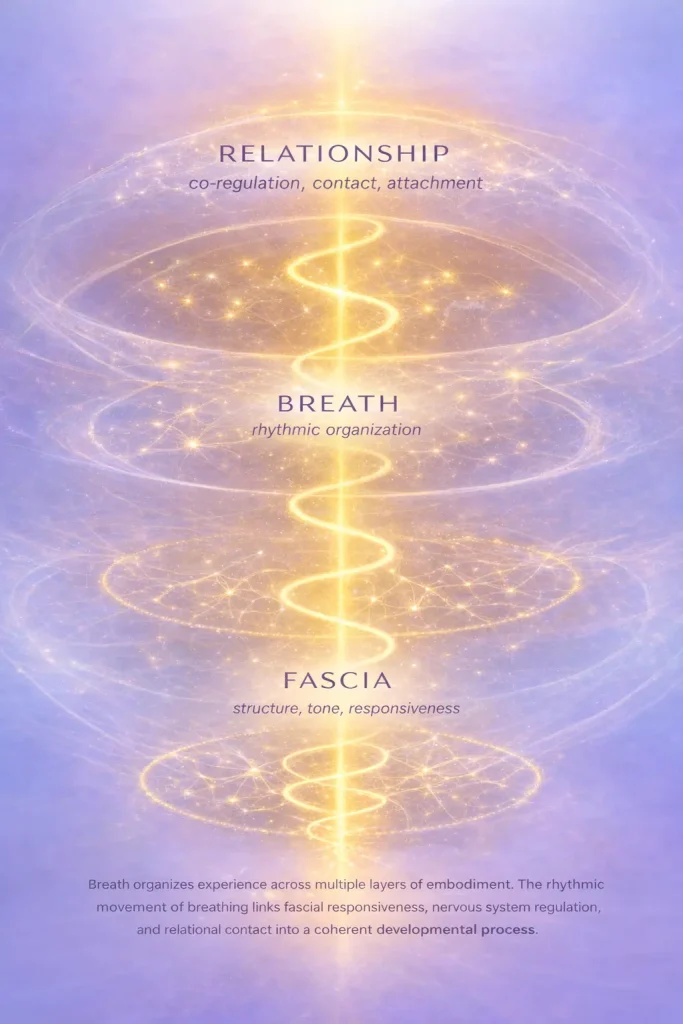
Breath organizes experience through:
- establishing rhythms of expansion and contraction,
- coordinating sensation, emotion, and movement,
- mediating contact between inner experience and the relational world.
Rather than simply reflecting psychological states, breathing patterns participate in the formation of those states. How breath flows, pauses, tightens, or fragments expresses how the organism has learned to meet life — how it approaches, withdraws, sustains contact, or interrupts engagement.
In this sense, breath is neither symptom nor solution.
It is process.
Readers interested in how this organizing principle unfolds across a full developmental arc may explore the
→Energetic Breath Cycle™
Developmental Sequencing and Coherence
Experience does not arise all at once. It organizes developmentally — through successive capacities for sensing safety, receiving support, exploring, expressing, yielding, and integrating. These capacities unfold in relationship and are shaped by the conditions present at each stage of development.
Breath provides continuity across this unfolding. Early in life, breathing is inseparable from holding, warmth, rhythm, and contact. Over time, it becomes differentiated — supporting curiosity, agency, emotional expression, intimacy, surrender, and rest.
When development is sufficiently supported, breath retains flexibility. It adapts fluidly to changing internal and relational demands. When development is disrupted, breath may organize defensively — becoming restricted, fragmented, inflated, collapsed, or dissociated. These patterns are not failures of technique; they are adaptive organizations of experience shaped by relational history.
A developmental map allows practitioners to recognize where and how organization has become constrained, without prematurely imposing corrective strategies.
Fascia as the Memory of Organization
Fascia plays a central role in stabilizing how breath organizes experience over time. As a continuous connective network, fascia carries the imprint of movement, protection, responsiveness, and relational adaptation. It holds not only mechanical tension, but developmental memory.
Breath and fascia are inseparable:
- breath mobilizes fascial layers,
- fascia shapes the pathways through which breath can move,
- together they express the organism’s history of contact and self-regulation.
From this perspective, fascial tone is not simply tight or loose, functional or dysfunctional. It reflects how experience has been organized. Therapeutic work therefore does not aim to “fix” fascia, but to invite reorganization by restoring conditions in which breath can move differently and new patterns of responsiveness can emerge.
For a deeper exploration of this dimension, see:
→The Memory of Fascia
→The Language of Textures
Relational Life and Co-Regulation
Breath does not organize in isolation.
It organizes in relationship.
Touch-centered and relational approaches — such as Somatic Experiencing, Hakomi, and body-oriented psychoanalytic traditions — have richly articulated the role of attuned contact, timing, and co-regulation in developmental repair. Core Strokes® complements these approaches by mapping how breath itself organizes and reflects relational dynamics over time.
In therapeutic contexts, the practitioner’s posture, breath, pacing, and responsiveness become part of the client’s regulatory environment. Within such conditions, breathing patterns may reorganize spontaneously — not because they are instructed to do so, but because the relational field allows for greater safety, curiosity, and continuity.
This reframes therapeutic action:
- from intervention to participation,
- from technique to attunement,
- from outcome to process tracking.
The practitioner becomes a reader of organization rather than a director of change.
Core Strokes® as a Developmental Map
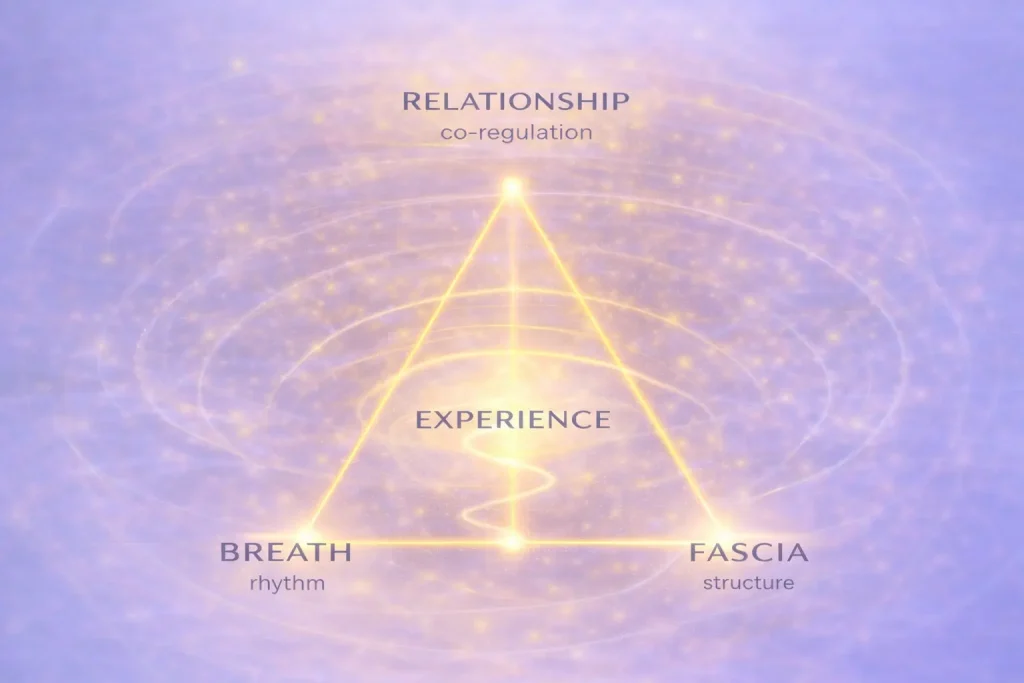
Core Strokes® contributes to the field of somatic psychotherapy by offering a breath-organized developmental map that integrates fascial responsiveness and relational presence into a coherent cycle of embodied organization.
This framework does not replace existing approaches. Rather, it offers a shared orientation through which diverse somatic practices can be understood as engaging different phases of an unfolding developmental process. In this sense, Core Strokes® functions as infrastructure rather than method — a way of seeing how experience organizes, disorganizes, and reorganizes over time.
Closing Reflection
Maps do not replace experience.
They help us orient within it.
By understanding breath as a primary organizer of experience — inseparable from fascia and relational life — somatic psychotherapy gains a unifying perspective that honors complexity without collapsing into protocol. Such an orientation supports practitioners in listening more precisely, intervening more sparingly, and trusting the intelligence of embodied process.
Breath, in this view, is not something we work on.
It is something that quietly, continuously organizes who we are becoming.
Part of the Core Strokes Essays & Foundations Series
These essays introduce key ideas that form the conceptual foundation of the Core Strokes® framework.
They explore how breath, fascia, relational presence, and developmental organization shape human experience in the body.
Continue exploring the Core Strokes Foundations:
Core Strokes Training Pathways
See also the Development & Integration Hub
Intensity as Capacity — meeting strong activation without overwhelm
Trauma as Restricted Development — how overwhelm limits access to safety, contact, and vitality
Pelvic-Heart Integration— restoring the vertical axis between instinct, emotion, and relational expression
Polarity as Developmental Maturation — how masculine and feminine dynamics evolve through embodied development
If you are beginning trauma recovery:
Frequently Asked Questions
“Core Strokes® emerged through decades of clinical, developmental, and phenomenological exploration into the organization of embodied participation.”