Embodiment in Core Strokes®
Living Presence Within the Body
By Dirk Marivoet, Founder of Core Strokes®· Psychotherapist · Somatic Researcher · Author
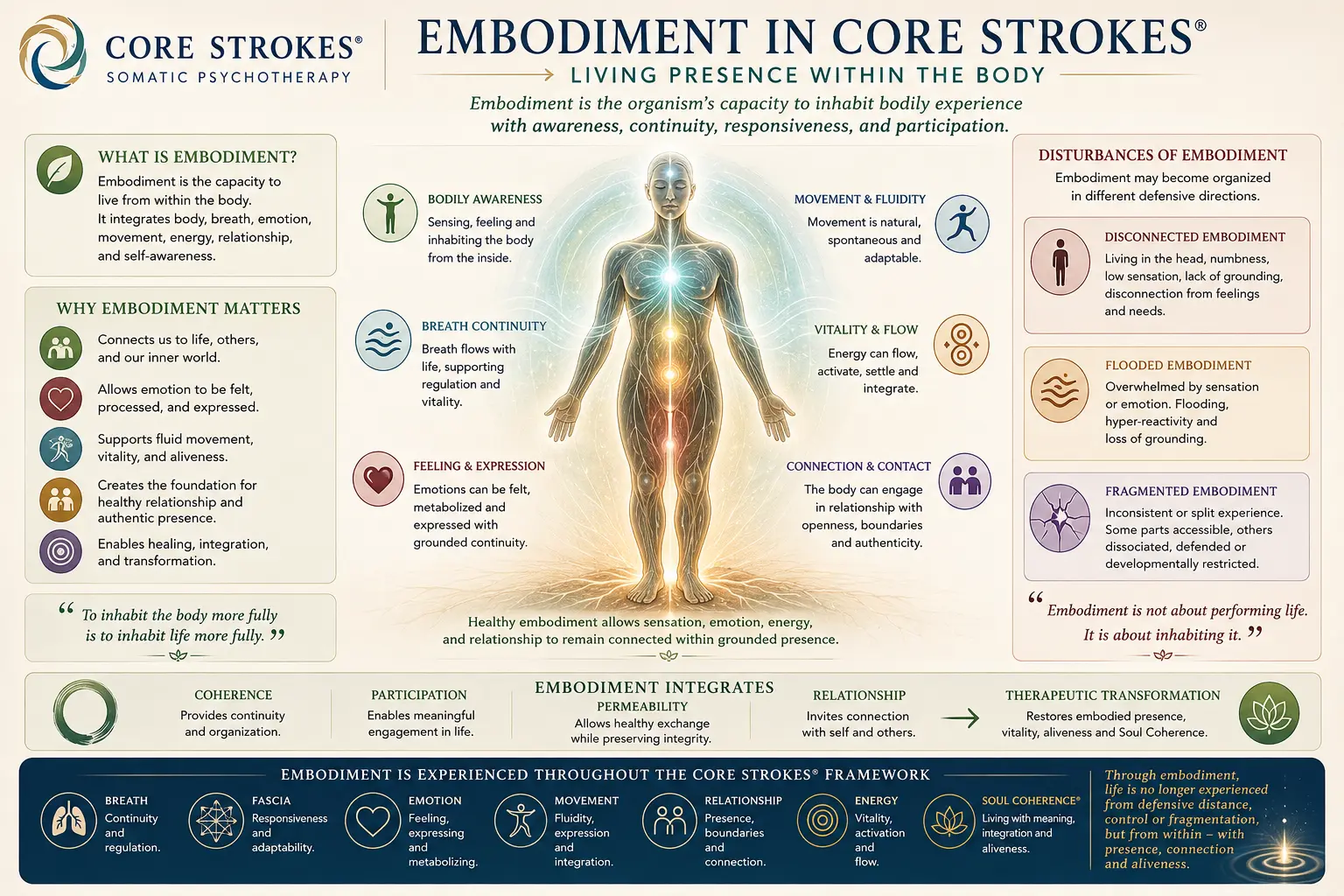
Embodiment — Core Definition
Embodiment refers to the organism’s capacity to experience itself as living within and through the body.
Within the Core Strokes® framework, embodiment describes the continuity between bodily sensation, emotional experience, movement, energetic responsiveness, relational participation, and self-awareness.
Embodiment allows experience to become lived rather than merely thought about, defended against, or dissociated from.
It is the organism’s capacity to inhabit itself from within lived experience.
Why Embodiment Matters
Human experience is always embodied.
Emotion appears through breath, posture, facial expression, movement, muscle tone, autonomic activation, energetic charge, and fascial responsiveness. Relationship is experienced through gaze, voice, touch, proximity, tension, resonance, and bodily participation.
Yet many individuals gradually lose continuity with embodied experience.
A person may think constantly while feeling disconnected from sensation. Another may remain highly emotionally reactive while lacking grounding, regulation, or bodily continuity. Someone may function efficiently in daily life while inwardly feeling numb, unreal, collapsed, overactivated, or absent from themselves.
Embodiment therefore involves far more than “being in the body.”
It involves the organism’s capacity to remain sufficiently present within sensation, emotion, movement, energetic activation, relational contact, and lived experience without becoming chronically defended, fragmented, dissociated, flooded, or disconnected.
Within Core Strokes®, many forms of suffering can be understood partly as disturbances in embodiment.
Therapeutic transformation therefore involves not merely cognitive insight, but the gradual restoration of embodied continuity throughout the organism.
Embodiment and Participation
Within Core Strokes®, embodiment and participation are inseparable.
Participation describes engagement with life. Embodiment describes the organism’s capacity to inhabit that engagement from within lived experience.
Without embodiment, participation may become mechanical, performative, compulsive, or disconnected from authentic self-experience.
Without participation, embodiment may become isolated, withdrawn, or developmentally restricted.
Healthy embodiment allows experience to be lived rather than merely observed, analyzed, performed, or defended against.
In this sense, embodiment may be understood as one of the primary conditions that allows participation to become real, felt, and meaningful.
Embodiment and the Body
The body continuously expresses the organism’s degree of embodiment.
A person with greater embodiment often breathes more fully, moves with continuity, maintains responsive eye contact, and remains capable of emotional expression while preserving grounded presence. Sensation, movement, emotion, and energetic activation remain linked rather than disconnected into separate compartments of experience.
Embodiment can often be observed in simple moments — the way someone walks into a room, receives touch, responds emotionally during conversation, senses internal states, or remains present during vulnerability and contact.
When embodiment becomes restricted, the organism frequently reorganizes defensively.
Breathing may become shallow or disconnected. Posture may collapse or rigidify. Movement may lose spontaneity or fluidity. Emotional expression may become exaggerated, flattened, inhibited, or disconnected from bodily awareness.
Some individuals live predominantly “from the head,” with limited connection to sensation, grounding, or emotional continuity. Others remain flooded by sensation or emotion while struggling to maintain coherence and self-regulation.
Fascial organization often reflects these patterns directly. Tissue may become armored, collapsed, diffuse, fragmented, or chronically activated without sufficient grounding and continuity.
Within Core Strokes®, the body is therefore understood not merely as anatomy, but as the living medium through which embodiment becomes visible.
Healthy Embodiment
Healthy embodiment allows the organism to remain present within bodily experience while preserving continuity, grounding, flexibility, and self-regulation.
Sensation can be felt without immediate overwhelm or defensive withdrawal. Emotion can arise and move through the body without fragmentation or collapse. Movement remains responsive rather than mechanically controlled or disconnected.
A person with healthy embodiment can often sense internal states clearly while remaining capable of reflection, relationship, emotional expression, and grounded participation in life.
They may feel fear without completely dissociating from the body, anger without losing self-continuity, sadness without collapsing into helplessness, or pleasure without needing to defensively restrict vitality and openness.
Healthy embodiment also includes adaptability.
The organism can alternate between activation and rest, expression and receptivity, autonomy and connection, intensity and recovery while maintaining embodied continuity.
Fascially, healthy embodiment is often reflected through responsiveness, hydration, adaptability, energetic continuity, and fluid propagation of movement and sensation throughout the organism.
Within Core Strokes®, healthy embodiment does not imply perfect self-awareness or constant regulation. Rather, it reflects the organism’s capacity to remain sufficiently present within lived experience while preserving coherence, participation, and continuity of self.
Disturbances of Embodiment
Disturbances of embodiment may emerge through trauma, chronic overwhelm, attachment disruption, developmental instability, environmental intrusion, shame, emotional suppression, or prolonged defensive adaptation.
These disturbances may organize in different directions.
Disconnected Embodiment
Some individuals become progressively disconnected from bodily experience.
The person may live primarily through cognition, external functioning, performance, or adaptation while remaining distant from sensation, emotional awareness, grounding, or energetic vitality.
They may struggle to recognize internal needs, bodily signals, emotional states, fatigue, tension, pleasure, or relational impact.
The organism protects itself by limiting embodied contact with experience.
Flooded Embodiment
In other organizations, embodiment becomes overwhelming or poorly regulated.
The organism may become flooded by sensation, emotional intensity, autonomic activation, energetic charge, or relational contact without sufficient grounding or continuity.
The person may feel emotionally overtaken, hyper-reactive, energetically overactivated, or unable to regulate bodily intensity during stress or interpersonal contact.
Embodiment remains intense, but insufficiently organized.
Fragmented Embodiment
Embodiment may also become inconsistent or fragmented.
Certain dimensions of bodily experience remain accessible while others become disconnected, dissociated, defended, or developmentally restricted.
A person may feel emotionally expressive while lacking grounding in the body. Another may remain physically functional while feeling emotionally absent or disconnected from authentic aliveness.
The organism may simultaneously long for contact, sensation, vitality, or intimacy while defensively withdrawing from embodiment itself.
This fragmentation often appears in trauma, structural dissociation, chronic developmental stress, unstable attachment organization, or severe relational disruption.
Within Core Strokes®, therapeutic transformation involves gradually restoring continuity between previously disconnected dimensions of embodied experience.
Embodiment and Characterological Organization
Within Core Strokes®, recurring disturbances of embodiment may also be reflected in broader patterns of developmental and characterological organization.
Over time, individuals often develop characteristic ways of inhabiting, restricting, protecting, or disconnecting from embodied experience in response to early relational and environmental conditions.
From this perspective, character structures may be understood partly as enduring styles of embodiment organization.
For example, schizoid organizations often involve restricted or discontinuous embodiment, where contact with bodily sensation, vitality, or emotional experience becomes limited in order to preserve safety and continuity. Oral organizations may struggle with stable grounding and embodied self-support, often seeking regulation through external contact. Psychopathic organizations frequently emphasize performance, control, or agency over embodied vulnerability. Masochistic organizations often reflect compressed embodiment, where vitality, feeling, and expression are chronically held or constrained. Rigid organizations commonly maintain controlled embodiment, preserving function and self-regulation while limiting spontaneity, emotional availability, or deeper surrender to experience.
These tendencies should not be understood as fixed categories, but as recurring ways in which embodiment becomes organized in response to developmental experience.
Within Core Strokes®, therapeutic transformation supports increasing continuity between bodily sensation, emotional life, energetic responsiveness, relationship, and self-awareness, allowing embodiment to become progressively more coherent, flexible, and alive.
Embodiment and Coherence
Embodiment and coherence are deeply interconnected.
Without embodiment, coherence may become overly cognitive, controlled, rigid, or disconnected from lived experience.
Without sufficient coherence, embodiment may become unstable, overwhelming, fragmented, or difficult to regulate.
Healthy embodiment therefore requires both presence and organization.
Within Core Strokes®, Participation, Permeability, Coherence, and Embodiment form a mutually supportive set of organizing principles.
Participation describes engagement with life.
Permeability allows exchange.
Coherence preserves continuity.
Embodiment allows life to be inhabited from within.
Together they support the organism’s capacity for authentic participation, meaningful relationship, and lived experience.
Soul Coherence requires more than continuity and exchange. It also requires inhabitation.
Experience must not only be organized and metabolized. It must be lived.
Embodiment provides the organism’s capacity to inhabit sensation, emotion, relationship, meaning, and presence from within.
Embodiment and Participation
Embodiment and participation continuously shape one another.
Without embodiment, participation may become superficial, compulsive, performative, or disconnected from authentic self-experience.
Without participation, embodiment may become withdrawn, isolated, collapsed, or developmentally restricted.
A person with healthy embodiment can participate emotionally, relationally, energetically, and physically while remaining connected to internal experience and grounded continuity of self.
Embodiment therefore allows participation to become lived rather than merely enacted.
Embodiment and Relationship
Relationship continuously challenges embodiment.
Intimacy, emotional contact, vulnerability, touch, conflict, sexuality, and energetic exchange all require the organism to remain sufficiently present within bodily experience.
Some individuals defend themselves by withdrawing from bodily feeling during contact. Others become flooded, overactivated, fused, or destabilized during relational intensity.
A person with healthy embodiment can remain emotionally and physically present during contact without losing grounding, continuity, or self-awareness.
Within Core Strokes®, therapeutic work does not aim toward forced catharsis or unrestricted emotional exposure, but toward increasing the organism’s capacity to remain embodied during relational experience.
Healthy embodiment allows intimacy without loss of self, and selfhood without defensive disconnection from relationship.
Embodiment and the Energetic Breath Cycle™
Within the Energetic Breath Cycle™, embodiment develops progressively through the organism’s developmental and energetic maturation.
Early phases establish grounding, safety, receptivity, and bodily continuity.
Later phases expand energetic tolerance, expressive capacity, erotic vitality, surrender, resonance, and integrated participation in embodied life.
Disturbances within the cycle may interrupt embodiment, leading the organism to stabilize around defensive organizations that reduce vitality, continuity, emotional responsiveness, energetic flow, or relational presence.
Therapeutic transformation therefore involves gradual restoration of coherent embodiment throughout the living system.
Embodiment and Therapeutic Transformation
Within Core Strokes®, therapeutic transformation involves restoring increasing embodiment across bodily, emotional, energetic, relational, and experiential dimensions of life.
This process may involve restoring breath continuity, increasing fascial responsiveness, strengthening autonomic regulation, integrating dissociated experience, expanding movement continuity, developing relational safety, and supporting emotional metabolization.
As embodiment deepens, people often report feeling more grounded in their body, more emotionally available, more connected during intimacy, more spontaneous in movement, more capable of sensing internal states, and more able to remain present during vulnerability and change.
The organism no longer needs to organize primarily around chronic disconnection, defensive control, collapse, or fragmentation.
Life becomes increasingly lived from within the body rather than managed from a defensive distance.
Embodiment, Soul Organization, and Soul Coherence
Within Core Strokes®, Soul Organization depends upon embodiment.
Meaning, authenticity, vitality, creativity, intimacy, presence, and participation cannot emerge solely through cognition, insight, or symbolic understanding. They require lived participation within the body itself.
Embodiment therefore provides one of the essential foundations through which Soul Organization becomes possible.
As embodiment matures within a sufficiently coherent organism, experience gradually becomes more integrated, meaningful, and alive.
The individual develops increasing capacity to remain present within sensation, emotion, energetic exchange, symbolic experience, relationship, and existential participation without losing continuity, groundedness, or integrity.
The person may experience moments of feeling deeply present within the body, emotionally open while remaining grounded, connected to others without losing selfhood, and increasingly capable of inhabiting life with authenticity, meaning, vitality, and embodied presence.
In this sense, embodiment contributes directly to the emergence of Soul Coherence — the organism’s capacity to inhabit life with increasing aliveness, integrity, depth, and participation.
In Summary
Within Core Strokes®, embodiment refers to the organism’s capacity to inhabit experience from within the living body.
Embodiment allows sensation, emotion, movement, energetic responsiveness, relationship, and awareness to become lived dimensions of participation rather than abstract ideas or disconnected experiences.
When embodiment becomes restricted, life may be experienced through distance, defense, fragmentation, dissociation, or chronic adaptation.
When embodiment deepens, experience becomes increasingly grounded, responsive, integrated, and alive.
Participation expresses engagement with life.
Permeability allows exchange.
Coherence provides continuity.
Embodiment allows experience to be lived.
Together, these principles form part of the foundational architecture of the Core Strokes® framework and support the organism’s capacity for regulation, vitality, authenticity, relationship, meaning, and therapeutic transformation.
Explore Related Core Strokes® Concepts
→ The Organisation of Embodied Participation
The phenomenological foundation of Core Strokes®, describing how continuity, coherence, permeability, metabolisation, adaptive organisation, and relational geometry organise embodied life.
→ Defensive Organisation
A protective form of Adaptive Organisation in which participation becomes organised around experienced or anticipated threat, overwhelm, disruption, or loss of continuity.
→ Living Participation Observation System™ (LPOS™)
The observational methodology through which embodied and relational expressions are described before provisional organisational interpretations are developed.
→ Relational Field and Relational Geometry
The Relational Field is the embodied space of interaction. Relational Geometry describes how proximity, distance, boundaries, orientation, reciprocity, and differentiation are organised within it.
→ Energetic Breath Cycle™
A developmental map describing how breathing organises grounding, activation, emotional expression, surrender, and restoration throughout the organism.
→ Fascia Texture Typology™
A phenomenological framework for describing recurring tactile configurations and considering their possible organisational significance without treating them as diagnoses, personality types, or records of developmental history.
→ Neurofascial Encoding™
A proposed research framework exploring possible relationships among repeated participation, neural plasticity, behaviour, physiological regulation, movement, mechanical loading, and connective-tissue remodelling.
→ Neurofascial Transformation Process™
The therapeutic process through which breathing, fascia, movement, therapeutic touch and relational participation can contribute to embodied reorganisation and therapeutic transformation.
→ Therapeutic Touch
An embodied and relational practice guided by consent, clinical judgement, perceptual attention, and responsiveness rather than by mechanical intervention or predetermined interpretation.
→ Character Structures
A framework for exploring recurring developmental organisations of bodily, emotional, behavioural, and relational participation without reducing people to fixed types.
→ Soul Organisation, Soul Coherence, and Soul Textures ™
Interrelated dimensions of Core Strokes® concerned with authenticity, meaning, inner resonance, embodied presence, and relational participation. Soul Organisation names the wider qualitative domain; Soul Coherence describes increasing integrity among dimensions of experience; Soul Textures™ describe qualities of coherent participation; and Shadow Soul Textures™ describe qualitative expressions of protective, constrained, fragmented, or compensatory Adaptive Organisation.
These principles can also be explored directly through experiential practice within:
Closing Invitation
Embodiment is explored experientially throughout Core Strokes® workshops, trainings, and therapeutic practice.
Through breath, movement, fascia-oriented work, emotional expression, energetic activation, therapeutic touch, and relational presence, participants gradually develop increasing capacity to remain present within bodily experience without becoming overwhelmed, disconnected, defended, or fragmented.
Many people discover that embodiment is not simply about “feeling the body,” but about learning how to live more fully from within themselves.
As embodiment deepens, breathing often becomes more continuous, movement more fluid, sensation more accessible, emotional experience more metabolizable, and relational contact more grounded and authentic.
Rather than promoting performance, catharsis, or idealized states of awareness, Core Strokes® supports the organism’s natural capacity for coherent embodiment — the ability to remain present within sensation, emotion, energetic life, relationship, vulnerability, and lived experience while preserving continuity, grounding, and selfhood.
As the organism becomes increasingly embodied, life is no longer experienced primarily from defensive distance, chronic control, or fragmentation.
It becomes increasingly inhabited from within.