The Neurofascial Transformation Process™
From Defensive Organization’ to Embodied Choice
By Dirk Marivoet, MSc., Founder of Core Strokes®
Neurofascial Transformation Process™ — Core Definition
The Neurofascial Transformation Process™ describes the therapeutic process through which breath, fascia, movement, emotional regulation, physiological activation, and relational presence gradually reorganize toward increasing coherence, regulation, and embodied participation.
Within Core Strokes®, transformation is understood as a developmental reorganization of embodied experience rather than symptom suppression alone. The process supports the restoration of breath continuity, fascial responsiveness, emotional processing, energetic integration, and relational openness within somatic psychotherapy and trauma-informed therapeutic practice.
What “Neurofascial” Means
The nervous system does not regulate in isolation. Fascia is not passive tissue. Human experience organizes simultaneously through sensation, breathing rhythm, posture, movement, autonomic regulation, emotional expectation, and relational participation.
Every lived experience — especially during early development — gradually shapes patterns of fascial tone, respiratory organization, muscular coordination, excitation, and relational anticipation. Over time, these repeated adaptations stabilize into embodied ways of perceiving, responding, protecting, and participating.
These are not memories stored only in the brain.
They are living organizations of tissue, perception, movement, and response.
Neurofascial Transformation describes how these organizations gradually reorganize through embodied relational experience.
From Encoding to Reorganization
In Core Strokes®, the body is understood as a formative and adaptive system.
Experience becomes organized through repeated states of activation, protection, inhibition, contact, and relational adaptation — a process described in Neurofascial Encoding™.
Over time, these organizations may stabilize as defensive breathing patterns, recurring fascial textures, postural strategies, autonomic tendencies, movement restrictions, emotional tolerances, and relational survival responses.
Transformation does not occur through force, imposed catharsis, or mechanical release alone.
It unfolds through graded relational experience, physiological regulation, embodied participation, and developmental reorganization.
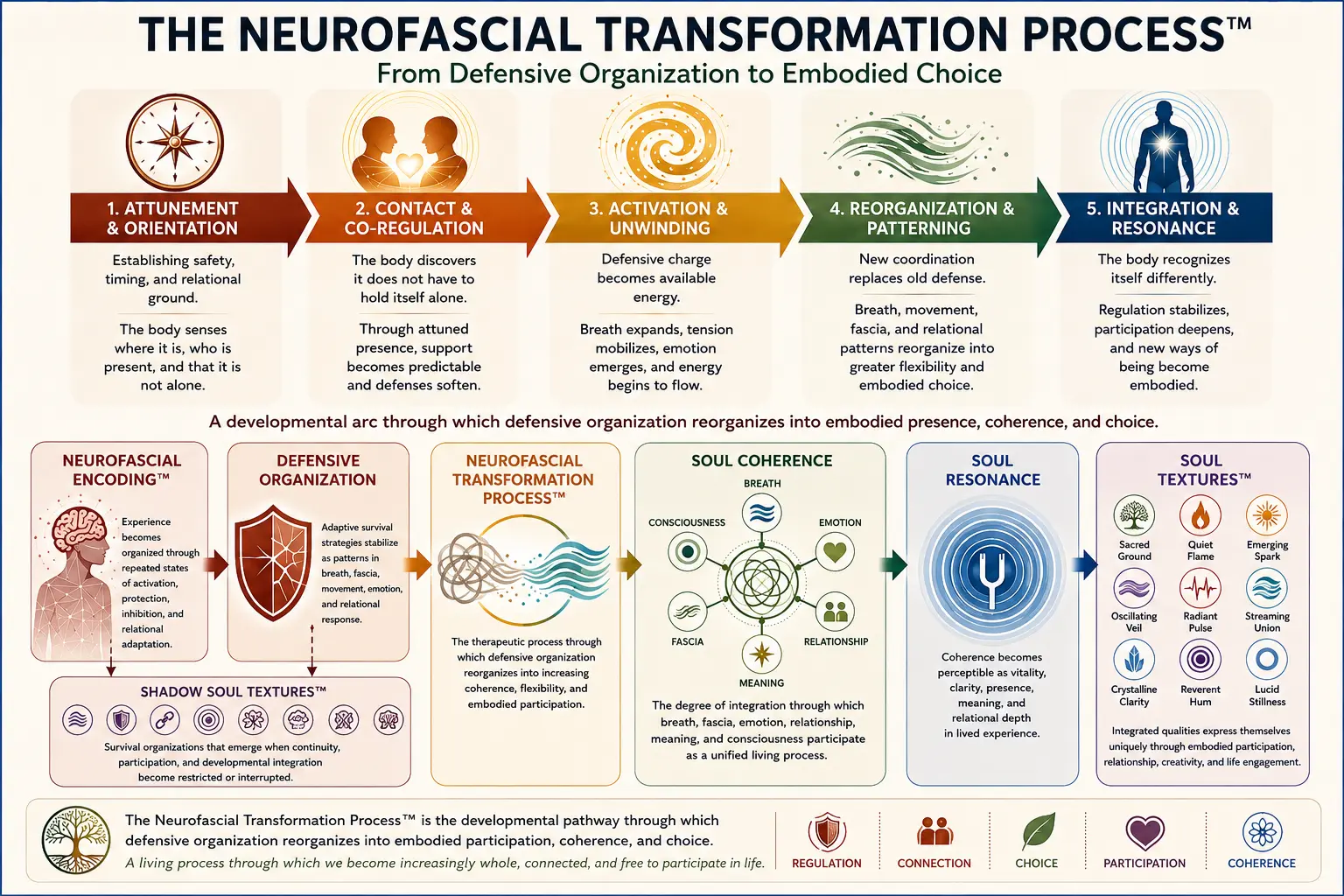
The Neurofascial Transformation Process describes a developmental arc through which defensive organization gradually reorganizes into increasing embodied participation:
Protection → Contact → Mobilization → Reorganization → Integration
The Five Phases of the Neurofascial Transformation Process
1. Attunement & Orientation
Establishing safety, timing, and relational ground
The process begins with orientation — not intervention.
The body must first sense who is present, where it is, and that it is not alone.
Breath rhythm, gaze, vocal tone, and respectful contact establish a relational field where vigilance can soften.
2. Contact & Co-Regulation
The body discovers it does not have to hold itself alone
Through attuned touch, breath pacing, and reliable presence, the system begins to co-regulate.
Fascia responds not to pressure, but to consistency.
When support becomes predictable, defensive tension no longer needs to remain organized.
3. Activation & Unwinding
Defensive charge becomes available energy
As safety and regulation increase, previously constrained physiological, emotional, energetic, and fascial organizations may begin mobilizing.
Breath amplitude may expand. Tissue responsiveness may change. Trembling, pulsation, emotional emergence, spontaneous movement, defensive impulses, or shifts in autonomic activation may appear.
This phase is not catharsis for its own sake.
Activation is carefully titrated and developmentally timed, allowing previously restricted energy and expression to emerge without overwhelming the organism’s capacity for regulation and continuity.
4. Reorganization & Patterning
New coordination replaces old defense
As defensive organization loosens, the organism gradually develops new possibilities for coordination, regulation, and participation.
Breath may expand without triggering danger. Movement may complete rather than remain inhibited. Contact may continue even while emotional intensity, organismic activation, or vulnerability increase.
At this stage, previously organized relational expectations and procedural survival responses may also begin reorganizing through embodied interaction, movement, expressive process, therapeutic enactment, symbolic exploration, and corrective relational experience.
The organism not only releases defensive organization — it develops new possibilities for contact, boundary, support, expression, differentiation, and participation.
Fascial tone reorganizes.
Breathing reshapes its rhythm.
The nervous system gradually updates its predictions regarding safety, intensity, relationship, and embodied presence.
What was once rigidly defensive becomes increasingly flexible, responsive, and coherent.
5. Integration & Resonance
The body recognizes itself differently
Integration is not a return to neutrality, but the emergence of a more coherent organization of embodied life.
Regulation becomes less effortful and more distributed throughout the system. Sensation, movement, emotion, breathing, activation, and relational participation increasingly function as interconnected rather than fragmented processes.
The organism develops greater capacity for presence, flexibility, intimacy, intensity, self-regulation, and embodied choice.
What once required protection alone gradually becomes available for participation.
Embodied Choice and Participation
Within Core Strokes®, transformation is not understood merely as symptom reduction or emotional release alone.
As defensive organization gradually softens, the organism develops increasing capacity for embodied choice.
Responses no longer emerge solely from survival prediction, defensive reflex, conditioned inhibition, or relational adaptation organized around protection.
Breathing, movement, emotional participation, relational contact, energetic expression, and self-regulation become increasingly flexible, differentiated, and responsive to present experience.
The organism no longer reacts only from what previously had to be defended.
New possibilities for participation gradually emerge.
Embodied choice therefore reflects the organism’s growing capacity to remain present within activation, vulnerability, differentiation, intimacy, expression, and relational uncertainty without automatically collapsing into defensive organization.
Transformation is not only the reduction of suffering.
It is the gradual restoration of participation, responsiveness, coherence, and living flexibility throughout embodied life.
A Phenomenological Glimpse of Transformation
The Neurofascial Transformation Process™ is not always recognized through dramatic catharsis or visible emotional release.
Often transformation first appears through subtle shifts within embodied experience.
A fuller exhalation.
Softening around the eyes.
Warmth returning to the hands.
Spontaneous movement emerging where inhibition once dominated.
The ability to remain present during emotional intensity without fragmentation or withdrawal.
Sometimes the body simply discovers that contact no longer immediately requires protection.
These moments may appear small externally, yet internally they often reflect profound reorganization across breath, fascia, nervous system regulation, emotional processing, energetic participation, and relational expectation.
Transformation therefore unfolds not only through release, but through increasing continuity, responsiveness, and embodied coherence.
From Transformation to Coherence
Within Core Strokes®, the Neurofascial Transformation Process™ describes how defensive organization gradually reorganizes into increasing coherence.
As breath continuity deepens, fascial responsiveness increases, emotional life becomes more metabolizable, and relational participation becomes more flexible, the organism develops greater capacity to participate in life as an integrated whole.
This growing integration is described within the framework as Soul Coherence.
As coherence becomes experientially perceptible through embodied presence, meaning, vitality, relationship, and authenticity, individuals often begin to experience what Core Strokes® refers to as Soul Resonance.
Over time, these changes may become visible through recurring qualities of embodied participation known as Soul Textures™.
The Neurofascial Transformation Process™ therefore describes not only how defensive organizations soften, but how increasing coherence becomes embodied, experienced, and expressed throughout the organism.
What Makes This Process Different
The Neurofascial Transformation Process emphasizes timing over technique, relationship over manipulation, and integration over dramatic release alone.
Rather than imposing change upon the body, the process supports the organism’s own capacity for reorganization through attuned contact, physiological regulation, developmental timing, and embodied participation.
Transformation therefore unfolds through increasing coherence rather than force.
Where NTP Is Applied
The Neurofascial Transformation Process underlies all Core Strokes work, including individual somatic psychotherapy, breath-oriented developmental work, relational bodymind integration, practitioner training, supervision, and experiential transformation processes.
It shapes how practitioners listen through touch, recognize defensive organization, regulate activation, support breath continuity, and facilitate long-term integration rather than temporary peak experience.
In somatic trauma therapy, integration is not achieved by releasing tension alone. Sustainable transformation requires updating how the body encodes safety, intensity, and relational contact.
NTP describes how this reorganization unfolds developmentally across breath, fascia, and nervous system regulation.
A Living Process, Not a Formula
The Neurofascial Transformation Process cannot be reduced to a set of steps.
It is a living orientation—one that respects:
- developmental timing
- nervous system thresholds
- relational history
- and the body’s own intelligence
When the process is sufficiently supported, regulated, and relationally held, the organism does not need to be forced into transformation.
It reorganizes because new forms of participation, regulation, contact, and embodiment gradually become possible.
Within this framework, what may be referred to as a “stroke” is not a manual technique, but a process marker within an unfolding somatic psychotherapy interaction.
🌿 Reflection
Where in your body does change feel possible only when you are not doing it alone?
Explore Related Core Strokes® Concepts
→ The Organisation of Embodied Participation
The phenomenological foundation of Core Strokes®, describing how continuity, coherence, permeability, metabolisation, adaptive organisation, and relational geometry organise embodied life.
→ Defensive Organisation
A protective form of Adaptive Organisation in which participation becomes organised around experienced or anticipated threat, overwhelm, disruption, or loss of continuity.
→ Living Participation Observation System™ (LPOS™)
The observational methodology through which embodied and relational expressions are described before provisional organisational interpretations are developed.
→ Relationsl Field and Relational Geometry
The Relational Field is the embodied space of interaction. Relational Geometry describes how proximity, distance, boundaries, orientation, reciprocity, and differentiation are organised within it.
→ Energetic Breath Cycle™
A developmental map describing how breathing organises grounding, activation, emotional expression, surrender, and restoration throughout the organism.
→ Fascia Texture Typology™
A phenomenological framework for describing recurring tactile configurations and considering their possible organisational significance without treating them as diagnoses, personality types, or records of developmental history.
→ Neurofascial Encoding™
A proposed research framework exploring possible relationships among repeated participation, neural plasticity, behaviour, physiological regulation, movement, mechanical loading, and connective-tissue remodelling.
→ Neurofascial Transformation Process™
The therapeutic process through which breathing, fascia, movement, therapeutic touch, and relational participation gradually support lasting embodied transformation.
→ Therapeutic Touch
An embodied and relational practice guided by consent, clinical judgement, perceptual attention, and responsiveness rather than by mechanical intervention or predetermined interpretation.
→ Character Structures
A framework for exploring recurring developmental organisations of bodily, emotional, behavioural, and relational participation without reducing people to fixed types.
→ Soul Organisation, Soul Coherence, and Soul Textures ™
Interrelated dimensions of Core Strokes® concerned with authenticity, meaning, inner resonance, embodied presence, and relational participation. Soul Organisation names the wider qualitative domain; Soul Coherence describes increasing integrity among dimensions of experience; Soul Textures™ describe describe qualities of coherent participation; and Shadow Soul Textures™ describe qualitative expressions of protective, constrained, fragmented, or compensatory Adaptive Organisation.
These principles can also be explored directly through experiential practice within:
Also Explore
→ Trauma & Development — A Somatic Developmental Framework
To understand how healing evolves beyond stabilization:
→ Development & Integration — From Trauma Repair to Embodied Maturation
To explore how vitality and relational coherence reorganize:
→ Pelvic–Heart Integration®
To deepen into embodied maturation and sovereignty: