🌐 Core Strokes Framework
A Living Architecture of Embodied Participation
By Dirk Marivoet, Founder of Core Strokes® · Body Psychotherapist · Somatic Researcher · Author
Core Strokes® is an integrative framework for somatic psychotherapy, embodied development, and therapeutic transformation. Developed by Dirk Marivoet through more than four decades of clinical practice, teaching, and research, it brings together breath, fascia, movement, emotional regulation, developmental psychology, trauma theory, relational experience, and consciousness into a coherent map of human development and healing.
Rather than focusing on symptoms alone, Core Strokes® explores how experience becomes organized within the living body—and how that organization can evolve toward greater vitality, coherence, resilience, and participation in life.
The diagram below illustrates the living architecture that underlies the entire framework.
The framework can be approached from many entry points—breath, fascia, trauma, character, relationship, or consciousness—but all ultimately belong to the same developmental architecture.
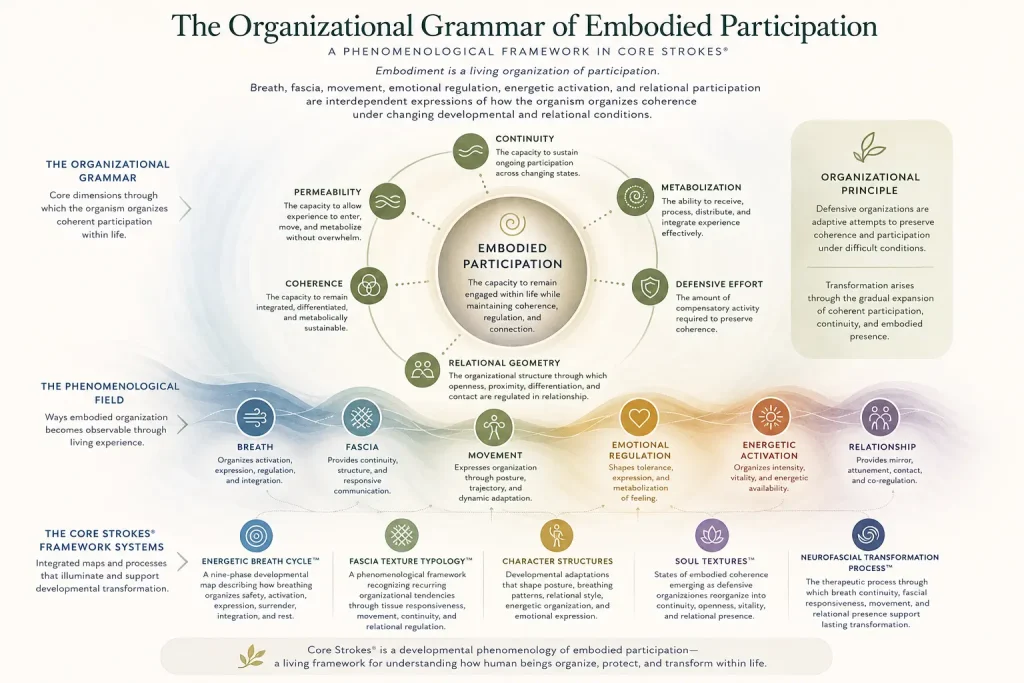
Understanding Organization and Transformation
The Core Strokes® Framework is not a theory to memorize or a collection of techniques to apply mechanically.
It is a developmental phenomenology of embodied life.
The framework explores two complementary dimensions:
Maps of Embodied Organization
These maps describe how experience becomes structured through breath, fascia, posture, movement, emotional regulation, energetic activation, and relationship.
Within this developmental architecture, recurring patterns emerge. These patterns shape how individuals perceive themselves, regulate intensity, form relationships, and participate in life.
Processes of Transformation
The framework also explores how these patterns can change.
When conditions of safety, regulation, embodied awareness, and meaningful relational contact become available, previously restricted forms of organization can gradually reorganize.
Transformation is understood not as force, catharsis, or symptom elimination, but as the gradual restoration of continuity, coherence, flexibility, and participation.
Together, these maps and processes form a living spiral of development rather than a fixed system of categories.
How to Read This Work
Core Strokes® is not a diagnostic system.
The maps presented throughout this website are descriptive rather than prescriptive. They are intended to support recognition, understanding, and embodied inquiry rather than labeling.
A few orienting principles may be helpful:
- Breath phases describe recurring developmental and energetic patterns rather than fixed identities.
- Fascia textures describe qualities of embodied organization rather than medical conditions.
- Character structures reflect adaptive developmental strategies rather than pathology.
- Development is non-linear. Most people will recognize aspects of themselves in multiple patterns simultaneously.
- Reading can itself become an embodied practice. If something resonates, pause and notice your breathing, posture, movement, or felt sense.
If the material ever feels abstract, begin with the body—or start with the Energetic Breath Cycle™, the primary gateway into the framework.
🌬 Energetic Breath Cycle™
How Energy Organizes Experience
A developmental spiral of nine recurring breath phases that describes how safety, activation, expression, surrender, integration, and rest become organized throughout life.
👉 Explore the Energetic Breath Cycle
🌿 Fascia Texture Typology™
How Experience Is Held in the Body
A phenomenological map describing recurring qualities of fascial organization—from Wet Earth to Streaming Silk—and how these textures influence movement, regulation, and relationship.
👉 Explore Fascia Texture Typology
👉 Explore Character Structures
🧠 Neurofascial Encoding™
How Patterns Form
Neurofascial Encoding™ describes how repeated experiences shape breath rhythms, fascial responsiveness, posture, nervous system regulation, emotional tendencies, and relational expectations. It explores how developmental experience becomes organized within the living body.
👉 Read about Neurofascial Encoding
🔄 Neurofascial Transformation Process™
How Patterns Reorganize
A developmental model describing how encoded patterns gradually soften and transform through safety, pacing, embodied awareness, and attuned relational contact.
👉 Explore the Neurofascial Transformation Process
Soul Textures
How Embodied Coherence Is Lived
Soul Textures™ describe the qualities that emerge when breath, fascia, polarity, relationship, and consciousness become increasingly integrated.
These are lived expressions of coherence, vitality, meaning, and presence.
Where Would You Like to Begin?
📖 Understand
For readers interested in the conceptual foundations:
- Energetic Breath Cycle
- Fascia Texture Typology™
- Character Structures
- Soul Organization
- Soul Dimensions
🛠 Apply
For clinicians, therapists, and practitioners
Embody
For experiential learning and professional training:
Closing Invitation
The Core Strokes® Framework is both conceptual map and lived practice.
Healing unfolds rhythmically — through breath, fascia, relational contact, and developmental integration.
Whether you begin with breath, fascia, trauma, relationship, clinical practice, or embodied training, you are entering the same spiral of developmental transformation.
And that spiral always returns to the body.