Beyond Trauma: Development, Integration, and Somatic Healing
A Developmental Approach to Somatic Trauma Therapy
By Dirk Marivoet, Founder of Core Strokes®· Psychotherapist · Somatic Researcher · Author
Core Strokes® Perspective
Trauma is not viewed primarily as pathology.
Within Core Strokes®, trauma is understood as an adaptive reorganization of the living organism in response to overwhelming experience. Rather than asking “What is wrong?”, the developmental question becomes “How has the organism learned to survive—and how can it continue developing?”
Therapy therefore aims not only to reduce symptoms or regulate the nervous system, but to restore the organism’s intrinsic capacity for breathing, movement, relationship, vitality, meaning, and embodied participation.
From this perspective, healing is not the endpoint of therapy. It is the restoration of development.
What Does “Beyond Trauma” Mean — Definition
Beyond trauma refers to the ongoing developmental process through which the organism moves from survival-based organization toward increasing flexibility, vitality, relational freedom, and embodied participation.
Within Core Strokes®, successful trauma therapy is not defined solely by the absence of symptoms. It is reflected in the gradual restoration of developmental capacities: breathing freely under emotional intensity, maintaining meaningful relationships without losing oneself, integrating instinct and feeling, regulating activation without rigidity, and participating fully in life. Healing therefore becomes an ongoing process of maturation rather than a return to a previous state.
At a Glance
Beyond Trauma in Core Strokes®
Core principles explored on this page
- Healing restores developmental capacities.
- Stabilization creates the foundation for further growth.
- Breath, fascia, emotion, and relationship reorganize together.
- Trauma adaptations gradually soften.
- Pelvic–Heart Integration® reunites vitality and relationship.
- Relational sovereignty supports authentic connection.
- Soul Dimensions emerge through increasing embodied coherence.
- Development continues throughout life.
- The long-term direction is embodied participation.
Beyond Symptom Reduction
For many people, beginning trauma therapy means finding relief from overwhelming symptoms. Anxiety becomes more manageable. Sleep improves. Emotional reactions become less extreme. Flashbacks occur less frequently. Daily life becomes more stable.
These changes are profoundly important. Without sufficient stabilization, deeper therapeutic work is rarely possible.
Yet an important question often emerges once the most acute distress has subsided.
Now what?
Many individuals discover that although their symptoms have diminished, they still experience subtle restrictions in the way they live. They may feel safer, yet hesitate to trust intimacy. They may regulate strong emotions more effectively while finding it difficult to experience joy, creativity, or spontaneous vitality. They may function well in everyday life while sensing that something essential remains only partially available.
From the perspective of Core Strokes®, this is not a therapeutic failure. Rather, it reflects the distinction between stabilization and development.
Stabilization reduces suffering. Development expands life. Integration deepens participation.
Protective adaptations no longer disappear; they become increasingly flexible and context-sensitive. Breathing becomes less defensive and more responsive. Fascial organization regains elasticity. Emotional experience becomes increasingly differentiated rather than overwhelming or constricted. Relationship shifts from managing danger toward genuine encounter. The organism no longer invests most of its energy in maintaining survival strategies and can begin directing that energy toward exploration, creativity, intimacy, and meaningful participation.
In this sense, trauma recovery is not simply about returning to a previous condition. Development never moves backward. Every meaningful developmental achievement becomes part of the organism’s continuing organization. Once protective adaptations begin to reorganize, the organism develops new capacities that did not previously exist in exactly the same form.
Healing therefore becomes an unfolding process of maturation.
Rather than asking, “How can I eliminate my symptoms?”, the developmental question gradually becomes:
“How can I participate more fully in life?”
This shift marks one of the central principles of the Core Strokes® framework. Symptom reduction creates the foundation upon which embodied growth can continue. The therapeutic process increasingly supports not only safety and regulation, but also curiosity, relational confidence, vitality, creativity, authenticity, and the capacity to remain present amidst the natural complexities of human existence.
Recovery becomes less about escaping suffering and more about expanding the organism’s possibilities for living.
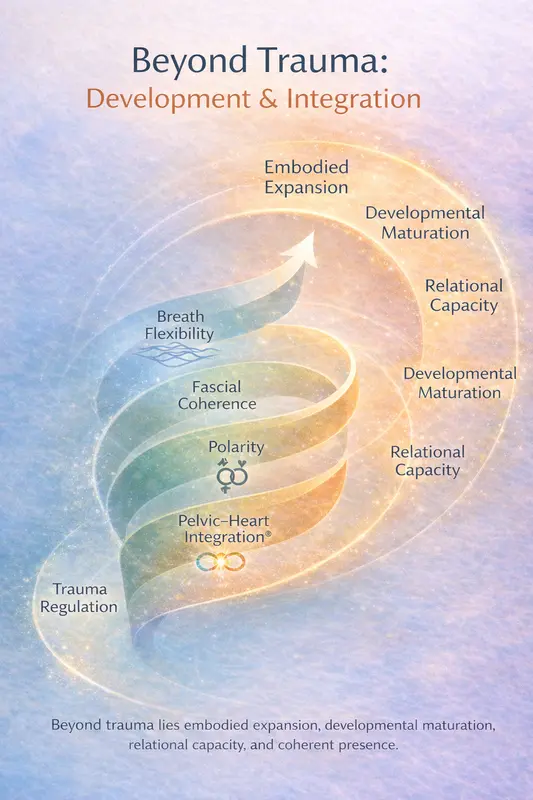
From Trauma Stabilization to Developmental Integration
Trauma therapy usually begins by helping the organism regain sufficient stability to tolerate experience without becoming overwhelmed. Establishing a sense of safety, reducing excessive autonomic activation, and restoring the capacity for self-regulation are indispensable foundations for therapeutic work.
Within Core Strokes®, however, stabilization is understood as the beginning of a larger developmental process rather than its final destination.
Human beings are not organized merely to survive. We are living, relational organisms whose intrinsic tendency is toward increasing differentiation, integration, creativity, and participation. When overwhelming experience interrupts this developmental movement, energy that would ordinarily support exploration, learning, intimacy, and growth is redirected toward protection.
As defensive organization gradually becomes more flexible and context-sensitive, developmental movement resumes.
The organism does not simply become calmer; it becomes more available. Breathing acquires greater depth and adaptability. Fascial responsiveness increases. Emotional experience becomes more nuanced. Relational contact grows more reciprocal. New possibilities emerge that extend well beyond the absence of distress.
From this perspective, trauma therapy is fundamentally concerned with restoring developmental potential. Healing gradually becomes a process of embodied maturation.
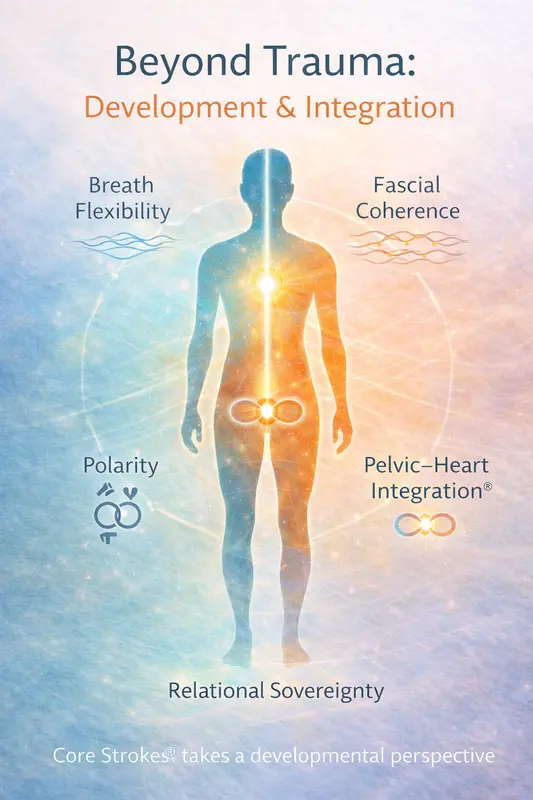
Developmental as Continuum
Within the Core Strokes® framework, therapeutic change unfolds along a continuum rather than through isolated interventions.
| Trauma Stabilization | Developmental Integration |
| Establishing safety | Cultivating vitality |
| Reducing overwhelming activation | Expanding adaptive flexibility |
| Stabilizing physiological regulation | Increasing embodied capacity |
| Softening defensive organization | Developing coherent participation |
| Managing symptoms | Supporting continued maturation |
| Restoring daily functioning | Living with greater authenticity and freedom |
These dimensions should not be understood as separate phases that occur in a fixed sequence. Throughout therapy they continually influence one another. Moments of increased stability make deeper exploration possible, while new developmental achievements often strengthen the individual’s capacity for regulation.
The movement is therefore dynamic rather than linear. Healing unfolds through an ongoing dialogue between stabilization and expansion, protection and exploration, consolidation and growth.
Restoring Developmental Capacities
Trauma does more than produce symptoms. It temporarily restricts developmental capacities that are intrinsic to healthy human functioning.
As therapeutic integration progresses, these capacities gradually become available again—not because they are imposed from outside, but because the organism rediscovers its own inherent possibilities for self-organization.
Among the capacities that often re-emerge are:
- breathing freely while remaining emotionally present;
- recovering more easily after periods of stress or activation;
- tolerating both pleasure and vulnerability without becoming overwhelmed;
- expressing authentic emotions with increasing clarity and flexibility;
- remaining connected during relational conflict without losing oneself;
- sustaining intimacy while preserving autonomy;
- maintaining healthy boundaries without excessive defensiveness;
- experiencing vitality without confusing it with danger;
- responding creatively instead of reacting automatically;
- engaging more fully with work, relationships, creativity, and meaning.
These developmental capacities cannot be reduced to isolated psychological skills. They reflect increasing coherence across the organism as a whole. Breath, fascia, posture, movement, emotional life, cognition, and relationship gradually become more integrated expressions of a living system.
Beyond Nervous System Regulation
In recent years, trauma-informed practice has rightly emphasized the importance of autonomic nervous system regulation. Understanding sympathetic activation, parasympathetic withdrawal, and states of neurophysiological safety has significantly enriched contemporary psychotherapy.
Core Strokes® fully acknowledges the importance of this work.
Autonomic regulation is indispensable, but it does not fully explain the richness of human development.
A well-regulated nervous system does not automatically give rise to intimacy, creativity, embodied vitality, ethical sensitivity, or existential meaning. These qualities emerge through the continuing organization of the whole person.
Consequently, Core Strokes® approaches healing as a multidimensional developmental process involving the dynamic interaction of breathing, fascial organization, emotional integration, movement, relational experience, and embodied awareness. Physiological regulation provides the ground from which these capacities can flourish, but it is not identical with the developmental process itself.
Healing therefore extends beyond restoring equilibrium.
It becomes the gradual recovery of participation in life.
As the organism develops increasing flexibility and coherence, attention naturally shifts from managing activation toward cultivating presence, relational depth, creativity, and meaningful engagement with the world.
This marks the transition from surviving life toward fully inhabiting it.
Trauma Recovery as Embodied Expansion
Traumatic experience narrows participation.
It narrows the organism’s range of responses, limiting how freely a person can breathe, move, feel, relate, and engage with the world. What originally developed as an intelligent adaptation to overwhelming circumstances gradually becomes an organizing principle that influences everyday life, often long after the original threat has disappeared.
From the perspective of Core Strokes®, healing is therefore not simply the removal of symptoms. It is the expansion of the organism’s capacity to participate in life with increasing flexibility and coherence.
This expansion unfolds across multiple dimensions simultaneously.
Breath Becomes More Flexible
Breathing is one of the earliest functions to reorganize in response to chronic stress or developmental adversity. Protective adaptations often lead to restricted respiratory movement, chronic holding patterns, or fluctuations between excessive activation and collapse.
As therapeutic work progresses, breathing gradually regains its natural adaptability.
Rather than remaining fixed within defensive patterns, respiration becomes capable of responding fluidly to changing circumstances. Emotional intensity can increase without immediately disrupting respiratory continuity. Periods of activation are more easily followed by recovery, allowing the organism to move rhythmically between engagement and rest.
Within Core Strokes®, this progressive restoration of respiratory flexibility is described through the developmental movement of the Energetic Breath Cycle™, in which breathing increasingly supports vitality, emotional expression, relationship, and embodied presence.
Fascia Recovers Its Responsiveness
The fascial network continuously adapts to lived experience.
Protective organization may be reflected in chronic tension, reduced elasticity, fragmentation, or diminished responsiveness throughout the connective tissue network. These adaptations often contribute to persistent restrictions in posture, movement, emotional expression, and bodily awareness.
As integration deepens, fascial organization gradually becomes more differentiated and responsive.
The body no longer needs to maintain the same degree of protective rigidity. Movement becomes less effortful. Touch can be received with greater openness. Emotional experience is increasingly accompanied by subtle changes in tone, posture, and gesture rather than being contained through chronic muscular contraction.
The organism regains its capacity for fluid adaptation.
Emotional Life Becomes Increasingly Differentiated
Overwhelming experience often restricts emotional expression in one of two directions.
Some individuals remain chronically activated, with emotions that feel intense, unpredictable, or difficult to regulate. Others become emotionally constricted, experiencing numbness, distance, or limited access to feeling.
Developmental integration gradually widens this emotional landscape.
Development does not make people less emotional. It increases their capacity to experience a wider emotional landscape with stability and discernment.
Emotions cease to function primarily as signals of danger and increasingly become meaningful expressions of participation in life.
Relationship Becomes a Place of Growth
Protective organization profoundly influences how people experience closeness.
When early relationships have been associated with inconsistency, intrusion, neglect, or fear, later relationships often continue to be approached through anticipation of danger or disappointment. Contact may be avoided, clung to, controlled, or constantly monitored for signs of threat.
As defensive organization softens, relational experience gradually changes.
Connection becomes less dominated by vigilance and more characterized by curiosity, reciprocity, and mutual responsiveness. Individuals become increasingly capable of remaining emotionally present without abandoning themselves or controlling others. Intimacy becomes something that can be experienced rather than merely managed.
Relationship itself once again becomes a developmental environment rather than primarily a survival challenge.
The Direction of Growth
These changes do not occur independently.
Breath reorganizes fascia.
Fascia shapes movement.
Movement influences emotional expression.
Emotion transforms relationship.
Relationship reorganizes the organism.
Development therefore unfolds as an integrated process involving the entire living organism rather than isolated psychological or physiological mechanisms.
For this reason, Core Strokes® understands trauma recovery not as the correction of dysfunction, but as the restoration of organismic organization.
As embodied flexibility increases, energy that was previously invested in maintaining survival strategies becomes increasingly available for exploration, intimacy, creativity, play, contribution, and meaning.
The deeper question is no longer simply whether the individual feels safe. It is whether the organism is becoming increasingly capable of participating fully in life.
Pelvic–Heart Integration®: Reuniting Vitality and Relationship
One of the most significant developmental movements beyond trauma involves the gradual integration of vitality and relationship.
Traumatic experience frequently disrupts this integration. The organism learns to separate instinct from feeling, sexuality from tenderness, strength from vulnerability, or desire from authentic connection. These separations are not conscious choices. They are intelligent adaptations that once protected the individual from experiences that were overwhelming, confusing, or unsafe.
As a result, vitality itself may become associated with danger.
Some individuals learn to suppress their life energy in order to preserve attachment. Others express intensity without emotional contact, while still others alternate between longing for closeness and withdrawing from it. In each case, the organism has found a way to survive, but at the cost of restricting its natural capacity for integrated participation.
Within Core Strokes®, this developmental process is understood through the principle of Pelvic–Heart Integration®.
The pelvis represents far more than sexuality alone. It expresses the organism’s instinctive vitality—grounding, movement, creativity, pleasure, generativity, and the energetic impulse toward life itself. The heart expresses emotional openness, empathy, relational reciprocity, and the capacity to remain present with oneself and others. Pelvic–Heart Integration® therefore does not simply connect two centres; it describes the progressive organization of vitality and relationship into a coherent way of being.
Healthy development gradually brings these dimensions into dialogue.
Vitality becomes increasingly capable of expressing itself through relationship, while relationship becomes enriched by embodied aliveness. Instinct no longer threatens connection, and intimacy no longer requires the suppression of desire or authentic self-expression.
From Separation to Integration
When development has been interrupted, several characteristic patterns may emerge.
Vitality may remain disconnected from emotional intimacy, leading to relationships that feel physically intense but emotionally distant.
Alternatively, emotional closeness may be possible only by suppressing instinctive impulses, resulting in relationships that feel caring yet lack spontaneity, playfulness, or embodied passion.
Others experience repeated oscillations between these positions. Intense attraction may be followed by fear of dependency. Longing for closeness may alternate with emotional withdrawal. Expressions of strength may evoke guilt, while vulnerability may feel dangerous or overwhelming.
These patterns are not viewed as fixed personality traits. They represent adaptive organizations that developed within particular relational environments.
As therapeutic work progresses, the organism gradually discovers new possibilities.
As development continues, vitality gradually becomes less dominated by impulsivity or inhibition and increasingly available for authentic expression. Tenderness no longer implies weakness, boundaries no longer require emotional distance, pleasure becomes compatible with safety, and emotional intensity can be experienced without immediately activating defensive organization.
The developmental task is therefore not to choose between instinct and love, autonomy and attachment, strength and openness. It is to cultivate an organization in which these dimensions can coexist within a coherent living whole.
Polarity as a Living Dialogue
Pelvic–Heart Integration® is closely related to the broader developmental principle of embodied polarity.
Life continually unfolds through complementary movements: grounding and expansion, receptivity and initiative, yielding and assertion, containment and expression. Healthy development does not eliminate these polarities. It increases the organism’s capacity to move fluidly between them according to the demands of each moment.
Traumatic experience often reduces this flexibility. The organism becomes organized around preferred or defensive positions that once ensured survival. One person may become chronically accommodating, another relentlessly self-reliant. One may fear intensity, another may compulsively seek it. Over time these protective tendencies can become experienced as one’s identity.
Developmental integration gradually restores freedom of movement between these complementary capacities.
Rather than remaining fixed within habitual patterns, individuals become increasingly capable of responding creatively to changing relational contexts. Strength can coexist with tenderness. Clear boundaries support intimacy rather than preventing it. Vulnerability no longer implies helplessness, while autonomy no longer requires emotional distance.
Polarity becomes a dynamic conversation rather than a rigid opposition.
A Vertical Axis of Development
Pelvic–Heart Integration® also describes the restoration of a coherent vertical axis within the organism.
The pelvis grounds instinctive vitality in the living body.
The heart opens that vitality toward relationship.
The head contributes reflection, discernment, and conscious choice.
When these centres become increasingly integrated, action arises less from automatic survival patterns and more from embodied awareness. Decisions become informed simultaneously by instinct, feeling, and thoughtful reflection. The individual develops greater coherence between what is sensed, what is felt, what is understood, and how life is lived.
This integration cannot be achieved through intellectual insight alone. It develops through repeated embodied experience in which breathing remains continuous, fascial organization becomes increasingly responsive, and emotional intensity can be tolerated without losing relational presence. Through such experiences, the organism learns to breathe through intensity rather than contract against it, receive support without surrendering autonomy, express emotion without becoming overwhelmed, experience pleasure without anticipating danger, and remain present in genuine encounter even when uncertainty arises.
Each of these experiences gradually reshapes the organism’s expectations about itself, about others, and about life.
Beyond Safety
Safety remains an indispensable foundation for therapeutic work.
Yet human development ultimately asks for something more.
The mature organism is not organized merely to avoid danger. It is organized to participate fully in life—to love, to create, to explore, to contribute, to play, and to belong.
Pelvic–Heart Integration® therefore represents more than the resolution of trauma.
It reflects the gradual reunification of vitality and relationship—the growing capacity to inhabit one’s instinctive aliveness while remaining emotionally available, ethically grounded, and deeply connected with others.
As instinctive vitality and emotional openness become increasingly integrated, the organism develops a greater capacity to love without abandoning itself and to express desire without losing relational presence.
In this sense, development moves beyond protection toward participation.
Vitality becomes increasingly trustworthy.
Relationship becomes increasingly alive.
Participation becomes increasingly embodied.
Together, these qualities express the continuing organization of a coherent living organism.
Relational Sovereignty: The Freedom to Remain Fully Oneself
Relational sovereignty is the developmental capacity to remain authentically oneself while participating openly in relationship. As vitality and relationship become increasingly integrated, individuals gradually become more able to remain present with others without losing contact with themselves.
Within Core Strokes®, this capacity is described as relational sovereignty.
Relational sovereignty is not independence, emotional distance, or self-sufficiency. Nor is it the absence of attachment needs. Human beings remain fundamentally relational throughout life.
Rather, relational sovereignty refers to the growing ability to participate in relationships freely, consciously, and authentically, without becoming dominated by habitual survival strategies.
From Survival Strategies to Relational Freedom
Traumatic experience often shapes how people approach closeness long after the original circumstances have passed.
Some individuals adapt by becoming highly accommodating, constantly monitoring the needs of others while neglecting their own. Others develop strong self-reliance, avoiding vulnerability in order to prevent disappointment or rejection. Still others alternate between intense pursuit of connection and abrupt withdrawal when intimacy feels uncertain.
Although these patterns appear very different, they share a common purpose.
Each represents an intelligent attempt to preserve safety within relationship.
During therapy these adaptations are approached with respect rather than judgment. They once protected the organism under circumstances where more flexible responses were simply unavailable.
As developmental integration proceeds, however, these protective organizations gradually become less necessary.
The organism discovers that closeness no longer requires self-abandonment.
Difference no longer threatens connection.
Conflict no longer inevitably leads to rupture.
Relationship gradually becomes a space in which authenticity can replace adaptation.
Characteristics of Relational Sovereignty
Relational sovereignty is not a fixed state that is permanently achieved. It is a continuously developing capacity that becomes increasingly available as embodied coherence deepens.
Individuals often discover that they can:
- remain emotionally present during moments of disagreement;
- express needs without excessive fear of rejection;
- receive support without experiencing dependency as weakness;
- establish clear boundaries without becoming defensive or withdrawn;
- tolerate uncertainty without immediately seeking control or reassurance;
- recognize the emotional reality of others while remaining grounded in their own experience;
- recover more easily when misunderstandings occur;
- engage in mutual relationships that allow both closeness and individuality.
These capacities emerge gradually through repeated relational experiences rather than through intellectual understanding alone.
Co-Regulation and Increasing Autonomy
Human development always unfolds in relationship.
Early life depends entirely upon co-regulation, as caregivers help organise the infant’s physiological and emotional states. Throughout development, healthy relationships continue to support emotional resilience, learning, and adaptation.
The goal of development is therefore not to eliminate the need for others.
Rather, it is to expand the organism’s capacity to participate in relationships without becoming dependent upon external regulation for every emotional challenge.
As embodied capacities mature, external support becomes increasingly integrated as an internal resource.
The individual develops greater confidence in their ability to remain present with difficult emotions, repair relational disruptions, and return to equilibrium following periods of stress. Relationships continue to nourish development, but they no longer determine one’s fundamental sense of self.
Autonomy and connection cease to be experienced as opposing forces.
Instead, they become complementary expressions of healthy development.
Relationship as a Living Process
Within Core Strokes®, relationship is understood as an ongoing process of mutual participation rather than a fixed interpersonal structure.
Each encounter continuously influences breathing, posture, movement, emotional expression, autonomic activity, attention, and meaning-making. Every interaction therefore becomes an opportunity for living organization to reorganise itself.
Relational sovereignty allows individuals to participate consciously in this ongoing process.
Instead of reacting automatically through established defensive patterns, they become increasingly capable of responding with flexibility, discernment, and embodied presence.
Relationships are no longer experienced primarily as sources of danger, validation, or security.
They become environments in which both people can continue developing.
The Emergence of Authentic Presence
Perhaps the most recognizable expression of relational sovereignty is a quiet sense of presence.
Nothing needs to be exaggerated.
Nothing needs to be hidden.
The individual becomes increasingly able to meet another person directly, without constantly managing impressions, anticipating rejection, or defending against imagined threats.
This presence is neither passive nor detached.
It is deeply engaged.
Authenticity becomes possible because defensive organization no longer consumes the majority of the organism’s energy. Attention becomes available for genuine listening, spontaneous expression, shared creativity, and meaningful dialogue.
Relationship changes from something that must be managed into something that can be lived.
In this way, relational sovereignty represents an important developmental milestone beyond trauma. It reflects not the absence of vulnerability, but the growing confidence that vulnerability itself can be held within an increasingly coherent, resilient, and embodied way of being.
From this foundation, development naturally continues.
As breathing becomes more fluid, vitality more integrated, and relationship more reciprocal, the organism begins to express a deeper quality of coherence—one that is experienced not simply through improved functioning, but through the felt qualities of embodied presence itself.
As embodied organization becomes increasingly coherent, the quality of experience itself begins to change. Life is no longer organized primarily around protection but around participation. Authenticity becomes less effortful. Presence becomes more stable. Relationship becomes increasingly reciprocal. Meaning arises naturally through lived engagement with the world.
Within Core Strokes®, these qualitative expressions of development are explored through the frameworks of Soul Dimensions and Soul Textures, which describe how embodied integration is experienced from within.
Soul Dimensions: The Deepening of Embodied Presence
As development continues, change becomes visible not only in what people are able to do, but also in how they experience themselves, others, and the world around them.
The therapeutic process is no longer concerned solely with reducing distress, regulating activation, or softening defensive organization. Increasingly, it supports the emergence of qualities that bring greater depth, richness, and meaning to embodied life.
Within Core Strokes®, these qualities are described as Soul Dimensions.
The term soul does not refer to a separate spiritual entity detached from the body, nor does it imply adherence to any particular philosophical or religious tradition. Rather, Soul Dimensions describe the organism’s evolving capacity for authenticity, vitality, relational openness, creativity, meaning, and conscious presence as development continues.
They emerge through the ongoing integration of breathing, fascial organization, movement, emotional life, relationship, and awareness.
Soul, in this sense, is not something we possess.
It is something we increasingly embody.
From Functioning to Flourishing
The early stages of trauma recovery are often devoted to restoring essential capacities.
Can I sleep again?
Can I regulate overwhelming emotions?
Can I sustain meaningful relationships?
Can I engage with everyday life without becoming overwhelmed?
These are profound developmental achievements and should never be underestimated.
Yet healthy development naturally continues beyond functional recovery.
Many people begin to notice changes that are more difficult to measure but deeply significant. They describe feeling increasingly at home in their own body, more available to the ordinary pleasures of life, and less preoccupied with protecting themselves from every uncertainty. Beauty becomes easier to perceive—in nature, music, art, silence, and human connection. Creativity returns with greater spontaneity, curiosity gradually replaces chronic vigilance, and relationships begin to feel less effortful and more reciprocal.
Rather than simply functioning more effectively, life itself becomes more fully inhabited.
These experiences do not represent a departure from embodiment.
They arise because embodiment has become increasingly integrated.
The Emergence of Coherent Presence
As defensive organization gradually softens, attention is liberated.
Less energy is required to anticipate danger, maintain chronic protective tension, or suppress unwanted experience. The organism becomes increasingly available for genuine participation in both inner and outer life.
Presence grows more stable.
Awareness becomes less fragmented.
The individual develops greater capacity to remain emotionally responsive without becoming overwhelmed, while perception itself becomes more spacious and less dominated by habitual defensive expectations.
People often describe subtle but profound changes. They find themselves listening more deeply, responding rather than reacting, and remaining curious in situations that previously evoked fear or withdrawal. Gratitude becomes more accessible. Intimacy feels less threatening. Moments that once passed unnoticed begin to carry a quiet sense of meaning.
These shifts cannot be explained simply as improvements in psychological functioning.
They reflect increasing coherence throughout the living organism.
Over time, this coherence often gives rise not only to greater vitality but also to discernment, compassion, and embodied wisdom.
Soul Textures: The Felt Qualities of Integration
While Soul Dimensions describe broad developmental capacities, Soul Textures describe how these capacities are lived and experienced from within.
They are the phenomenological expressions of embodied integration.
Just as healthy fascial organization possesses recognizable qualities of elasticity, continuity, and responsiveness, integrated human experience also develops distinctive qualitative characteristics. At times it is quietly grounded; at others vibrant and expansive. It may be experienced as gentle openness, luminous clarity, resonant presence, or profound stillness. Although these qualities continually evolve, they all express increasing coherence within the living organism.
Soul Textures are therefore neither emotional states nor personality traits.
They emerge through the continuing organization of embodied life itself.
Within Core Strokes®, they provide a language for recognizing not only the reduction of suffering, but also the subtle emergence of authenticity, vitality, relational depth, creativity, and existential coherence.
Meaning as Embodied Participation
One of the most remarkable consequences of developmental integration is the gradual transformation of meaning itself.
When survival dominates experience, attention naturally narrows toward protection. The world is approached primarily through questions of safety, certainty, and adaptation.
As defensive organization relaxes, the organism becomes increasingly available for participation.
Meaning is no longer sought primarily through external achievement, control, or validation. Instead, it emerges through lived engagement with the world. It is discovered in authentic relationships, creative expression, compassionate action, meaningful contribution, the experience of belonging, and moments of profound stillness.
Meaning becomes embodied.
Rather than existing as an abstract idea, it is lived through participation.
Life is no longer organized primarily around avoiding pain.
It becomes increasingly organized around engaging with what is alive.
The Continuing Movement of Development
Development has no final destination.
There is no definitive state of complete integration beyond which growth ceases. Human beings continue developing throughout life as each relationship, transition, challenge, loss, and creative endeavour invites new processes of differentiation, integration, and participation.
Trauma recovery therefore opens the possibility for something larger than healing alone.
It allows development to resume.
As protective organization gradually gives way to increasing coherence, the organism discovers greater freedom to participate in life with authenticity, creativity, love, discernment, and responsibility. Development is therefore not simply the opposite of trauma. It is the continuation of life’s intrinsic movement toward increasing participation in the unfolding process of living.
Within Core Strokes®, this lifelong movement toward embodied participation represents one of the central organizing principles of healthy human development.
The Developmental Continuum in Core Strokes®
Throughout this article, trauma recovery has been explored through multiple developmental lenses. Breath, fascia, emotional life, relationship, vitality, and meaning each illuminate a different aspect of the same living process: the progressive reorganization of the organism toward increasing coherence and participation.
Within Core Strokes®, this developmental movement may be understood as a continuum rather than as a sequence of isolated therapeutic goals.
| Developmental Movement | Primary Therapeutic Focus |
| Protection | Establishing safety and reducing overwhelming activation |
| Stabilization | Restoring regulation and physiological flexibility |
| Capacity | Expanding tolerance, responsiveness, and resilience |
| Integration | Coordinating breath, fascia, emotion, movement, and relationship |
| Participation | Living with increasing authenticity, vitality, creativity, and relational openness |
These movements are not rigid stages through which every individual progresses in the same way. Development often advances, pauses, revisits earlier themes, and then continues with greater depth and complexity. Each movement supports the next. Safety allows regulation to emerge; regulation creates the conditions for increasing flexibility; flexibility supports greater coherence; and coherence makes richer participation in life possible.
The most significant change is therefore not simply the reduction of distress, but the organism’s growing capacity to respond creatively, adaptively, and authentically to the changing circumstances of life.
Integration Across the Core Strokes® Framework
Each map within the Core Strokes® framework explores a different dimension of developmental organization. Although they focus on distinct aspects of human functioning, they all describe the same underlying process: the continuing organization of embodied participation.
The Energetic Breath Cycle™ describes how breathing evolves from fundamental security through increasing vitality toward integration, surrender, and restorative stillness.
The Fascia Texture Typology™ explores how connective tissue reflects patterns of protection, adaptation, responsiveness, and increasing embodied coherence.
Neurofascial Encoding™ examines how lived experience becomes organized through the dynamic interaction of the nervous system, fascia, posture, movement, and relationship.
The Neurofascial Transformation Process™ describes how these embodied organizations gradually reorganize through therapeutic relationship, breath, movement, touch, emotional integration, and conscious participation.
Pelvic–Heart Integration® explores the developmental reunification of instinctive vitality and relational openness.
Soul Dimensions and Soul Textures articulate the lived qualities that emerge as embodied coherence deepens and life becomes richer in authenticity, creativity, meaning, and presence.
Together, these complementary perspectives form a coherent developmental framework for understanding therapeutic change—from the restoration of safety to the lifelong cultivation of embodied participation.
Beyond Trauma Is the Return of Development
Trauma interrupts development. Healing allows development to continue. Yet development does not simply continue where it once left off.
Every experience that has been integrated becomes part of the organism’s continuing maturation. New capacities emerge that were not previously available. Greater discernment, emotional depth, resilience, compassion, creativity, and relational wisdom often develop precisely because the organism has learned to reorganize through adversity.
Living systems naturally move toward increasing differentiation, integration, and participation when the conditions that support development are restored.
Development is therefore not something therapy gives to the organism.
It is what the organism naturally does when the conditions for living participation are restored.
Psychotherapy does not create this developmental impulse.
Rather, it helps remove the constraints that have limited its expression, allowing the organism’s intrinsic capacity for self-organization to become active once again.
In this sense, trauma does not define the future.
It becomes one chapter within a much larger developmental story.
The aim of psychotherapy is therefore not merely to help people survive what has happened to them.
It is to support their growing capacity to participate more fully in life—with increasing authenticity, vitality, creativity, relational depth, and meaning.
Development Continues Beyond Therapy
One of the most encouraging aspects of developmental work is that growth does not end when therapy concludes.
The therapeutic relationship offers a unique environment in which new ways of organizing experience can emerge, yet development continues wherever life presents opportunities for authentic participation.
Every meaningful conversation, creative endeavour, experience of love, disappointment that is integrated rather than defended against, and moment of genuine presence contributes to the organism’s continuing reorganization.
Development is therefore measured not by the accumulation of techniques or knowledge, but by the increasing quality of participation itself.
People often notice subtle yet profound changes. They recover more easily after emotional challenges, remain curious in situations that once evoked fear, tolerate uncertainty with greater confidence, and discover increasing enjoyment in ordinary moments. Their lives become progressively less organized around habitual protection and more oriented toward authenticity, contribution, creativity, and relationship.
These changes cannot be reduced to symptom reduction alone.
They reflect the continuing maturation of the living organism.
Clinical Illustration
The developmental principles described throughout this article become most tangible when they are observed in lived experience.
The following vignette is a composite example based on recurring clinical themes rather than the story of any single individual.
A woman in her early forties sought therapy after years of struggling with chronic anxiety, emotional exhaustion, and recurring difficulties in intimate relationships. Professionally she functioned well, yet she described her daily life as a constant state of vigilance. Relaxing felt almost impossible, receiving support was uncomfortable, and she had largely lost contact with her own body.
During the initial phase of therapy, the primary focus was on restoring safety. From the perspective of the Secure Breath™, therapeutic work aimed to gradually re-establish a safe physiological and relational foundation. Through breathwork, body awareness, attuned therapeutic presence, and careful respect for the organism’s capacity, chronic activation gradually diminished. She began sleeping more consistently, panic episodes became less frequent, and everyday life required noticeably less effort.
These changes were important.
But they were only the beginning.
As therapy progressed, the therapeutic work itself was able to deepen. Through the combination of breathwork, myofascial Core Strokes®, body-oriented exploration, movement, emotional integration, and continuous relational attunement, the organism gradually began to reorganize itself at a deeper level. Her breathing became fuller and more spontaneous, even during emotionally meaningful conversations. Long-standing patterns of tension gradually lost their organizing function, allowing greater freedom of movement, a stronger sense of grounding, and increased openness to contact. Loving touch could increasingly be received without immediately triggering tension or withdrawal.
Her relationships also began to change. The therapeutic relationship itself functioned as a living developmental space in which breathing, fascial resonance, emotional attunement, and relational experience continuously influenced one another. Within this developmental space, the organism gradually developed new ways of engaging in contact, intimacy, and reciprocity. As a result, she increasingly dared to express her own perspective outside the therapy room without excessive fear of rejection. Conflicts were less readily experienced as threats to the relationship and increasingly became opportunities for dialogue. She discovered that closeness no longer required self-abandonment.
Perhaps the most meaningful changes occurred outside the therapy room. After more than twenty years, she began painting again. She rediscovered her curiosity about people, found that walks in nature were no longer an escape from tension but a source of peace and inspiration, laughed more easily, and increasingly experienced silence as nourishing rather than empty.
From the perspective of Core Strokes®, these changes represented far more than successful symptom reduction.
They reflected the resumption of the developmental process.
The organism had not simply become less anxious.
It had become available for life once again.
Conclusion
Trauma narrows the possibilities of life. Healing restores safety. Development restores possibility. Embodied participation restores the fullness of life.
Within Core Strokes®, psychotherapy is understood as a developmental process through which the living organism gradually regains its intrinsic capacity for flexibility, vitality, relationship, creativity, meaning, and authentic presence. The aim is not simply to eliminate symptoms, but to support the continuing reorganization of the organism toward increasing coherence and participation.
Recovery is therefore measured not only by the disappearance of distress, but by the emergence of new developmental capacities. Breathing becomes more flexible, fascial organization more responsive, emotional life more differentiated, and relationships increasingly reciprocal. Vitality becomes more trustworthy, presence more stable, and participation in life more open, creative, and authentic.
This developmental movement does not end when symptoms subside, nor does it conclude when therapy comes to an end. Human beings continue to grow throughout life, and every meaningful relationship, challenge, loss, and creative endeavour offers new opportunities for differentiation, integration, and embodied maturation.
From this perspective, trauma is not the final chapter of a person’s story. It is one moment within the lifelong unfolding of human development.
Beyond trauma lies not perfection, but the continuing maturation of embodied participation—the growing capacity to live more fully, love more deeply, create more freely, and contribute more consciously to the unfolding of life.
Key Takeaways
Beyond Trauma in Core Strokes®
- Trauma is understood as a disruption of embodied development rather than simply a collection of symptoms.
- Therapeutic stabilization creates the conditions for continued development but is not its final destination.
- Healing restores developmental capacities involving breath, fascia, movement, emotional life, relationship, and conscious participation.
- Pelvic–Heart Integration® reunites instinctive vitality with emotional openness and authentic relationship.
- Relational sovereignty reflects the growing capacity to remain fully oneself while participating openly with others.
- Soul Dimensions and Soul Textures describe the lived qualities of increasing embodied coherence.
- The long-term direction of psychotherapy is not simply recovery from trauma, but the continuing maturation of embodied participation.
Healing restores safety.
Development restores possibility.
Embodied participation restores the fullness of life.
Continue Exploring
The ideas introduced in this article form part of the broader Core Strokes® developmental framework. The following resources explore each dimension in greater depth.
- Trauma & Development — understanding trauma as a disruption of developmental organization rather than a psychological disorder.
- How Core Strokes® Works with Trauma — the clinical process of developmental integration through breath, fascia, movement, relationship, and therapeutic touch.
- The Energetic Breath Cycle™ — a developmental map of respiratory organization from security to embodied integration.
- Pelvic–Heart Integration® — integrating instinctive vitality, emotional openness, and relational reciprocity.
- Soul Dimensions — exploring authenticity, meaning, creativity, relational depth, and embodied presence.
- Soul Textures — understanding the lived qualities of increasing embodied coherence.
- Embodied Participation — the organizing principle through which development becomes increasingly expressed in everyday life.
- Participatory Consciousness — exploring consciousness as an emergent expression of living participation.
Every developmental journey begins with safety. Its deepest destination is not merely healing, but an ever-deepening participation in life.
Frequently Asked Questions About Trauma, Development, and Somatic Therapy
Closing Perspective
Core Strokes® is a developmental somatic framework rooted in breath, fascia, relationship, and embodied participation.
It does not simply treat trauma. It restores developmental capacity.
From that restoration, integration unfolds.; and from integration, a fuller participation in life becomes possible.