What is Core Strokes®?
The Organization of Embodied Participation
By Dirk Marivoet, Founder of Core Strokes® · Body Psychotherapist · Somatic Researcher · Author
Core Definition — The Organizational Dynamics of Embodied Participation
At the heart of Core Strokes® lies a simple observation:
Human experience is not organized through isolated systems. Breath, fascia, movement, emotion, energy, and relationship continuously influence one another within a living process of participation.
The Organizational Dynamics of Embodied Participation describes the recurring principles through which this process unfolds.
Rather than asking only what symptom is present or which structure is involved, the framework also asks:
How is participation being organized?
From this perspective, health and transformation emerge not from any single mechanism, but from the organism’s ongoing capacity to maintain continuity, regulate openness, metabolize experience, preserve coherence, and adapt within relationship.
Beyond Anatomy and Symptom Reduction
Anatomy, physiology, nervous system regulation, emotional process, and psychological meaning each contribute important perspectives on human experience. Yet none of these alone fully explains how a person participates in life.
Two individuals may present with similar symptoms while organizing their experience in profoundly different ways.
Core Strokes® therefore approaches embodiment through an organizational lens. The focus shifts from isolated mechanisms toward the living patterns through which the organism engages, protects, adapts, and transforms.
“The organism continuously negotiates how available it can safely remain to life.”
The Organizational Grammar of Embodied Participation
Core Strokes® can be understood as a developmental phenomenology of embodied participation.
Rather than focusing primarily on symptoms, structures, or behaviors, the framework explores the recurring principles through which human beings organize continuity, coherence, openness, protection, relationship, and transformation throughout life.
The diagram below illustrates the central organizational principles of the framework, the phenomenological field through which they become observable, and the major maps that support understanding, assessment, and transformation.
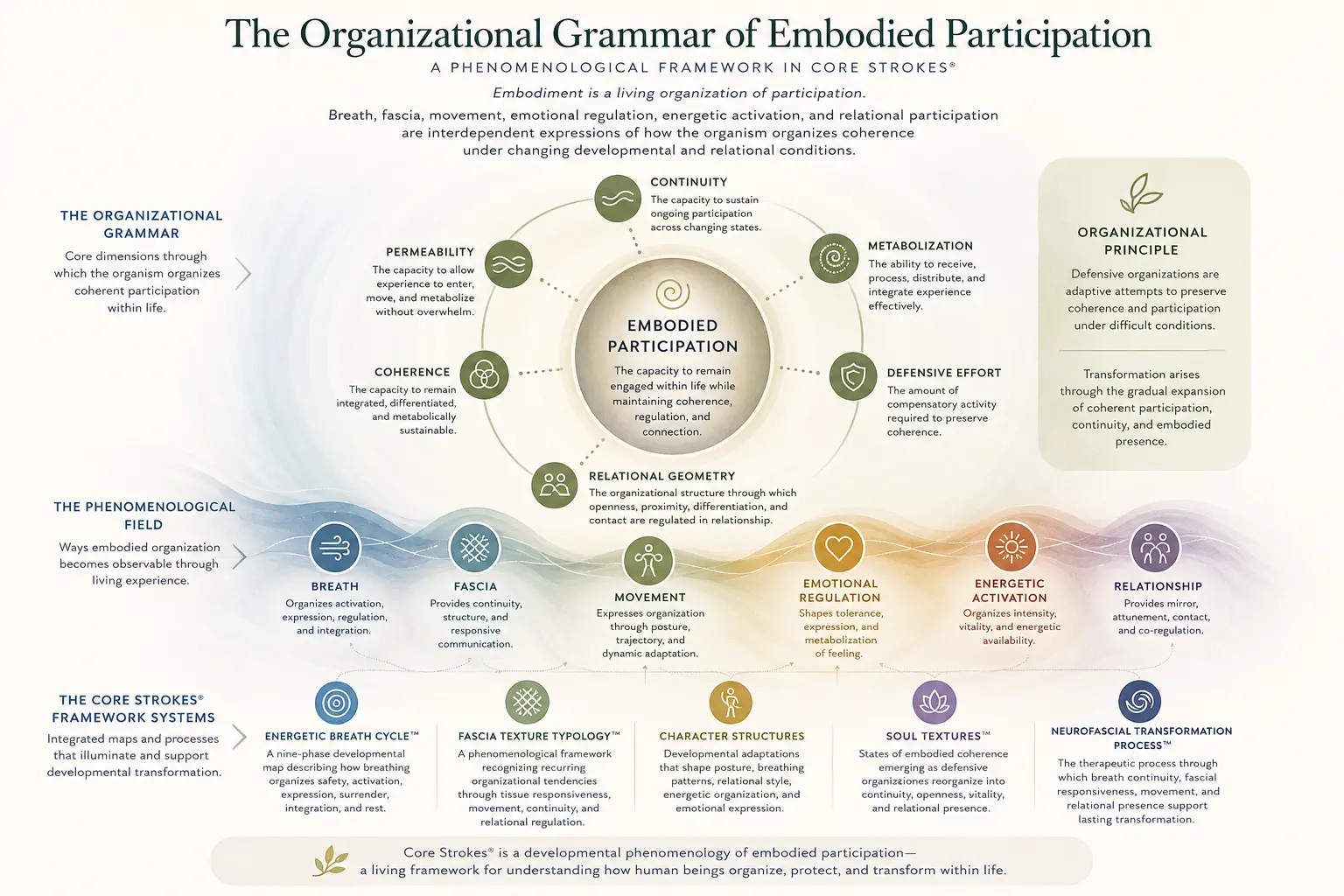
Reading the Diagram
At the center of the framework lies embodied participation: the organism’s capacity to remain engaged with life while maintaining coherence, regulation, and connection.
Surrounding this center are the organizational principles that shape participation:
These principles become visible through the phenomenological field of lived experience — breathing, fascia, movement, emotional regulation, energetic activation, and relationship.
The diagram also shows the major maps of Core Strokes®, each illuminating a different aspect of how participation is organized, protected, and transformed throughout life.
Together they form a unified framework for understanding how human beings develop, adapt, protect themselves, relate, and transform throughout life.
Participation as a Central Principle
At the heart of Core Strokes® lies the understanding that living organisms continuously seek to preserve participation in life.
Participation refers to far more than social interaction. It describes the capacity to remain engaged with sensation, movement, emotion, breathing, energetic activation, relationship, expression, and experience itself.
Human beings do not merely seek survival. They seek viable participation.
Throughout development, the organism continuously negotiates how open it can remain, how much intensity it can tolerate, how much contact it can sustain, and how much experience it can integrate without losing coherence.
When participation becomes overwhelming, fragmenting, or metabolically unsustainable, adaptive organizations emerge. These organizations may restrict openness, reduce feeling, increase control, withdraw contact, or alter expression. Their purpose is not failure, but preservation.
From this perspective, many symptoms, defensive patterns, and developmental adaptations can be understood as intelligent attempts to maintain participation under challenging developmental, relational, or environmental conditions.
The central question within Core Strokes® therefore shifts from:
“What is wrong?”
to:
“How is participation being organized?”
Transformation involves gradually expanding the organism’s capacity to participate coherently within embodied and relational life.
As participation becomes increasingly sustainable, defensive effort softens, continuity strengthens, openness becomes safer, and embodied presence becomes more available.
The Organizational Principles of Core Strokes®
Core Strokes® proposes that participation is shaped by several recurring organizational principles. These principles do not describe fixed traits or categories. Rather, they describe living processes through which the organism maintains continuity, regulates openness, metabolizes experience, preserves coherence, and adapts to changing conditions.
Together they form the organizational grammar of embodied participation.
Continuity
Continuity refers to the organism’s capacity to sustain participation across changing states without excessive fragmentation, collapse, dissociation, or interruption. It provides the experiential thread that allows life to feel connected and ongoing.
Example: After a difficult disagreement, a person remains connected to themselves, their relationship, and their daily life rather than withdrawing completely or becoming overwhelmed.
Permeability
Permeability describes the capacity to allow sensation, emotion, movement, energetic activation, and relational contact to enter awareness without overwhelming the organism’s ability to remain coherent.
Example: A person receives heartfelt feedback and allows themselves to be touched by it without becoming flooded or shutting down.
Coherence
Coherence refers to the integration and coordination of bodily, emotional, energetic, and relational processes into a functioning whole. It allows participation to remain stable without becoming rigid.
Example: Although nervous before speaking in public, a person remains grounded, clear, emotionally present, and able to communicate effectively.
Metabolization
Metabolization is the organism’s capacity to receive, process, distribute, transform, and integrate experience. Through metabolization, activation becomes learning, contact becomes nourishment, and experience becomes growth.
Example: Following a disappointment, a person reflects, learns from the experience, and gradually incorporates its lessons into their life.
Defensive Organization
Defensive Organization describes the adaptive strategies through which the organism preserves participation when openness becomes unsafe, overwhelming, or unsustainable. These strategies are approached not as pathology, but as intelligent attempts to maintain coherence under difficult conditions.
Example: A person responds to criticism with humor, withdrawal, or control in order to protect themselves from feelings that seem too vulnerable or overwhelming.
Relational Geometry
Relational Geometry refers to the ways the organism organizes proximity, distance, boundaries, differentiation, and connection within relationship. It describes the living architecture through which participation unfolds between self and other.
Example: A person can remain emotionally close to a loved one while still maintaining their own perspective, boundaries, and individuality.
These principles continuously influence one another. Participation is never shaped by a single factor, but emerges from their dynamic interaction within embodied and relational life.
Dynamic Relationships Between the Organizational Principles
None of the organizational principles operates independently. Continuity, permeability, coherence, metabolization, defensive organization, and relational geometry continuously influence one another within lived experience.
Difficulties often emerge when one principle becomes disconnected from the others. Permeability without coherence may contribute to overwhelm. Continuity without permeability may contribute to rigidity. Openness without sufficient metabolization may exceed the organism’s capacity to integrate experience. Defensive organization may preserve coherence while simultaneously restricting participation.
Healthy organization emerges through dynamic balance rather than through the maximization of any single principle. Transformation therefore involves gradually restoring the conditions under which participation can become increasingly coherent, differentiated, resilient, and sustainable.
The Maps of Core Strokes®
The organizational principles described above become visible through a series of complementary maps within the Core Strokes® framework.
Each map illuminates a different aspect of embodied participation. Together they offer complementary perspectives on how human beings organize development, protection, relationship, and transformation throughout life.
Rather than describing separate phenomena, these maps explore the same living process from different vantage points.
Energetic Breath Cycle™
The Energetic Breath Cycle™ describes the developmental rhythms through which participation unfolds.
From safety and nourishment through exploration, expression, surrender, and rest, the cycle illustrates how breathing organizes the organism’s capacity to engage life. Distortions within the cycle reveal adaptive patterns that emerge when participation becomes interrupted, overwhelming, or developmentally constrained.
Example:
After receiving criticism, one person remains open, listens, reflects, responds, and eventually settles again. Another immediately becomes defensive, collapses into self-doubt, or disconnects emotionally. The Energetic Breath Cycle™ helps illuminate where participation becomes interrupted and how the organism attempts to restore balance.
Fascia Texture Typology™
The Fascia Texture Typology™ explores how embodied organization becomes visible through tissue responsiveness, movement quality, continuity, elasticity, density, and energetic expression.
Rather than classifying pathology, the typology recognizes recurring patterns through which participation organizes itself within the living fabric of the body.
Example:
Two people may hear the same feedback. One remains physically responsive, breathing freely and staying connected. Another becomes visibly rigid, tightens through the jaw and shoulders, and loses movement fluidity. The Fascia Texture Typology™ explores how these different organizational styles become expressed through the body’s tissue qualities and movement patterns.
Neurofascial Encoding™
Neurofascial Encoding™ describes how developmental experience, emotional learning, relational history, and adaptive survival strategies become organized throughout breath, fascia, posture, movement, perception, and regulation.
Example:
A manager receives constructive feedback from a supervisor. Rationally, the feedback is reasonable. Yet her body reacts as if she is being rejected. Her chest tightens, her stomach contracts, and she feels an immediate urge to defend herself. Neurofascial Encoding™ explores how earlier relational experiences may continue to shape present-day perception, regulation, and bodily response.
Character Structures and Developmental Organization
Core Strokes® also draws upon developmental and characterological perspectives to understand how participation becomes organized throughout early life.
Character structures are approached not as fixed personality types, but as adaptive organizational patterns that emerge through the interaction of developmental needs, relational experience, breath organization, and embodied survival strategies.
Example:
Faced with the same criticism, one person withdraws and questions their worth, another argues and attempts to regain control, while a third tries harder to earn approval. Developmental organization helps explain how different adaptive strategies emerge from different developmental histories and unmet needs.
Neurofascial Transformation Process™
The Neurofascial Transformation Process™ describes the therapeutic pathway through which embodied organizations gradually reorganize.
Through breath continuity, fascial responsiveness, movement, emotional processing, energetic activation, and relational presence, previously adaptive patterns can soften, reorganize, and evolve toward greater coherence and participation.
Example:
Over time, the manager learns to notice tension arising when she receives feedback. Instead of automatically defending or collapsing, she breathes, remains present, and gradually develops new ways of responding. The Neurofascial Transformation Process™ describes how such shifts become possible through embodied therapeutic work.
Soul Textures
Soul Textures describe qualitative expressions of embodied coherence, vitality, presence, and participation.
They illuminate how deeper dimensions of human experience become visible through characteristic qualities of presence, vitality, meaning, and participation. Shadow Soul Textures describe adaptive survival organizations that emerge when participation becomes restricted, fragmented, or disconnected from its deeper vitality.
Example:
Two people may appear equally successful externally. Yet one moves through life with grounded vitality, authenticity, and meaningful connection, while the other feels chronically disconnected despite achievement. Soul Textures explore these deeper qualities of embodied presence and participation that become visible beyond behavior alone.
Together, these maps form a unified framework for understanding how human beings develop, protect themselves, adapt, relate, and transform.
Each map illuminates a different aspect of the same living question:
How is participation being organized within embodied and relational life?
Why Fascia Matters
Although Core Strokes® is not a fascial therapy model, fascia occupies a central place within the framework because it provides a uniquely accessible window into embodied organization.
Fascia participates simultaneously in posture, movement, proprioception, interoception, breath propagation, tension distribution, emotional expression, energetic activation, and relational responsiveness. As a result, organizational patterns that may remain difficult to recognize through thoughts, symptoms, or behavior alone often become visible through the qualities of fascial responsiveness.
Within Core Strokes®, fascia is approached not merely as connective tissue, but as a living medium through which participation becomes embodied and observable.
For this reason, fascia serves as one of the primary observational fields within the framework. It provides a bridge between physiology and experience, between structure and process, between developmental history and present-moment participation.
The Fascia Texture Typology™ emerged from this perspective. Rather than diagnosing tissue pathology, it describes recurring organizational tendencies that become visible through characteristic qualities of fascial responsiveness. These textures offer insight into how continuity, openness, coherence, protection, and adaptation are being organized throughout the organism as a whole.
Yet fascia is never viewed in isolation. Fascial organization continuously interacts with breathing, movement, emotional regulation, energetic activation, developmental learning, and relational experience. No texture exists independently of the living process from which it emerges.
In this sense, fascia is important not because it explains everything, but because it reveals so much. It offers a tangible and observable expression of the deeper organizational dynamics through which human beings participate in life.
Fascia therefore functions not simply as tissue, but as one of the most accessible gateways into understanding embodied participation, developmental organization, and transformational change.
Defensive and Healthy Organization
Core Strokes® approaches human organization through a developmental and adaptive lens.
When participation becomes overwhelming, fragmenting, or metabolically unsustainable, the organism naturally develops strategies to preserve continuity, coherence, and survival. These strategies may appear through restriction, withdrawal, control, tension, collapse, dissociation, accommodation, resistance, or other forms of adaptive organization.
Within the framework, such patterns are not approached primarily as pathology or dysfunction. They are understood as intelligent attempts to maintain participation under conditions that exceed the organism’s available resources.
Every defensive organization serves a purpose. Patterns that appear restrictive in one context may once have preserved continuity, reduced overwhelm, protected coherence, or maintained essential connection.
For this reason, Core Strokes® seeks to understand not only what a pattern is, but what function it serves within the larger organization of participation.
Healthy organization does not emerge through the elimination of defensive patterns. Rather, it develops as the organism acquires increasing capacity to tolerate openness, metabolize experience, sustain continuity, regulate activation, and remain present within relationship.
As this capacity grows, defensive organizations gradually become less necessary. Protection no longer needs to dominate participation. Openness becomes increasingly sustainable. Coherence requires less effort. Adaptation becomes more flexible and creative.
Transformation therefore involves neither forcing change nor dismantling defenses prematurely. It involves supporting the developmental conditions through which participation can gradually reorganize itself.
The question shifts from:
“How do we get rid of this pattern?”
to:
“What would allow participation to become more sustainable?”
From this perspective, healing is not the absence of protection, but the restoration of choice.
The Developmental Movement of Transformation
Within Core Strokes®, transformation is understood as a process of developmental reorganization.
Rather than focusing exclusively on symptom reduction, emotional release, insight, or behavioral change, the framework explores how the organism gradually develops greater capacity for participation, regulation, continuity, openness, and coherence.
As developmental resources become available, previously adaptive organizations may no longer be required in the same way. Patterns that once preserved continuity can become more flexible. Defensive effort may decrease. New forms of participation become possible.
This process is rarely linear. Growth often involves periods of stabilization, activation, reorganization, integration, and consolidation. Different aspects of the organism may develop at different rates, and earlier adaptive patterns may re-emerge when new challenges arise.
Transformation therefore does not mean eliminating protection, vulnerability, or adaptation. Rather, it involves increasing the organism’s capacity to respond flexibly to changing conditions while maintaining coherence and participation.
Within Core Strokes®, this developmental movement is explored through the interaction of the Energetic Breath Cycle™, Fascia Texture Typology™, Neurofascial Encoding™, Character Structures, Soul Textures, and the Neurofascial Transformation Process™.
Together, these maps illuminate how participation becomes organized, how adaptive patterns emerge, and how new possibilities for embodiment, relationship, and expression gradually develop.
From this perspective, transformation is not something imposed upon the organism. It is the ongoing process through which participation becomes increasingly coherent, differentiated, resilient, and sustainable.
How Core Strokes® Differs from Other Somatic Approaches
Core Strokes® shares common ground with many traditions within body psychotherapy, somatic psychology, developmental psychotherapy, trauma-informed practice, and fascia-oriented approaches.
The framework draws upon insights from Reichian therapy, Postural Integration®, Core Energetics, developmental psychology, attachment theory, Polyvagal Theory, phenomenology, and contemporary fascia research.
At the same time, Core Strokes® is not organized around any single explanatory model.
It is not primarily a trauma model, a nervous system model, a fascial model, a breathwork method, or a characterological system.
Instead, Core Strokes® approaches human experience through the lens of embodied participation.
The central question is not:
“What symptom is present?”
or
“What diagnosis applies?”
but:
“How is participation being organized?”
From this perspective, breath, fascia, movement, emotional regulation, energetic activation, developmental adaptation, and relational experience are understood as interconnected expressions of a larger organizational process.
This organizational perspective provides a common language through which diverse dimensions of embodied experience can be understood as parts of a coherent whole.
Explore Related Core Strokes® Concepts
→ The Organisation of Embodied Participation
The phenomenological foundation of Core Strokes®, describing how continuity, coherence, permeability, metabolisation, adaptive organisation, and relational geometry organise embodied life.
→ Defensive Organisation
A protective form of Adaptive Organisation in which participation becomes organised around experienced or anticipated threat, overwhelm, disruption, or loss of continuity.
→ Living Participation Observation System™ (LPOS™)
The observational methodology through which embodied and relational expressions are described before provisional organisational interpretations are developed.
→ Relational Field and Relational Geometry
The Relational Field is the embodied space of interaction. Relational Geometry describes how proximity, distance, boundaries, orientation, reciprocity, and differentiation are organised within it.
→ Energetic Breath Cycle™
A developmental map describing how breathing organises grounding, activation, emotional expression, surrender, and restoration throughout the organism.
→ Fascia Texture Typology™
A phenomenological framework for describing recurring tactile configurations and considering their possible organisational significance without treating them as diagnoses, personality types, or records of developmental history.
→ Neurofascial Encoding™
A proposed research framework exploring possible relationships among repeated participation, neural plasticity, behaviour, physiological regulation, movement, mechanical loading, and connective-tissue remodelling.
→ Neurofascial Transformation Process™
The therapeutic process through which breathing, fascia, movement, therapeutic touch and relational participation can contribute to embodied reorganisation and therapeutic transformation.
→ Therapeutic Touch
An embodied and relational practice guided by consent, clinical judgement, perceptual attention, and responsiveness rather than by mechanical intervention or predetermined interpretation.
→ Character Structures
A framework for exploring recurring developmental organisations of bodily, emotional, behavioural, and relational participation without reducing people to fixed types.
→ Soul Organisation, Soul Coherence, and Soul Textures ™
Interrelated dimensions of Core Strokes® concerned with authenticity, meaning, inner resonance, embodied presence, and relational participation. Soul Organisation names the wider qualitative domain; Soul Coherence describes increasing integrity among dimensions of experience; Soul Textures™ describe qualities of coherent participation; and Shadow Soul Textures™ describe qualitative expressions of protective, constrained, fragmented, or compensatory Adaptive Organisation.
These principles can also be explored directly through experiential practice within:
Related Dimensions of the Framework
These dimensions expand and deepen specific aspects of the Core Strokes® framework, exploring how coherence, meaning, regulation, and developmental organization become visible within embodied participation.
→Shadow Soul Textures
Survival organizations that emerge when participation, continuity, and developmental integration become restricted or interrupted.
→ Soul Coherence
The degree of integration through which breath, fascia, emotion, relationship, meaning, and consciousness participate as a unified living process.
→ Soul Dimensions
The capacities for vitality, authenticity, meaning, creativity, relational depth, and embodied participation that emerge as integration deepens.
→ Autonomic Regulation in Core Strokes®
The physiological foundations through which safety, activation, restoration, and relational capacity are organized and sustained.
Resources & Learning
Explore the Core Strokes® framework through foundational references, practical applications, experiential learning, and professional training.
→ Publications & Media
Articles, interviews, presentations, and professional contributions exploring the development and application of the Core Strokes® approach.
→ Core Strokes® Glossary
A comprehensive reference guide to the concepts, principles, and terminology used throughout the framework.
→ Core Strokes® Strong Emotions Workshops
Experiential workshops exploring emotional regulation, embodied expression, relational participation, and transformational process.
→ Core Strokes® Training Modules
Professional and personal development programmes integrating breath, fascia, movement, developmental psychology, relational presence, and embodied transformation.
FAQ — The Organization of Embodied Participation
Final Orientation
Core Strokes® approaches embodiment not as a static structure, but as a living organization of participation.
Breathing, movement, fascia, emotional regulation, energetic activation, relationship, and meaning are understood as interconnected expressions of how human beings organize continuity, coherence, openness, protection, and transformation throughout life.
The maps within the framework are not rigid classifications, but phenomenological tools for recognizing how participation becomes organized, how adaptive patterns emerge, and how new possibilities for embodied and relational life gradually develop.
At its heart, Core Strokes® explores a simple question:
How is participation being organized within life?