Neurofascial Encoding™
How Experience Becomes Embodied in the Living Organism
By Dirk Marivoet, Founder of Core Strokes® · Psychotherapist · Teacher · Author
Neurofascial Encoding — Core Definition
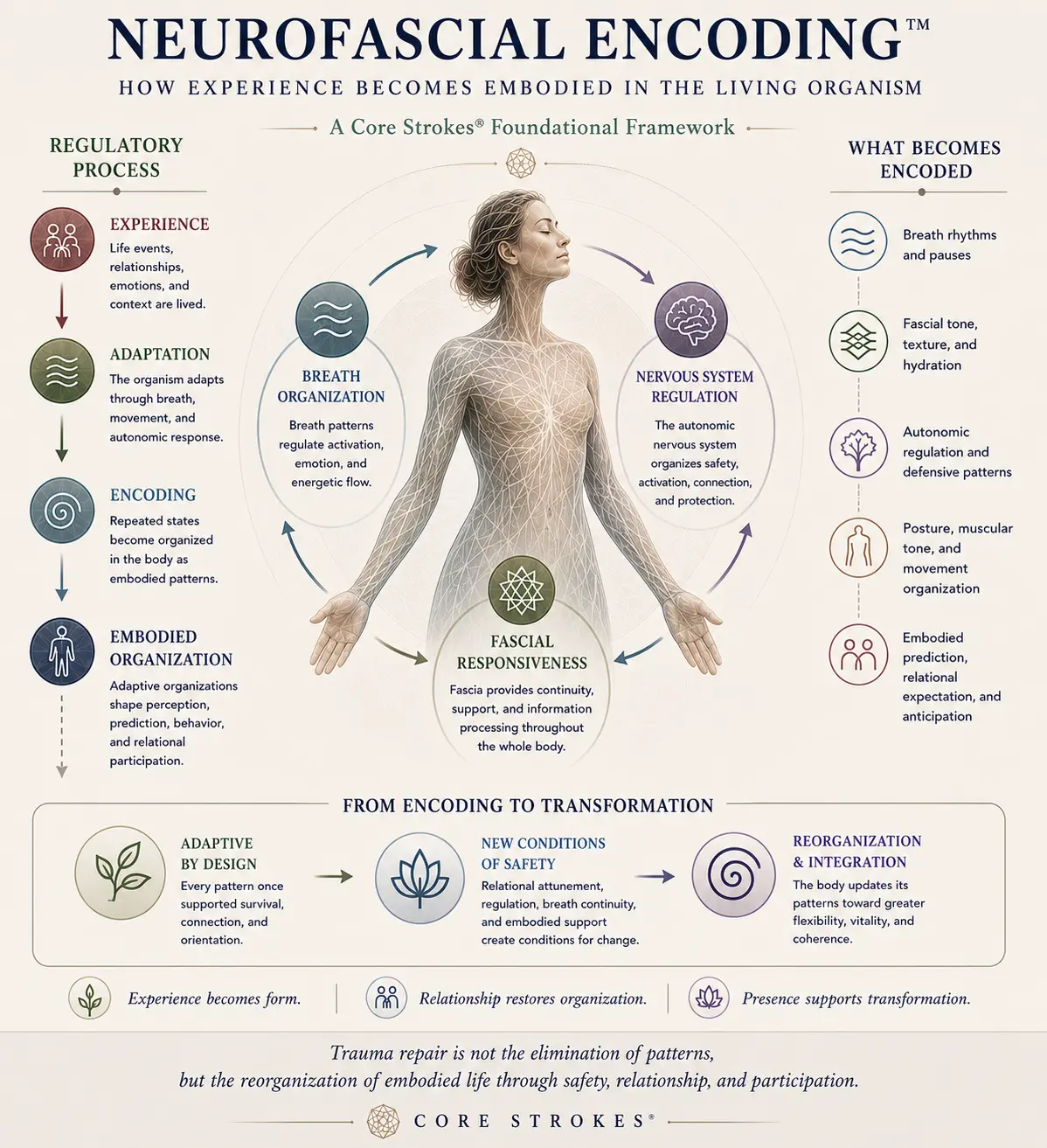
Neurofascial Encoding™ describes the ongoing process through which lived experience becomes stabilized within embodied life through interacting patterns of breathing, fascia responsiveness, autonomic regulation, posture, movement, emotional regulation, energetic organization, and relational expectation.
Within Core Strokes®, encoding is not understood as isolated trauma being mechanically stored inside tissues. Rather, experience gradually shapes the organism’s regulatory and participatory organization across the whole bodymind system.
These adaptive patterns become perceptible through tissue texture, breathing rhythms, posture, movement continuity, emotional responsiveness, energetic tone, autonomic rhythm, and relational participation. Neurofascial Encoding™ therefore offers a developmental and phenomenological framework for understanding how experience becomes embodied over time — and how these adaptive organizations may gradually reorganize through somatic, relational, and breath-oriented therapeutic processes.
Experience Does Not Simply Pass — It Organizes
From the earliest stages of life, the organism continuously adapts to its relational and environmental conditions.
Experiences of safety, threat, nourishment, inconsistency, emotional attunement, overwhelm, absence, touch, regulation, movement restriction, expression, and relational contact all contribute to how the organism gradually organizes itself. Over time, repeated experience influences breathing rhythms, autonomic flexibility, fascial responsiveness, posture, movement continuity, emotional regulation, energetic tone, and relational expectation.
These are not merely psychological memories. They are living adaptive organizations.
Encoded organization does not merely reflect past experience. It also shapes future anticipation. The organism continuously anticipates safety, danger, contact, interruption, nourishment, overwhelm, or rejection through embodied expectation formed across previous relational experience.
Neurofascial Encoding™ describes how such organizations become stabilized throughout embodied life.
Diagram illustrating Neurofascial Encoding™ within the Core Strokes® framework, showing how experience becomes embodied through breath organization, fascia responsiveness, nervous system regulation, posture, movement, and relational adaptation.
Encoding Is Developmental Before It Is Traumatic
Neurofascial Encoding™ does not apply only to trauma.
All experience participates in shaping embodied organization. Early attachment, developmental transitions, emotional environments, relational patterns, cultural conditioning, chronic stress, repetitive activation, and long-term adaptation all contribute to encoding processes.
What shapes encoding is not simply the external event itself, but also developmental timing, duration, relational context, autonomic capacity, and the organism’s ability to metabolize and complete experience.
When activation cannot fully cycle through breathing, movement, emotional expression, relational contact, or physiological regulation, adaptive patterns may gradually stabilize as ongoing embodied organization.
Encoding is therefore fundamentally developmental, relational, and regulatory in nature.
The Role of Breath in Neurofascial Encoding™
Within Core Strokes®, breathing plays a central role in how experience becomes organized.
Breath continuously regulates activation, emotional expression, energetic charge, mobilization, surrender, contact, and restoration throughout the organism. As breathing adapts under developmental or relational pressure, fascial organization often adapts alongside it.
Over time, recurring breathing organizations may stabilize as compressed, inflated, interrupted, dissociated, conflicted, overextended, or exhausted regulatory patterns within the Energetic Breath Cycle™.
These are not viewed as faulty breathing habits requiring correction. They are intelligent adaptive organizations shaped through lived developmental conditions.
The organism did not fail by creating them. It survived through them.
Neurofascial Encoding™ Is Adaptive Organization
A central principle within Core Strokes® is that encoded patterns are not approached primarily as pathology.
They are adaptive organizational responses that once supported continuity, attachment, orientation, protection, regulation, or energetic survival under specific developmental conditions.
This perspective fundamentally shifts therapeutic orientation. The task is not to force release, override protection, or dismantle adaptation prematurely. Instead, somatic psychotherapy becomes a process of listening for the organizational intelligence embedded within the body itself.
What appears defensive may once have been necessary. What appears rigid may once have preserved continuity. What appears collapsed may once have protected survival.
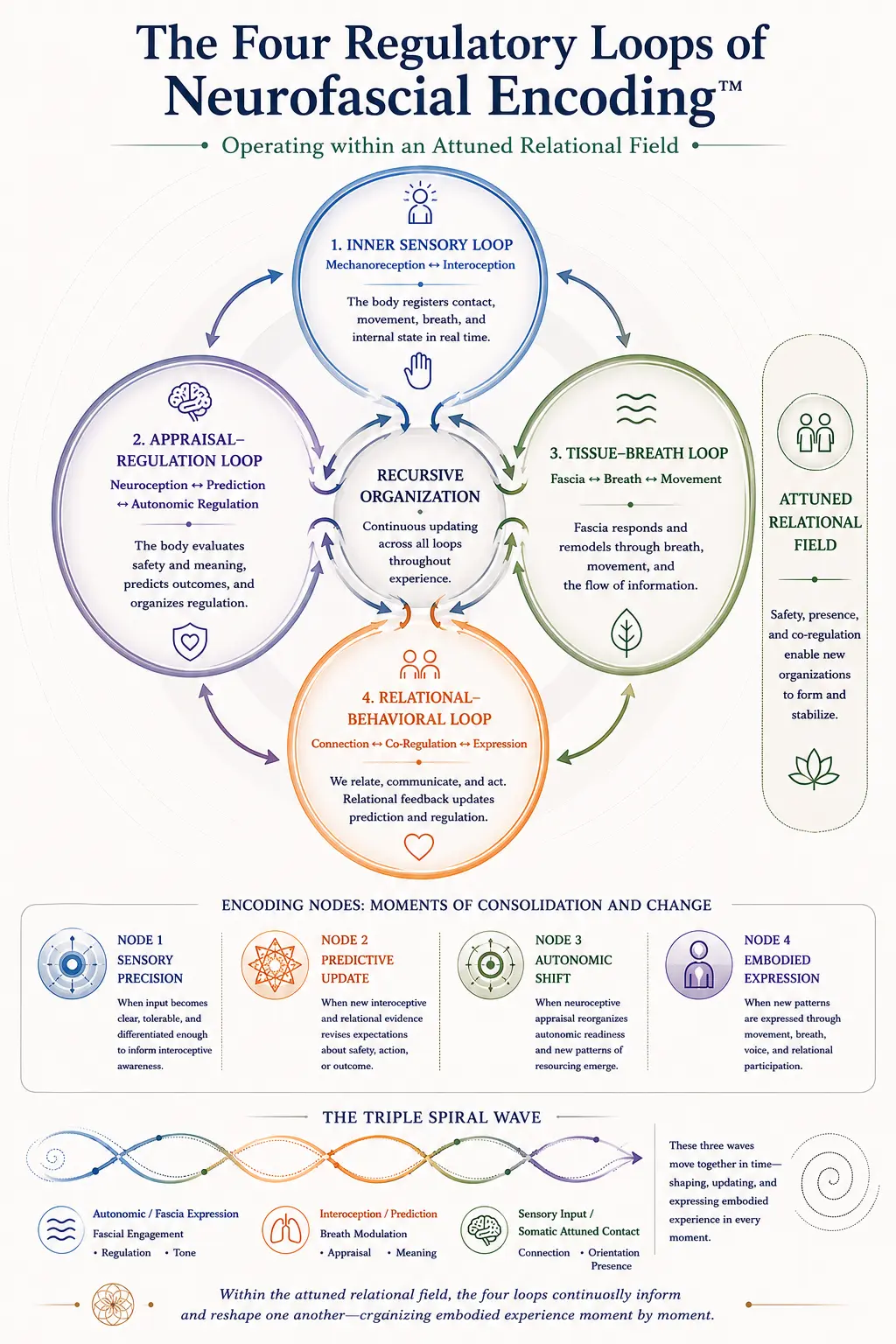
The Four Regulatory Loops of Neurofascial Encoding™
Within Core Strokes®, Neurofascial Encoding™ is understood not as a single mechanism, but as a continuously interacting regulatory process unfolding across multiple dimensions of embodied life.
Rather than functioning linearly, experience becomes organized through recursive loops that continually inform, update, and reshape one another within the organism and its relational environment.
These loops operate simultaneously through perception, autonomic regulation, breathing, fascia responsiveness, movement, emotional process, and relational participation.
1. The Inner Sensory Loop
The organism continuously registers internal and external experience through interoception, mechanoreception, movement, breath, and sensory awareness.
Contact, pressure, rhythm, muscular tone, breathing shifts, visceral sensation, and internal state all contribute to how the organism perceives itself moment by moment.
This sensory flow forms the living basis through which embodied experience becomes recognizable, orienting, and available for regulation.
2. The Appraisal–Regulation Loop
Sensory information is continuously evaluated through autonomic and relational meaning-making processes.
The organism assesses safety, danger, connection, uncertainty, nourishment, overwhelm, and relational significance through ongoing neuroceptive and predictive organization.
These evaluations shape autonomic readiness, emotional regulation, energetic mobilization, posture, and behavioral orientation throughout experience.
3. The Tissue–Breath Loop
Breath and fascia continuously influence one another.
Changes in breathing affect tension, elasticity, hydration, movement propagation, autonomic tone, and fascial responsiveness throughout the body. At the same time, existing fascial organization influences breathing range, movement continuity, energetic flow, emotional expression, and regulation.
Over time, repeated regulatory states may gradually stabilize as embodied organizational patterns.
4. The Relational–Behavioral Loop
The organism continuously participates within relational environments through posture, movement, emotional expression, communication, proximity, protection, and contact.
Relational feedback influences breathing, autonomic regulation, muscular tone, emotional process, and prediction in real time. Through repeated relational experience, patterns of participation gradually become embodied expectations shaping future interaction.
Recursive Updating and Embodied Prediction
These loops do not function independently.
They continually influence and reorganize one another through recursive updating occurring moment by moment throughout embodied life.
Changes in breathing influence autonomic regulation. Relational experience reshapes prediction. Fascial responsiveness alters movement and perception. Emotional regulation influences posture, contact capacity, and energetic expression.
Over time, the organism develops anticipatory patterns based upon previous experience. The body does not merely remember what has happened. It also prepares for what it expects may happen next.
Neurofascial Encoding™ therefore describes an ongoing process of embodied participation, prediction, adaptation, and reorganization occurring continuously throughout the living organism.
Encoding Nodes and Moments of Change
Within therapeutic and developmental process, moments of transformation often emerge through shifts in sensory clarity, prediction, autonomic regulation, embodied expression, relational safety, and movement continuity.
As new experience becomes tolerable, embodied expectations may gradually update. Breathing reorganizes. Fascial responsiveness changes. Previously defensive patterns may soften into greater flexibility, participation, coherence, and relational freedom.
Transformation therefore emerges not through forceful correction, but through recursive reorganization occurring within an attuned relational field.
From Encoding to Transformation
Neurofascial Encoding™ describes how embodied organizations form.
The Neurofascial Transformation Process™ describes how they may gradually reorganize.
Transformation does not erase history or remove adaptation. Rather, previously defensive organizations may slowly reorganize when the organism encounters sufficient relational safety, autonomic support, embodied regulation, breath continuity, fascial responsiveness, emotional integration, and developmental timing.
Under these conditions, previously restricted movement, frozen activation, dissociated organization, collapsed regulation, or defensive holding may gradually regain flexibility, responsiveness, continuity, and participation.
This process is not based primarily on catharsis or forceful release. It reflects developmental reorganization emerging through embodied relational experience.
Reading Neurofascial Encoding in the Body
Within Core Strokes®, practitioners recognize neurofascial encoding phenomenologically through the living organization of the body itself.
Encoding may become perceptible through fascial texture, breathing rhythm, posture, movement continuity, autonomic activation, emotional regulation, energetic tone, and anticipatory relational organization.
The aim is not diagnostic labeling. It is embodied listening.
The organism expresses its developmental history not only through narrative, but through living structure, regulation, movement, and participation.
Why Neurofascial Encoding™ Matters in Somatic Psychotherapy
Understanding encoding transforms how therapeutic process itself is approached.
Rather than pushing for emotional discharge or attempting to eliminate symptoms directly, somatic psychotherapy becomes oriented toward supporting regulation, continuity, responsiveness, embodied participation, and developmental integration.
Within this perspective, symptoms are not isolated malfunctions detached from the organism. They are expressions of broader adaptive organization.
When sufficient safety, regulation, relational coherence, and embodied support emerge, the organism may gradually reorganize itself toward increasing vitality, flexibility, coherence, and participation.
The body is therefore approached not as a problem to be corrected, but as a living organism continuously attempting to preserve continuity under changing conditions.
🌿 Reflection
Which patterns within your body may represent not failure, but intelligent forms of adaptation that once helped preserve continuity, protection, or relationship?
Explore Related Core Strokes® Concepts
→ The Organisation of Embodied Participation
The phenomenological foundation of Core Strokes®, describing how continuity, coherence, permeability, metabolisation, adaptive organisation, and relational geometry organise embodied life.
→ Defensive Organisation
A protective form of Adaptive Organisation in which participation becomes organised around experienced or anticipated threat, overwhelm, disruption, or loss of continuity.
→ Living Participation Observation System™ (LPOS™)
The observational methodology through which embodied and relational expressions are described before provisional organisational interpretations are developed.
→ Relationsl Field and Relational Geometry
The Relational Field is the embodied space of interaction. Relational Geometry describes how proximity, distance, boundaries, orientation, reciprocity, and differentiation are organised within it.
→ Energetic Breath Cycle™
A developmental map describing how breathing organises grounding, activation, emotional expression, surrender, and restoration throughout the organism.
→ Fascia Texture Typology™
A phenomenological framework for describing recurring tactile configurations and considering their possible organisational significance without treating them as diagnoses, personality types, or records of developmental history.
→ Neurofascial Encoding™
A proposed research framework exploring possible relationships among repeated participation, neural plasticity, behaviour, physiological regulation, movement, mechanical loading, and connective-tissue remodelling.
→ Neurofascial Transformation Process™
The therapeutic process through which breathing, fascia, movement, therapeutic touch, and relational participation gradually support lasting embodied transformation.
→ Therapeutic Touch
An embodied and relational practice guided by consent, clinical judgement, perceptual attention, and responsiveness rather than by mechanical intervention or predetermined interpretation.
→ Character Structures
A framework for exploring recurring developmental organisations of bodily, emotional, behavioural, and relational participation without reducing people to fixed types.
→ Soul Organisation, Soul Coherence, and Soul Textures ™
Interrelated dimensions of Core Strokes® concerned with authenticity, meaning, inner resonance, embodied presence, and relational participation. Soul Organisation names the wider qualitative domain; Soul Coherence describes increasing integrity among dimensions of experience; Soul Textures™ describe describe qualities of coherent participation; and Shadow Soul Textures™ describe qualitative expressions of protective, constrained, fragmented, or compensatory Adaptive Organisation.
These principles can also be explored directly through experiential practice within: