The Orgastic Principle in Core Strokes®
Pulsation, Integration, and the Rhythm of Living Energy
The Orgastic Principle — Core Definition
The Orgastic Principle describes the organism’s innate capacity to sustain rhythmic cycles of activation, expansion, expression, surrender, discharge, and restoration without fragmentation or defensive interruption.
Within the Core Strokes® framework, the orgastic principle reflects a fundamental property of living systems:
the ability to remain coherent while energy moves.
It describes not merely the release of tension, but the organism’s capacity to tolerate intensity, participate within pulsation, surrender to movement, and return to regulation without collapse, rigidity, dissociation, or chronic defensive control.
The orgastic principle therefore reflects a broader organizational capacity for coherent energetic
Introduction
Life expresses itself through rhythm.
Breathing expands and releases.
The heart contracts and softens.
Emotion rises and settles.
Movement alternates between activation and rest.
Within the Core Strokes® framework, these rhythms reflect a deeper biological and phenomenological process:
the organism’s capacity for pulsation.
Pulsation describes the ongoing movement between expansion and contraction through which living systems maintain vitality, regulation, continuity, and participation.
The orgastic principle reflects the organism’s ability to remain coherent within these movements.
Rather than referring only to sexuality, it describes a broader capacity for embodied integration — the ability to experience activation, intensity, pleasure, surrender, emotional movement, energetic charge, and restoration without fragmentation or defensive interruption.
Within Core Strokes®, the orgastic principle becomes visible through breath, fascia, emotional regulation, energetic continuity, relational participation, and the living rhythms of the body itself.
The Pulsatory Nature of Life
Living systems organize through pulsation.
Every organism continuously alternates between activation and release, expansion and return, charge and restoration.
Breathing expands and softens.
Muscles contract and relax.
The autonomic nervous system moves between mobilization and restoration.
Emotion intensifies and settles.
These movements are not secondary phenomena imposed upon life.
They are life.
Healthy regulation therefore does not depend upon permanent calmness or uninterrupted activation, but upon the organism’s capacity to move rhythmically between changing states without losing continuity.
When pulsation remains fluid, experience becomes metabolizable.
Breath can deepen.
Emotion can move.
Energy can circulate.
Contact can remain possible even during intensity.
The organism no longer needs to interrupt experience prematurely in order to preserve coherence.
Reich and the Orgastic Formula
The orgastic principle was first articulated within body-oriented psychotherapy by Wilhelm Reich.
Reich observed that healthy emotional and sexual functioning followed a natural energetic sequence often summarized as the orgastic formula:
Tension → Charge → Discharge → Relaxation
Within this sequence, tension prepares the organism for activation, charge builds energetic intensity, discharge releases accumulated energy, and relaxation restores equilibrium and physiological settling.
Yet Reich’s deeper insight extended beyond discharge alone.
The orgastic principle reflected the organism’s broader capacity to sustain coherent pulsatory regulation without chronic interruption.
When this rhythmic process becomes restricted, fragmented, overcontrolled, or prematurely inhibited, the organism may gradually organize around chronic muscular tension, emotional restriction, breathing inhibition, dissociation, or defensive rigidity.
Within Core Strokes®, Reich’s insight is therefore expanded developmentally and phenomenologically.
The emphasis shifts from discharge alone toward the restoration of coherent embodied pulsation throughout the organism as a whole.
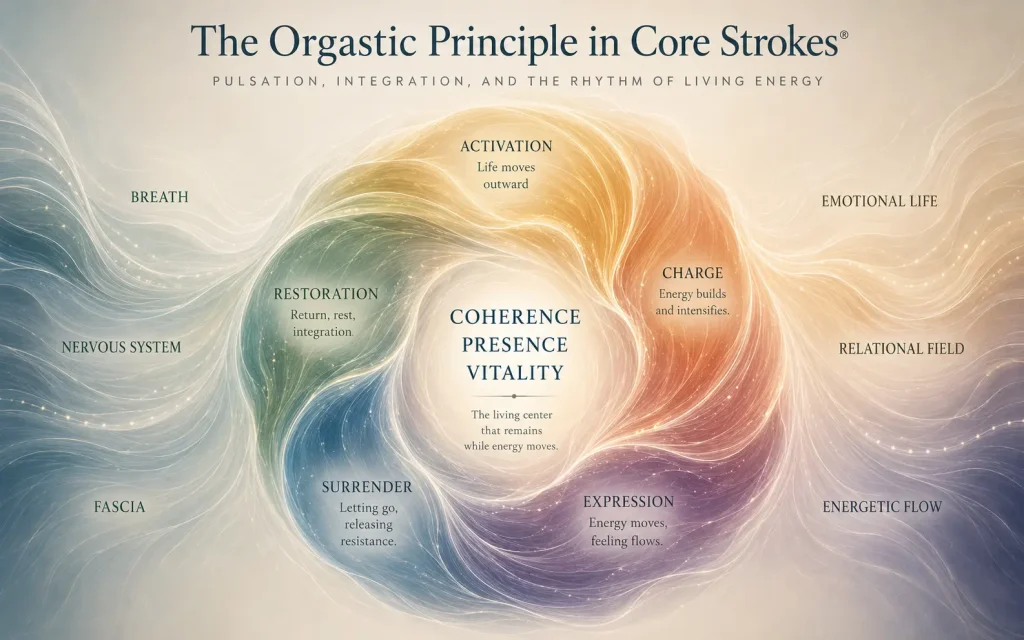
The Orgastic Principle and the Breath Cycle
Within Core Strokes®, the Energetic Breath Cycle™ provides a developmental map of how pulsatory regulation unfolds within embodied life.
Breathing itself expresses the orgastic principle.
Inhalation builds energetic charge.
Activation intensifies experience.
Expression releases accumulated energy.
Exhalation and settling restore equilibrium.
Several phases of the Energetic Breath Cycle™ particularly illustrate this pulsatory movement:
Several phases of the breath spiral illustrate this process:
Excited Breath — rising energetic charge and relational vitality
Orgastic Breath — surrender into rhythmic energetic expression
Ecstatic Breath — expanded coherence of energy and awareness
Surrendering Breath — yielding into gravity and integration
Resting Breath — stabilization and restoration
Through these developmental movements, the organism gradually learns to tolerate increasing intensity without fragmentation and increasing surrender without collapse.
Pulsation becomes inhabitable.
Streaming Union — The Soul Texture of Orgastic Breath
Within the Core Strokes® framework, the experiential expression of the orgastic principle appears through the Soul Texture known as Streaming Union.
Here the organism no longer resists the pulsatory movement of life.
Breath, sensation, movement, emotion, energetic charge, and relational openness begin to flow through the body as coherent waves rather than fragmented impulses.
Expansion and surrender become part of the same rhythmic process.
The organism no longer needs to rigidly control activation or defensively interrupt intensity in order to remain coherent.
Within Streaming Union, polarity integrates into living participation.
The body softens into rhythmic continuity.
Breath moves more freely throughout the organism.
Vitality circulates without excessive obstruction.
Presence becomes increasingly fluid, coherent, and embodied.
The organism gradually rediscovers its capacity to participate within intensity without losing connection to itself.
Integration of Embodied Polarity
The orgastic principle is closely connected to the integration of embodied polarity.
Erotic vitality emerges when complementary forces within the organism enter into dynamic relationship rather than defensive opposition.
These movements may appear as initiative and receptivity, expression and surrender, penetration and yielding, movement and support, expansion and containment.
Healthy polarity does not rigidly divide these qualities.
Rather, it allows them to participate rhythmically within coherent energetic movement.
The orgastic principle reflects the organism’s growing ability to sustain this polarity dynamically without fragmentation, collapse, defensive control, or dissociation.
Intensity becomes relational rather than overwhelming.
Surrender becomes participatory rather than helpless.
The organism gradually discovers that movement, pleasure, vulnerability, expression, and energetic openness can coexist within coherent embodied experience.
Fascial Resonance and Energetic Flow
Within Core Strokes®, fascia plays an essential role in how pulsatory rhythms propagate throughout the organism.
The fascial network functions as a living medium of transmission, responsiveness, continuity, and embodied communication.
When fascial organization remains sufficiently responsive, energetic movement can travel through the organism as coherent waves of motion, sensation, vibration, breathing, and emotional expression.
Breath may deepen spontaneously.
Subtle trembling may emerge.
Warmth and energetic circulation may become perceptible throughout the tissues.
Movement may propagate fluidly through the spine, pelvis, diaphragm, and limbs.
Within the Fascia Texture Typology™, these qualities correspond with textures supporting elasticity, responsiveness, transmission, and energetic continuity.
When tissues become chronically rigid, collapsed, fragmented, dissociated, or armored, pulsatory regulation may become restricted.
The organism may then lose its capacity to remain coherent while energy moves.
Developmental Interruptions of Pulsation
Developmental environments strongly influence the organism’s relationship to pulsation.
When emotional expression becomes shamed, frightening, inconsistent, intrusive, or overwhelming, the organism may gradually learn to interrupt activation in order to preserve safety and relational survival.
Intensity may become associated with loss of control, fragmentation, engulfment, abandonment, overwhelm, or relational danger.
The organism may then defend itself through chronic muscular holding, breathing restriction, emotional inhibition, hypercontrol, energetic withdrawal, collapse, or dissociation.
Over time, these adaptations may stabilize into enduring patterns of character organization.
Within Core Strokes®, these defensive organizations are approached not as pathology alone, but as intelligent attempts to preserve coherence under conditions where pulsation no longer felt safe.
Restoring the Orgastic Principle in Somatic Therapy
Somatic psychotherapy approaches such as Core Strokes® support the gradual restoration of pulsatory regulation within the organism.
This restoration cannot be forced.
The organism requires sufficient safety, regulation, relational attunement, differentiation, and support to remain coherent while increasing activation, emotional movement, energetic charge, and surrender become possible again.
Therapeutic work may involve restoring breathing continuity, softening defensive fascial and muscular holding, increasing tolerance for energetic intensity, supporting emotional expression, and expanding the organism’s capacity for relational participation.
As defensive interruption gradually softens, the organism may rediscover rhythms that were previously restricted or fragmented.
Breath regains movement.
Energy regains circulation.
Feeling regains continuity.
Pleasure and surrender become increasingly inhabitable.
The organism no longer needs to defend itself as strongly against the movement of life itself.
Conclusion — The Rhythm of Living Energy
The orgastic principle describes the organism’s capacity to move rhythmically through activation, intensity, expression, surrender, and restoration without fragmentation.
This rhythm extends far beyond sexuality alone.
It reflects the deeper pulsatory organization through which life maintains vitality, coherence, energetic continuity, and embodied participation.
Within Core Strokes®, therapeutic transformation involves restoring the organism’s capacity for coherent living pulsation through breath, fascia, movement, emotional regulation, energetic responsiveness, and relational presence.
When pulsatory continuity returns, the organism no longer needs to interrupt experience prematurely in order to remain coherent.
Breath regains its rhythm.
Energy regains its movement.
Feeling regains its continuity.
The body rediscovers its capacity to participate within life without fragmentation.
vThe orgastic principle therefore reflects not merely discharge, but the restoration of coherent living pulsation throughout embodied existence itself.
The Core Strokes Framework
Core Strokes® integrates breath, fascia, relational presence, developmental psychology, and phenomenological observation into a unified framework of embodied organization and somatic psychotherapy.
Rather than approaching embodiment through isolated symptoms or fixed categories alone, Core Strokes® explores how human experience organizes through breath, movement, fascia, emotional regulation, energetic activation, and relational participation.
📘 Explore the foundational dimensions of the framework below:
→ The Organization of Embodied Participation
A phenomenological framework describing how continuity, coherence, permeability, metabolization, and defensive organization shape embodied and relational life.
→ Energetic Breath Cycle™
A developmental rhythm describing how breathing organizes safety, activation, emotional expression, surrender, and rest.
→ Fascia Texture Typology™
A phenomenological system recognizing recurring organizational tendencies through tissue responsiveness, movement, continuity, and regulation.
→ Soul Textures™
Qualitative states of embodied coherence emerging as defensive organizations gradually reorganize into integrated vitality and relational openness.
→Shadow Soul Textures™
Survival organizations that emerge when participation, continuity, and developmental integration become restricted or interrupted.
→ Neurofascial Transformation Process™
The therapeutic process through which breath continuity, fascial responsiveness, movement, and relational presence support lasting transformation.
→ Character Structures
Developmental adaptations that stabilize patterns of regulation.
→Developmental Foundations of Core Strokes®
🌿 These principles can also be explored directly through experiential practice within:
Closing Invitation
The principles described here are explored experientially in Core Strokes® workshops and professional trainings.
Participants learn to recognize how breathing rhythms, fascial responsiveness, emotional expression, and relational contact shape the organism’s capacity for pulsation and integration.
Through embodied exploration and relational attunement, the body can gradually rediscover the natural rhythms through which vitality, expression, and deep restoration become possible.