Polarity as Developmental Maturation in Core Strokes®
Integrating Receptive and Expressive Capacities After Trauma
By Dirk Marivoet, Founder of Core Strokes® · Psychotherapist · Teacher · Author
Polarity Integration — Core Definition
Within Core Strokes®, polarity integration reflects the organism’s capacity to move fluidly between complementary dimensions of experience while maintaining coherence, embodiment, and relational participation. Capacities such as receptivity and expression, grounding and expansion, autonomy and connection, vitality and intimacy gradually become coordinated rather than opposed.
Healthy polarity does not eliminate difference. It allows difference to participate within a larger coherence.
Polarity is therefore understood not as a fixed identity or role, but as a living developmental process through which complementary capacities become increasingly differentiated, integrated, and available. As developmental repair unfolds, qualities that once functioned as opposing forces gradually become capable of cooperating within embodied life.
Within this broader developmental perspective, masculine and feminine principles may be understood as particular expressions of polarity within the broader developmental process of embodied participation. Polarity itself reflects the organism’s growing capacity to sustain dynamic movement between complementary aspects of experience without sacrificing coherence, connection, or selfhood.
Why Polarity Matters
Polarity integration influences how individuals love, create, express themselves, set boundaries, receive support, tolerate vulnerability, and participate in relationship.
When polarity remains divided, life often becomes organized around compensation, conflict, control, collapse, or disconnection. Capacities that naturally belong together become experienced as opposites: intimacy competes with autonomy, receptivity with expression, vulnerability with strength, and vitality with containment.
As polarity matures, these apparent opposites become increasingly coordinated. Vitality and intimacy, autonomy and connection, expression and receptivity can coexist within the same organism, supporting greater flexibility, authenticity, and relational participation.
Polarity therefore influences not only relationship, but also creativity, leadership, intimacy, self-expression, decision-making, and the organism’s overall capacity for embodied participation.
Developmental Origins of Polarity
Polarity develops through relationship.
Before receptive and expressive capacities can mature, the organism requires developmental conditions that support regulation, differentiation, and participation. Within Core Strokes®, these conditions are reflected in five fundamental developmental needs: Place, Nurturance, Support, Protection, and Loving Limits.
When these needs are sufficiently supported, the child gradually learns that receiving does not require dependency, expression does not require disconnection, and differentiation does not require the loss of relationship. The organism develops increasing capacity to need without collapse, to assert without domination, and to remain connected while becoming more fully itself.
Polarity therefore emerges through development rather than through ideology, role expectations, or abstract concepts. It grows from the organism’s lived experience of relationship.
Trauma and Polarity Distortion
Polarity integration is not the beginning of trauma healing. It is a developmental achievement that becomes possible as regulation stabilizes and embodied participation expands.
Trauma frequently disrupts the natural oscillation between receptive and expressive capacities. When developmental environments become intrusive, neglectful, overwhelming, or emotionally inconsistent, the organism adapts by narrowing its range of participation.
Some individuals become overly accommodating, compliant, or dependent upon external connection. Others organize around control, performance, or defensive autonomy. Still others withdraw from vitality through collapse, numbing, fragmentation, or dissociation.
Although these adaptations differ in appearance, they share a common purpose: preserving safety when participation becomes too threatening or overwhelming.
In each case, polarity becomes organized around protection rather than coherence. Capacities that would normally cooperate become separated, exaggerated, or restricted. Developmental repair gradually restores communication between these dimensions, allowing receptive and expressive capacities to function together once again.
Polarity as Somatic Organization
Within Core Strokes®, polarity is expressed through the body itself.
It can be observed in the way a person breathes, moves, meets intensity, inhabits posture, sustains relational contact, and organizes continuity throughout the fascial system. Polarity therefore is not merely a psychological concept. It is a living oscillation expressed through embodied experience.
When regulation is flexible, this oscillation remains fluid. The organism can move between receptivity and expression, grounding and expansion, autonomy and connection without losing coherence.
When trauma restricts flexibility, this movement becomes constrained. One pole may become dominant while the complementary capacity becomes diminished, defended against, or inaccessible. The body gradually organizes around compensation rather than rhythmic participation.
Polarity integration restores the organism’s capacity for rhythmic alternation, allowing complementary capacities to participate within a larger coherence rather than competing for dominance.
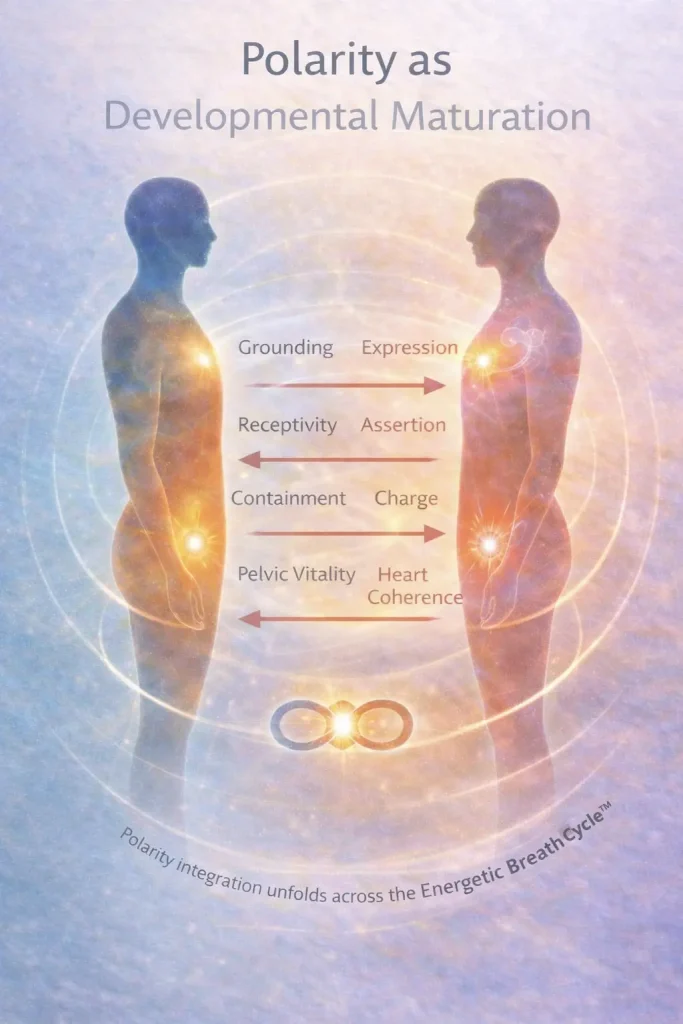
The Pelvic–Heart Axis
One of the most important expressions of polarity integration involves the restoration of communication between the pelvis and the heart.
Within Core Strokes®, the pelvis and the heart represent two essential dimensions of embodied participation. The pelvis organizes vitality, instinct, desire, grounding, pleasure, and embodied life force. The heart organizes emotional resonance, attachment, empathy, intimacy, and relational meaning.
Developmental trauma often disrupts the dialogue between these centers. Vitality may become disconnected from intimacy. Desire may separate from relationship. Emotional openness may lose access to embodied power, while instinctive energy may surge without sufficient containment or relational orientation.
As regulation stabilizes and developmental repair unfolds, communication gradually returns. Vitality becomes increasingly relational, intimacy increasingly embodied, and desire increasingly integrated with emotional presence. The organism develops greater capacity to experience intensity without losing connection, openness without collapse, and power without domination.
Within Core Strokes®, this developmental reorganization is known as Pelvic–Heart Integration®.
It is not simply the integration of sexuality and emotion. It is the embodied alignment of vitality and intimacy, instinct and relationship, power and tenderness. As this axis becomes more coherent, the organism gains increasing capacity to participate in life with authenticity, depth, and embodied presence.
Polarity and the Energetic Breath Cycle™
The Energetic Breath Cycle™ provides a developmental map through which polarity gradually matures.
Early phases establish safety, receptivity, trust, and exploratory movement. Later phases support increasing capacity for expression, charge, intimacy, surrender, and coherent participation. The movement from Nurturing Breath through Exploring Breath, Free Breath, Excited Breath, Orgastic Breath, and Ecstatic Breath can be understood as a progressive integration of receptive and expressive capacities.
Polarity maturation therefore does not eliminate oscillation. It restores rhythmic alternation. Breathing becomes more fluid, charge becomes more sustainable, and contact becomes increasingly coherent.
As flexibility develops across the breath cycle, the organism becomes less organized around defensive polarization and more capable of moving freely between complementary dimensions of experience. Receptivity no longer opposes expression. Autonomy no longer opposes connection. Vitality no longer opposes intimacy.
The breath becomes a living expression of integrated polarity.
Polarity and Relationship
Integrated polarity becomes most visible within relationship.
The organism develops the ability to receive while remaining differentiated, express while remaining connected, influence while remaining receptive, and move fluidly between leading and following. Intimacy no longer requires fusion, and autonomy no longer requires isolation.
Relationship gradually becomes a dynamic exchange rather than a defensive strategy. Difference no longer threatens connection, and connection no longer threatens selfhood.
As receptive and expressive capacities become integrated, relationship can support both individuality and mutuality. The organism becomes increasingly able to participate in contact without losing either connection or self-definition.
Polarity and Embodied Sovereignty
As polarity matures, the organism develops greater embodied sovereignty.
Vitality no longer requires aggression, receptivity no longer requires collapse, autonomy no longer requires distance, and intimacy no longer requires fusion. Capacities that once competed for dominance begin to cooperate within a larger coherence.
The body gradually shifts from defensive organization toward embodied participation. Expression and containment, openness and boundary, strength and vulnerability become capable of existing together within the same organism.
Embodied sovereignty therefore reflects not self-sufficiency, but the ability to remain fully oneself while remaining open to relationship.
Polarity, Soul Organization, and Soul Coherence
As polarity matures, new developmental possibilities emerge.
Authenticity deepens. Intimacy becomes less threatening. Vitality becomes more sustainable. Creativity, freedom, and meaningful participation become increasingly available.
Receptive and expressive capacities no longer compete for dominance. Instead, they cooperate within a larger field of embodied coherence.
In this sense, polarity integration contributes directly to Soul Organization and Soul Coherence. The organism becomes increasingly capable of participating in life without sacrificing either openness or selfhood.
From Survival to Rhythmic Integration
Trauma often divides capacities that naturally belong together. Expression becomes separated from receptivity, vitality from intimacy, and autonomy from connection.
Developmental repair gradually restores communication between these dimensions, allowing the organism to participate in life with greater flexibility, coherence, and freedom.
Polarity integration therefore reflects the organism’s return to rhythmic oscillation—grounded, expressive, receptive, relational, and sovereign.
It marks a movement beyond survival organization toward embodied participation in life. What was once organized around protection gradually becomes organized around coherence, vitality, intimacy, and meaningful participation.
Part of the Core Strokes Development & Integration Series
These articles explore how trauma recovery unfolds as a developmental process within the Core Strokes® framework. Together they describe how breath, fascia, intensity regulation, and relational presence reorganize the body toward safety, vitality, and authentic relational contact.
Continue exploring these concepts
Relationship as a Developmental Capacity — how self-regulation and co-regulation mature through relational contact
Relational Sovereignty— integration of self-regulation and co-regulation within embodied autonomy
Polarity as Developmental Maturation — how masculine and feminine dynamics evolve through embodied development
Pelvic-Heart Integration— restoring the vertical axis between instinct, emotion, and relational expression
Trauma as Restricted Development — how overwhelm limits access to safety, contact, and vitality
Intensity as Capacity — meeting strong activation without overwhelm
Core Strokes Training Pathways
Development & Integration Hub
If you are beginning trauma recovery