Participation in Core Strokes®
Embodied Engagement and the Capacity to Be Fully in Life
By Dirk Marivoet, Founder of Core Strokes®· Psychotherapist · Teacher · Author
Participation — Core Definition
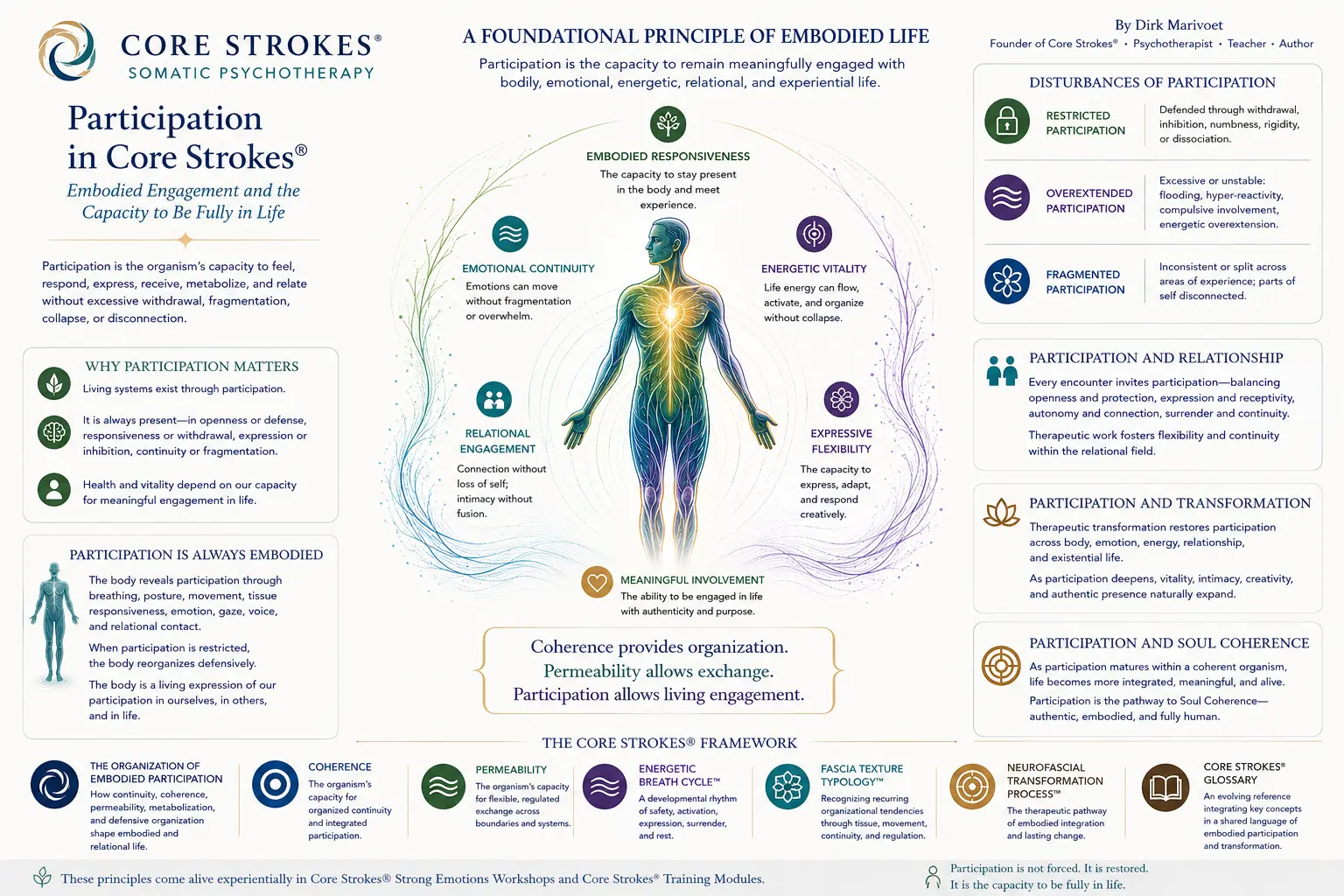
Participation refers to the organism’s capacity to remain meaningfully engaged with experience while maintaining sufficient continuity, regulation, embodiment, and self-organization.
Within the Core Strokes® framework, participation describes the ability to feel, respond, express, receive, metabolize, and relate without excessive withdrawal, fragmentation, collapse, defensive isolation, or disconnection from embodied life.
Participation allows the organism not merely to survive experience, but to inhabit it.
Why Participation Matters
Living systems exist through participation.
Breathing participates with atmosphere. Fascia participates in movement and transmission. Nervous systems participate with changing environments. Relationships continuously shape emotional and energetic organization through exchange, responsiveness, and co-regulation.
Participation is therefore not optional.
The organism is always participating in some way — through openness or defense, responsiveness or withdrawal, expression or inhibition, continuity or fragmentation.
Within Core Strokes®, many forms of suffering can be understood as disturbances in participation.
A person may continue functioning outwardly — going to work, maintaining routines, caring for others, or fulfilling responsibilities — while inwardly feeling increasingly numb, disconnected, emotionally distant, exhausted, or absent from life itself.
Another person may remain highly active and externally engaged, yet feel unable to truly relax, receive support, or remain grounded during emotional contact. Participation may continue externally while becoming internally fragmented or defended.
The organism may remain biologically alive while becoming progressively restricted in vitality, relational engagement, emotional responsiveness, energetic flow, spontaneity, embodiment, and existential aliveness.
Therapeutic transformation therefore involves not merely reducing symptoms, but restoring the organism’s capacity for fuller participation in life.
Participation and the Body
Participation is always embodied.
The body continuously reveals how the organism relates to experience.
A person who participates openly in life often breathes more fully, moves with greater continuity, maintains responsive eye contact, and remains capable of emotional expression while staying grounded in the body. Movement tends to propagate through the organism rather than stopping abruptly in defended areas. The voice carries vitality and modulation. The fascia remains sufficiently responsive to support fluid movement, sensation, and energetic exchange.
Participation can often be observed in simple moments — the way someone reaches toward another person, receives touch, enters a room, responds during conversation, or remains present during emotional intensity.
When participation becomes restricted, the body frequently reorganizes defensively.
Breathing may become shallow, frozen, or interrupted during contact or emotion. The shoulders may tighten protectively. The gaze may avoid connection or lose vitality. Movement may become rigid, hesitant, overly controlled, collapsed, fragmented, or mechanically repetitive.
Some individuals participate minimally by withdrawing from sensation, emotion, or relational engagement. Others remain physically present while emotionally disconnected. In other cases, the organism may over-participate through hyper-reactivity, compulsive expression, overextension, or difficulty maintaining boundaries and continuity of self.
Fascial organization often reflects these patterns directly. Tissue may become armored and dense, diffuse and collapsed, fragmented in responsiveness, or excessively activated without sufficient grounding.
Within Core Strokes®, the body is therefore understood not merely as a structure, but as a living expression of how the organism participates in itself, in relationship, and in life.
Healthy Participation
Healthy participation allows the organism to remain engaged with life while preserving continuity, groundedness, and integrity.
Experience can be received, felt, expressed, and integrated without immediately triggering collapse, defensive withdrawal, fragmentation, or overwhelm.
A person with healthy participation can remain emotionally present during a difficult conversation without losing contact with themselves. They may feel sadness without collapsing into helplessness, anger without becoming destructive, excitement without losing grounding, or intimacy without dissolving into fusion or defensive retreat.
In the body, healthy participation often appears as continuity. Breathing remains connected during activation, movement stays fluid and responsive, posture adapts rather than rigidifies, and emotional expression remains linked to embodied awareness.
The organism can move toward experience while still preserving self-regulation.
Healthy participation also includes flexibility.
A person may engage deeply when connection feels meaningful, yet also withdraw temporarily when rest, reflection, or protection are needed. Boundaries remain alive and adaptable rather than rigid or diffuse.
Fascially, healthy participation is often reflected through tissue responsiveness and energetic continuity. The body neither hardens chronically against experience nor collapses under intensity. Sensation, movement, emotion, and energetic activation can propagate through the organism without excessive interruption.
This supports embodied responsiveness, emotional continuity, relational engagement, energetic vitality, expressive flexibility, creativity, and meaningful involvement in life.
Within Core Strokes®, healthy participation does not mean constant openness or endless activity. It refers to the organism’s capacity to remain sufficiently available to life while maintaining continuity of self, embodied presence, and grounded organization.
Disturbances of Participation
Disturbances of participation may emerge through trauma, chronic overwhelm, attachment disruption, developmental instability, environmental intrusion, or prolonged defensive adaptation.
These disturbances may organize in different directions.
Restricted Participation
When participation becomes excessively restricted, the organism may defend itself through withdrawal, contraction, emotional inhibition, defensive isolation, numbness, rigidity, or dissociation.
The person may stop reaching toward others, avoid emotional conversations, minimize needs, disconnect from bodily sensation, or move through daily life in a controlled and emotionally flattened way.
Some individuals remain highly functional outwardly while inwardly feeling absent, disconnected, or unable to fully engage with relationships, creativity, pleasure, spontaneity, or emotional intimacy.
The organism protects itself by limiting engagement with experience.
This may temporarily reduce overwhelm, yet also restrict vitality, intimacy, spontaneity, creativity, and aliveness.
Overextended Participation
In some organizations, participation becomes excessive, unstable, or poorly regulated.
The organism may struggle with flooding, diffuse boundaries, emotional overwhelm, hyper-reactivity, compulsive relational involvement, energetic overextension, or loss of grounded continuity.
The person may become chronically overinvolved in relationships, unable to rest, constantly emotionally activated, compulsively expressive, or unable to sense where they end and another person begins.
Others may attempt to maintain connection through over-giving, emotional intensity, excessive caretaking, or continuous activity while losing contact with their own limits, needs, or embodied grounding.
Participation remains intense, but insufficiently organized.
Fragmented Participation
Participation may also become inconsistent or fragmented.
Certain aspects of experience remain accessible while others become disconnected, dissociated, defended, or developmentally restricted.
A person may participate cognitively while remaining emotionally absent. Another may express strong emotion while lacking embodied grounding or continuity of self. Someone may appear socially engaged while inwardly feeling detached, unreal, or disconnected from authentic participation.
In other cases, different parts of the organism may participate in contradictory ways at the same time. The body may move forward while another part withdraws. The person may long for intimacy while simultaneously fearing contact, openness, or vulnerability.
Participation therefore loses continuity across bodily, emotional, energetic, relational, and experiential systems.
This fragmentation often appears in trauma, structural dissociation, unstable attachment organization, chronic developmental stress, or severe relational disruption.
Within Core Strokes®, therapeutic transformation involves gradually restoring continuity between previously disconnected dimensions of experience so the organism can participate more coherently in life.
Participation and Coherence
Participation and coherence are deeply interconnected.
Without sufficient participation, coherence can become rigid, defensive, emotionally restricted, or overly controlled. A person may appear organized outwardly while inwardly feeling disconnected, flattened, or absent from authentic engagement.
Without sufficient coherence, participation may become unstable, overwhelming, impulsive, or fragmented. Emotional intensity, relational contact, or energetic activation may exceed the organism’s capacity for grounded continuity.
Healthy organization therefore requires both continuity and engagement.
Coherence provides organization.
Participation allows living involvement.
A person with healthy coherence and participation can remain present during emotional intensity without becoming overwhelmed, defended, dissociated, or disconnected from themselves.
Together, coherence and participation support the organism’s capacity for embodied, relational, emotional, and energetic life.
Participation and Permeability
Participation depends upon permeability.
Without sufficient permeability, the organism may become excessively closed, defended, emotionally distant, or isolated from experience. Contact, sensation, intimacy, and emotional exchange may feel threatening, intrusive, or overwhelming.
Without sufficient organization and boundaries, participation may become diffuse, flooding, or destabilizing. The person may absorb too much emotional intensity, struggle to maintain continuity of self, or lose grounding during contact with others.
Healthy permeability allows the organism to remain open enough for exchange while preserving continuity, integrity, and embodied regulation.
A person with healthy permeability can receive emotional contact, support, intimacy, touch, or energetic exchange without needing to collapse, defend excessively, or lose themselves in the process.
Participation therefore emerges through regulated exchange between self and world.
Participation and Relationship
Relationship continuously invites participation.
Every encounter involves negotiation between openness and protection, expression and receptivity, autonomy and connection, surrender and continuity of self.
Relational difficulties often reflect disturbances in participation.
Some individuals defend themselves through chronic distancing, emotional withdrawal, self-protection, or difficulty remaining vulnerable during contact. Others struggle with fusion, compulsive caretaking, overadaptation, emotional flooding, or unstable involvement in relationships.
A person with healthy participation can remain emotionally present during disagreement without immediately collapsing, attacking, withdrawing, overexplaining, or losing connection with themselves.
They can express emotion while remaining embodied, receive another person’s experience without becoming overwhelmed, and move between closeness and autonomy with increasing flexibility.
Within Core Strokes®, therapeutic work does not aim toward forced openness or emotional exposure, but toward increasing flexibility, continuity, and grounded participation within the relational field.
Healthy participation allows connection without loss of self, and individuality without defensive isolation.
Participation and the Energetic Breath Cycle™
Within the Energetic Breath Cycle™, participation develops progressively as the organism matures developmentally, relationally, energetically, and emotionally.
In the early phases, participation emerges through safety, support, receptivity, and trust. The organism first learns how to receive nourishment, remain connected, and engage the environment without becoming overwhelmed.
As development continues, participation expands through curiosity, exploration, expression, and increasing autonomy. The organism develops greater capacity to reach outward, experiment, communicate, and engage life more actively.
In the later phases, participation becomes increasingly complex and differentiated. It includes emotional depth, energetic intensity, erotic vitality, mutual relationship, surrender, meaning, and integration. The individual becomes capable of participating not only in action and expression, but also in intimacy, vulnerability, creativity, and authentic contact with self and others.
Disturbances within the cycle may interrupt this developmental unfolding. When participation becomes overwhelming, unsafe, or unsupported, the organism may stabilize around adaptive defensive organizations that restrict openness, spontaneity, continuity, emotional responsiveness, or embodied aliveness.
Therapeutic transformation therefore involves the gradual restoration and expansion of the organism’s capacity to participate coherently in the full spectrum of embodied and relational life.
Participation and Therapeutic Transformation
Within Core Strokes®, therapeutic transformation involves restoring increasing participation across bodily, emotional, energetic, relational, and existential dimensions of experience.
This process may involve restoring breath continuity, increasing fascial responsiveness, strengthening autonomic regulation, reducing defensive organization, supporting emotional metabolization, developing relational safety, and expanding embodied awareness.
As participation deepens, people often report feeling more present during conversations, more connected during intimacy, more spontaneous in movement, more emotionally available, and more capable of engaging life without chronic exhaustion or defensive withdrawal.
The organism no longer needs to organize primarily around chronic withdrawal, defensive interruption, or fragmentation.
Life becomes increasingly inhabitable from within.
Participation and Soul Coherence
As participation matures within a sufficiently coherent organism, experience gradually becomes more integrated, metabolizable, and meaningful.
The individual develops increasing capacity to remain engaged with embodiment, emotion, energetic exchange, relationship, symbolic experience, and existential life without losing continuity, integrity, or grounded presence.
The person may experience moments of feeling fully present in the body, emotionally open while remaining grounded, connected to others without losing themselves, and increasingly capable of inhabiting life with authenticity, meaning, and aliveness.
In this sense, participation contributes directly to the emergence of Soul Coherence — the organism’s capacity to inhabit life with increasing authenticity, aliveness, meaning, and embodied presence.
In Summary
Within Core Strokes®, participation refers to the organism’s capacity to engage meaningfully with life.
Participation allows sensation, emotion, movement, energetic responsiveness, relationship, creativity, meaning, and experience to become active dimensions of living rather than merely observed, managed, avoided, or endured.
When participation becomes restricted, life may narrow through withdrawal, defensive adaptation, fragmentation, collapse, or disconnection.
When participation deepens, experience becomes increasingly embodied, responsive, meaningful, relational, and alive.
Participation expresses engagement with life.
Permeability allows exchange.
Coherence provides continuity.
Embodiment allows experience to be lived.
Together, these principles form part of the foundational architecture of the Core Strokes® framework and support the organism’s capacity for vitality, authenticity, relationship, meaning, regulation, and therapeutic transformation.
Explore Related Core Strokes® Concepts
→ The Organisation of Embodied Participation
The phenomenological foundation of Core Strokes®, describing how continuity, coherence, permeability, metabolisation, adaptive organisation, and relational geometry organise embodied life.
→ Defensive Organisation
A protective form of Adaptive Organisation in which participation becomes organised around experienced or anticipated threat, overwhelm, disruption, or loss of continuity.
→ Living Participation Observation System™ (LPOS™)
The observational methodology through which embodied and relational expressions are described before provisional organisational interpretations are developed.
→ Relational Field and Relational Geometry
The Relational Field is the embodied space of interaction. Relational Geometry describes how proximity, distance, boundaries, orientation, reciprocity, and differentiation are organised within it.
→ Energetic Breath Cycle™
A developmental map describing how breathing organises grounding, activation, emotional expression, surrender, and restoration throughout the organism.
→ Fascia Texture Typology™
A phenomenological framework for describing recurring tactile configurations and considering their possible organisational significance without treating them as diagnoses, personality types, or records of developmental history.
→ Neurofascial Encoding™
A proposed research framework exploring possible relationships among repeated participation, neural plasticity, behaviour, physiological regulation, movement, mechanical loading, and connective-tissue remodelling.
→ Neurofascial Transformation Process™
The therapeutic process through which breathing, fascia, movement, therapeutic touch and relational participation can contribute to embodied reorganisation and therapeutic transformation.
→ Therapeutic Touch
An embodied and relational practice guided by consent, clinical judgement, perceptual attention, and responsiveness rather than by mechanical intervention or predetermined interpretation.
→ Character Structures
A framework for exploring recurring developmental organisations of bodily, emotional, behavioural, and relational participation without reducing people to fixed types.
→ Soul Organisation, Soul Coherence, and Soul Textures ™
Interrelated dimensions of Core Strokes® concerned with authenticity, meaning, inner resonance, embodied presence, and relational participation. Soul Organisation names the wider qualitative domain; Soul Coherence describes increasing integrity among dimensions of experience; Soul Textures™ describe qualities of coherent participation; and Shadow Soul Textures™ describe qualitative expressions of protective, constrained, fragmented, or compensatory Adaptive Organisation.
These principles can also be explored directly through experiential practice within:
Closing Invitation
Participation is explored experientially throughout Core Strokes® workshops, trainings, and therapeutic practice.
Through breath, movement, fascia-oriented work, emotional expression, energetic activation, and relational presence, participants gradually develop increasing capacity for embodied engagement with life.
Rather than promoting performance, forced expression, or unrestricted openness, Core Strokes® supports the organism’s natural capacity for coherent participation — the ability to remain present, responsive, relational, and alive while preserving continuity and grounded organization.
As participation deepens, the organism becomes increasingly capable of vitality, intimacy, embodiment, emotional flexibility, creativity, and meaningful involvement in life.