Breath as a Cycle of Energy
How breath organizes vitality, protection, and relationship
Written by Dirk Marivoet, founder of Core Strokes®
This essay explores breath as a living cycle through which energy, sensation, and meaning are continuously organized in the body.
Breath before technique
Breath is often approached as something to be improved, deepened, regulated, or controlled. It is measured, trained, corrected, or optimized. Yet long before breath becomes an object of technique, it is already doing something far more fundamental.
Breath organizes how life moves through the body.
Every inhalation and exhalation participates in a rhythmic process of expansion and contraction, engagement and withdrawal, charge and release. This process is not mechanical. It is relational. Breath responds to environment, contact, emotion, posture, and expectation. It adapts to what feels possible, safe, or required in any given moment.
In Core Strokes®, breath is approached not as a function to be trained, but as a cycle of energy—a living rhythm that reveals how the organism meets life.
Energy as movement, not concept
When we speak of energy here, we do not refer to an abstract force or metaphysical substance. Energy is understood in its most immediate sense: the capacity for movement, sensation, and responsiveness.
Energy is present when breath can build, crest, and resolve.
Energy diminishes when breath is interrupted, held, flattened, or dispersed.
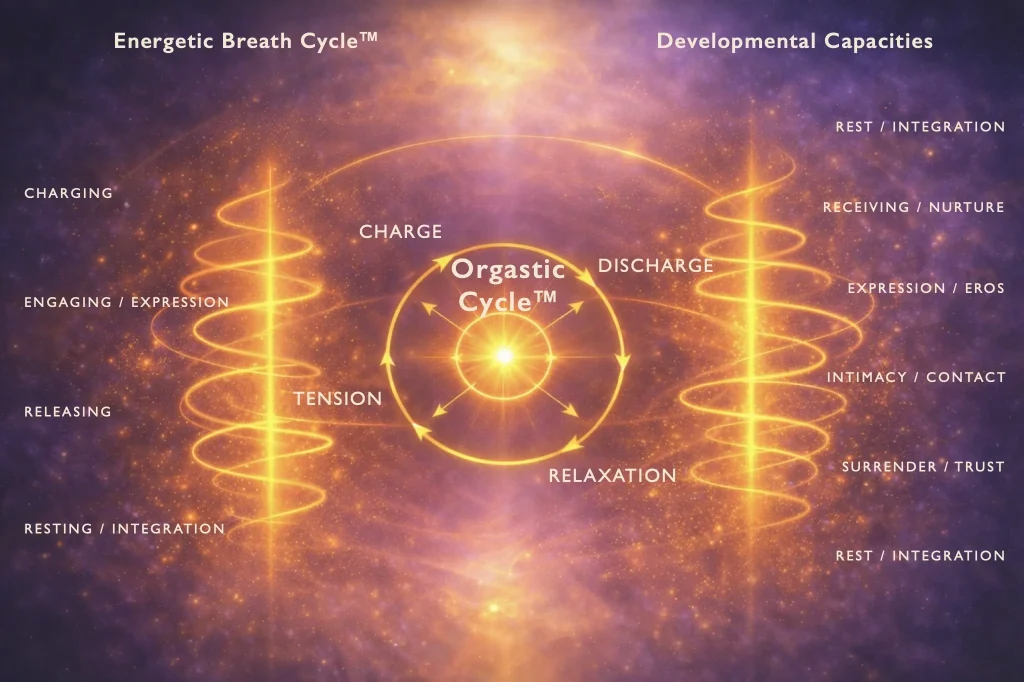
This energetic cycle unfolds continuously:
- charge gathers through inhalation and mobilization,
- movement seeks expression or contact,
- release allows settling and integration,
- rest restores availability for the next cycle.
When this rhythm is intact, the body remains fluid and adaptable. When it is disrupted, the organism must compensate.
The breath learns
Breath does not exist independently of experience. It learns.
From early life onward, breath adapts to relational conditions. How excitement was welcomed or curtailed, how fear was met or ignored, how closeness felt, how much expression was allowed—all of this shapes the breath’s rhythm.
- Some breaths learn to hold back.
- Others learn to rush forward.
- Some flatten to avoid feeling.
- Others remain suspended, never quite completing their cycle.
These patterns are not errors. They are adaptive solutions that once preserved coherence in the face of overwhelming, insufficient, or unpredictable conditions.
Breath remembers how to survive.
Distortion as protection
When the natural cycle of breath is interrupted, energy no longer completes its movement. Charge may accumulate without release, or dissipate without integration. The body responds by organizing protective patterns—muscular, fascial, postural, emotional.
- Restricted breath often coincides with increased tension and control.
- Fragmented breath may accompany vigilance or anxiety.
- Collapsed breath frequently appears where effort has ceased to feel meaningful.
In Core Strokes®, these breath patterns are not treated as problems to be fixed. They are read as signals—expressions of how the organism learned to regulate energy when full participation in the cycle was not available.
The question is never, “How do we make the breath better?”
It is, “What did the breath need to learn in order to cope?”
Breath in relationship
Breath reorganizes most profoundly in relationship, not in isolation.
When another nervous system is present—attentive, responsive, and not imposing—the breath begins to register new possibilities. It may deepen spontaneously. It may slow. It may hesitate, then continue. These shifts are not induced. They emerge when the body senses that it does not have to manage the cycle alone.
In Core Strokes®, breath is continuously tracked in dialogue with touch, posture, and language. Touch supports continuity. Words offer orientation. Silence allows sensing. None of these lead; all of them respond.
A simple acknowledgment—“Something here is holding back,” or *“There’s a lot of energy waiting”—*can be enough to allow breath to reorganize. Not because it is instructed to, but because it is recognized.
From breath control to breath continuity
Many approaches attempt to restore vitality by controlling breath. In Core Strokes®, the emphasis is different.
What matters is not depth, speed, or volume.
What matters is continuity.
A complete breath cycle is not achieved through effort, but through accompaniment. When the breath senses that it does not have to manage the arc alone, it often completes itself.
- Energy may then build without fear.
- Release can happen without collapse.
- Rest may follow without vigilance.
As breath regains continuity, the body no longer needs to protect energy in the same way. Fascial organization softens. Sensation becomes more nuanced. Movement regains elasticity. Emotional states pass without becoming fixed.
Breath does not need to be trained.
It needs to be met under different conditions.
This shift—from control to continuity—marks a central orientation in Core Strokes®. Breath reorganizes not because it is directed, but because the body senses that the conditions which once required interruption are no longer fully present.
A moment of sensing
You might pause for a moment and notice your breath as it is.Not to change it.
Not to deepen it.
Simply notice where the breath tends to complete itself—and where it hesitates, pauses, or redirects.
See if you can stay with that moment without correcting it.
As if you were listening to someone finish a sentence.
There is nothing to achieve here.
Just a brief experience of accompaniment.
Breath as organizer of meaning
Breath not only moves energy; it organizes meaning.
How we breathe shapes how we perceive ourselves, others, and the world. A breath that is always held back carries a different sense of possibility than one that can fully expand and release. A breath that never rests cannot trust completion.
As breath reorganizes, so does orientation:
- toward self,
- toward others,
- toward life.
This is why changes in breath often coincide with shifts in affect, imagery, or insight. Meaning is not imposed from above. It emerges from within the reorganizing cycle.
Toward the next exploration
Breath gives rhythm to energy.
Fascia gives form to adaptation.
But there is another layer through which experience becomes perceptible.
As breath and fascia reorganize, the body begins to speak more clearly in texture—in qualities of density, softness, elasticity, flow, and resistance. These textures form a language that can be felt, read, and responded to through touch.
This leads to the next exploration: the language of textures, and how touch becomes a dialogical listening to the body’s lived meaning.
Part of the Core Strokes Essays & Foundations Series
These essays introduce key ideas that form the conceptual foundation of the Core Strokes® framework.
They explore how breath, fascia, relational presence, and developmental organization shape human experience in the body.
Continue exploring the Core Strokes Foundations:
Core Strokes Training Pathways
See also the Development & Integration Hub
Intensity as Capacity — meeting strong activation without overwhelm
Trauma as Restricted Development — how overwhelm limits access to safety, contact, and vitality
Pelvic-Heart Integration— restoring the vertical axis between instinct, emotion, and relational expression
Polarity as Developmental Maturation — how masculine and feminine dynamics evolve through embodied development
If you are beginning trauma recovery:
Frequently Asked Questions
“Core Strokes® emerged through decades of clinical, developmental, and phenomenological exploration into the organization of embodied participation.”