Defensive Organization in Core Strokes®
Protection, Adaptation, and the Preservation of Participation
By Dirk Marivoet, Founder of Core Strokes®· Psychotherapist · Somatic Researcher · Author
Defensive Organisation — Core Definition
Defensive Organisation is a relatively enduring form of Adaptive Organisation in which participation becomes organised around protection from experienced or anticipated threat, overwhelm, disruption, or loss of continuity.
It may limit, redirect, inhibit, intensify, fragment, or tightly control particular forms of participation. In doing so, it may protect one capacity while restricting another. Withdrawal may preserve a sense of self while reducing contact. Control may maintain functioning while limiting spontaneity. Emotional inhibition may preserve relationship while weakening access to feeling. Constant activity may prevent collapse while making rest difficult.
Defensive Organisation is therefore neither inherently pathological nor necessarily beneficial. Its significance depends on the conditions in which it occurs, the functions it serves, its flexibility, and its consequences within the person’s present life.
It is not a diagnosis, personality type, or history that can be read directly from the body. Its meaning must be explored through present observation, the person’s own experience and account, known history, relational context, relevant clinical information, and change over time.
From Adaptation to Defensive Organisation
The distinction between Adaptation, Adaptive Organisation, and Defensive Organisation is fundamental.
Adaptation is one of the eight Organisational-Dynamic Principles within the Living Organisation Framework. It describes relatively enduring reorganisation within a person’s lifetime in response to changing bodily, developmental, relational, social, and environmental conditions.
Adaptive Organisation describes a relatively enduring, context-shaped configuration that may emerge through such adaptation. It may enable participation under one set of conditions while becoming restrictive or costly under another.
Defensive Organisation is a particular form of Adaptive Organisation in which protection becomes especially prominent.
The relationship can be expressed simply:
Adaptation is the dynamic process. Adaptive Organisation is the configuration that may develop through it. Defensive Organisation is an Adaptive Organisation shaped especially around protection.
This distinction prevents defence from becoming the explanation for every adaptation. Human beings adapt through learning, development, practice, relationship, injury, recovery, social conditions, and changing environments. Not every adaptation is defensive, and not every protective response is problematic.
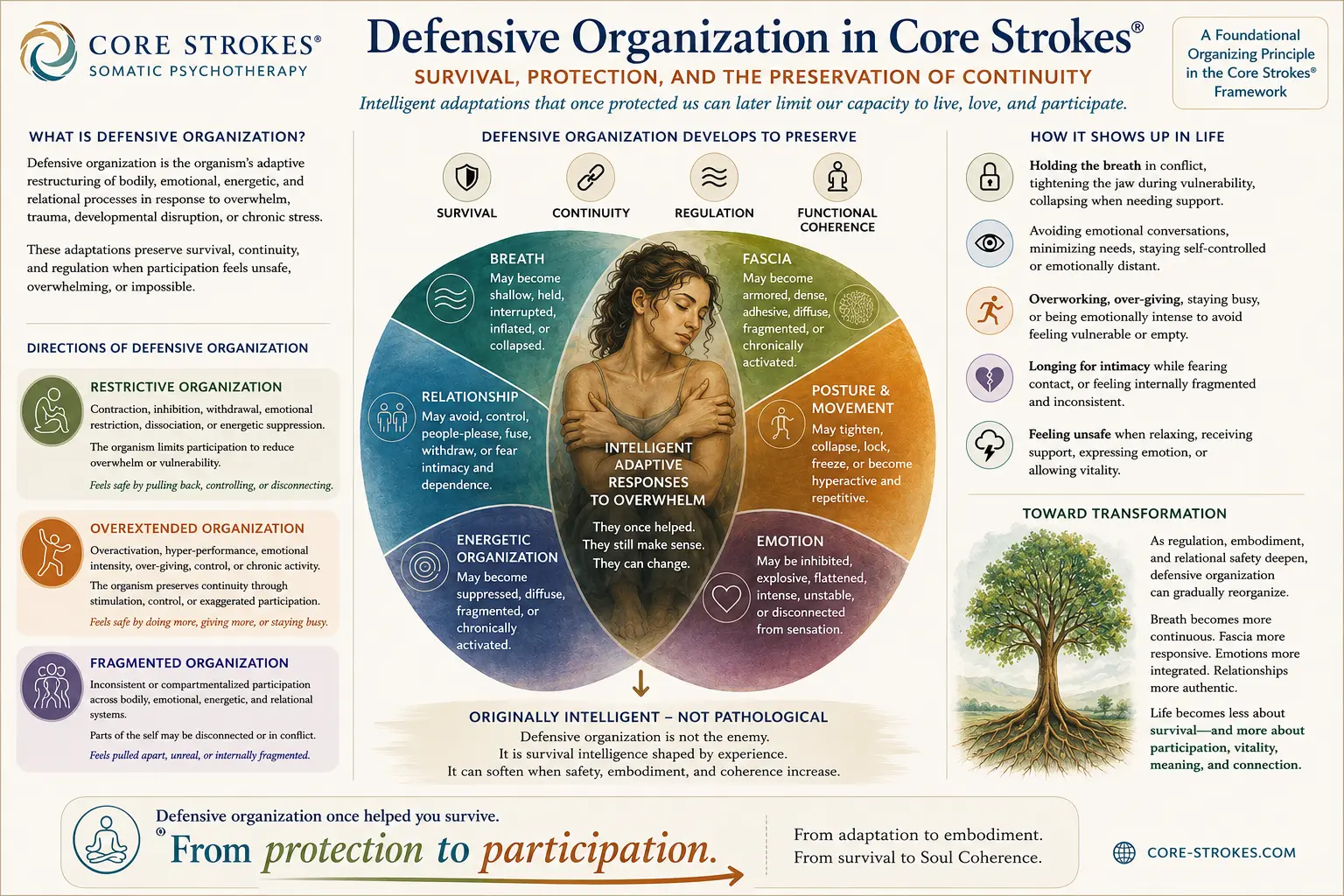
The Intelligence of Protection
Living organisms continually regulate their openness to experience.
No person can remain equally open, expressive, receptive, and relationally available under every condition. Human beings need capacities for inhibition, withdrawal, vigilance, mobilisation, boundary-setting, discrimination, and recovery. Protection is not the opposite of health. It is part of viable participation.
Under difficult circumstances, a child may learn to reduce emotional expression, monitor the emotional state of others, become highly self-reliant, withdraw from bodily sensation, or maintain connection through compliance. Another person may organise around activity, strength, caretaking, achievement, emotional intensity, or control. These responses may help preserve attachment, reduce exposure, contain activation, or sustain functioning.
What appears restrictive in the present may therefore once have made participation possible.
This historical possibility should inspire curiosity and respect, but it must not become an automatic story. Present posture, breathing, behaviour, movement, or tissue quality cannot establish how an organisation developed. Injury, illness, temperament, current stress, social conditions, learning, physical activity, medication, and many other influences may contribute to what is observed.
The therapist does not discover a hidden history by interpreting the body. Historical understanding develops provisionally through dialogue, known experience, clinical information, recurring patterns, and careful attention to how organisation changes.
When Protection Becomes Restrictive
Protective organisation becomes clinically relevant when it is experienced as costly, remains active across significantly different conditions, or limits capacities the person wishes to develop.
A person may continue anticipating intrusion in relationships where boundaries are respected. Rest may evoke anxiety because sustained activity has become associated with safety. Receiving support may feel dangerous because dependence once involved disappointment, control, or loss of autonomy. Emotional expression may awaken shame, disorganisation, or fear of relational rupture.
In other circumstances, protection may be insufficient rather than excessive. A person may need stronger boundaries, clearer discrimination, more effective mobilisation, or a greater capacity to leave harmful situations.
Therapeutic change should therefore not be described simply as moving from defence towards openness. Greater openness is not always safer or healthier.
The more meaningful direction is:
from protection that is rigid, costly, or poorly matched to present conditions towards protection and participation that are more flexible, differentiated, and responsive to context.
Sometimes this involves softening contraction. Sometimes it involves strengthening a boundary. Sometimes it means becoming more expressive; at other times, learning to pause, refuse, withdraw, or conserve energy.
Embodied Expressions of Defensive Organisation
Defensive Organisation may become perceptible through relationships among breathing, posture, movement, attention, emotional expression, physiological activation, language, and relational contact.
A person may hold their breath during conflict, reduce movement as vulnerability approaches, or become highly activated when rest becomes possible. They may remain physically present while feeling detached from sensation or emotion. Their words may communicate agreement while posture, gesture, or movement suggest withdrawal.
Others may organise protection through sustained engagement. Constant activity, performance, emotional intensity, caretaking, or attention to others may help prevent contact with exhaustion, helplessness, uncertainty, or unmet need.
These observations do not carry predetermined meanings. A held breath may accompany fear, concentration, pain, effort, anticipation, or an attempt to control movement. Reduced expression may reflect protection, fatigue, cultural convention, reflection, medication, or personal preference. Increased distance may communicate fear, differentiation, discomfort, respect, or simply a need for space.
LPOS™—the Living Participation Observation System™—therefore gives priority to description before interpretation. It asks how observations occur together, under which conditions they recur, how they change, and whether the person recognises the proposed description.
The relevant question is not:
“What does this bodily sign reveal?”
It is:
“How might these expressions participate together, and what becomes possible when we explore them in context?”
Possible Directions of Protection
Defensive Organisation does not form one uniform pattern. Protection may take different directions, and several directions may coexist or alternate within the same person.
In a restrictive direction, participation may narrow through contraction, withdrawal, inhibition, emotional distancing, reduced movement, or diminished access to sensation. Limiting participation may reduce vulnerability or stimulation, but it may also constrain vitality, pleasure, creativity, and relationship.
In an overextended direction, protection may be organised through sustained mobilisation, activity, performance, control, caretaking, emotional intensity, or attention directed predominantly towards others. The person may remain highly engaged while having difficulty sensing limits, receiving support, or settling.
In a fragmented direction, different aspects of experience may become insufficiently connected. A person may speak coherently while feeling detached from bodily experience, express intense emotion without an adequate sense of support, or approach relationship while simultaneously withdrawing from it.
These directions are not fixed categories or personality types. They are descriptive orientations that may help organise observation. Their presence does not establish trauma, attachment history, character structure, or diagnosis.
Defensive Organisation and Relational Geometry
Protection is often organised within relationship.
Relational Geometry describes how embodied participation takes form through proximity, distance, orientation, boundaries, direction, reciprocity, differentiation, approach, and withdrawal. It makes visible how contact is arranged within the Relational Field.
A person may increase distance as vulnerability becomes present. Another may approach contact while losing differentiation. Someone may preserve connection through compliance, maintain autonomy through emotional distance, or alternate between longing for closeness and fearing it.
Such movements are not merely psychological ideas. They may become perceptible through changes in breathing, gaze, posture, timing, gesture, vocal expression, movement, and interpersonal distance. Yet their meaning cannot be determined from those expressions alone.
Relational Geometry describes how contact is presently organised. Attachment theory, developmental understanding, and personal history may contribute to interpretation, but the observed geometry does not by itself establish any of them.
The therapeutic relationship becomes one context in which these arrangements can be noticed and explored. The therapist is not outside this organisation. Their distance, timing, tone, attention, expectations, and interventions all contribute to the field in which participation unfolds.
Defensive Organisation and Character Structure
Body psychotherapy traditions have often understood character structures as enduring organisations of bodily, emotional, behavioural, and relational life.
Within Core Strokes®, characterological patterns may be considered expressions of relatively enduring Adaptive Organisation. Defensive processes may participate in these patterns, but character cannot be reduced to defence alone.
Nor can character structure be reliably determined from posture, breathing, movement, fascial texture, or any isolated bodily observation. These expressions may contribute information, but they do not disclose personality or developmental history directly.
Core Strokes® therefore moves away from defining a person as a character type. It asks instead:
How has participation become organised? What does this organisation support or protect? What capacities remain available, and how does the pattern change across conditions?
This preserves the clinical value of recognising recurring organisation without turning a provisional formulation into an identity.
Defensive Organisation and Coherence
Defensive organisation may initially support coherence.
When experience becomes difficult to contain, a person may narrow attention, restrict expression, increase control, withdraw from contact, or mobilise intensely in order to preserve sufficient organisation for functioning to continue.
A tightly controlled organisation may support competence while limiting spontaneity. Emotional distance may preserve continuity while reducing intimacy. Overadaptation may preserve relationship while weakening differentiation. Constant mobilisation may sustain action while making rest and receptivity difficult.
Defence and coherence are therefore not simple opposites. Protection may maintain one form of coherence while reducing the organism’s capacity to reorganise flexibly.
Therapeutic work explores whether coherence can be maintained without requiring the same degree of restriction, control, fragmentation, or overextension.
Defensive Organisation and the Energetic Breath Cycle™
The Energetic Breath Cycle™ provides a developmental and phenomenological map of breathing, activation, expression, surrender, and restoration.
Protective organisation may become perceptible through recurring interruptions, restrictions, intensifications, or discontinuities within breathing and participation. Activation may be inhibited before it develops into action. Expression may become separated from support. Surrender may be associated with collapse or loss of control. Restoration may remain unavailable because vigilance or activity continues.
These patterns do not prove the existence of trauma, defence, or developmental disruption. Breathing is influenced by many physiological, psychological, behavioural, and situational processes.
LPOS™ therefore considers breath alongside movement, emotion, relationship, reported experience, and change over time. The purpose is not to assign a predetermined meaning to a breathing pattern, but to explore how breathing participates in the person’s present organisation.
Defensive Organisation and the Fascia Texture Typology™
Where touch is clinically appropriate and explicitly consented to, qualities perceived through touch may contribute to an exploration of embodied organisation.
A practitioner may perceive differences in yielding, movement, continuity, elasticity, density, responsiveness, or recovery. These are descriptions of a tactile encounter occurring between a particular practitioner and person under particular conditions.
They do not demonstrate that defence is stored in fascia. Nor can they establish trauma, attachment organisation, character structure, autonomic state, or personal history.
The Fascia Texture Typology™ offers a phenomenological language for gathering recurring tactile qualities into provisional configurations. Any wider organisational interpretation must be considered alongside the person’s report, breathing, posture, movement, behaviour, relational context, and relevant clinical information.
The body may be encountered, but the person cannot be decoded.
Therapeutic Participation
Defensive Organisation developed—or continues to occur—for reasons that may remain important.
A therapist cannot assume that protection should be relinquished simply because it appears restrictive. Nor can safety be imposed by reassurance. What seems safe to the therapist may not yet be experienced as safe by the person.
Attempts to force vulnerability, emotional exposure, catharsis, surrender, or energetic intensity may increase overwhelm and reinforce the need for protection.
Therapeutic participation therefore requires careful observation, appropriate assessment, informed and continuing consent, attention to pacing, and respect for the person’s aims. The practitioner monitors responses, considers alternative explanations, and revises the clinical understanding when necessary.
The work may involve supporting rest or mobilisation, expression or containment, closeness or distance, yielding or boundary formation. At times it may involve helping the person recognise protection that has become automatic. At other times, therapy may need to strengthen the ability to refuse, differentiate, withdraw, seek support, or act decisively.
The direction cannot be derived from an ideal image of openness. It emerges through the relationship among the person’s aims, present conditions, professional knowledge, relevant evidence, and what becomes observable as therapy proceeds.
From Protection Towards Greater Choice
Therapeutic transformation does not mean the disappearance of defence.
A meaningful change may involve recognising when protection is necessary and when it is no longer required. A person may develop more ways to establish boundaries, tolerate manageable activation, recover continuity after disruption, or move between contact and withdrawal without losing their sense of self.
Protection becomes more differentiated. Withdrawal can become a choice rather than an automatic disappearance. Strength can become available without continuous control. Openness can coexist with boundaries. Rest need not mean collapse, and mobilisation need not become chronic activation.
Such changes become credible not because they appear dramatically during one session, but because they recur, remain available in relevant situations, endure over time, and matter within the person’s life.
Transformation remains a possibility rather than a promise.
Defensive Organisation and Soul Organisation
Within Core Strokes®, Soul Organisation concerns qualitative dimensions of participation associated with authenticity, inner resonance, presence, meaning, and relationship.
Defensive Organisation may constrain access to these qualities, but it should not be presented simply as their opposite. Protection may preserve something essential until the person has sufficient support and capacity for another form of participation.
As organisation becomes more flexible, a person may discover greater continuity between bodily experience, emotion, expression, relationship, and meaning. They may become more able to remain embodied during vulnerability, receive support without losing differentiation, express themselves without sacrificing relationship, or maintain boundaries without withdrawing completely from contact.
Core Strokes® describes such developments as possible expressions of Soul Coherence. Their significance arises through the person’s lived experience and participation, not through an ideal form imposed by the framework.
Clinical and Epistemic Boundaries
Defensive Organisation is a clinical and organisational construct. Its responsible use requires several distinctions:
- Observation does not establish interpretation.
- Present organisation does not reveal a unique developmental history.
- A local bodily or tactile observation cannot describe the whole person.
- A protective pattern is not the identity of the person.
- Adaptation may be enabling, restrictive, or both.
- Therapeutic change cannot be guaranteed or prescribed in advance.
These boundaries do not diminish the importance of embodied observation. They make it more precise, accountable, and open to correction.
In Summary
Defensive Organisation is a protective form of Adaptive Organisation. It may develop when participation occurs under conditions of threat, overwhelm, instability, insufficient support, or constrained choice.
Its purpose is not necessarily to prevent life, but to preserve what participation remains possible. It may protect continuity, safety, coherence, relationship, or functioning while restricting other capacities.
Defensive Organisation is not a Primary Foundational Organisational Principle or an Organisational-Dynamic Principle. It is not a diagnosis, fixed identity, or history that can be read from the body.
Core Strokes® approaches it as a provisional clinical understanding of how protection may be organised within present participation.
The therapeutic task is not to destroy defence. It is to understand what protection preserves, recognise what it may now constrain, and support conditions in which both protection and participation can become more flexible, differentiated, and responsive.
At the centre of the inquiry is a question:
Can the person protect themselves when necessary while retaining access to embodiment, relationship, expression, and fuller participation in life?
Explore Related Core Strokes® Concepts
→ The Organisation of Embodied Participation
The phenomenological foundation of Core Strokes®, describing how continuity, coherence, permeability, metabolisation, adaptive organisation, and relational geometry organise embodied life.
→ Defensive Organisation
A protective form of Adaptive Organisation in which participation becomes organised around experienced or anticipated threat, overwhelm, disruption, or loss of continuity.
→ Living Participation Observation System™ (LPOS™)
The observational methodology through which embodied and relational expressions are described before provisional organisational interpretations are developed.
→ Relational Field and Relational Geometry
The Relational Field is the embodied space of interaction. Relational Geometry describes how proximity, distance, boundaries, orientation, reciprocity, and differentiation are organised within it.
→ Energetic Breath Cycle™
A developmental map describing how breathing organises grounding, activation, emotional expression, surrender, and restoration throughout the organism.
→ Fascia Texture Typology™
A phenomenological framework for describing recurring tactile configurations and considering their possible organisational significance without treating them as diagnoses, personality types, or records of developmental history.
→ Neurofascial Encoding™
A proposed research framework exploring possible relationships among repeated participation, neural plasticity, behaviour, physiological regulation, movement, mechanical loading, and connective-tissue remodelling.
→ Neurofascial Transformation Process™
The therapeutic process through which breathing, fascia, movement, therapeutic touch and relational participation can contribute to embodied reorganisation and therapeutic transformation.
→ Therapeutic Touch
An embodied and relational practice guided by consent, clinical judgement, perceptual attention, and responsiveness rather than by mechanical intervention or predetermined interpretation.
→ Character Structures
A framework for exploring recurring developmental organisations of bodily, emotional, behavioural, and relational participation without reducing people to fixed types.
→ Soul Organisation, Soul Coherence, and Soul Textures ™
Interrelated dimensions of Core Strokes® concerned with authenticity, meaning, inner resonance, embodied presence, and relational participation. Soul Organisation names the wider qualitative domain; Soul Coherence describes increasing integrity among dimensions of experience; Soul Textures™ describe qualities of coherent participation; and Shadow Soul Textures™ describe qualitative expressions of protective, constrained, fragmented, or compensatory Adaptive Organisation.
These principles can also be explored directly through experiential practice within: