Shape, Countershape, and Contrashape in Core Strokes®
Relational Form and the Organization of the Body
By Dirk Marivoet · Founder of Core Strokes® · European Certified Psychotherapist · Somatic Researcher · Author
Shape, Countershape, and Contrashape — A Definition
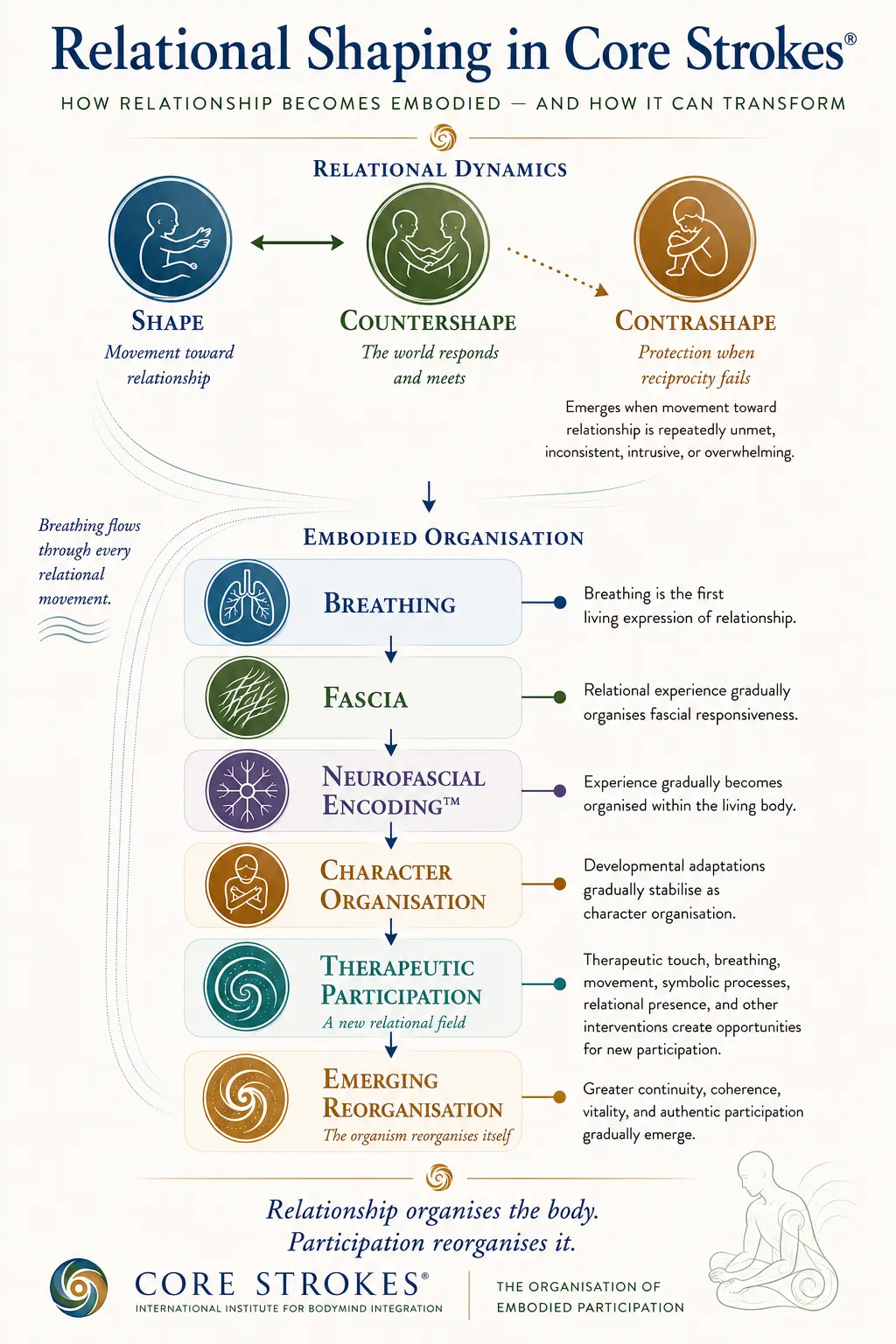
At its deepest level, shape, countershape, and contrashape describe three complementary movements within every relationship.
Shape is the organism’s movement toward the world.
Countershape is the world’s response to that movement.
Contrashape emerges when the organism can no longer organise itself through reciprocal relationship and instead organises itself against the environment in order to preserve safety, continuity, or coherence.
These are not simply postural forms or movement patterns. They are living expressions of how the organism regulates itself through relationship.
Within Core Strokes®, these relational dynamics become directly observable through breathing, posture, movement, fascial responsiveness, emotional expression, therapeutic touch, and embodied presence. They reveal not only how developmental experience has shaped the organism, but also how new relational possibilities may gradually emerge through therapy.
Relationship Shapes the Body
Human beings develop within relationship.
From the very beginning of life, the organism continually organises itself in response to the environment. Long before language emerges, the infant encounters the world through touch, movement, breathing, rhythm, gaze, and countless moments of contact with caregivers. Every experience of being held, supported, mirrored, frustrated, comforted, ignored, or overwhelmed contributes to the gradual organisation of embodied life.
These early experiences do not remain simply as psychological memories. They become woven into the living organisation of the body. Breathing acquires characteristic rhythms, posture develops recurring patterns of orientation, movement becomes increasingly organised, and fascial tissue gradually reflects repeated ways of responding to the world. Emotional regulation likewise develops through these ongoing cycles of relational participation rather than in isolation.
Within Core Strokes®, this developmental process is understood through the dynamic interaction of shape, countershape, and contrashape. These concepts describe how the organism continually forms itself in relationship with its environment. Every movement toward contact expresses a shape. Every response from the environment provides a countershape. Whenever relationship becomes insufficient, intrusive, inconsistent, or unavailable, the organism may organise itself through contrashape in order to preserve safety, coherence, and continuity.
Rather than describing isolated behaviours, these concepts illuminate a continuous relational dialogue through which embodied organisation develops throughout life. They reveal how relational experience becomes organised through breathing, posture, movement, fascia, emotional regulation, and nervous system activity, eventually contributing to the stable patterns recognised in body psychotherapy as character organisation.
Seen in this way, relationship does not simply influence the body; it actively participates in shaping the body’s ongoing organisation. The organism is continually forming itself through relationship, and every new relational experience carries the potential to reinforce existing patterns or to support new possibilities for regulation, vitality, and authentic participation.
From Pesso to Core Strokes®
The concepts of shape and countershape were originally developed by Albert Pesso and Diane Boyden-Pesso within Pesso Boyden System Psychomotor (PBSP). Their pioneering work demonstrated that human beings continually organise themselves through reciprocal bodily interaction with others, and that unmet developmental needs often remain expressed through posture, movement, and bodily orientation. Through carefully structured therapeutic experiences, PBSP showed that these relational patterns could be revisited and reorganised within the therapeutic relationship.
Core Strokes® fully acknowledges the significance of this contribution. The work of Pesso and Boyden-Pesso opened an important doorway for understanding that relationship is not merely experienced psychologically but is continually expressed through the living body.
At the same time, Core Strokes® expands this relational perspective into a broader developmental and organisational framework. Shape, countershape, and contrashape are understood not only through posture and movement, but also through breathing, fascial organisation, nervous system regulation, emotional process, therapeutic touch, and embodied participation. Relational shaping therefore becomes one expression of a much larger process through which the organism continually organises itself throughout development.
Within this wider perspective, relational organisation is explored through several complementary maps. The Energetic Breath Cycle™ describes how breathing organises vitality, regulation, and developmental process. The Fascia Texture Typology™ reveals how repeated relational adaptations become embodied within fascial responsiveness. Neurofascial Encoding™ explores how lived experience gradually stabilises within the neurofascial organisation of the body, while the Neurofascial Transformation Process™ describes how these embodied patterns can reorganise through safety, relationship, and therapeutic participation.
Core Strokes® therefore does not replace the original concepts of shape and countershape; it situates them within a more comprehensive understanding of embodied development. Relationship is viewed not simply as an interpersonal event, but as an organising principle that continuously shapes breathing, movement, fascia, emotional regulation, and the organism’s evolving capacity for participation in life.
Shape — The Organism’s Movement Toward Relationship
Within Core Strokes®, shape describes the way an organism continually forms itself in relation to the world. Every movement of the body expresses an orientation toward something or someone. Reaching, turning, softening, leaning, expanding, withdrawing, or protecting are not merely physical actions. They are living expressions of how the organism seeks relationship, regulates experience, and participates in its environment.
Shape therefore begins long before conscious intention. From the earliest moments of life, the developing infant continuously organises itself in response to the people and circumstances surrounding it. A hand reaches toward a caregiver, the body settles into supportive arms, the head turns toward a familiar voice, breathing deepens in moments of safety, or the body curls inward when stimulation becomes overwhelming. These are not isolated behaviours but developmental movements through which relationship gradually becomes embodied.
Every act of shaping reflects an attempt to establish an optimal relationship with the environment. Sometimes the organism moves toward contact with curiosity and openness. At other times it protects itself through hesitation, withdrawal, or increased muscular organisation. In each case, the body is not acting randomly. It is responding intelligently to its perception of safety, possibility, and relational meaning.
Within Core Strokes®, shape is understood as a dynamic process rather than a fixed posture. The organism is continually reshaping itself from one moment to the next as breathing changes, attention shifts, emotions arise, and relationships unfold. Even subtle adjustments of gaze, facial expression, spinal organisation, or breathing rhythm reflect ongoing processes of shaping. The living body is never static. It is continuously participating in an active dialogue with its surroundings.
Because shape expresses the organism’s orientation toward relationship, it is inseparable from breathing. Every gesture toward the world influences respiratory organisation, just as breathing influences the body’s readiness to move, express, or receive contact. A spontaneous movement of curiosity often accompanies a fuller inhalation, while protective withdrawal frequently narrows breathing and limits movement. Shape and breath therefore organise one another continuously.
This relational organisation also becomes visible within fascia. Repeated movements of reaching, protecting, collapsing, or orienting gradually influence fascial continuity, elasticity, hydration, and responsiveness. Over years of development these recurring patterns become increasingly embodied, contributing to the characteristic qualities later recognised through the Fascia Texture Typology™. Shape therefore leaves traces not only in posture but throughout the organism’s living connective tissue network.
Seen in this way, shape is far more than bodily form. It is the organism’s ongoing participation in relationship. Every movement expresses an attempt to establish contact, regulate experience, preserve continuity, or discover new possibilities for engagement with the world. Shape is the living body’s first language—a language spoken through breath, movement, fascia, posture, and presence long before words are ever available.
Countershape — The World Responds
If shape expresses the organism’s movement toward relationship, countershape describes how the environment responds to that movement. Every reaching gesture implicitly invites a response. Every expression of need, curiosity, joy, fear, or vulnerability seeks an encounter with something beyond itself. Development unfolds not through shape alone but through the continual dialogue between the organism and its environment.
For the developing infant, countershape is initially provided by caregivers. Arms receive the reaching body. Eyes meet the searching gaze. A soothing voice accompanies distress. Supportive hands offer containment when experience becomes overwhelming. Through thousands of these seemingly ordinary interactions, the nervous system gradually learns what relationship feels like. The infant not only experiences care; the infant begins to organise itself through the experience of being received.
Within Core Strokes®, countershape is understood as far more than a behavioural response. It is the living participation of the environment in the organisation of the organism. A responsive countershape does not simply satisfy a need; it helps regulate breathing, organise movement, soften fascial holding, and support emotional integration. The organism discovers that its movement toward relationship can be met without losing itself.
This reciprocal process lies at the heart of healthy development. Every experience of attuned response strengthens the organism’s capacity to tolerate emotional intensity, maintain connection during moments of vulnerability, and recover from disruption. Gradually, trust becomes embodied. Breathing gains continuity. Movement becomes more fluid. Fascial responsiveness remains flexible rather than chronically defensive. Relationship is no longer experienced as unpredictable but as a source of regulation, orientation, and support.
Countershape is therefore not passive. It actively participates in the organisation of embodied life. It continually influences how the organism perceives safety, regulates activation, and develops confidence in its own capacity for contact. Through repeated experiences of attuned countershape, the body gradually learns that reaching toward the world can lead to connection rather than disappointment or threat.
Within psychotherapy, the therapeutic relationship often provides new experiences of countershape. The therapist does not simply respond to behaviour but participates with the client’s ongoing organisation through presence, breathing, movement, therapeutic touch, pacing, and relational attunement. These responses do not erase developmental history. Instead, they create conditions in which the organism can gradually discover new possibilities for regulation and participation. In this sense, therapeutic countershape supports the emergence of new relational experiences that can be integrated within the living organisation of the body.
Contrashape — Organising Against the Environment
Development does not always unfold within relationships that are consistently responsive. Caregivers may be unavailable, intrusive, frightening, inconsistent, or themselves overwhelmed. Under such conditions, the organism cannot always organise itself through reciprocal shaping and supportive countershape. Yet development must continue. Rather than abandoning organisation altogether, the organism discovers another possibility: contrashape.
Contrashape describes the body’s remarkable capacity to preserve continuity by organising itself against the relational environment. Instead of moving freely toward connection, the organism adapts by developing patterns of protection that reduce vulnerability while maintaining sufficient coherence to survive. These adaptations are not signs of pathology or failure. They are intelligent developmental solutions to circumstances in which genuine reciprocity has become difficult or impossible.
Contrashape may appear in many different forms. The body may brace against anticipated intrusion, withdraw from overwhelming stimulation, become excessively self-reliant when support is unavailable, or organise muscular holding that protects emotional vulnerability. Breathing often becomes restricted, movement loses spontaneity, and fascial tissues gradually stabilise around recurring patterns of defence. Over time, what began as flexible adaptation may become increasingly habitual.
Within Core Strokes®, contrashape is therefore understood as an expression of developmental intelligence rather than dysfunction. It preserves organisation when relationship cannot. At the same time, adaptations that once ensured survival may later restrict vitality, emotional flexibility, intimacy, and authentic participation. The organism continues to organise itself according to relational conditions that no longer exist.
These protective organisations gradually become visible throughout the living body. They influence breathing rhythms, posture, movement, fascial responsiveness, autonomic regulation, and emotional expression. Repeated over years, they contribute to the emergence of the stable patterns recognised in body psychotherapy as character organisation. Contrashape therefore represents not merely a defensive posture but a comprehensive mode of embodied organisation shaped through developmental experience.
Therapeutic work does not seek to eliminate contrashape. Such patterns deserve respect because they once protected the organism’s integrity. Instead, Core Strokes® approaches contrashape with curiosity, recognising the intelligence embedded within every adaptation. As new experiences of safety, regulation, and responsive countershape gradually emerge, the organism may discover that previously necessary forms of protection can soften without threatening its continuity. Transformation becomes possible not because contrashape is forced to disappear, but because new ways of organising relationship gradually become available.
Development, Regulation, and Character Organization
Shape, countershape, and contrashape are not isolated relational events. They are developmental processes through which the organism gradually learns how to regulate itself within relationship. Every cycle of reaching and response contributes to the organisation of breathing, movement, emotional regulation, fascial responsiveness, and the expectations that shape future encounters with the world.
When relational exchanges are sufficiently attuned, the organism develops increasing confidence in its capacity to participate. Reaching no longer threatens the integrity of the self. Emotional expression can emerge without overwhelming the nervous system. Breathing becomes more continuous, movement more spontaneous, and the body gradually develops greater flexibility in responding to changing relational circumstances. The organism learns that connection and autonomy can coexist rather than compete.
When relational experiences are repeatedly inconsistent, intrusive, neglectful, or frightening, development follows a different trajectory. The organism increasingly relies upon protective patterns of contrashape to preserve coherence and minimise vulnerability. What initially arises as an adaptive response gradually becomes stabilised through repetition. Over time, these ways of organising relationship become increasingly familiar, shaping not only posture and movement but also emotional regulation, breathing rhythms, fascial organisation, and relational expectations.
Within body psychotherapy, these enduring developmental organisations have traditionally been described as character structures. Core Strokes® understands them not as fixed personality types, but as evolving patterns of embodied organisation that emerge through repeated interactions between the organism and its relational environment. Character therefore represents neither pathology nor identity. It reflects the ways in which the organism has learned to preserve continuity, regulate experience, and participate in relationship under particular developmental conditions.
Seen from this perspective, shape, countershape, and contrashape provide an important bridge between early relational experience and later character organisation. They illuminate the living processes through which moment-to-moment relational adaptations gradually become embodied patterns that influence breathing, movement, fascia, emotional life, and therapeutic process. They also remind us that because these patterns were learned through relationship, they may continue to evolve through new relational experiences.
This developmental understanding shifts the focus of psychotherapy. Rather than attempting to dismantle defensive patterns directly, Core Strokes® seeks to understand the relational intelligence from which they emerged. Therapeutic change becomes less a matter of correcting the organism and more a matter of creating conditions in which new forms of participation become possible. As breathing regains continuity, fascial responsiveness becomes more fluid, and relationship offers new experiences of safety and reciprocity, previously fixed patterns of organisation can gradually reorganise into greater flexibility, vitality, and coherence.
Breath, Fascia, and Relational Shaping
Within Core Strokes®, shape, countershape, and contrashape are never understood as postural phenomena alone. They are expressed throughout the organism, influencing breathing, fascial organisation, movement, emotional regulation, and nervous system activity. Every relational movement therefore has both a visible and an invisible dimension. While posture reveals how the organism orients itself in relationship, breathing and fascia reveal how that relationship is lived from within.
Breathing is one of the most immediate expressions of relational organisation. Every movement toward contact influences respiratory rhythm, just as every change in breathing affects the organism’s capacity to engage with the world. A spontaneous movement of curiosity often accompanies a fuller inhalation, while protective withdrawal may restrict respiratory continuity. Moments of safety frequently allow the breath to deepen and become more fluid, whereas experiences of uncertainty, intrusion, or overwhelm often interrupt its natural rhythm. Breathing therefore does not simply accompany relational life; it participates in organising it.
Fascia provides another essential dimension of this process. As the body’s continuous connective tissue network, it adapts to the countless movements through which the organism meets its environment. Repeated gestures of reaching, bracing, collapsing, turning away, or opening toward another person gradually influence fascial tone, elasticity, hydration, and responsiveness. Over time, relational experience becomes embodied not only in posture but also in the qualitative organisation of living tissue itself.
Within Core Strokes®, these recurring qualities are explored through the Fascia Texture Typology™. Defensive patterns of contrashape may gradually stabilise as dense, rigid, brittle, or collapsed fascial organisations, while repeated experiences of safety, support, and responsive countershape often contribute to greater elasticity, continuity, and tissue responsiveness. Fascial organisation therefore reflects far more than mechanical adaptation. It reveals how the organism has learned to participate in relationship throughout its developmental history.
Breathing and fascia continually influence one another. As breathing becomes more continuous, fascial tissues often become more responsive and differentiated. Likewise, as fascial restrictions soften through therapeutic participation, new possibilities emerge for fuller breathing, freer movement, and greater emotional expression. Neither process leads the other in a simple linear manner. They participate in a dynamic reciprocity through which the organism continually reorganises itself.
This understanding moves beyond viewing posture, breathing, or fascia as separate clinical observations. Together they form a coherent language describing how relationship becomes organised within the living body. Shape, countershape, and contrashape therefore become directly perceptible not only through outward movement but also through the subtler rhythms of breath, tissue, and embodied responsiveness. They reveal how relational history continues to live within the organism—and how that organisation can gradually evolve through new experiences of safety, contact, and participation.
Therapeutic Touch and Relational Reorganisation
One of the distinctive contributions of Core Strokes® is that these relational shaping processes are not only observed but also directly perceived through therapeutic touch. While posture and movement make aspects of shape visible, touch allows the therapist to encounter how these patterns are organised within breathing, fascia, muscular tone, and the living responsiveness of the organism.
Therapeutic touch is therefore never applied in order to correct posture or mechanically alter tissue. Instead, it becomes a way of listening to the relational organisation already present. Through carefully attuned contact, the therapist begins to perceive how the organism shapes itself toward relationship, how it receives or anticipates countershape, and where contrashape continues to organise protection. The hands become organs of perception before they become instruments of intervention.
This perceptual dialogue unfolds continuously. Every touch evokes a response. Breathing may deepen or become restricted. Fascial tissues may soften, organise, hesitate, or withdraw. Emotional expression may emerge or temporarily recede. These subtle changes provide ongoing information about how the organism is receiving contact and whether the relational conditions support further participation. The therapist continually adjusts the quality, timing, direction, and intensity of contact in response to what the organism itself communicates.
Within this process, therapeutic touch becomes a living experience of countershape. Rather than imposing change from the outside, the therapist offers a responsive relational presence through which the organism can gradually discover new possibilities for organisation. Defensive patterns of contrashape are approached with respect rather than confrontation, allowing protection to soften only as new experiences of safety become embodied.
Seen in this way, therapeutic touch supports much more than tissue change. It participates in the gradual reorganisation of the organism’s relationship with itself and with others. As breathing regains continuity, fascial responsiveness becomes more fluid, and relational participation expands, the organism no longer needs to rely exclusively on earlier adaptive strategies. Shape, countershape, and contrashape become living processes once again rather than fixed patterns of survival, allowing new forms of vitality, coherence, and authentic relationship to emerge.Over time, these patterns contribute to the emergence of character structures and relational styles.
Shape as Embodied Participation
Within Core Strokes®, shape, countershape, and contrashape ultimately describe far more than relational movements. They illuminate one of the fundamental principles of embodied participation: the organism is continuously organising itself through relationship.
This perspective shifts attention away from seeing the body as a collection of structures that require correction. Instead, posture, breathing, movement, fascia, emotional regulation, and relational responsiveness are understood as interconnected expressions of a living organism continually adapting to its environment. Every gesture reflects an ongoing dialogue between self and world, between continuity and change, between protection and openness.
From this perspective, therapeutic work does not seek to replace one pattern with another. Nor does it attempt to eliminate contrashape simply because it appears defensive. Every pattern of organisation once served an important developmental purpose. It protected continuity when continuity was threatened. It preserved coherence when relationship became unreliable. Respecting this developmental intelligence is essential if transformation is to occur without becoming another form of intrusion.
As new experiences of safety, reciprocity, and embodied participation gradually emerge, the organism no longer needs to organise itself exclusively around earlier adaptations. Shape becomes increasingly spontaneous. Countershape becomes more readily received. Contrashape gradually loses its rigidity without losing the wisdom it once embodied. The organism discovers that it can remain connected without abandoning itself and can protect itself without withdrawing from life.
Within the broader Core Strokes® framework, these changes are understood as expressions of increasing organisational coherence. Breathing becomes more continuous, fascial responsiveness more fluid, movement more adaptable, emotional regulation more flexible, and relationship more authentic. Transformation therefore does not arise through imposing new forms upon the body but through creating relational conditions in which the organism can rediscover its own inherent capacity for self-organisation.
Shape, countershape, and contrashape thus become more than useful clinical concepts. They offer a language for understanding how human beings continually participate in the creation of their embodied lives. They remind us that every relationship leaves traces within the body, while also affirming that the body remains capable of reorganising itself throughout life. In this sense, relational shaping is not only a story of development—it is also a story of possibility.
In Summary
Shape, countershape, and contrashape describe the living dialogue through which relationship becomes embodied. They reveal how the organism continually organises itself in response to contact, support, frustration, absence, and protection, shaping breathing, posture, movement, fascia, emotional regulation, and relational expectation throughout development.
Within Core Strokes®, these processes are understood as dynamic rather than fixed. Shape expresses the organism’s movement toward relationship. Countershape reflects the world’s response to that movement. Contrashape represents the intelligent adaptations that preserve continuity when reciprocal relationship becomes unavailable or overwhelming. Together, they provide a phenomenological language for understanding how embodied organisation develops and how it can gradually reorganise through therapeutic participation.
Integrated with the Energetic Breath Cycle™, Fascia Texture Typology™, Neurofascial Encoding™, and the Neurofascial Transformation Process™, these concepts form part of a broader understanding of embodied participation. They demonstrate that transformation does not occur by correcting the body from the outside, but by supporting the organism’s intrinsic capacity to develop new ways of participating in relationship, breathing more freely, moving more spontaneously, and living with greater coherence, vitality, and authenticity.
The Core Strokes Framework
Shape, countershape, and contrashape are one part of a broader understanding of embodied organisation within Core Strokes®. Together with the framework’s complementary models, they help clinicians understand how relationship, breathing, fascia, movement, emotional regulation, and therapeutic participation continually shape the living organism.
📘 Explore the foundational dimensions of the framework below:
→ The Organization of Embodied Participation
The phenomenological foundation of Core Strokes®, describing how continuity, coherence, permeability, metabolization, defensive organisation, and relational geometry organise embodied life.
→ Energetic Breath Cycle™
A developmental map of breathing that illustrates how safety, activation, emotional expression, surrender, and restoration unfold through the organism.
→ Fascia Texture Typology™
A phenomenological framework describing how relational and developmental experience becomes expressed through recurring qualities of fascial organisation and tissue responsiveness.
→ Neurofascial Encoding™
A model describing how repeated experience gradually becomes organised through breathing, fascia, posture, movement, autonomic regulation, and relational expectation.
→ Neurofascial Transformation Process™
A clinical framework describing how embodied organisation gradually reorganises through therapeutic participation, breathing, movement, fascia, and relationship.
→Therapeutic Touch
An embodied approach to therapeutic touch that supports perception, regulation, and transformation through relational participation rather than technique alone.
→ Character Structures
Developmental adaptations that emerge through repeated relational shaping and become organised through breathing, fascia, posture, emotional regulation, and embodied participation.
→ Soul Textures™
Qualitative states of embodied coherence emerging as defensive organizations gradually reorganize into integrated vitality and relational openness.
🌿 These principles can also be explored directly through experiential practice within:
Conclusion — Relationship Lives in the Body
Shape, countershape, and contrashape remind us that human development is fundamentally relational. Every gesture toward another person, every experience of being received, and every adaptation made in response to disappointment or intrusion contributes to the ongoing organisation of embodied life.
Within Core Strokes®, these concepts describe far more than patterns of posture or movement. They illuminate how breathing, fascia, nervous system regulation, emotional expression, and relational participation continually organise one another throughout development. Relationship does not simply influence the body from the outside; it becomes woven into the body’s living organisation.
Therapeutic work therefore does not seek to replace one relational pattern with another. It creates the conditions in which the organism can gradually rediscover new ways of participating in relationship. As breathing becomes more continuous, fascial responsiveness more fluid, and relational safety more deeply embodied, the organism no longer needs to rely exclusively on earlier forms of protection. New possibilities for coherence, vitality, flexibility, and authentic participation gradually emerge.
Ultimately, shape, countershape, and contrashape invite us to see the body as a living history of relationship—and as a living possibility for continued development.