The Fascia Texture Typology
Reading Embodied Organization Through Fascia, Breath & Participation
By Dirk Marivoet, Founder of Core Strokes®· Psychotherapist · Teacher · Author
Fascia Texture Typology™ — Core Definition
The Fascia Texture Typology™ is a phenomenological framework for recognizing recurring organizational tendencies expressed through tissue responsiveness, movement continuity, breathing organization, energetic flow, emotional expression, and relational participation.
Within Core Strokes®, textures are not understood as fixed tissue categories, medical diagnoses, or literal storage sites of trauma. Rather, they reflect dynamic patterns of embodied organization emerging through the interaction of autonomic regulation, developmental adaptation, movement organization, emotional process, relational experience, and organismic participation.
The typology describes recurring qualitative tendencies such as density, elasticity, fragmentation, adhesiveness, pulsation, continuity, collapse, rigidity, fluidity, and energetic responsiveness as they become perceptible through touch, movement, posture, breathing, and relational process.
Fascia as Living Organization
Fascia is more than connective tissue.
Within Core Strokes®, fascia is approached as part of the organism’s living participatory matrix through which breathing, movement, sensation, emotional process, posture, regulation, and relational experience continuously organize one another.
Rather than viewing fascia as a passive structural wrapping or literal container of memory, the framework understands fascia as a dynamic responsive medium participating in the organism’s ongoing embodied organization.
Developmental experience, emotional process, chronic stress, movement habits, autonomic conditioning, relational contact, and adaptive survival responses may all influence how the organism organizes itself through tissue quality, posture, energetic tone, breathing organization, and movement continuity.
These patterns often become perceptible as recognizable textures of embodied responsiveness.
Some tissues may feel grounded, cohesive, elastic, fluid, or vibrantly responsive. Others may feel rigid, adhesive, fragmented, collapsed, constricted, brittle, or dissociated.
The Fascia Texture Typology™ offers a language for recognizing these recurring patterns within lived embodied experience.
A Typology Rooted in Clinical Practice
The Fascia Texture Typology™ was developed by Dirk Marivoet, MSc, through decades of phenomenological observation, clinical practice, body psychotherapy, fascia-oriented work, and embodied relational exploration within the evolving Core Strokes® framework.
The typology integrates influences from Reichian and post-Reichian body psychotherapy, developmental psychology, somatic psychotherapy, contemporary fascia research, Core Energetics, Postural Integration®, Bodymind Integration, and organismic perspectives on embodied process and transformation.
Rather than functioning as a biomechanical classification system, the Fascia Texture Typology™ emerged as a phenomenological language for recognizing recurring patterns of embodied organization as they become perceptible through touch, movement, posture, breathing, energetic responsiveness, emotional process, and relational participation.
A Phenomenological Framework
The Fascia Texture Typology™ does not classify fascia anatomically, histologically, or biomechanically.
Instead, it describes how embodied organization becomes perceptible phenomenologically through touch, movement, posture, breathing, energetic responsiveness, emotional tone, and relational participation.
Textures are therefore understood as qualities of embodied organization rather than isolated tissue properties alone.
Tissue responsiveness cannot be separated fully from emotional process, autonomic regulation, developmental organization, energetic coherence, movement continuity, symbolic participation, or relational contact.
The typology functions as a clinical and phenomenological orientation system — a language for perceiving how the organism organizes protection, adaptation, vitality, responsiveness, and participation throughout embodied life.
Development, Regulation & Embodied Adaptation
Human development unfolds through embodied relational experience.
From the earliest stages of life, touch, breathing, movement freedom, emotional attunement, nourishment, regulation, and environmental safety all contribute to how the organism organizes posture, fascia responsiveness, emotional expression, energetic tone, autonomic flexibility, and movement continuity.
Over time, repeated experiences shape recurring patterns of embodied organization.
When development unfolds within sufficient regulation and relational support, tissues tend to retain greater elasticity, pulsation, responsiveness, adaptability, energetic continuity, and movement freedom.
When the organism encounters chronic stress, developmental disruption, emotional inhibition, trauma, attachment insecurity, overwhelming activation, neglect, or relational inconsistency, protective adaptations may gradually emerge throughout the bodymind system.
These adaptations reflect the organism’s attempt to preserve continuity under overwhelming or insufficiently supported conditions.
Within the Fascia Texture Typology™, such adaptations may become perceptible through recurring qualities of tissue organization, breathing pattern, emotional responsiveness, energetic tone, movement quality, and relational participation.
The Healthy Fascial Continuum
When the organism experiences sufficient safety, nourishment, regulation, movement freedom, and relational support, fascia often expresses itself as living texture — hydrated, responsive, adaptable, and dynamically connected with breathing, movement, sensation, and embodied participation.
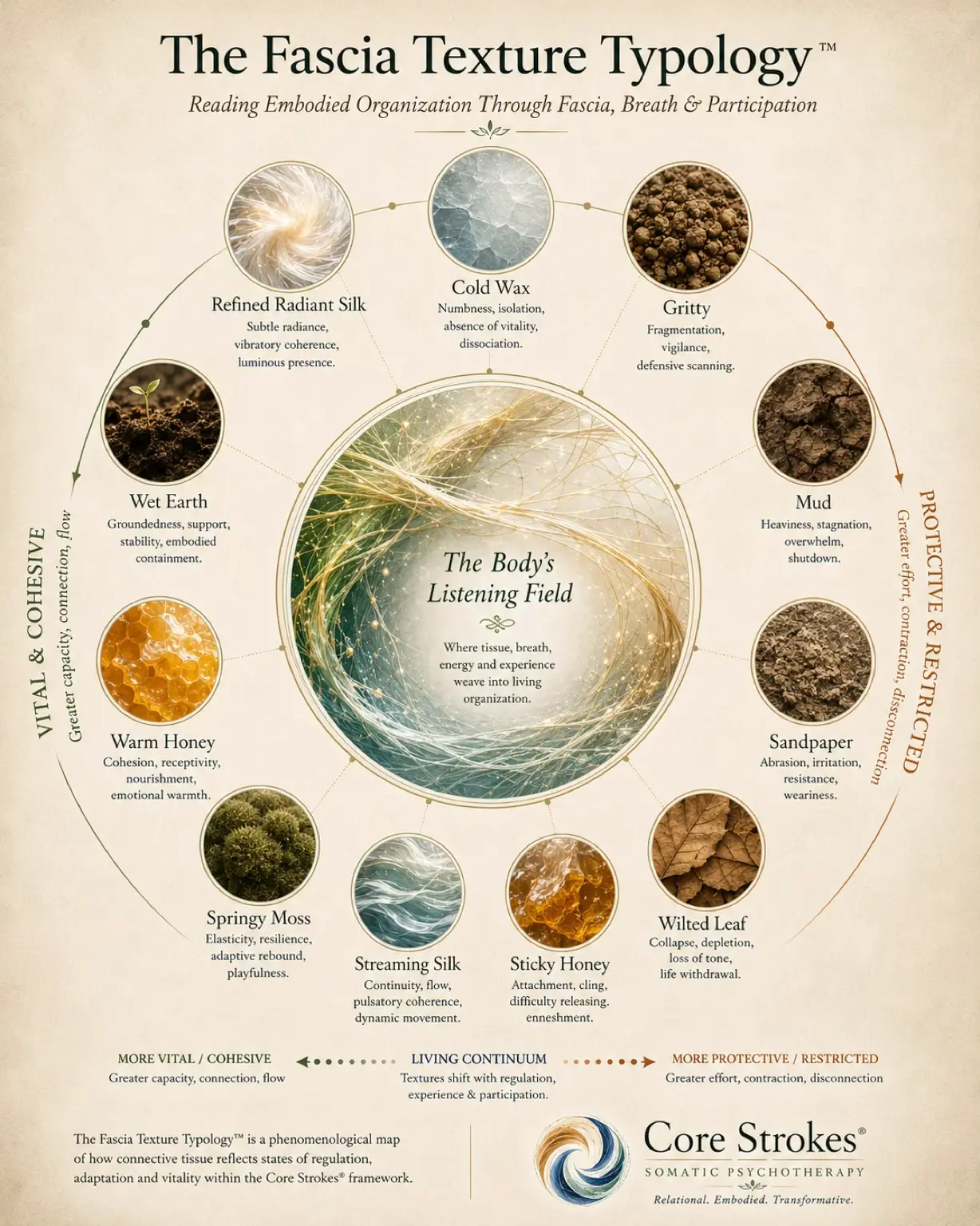
Within Core Strokes®, several recurring healthy textures may become perceptible phenomenologically through touch, movement, posture, energetic responsiveness, and relational contact.
- 🌾 Wet Earth reflects grounded density, embodied support, stability, and reliable containment.
- 🍯 Warm Honey expresses cohesive receptivity, emotional nourishment, and the organism’s capacity to soften into supportive contact.
- 🌿 Springy Moss reflects elastic resilience, playful rebound, adaptive responsiveness, and flexible regulation.
- 🕊 Streaming Silk expresses continuity of movement, energetic flow, pulsatory responsiveness, and coherent participation throughout the organism.
- ✨ Refined Radiant Silk reflects subtle vibratory coherence, luminous presence, and integrated embodied responsiveness.
These textures form a healthy continuum of embodied organization ranging from grounded support and cohesive receptivity toward increasing continuity, fluidity, pulsation, and energetic coherence.
They are not rigid stages or idealized achievements, but recurring expressions of healthy organismic participation that may shift continuously according to regulation, developmental history, emotional process, relational conditions, energetic organization, and life experience.
The Fascia Texture Typology™ therefore offers a phenomenological map of how living tissue may express regulation, vitality, adaptation, responsiveness, and embodied coherence throughout the organism.
Defensive Organization & Survival Adaptation
When the organism organizes around protection, interruption, fragmentation, collapse, chronic vigilance, or defensive adaptation, recurring survival-based textures may emerge.
Within Core Strokes®, these textures are understood not as pathological defects, but as adaptive embodied organizations that once supported continuity under overwhelming or insufficiently supported conditions.
Some textures express constriction, rigidity, fragmentation, numbness, adhesiveness, collapse, or chronic defensive holding. Others reflect diminished pulsation, restricted movement continuity, or impaired relational participation.
→ Explore the Distorted Fascial Textures →
Fascia, Trauma & Embodied Organization
Within embodied and trauma-informed perspectives, trauma is understood not solely as an external event or psychological memory, but as an ongoing disruption in the organism’s capacity for regulation, participation, coherence, integration, and adaptive responsiveness.
When overwhelming experiences cannot be sufficiently metabolized, breathing patterns may narrow or fragment, movement continuity may become restricted, autonomic flexibility may diminish, and fascia responsiveness may reorganize around protection, constriction, collapse, vigilance, or dissociation.
These adaptive organizations often become perceptible through tissue texture, posture, energetic tone, movement quality, emotional expression, and relational participation.
Within Core Strokes®, the Fascia Texture Typology™ helps recognize these embodied patterns not as fixed identities, but as living organizational responses that may gradually transform through therapeutic process.
Transformation does not involve mechanically forcing release, but supporting increasing regulation, grounding, movement continuity, emotional integration, relational safety, energetic participation, and embodied coherence.
As this occurs, texture itself often changes.
Breathing deepens.
Movement becomes more fluid.
Participation increases.
The organism gradually regains flexibility, vitality, and coherent responsiveness.
Beyond Defense — Soul Textures
Beyond both defensive organization and healthy regulation, Core Strokes® also recognizes emergent states of deeper embodied coherence known as Soul Textures™.
Soul Textures reflect qualities of embodied participation that emerge as defensive interruption softens and the organism reorganizes into increasing vitality, openness, energetic coherence, symbolic participation, and embodied presence.
Examples include Sacred Ground, Radiant Pulse, Crystalline Clarity, Reverent Hum, and Lucid Stillness.
These are not merely tissue qualities, but broader expressions of embodied coherence involving breath, fascia, movement, consciousness, relational participation, and energetic organization.
The Fascia Texture Typology™ therefore functions as a bridge — from survival organization toward healthy regulation, and eventually toward deeper embodied coherence and participatory aliveness.
Why the Fascia Texture Typology™ Matters
For practitioners, the Fascia Texture Typology™ offers a phenomenological and clinical compass for recognizing how the organism organizes itself through touch, movement, breathing, emotional process, energetic tone, and relational participation.
For clients, the typology often provides language for bodily experiences that may previously have felt confusing, fragmented, unnamed, or difficult to articulate.
The framework may help guide therapeutic pacing, touch quality, breath awareness, movement exploration, emotional integration, relational attunement, and regulation throughout therapeutic process.
Transformation becomes increasingly tangible and embodied rather than merely conceptual.
As breathing, movement, regulation, and relational participation reorganize, tissue responsiveness itself may gradually change.
The Core Strokes Framework
Core Strokes® integrates breath, fascia, relational presence, developmental psychology, and phenomenological observation into a unified framework of embodied organization and somatic psychotherapy.
Rather than approaching embodiment through isolated symptoms or fixed categories alone, Core Strokes® explores how human experience organizes through breath, movement, fascia, emotional regulation, energetic activation, and relational participation.
📘 Explore the foundational dimensions of the framework below:
→ The Organization of Embodied Participation
A phenomenological framework describing how continuity, coherence, permeability, metabolization, and defensive organization shape embodied and relational life.
→ Energetic Breath Cycle™
A developmental rhythm describing how breathing organizes safety, activation, emotional expression, surrender, and rest.
→ Fascia Texture Typology™
A phenomenological system recognizing recurring organizational tendencies through tissue responsiveness, movement, continuity, and regulation.
→ Soul Textures™
Qualitative states of embodied coherence emerging as defensive organizations gradually reorganize into integrated vitality and relational openness.
→Shadow Soul Textures™
Survival organizations that emerge when participation, continuity, and developmental integration become restricted or interrupted.
→ Neurofascial Transformation Process™
The therapeutic process through which breath continuity, fascial responsiveness, movement, and relational presence support lasting transformation.
→ Character Structures
Developmental adaptations that stabilize patterns of regulation.
🌿 These principles can also be explored directly through experiential practice within:
Closing Orientation
The Fascia Texture Typology™ ultimately invites a shift in how the body is perceived.
The organism is not approached as a machine to be corrected, but as a living participatory process continuously organizing protection, adaptation, expression, regulation, relationship, meaning, and transformation throughout embodied life itself.
Texture becomes part of the organism’s living expressive language.
By learning to perceive this language phenomenologically and relationally, practitioners and clients gradually recognize not only how the organism has protected itself, but also how it may reorganize toward increasing vitality, coherence, responsiveness, and participation within life.