Character Structures in Core Strokes®
Developmental Organization Through Breath, Fascia & Relationship
By Dirk Marivoet, Founder of Core Strokes® · Psychotherapist · Teacher · Author
Character Structures — Core Definition
Character Structures describe recurring developmental organizations through which the organism adapts to relational, emotional, energetic, and environmental conditions during early life.
Within Core Strokes®, character structures are understood as embodied organizational tendencies shaping breath, posture, fascia, movement, emotional regulation, energetic expression, relational participation, and autonomic responsiveness.
These adaptive organizations emerge as the organism attempts to preserve continuity, attachment, expression, protection, and coherence under varying developmental conditions.
Character therefore reflects organized adaptation rather than pathology.
Character as Embodied Development
Character is structured adaptation.
When developmental capacities for safety, receiving, agency, polarity, intensity, surrender, or rest could not fully stabilize within relationship, the organism reorganized in order to preserve continuity.
Over time, these adaptations consolidated through breathing patterns, fascial tone, posture, movement tendencies, emotional regulation, energetic positioning, and relational expectation.
Character is therefore not an abstract psychological construct.
It is developmental experience organized within embodied life.
Within Core Strokes®, character structures are understood as stabilized interruptions in breath continuity — embodied strategies through which the organism preserved protection, attachment, expression, and coherence under developmental constraint.
Seen in this way, character becomes understandable rather than diagnostic: a living record of how the organism negotiated vulnerability, contact, intensity, and safety across development.
Developmental Character Organization Map
Character organizations emerge where developmental movement along the Energetic Breath Cycle™ became restricted and stabilized.
Rather than representing rigid personality types, these structures reflect patterned solutions to interrupted developmental capacities — ways the organism maintained continuity when relational conditions did not adequately support development.
The map below traces these stabilizations across the Breath–Fascia continuum.
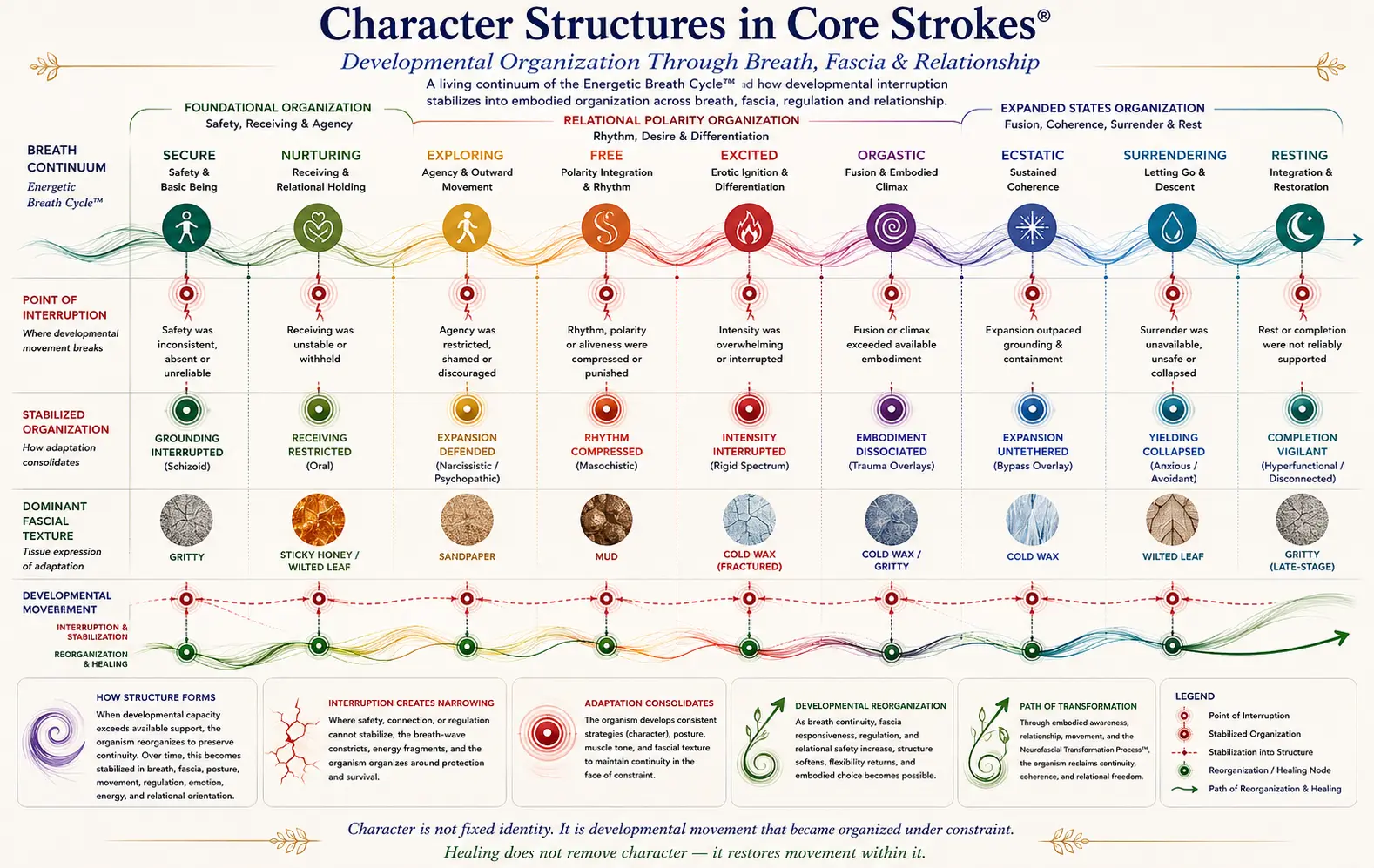
Foundational Organization
(Early stabilization of safety, receiving, and agency)
| Breath Phase | Core Developmental Need | Developmental Organization (Classical Reference) | Dominant Fascial Texture | Developmental Theme |
| Secure | Safety & basic being | Grounding Interrupted (Schizoid) | Gritty | Safety did not fully settle |
| Nurturing | Receiving & relational holding | Receiving Restricted (Oral) | Sticky Honey / Wilted Leaf | Receiving was unstable |
| Exploring | Agency & outward movement | Expansion Defended (Narcissistic / Psychopathic) | Sandpaper | Expansion defended vulnerability |
These organizations stabilize early capacities around safety, nourishment, and agency.
Relational Polarity Organization
(Stabilization of rhythm, desire, and differentiation)
| Breath Phase | Core Developmental Need | Developmental Organization (Classical Reference) | Dominant Fascial Texture |
| Free | Polarity integration & rhythm | Rhythm Compressed (Masochistic) | Mud |
| Excited | Erotic ignition & differentiation | Intensity Interrupted (Rigid spectrum) | Cold Wax (Fractured) |
Here, polarity and desire could not fully stabilize. Ambivalence or interruption became structural.
Integration & Transpersonal Organization
(Stabilization of fusion, coherence, surrender, and rest)
| Breath Phase | Core Developmental Need | Developmental Organization (Classical Reference) | Dominant Fascial Texture |
| Orgastic | Fusion & embodied climax | Embodiment Dissociated (Trauma overlays) | Cold Wax / Gritty |
| Ecstatic | Sustained coherence | Expansion Untethered (Bypass overlay) | Cold Wax (False Light) |
| Surrendering | Letting go & descent | Yielding Collapsed (Anxious / Avoidant) | Wilted Leaf |
| Resting | Integration & restoration | Completion Vigilant (Hyperfunctional / Disconnected) | Gritty (late-stage) |
At these later stages, intensity, surrender, or openness exceeded available integration. Dissociation, vigilance, inflation, collapse, or defensive compensation gradually replaced continuity.
Developmental Reorganization Principle
Read vertically, the map shows how developmental interruption stabilizes into structure.
Read developmentally, it reveals how structure itself can gradually reopen as breath continuity, fascia responsiveness, regulation, and relational safety increase.
Character is not fixed identity.
It is developmental movement that became organized under constraint.
The body does not invent character arbitrarily.
It reorganizes around what was possible.
Where developmental capacity exceeded available support, structure formed.
Where safety was inconsistent, protection stabilized.
Where intensity overwhelmed integration, continuity narrowed.
Healing does not remove character.
It restores movement within it.
As breath becomes more continuous and fascia more responsive, organization gradually softens.
Protection becomes choice.
Stabilization becomes flexibility.
Character remains — but no longer as necessity.
It becomes capacity.
Character as Relational Organization
Every character organization reflects a particular way of regulating contact, intensity, grounding, vulnerability, expression, dependency, differentiation, and energetic charge.
Character forms where breath organization, fascia responsiveness, autonomic regulation, developmental experience, and relational adaptation intersect.
Different structures therefore express different ways of approaching closeness, tolerating intensity, receiving support, expressing need, regulating activation, or maintaining continuity within relationship.
Character is ultimately relational organization embodied through the bodymind system.
Structure Is Not Identity
Within Core Strokes®, character structures are not viewed as rigid personality categories.
They are dynamic developmental tendencies that may intensify under stress, soften under safety, and gradually reorganize through embodied therapeutic process.
The aim is not to dismantle character, but to restore flexibility, continuity, responsiveness, and embodied choice within structure itself.
As breathing regains rhythm, fascia regains elasticity, and relational safety increases, organization becomes less defensive and more adaptive.
From Adaptation to Embodied Choice
Core Strokes® does not aim to eliminate character structure.
The aim is to restore movement within organization.
As breathing regains flexibility, fascia regains continuity, intensity becomes more tolerable, and relationship becomes increasingly safe, character gradually shifts from survival necessity toward increasing embodied choice, flexibility, and relational freedom.
Defensive organization no longer dominates participation.
Structure becomes more fluid, responsive, conscious, and relationally alive.
Relationship to Distorted Fascia Textures™
Distorted Fascial Textures™ describe how developmental adaptation becomes organized structurally within tissue responsiveness, movement continuity, and embodied protection.
Character Structures describe how these same adaptations stabilize relationally through posture, emotional regulation, defensive strategy, and participation within contact.
One dimension is primarily tactile and structural.
The other is primarily relational and organizational.
Both reflect different expressions of the same developmental process.
Relationship to Shadow Soul Textures™
Where Character Structures describe developmental organization, Shadow Soul Textures™ describe the symbolic and experiential field that constellates around that organization.
Character expresses how adaptation functions.
Shadow expresses how adaptation imagines, experiences, and narrates itself.
Structural and symbolic dimensions are therefore complementary rather than opposing perspectives within embodied process.
Developmental Restoration
Character structures do not disappear.
They reorganize progressively along the Healthy Texture Continuum™.
Where fragmentation once stabilized identity, coherence may gradually emerge. Where inflation once defended vulnerability, authentic presence may unfold. Where collapse once ensured survival, grounded vitality may slowly return.
Healing does not erase developmental organization.
It restores movement, flexibility, continuity, and participation within it.
Closing Orientation
Character structures are not obstacles standing outside life.
They are life organized under developmental conditions that once required protection, adaptation, restraint, vigilance, compensation, or interruption in order to preserve continuity.
What once formed through necessity may gradually soften through regulation, relational safety, embodied awareness, movement continuity, and emotional integration.
The organism does not lose its history.
It regains flexibility within it.
Healing therefore does not erase character.
It restores the capacity to participate more freely, coherently, and responsively within embodied life itself.
The Core Strokes Framework
Core Strokes® integrates breath, fascia, relational presence, developmental psychology, and phenomenological observation into a unified framework of embodied organization and somatic psychotherapy.
Rather than approaching embodiment through isolated symptoms or fixed categories alone, Core Strokes® explores how human experience organizes through breath, movement, fascia, emotional regulation, energetic activation, and relational participation.
📘 Explore the foundational dimensions of the framework below:
→ The Organization of Embodied Participation
A phenomenological framework describing how continuity, coherence, permeability, metabolization, and defensive organization shape embodied and relational life.
→ Energetic Breath Cycle™
A developmental rhythm describing how breathing organizes safety, activation, emotional expression, surrender, and rest.
→ Fascia Texture Typology™
A phenomenological system recognizing recurring organizational tendencies through tissue responsiveness, movement, continuity, and regulation.
→ Soul Textures™
Qualitative states of embodied coherence emerging as defensive organizations gradually reorganize into integrated vitality and relational openness.
→Shadow Soul Textures™
Survival organizations that emerge when participation, continuity, and developmental integration become restricted or interrupted.
→ Neurofascial Transformation Process™
The therapeutic process through which breath continuity, fascial responsiveness, movement, and relational presence support lasting transformation.
→ Character Structures
Developmental adaptations that stabilize patterns of regulation.
🌿 These principles can also be explored directly through experiential practice within: