The Memory of Fascia
How the body remembers what the mind may never have learned to name
Written by Dirk Marivoet, founder of Core Strokes®
This essay offers an embodied perspective on how experience is held and reorganized through fascia, breath, and relational presence.
Introduction
The body remembers long before the mind can explain.
Not as images, not as stories, and not as words we can easily retrieve—but as ways of holding, breathing, yielding, and protecting. Much of what shapes us is never consciously remembered, yet it continues to organize how we inhabit ourselves and meet the world.
In Core Strokes®, this kind of remembering is approached not as something to be uncovered or interpreted, but as something already present—continuously expressing itself through tissue tone, breath rhythm, and subtle shifts in contact. The body does not wait to be understood. It waits to be met.
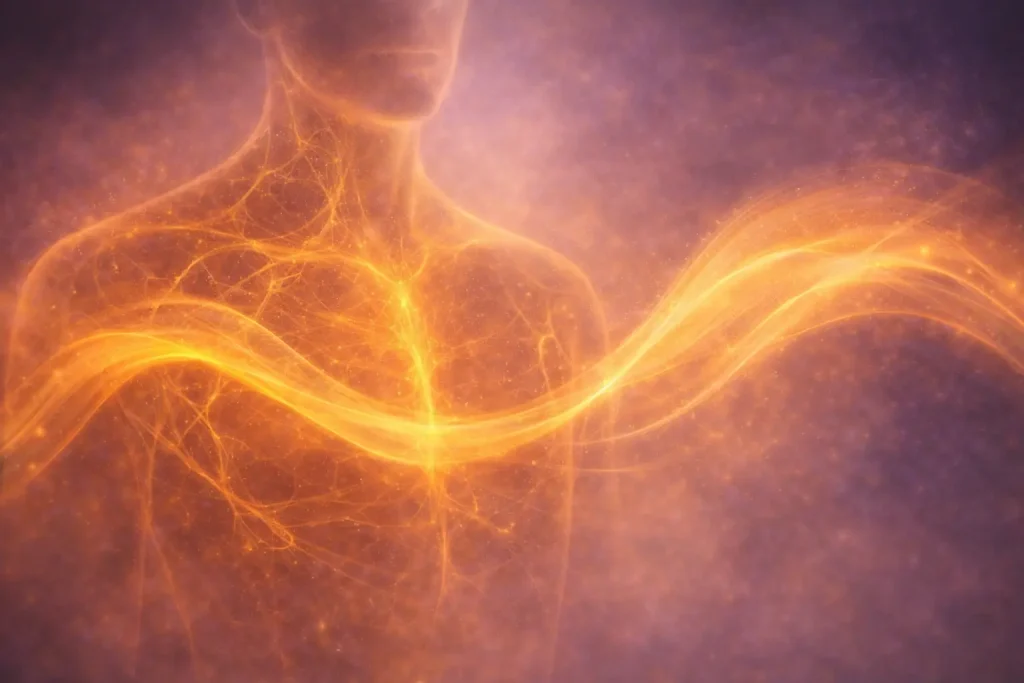
A visual representation of how breath movement and relational experience shape the living network of fascia within the body.
Memory Beyond Story
In Core Strokes®, fascia is understood as more than connective tissue.
It is a living, sensing medium through which the body organizes continuity, protection, and relationship. Richly innervated and responsive, fascia adapts to breath, movement, touch, and emotional tone. Over time, it stabilizes patterns of holding, yielding, or tension that reflect how the organism has learned to remain intact within its environment.
In this sense, fascia is structural and experiential. It participates in how meaning is lived in the body—often long before that meaning can be thought or spoken.
When people think of memory, they often imagine recall: events remembered, images replayed, histories told. Yet much of what shapes us lies outside this kind of remembering. Early experiences, preverbal states, and relational atmospheres are often never encoded as conscious narrative. Still, they shape how we stand, breathe, reach, and protect ourselves.
This is where fascia becomes central.
Fascia is the vast connective tissue network that envelops and interpenetrates muscles, organs, nerves, and bones. It is continuous throughout the body, richly innervated, and deeply responsive. Fascia responds continuously to breath, movement, touch, and relational tone.
Over time, these adaptations stabilize. What was once a momentary response becomes a familiar pattern. The tissue learns what is required to remain intact.
This is not memory as storage.
It is memory as organization.
Fascia as Lived History
Fascia does not “hold” memories like an archive. It becomes shaped by repeated conditions: pressure, effort, holding, collapse, bracing, withdrawal, reaching. These conditions may arise from physical strain, emotional stress, developmental interruption, or relational misattunement.
When safety is present, fascia tends toward elasticity, hydration, and responsiveness. When safety is compromised, the tissue adapts. It may densify to contain overwhelming charge, tighten to protect vulnerable areas, or soften and collapse when mobilization no longer feels possible.
From this perspective, what we often call “tension” is not a mistake. It is an intelligent response that once served a purpose.
Fascia remembers how the organism learned to survive.
Development, Relationship, and Tissue
Many of these adaptations form early. Long before a child can speak, the body learns through contact: how it is held, how it is soothed, how excitement is met, how distress is regulated—or left alone.
These experiences are not stored as ideas. They are woven into posture, breath patterns, and tissue tone. The body learns whether it is safe to expand, whether reaching will be met, whether yielding is allowed, whether holding on is necessary.
Later in life, similar patterns may be reinforced through trauma, chronic stress, injury, or relational strain. Fascia continuously adapts to what is asked of it.
In this sense, fascia carries a developmental and relational history, even when the person has no conscious access to it.
Trauma as Adaptation, not Pathology
From a Core Strokes perspective, trauma is not defined primarily by what happened, but by how the body learned to remain in relationship to life when conditions exceeded its capacity.
Fascial adaptations associated with trauma are not viewed as symptoms to be eliminated. They are understood as relational solutions—ways the organism preserved coherence when movement, expression, or contact were no longer safely available.
Dense, braced tissue may reflect an early necessity to hold oneself together. Collapsed or yielding tissue may speak of moments when effort no longer made sense. Fragmented or dissociated textures often arise when continuity of contact—internal or relational—could not be maintained.
In Core Strokes, these adaptations are not approached through correction or release. They are approached through recognition. The practitioner does not ask the tissue to change. Instead, the tissue is met as meaningful, intelligent, and responsive to the conditions that shaped it.
This meeting is not silent, nor is it interpretive. As touch tracks breath and tone, language may emerge as quiet acknowledgment—“Something here learned to stay very still,” or “This holding makes sense.” Such words do not analyze the past. They orient the present. They let the tissue know it is no longer alone in carrying what it learned.
It is within this relational field—where sensation, breath, and meaning are held simultaneously—that traumatic adaptations begin to soften. Not because they are forced to, but because the conditions that required them are no longer fully present.
Listening to the Body Through Touch and Breath
In Core Strokes, working with the memory of fascia begins with listening rather than fixing.
Through slow, precise, and responsive touch, the practitioner meets the tissue as it is. Breath is invited, not imposed. Movement is supported, not demanded. The body is given the conditions it needs to complete unfinished processes at its own pace.
As the tissue feels met rather than managed, new options emerge: softening where holding was necessary, differentiation where fusion dominated, movement where immobility once felt safer.
This is how memory transforms—not through explanation, but through experience.
Remembering Rorward
The memory of fascia is not something to be uncovered or resolved. It is something that has been waiting to be met.
When tissue is approached with respect for its history and curiosity for its meaning, it no longer needs to defend itself in the same way. Breath finds new pathways. Sensation regains continuity. The body discovers that holding is no longer the only option.
In this sense, healing is not a return to the past, nor the achievement of a new ideal state. It is a relational event in the present moment—one in which the body recognizes that it is now accompanied by attention, language, and touch that do not demand change.
What emerges then is not simply release, but orientation. The organism remembers—not what happened—but that it can now move, feel, and respond differently. And this remembering unfolds forward, into lived life, one moment of recognition at a time.
Breath and the Continuity of Fascial Memory
Fascia does not exist in isolation. It is continuously shaped and animated by breath.
Breath gives rhythm to holding and yielding. It modulates how charge builds, how it is contained, and how it resolves. When breath is free, fascial organization remains fluid and responsive. When breath is restricted, interrupted, or fragmented, fascial patterns tend to stabilize around protection and control.
To understand the memory of fascia, then, we must also understand breath—not as a technique, but as a living cycle through which energy, sensation, and meaning move. This cycle reveals how the body engages with life moment by moment, and how it adapts when engagement becomes difficult or unsafe.
This is the focus of the next exploration: Breath as a Cycle of Energy, and its role as a primary organizer of bodily experience.
This reflection continues with an exploration of breath as a living cycle of energy.
Part of the Core Strokes Essays & Foundations Series
These essays introduce key ideas that form the conceptual foundation of the Core Strokes® framework.
They explore how breath, fascia, relational presence, and developmental organization shape human experience in the body.
Continue exploring the Core Strokes Foundations:
Published Essays and articles by Dirk Marivoet
Development & Integration Hub
- Development & Integration
Trauma as Restricted Development — how overwhelm limits access to safety, contact, and vitality
Pelvic-Heart Integration— restoring the vertical axis between instinct, emotion, and relational expression
If you are beginning trauma recovery:
Core Strokes Training Pathways
Frequently Asked Questions
“Core Strokes® emerged through decades of clinical, developmental, and phenomenological exploration into the organization of embodied participation.”