The Lineage of Core Strokes®
Breath, Fascia, Relationship, and the Evolution of Embodied Psychotherapy
Written by Dirk Marivoet, founder of Core Strokes®
The Lineage of Core Strokes® — Core Definition
Core Strokes® belongs to the evolving lineage of somatic psychotherapy and bodymind integration approaches that understand human experience as embodied through breath, movement, fascia, emotional regulation, energetic organization, and relational participation.
The framework integrates classical Reichian and post-Reichian body psychotherapy traditions with developmental psychology, fascia-informed observation, trauma therapy, phenomenology, nervous system regulation, and transpersonal perspectives on healing and consciousness.
Rather than functioning as a single technique or isolated modality, Core Strokes® represents a developmental synthesis emerging at the intersection of body psychotherapy, relational regulation, fascial continuity, and embodied transformation.
The Evolution of Body Psychotherapy
Long before contemporary trauma theory and nervous system regulation became widely discussed, body psychotherapists were already exploring how emotional life becomes embodied through posture, breath, movement, muscular tension, energetic expression, and relational contact.
The origins of modern body psychotherapy are often traced to the work of Wilhelm Reich, who recognized that psychological defense is expressed physically through what he called character armor — chronic patterns of muscular tension, emotional restriction, breathing inhibition, and energetic holding.
Reich understood that breathing, emotional expression, sexuality, vitality, and psychological organization were inseparable.
This insight became foundational for multiple generations of somatic psychotherapy approaches.
Core Strokes® continues within this lineage while expanding it through contemporary understandings of trauma, fascia, developmental regulation, relational embodiment, and phenomenological organization.
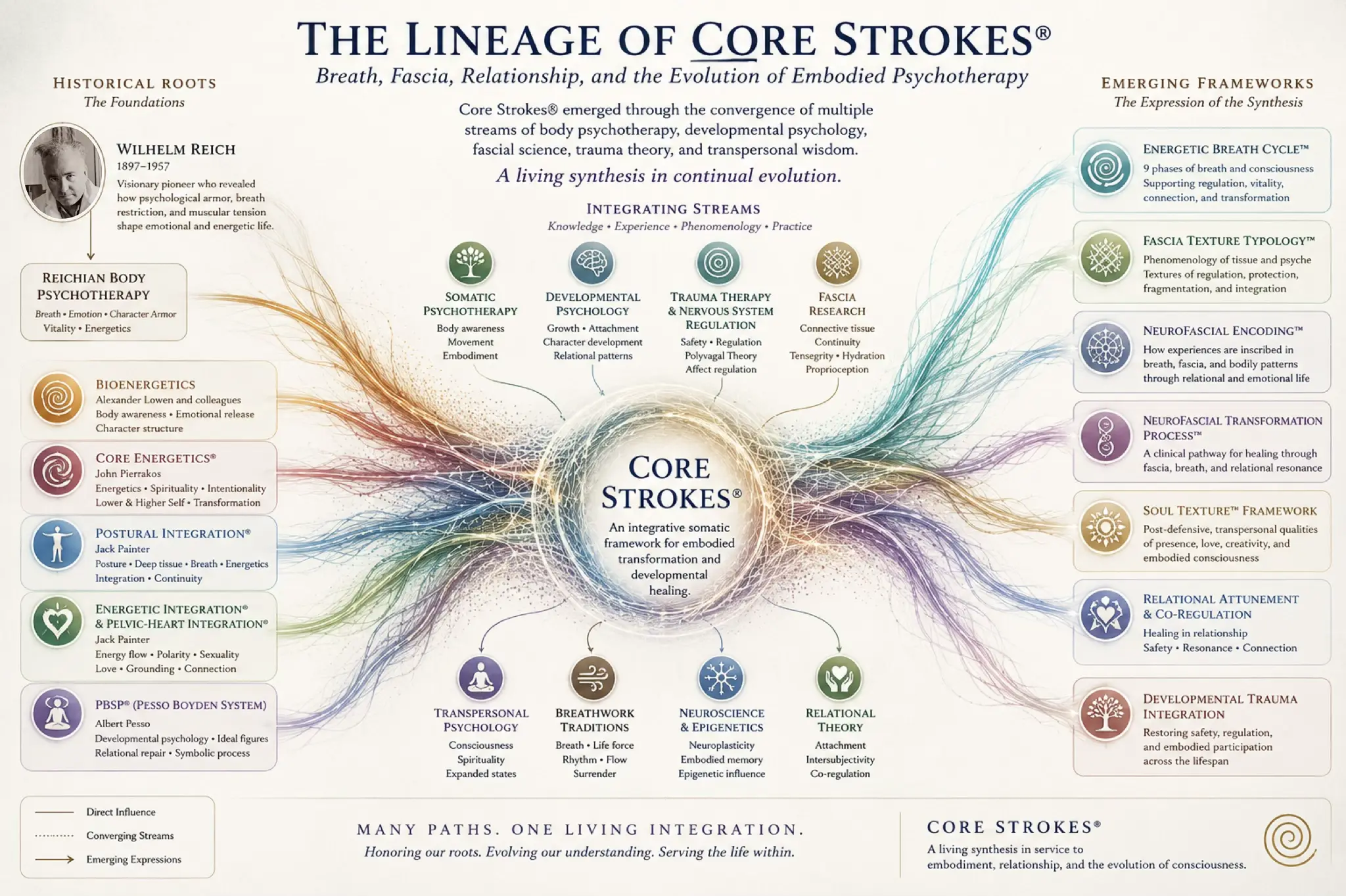
Diagram showing the lineage of Core Strokes® through Reichian body psychotherapy, fascia research, trauma therapy, developmental psychology, and somatic psychotherapy.
Reichian and Post-Reichian Foundations
Core Strokes® draws deeply from Reichian and post-Reichian traditions that explored the body not merely anatomically, but as a living process shaped by emotional history, energetic organization, and relational experience.
Important influences include Bioenergetics, Core Energetics®, Postural Integration®, Energetic Integration®, Pelvic-Heart Integration®, Radix, Hakomi, Bodynamic, Somatic Experiencing®, and PBSP® (Pesso Boyden System Psychomotor).
Together, these approaches contributed essential understandings of breath and emotional regulation, developmental adaptation, character structure, grounding, embodiment, energetic expression, trauma organization, movement, posture, and relational attunement.
Core Strokes® does not replicate any single lineage, but emerges through dialogue among them.
Jack Painter and Bodymind Integration
One of the deepest formative influences on Core Strokes® was the work of Jack Painter.
Painter developed Postural Integration®, Energetic Integration®, and Pelvic-Heart Integration® as integrative bodymind approaches combining deep tissue work, breath, emotional process, energetic awareness, and developmental understanding.
Within these methods, the body was approached as structurally organized, emotionally expressive, energetically alive, developmentally shaped, and relationally responsive.
Painter’s work strongly emphasized continuity of embodied experience — the organism’s capacity to remain connected across breath, sensation, movement, emotion, and relationship without fragmentation or defensive interruption.
He also emphasized energetic flow, emotional authenticity, embodied presence, and the integration of sexuality, love, and consciousness.
These principles profoundly shaped Dirk Marivoet’s clinical and teaching work over decades of practice and international training.
John Pierrakos and Core Energetics®
Another major influence came through the work of John Pierrakos, founder of Core Energetics® and collaborator of Wilhelm Reich and Alexander Lowen.
Core Energetics expanded Reichian body psychotherapy by integrating emotional process work, energetic awareness, spirituality, consciousness development, intentionality, and transpersonal dimensions of healing.
Pierrakos introduced concepts influenced by the Pathwork teachings, including:
- the Mask
- the Lower Self
- the Higher Self
- energetic intentionality
- soul-centered transformation
Core Energetics® therefore expanded Reichian body psychotherapy beyond emotional discharge alone, integrating consciousness development, relational truth, and embodied transformation.
These perspectives later profoundly influenced the development of Soul Textures™, Shadow Soul Textures™, relational sovereignty, embodied polarity, and Core Strokes® approaches to developmental and transpersonal integration.
Al Pesso and Developmental Repair
The work of Albert Pesso (PBSP® — Pesso Boyden System Psychomotor) contributed important developmental and relational insights.
PBSP explored how unmet developmental needs shape procedural memory, emotional organization, relational expectation, and embodied behavior.
Particularly influential within Core Strokes® were developmental sequencing, symbolic process, ideal figures, relational repair, and the body’s role in emotional memory.
This developmental orientation later became central within Core Strokes® approaches to attachment trauma, developmental trauma, relational regulation, and embodied participation.
These themes continue to shape the trauma-oriented dimensions of Core Strokes®, particularly in relation to developmental repair, embodied regulation, and relational healing.
→ Trauma & Development
→ Attachment Trauma and Embodied Regulation
→ Relationship as a Developmental Capacity
Fascia, Phenomenology, and Embodied Organization
While many earlier body psychotherapy traditions focused primarily on muscular tension and energetic discharge, Core Strokes® increasingly evolved toward a more nuanced exploration of fascia and embodied continuity.
Contemporary fascia research contributed important understandings of connective tissue responsiveness, proprioception, interoception, hydration and elasticity, force transmission, nervous system interaction, and whole-body continuity.
At the same time, phenomenological observation remained central.
Rather than reducing experience to anatomy or diagnosis, Core Strokes® explores how organization becomes visible through breath propagation, tissue responsiveness, movement quality, emotional regulation, energetic continuity, and relational participation.
This eventually led to the development of the Fascia Texture Typology™, Neurofascial Encoding™, and the Neurofascial Transformation Process™.
Developmental Trauma and Nervous System Regulation
As trauma theory evolved, Core Strokes® increasingly integrated contemporary understandings of developmental trauma, attachment, autonomic regulation, Polyvagal Theory, affect regulation, relational neuroscience, and neurobiology.
These perspectives helped articulate how trauma reorganizes breathing, fascia, emotional continuity, relational participation, and embodied safety.
Yet Core Strokes® does not reduce trauma solely to nervous system dysregulation.
The framework approaches trauma developmentally and phenomenologically — as a reorganization of embodied participation affecting the organism’s capacity to remain coherent, emotionally metabolizing, relationally open, and physiologically regulated.
The Emergence of Core Strokes®
Through decades of clinical work, teaching, supervision, and phenomenological exploration, these multiple streams gradually converged into the Core Strokes® framework.
Core Strokes® gradually integrated the Energetic Breath Cycle™, the Fascia Texture Typology™, Neurofascial Encoding™, and the Neurofascial Transformation Process™ into a broader developmental framework linking breath, fascia, movement, energetic organization, relational regulation, trauma-informed somatic psychotherapy, embodied polarity, pelvic–heart integration, and transpersonal development.
The work approaches human beings not as collections of symptoms, but as living developmental organizations continuously negotiating safety, openness, continuity, differentiation, expression, surrender, and participation within life.
Conferences, Teaching & Publications
Dirk Marivoet has taught internationally for decades within the fields of body psychotherapy, bodymind integration, developmental trauma work, and consciousness-oriented somatic practice.
His work has been presented through international training programs, professional conferences, supervision programs, workshops, and seminars across Europe and beyond.
Articles and theoretical contributions related to Core Strokes®, fascia, breath organization, and embodied transformation have appeared in professional publications and ongoing dialogues within the somatic psychotherapy field.
The work continues to evolve through clinical practice, scientific dialogue, teaching, and embodied research.
A Living and Evolving Lineage
Core Strokes® does not position itself outside the traditions that preceded it.
It belongs to an evolving lineage of somatic psychotherapy and bodymind integration while also contributing new maps, language, and phenomenological frameworks.
The work continues to evolve through clinical practice, teaching, supervision, scientific dialogue, and embodied exploration.
At its heart remains a simple understanding:
Breath, fascia, movement, emotional life, consciousness, and relationship are not separate systems.
They are interwoven expressions of embodied life itself.
As defensive organization softens, the organism gradually requires less effort to remain participatory, relationally open, and developmentally alive.
FAQ — The Lineage of Core Strokes®
Explore Related Core Strokes® Concepts
→ The Organisation of Embodied Participation
The phenomenological foundation of Core Strokes®, describing how continuity, coherence, permeability, metabolisation, adaptive organisation, and relational geometry organise embodied life.
→ Defensive Organisation
A protective form of Adaptive Organisation in which participation becomes organised around experienced or anticipated threat, overwhelm, disruption, or loss of continuity.
→ Living Participation Observation System™ (LPOS™)
The observational methodology through which embodied and relational expressions are described before provisional organisational interpretations are developed.
→ Relational Field and Relational Geometry
The Relational Field is the embodied space of interaction. Relational Geometry describes how proximity, distance, boundaries, orientation, reciprocity, and differentiation are organised within it.
→ Energetic Breath Cycle™
A developmental map describing how breathing organises grounding, activation, emotional expression, surrender, and restoration throughout the organism.
→ Fascia Texture Typology™
A phenomenological framework for describing recurring tactile configurations and considering their possible organisational significance without treating them as diagnoses, personality types, or records of developmental history.
→ Neurofascial Encoding™
A proposed research framework exploring possible relationships among repeated participation, neural plasticity, behaviour, physiological regulation, movement, mechanical loading, and connective-tissue remodelling.
→ Neurofascial Transformation Process™
The therapeutic process through which breathing, fascia, movement, therapeutic touch and relational participation can contribute to embodied reorganisation and therapeutic transformation.
→ Therapeutic Touch
An embodied and relational practice guided by consent, clinical judgement, perceptual attention, and responsiveness rather than by mechanical intervention or predetermined interpretation.
→ Character Structures
A framework for exploring recurring developmental organisations of bodily, emotional, behavioural, and relational participation without reducing people to fixed types.
→ Soul Organisation, Soul Coherence, and Soul Textures ™
Interrelated dimensions of Core Strokes® concerned with authenticity, meaning, inner resonance, embodied presence, and relational participation. Soul Organisation names the wider qualitative domain; Soul Coherence describes increasing integrity among dimensions of experience; Soul Textures™ describe qualities of coherent participation; and Shadow Soul Textures™ describe qualitative expressions of protective, constrained, fragmented, or compensatory Adaptive Organisation.
These principles can also be explored directly through experiential practice within:
“Core Strokes® emerged through decades of clinical, developmental, and phenomenological exploration into the organization of embodied participation.”
— Dirk Marivoet