Shadow Soul Textures in Core Strokes®
The Distorted Expressions of the Breath Spiral
By Dirk Marivoet, Founder of Core Strokes® · Body Psychotherapist · Somatic Researcher · Author
What are Shadow Soul Textures?
Shadow Soul Textures describe recurring survival organizations that emerge when continuity, participation, developmental integration, or relational openness become restricted, fragmented, distorted, or organized primarily around protection.
Within Core Strokes®, Shadow Soul Textures are understood not as pathologies, defects, or fixed identities, but as adaptive expressions of reduced coherence through which the organism attempts to preserve safety, attachment, vitality, continuity, or meaning under difficult developmental and relational conditions.
They become visible through characteristic patterns of breath, fascial tone, movement, emotional regulation, energetic responsiveness, and relational participation. As such, they provide a phenomenological language for recognizing how embodied life organizes when participation becomes constrained by survival adaptation.
Shadow Soul Textures represent adaptive survival configurations that arise when phases of the Energetic Breath Cycle™ cannot fully complete. Each distortion reflects a particular way breath, fascia, polarity, and relational organization stabilize under overwhelming developmental conditions.
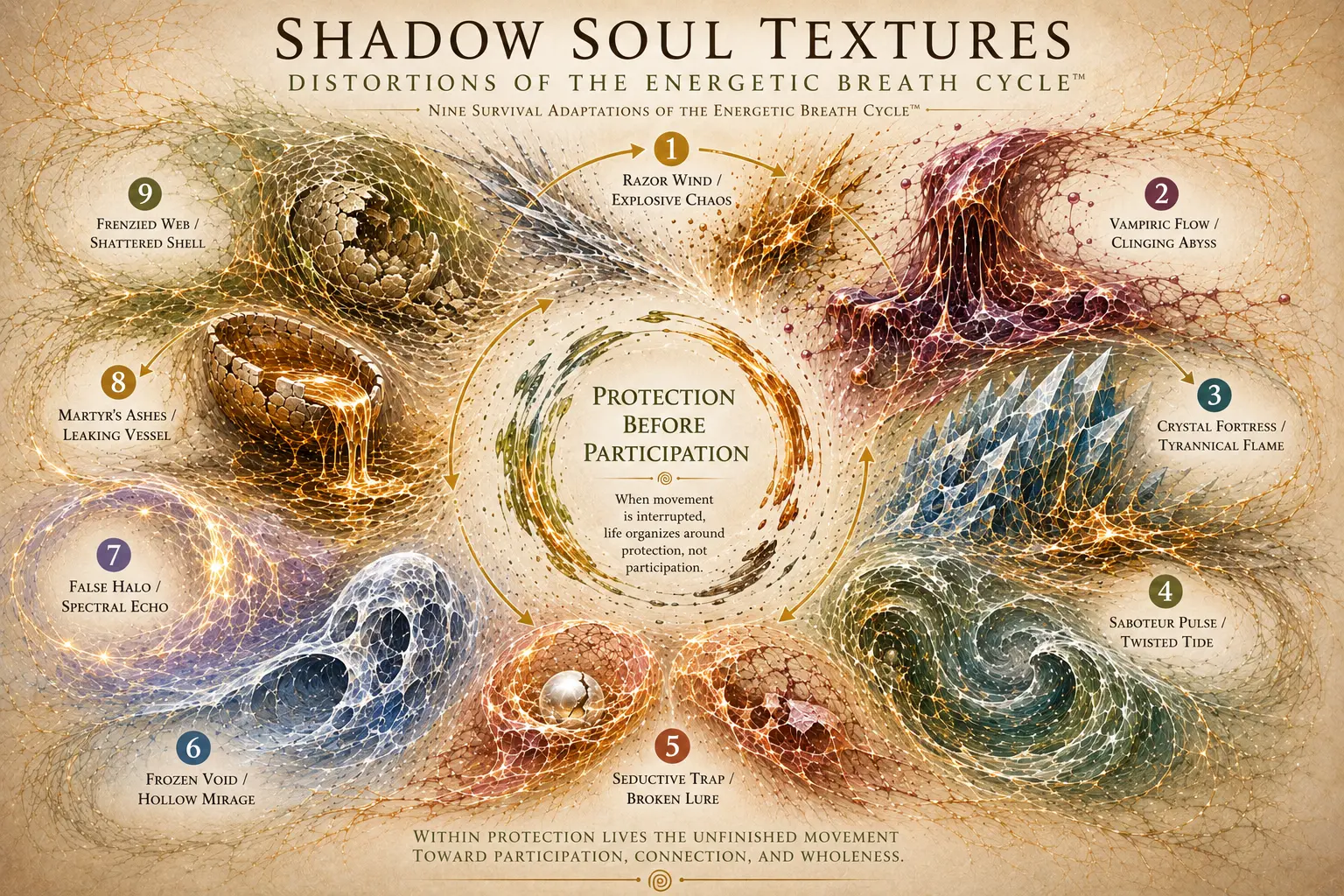
Orientation — When Participation Becomes Organized Around Survival
Human development does not unfold under ideal conditions.
The organism continuously encounters experiences that challenge its capacity to remain coherent. Some of these challenges support growth. Others exceed available resources and require adaptation.
When support is unreliable, nourishment inconsistent, exploration unsafe, intimacy overwhelming, awareness disembodied, or surrender associated with loss, participation reorganizes around survival.
Breath changes, fascia adapts, perception narrows, and relationship becomes increasingly organized around protection.
These adaptations are not mistakes. They are intelligent attempts to preserve continuity under difficult circumstances.
Shadow Soul Textures describe the recurring forms these adaptations take once they stabilize.
If Soul Textures describe how life organizes when coherence deepens, Shadow Soul Textures describe how life organizes when continuity becomes restricted, participation narrows, and protection begins to dominate organization.
Together they form a developmental continuum that extends from survival adaptation toward increasing integration, vitality, relational openness, and meaningful participation.
Shadow and Soul — Two Expressions of the Same Life Movement
Shadow Soul Textures and Soul Textures are not separate systems.
Each Shadow Soul Texture reflects a distortion of the same developmental movement that, under more supportive conditions, may mature into a Soul Texture.
The movement toward support may become fragmented into Razor Wind or overwhelmed into Explosive Chaos.
The movement toward intimacy may become Frozen Void or Hollow Mirage.
The movement toward awareness may become False Halo or Spectral Echo.
The underlying developmental impulse remains the same. What changes is how the organism organizes participation.
Shadow Soul Textures therefore do not represent the absence of growth. They reveal where growth became interrupted, distorted, or organized around protection.
For this reason, every Shadow Soul Texture simultaneously points toward a corresponding possibility for transformation.
Reading Survival Through the Body
Shadow Soul Textures provide practitioners with a language for recognizing how survival organization becomes visible in lived experience. Rather than focusing primarily on symptoms, diagnoses, or personality categories, the framework attends to the qualitative ways an organism breathes, moves, regulates emotion, enters relationship, and participates in life. These patterns can often be sensed in the rhythm of breathing, the responsiveness of fascia, the quality of gaze and contact, characteristic postures, emotional tendencies, and recurring relational strategies. The emphasis is not on categorizing people but on understanding how protective organization has taken shape—and how greater coherence might emerge.
The Nine Shadow Soul Texture Pairs
Each phase of the Energetic Breath Cycle™ is associated with two complementary Shadow Soul Textures. These paired textures represent different adaptive responses to the same developmental challenge. One may emerge through withdrawal, fragmentation, collapse, or disconnection, while the other develops through compensation, overactivation, idealization, inflation, or excessive engagement.
Together, the nine pairs form a map of survival organization that parallels the Soul Texture continuum.
From Shadow to Soul
How developmental interruption reorganizes into coherence
Each Shadow Soul Texture corresponds to a Soul Texture that reflects the healthy expression of the same developmental movement.
The following table maps the relationship between Breath Phases, Soul Textures, and their Shadow expressions.
It illustrates how developmental interruption may stabilize into adaptive survival patterns, and how therapeutic transformation supports the gradual restoration of the original developmental movement.
Comparative Map of the Breath Spiral
| Breath Phase | Soul Texture | Shadow Soul Textures | Core Distortion Pattern | Restorative Movement |
| Secure Breath | Sacred Ground | Razor Wind Explosive Chaos | Safety fractured | Re-establish landing and containment |
| Nurturing Breath | Quiet Flame | Vampiric Flow Clinging Abyss | Receiving distorted | Restore cohesive inward flow |
| Exploring Breath | Emerging Spark | Crystal Fortress Tyrannical Flame | Autonomy armored | Reclaim elastic outward reach |
| Free Breath | Oscillating Veil | Saboteur Pulse Twisted Tide | Rhythm conflicted | Reintegrate expansion–contraction harmony |
| Excited Breath | Radiant Pulse | Seductive Trap Broken Lure | Erotic charge destabilized | Ground excitement in embodied innocence |
| Orgastic Breath | Streaming Union | Frozen Void Hollow Mirage | Fusion overwhelmed | Restore pulsation and embodied merging |
| Ecstatic Breath | Crystalline Clarity | False Halo Spectral Echo | Transcendence detached from embodiment | Re-root luminosity in density |
| Surrendering Breath | Reverent Hum | Martyr’s Ashes Leaking Vessel | Yielding becomes depletion | Contain energy while softening |
| Resting Breath | Lucid Stillness | Frenzied Web Shattered Shell | Integration unstable | Stabilize coherent rest |
Therapeutic transformation does not seek to eliminate these adaptations, nor to oppose the intelligence they contain. Each Shadow Soul Texture represents an attempt to preserve continuity under conditions that challenged coherent participation.
As support, regulation, relational safety, and embodied awareness deepen, survival organization may gradually reorganize into increasing coherence. In this sense, the movement from Shadow to Soul is not a movement from pathology to health, nor from bad to good. It is a movement from protection toward participation, from adaptation toward integration, and from defensive organization toward a fuller expression of life.
For practitioners interested in the deeper organizational dynamics of the Shadow Soul Textures, the following clinical map summarizes characteristic fascial qualities, polarity tensions, and existential themes frequently associated with each pattern.
Clinical Organization Map (Advanced)
Open Clinical Map
| Shadow Texture | Fascial Tone | Polarity Split | Core Existential Wish |
| Razor Wind | Brittle / Fragmented | Safety vs Existence | “Let me exist without shattering.” |
| Vampiric Flow | Sticky / Adhesive | Need vs Autonomy | “Do not withdraw from me.” |
| Crystal Fortress | Braced / Rigid | Autonomy vs Vulnerability | “Let me move without invasion.” |
| Saboteur Pulse | Conflicted / Oscillating | Freedom vs Attachment | “Let me move without losing love.” |
| Seductive Trap | Tensile / Performative | Desire vs Shame | “See me without rejecting me.” |
| Frozen Void | Numb / Dissociated | Fusion vs Identity | “Let me merge without disappearing.” |
| False Halo | Upward / Disembodied | Spirit vs Body | “Let my radiance be real.” |
| Martyr’s Ashes | Drained / Overextended | Giving vs Selfhood | “Let me rest without vanishing.” |
| Frenzied Web | Disorganized / Unsettled | Stillness vs Anxiety | “Let me belong in rest.” |
Why Shadow Soul Textures Matter
Shadow Soul Textures provide a language for recognizing how survival organization becomes embodied.
Many people experience recurring difficulties in relationship, emotional regulation, vitality, self-expression, intimacy, or trust without fully understanding how these patterns became established. Symptoms may be visible, yet the deeper organization shaping those symptoms often remains hidden.
Shadow Soul Textures help bring that organization into awareness.
They illuminate how developmental interruption becomes lived through the body, revealing the ways breath, fascia, emotion, energy, and relationship have adapted in order to preserve continuity under difficult conditions.
Seen in this way, a Shadow Soul Texture is not merely a problem to overcome. It is evidence of the organism’s intelligence. Each pattern reflects an attempt to remain coherent when coherence itself was challenged.
For practitioners, this perspective supports greater precision and compassion. For clients, it often transforms self-judgment into understanding. What once appeared as weakness, failure, resistance, or dysfunction can be recognized as an adaptive strategy that once served an important protective purpose.
By making these patterns visible, Shadow Soul Textures reveal both the history of adaptation and the possibility of transformation. They show where developmental movement became interrupted and where life may be seeking to continue its unfinished unfolding.
Experiencing Shadow Soul Textures
Shadow Soul Textures are not abstract concepts. They are lived bodily realities that can be sensed through breathing that cannot settle, fascia that feels brittle, collapsed, diffuse, or overcharged, recurring relational difficulties, chronic vigilance, depletion, fragmentation, withdrawal, idealization, or a diminished capacity to sustain contact with oneself and others.
Because they are embodied patterns, they are best approached through gradual restoration of continuity rather than confrontation.
The goal is not to eliminate protection, but to help the organism discover that protection is no longer the only available option.
From Shadow to Soul
Every Shadow Soul Texture contains the unfinished movement of a corresponding Soul Texture.
Razor Wind points toward Sacred Ground.
Vampiric Flow points toward Quiet Flame.
Crystal Fortress points toward Emerging Spark.
False Halo points toward Crystalline Clarity.
Frenzied Web points toward Lucid Stillness.
The adaptive pattern and the restorative possibility are therefore inseparable. The same life movement that became organized around protection remains present within the distortion itself.
Conclusion — The Intelligence of Survival
Shadow Soul Textures reveal the organism’s extraordinary capacity to preserve continuity under difficult conditions.
They are not signs of failure. They are expressions of the organism’s attempt to preserve continuity under conditions that challenged coherent participation.
Each Shadow Soul Texture represents an attempt to maintain participation when the original developmental movement could not fully unfold.
Within Core Strokes®, therapeutic transformation is understood as the gradual restoration of continuity, coherence, vitality, relational openness, and meaningful participation.
As this process unfolds, survival organization no longer needs to carry the entire burden of adaptation.
The organism gradually rediscovers its capacity to participate more fully in life.
In this sense, Shadow Soul Textures are not the opposite of healing.
They are often where healing begins.
Explore Related Core Strokes® Concepts
→ The Organisation of Embodied Participation
The phenomenological foundation of Core Strokes®, describing how continuity, coherence, permeability, metabolisation, adaptive organisation, and relational geometry organise embodied life.
→ Defensive Organisation
A protective form of Adaptive Organisation in which participation becomes organised around experienced or anticipated threat, overwhelm, disruption, or loss of continuity.
→ Living Participation Observation System™ (LPOS™)
The observational methodology through which embodied and relational expressions are described before provisional organisational interpretations are developed.
→ Relational Field and Relational Geometry
The Relational Field is the embodied space of interaction. Relational Geometry describes how proximity, distance, boundaries, orientation, reciprocity, and differentiation are organised within it.
→ Energetic Breath Cycle™
A developmental map describing how breathing organises grounding, activation, emotional expression, surrender, and restoration throughout the organism.
→ Fascia Texture Typology™
A phenomenological framework for describing recurring tactile configurations and considering their possible organisational significance without treating them as diagnoses, personality types, or records of developmental history.
→ Neurofascial Encoding™
A proposed research framework exploring possible relationships among repeated participation, neural plasticity, behaviour, physiological regulation, movement, mechanical loading, and connective-tissue remodelling.
→ Neurofascial Transformation Process™
The therapeutic process through which breathing, fascia, movement, therapeutic touch and relational participation can contribute to embodied reorganisation and therapeutic transformation.
→ Therapeutic Touch
An embodied and relational practice guided by consent, clinical judgement, perceptual attention, and responsiveness rather than by mechanical intervention or predetermined interpretation.
→ Character Structures
A framework for exploring recurring developmental organisations of bodily, emotional, behavioural, and relational participation without reducing people to fixed types.
→ Soul Organisation, Soul Coherence, and Soul Textures ™
Interrelated dimensions of Core Strokes® concerned with authenticity, meaning, inner resonance, embodied presence, and relational participation. Soul Organisation names the wider qualitative domain; Soul Coherence describes increasing integrity among dimensions of experience; Soul Textures™ describe qualities of coherent participation; and Shadow Soul Textures™ describe qualitative expressions of protective, constrained, fragmented, or compensatory Adaptive Organisation.
These principles can also be explored directly through experiential practice within:
Closing Invitation
Shadow Soul Textures are explored experientially in Core Strokes® workshops and professional trainings. Participants learn to sense, recognize, and work with these embodied survival configurations — restoring coherence through breath, fascia, polarity, and relational presence.
Shadow Soul Textures reveal the organism’s extraordinary capacity to adapt under difficult conditions.
They are not signs of failure. They are expressions of the organism’s attempt to maintain participation when coherence, support, or relational safety were insufficiently available.
Shadow Soul Textures provide a clinical and phenomenological map showing how distortions of the Energetic Breath Cycle™ can reorganize into coherence through somatic psychotherapy.