Coherence in Core Strokes®
Continuity, Participation, and Living Organization in Somatic Psychotherapy
By Dirk Marivoet, Founder of Core Strokes®· Psychotherapist · Somatic Researcher · Author
Coherence — Core Definition
Coherence is the living organization that makes participation possible.
Within Core Strokes®, coherence refers to the organism’s capacity to remain connected to itself while responding to the changing experiences of life. It allows breathing, feeling, moving, relating, and thinking to function together as parts of a living whole rather than becoming disconnected, fragmented, or organized primarily around protection.
As a result, experience can remain sufficiently integrated and responsive for participation to continue without excessive fragmentation, collapse, dissociation, rigidity, or defensive disorganization.
Rather than describing a state of perfection or constant harmony, coherence reflects the organism’s ongoing capacity to reorganize, adapt, and remain present while moving through change.
Coherence and the Living Organization of Participation
Every living organism continuously coordinates breathing, movement, sensation, emotion, relationship, and adaptation.
When these processes can communicate, regulate, and reorganize together, life tends to feel coherent. When they become disconnected, fragmented, chronically defended, or organized primarily around protection, participation narrows.
Coherence is not a fixed state. It is a living process of organization through which the organism continuously integrates activation and settling, contact and withdrawal, expression and reflection, individuality and relationship.
The greater the coherence, the greater the organism’s capacity to remain connected to itself, to others, and to life while moving through change.
For this reason, coherence is understood as one of the foundational organizing principles underlying embodiment, regulation, relational participation, therapeutic transformation, and psychological development within the Core Strokes® framework.
Why Coherence Matters
Within somatic psychotherapy, suffering is often associated not only with emotional pain, but with disturbances in continuity, integration, and participation.
A person may feel emotionally overwhelmed while simultaneously disconnected from the body. Another may function efficiently in daily life while inwardly feeling numb, fragmented, chronically tense, or absent from meaningful contact with self and others.
For example, a manager may perform competently at work while feeling increasingly disconnected from emotion, bodily sensation, and meaningful relationships. Outward functioning remains intact, yet participation gradually narrows as more energy is devoted to maintaining protection than supporting engagement with life.
Breathing may become restricted or fragmented during stress, conflict, or emotional intensity. Emotional experience may become disconnected from bodily awareness, so feelings are either overwhelming or difficult to access altogether. Movement may lose fluidity and become rigid, collapsed, hesitant, mechanically repetitive, or disconnected from spontaneity and vitality.
Relational participation may also become disrupted. Some individuals withdraw protectively from intimacy, vulnerability, or emotional expression. Others become flooded, overreactive, or unable to maintain grounded continuity during contact with others.
In these states, the organism may continue functioning outwardly while increasingly organizing itself around protection rather than participation.
This distinction is important.
Within Core Strokes®, health is not defined by the absence of activation, conflict, vulnerability, or emotional intensity. It is reflected in the organism’s capacity to remain sufficiently connected and responsive while moving through these experiences.
A coherent organism does not avoid activation, emotion, uncertainty, intimacy, or change. Rather, it can move through them without losing continuity of self, embodied grounding, relational presence, or meaningful participation.
For example, a coherent person may feel anxious before an important conversation, yet remain able to breathe, stay present, listen, express themselves, and remain connected throughout the interaction.
Core Strokes® therefore understands therapeutic transformation not as the imposition of control over experience, but as the gradual restoration of coherence throughout the organism.
As coherence increases, breathing often becomes more continuous, movement more fluid, emotional experience more metabolizable, relational contact more stable, and fascia more responsive and adaptable. The organism develops greater capacity to remain present during intensity without collapsing, fragmenting, dissociating, or becoming chronically defended.
Participation gradually expands.
Life becomes less organized around managing disruption and more organized around engaging experience. Emotional responsiveness, creativity, intimacy, vitality, meaning, and relational depth become increasingly available.
In this sense, coherence represents the organism’s capacity to remain meaningfully connected to itself, to others, and to life while maintaining sufficient organization for participation, adaptation, and transformation to continue.
Coherence and Participation
Within Core Strokes®, coherence and participation are inseparable.
Coherence is not merely an internal state of organization. It becomes visible through the organism’s capacity to participate in breathing, movement, emotional life, relationship, meaning-making, creativity, and change.
When coherence decreases, participation often narrows. A person who once enjoyed creativity, intimacy, and spontaneity may gradually withdraw into routine, control, or emotional distancing as coherence decreases and defensive organization increases. Breathing may become restricted. Emotional responsiveness may diminish. Movement may become rigid or inhibited. Relational contact may become defensive, overwhelming, or difficult to sustain.
When coherence increases, the organism gains greater freedom to engage life without becoming dominated by defensive organization.
Participation becomes more flexible, more differentiated, and more responsive.
In this sense, coherence may be understood as one of the essential conditions supporting embodied participation. It allows the organism to remain connected while adapting to changing internal and external circumstances.
Within the broader Core Strokes® framework, coherence serves as an important bridge between regulation and participation, between embodiment and relationship, and between therapeutic integration and the emergence of Soul Coherence.
Coherence as an Organismic Principle
Living systems continuously organize themselves through rhythms of tension and release, activation and recovery, expansion and contraction, contact and withdrawal.
Health does not require permanent calm or uninterrupted stability. Instead, health depends upon the organism’s ability to reorganize after disturbance while preserving enough continuity for adaptation and participation to continue.
Coherence therefore involves continuity without rigidity, flexibility without fragmentation, responsiveness without chaos, and organization without suppression.
Coherence also depends upon sufficient permeability, allowing information, sensation, emotion, movement, and relationship to flow throughout the organism without becoming excessively blocked, overwhelming, or disorganizing.
Within somatic psychotherapy, disturbances of coherence may appear through fragmentation, dissociation, energetic disorganization, autonomic instability, contradictory self-states, chronic defensive effort, relational inconsistency, movement interruption, or loss of embodied continuity.
The organism may still function, yet experience becomes increasingly organized around survival rather than participation.
Coherence and the Body
In Core Strokes®, coherence is always embodied.
It expresses itself through breath continuity, fascial responsiveness, movement organization, postural integration, energetic flow, emotional metabolization, and relational participation.
The body reveals coherence not through idealized form, but through living continuity. A person may not appear particularly flexible, athletic, or expressive, yet still demonstrate coherence through natural breathing, fluid transitions between activities, emotional responsiveness, and the capacity to remain present during challenge or change.
Coherence is therefore not measured by appearance, posture, flexibility, or performance alone, but by the organism’s capacity to maintain responsive participation across changing conditions.
Breathing can deepen and recover naturally. Movement propagates through the organism rather than becoming mechanically segmented. Fascial tissues remain sufficiently responsive to transmit sensation, support, and energetic communication throughout the body.
Emotions can arise, organize, and resolve without overwhelming the organism’s structural integrity.
The organism remains capable of participation while maintaining contact with itself.
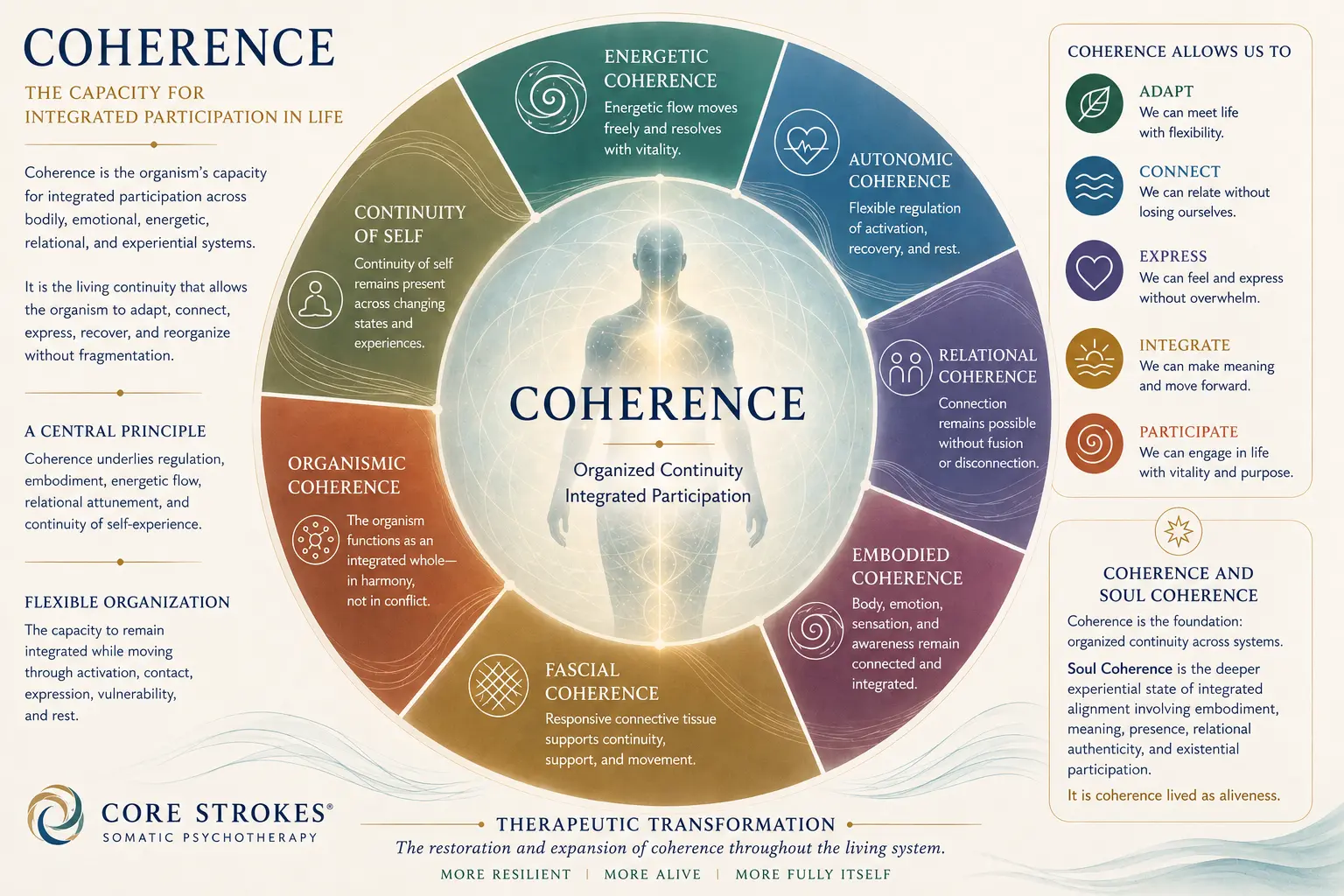
Dimensions of Coherence in the Core Strokes® Framework
Because coherence operates across multiple domains, the term appears throughout the Core Strokes® framework in different but related dimensions.
Energetic Coherence
Energetic coherence refers to the continuity and organization of energetic flow throughout the organism.
Charge can build, circulate, discharge, and settle without becoming chronically blocked, fragmented, excessive, or collapsed. Energetic coherence supports vitality, pulsation, expressiveness, and organismic participation.
Autonomic Coherence
Autonomic coherence refers to the nervous system’s capacity to regulate activation, mobilization, rest, and recovery with sufficient flexibility and continuity.
Rather than becoming trapped in chronic sympathetic arousal, dorsal withdrawal, or unstable oscillation, the organism develops broader regulatory capacity. This allows increasing tolerance for intensity, contact, emotion, and relational participation.
Relational Coherence
Relational coherence refers to the organism’s capacity to remain sufficiently present and continuous within interpersonal contact.
The individual can maintain connection without excessive fusion, defensive distancing, collapse, domination, or fragmentation of self-experience. Relational coherence supports authentic participation, mutual regulation, and emotional continuity within relationships.
Embodied Coherence
Embodied coherence refers to continuity between bodily sensation, emotional experience, movement, awareness, and self-perception.
The body is no longer experienced as disconnected, contradictory, numb, or fragmented. Instead, experience becomes increasingly integrated within lived embodiment.
Fascial Coherence
Fascial coherence refers to the connective tissue system’s capacity to transmit force, sensation, movement, hydration, and energetic responsiveness with continuity throughout the organism.
Rather than becoming chronically rigid, collapsed, adhesive, fragmented, or disconnected, the fascial network maintains adaptable organization and responsiveness. This contributes to both structural integration and felt aliveness.
Organismic Coherence
Organismic coherence refers to the overall integration of the organism as a living system.
Breath, movement, emotion, posture, nervous system regulation, energetic flow, relational participation, and cognition increasingly function with continuity rather than operating as disconnected or conflicting subsystems.
Continuity of Self
Self coherence refers to the organism’s capacity to maintain continuity of self-experience across changing emotional, bodily, relational, and existential states.
The individual retains continuity of self-experience without requiring rigid defensive control or dissociative separation between aspects of experience.
Coherence and the Energetic Breath Cycle™
Within the Energetic Breath Cycle™, coherence develops progressively across the organism’s developmental and energetic maturation.
Early phases establish safety, support, receptivity, and exploratory continuity. Later phases expand energetic tolerance, expressive capacity, erotic vitality, surrender, and integration.
Disturbances within the cycle may interrupt the development of coherence, leading to defensive organizations that stabilize survival but reduce continuity across systems.
Therapeutic transformation therefore involves not merely symptom reduction, but restoration of coherent participation throughout the organism.
Coherence and Therapeutic Transformation
Within Core Strokes®, therapeutic work aims to restore increasing coherence across bodily, emotional, energetic, relational, and existential dimensions of experience.
This often involves restoring breath continuity, increasing fascial responsiveness, supporting autonomic regulation, integrating dissociated experience, developing movement continuity, strengthening relational safety, and expanding the organism’s capacity for embodied participation.
As coherence increases, the organism no longer needs to organize primarily around defensive interruption.
Experience becomes increasingly metabolizable. Participation becomes more continuous. Vitality becomes more available.
The individual develops greater capacity to remain present within intensity, intimacy, expression, vulnerability, and change.
Coherence and Soul Coherence
Within the Core Strokes® framework, coherence represents a foundational organismic principle.
It describes the organism’s capacity for organized continuity across bodily, emotional, energetic, relational, and experiential systems.
Soul Coherence describes a deeper qualitative expression that may emerge as this integration matures and becomes increasingly embodied.
While coherence refers broadly to coordinated organization across systems, Soul Coherence reflects a more profound alignment involving embodiment, meaning, vitality, relational authenticity, symbolic participation, consciousness, and lived presence.
Coherence and Soul Coherence are therefore closely related, but they are not identical.
Coherence provides the organizational foundation. Soul Coherence reflects the experiential depth and lived quality that become possible when this foundation develops sufficiently.
One may think of coherence as the architecture of participation, while Soul Coherence describes the richness, depth, and authenticity of participation itself. For example, two people may appear equally organized and functional. Yet one experiences life primarily as obligation and management, while the other experiences vitality, meaning, relational depth, and a sense of authentic participation. Both may possess coherence, but the latter reflects a deeper expression of Soul Coherence.
Soul Textures™ may be understood as recurring qualitative expressions of this deeper coherence as it becomes embodied through breathing, fascia, emotion, relationship, and presence.
As coherence deepens, individuals often report greater emotional availability, stronger continuity of self, increased vitality, deeper relational connection, enhanced capacity for meaning, and a growing sense of living from an integrated center.
In this sense, Soul Coherence represents not merely improved regulation or organization, but the progressive integration of embodied life itself.
Where coherence allows participation to remain possible, Soul Coherence reflects the organism’s increasing capacity to participate fully, authentically, and meaningfully in life.
In Summary
Within Core Strokes®, coherence is a foundational principle describing the organism’s capacity for organized continuity across bodily, emotional, energetic, relational, and experiential systems.
It reflects the ability to remain sufficiently integrated while participating in the movements of life.
Rather than eliminating disturbance, coherence allows the organism to reorganize, adapt, and continue participating without losing continuity of self, embodiment, or relational presence.
Coherence is therefore central to regulation, embodiment, participation, transformation, and therapeutic integration. It forms one of the core organizing principles underlying the entire Core Strokes® framework.
Coherence may therefore be understood as the living organization that allows participation to remain possible throughout the changing conditions of life.
Within the Organization of Embodied Participation, coherence may be understood as one of the primary conditions that allows participation to remain possible. Participation describes engagement with life; coherence describes the living organization that supports that engagement.
Explore Related Core Strokes® Concepts
→ The Organisation of Embodied Participation
The phenomenological foundation of Core Strokes®, describing how continuity, coherence, permeability, metabolisation, adaptive organisation, and relational geometry organise embodied life.
→ Defensive Organisation
A protective form of Adaptive Organisation in which participation becomes organised around experienced or anticipated threat, overwhelm, disruption, or loss of continuity.
→ Living Participation Observation System™ (LPOS™)
The observational methodology through which embodied and relational expressions are described before provisional organisational interpretations are developed.
→ Relational Field and Relational Geometry
The Relational Field is the embodied space of interaction. Relational Geometry describes how proximity, distance, boundaries, orientation, reciprocity, and differentiation are organised within it.
→ Energetic Breath Cycle™
A developmental map describing how breathing organises grounding, activation, emotional expression, surrender, and restoration throughout the organism.
→ Fascia Texture Typology™
A phenomenological framework for describing recurring tactile configurations and considering their possible organisational significance without treating them as diagnoses, personality types, or records of developmental history.
→ Neurofascial Encoding™
A proposed research framework exploring possible relationships among repeated participation, neural plasticity, behaviour, physiological regulation, movement, mechanical loading, and connective-tissue remodelling.
→ Neurofascial Transformation Process™
The therapeutic process through which breathing, fascia, movement, therapeutic touch and relational participation can contribute to embodied reorganisation and therapeutic transformation.
→ Therapeutic Touch
An embodied and relational practice guided by consent, clinical judgement, perceptual attention, and responsiveness rather than by mechanical intervention or predetermined interpretation.
→ Character Structures
A framework for exploring recurring developmental organisations of bodily, emotional, behavioural, and relational participation without reducing people to fixed types.
→ Soul Organisation, Soul Coherence, and Soul Textures ™
Interrelated dimensions of Core Strokes® concerned with authenticity, meaning, inner resonance, embodied presence, and relational participation. Soul Organisation names the wider qualitative domain; Soul Coherence describes increasing integrity among dimensions of experience; Soul Textures™ describe qualities of coherent participation; and Shadow Soul Textures™ describe qualitative expressions of protective, constrained, fragmented, or compensatory Adaptive Organisation.
These principles can also be explored directly through experiential practice within:
Closing Invitation
Coherence is explored experientially throughout Core Strokes® workshops, trainings, and therapeutic practice.
Through breath, movement, fascia-oriented work, emotional expression, and relational presence, participants gradually develop increasing continuity across bodily, emotional, energetic, and relational experience.
Rather than imposing rigid control, Core Strokes® supports the organism’s natural capacity for integrated participation, adaptive regulation, and living responsiveness.
As coherence deepens, the organism becomes increasingly capable of vitality, embodiment, relational authenticity, and meaningful participation in life.