Autonomic Regulation in Core Strokes®
How the Living Organism Organizes Safety, Activation, and Participation
By Dirk Marivoet · Founder of Core Strokes® · European Certified Psychotherapist · Somatic Researcher · Author
Autonomic Regulation — A Definition
Autonomic regulation refers to the organism’s capacity to organize changing states of activation, settling, recovery, and engagement through the coordinated activity of the autonomic nervous system, breathing, fascia, movement, emotion, and relationship.
Rather than remaining fixed within either activation or relaxation, healthy regulation reflects the organism’s capacity to move fluidly between different physiological and relational states according to the demands of the present moment.
Within Core Strokes®, regulation is therefore understood as a dynamic organisational process rather than as a neurological mechanism alone. It is continuously expressed through breathing rhythms, fascial responsiveness, postural organization, emotional regulation, and the organism’s capacity to remain present while participating fully in life.
Regulation as Organisational Capacity
One of the distinguishing perspectives of Core Strokes® is that autonomic regulation is understood primarily as an organisational capacity rather than simply as a physiological state.
Healthy regulation does not mean remaining permanently calm, relaxed, or parasympathetically dominant. Living organisms continually encounter changing demands that require mobilisation, emotional expression, recovery, exploration, protection, intimacy, surrender, and rest. Regulation therefore reflects the organism’s ability to reorganise itself appropriately as these conditions change.
Sometimes healthy regulation requires increased activation. At other moments it requires slowing down, receiving support, expressing emotion, yielding into gravity, or allowing restoration. Each state serves a particular function within the organism’s ongoing participation in life. The capacity to move fluidly between these different organisational states is one of the hallmarks of embodied health.
From this perspective, the essential question is not simply, “Is the nervous system calm?” Rather, it becomes, “Can the organism organise itself appropriately for the reality of the present moment?”
This shift from state regulation toward organisational flexibility represents one of the central contributions of the Core Strokes® framework. Regulation is understood less as maintaining a preferred autonomic state than as developing the capacity to move coherently through the full spectrum of embodied experience.
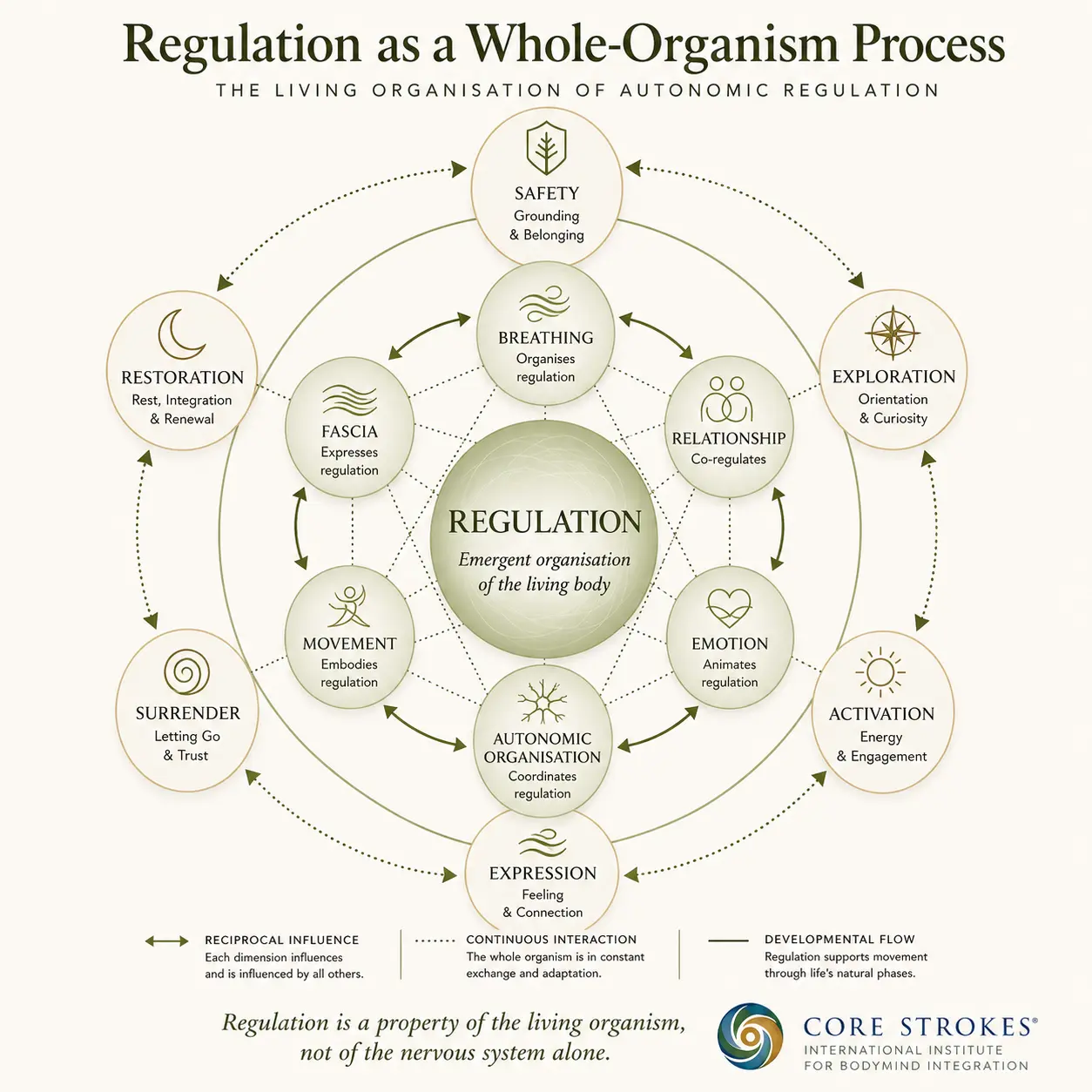
Breathing, fascia, posture, movement, emotional expression, autonomic activity, and relational participation continually reorganise one another. Regulation therefore emerges as a living process of coordination across the entire organism rather than as the product of any single physiological system.
Seen in this way, autonomic regulation is not something the organism possesses once and for all. It is an ongoing developmental achievement that continually evolves through lived experience, relationship, and therapeutic participation.
The Autonomic Nervous System
The autonomic nervous system (ANS) plays a central role in this ongoing process of organisation. It continually regulates many of the body’s essential functions, including heart rate, breathing, digestion, vascular tone, endocrine activity, and levels of physiological arousal. Most of these adjustments occur outside conscious awareness, allowing the organism to respond rapidly to changing internal conditions and environmental demands.
Traditionally, the autonomic nervous system has been described as comprising two major branches. The sympathetic nervous system supports mobilisation. It prepares the organism for exploration, action, protection, and energetic engagement by increasing physiological activation whenever greater energy is required. The parasympathetic nervous system, by contrast, supports restoration, settling, digestion, recovery, and the integration of experience. It allows the organism to conserve energy, repair tissues, and return to states of relative physiological stability.
Within Core Strokes®, these two branches are not viewed as opposing forces locked in a constant struggle for dominance. Rather, they are understood as complementary organisational tendencies that continually cooperate in regulating embodied life. Every meaningful activity—including movement, emotional expression, intimacy, creativity, play, and therapeutic transformation—requires ongoing shifts between mobilisation and restoration.
Healthy autonomic regulation therefore does not consist of remaining predominantly sympathetic or predominantly parasympathetic. It reflects the organism’s capacity to transition fluidly between these different modes of organisation according to the changing realities of the present moment.
This flexibility is experienced directly within the body. It becomes perceptible through changing rhythms of breathing, shifts in muscular tone, alterations in fascial responsiveness, variations in emotional intensity, and the organism’s capacity to remain present while participating fully in relationship.
Rather than viewing the autonomic nervous system as an isolated controller of bodily function, Core Strokes®understands it as one participant within a far larger living network of breathing, fascia, movement, emotion, relationship, and embodied organisation. The nervous system does not regulate the organism alone; it continually participates in the organism’s ongoing process of self-organisation.
Breath as the Primary Organiser of Regulation
Within Core Strokes®, breathing is understood as one of the primary organisers of autonomic regulation. Every alteration in respiratory rhythm influences multiple regulatory systems simultaneously, continually reshaping the organism’s physiological, emotional, and relational organisation.
Breathing does far more than exchange oxygen and carbon dioxide. Each inhalation and exhalation subtly influences heart rate variability, muscular tone, fascial tension, autonomic activity, emotional intensity, postural organisation, and the organism’s readiness for relational contact. Rather than functioning as one physiological process among many, breathing provides one of the central rhythms through which the living organism continually reorganises itself.
Because breathing is both voluntary and involuntary, it occupies a unique position within human regulation. It forms a living bridge between conscious experience and autonomic function, between intentional action and spontaneous physiological organisation. Every change in breathing therefore reflects—and simultaneously influences—the organism’s overall regulatory state.
When breathing remains continuous, adaptable, and responsive to changing circumstances, the organism is generally able to move flexibly between activation and restoration. Emotional intensity can rise without becoming overwhelming. Mobilisation can be followed by recovery. Relationship can deepen without requiring defensive withdrawal. Breathing continually supports the organism’s capacity to participate in experience while maintaining organisational coherence.
When breathing becomes chronically restricted, fragmented, or interrupted, the organism’s regulatory flexibility gradually narrows. Instead of adapting fluidly to changing circumstances, the body may stabilise around persistent patterns of vigilance, emotional inhibition, collapse, or defensive muscular holding. These breathing organisations often become so familiar that they are experienced as natural, even though they substantially limit the organism’s capacity for regulation.
Within Core Strokes®, such breathing patterns are understood as expressions of embodied organisation rather than isolated respiratory habits. They reveal how the organism has learned to regulate itself in response to developmental experience, relational conditions, and accumulated adaptive strategies.
This understanding forms the foundation of the Energetic Breath Cycle™, which describes how breathing normally unfolds through a developmental rhythm of grounding, activation, emotional expression, surrender, and restoration. Interruptions within this rhythm often correspond to characteristic changes in autonomic organisation.
A chronically shallow or restricted breath may accompany persistent vigilance and sympathetic mobilisation. Breath holding often appears when emotional activation cannot safely unfold. Collapsing or weakened breathing may reflect states of overwhelm, withdrawal, or diminished vitality. These respiratory organisations are not viewed simply as symptoms but as intelligent adaptations through which the organism has attempted to preserve continuity under difficult circumstances.
Therapeutic work therefore does not seek merely to deepen the breath or increase respiratory volume. Instead, it supports the gradual restoration of breathing continuity. As continuity returns, the organism often discovers increasing flexibility within autonomic regulation. Emotional expression becomes less fragmented, fascial responsiveness becomes more fluid, movement regains spontaneity, and relationship can unfold with greater safety and openness.
Breathing thus becomes far more than a physiological function. Within Core Strokes®, it is understood as one of the primary organising principles through which the living organism continually regulates itself and participates in life.
The Energetic Breath Cycle™ as a Developmental Map of Regulation
The Energetic Breath Cycle™ provides the principal developmental map through which autonomic regulation is understood within Core Strokes®.
Rather than viewing regulation as a simple oscillation between sympathetic activation and parasympathetic relaxation, the Energetic Breath Cycle™ describes regulation as a living developmental rhythm that unfolds through a series of increasingly differentiated breathing organisations. Each phase reflects characteristic qualities of autonomic organisation, emotional experience, relational orientation, and embodied participation.
The cycle therefore expands conventional models of autonomic regulation. Instead of asking only whether the organism is activated or settled, it explores how activation is organised, how expression unfolds, how surrender becomes possible, and how restoration prepares the organism for renewed engagement with life.
The nine phases of the Energetic Breath Cycle™ describe successive yet continually interacting qualities of regulation. Secure Breath establishes grounding, safety, and physiological stability. Nurturing Breath supports receptivity and the capacity to receive nourishment, care, and emotional support. Exploring Breath introduces gentle mobilisation as curiosity and orientation toward the environment emerge. Free Breath reflects flexible oscillation between activation and settling, demonstrating growing regulatory adaptability.
As vitality increases, Excited Breath allows energetic activation and emotional intensity to deepen while maintaining relational participation. Orgastic Breath represents the integration of activation and surrender, allowing energy to flow without fragmentation. Ecstatic Breath reflects an expanded coherence in which activation, expression, and regulation remain fully integrated.
The final phases support consolidation. Surrendering Breath allows effort to soften into gravity, trust, and integration. Resting Breath stabilises restoration, enabling recovery before the organism naturally re-engages with life through a new cycle of participation.
Seen from this developmental perspective, autonomic regulation is not primarily concerned with calming the nervous system. It reflects the organism’s growing capacity to move fluidly through the entire spectrum of grounding, activation, expression, integration, surrender, and restoration. The Energetic Breath Cycle™ therefore offers a practical map for understanding regulation as a dynamic process of embodied organisation rather than a succession of isolated physiological states.
Fascia as the Living Expression of Regulation
Autonomic regulation is never experienced solely within the nervous system. Every regulatory state gradually becomes expressed throughout the body’s tissues, making the organism’s history of adaptation visible and palpable. Within Core Strokes®, fascia provides one of the clearest windows into this ongoing process of embodied regulation.
As the body’s continuous connective tissue network, fascia responds dynamically to every shift in breathing, movement, emotional activation, and autonomic organisation. Changes in physiological state are not confined to neural pathways; they are distributed throughout the living architecture of the organism. The quality of fascial responsiveness therefore reflects not only the body’s present regulatory state but also the cumulative history through which regulation has developed over time.
Periods of safety and flexible regulation are often accompanied by tissues that feel hydrated, elastic, resilient, and responsive. Movement flows with relatively little resistance, breathing is transmitted throughout the body with continuity, and contact can be received without excessive guarding. The organism demonstrates an ability to mobilise and settle without becoming rigid or collapsing.
When autonomic regulation becomes chronically restricted, different fascial qualities gradually emerge. Persistent vigilance may contribute to increased density, muscular bracing, and reduced elasticity. Prolonged withdrawal or collapse may be accompanied by diminished tone, reduced responsiveness, or a loss of structural continuity. Rather than viewing these tissue qualities as purely mechanical phenomena, Core Strokes® understands them as embodied expressions of how the organism has learned to regulate itself within its developmental and relational history.
These recurring qualities are explored systematically through the Fascia Texture Typology™, which recognises characteristic organisational tendencies expressed through tissue responsiveness, elasticity, hydration, continuity, and movement. Fascial organisation therefore becomes a living record of autonomic adaptation rather than merely a consequence of biomechanical stress.
Breathing and fascia continually organise one another. As breathing regains continuity, fascial tissues often become more differentiated, responsive, and adaptable. Likewise, as fascial restrictions soften through therapeutic participation, new possibilities emerge for fuller breathing, freer movement, and greater emotional expression. Neither process simply causes the other. Both participate within an ongoing reciprocal process of embodied organisation.
From this perspective, fascia becomes much more than connective tissue. It expresses how the organism has organised safety, protection, vitality, and relationship throughout its life. The qualities encountered through therapeutic touch therefore offer direct insight into the organism’s regulatory organisation and its capacity for further transformation.
Relational Regulation
One of the central assumptions of Core Strokes® is that human beings do not regulate themselves in isolation. From the earliest moments of life, autonomic regulation develops through relationship. The infant’s nervous system does not mature independently but gradually organises itself through thousands of moments of shared breathing, touch, movement, facial expression, vocal tone, rhythm, and emotional attunement.
Regulation therefore begins as co-regulation. Before the organism can regulate itself independently, it learns regulation through the presence of another. Experiences of being held, soothed, mirrored, protected, and emotionally received gradually expand the organism’s capacity to tolerate activation while maintaining continuity and connection.
These early relational experiences become progressively embodied. Breathing rhythms develop characteristic patterns of organisation. Fascial tissues adapt to repeated experiences of openness or protection. Emotional expression becomes either facilitated or restricted according to the quality of relational support that has been available throughout development. In this way, autonomic regulation gradually becomes inseparable from the organism’s developmental history.
Within psychotherapy, this developmental process continues. Therapeutic regulation does not arise simply because techniques are applied to the nervous system. Rather, it emerges through the quality of the therapeutic relationship itself. Presence, pacing, breathing, movement, therapeutic touch, emotional attunement, and respectful participation together create conditions in which the organism may gradually discover new possibilities for regulation.
The therapeutic relationship therefore offers much more than external support. It provides opportunities for previously restricted regulatory capacities to develop further. As the organism experiences increasing safety, breathing often becomes more continuous, fascial responsiveness more fluid, emotional expression more integrated, and autonomic flexibility gradually expands.
Within Core Strokes®, regulation is thus understood not only as a physiological achievement but also as a profoundly relational process. Safety is not simply an internal state; it is something that continually emerges through the organism’s participation with its environment. Therapeutic transformation therefore unfolds not through control of the nervous system, but through the gradual restoration of the organism’s capacity to participate fully in relationship while remaining coherent, vital, and embodied.
Autonomic Regulation and Development
Patterns of autonomic regulation do not arise spontaneously in adulthood. They develop gradually through countless interactions between the organism and its relational environment. Every experience of safety, frustration, support, absence, synchrony, or overwhelm contributes to the way regulation becomes organised within the living body.
When early developmental environments provide sufficient stability, attunement, and responsiveness, the organism gradually develops a broad regulatory range. Breathing remains adaptable, emotional activation can unfold without overwhelming the system, and physiological mobilisation can be followed naturally by recovery and rest. The organism learns not simply to survive, but to participate confidently in an ever-changing world.
When developmental conditions are inconsistent, intrusive, neglectful, or traumatic, regulation often becomes progressively restricted. Rather than responding flexibly to changing circumstances, the organism begins to stabilise around protective regulatory organisations that once supported survival but later limit participation.
These adaptive organisations may appear as chronic vigilance, persistent muscular holding, restricted breathing, emotional inhibition, exaggerated self-reliance, collapse, or withdrawal. Over time they become increasingly embodied within posture, movement, fascial organisation, autonomic regulation, and relational expectations.
Within Core Strokes®, these enduring organisations are understood as developmental adaptations rather than pathological conditions. They represent intelligent solutions through which the organism preserved continuity under particular relational circumstances. What later appears as dysregulation often reflects earlier attempts to maintain coherence when relational safety could not be relied upon.
This developmental understanding closely connects autonomic regulation with the Character Structures described in body psychotherapy. Character organisation is not viewed as a fixed personality type but as the progressive stabilisation of regulatory strategies that have become embodied throughout development. Breathing, fascia, posture, emotional expression, and autonomic organisation all participate in this larger developmental process.
Recognising the developmental origins of regulation fundamentally changes the therapeutic perspective. Rather than attempting to suppress symptoms or correct physiological states, therapy seeks to understand the organisational intelligence from which these patterns emerged. Respect for the adaptive function of regulation becomes the foundation for lasting transformation.
Regulation, Therapeutic Participation, and Transformation
Within Core Strokes®, therapeutic work does not aim to regulate the nervous system through technique alone. Regulation develops through participation. Every therapeutic encounter becomes an opportunity for the organism to discover new possibilities for breathing, movement, emotional expression, fascial responsiveness, and relationship.
The therapist therefore does not attempt to impose regulation from outside. Instead, therapeutic presence creates conditions in which the organism’s own regulatory capacities can gradually reorganise themselves. Breathing is invited rather than forced. Movement emerges rather than being prescribed. Emotional expression is supported rather than stimulated for its own sake. Touch becomes a way of perceiving and participating in the organism’s ongoing process of organisation rather than a technique for mechanically changing tissue.
As breathing regains continuity, autonomic flexibility often expands naturally. Fascial tissues become more responsive. Emotional activation can unfold without overwhelming the organism. Mobilisation no longer requires chronic vigilance, and surrender no longer leads automatically to collapse. Gradually, the organism discovers that activation and safety, expression and regulation, vulnerability and coherence no longer need to oppose one another.
Within the broader Core Strokes® framework, this process is described through the Neurofascial Transformation Process™. Therapeutic participation gradually supports the reorganisation of previously stabilised neurofascial patterns, allowing defensive regulatory organisations to evolve into increasingly flexible forms of embodied participation.
Transformation therefore does not consist of replacing one regulatory state with another. It reflects the organism’s growing capacity to reorganise itself continuously in response to changing internal experiences, relational encounters, and environmental conditions. Regulation becomes increasingly dynamic rather than defensive, increasingly adaptive rather than habitual.
Ultimately, therapeutic transformation restores not simply physiological balance but the organism’s capacity to participate more fully in life.
Regulation Serves Participation
One of the distinguishing perspectives of Core Strokes® is that regulation is never understood as an end in itself.
The organism does not regulate simply in order to remain calm. It regulates in order to participate.
Grounding supports exploration.
Activation supports engagement.
Emotional expression deepens relationship.
Surrender allows integration.
Rest restores vitality and prepares the organism for renewed participation.
Seen from this perspective, autonomic regulation exists in service of life rather than comfort. Every regulatory movement prepares the organism for a different form of participation with itself, with others, and with the surrounding world.
This understanding distinguishes Core Strokes® from approaches that define regulation primarily as the reduction of physiological arousal or the elimination of stress. While reducing excessive activation may sometimes be clinically necessary, the larger therapeutic aim is the expansion of the organism’s capacity to participate creatively, emotionally, physically, and relationally across the full range of embodied experience.
Healthy regulation therefore supports freedom rather than control. It allows the organism to move fluidly between mobilisation and recovery, expression and stillness, intimacy and autonomy, while maintaining continuity, coherence, and vitality throughout these changing states.
Conclusion — Regulation as Living Organisation
Autonomic regulation is far more than the modulation of physiological arousal. It is one expression of the organism’s ongoing capacity to organise itself within life.
Within Core Strokes®, regulation is understood as an embodied process through which breathing, fascia, movement, emotional expression, autonomic activity, and relationship continually organise one another. Rather than attempting to suppress activation or maintain permanent calm, therapeutic work supports the organism’s growing capacity to move flexibly through the full spectrum of embodied experience. Grounding, mobilisation, expression, surrender, and restoration all become essential phases within a coherent rhythm of participation.
Breathing provides one of the primary organisational rhythms through which this process unfolds. Fascia expresses how regulatory history becomes embodied within the living tissues. Relationship creates the conditions in which new possibilities for regulation can gradually emerge. Together they allow the organism to develop increasing coherence, resilience, vitality, and relational freedom.
Seen in this way, autonomic regulation is not simply a function of the nervous system. It is a living expression of how the organism continually creates, loses, and rediscovers its capacity for embodied participation throughout life.
The Core Strokes Framework
Autonomic regulation represents one dimension of the broader understanding of Embodied Participation within Core Strokes®. Together with the framework’s complementary models, it illustrates how breathing, fascia, movement, emotional regulation, therapeutic relationship, and developmental organisation continually shape the living organism.
📘 Explore the foundational dimensions of the framework below:
→ The Organization of Embodied Participation
The phenomenological foundation of Core Strokes®, describing how continuity, coherence, permeability, metabolization, defensive organization, and relational geometry organise embodied life.
→ Energetic Breath Cycle™
A developmental map describing how breathing organises grounding, activation, emotional expression, surrender, and restoration throughout the organism.
→ Fascia Texture Typology™
A phenomenological framework describing how developmental and relational experience becomes embodied through recurring qualities of fascial organisation and tissue responsiveness.
→ Neurofascial Encoding™
A model explaining how lived experience gradually becomes organised through breathing, fascia, posture, movement, autonomic regulation, and relational participation.
→ Neurofascial Transformation Process™
The therapeutic process through which breathing, fascia, movement, therapeutic touch, and relational participation gradually support lasting embodied transformation.
→ Therapeutic Touch
An approach to therapeutic touch based on perception, relational attunement, and embodied participation rather than mechanical intervention.
→ Character Structures
Developmental organisations that emerge through repeated adaptations in breathing, posture, movement, fascia, emotional regulation, and relationship.
→ Soul Textures
Qualitative expressions of embodied coherence that emerge as defensive organisations gradually reorganise into vitality, authenticity, and relational openness.
🌿 These principles can also be explored directly through experiential practice within:
Closing Invitation
Autonomic regulation is explored experientially throughout the Core Strokes® workshops, postgraduate programmes, and professional trainings.
Participants gradually learn to recognise how regulation expresses itself through breathing, fascia, posture, movement, emotional organisation, and relationship. Rather than attempting to control the nervous system directly, therapeutic work supports the organism’s natural capacity to rediscover its own rhythms of regulation and participation.
As breathing regains continuity, fascial responsiveness becomes more fluid, and relationship provides increasing safety, the organism develops greater flexibility across the full spectrum of embodied experience. Regulation becomes less defensive and more adaptive. Participation becomes less effortful and more spontaneous.
Ultimately, the aim of Core Strokes® is not simply to regulate the nervous system, but to support the organism’s growing capacity for vitality, resilience, coherence, authentic relationship, and embodied participation in life.