Therapeutic Contact in Core Strokes®
Therapeutic Contact as Somatic Listening
Therapeutic Contact — Core Definition
Therapeutic contact refers to the practitioner’s embodied and relational capacity to establish safe, attuned, and responsive forms of physical, emotional, energetic, and interpersonal contact within the therapeutic relationship.
Within the Core Strokes® framework, therapeutic contact supports co-regulation, embodied awareness, breath continuity, fascial responsiveness, emotional expression, and the organism’s unfolding capacity for therapeutic transformation.
Introduction
Within somatic psychotherapy, contact is never merely physical.
Touch, proximity, movement, breath, posture, emotional tone, and relational responsiveness all participate in shaping how the organism experiences safety, regulation, openness, activation, and connection.
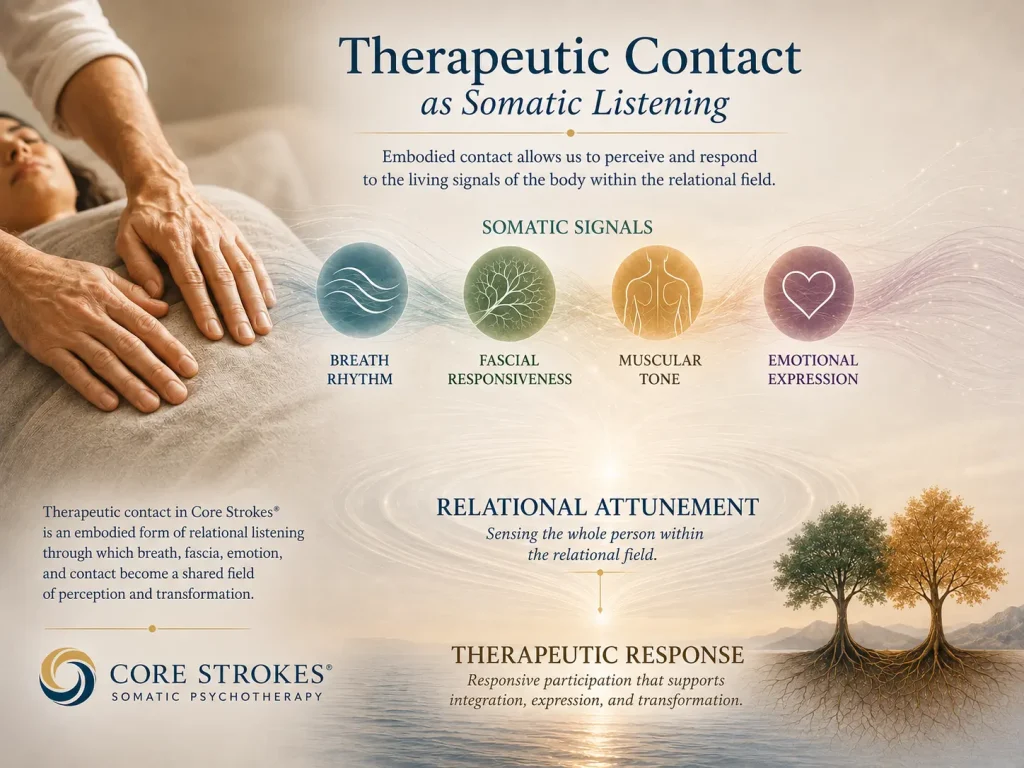
Within the Core Strokes® framework, therapeutic contact is understood as a form of embodied relational listening.
Rather than functioning as a mechanical intervention or corrective technique, therapeutic contact becomes a responsive form of participation within the relational field. Through contact, subtle signals of breath, fascia, muscular tone, emotional expression, nervous system activation, and relational orientation become increasingly perceptible.
In this way, therapeutic contact supports the emergence of greater awareness, co-regulation, embodiment, and therapeutic transformation.
Touch as a Relational Experience
Touch is one of the earliest forms of communication in human development.
Infants experience safety, warmth, and containment through physical contact with caregivers. These early experiences shape how the nervous system learns to regulate itself in relation to others.
When touch is consistent, attuned, and respectful, it supports the development of:
- emotional security
- bodily awareness
- nervous system regulation
- relational trust
When touch is absent, inconsistent, or intrusive, the organism may develop protective patterns that limit the capacity to experience contact safely.
Within somatic psychotherapy, therapeutic contact can offer new experiences of supportive and respectful touch, allowing the organism to explore contact in a regulated and conscious way.
Contact as Embodied Relational Listening
Therapeutic contact begins with listening.
The practitioner does not impose change upon the organism, but learns to perceive how the body is already organizing experience through breathing rhythms, tissue responsiveness, posture, movement impulses, emotional expression, and energetic activation.
Within Core Strokes®, touch becomes meaningful when it arises from embodied presence and relational attunement.
The practitioner listens not only through observation or cognition, but through embodied participation within the therapeutic field itself.
Through contact, the organism communicates continuously.
Subtle changes in breath continuity, muscular tone, fascial responsiveness, emotional intensity, movement, or relational orientation may reveal shifts occurring long before they become consciously verbalized.
Therapeutic contact therefore allows the practitioner to accompany the unfolding process with greater sensitivity, timing, and responsiveness.
The Body as a Relational System
Human regulation develops through relationship.
From infancy onward, the organism learns safety, expression, emotional regulation, and relational participation through repeated experiences of co-regulation with others.
Within psychotherapy, therapeutic contact may therefore support experiences of grounding, responsiveness, containment, support, differentiation, and embodied connection that were previously unavailable, inconsistent, intrusive, or overwhelming.
Contact influences not only emotional experience, but also breathing rhythms, nervous system activation, muscular organization, fascial responsiveness, energetic participation, and the organism’s capacity to remain present during vulnerability or activation.
Within Core Strokes®, therapeutic contact is always understood relationally rather than mechanically.
The meaning of touch depends entirely upon the quality of embodied presence, attunement, pacing, regulation, consent, and responsiveness within the therapeutic field.
Therapeutic contact allows subtle somatic signals to emerge more clearly within awareness.
Breathing rhythms may deepen, restrict, accelerate, pause, or soften in response to emotional activation and relational experience. Fascia may become more fluid, responsive, contracted, rigid, vibratory, or collapsed depending upon how the organism is organizing experience in the present moment.
Muscular tone, posture, movement impulses, temperature, energetic intensity, and emotional expression likewise provide important information about the organism’s regulatory state.
Within Core Strokes®, practitioners gradually develop sensitivity to these unfolding signals without reducing them to fixed interpretations or diagnostic conclusions.
The organism is understood not as a machine to be corrected, but as a living system continuously adapting, protecting, expressing, and reorganizing itself within relationship.Breath, Fascia, and Somatic Signals
Therapeutic Contact and Co-Regulation
Therapeutic contact also participates directly in processes of co-regulation.
When contact is grounded, attuned, paced appropriately, and relationally responsive, the nervous system may gradually shift toward increased safety, flexibility, and continuity.
Breathing often becomes more coherent. Muscular and fascial holding patterns may soften. Emotional expression may become increasingly tolerable and metabolizable. The organism may gradually develop greater capacity to remain embodied during activation, intimacy, vulnerability, and emotional expression.
Within Core Strokes®, co-regulation does not imply dependency or control.
Rather, it supports the organism’s increasing capacity for self-regulation, embodied participation, emotional flexibility, and relational responsiveness.
Therapeutic contact therefore becomes part of the living relational field through which regulation and transformation unfold.
Contact, Boundaries, and Safety
Because therapeutic contact directly affects relational and nervous system organization, safety and consent remain central.
Within Core Strokes®, therapeutic contact is never imposed or separated from relational awareness.
The practitioner continuously responds to verbal and nonverbal feedback emerging through breath, posture, movement, emotional expression, nervous system activation, and relational orientation.
Respectful pacing allows the organism to maintain increasing continuity rather than becoming overwhelmed, fragmented, collapsed, or defensively activated.
Therapeutic contact therefore involves ongoing sensitivity to boundaries, readiness, consent, differentiation, and the organism’s capacity for participation.
In this sense, contact supports freedom and embodiment rather than compliance or control.
Therapeutic Contact and Transformation
Within Core Strokes®, therapeutic transformation unfolds through increasing continuity between embodiment, emotional life, relational participation, nervous system regulation, and energetic responsiveness.
Therapeutic contact may support this process by helping previously restricted experiences gradually emerge into awareness and integration.
Breathing may become more continuous. Fascial responsiveness may become more dynamic and alive. Emotional expression may become less defended and more metabolizable. The organism may gradually reorganize around greater participation, flexibility, vitality, and relational openness.
Transformation therefore does not occur through touch alone.
It unfolds through the quality of embodied relational participation within which touch, breath, fascia, emotional expression, and co-regulation become integrated into a living therapeutic process.
Conclusion — Contact as Participation
Within Core Strokes®, therapeutic contact is understood not as technique alone, but as embodied relational participation.
Touch becomes a way of listening to the organism’s living processes through breath, fascia, movement, emotional expression, and nervous system responsiveness.
Through attuned and responsive contact, the organism may gradually rediscover greater safety, regulation, emotional continuity, embodiment, and relational participation.
In this way, therapeutic contact supports the unfolding capacity for therapeutic transformation within the relational field itself.
Part of the Core Strokes® Framework
Core Strokes® integrates breath, fascia, relational presence, developmental psychology, and phenomenological observation into a unified framework of embodied organization and somatic psychotherapy.
Explore related dimensions of the framework:
→ Therapeutic Presence in Core Strokes®
→ Relational Field in Core Strokes®
→ Co-Regulation in Core Strokes®
→ Neurofascial Transformation Process™
→ Developmental Needs and Relational Regulation
Closing Invitation
Therapeutic contact is explored experientially throughout Core Strokes® workshops, trainings, and professional practice.
Participants gradually develop increasing sensitivity to breath rhythms, fascial responsiveness, emotional expression, nervous system activation, and relational participation as they unfold through embodied contact.
Through this process, practitioners learn how therapeutic transformation emerges not only through technique, but through the quality of embodied relational listening itself.
As therapeutic contact becomes increasingly attuned and responsive, the organism may gradually rediscover greater continuity, regulation, vitality, emotional openness, and embodied participation within relationship and life.
Frequently Asked Questions
“Core Strokes® emerged through decades of clinical, developmental, and phenomenological exploration into the organization of embodied participation.”