Permeability in Core Strokes®
Boundaries, Exchange, and the Capacity for Living Participation
By Dirk Marivoet, Founder of Core Strokes®· Psychotherapist · Teacher · Author
Permeability — Core Definition
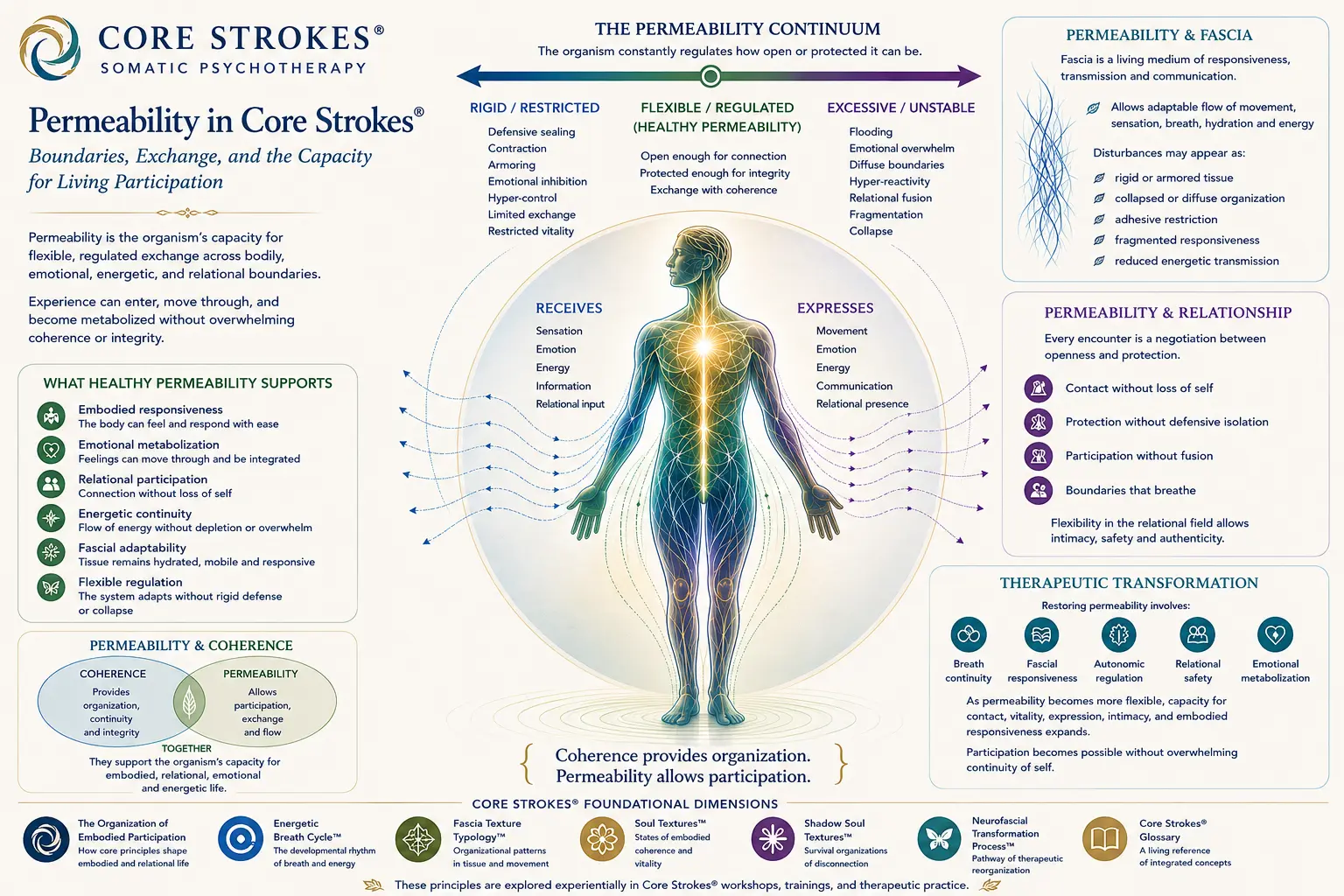
Permeability refers to the organism’s capacity for flexible, regulated exchange across bodily, emotional, energetic, relational, and experiential boundaries.
Within the Core Strokes® framework, permeability describes the ability to receive, transmit, process, and respond to experience without excessive rigidity, collapse, flooding, defensive sealing, or fragmentation.
Permeability allows the organism to remain open enough for participation while maintaining sufficient organization for continuity, regulation, and self-integrity.
Permeability allows exchange while coherence preserves continuity, together supporting the organism’s capacity for participation.
Why Permeability Matters
Every living organism exists through exchange.
The organism exchanges air through breathing, information through sensation, nourishment through digestion, emotion through relationship, movement through interaction, and meaning through participation in life.
Without permeability, these exchanges become restricted.
The organism may become increasingly defended, isolated, rigid, emotionally constricted, energetically blocked, or disconnected from participation.
Yet unrestricted openness is not the answer.
An organism that cannot regulate exchange may become overwhelmed by stimulation, flooded by emotion, diffuse in its boundaries, fragmented in its organization, or unable to maintain continuity of self.
Health therefore does not depend upon maximum openness or maximum protection.
It depends upon flexible permeability.
Flexible permeability allows the organism to regulate exchange according to changing circumstances while preserving continuity, integrity, responsiveness, and participation.
Within Core Strokes®, many forms of suffering may be understood partly as disturbances in permeability.
Some individuals become excessively closed.
Others become excessively open.
Many fluctuate between the two.
Therapeutic transformation often involves restoring the organism’s capacity to participate in exchange without becoming overwhelmed, fragmented, armored, or withdrawn.
As permeability develops, life becomes increasingly available.
Experience can be received, metabolized, expressed, and integrated with greater freedom.
Participation expands.
Permeability and Participation
Within Core Strokes®, permeability and participation are inseparable.
Participation requires exchange. Every act of breathing, sensing, feeling, moving, relating, learning, expressing, receiving, and creating depends upon some degree of permeability.
The organism participates in life through continuous exchange with its environment. Air enters and leaves through breathing. Sensory information moves through perception. Emotions arise through contact with experience. Relationships unfold through mutual influence and responsiveness. Meaning itself emerges through ongoing interaction between organism and world.
When permeability becomes excessively restricted, participation narrows. The organism may defend itself through contraction, emotional inhibition, withdrawal, armoring, control, or isolation. Exchange becomes limited in order to preserve safety or continuity.
When permeability becomes excessive or unstable, participation may become overwhelming. Emotional flooding, diffuse boundaries, energetic overwhelm, relational fusion, or fragmentation may reduce the organism’s capacity to metabolize experience coherently.
Healthy participation therefore depends upon regulated permeability — sufficient openness for exchange combined with sufficient organization for continuity and integration.
In this sense, permeability may be understood as one of the primary conditions that makes embodied participation possible.
Within the broader Core Strokes® framework, participation describes engagement with life, while permeability describes the organism’s capacity to remain open to that engagement without losing integrity, continuity, or self-organization.
Permeability and the Body
Permeability is always embodied because exchange occurs through the living organism itself. The body continuously regulates what can enter, what can be expressed, what can be contained, and what can be transmitted.
It expresses itself through breathing, tissue responsiveness, movement propagation, emotional processing, energetic exchange, sensory regulation, and relational contact.
The body continuously negotiates how open or protected it can safely remain.
Breathing may become shallow or restricted when experience feels overwhelming. Fascia may harden, collapse, densify, fragment, or lose responsiveness. Movement may become interrupted or defensive. Emotional expression may become inhibited, diffuse, excessive, or dissociated.
Within Core Strokes®, the body is understood as a living permeability system continuously regulating exchange between self and world.
Regulated Permeability
Regulated permeability allows the organism to remain sufficiently open while preserving integrity and continuity.
Experience can enter, move through, and become metabolized without overwhelming the organism’s organizational capacity.
Emotion can be felt without flooding. Contact can occur without collapse or defensive withdrawal. Energetic exchange remains possible without loss of self-continuity.
Healthy permeability supports embodied responsiveness, emotional metabolization, relational participation, energetic continuity, fascial adaptability, and flexible regulation.
The organism remains capable of participation without becoming either excessively defended or excessively exposed.
Disturbances of Permeability
Disturbances of permeability may emerge through developmental disruption, trauma, chronic overwhelm, attachment instability, environmental intrusion, or prolonged defensive adaptation.
Because permeability regulates exchange between organism and environment, disturbances often reflect adaptive attempts to manage safety, continuity, contact, and survival under difficult conditions.
Within Core Strokes®, disturbances of permeability may organize in several directions.
Rigid or Restricted Permeability
When permeability becomes excessively restricted, the organism may defend itself through chronic contraction, armoring, emotional inhibition, distancing, hyper-control, energetic sealing, or withdrawal from contact.
Exchange becomes limited in order to preserve safety, continuity, or protection from overwhelm.
While this organization may temporarily reduce vulnerability, it may also restrict vitality, spontaneity, intimacy, creativity, emotional responsiveness, and participation in life.
The organism remains protected, but often at the cost of openness and aliveness.
Excessive or Unstable Permeability
When permeability becomes excessively open or unstable, the organism may experience emotional flooding, energetic overwhelm, diffuse boundaries, hyper-reactivity, relational fusion, fragmentation, or collapse.
The capacity to regulate incoming stimulation becomes reduced.
Experience enters more rapidly than it can be metabolized, integrated, or contained.
Participation may remain emotionally intense and highly activated while lacking sufficient continuity, differentiation, grounding, or self-regulation.
The organism remains open, but often without adequate protection or organizational stability.
Inconsistent or Fragmented Permeability
In some organizations, permeability becomes inconsistent or fragmented.
Certain aspects of the organism remain highly defended while others remain excessively exposed. Bodily, emotional, energetic, cognitive, or relational systems may no longer function with coherent continuity.
The individual may alternate unpredictably between openness and closure, connection and withdrawal, emotional flooding and emotional absence.
This pattern frequently appears in trauma, dissociation, disorganized attachment, developmental disruption, or chronic experiences of instability and overwhelm.
The challenge is neither excessive openness nor excessive closure alone, but a loss of coordinated regulation across the organism as a whole.
Permeability and Characterological Organization
Within Core Strokes®, recurring disturbances of permeability may also be reflected in broader patterns of developmental and characterological organization. Over time, individuals often develop characteristic ways of regulating openness, protection, contact, and exchange in response to early relational and environmental conditions.
From this perspective, character structures may be understood partly as enduring styles of permeability regulation.
For example, schizoid organizations often involve restricted or fragmented permeability, where exchange becomes limited or discontinuous in order to preserve safety and continuity. Oral organizations may reflect diffuse permeability, characterized by heightened receptivity and difficulty regulating exchange. Psychopathic organizations frequently develop selective permeability, remaining open where control can be maintained while restricting vulnerability. Masochistic organizations may express compressed permeability, where exchange remains constrained by chronic holding and inhibition. Rigid organizations often reflect controlled permeability, allowing carefully regulated exchange while limiting spontaneity and emotional exposure.
These tendencies should not be understood as fixed categories, but as recurring styles through which the organism regulates openness, protection, contact, and participation in life.
Permeability and Fascia
Within Core Strokes®, permeability is deeply connected to fascial organization.
From a Core Strokes® perspective, fascia may be understood as one of the organism’s primary permeability systems, continuously mediating transmission, responsiveness, containment, support, and communication throughout embodied life.
Fascia functions not merely as structural tissue, but as a living medium of responsiveness, transmission, support, and communication throughout the organism.
Healthy fascia allows adaptable propagation of movement, sensation, breath, hydration, energetic responsiveness, and relational expression.
Disturbances of permeability may appear through rigid or armored tissue, collapsed or diffuse organization, adhesive restriction, fragmented responsiveness, or reduced energetic transmission.
The Fascia Texture Typology™ can therefore be understood partly as a map of organismic permeability patterns expressed through tissue organization.

Permeability and Relationship
Relationship continuously challenges the organism’s permeability.
Every encounter involves negotiation between openness and protection, contact and withdrawal, participation and defense, surrender and continuity of self.
Relational difficulties often involve disturbances in permeability.
Some individuals defend through excessive closure and distancing. Others struggle with insufficient boundaries, emotional flooding, or relational fusion.
Within Core Strokes®, therapeutic work does not aim toward unrestricted openness, but toward increasing flexibility of participation within the relational field.
Healthy relational permeability allows a person to be affected by another without becoming overwhelmed, to remain open without losing boundaries, and to maintain individuality without withdrawing from connection.
The capacity to move fluidly between openness and protection, closeness and differentiation, represents an important aspect of relational maturity and embodied participation.
From this perspective, relationship becomes one of the primary arenas through which permeability develops, is challenged, and can gradually become more coherent.
Permeability and Boundaries
Within Core Strokes®, boundaries are not understood as rigid walls separating self from world.
Healthy boundaries function as living regulatory processes that support exchange while preserving continuity and integrity.
A boundary that is too rigid may restrict participation and intimacy.
A boundary that is too diffuse may permit excessive intrusion, flooding, or loss of self-continuity.
Healthy boundaries therefore depend upon regulated permeability.
They allow the organism to open, close, receive, express, approach, withdraw, and adapt according to changing circumstances.
In this sense, boundaries do not oppose permeability.
They make healthy permeability possible.
Permeability and Coherence
Permeability and coherence are deeply interconnected.
Without sufficient permeability, coherence becomes rigid and defensive.
Without sufficient coherence, permeability becomes unstable and overwhelming.
Healthy organization therefore requires both continuity and regulated exchange.
Coherence provides continuity. Permeability allows exchange. Participation expresses engagement with life.
Together, they support the organism’s capacity for embodied, relational, emotional, and energetic life.
Permeability and Therapeutic Transformation
Within Core Strokes®, therapeutic transformation often involves gradual restoration of regulated permeability throughout bodily, emotional, energetic, and relational systems.
This process may involve restoring breath continuity, increasing fascial responsiveness, strengthening autonomic regulation, developing relational safety, supporting emotional metabolization, and reducing chronic defensive organization.
As permeability becomes more flexible, the organism develops increasing capacity for contact, vitality, expression, intimacy, energetic participation, and embodied responsiveness.
The organism no longer needs to organize primarily around chronic sealing, collapse, or fragmentation.
Participation becomes increasingly possible without overwhelming continuity of self.
Permeability and Soul Coherence
As permeability matures within a sufficiently coherent organism, experience gradually becomes more fluidly metabolized and integrated.
The individual develops increasing capacity to remain open to embodiment, emotion, energetic exchange, symbolic meaning, relationship, and existential participation without losing continuity, integrity, or grounded presence.
In this sense, permeability contributes directly to the emergence of Soul Coherence — the organism’s capacity to inhabit life with increasing authenticity, responsiveness, meaning, and aliveness.
Soul Coherence requires both openness and continuity.
Without permeability, meaning, relationship, embodiment, and participation cannot enter the organism deeply enough to be integrated. Without coherence, these same experiences may become overwhelming, fragmented, or disorganizing.
Permeability allows exchange.
Coherence preserves continuity.
Participation expresses life.
Together, they support the emergence of authentic participation in life.
As these capacities deepen, the organism becomes increasingly able to receive, metabolize, express, and participate in experience while remaining connected to itself, to others, and to the larger movements of life.
In Summary
Within Core Strokes®, permeability refers to the organism’s capacity for flexible, regulated exchange across bodily, emotional, energetic, relational, and experiential life.
Permeability allows the organism to receive, transmit, metabolize, and respond to experience while preserving continuity, integrity, and participation.
When permeability becomes excessively restricted, exchange narrows and life becomes increasingly organized around protection.
When permeability becomes excessive or unstable, experience may become overwhelming, diffuse, fragmented, or difficult to integrate.
Healthy permeability does not mean unlimited openness.
It means flexible openness.
Within Core Strokes®, Participation, Permeability, and Coherence form an interdependent triad.
Participation describes engagement with life.
Permeability allows exchange.
Coherence preserves continuity.
Together, they support embodied participation in a living world.
These principles form part of the foundational architecture of the Core Strokes® framework and support the organism’s capacity for embodiment, relationship, vitality, meaning, and therapeutic transformation.
Explore Related Core Strokes® Concepts
→ The Organisation of Embodied Participation
The phenomenological foundation of Core Strokes®, describing how continuity, coherence, permeability, metabolisation, adaptive organisation, and relational geometry organise embodied life.
→ Defensive Organisation
A protective form of Adaptive Organisation in which participation becomes organised around experienced or anticipated threat, overwhelm, disruption, or loss of continuity.
→ Living Participation Observation System™ (LPOS™)
The observational methodology through which embodied and relational expressions are described before provisional organisational interpretations are developed.
→ Relational Field and Relational Geometry
The Relational Field is the embodied space of interaction. Relational Geometry describes how proximity, distance, boundaries, orientation, reciprocity, and differentiation are organised within it.
→ Energetic Breath Cycle™
A developmental map describing how breathing organises grounding, activation, emotional expression, surrender, and restoration throughout the organism.
→ Fascia Texture Typology™
A phenomenological framework for describing recurring tactile configurations and considering their possible organisational significance without treating them as diagnoses, personality types, or records of developmental history.
→ Neurofascial Encoding™
A proposed research framework exploring possible relationships among repeated participation, neural plasticity, behaviour, physiological regulation, movement, mechanical loading, and connective-tissue remodelling.
→ Neurofascial Transformation Process™
The therapeutic process through which breathing, fascia, movement, therapeutic touch and relational participation can contribute to embodied reorganisation and therapeutic transformation.
→ Therapeutic Touch
An embodied and relational practice guided by consent, clinical judgement, perceptual attention, and responsiveness rather than by mechanical intervention or predetermined interpretation.
→ Character Structures
A framework for exploring recurring developmental organisations of bodily, emotional, behavioural, and relational participation without reducing people to fixed types.
→ Soul Organisation, Soul Coherence, and Soul Textures ™
Interrelated dimensions of Core Strokes® concerned with authenticity, meaning, inner resonance, embodied presence, and relational participation. Soul Organisation names the wider qualitative domain; Soul Coherence describes increasing integrity among dimensions of experience; Soul Textures™ describe qualities of coherent participation; and Shadow Soul Textures™ describe qualitative expressions of protective, constrained, fragmented, or compensatory Adaptive Organisation.
These principles can also be explored directly through experiential practice within:
Closing Invitation
Permeability is explored experientially throughout Core Strokes® workshops, trainings, and therapeutic practice.
Through breath, movement, fascia-oriented work, emotional expression, and relational presence, participants gradually develop increasing flexibility of exchange across bodily, emotional, energetic, and relational experience.
Rather than promoting unrestricted openness, Core Strokes® supports the organism’s capacity for regulated permeability — the ability to remain receptive while preserving continuity, integrity, and embodied participation.
As permeability becomes increasingly flexible, regulated, and integrated within a coherent organism, the capacity for vitality, intimacy, responsiveness, emotional metabolization, and meaningful participation gradually expands.