Relational Sovereignty
From Co-Regulation to Embodied Freedom in Connection
Written by Dirk Marivoet, founder of Core Strokes®
Relational Sovereignty — Core Definition
Relational sovereignty describes the organism’s capacity to remain authentically present within relational contact while maintaining sufficient differentiation, embodied coherence, emotional integrity, and continuity of self.
Within Core Strokes®, relational sovereignty does not imply isolation, defensive independence, emotional self-sufficiency, or withdrawal from relationship. Rather, it reflects the ability to participate openly in connection without excessive collapse, fusion, submission, inflation, avoidance, or loss of embodied presence.
Relational sovereignty emerges through increasing integration between breath, fascia, emotional regulation, energetic responsiveness, developmental maturation, and relational attunement. It represents the organism’s growing capacity to sustain contact, vulnerability, expression, intimacy, and autonomy simultaneously.
The Development of Relational Sovereignty
Relational sovereignty rarely appears at the beginning of healing. It emerges gradually as developmental capacities become restored.
Trauma recovery often begins with safety. The organism first learns how to regulate activation, restore continuity, tolerate intensity, and experience greater embodied support.
As breath reorganizes, fascia becomes more responsive, and regulation becomes increasingly available, a deeper developmental possibility begins to emerge.
The individual becomes progressively less organized around survival and increasingly capable of participation. Connection is no longer experienced primarily as something to manage, avoid, control, or depend upon.
Instead, relationship becomes a space in which both selfhood and connection can coexist.
This developmental achievement is relational sovereignty.
Sovereignty Is Not Independence
Relational sovereignty is often misunderstood.
It is not emotional detachment.
It is not radical self-reliance.
It is not the absence of need.
Human beings remain profoundly relational throughout life. We continue to depend upon connection, support, recognition, cooperation, and co-regulation. Development does not eliminate these needs.
Rather, relational sovereignty reflects a shift in how relationship is organized.
The organism no longer depends upon connection in order to maintain a basic sense of self, nor does it withdraw from connection in order to preserve autonomy.
Instead, autonomy and connection become increasingly capable of coexisting.
The individual can receive support without collapse, express difference without losing belonging, establish boundaries without excessive defense, and remain open without becoming overwhelmed.
Relational sovereignty therefore reflects not separation from relationship, but increasing freedom within relationship.
Trauma and the Loss of Sovereignty
When developmental trauma restricts capacity, relationship often becomes organized around protection rather than participation.
The organism learns to anticipate disruption where connection should have brought support. Proximity may evoke vigilance rather than ease. Vulnerability may trigger withdrawal. The longing for connection may coexist with a fear of being overwhelmed, engulfed, controlled, abandoned, or exposed.
Over time, relational life can become organized around a series of adaptive compromises. The individual may move toward others while simultaneously preparing to retreat. Boundaries may become rigid in some situations and diffuse in others. Contact may be deeply desired yet difficult to sustain. The body remains caught between the need for connection and the need for protection.
These patterns are not signs of weakness, dependency, immaturity, or personality defect. They reflect intelligent somatic adaptations that once supported continuity under conditions where safety, attunement, regulation, or developmental support were insufficient.
What appears today as relational difficulty often began as an attempt to preserve connection, maintain organization, or survive overwhelming experience.
Within this context, sovereignty is not something that can be imposed through willpower, insight, or behavioral correction. It emerges gradually as the organism develops greater capacity for regulation, differentiation, and embodied participation.
Relational sovereignty becomes possible when protection no longer dominates participation.
As breathing regains continuity, fascial organization becomes more coherent, emotional intensity becomes increasingly tolerable, and relational safety becomes more deeply embodied, the organism gradually discovers that connection no longer requires self-abandonment.
The capacity to remain present with another while remaining present with oneself begins to emerge.
This marks the beginning of relational sovereignty.
The Somatic Foundations of Sovereignty
Relational sovereignty does not emerge through insight alone.
It develops through the gradual reorganization of embodied capacities that support participation within relationship.
The ability to remain oneself while remaining connected depends upon how the organism regulates breath, organizes fascia, metabolizes intensity, and participates within the relational field.
These capacities are not separate. They continuously influence one another.
As they mature, relational sovereignty becomes increasingly embodied rather than effortful.
Continuity of Breath
Breath provides one of the primary foundations of relational stability.
When breathing becomes interrupted, restricted, collapsed, or excessively controlled, connection often becomes difficult to sustain. Closeness may feel overwhelming, activating, or destabilizing. Emotional expression may narrow. Presence may fragment under intensity.
As breath continuity develops, the organism becomes increasingly capable of remaining present during vulnerability, conflict, attraction, grief, excitement, and intimacy.
The body no longer needs to interrupt its own experience in order to remain connected.
Connection becomes less threatening because participation becomes more sustainable.
Fascial Coherence
Fascial organization profoundly shapes how relationship is experienced.
When fascia becomes chronically braced, fragmented, collapsed, or defensive, relational contact may feel intrusive, engulfing, invasive, or unsafe. Boundaries often require constant protection.
As fascial responsiveness becomes more fluid, coherent, and adaptable, the organism develops greater capacity to differentiate without disconnecting and to open without losing containment.
Boundaries become increasingly embodied rather than defended.
The body begins to trust its own capacity to remain organized within contact.
Capacity for Intensity
Relational sovereignty requires more than safety.
It also requires the capacity to remain present when life becomes emotionally charged.
Attraction, desire, anger, disappointment, conflict, grief, longing, joy, and vulnerability all involve activation. When activation exceeds available capacity, defensive organization often returns.
As developmental integration progresses, intensity becomes increasingly tolerable.
The organism learns to experience activation without immediate collapse, withdrawal, aggression, dissociation, or loss of coherence.
Intensity becomes available for expression rather than survival.
Energy becomes available for participation rather than protection.
Relational Presence
Human regulation is never purely individual.
From the earliest stages of life, regulation emerges within relationship.
Breath, posture, movement, facial expression, energetic tone, and autonomic state continuously participate within a shared relational field.
Relational sovereignty reflects the growing capacity to remain conscious within this field without becoming absorbed by it.
The individual develops increasing capacity to sense others while remaining connected to themselves, to receive influence without losing orientation, and to participate in co-regulation without becoming dependent upon it.
Autonomy and connection gradually cease to be opposites.
They become complementary expressions of embodied participation.
From Attachment Survival to Sovereign Presence
In trauma survival, connection is often shaped by necessity.
The organism may seek contact in order to regulate distress, preserve attachment, avoid abandonment, reduce anxiety, maintain orientation, or restore a sense of safety. Relationship becomes organized around survival needs that were once developmentally necessary.
There is nothing inherently wrong with this. Human beings are profoundly relational organisms, and co-regulation remains essential throughout life.
Yet when survival becomes the primary organizer of relationship, participation becomes restricted. The individual may remain excessively dependent upon external regulation, lose access to personal boundaries, suppress authentic expression, or struggle to tolerate difference, distance, conflict, or autonomy within connection.
As developmental integration progresses, a gradual shift begins to occur.
Connection becomes less organized around fear and more organized around presence.
The organism no longer relates primarily from anticipation of loss, rejection, engulfment, or overwhelm. Instead, increasing capacity emerges to remain grounded within one’s own embodied experience while remaining available for genuine relational contact.
This shift reflects the emergence of embodied agency.
Agency does not mean control over others. It reflects the growing capacity to choose participation rather than react from adaptation.
The individual becomes increasingly capable of saying yes without submission, no without withdrawal, closeness without fusion, and difference without disconnection.
Relationship becomes less about managing threat and more about participating in life.
Relational sovereignty represents the maturation of this developmental movement.
The organism no longer depends upon connection in order to exist, nor avoids connection in order to remain itself.
Instead, selfhood and relationship become mutually supportive expressions of embodied participation.
Presence replaces protection as the primary organizer of contact.
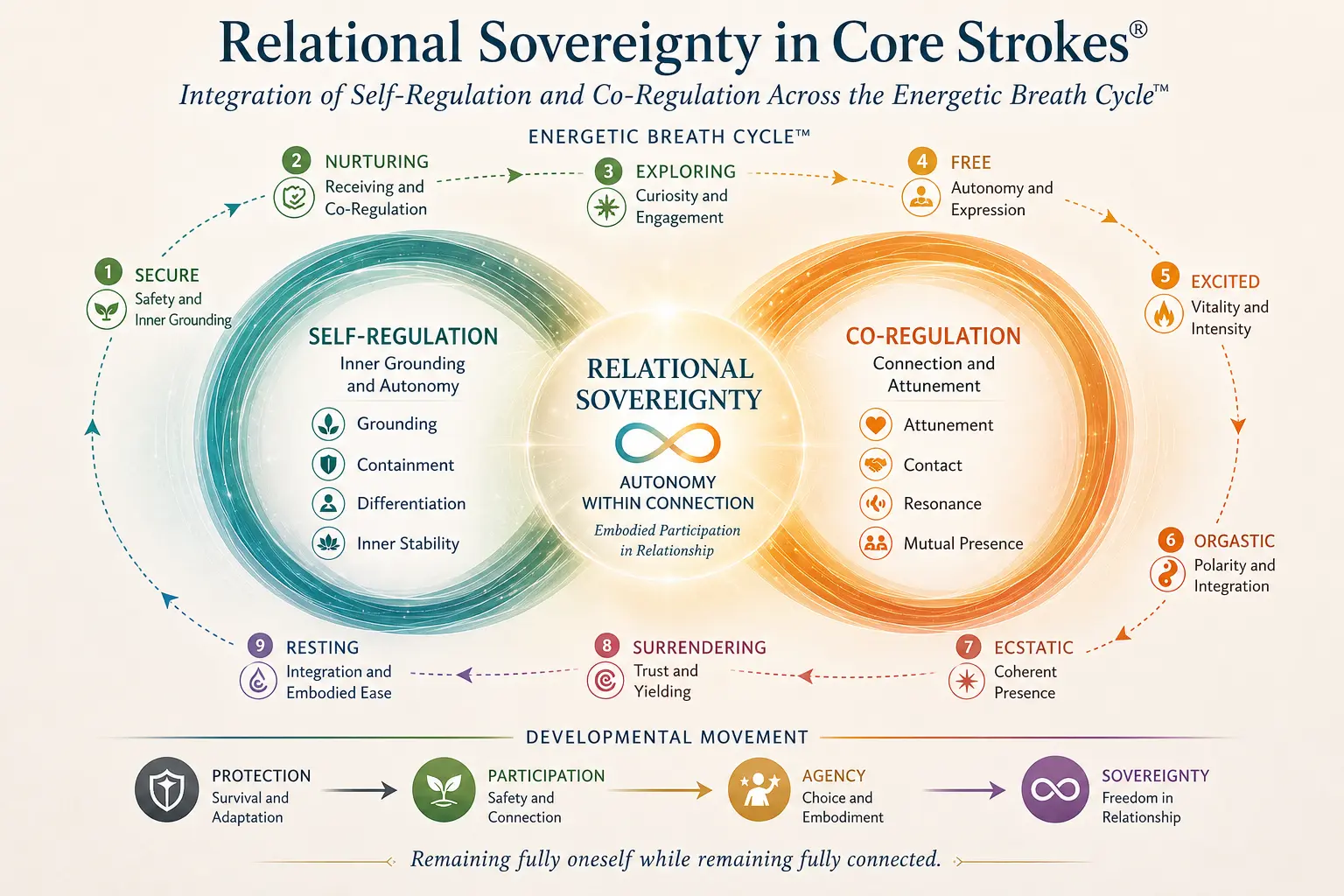
Relational Sovereignty and the Energetic Breath Cycle™
Relational sovereignty is not a separate developmental achievement added onto the Energetic Breath Cycle™.
It emerges through the gradual integration of the entire cycle.
The capacity to remain sovereign in relationship begins with Secure Breath, where the organism develops an embodied sense of safety and continuity. Without this foundation, connection remains organized around protection.
Through Nurturing Breath, the organism learns to receive support, nourishment, and co-regulation without losing its own coherence.
Through Exploring Breath, differentiation begins to emerge. Curiosity, initiative, and movement toward the world become possible while maintaining connection.
Free Breath deepens this process through the growing capacity to alternate between autonomy and relationship without excessive conflict between the two.
As development continues, Excited Breath introduces intensity. The organism learns to remain present with increasing energetic activation, emotional expression, attraction, vulnerability, and relational charge without fragmentation.
Orgastic Breath reflects a further integration of polarity. Receiving and expressing, yielding and asserting, self and other become increasingly capable of coexisting within a unified field of embodied participation.
Ecstatic Breath introduces coherent presence. The organism no longer organizes primarily around protection but around increasing openness, vitality, and participation.
Surrendering Breath allows trust to deepen without collapse. The individual can yield to connection, intimacy, support, and life itself while maintaining embodied continuity.
Finally, Resting Breath reflects stable contact. Regulation, participation, and coherence become increasingly self-sustaining across changing relational conditions.
Relational sovereignty is therefore not one phase of the cycle.
It is the developmental integration of the entire Energetic Breath Cycle™ expressed within relationship.
The organism becomes capable of remaining fully present with itself, fully present with another, and fully present with the living field that emerges between them.
Beyond Trauma: Sovereignty as Developmental Maturation
Trauma therapy often focuses on restoring regulation.
This is essential.
Without sufficient safety, autonomic flexibility, breath continuity, and embodied support, deeper developmental capacities remain difficult to access.
Yet regulation alone is not the final destination.
The restoration of regulation creates the conditions through which development can continue.
Within Core Strokes®, healing is not understood merely as symptom reduction. It also involves the gradual expansion of embodied capacities that may have been restricted, interrupted, or underdeveloped.
Relational sovereignty reflects one expression of this maturation.
As development unfolds, the organism becomes increasingly capable of remaining present during intimacy, conflict, vulnerability, difference, desire, disappointment, uncertainty, and change without abandoning itself or disconnecting from others.
This represents more than emotional stability.
It reflects an expansion of participation.
The individual becomes increasingly capable of meeting life directly rather than primarily through protective adaptation.
Relationship becomes less organized around fear and more organized around choice.
Expression becomes less reactive and more authentic.
Boundaries become less defensive and more embodied.
Connection becomes less dependent upon regulation and more available as a genuine expression of contact.
Relational sovereignty therefore reflects a developmental achievement rather than a personality trait.
It emerges through the ongoing integration of body, breath, fascia, emotion, relationship, and awareness.
It is not something one possesses.
It is something one continually embodies.
Relational Sovereignty and Embodied Participation
Within the Organization of Embodied Participation™, relational sovereignty reflects the growing capacity to remain coherent while participating fully in relational life.
The organism no longer needs to choose between autonomy and connection.
Differentiation and intimacy become mutually supportive rather than mutually exclusive.
The body no longer organizes primarily around protection.
It organizes around participation.
The breath remains available.
The fascia remains responsive.
Intensity becomes tolerable.
Presence becomes sustainable.
Connection becomes a choice rather than a necessity, a threat, or a strategy of survival.
Trauma organizes survival.
Integration restores continuity.
Relational sovereignty allows participation to emerge from coherence.
The organism remains connected to itself while remaining connected to life.
Part of the Core Strokes Development & Integration Series
These articles explore how trauma recovery unfolds as a developmental process within the Core Strokes® framework. Together they describe how breath, fascia, intensity regulation, and relational presence reorganize the body toward safety, vitality, and authentic contact.
Continue exploring:
Relationship as a Developmental Capacity — how self-regulation and co-regulation mature through relational contact
Polarity as Developmental Maturation — how masculine and feminine dynamics evolve through embodied development
Pelvic-Heart Integration— restoring the vertical axis between instinct, emotion, and relational expression
Soul Textures™— the experiential qualities of embodied integration within the Core Strokes process
Trauma as Restricted Development — how overwhelm limits access to safety, contact, and vitality
Intensity as Capacity — meeting strong activation without overwhelm
- The Organization of Embodied Participation
A phenomenological framework describing how continuity, coherence, permeability, metabolization, and defensive organization shape embodied and relational life.