Soul Resonance in Core Strokes®
The Felt Expression of Embodied Coherence
By Dirk Marivoet, Founder of Core Strokes® · Psychotherapist · Teacher · Author
Soul Resonance — Core Definition
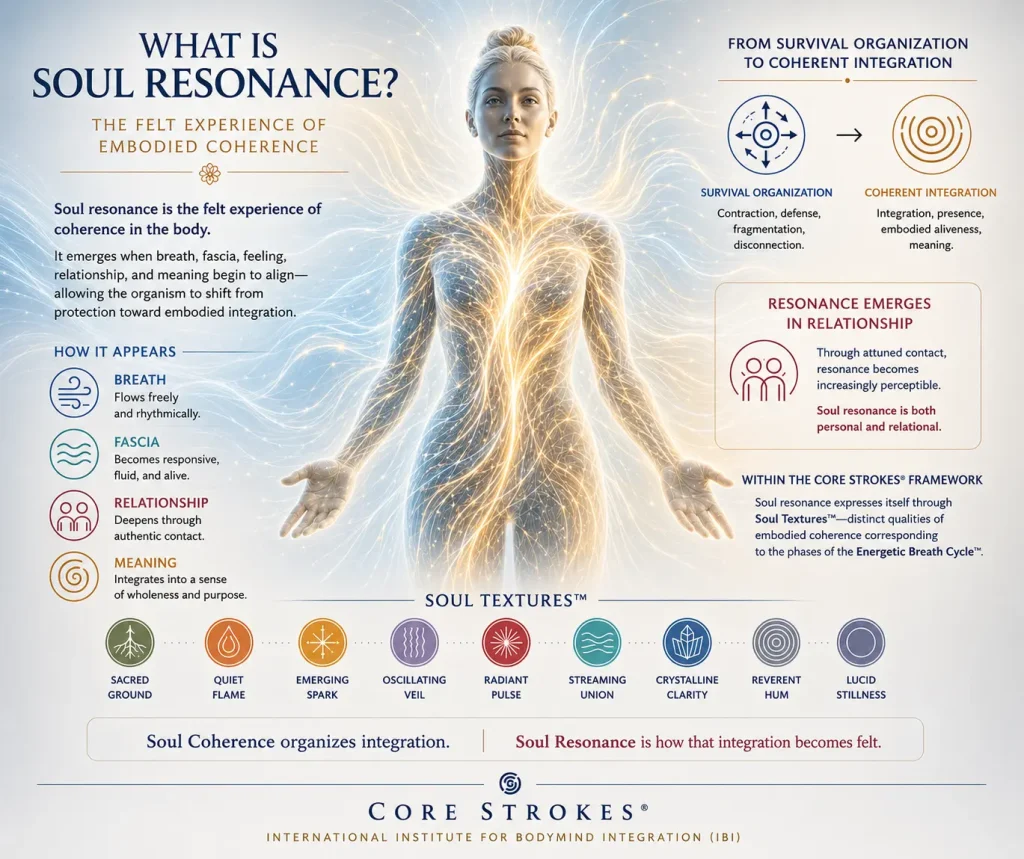
Soul Resonance refers to the lived experience of increasing integration becoming perceptible within embodied life.
Where Soul Coherence refers to the degree of integration within the organism, Soul Resonance refers to the felt expression of that integration.
A person may not consciously think about coherence, yet may experience growing aliveness, authenticity, emotional depth, meaningful participation, relational openness, or embodied presence. These qualities reflect resonance emerging from increasing organismic integration.
Soul Resonance therefore describes not what the organism knows conceptually, but what it directly experiences.
Why Soul Resonance Matters
Many therapeutic approaches focus primarily upon symptoms, trauma, emotional regulation, or defensive organization.
These are essential dimensions of healing.
Yet transformation also involves learning to recognize what emerges as defensive interference gradually softens.
People often describe moments when life feels unexpectedly vivid, meaningful, grounded, intimate, or true. A conversation may feel unusually real. A movement may feel deeply authentic. A simple moment of contact may carry unexpected depth and significance.
These experiences often reflect Soul Resonance.
They indicate that participation is becoming increasingly organized around embodied presence rather than defensive adaptation.
Within Core Strokes®, such experiences are not regarded as extraordinary events. They are natural expressions of increasing coherence becoming available within lived experience.
Soul Resonance and Soul Coherence
Soul Resonance and Soul Coherence describe closely related but distinct aspects of transformation.
Soul Coherence refers to the integration of breath, fascia, emotional life, relationship, meaning, and consciousness into a more unified organismic whole.
Soul Resonance refers to how that integration becomes felt, sensed, and lived within experience.
As coherence increases, many individuals experience greater continuity, aliveness, intimacy, authenticity, emotional depth, and meaningful participation. These experiences represent resonance emerging from increasing coherence.
In this sense, Soul Coherence describes the organization of integration, while Soul Resonance describes its phenomenology.
Soul Resonance and Soul Dimensions
Soul Dimensions describe the broad capacities that become available through increasing integration, including authenticity, vitality, intimacy, creativity, meaning, and participation.
Soul Resonance describes how these capacities become experientially felt.
A person may not consciously identify a particular Soul Dimension, yet may experience a growing sense of aliveness, depth, authenticity, meaningful connection, or embodied presence. These lived experiences often reflect the emergence of Soul Resonance.
How Soul Resonance Appears
Soul Resonance is not a single sensation, emotional state, or mystical experience.
Rather, it appears through recurring qualities of lived experience.
Although Soul Resonance is highly individual, certain qualities tend to appear repeatedly as coherence becomes increasingly available within experience.
A person may notice:
- Increased aliveness within the body
- Greater continuity between feeling and expression
- A deeper sense of presence
- More fluid participation in relationship
- Greater capacity to receive beauty, intimacy, or meaning
- Reduced effort in maintaining connection with self
- Increased authenticity during contact
- A quiet sense of inner rightness or alignment
Often these experiences arise naturally rather than through deliberate effort.
The organism gradually becomes more inhabitable from within.
A Relational Phenomenon
Soul Resonance rarely develops in isolation.
It often becomes most visible within relationship.
Through attuned presence, therapeutic contact, emotional honesty, shared attention, touch, movement, and authentic encounter, the organism may gradually discover new possibilities for participation.
As this occurs, the quality of contact changes.
Conversation may feel less constructed. Presence may deepen without effort. Vulnerability becomes more tolerable. Mutual recognition becomes more available.
Something within the interaction begins to feel increasingly alive.
Within Core Strokes®, Soul Resonance is therefore understood as both personal and relational.
It emerges not only within the individual organism, but within the quality of participation between organisms.
The Body as a Resonant System
The body is not merely a structure.
It is a resonant system.
Breathing, movement, fascia, emotional regulation, energetic responsiveness, nervous system organization, and relational participation continuously influence one another.
When defensive organization dominates, resonance may become restricted. Breathing narrows, sensation diminishes, movement becomes constrained, and participation may feel effortful or disconnected.
As continuity develops, the organism increasingly functions as a coherent field.
Breath moves more freely. Sensation becomes more continuous. Movement gains fluidity. Emotional life becomes increasingly metabolizable.
Resonance becomes easier to perceive because the organism no longer needs to devote as much energy to interruption.
Resonance and Meaning
One of the most distinctive aspects of Soul Resonance is its relationship to meaning.
Not conceptual meaning, but embodied significance.
Individuals often describe moments that feel quietly meaningful without needing explanation.
A simple interaction may feel deeply true. A movement may carry unexpected clarity. A moment of stillness may reveal a sense of participation larger than the immediate situation.
Meaning emerges directly through experience.
Within Core Strokes®, this reflects increasing resonance between embodiment, emotion, relationship, and consciousness.
The organism begins not only to understand life.
It begins to feel its significance.
Soul Resonance and Soul Textures™
Within Core Strokes®, Soul Textures™ describe recurring qualities of embodied coherence.
Soul Resonance becomes visible through these textures.
Sacred Ground expresses resonance through stability and rooted presence.
Quiet Flame expresses resonance through nourishment and receptivity.
Emerging Spark expresses resonance through curiosity and exploration.
Radiant Pulse expresses resonance through vibrant aliveness.
Streaming Union expresses resonance through continuity and relational flow.
Crystalline Clarity expresses resonance through luminous coherence.
Lucid Stillness expresses resonance through integrated rest and spacious presence.
Each Soul Texture™ represents a distinct expression of resonance within embodied life.
Soul Resonance and Therapeutic Transformation
Therapeutic transformation involves more than reducing symptoms or regulating activation.
It also involves increasing the organism’s capacity to feel its own coherence.
As breath deepens, fascia becomes more responsive, emotional life becomes increasingly integrated, and relational participation becomes more authentic, Soul Resonance often emerges naturally.
Individuals frequently report feeling more alive, more real, more connected, and more present.
Life gradually becomes less organized around protection and more organized around participation.
Resonance is not something created by therapy.
It is what becomes perceptible when defensive interference no longer dominates the organism’s organization.
In Summary
Within Core Strokes®, Soul Resonance refers to the lived experience of increasing embodied coherence.
It reflects the organism’s growing capacity to experience life with increasing immediacy, authenticity, depth, and participation.
As defensive organization softens and organismic continuity deepens, individuals often experience greater authenticity, aliveness, intimacy, emotional depth, meaningful participation, and embodied presence.
Soul Resonance therefore reflects the organism’s growing capacity to feel its own coherence.
Not as an idea.
But as a living experience.
A directly felt expression of embodied participation in life.
Explore Related Core Strokes® Concepts
→ The Organisation of Embodied Participation
The phenomenological foundation of Core Strokes®, describing how continuity, coherence, permeability, metabolisation, adaptive organisation, and relational geometry organise embodied life.
→ Defensive Organisation
A protective form of Adaptive Organisation in which participation becomes organised around experienced or anticipated threat, overwhelm, disruption, or loss of continuity.
→ Living Participation Observation System™ (LPOS™)
The observational methodology through which embodied and relational expressions are described before provisional organisational interpretations are developed.
→ Relationsl Field and Relational Geometry
The Relational Field is the embodied space of interaction. Relational Geometry describes how proximity, distance, boundaries, orientation, reciprocity, and differentiation are organised within it.
→ Energetic Breath Cycle™
A developmental map describing how breathing organises grounding, activation, emotional expression, surrender, and restoration throughout the organism.
→ Fascia Texture Typology™
A phenomenological framework for describing recurring tactile configurations and considering their possible organisational significance without treating them as diagnoses, personality types, or records of developmental history.
→ Neurofascial Encoding™
A proposed research framework exploring possible relationships among repeated participation, neural plasticity, behaviour, physiological regulation, movement, mechanical loading, and connective-tissue remodelling.
→ Neurofascial Transformation Process™
The therapeutic process through which breathing, fascia, movement, therapeutic touch, and relational participation gradually support lasting embodied transformation.
→ Therapeutic Touch
An embodied and relational practice guided by consent, clinical judgement, perceptual attention, and responsiveness rather than by mechanical intervention or predetermined interpretation.
→ Character Structures
A framework for exploring recurring developmental organisations of bodily, emotional, behavioural, and relational participation without reducing people to fixed types.
→ Soul Organisation, Soul Coherence, and Soul Textures ™
Interrelated dimensions of Core Strokes® concerned with authenticity, meaning, inner resonance, embodied presence, and relational participation. Soul Organisation names the wider qualitative domain; Soul Coherence describes increasing integrity among dimensions of experience; Soul Textures™ describe describe qualities of coherent participation; and Shadow Soul Textures™ describe qualitative expressions of protective, constrained, fragmented, or compensatory Adaptive Organisation.
These principles can also be explored directly through experiential practice within:
Conclusion — The Return to Coherence
Soul resonance is not something new that must be created.
It becomes perceptible when the organism no longer needs to maintain coherence primarily through fragmentation, chronic tension, collapse, or defensive interruption.
It reflects the organism’s inherent capacity for embodied coherence and living participation.
Therapeutic work is therefore not only about resolving trauma or reducing symptoms.
It is also about restoring the conditions under which resonance can gradually emerge.
When this happens, the body is no longer experienced primarily as a problem to manage or repair.
It becomes a living field of presence.
And within that field, something essential becomes recognizable again.
Not as an idea.
But as a felt, embodied truth.