🌿 Core Strokes Approach & Methods
A Developmental Somatic Psychotherapy Framework

Core Strokes® operates within the field of somatic psychotherapy and trauma-informed bodywork
→ What is Somatic Psychotherapy
→ Trauma and the Body
Core Strokes® integrates three dimensions of embodied organization. Breath organizes activation, emotional expression, and participation. Fascia reveals recurring organizational tendencies through movement, responsiveness, continuity, and tension distribution. Relationship provides the regulatory field through which embodied transformation becomes possible.
🔹 The Core Strokes® System at a Glance
A Phenomenological Framework of Embodied Organization
Core Strokes® approaches embodiment not primarily as fixed anatomy or symptom classification, but as a living organizational process.
Breathing, fascia, movement, emotional regulation, energetic activation, and relational participation are understood as interdependent expressions of how the organism organizes coherence under changing developmental and relational conditions.
Rather than focusing only on pathology or symptom reduction, Core Strokes® explores recurring patterns of embodied participation:
- how continuity is preserved,
- how openness is regulated,
- how defensive effort organizes,
- and how coherent presence gradually develops through embodied experience.
The maps and frameworks within Core Strokes® are therefore phenomenological-organizational maps —
ways of recognizing recurring patterns of embodied organization as they appear through breath, movement, tissue responsiveness, posture, energetic regulation, and relational participation.
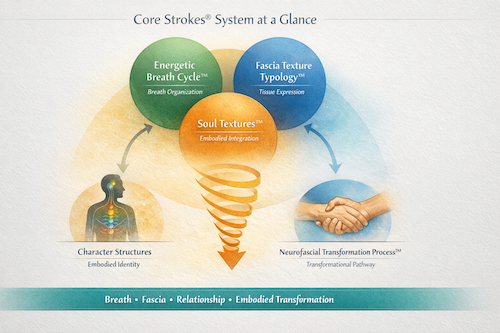
Core Strokes® System Overview
Breath organization, fascial expression, and relational regulation interact through the Neurofascial Transformation Process™ to support embodied transformation.
Core Strokes® integrates several complementary frameworks that together describe how human experience becomes embodied and how transformation unfolds.
The Core Strokes® framework can be understood through five complementary dimensions of embodied participation and organization.
🌬 Breath Organization
Energetic Breath Cycle™
A nine-phase developmental spiral describing how breathing organizes safety, activation, emotional expression, surrender, and rest.
🌿 Tissue Expression
Fascia Texture Typology™
A phenomenological system recognizing recurring organizational tendencies as they appear through tissue responsiveness, movement, continuity, and relational regulation.
🧍 Embodied Identity
Character Structures
Developmental adaptations shaping posture, breathing patterns, relational style, and emotional expression.
✨ Qualitative Integration
Soul Textures™
States of embodied coherence that emerge when breath, fascia, and relational regulation reorganize into integrated vitality.
🔄 Transformational Process
Neurofascial Transformation Process™
The therapeutic pathway through which breath continuity, fascial responsiveness, and relational presence support lasting change.
🔹 Developmental Foundations
Core Strokes® understands healing as developmental reorganization — not symptom suppression.
It works with breath, fascia, movement, touch, and relational presence to restore the body’s capacity for:
- safety
- contact
- vitality
- intensity tolerance
- relational coherence
More than a method, Core Strokes® is a living developmental model. Healing is understood as the gradual reopening of embodied capacities that were restricted by trauma, adaptation, or relational interruption.
Rather than “fixing” the body, we support the re-emergence of:
- full breath continuity
- fascial responsiveness
- regulated intensity
- sovereign relational presence
Through the integration of body, emotion, and relational experience, Core Strokes® supports trauma repair and developmental expansion across all levels of lived experience.
🔹 Three Foundational Frameworks
At the heart of this approach are three interwoven frameworks:

The Energetic Breath Cycle
A developmental map of how breath organizes safety, charge, release, and integration across nine recurring phases.
The Energetic Breath Cycle™ describes how breathing patterns shape perception, intensity tolerance, fascia organization, and relational presence.

The Fascia Texture Typology
A phenomenological system for reading how lived experience is expressed in tissue quality and responsiveness.
Rather than classifying fascia anatomically, this framework recognizes recurring textures — dense, elastic, fragmented, adhesive — that reflect adaptive organization and developmental history.

Soul Texture
The integration of polarity, vitality, and relational coherence into embodied presence.
Soul Textures™ describe the qualitative states of embodied coherence that emerge when breath, fascia, and relational regulation reorganize into integrated vitality.
How We Work
Core Strokes unfolds through four inseparable dimensions of therapeutic practice:
Breath — the organizing rhythm of safety, activation, surrender, and rest.
Touch — precise, respectful, and fascia-informed contact supporting perception, release, and integration.
Movement — grounding, charging, oscillating and streaming through the body’s inherent wave-like organization.
Dialogue — giving language to sensation, affect, imagery, and relational dynamics as they emerge.
Together, these elements create a relational field in which defensive organization can soften and reorganize into choice.
In Core Strokes®, breath is not merely a regulation technique.
Breathing is understood as a developmental capacity that organizes how safety, intensity, and connection are lived in the body.
When experience is overwhelming or insufficient, access to certain breath phases becomes restricted — limiting how much vitality, feeling, and contact can be sustained.
→ Read more: Breath and Trauma

🔹 What Makes Core Strokes Unique?
- Core Strokes® stands within the lineage of body-oriented psychotherapy — informed by the work of Jack Painter and John Pierrakos — while developing its own coherent developmental architecture.
- Its distinctiveness lies in:
- a fascia-informed, phenomenological reading of lived experience
- a spiral developmental model integrating
trauma, character organization, and embodied maturation - the integration of breath phases with tissue textures and relational dynamics
- a continuous balance between clinical precision and creative responsiveness
- For deeper theoretical exploration:
→ Trauma as Restricted Development
→ Intensity as Capacity
→ Energetic Breath Cycle

🔹 From Framework to Clinical Application
Core Strokes® is both a theoretical framework and a clinically applied method.
Its foundations — breath, fascia, intensity regulation, relational presence — form the developmental map.
Its applications translate that map into work with:
- complex trauma
- attachment trauma
- dissociation
- relational instability
- emotional dysregulation
And its training modules provide the embodied pathway through which practitioners integrate this work in lived practice.
If you are exploring Core Strokes® for trauma therapy:
→ How Core Strokes® Works with Trauma
If you are seeking embodied experience:
🔹 Where to Begin
You may begin by:
- Exploring the Practices page for simple embodied invitations.
- Reading the Resources page for theoretical articles and diagrams.
- Joining a Core Strokes® Workshop to experience the work directly.

✨ Core Strokes® is not only a method — it is a developmental orientation.
“At the CORE, life is movement, breath, and relationship.
When these flow, the body becomes a vessel of presence
— capable of healing, joy, and connection.”