Relational Field in Core Strokes®
How Relationship Organises Embodied Experience
By Dirk Marivoet, Founder of Core Strokes® · Psychotherapist · Teacher · Author
Relational Field — Core Definition
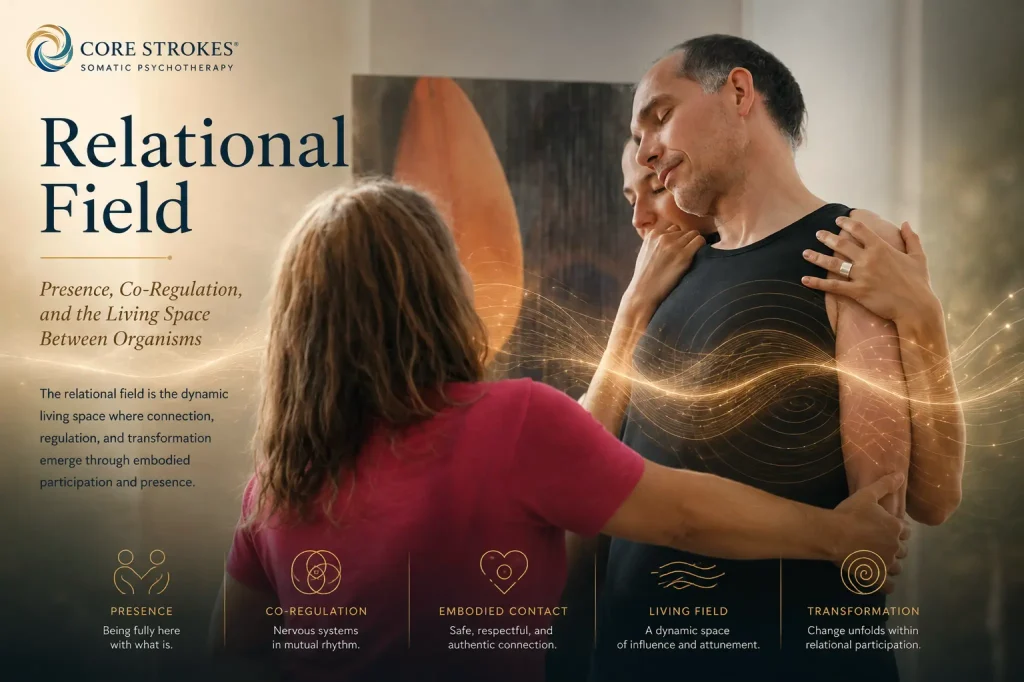
The relational field refers to the dynamic embodied space that emerges between organisms in contact.
Within Core Strokes®, the relational field includes emotional exchange, autonomic co-regulation, energetic responsiveness, nonverbal communication, movement interaction, and the continuity or interruption of embodied presence between individuals.
Human beings continuously influence one another through breathing rhythms, posture, gaze, movement, emotional expression, touch, and nervous system responsiveness.
The relational field therefore shapes how safety, connection, regulation, openness, defense, and participation are experienced within relationship.
Relational Geometry and the Relational Field
Within Core Strokes®, the term Relational Geometry refers to the ways the organism organises proximity, distance, boundaries, contact, differentiation, and connection within relationship.
The Relational Field can be understood as the living space in which this relational geometry becomes embodied and observable. It is through the relational field that patterns of closeness and distance, openness and protection, mutuality and autonomy, attachment and differentiation continuously unfold.
Some individuals organise relationship through increased distance and self-protection. Others move toward contact while struggling to maintain differentiation. Still others oscillate between longing for connection and fearing it. These patterns are not merely psychological; they are expressed through breathing, movement, posture, emotional regulation, autonomic responsiveness, energetic activation, and embodied participation.
Relational Geometry therefore describes the organisational structure of relationship, while the Relational Field describes the living experiential space through which that structure becomes visible.
Together they help illuminate how human beings organise participation within relationship throughout development and transformation.
Why the Relational Field Matters
Human development unfolds within relationship.
From the beginning of life, touch, gaze, rhythm, voice, emotional responsiveness, rupture, repair, and embodied contact shape how the organism organises breathing, emotional regulation, fascial responsiveness, attachment, and continuity of self-experience.
These experiences gradually become embodied. Over time, they influence how a person approaches intimacy, vulnerability, trust, expression, conflict, and participation in relationship.
Within Core Strokes®, many forms of emotional suffering can therefore be understood partly as disturbances in relational participation. A person may continue relating outwardly while internally anticipating rejection, intrusion, abandonment, engulfment, shame, overwhelm, or instability.
Therapeutic transformation involves gradually restoring safer, more coherent, and more embodied forms of relational participation.
The Relational Field and the Body
The relational field is always embodied.
Human beings continuously communicate through breathing rhythms, posture, movement, gaze, muscular tone, facial expression, vocal quality, pacing, touch, energetic activation, and nervous system responsiveness.
A person entering a room often senses immediately whether the atmosphere feels welcoming, tense, emotionally alive, disconnected, performative, chaotic, or safe — long before conscious interpretation occurs. The body continuously reads relational information.
A softening gaze may reduce defensive activation. An emotionally attuned voice may support regulation. Intrusive proximity may trigger contraction. Emotional unpredictability may increase vigilance. Grounded presence may gradually support safety and settling.
Participation in relationship can often be observed in simple moments — how someone receives touch, maintains eye contact, approaches closeness, responds during emotional intensity, tolerates disagreement, or remains present during vulnerability.
Qualities perceived through touch may change during relational contact. Such changes can be considered alongside breathing, posture, movement, emotional expression, context, and the person’s report. They do not, by themselves, establish trust, fear, trauma, attachment organisation, or any other psychological meaning.
Within Core Strokes®, the body is therefore understood as a living expression of relationship rather than a separate structure existing outside it.
Healthy Relational Field
Healthy relational fields support increasing safety, flexibility, differentiation, emotional continuity, and embodied participation.
Within such fields, people can remain connected without excessive fusion, withdrawal, collapse, domination, or fragmentation of self-experience. Emotion becomes more metabolisable, conflict becomes more workable, and vulnerability becomes increasingly possible without immediate disorganisation or defensive shutdown.
The body often reflects this directly. Breathing becomes more continuous, movement remains responsive, emotional expression becomes more authentic, and fascial tone retains adaptability rather than becoming chronically armored or collapsed.
Healthy relational fields do not eliminate tension, rupture, difference, or emotional intensity. Rather, they support sufficient continuity and repair for participation to remain possible even during challenge, vulnerability, and change.
Within Core Strokes®, healing does not occur through perfect relationships, but through increasing capacity for embodied participation within imperfect yet sufficiently coherent relational fields.
Disturbances in the Relational Field
Relational fields may become shaped by fear, instability, intrusion, emotional inconsistency, shame, unpredictability, absence, domination, emotional flooding, or chronic defensive adaptation.
When participation repeatedly becomes unsafe or disorganising, the organism often develops protective strategies. Some individuals withdraw emotionally, reduce vulnerability, or cultivate hyper-independence. Others become hypervigilant, overadapt to the needs of others, assume chronic caretaking roles, or seek control in order to maintain a sense of safety.
Over time, the nervous system may become highly sensitive to subtle shifts in tone, facial expression, emotional atmosphere, or interpersonal distance. In other cases, the organism may disconnect from feeling, bodily awareness, or emotional expression altogether in order to reduce overwhelm.
These adaptations influence attachment organisation, emotional regulation, defensive patterns, energetic responsiveness, and continuity of self-experience. Within Core Strokes®, such difficulties are understood not as personality defects, but as embodied survival organisations that emerged within earlier relational environments.
As a result, relationship itself may gradually come to be experienced as exhausting, unsafe, unpredictable, or destabilising, even when present circumstances no longer require the same protective responses.
Relational Field and Co-Regulation
Within Core Strokes®, co-regulation refers to the organism’s capacity to regulate through embodied relational contact.
Human nervous systems continuously influence one another.
A grounded and emotionally regulated presence may gradually help another organism settle, soften, breathe more fully, and regain continuity. Likewise, chronic dysregulation, emotional unpredictability, intrusion, or fragmentation within the field may increase defensive activation, vigilance, collapse, or emotional instability.
Co-regulation can often be observed in ordinary moments — a calm and attuned presence helping someone settle during emotional intensity, supportive eye contact reducing defensive withdrawal, or a regulated voice helping breathing and emotional activation soften.
Healthy co-regulation does not mean emotional dependence or fusion.
Rather, it supports increasing self-regulation, differentiation, flexibility, embodied safety, and continuity of self within relationship.
Within Core Strokes®, therapeutic work therefore involves helping the organism gradually develop increasing capacity to remain present, embodied, emotionally responsive, and relationally connected without losing grounded continuity.
Relational Field and Therapeutic Transformation
Within Core Strokes®, therapeutic transformation unfolds partly through the quality of the relational field itself.
The therapeutic relationship becomes a living environment in which new forms of contact, expression, regulation, and participation can gradually emerge. For many individuals, healing involves experiences that were previously unavailable or emotionally unsafe — support without engulfment, boundaries without rejection, vulnerability without collapse, expression without shame, and closeness without loss of self.
As the relational field becomes increasingly coherent and trustworthy, previously necessary protective adaptations may become less dominant, allowing greater flexibility, expression, and choice. A person who once anticipated criticism may gradually risk authentic expression and remain emotionally present during contact.
These shifts are not merely cognitive. Breathing may deepen, fascia may become more responsive, emotional experience becomes increasingly metabolisable, and movement often becomes more spontaneous and less defended. The organism develops greater capacity to remain emotionally available, embodied, and relationally engaged during contact.
Within Core Strokes®, transformation therefore unfolds not through interpretation alone, but through repeated experiences of safer embodied relationship.
Over time, relationship becomes less organised around self-protection and more organised around vitality, authenticity, mutuality, and living participation.
Relational Field and Soul Coherence
As relational participation becomes increasingly coherent, embodied, and emotionally regulated, relationship itself may gradually feel less organised around defense and more organised around presence, mutuality, meaning, authenticity, and living contact.
A person may gradually develop increasing capacity to remain emotionally open while grounded, receive support without collapse, express vulnerability without fragmentation, maintain boundaries without defensive isolation, and participate relationally without losing continuity of self.
Contact becomes less performative, defended, or survival-oriented and increasingly rooted in embodied presence and authentic participation.
In this sense, the relational field contributes directly to the emergence of Soul Coherence — the organism’s capacity to inhabit relationship and life with increasing integrity, responsiveness, embodiment, flexibility, and meaningful participation.
Relational Field and the Energetic Breath Cycle™
Within the Energetic Breath Cycle™, relational participation develops progressively through safety, receptivity, exploration, emotional expression, surrender, and embodied contact.
Disturbances within early relational fields may interrupt these developmental capacities, shaping defensive organisation, emotional regulation, energetic participation, and continuity of self-experience.
Therapeutic transformation therefore involves gradually restoring increasing capacity for embodied relational participation throughout the organism.
In Summary
Within Core Strokes®, the relational field refers to the living embodied space of emotional, autonomic, energetic, and experiential exchange that emerges between organisms in contact.
The relational field continuously influences regulation, attachment, emotional organisation, embodied participation, and continuity of self-experience. It shapes how safety, connection, vulnerability, expression, and relationship are experienced throughout life.
Therapeutic transformation therefore unfolds not only within the individual organism, but also within the quality of relational participation itself.
As relational coherence deepens, the organism develops increasing capacity for grounded presence, emotional flexibility, intimacy, authenticity, vitality, and meaningful participation in life.
The Relational Field is one of the principal relational dimensions through which living participation becomes embodied and observable within Core Strokes®.
Explore Related Core Strokes® Concepts
→ The Organisation of Embodied Participation
The phenomenological foundation of Core Strokes®, describing how continuity, coherence, permeability, metabolisation, adaptive organisation, and relational geometry organise embodied life.
→ Defensive Organisation
A protective form of Adaptive Organisation in which participation becomes organised around experienced or anticipated threat, overwhelm, disruption, or loss of continuity.
→ Living Participation Observation System™ (LPOS™)
The observational methodology through which embodied and relational expressions are described before provisional organisational interpretations are developed.
→ Relational Field and Relational Geometry
The Relational Field is the embodied space of interaction. Relational Geometry describes how proximity, distance, boundaries, orientation, reciprocity, and differentiation are organised within it.
→ Energetic Breath Cycle™
A developmental map describing how breathing organises grounding, activation, emotional expression, surrender, and restoration throughout the organism.
→ Fascia Texture Typology™
A phenomenological framework for describing recurring tactile configurations and considering their possible organisational significance without treating them as diagnoses, personality types, or records of developmental history.
→ Neurofascial Encoding™
A proposed research framework exploring possible relationships among repeated participation, neural plasticity, behaviour, physiological regulation, movement, mechanical loading, and connective-tissue remodelling.
→ Neurofascial Transformation Process™
The therapeutic process through which breathing, fascia, movement, therapeutic touch and relational participation can contribute to embodied reorganisation and therapeutic transformation.
→ Therapeutic Touch
An embodied and relational practice guided by consent, clinical judgement, perceptual attention, and responsiveness rather than by mechanical intervention or predetermined interpretation.
→ Character Structures
A framework for exploring recurring developmental organisations of bodily, emotional, behavioural, and relational participation without reducing people to fixed types.
→ Soul Organisation, Soul Coherence, and Soul Textures ™
Interrelated dimensions of Core Strokes® concerned with authenticity, meaning, inner resonance, embodied presence, and relational participation. Soul Organisation names the wider qualitative domain; Soul Coherence describes increasing integrity among dimensions of experience; Soul Textures™ describe qualities of coherent participation; and Shadow Soul Textures™ describe qualitative expressions of protective, constrained, fragmented, or compensatory Adaptive Organisation.
These principles can also be explored directly through experiential practice within:
Closing Invitation
The relational field is explored experientially throughout Core Strokes® workshops, trainings, and therapeutic practice.
Through breath, movement, fascia-oriented work, emotional process, energetic activation, therapeutic touch, and relational presence, participants gradually begin recognising how deeply human experience is shaped within embodied relational participation.
Within Core Strokes®, healing does not occur through technique alone, but through the gradual emergence of safer, more coherent, embodied, and emotionally responsive relational fields.
As relational participation deepens, many people discover increasing capacity to remain present during intimacy, grounded during vulnerability, emotionally open without collapse, and connected without losing continuity of self.
Breathing often becomes more continuous. Emotional expression becomes more authentic. The body becomes more responsive and alive within contact.
Relationship gradually becomes less organised around defense and more organised around presence, mutuality, participation, and embodied aliveness.
In this sense, therapeutic transformation involves not merely changing internal states, but rediscovering the organism’s capacity to participate relationally in life with increasing coherence, embodiment, flexibility, and authenticity.