Therapeutic Presence in Core Strokes®
The Relational Field of Somatic Transformation
Therapeutic Presence — Core Definition
Therapeutic presence in somatic psychotherapy refers to the practitioner’s embodied capacity to remain regulated, relationally responsive, and emotionally attuned while accompanying another person through processes of activation, expression, and integration.
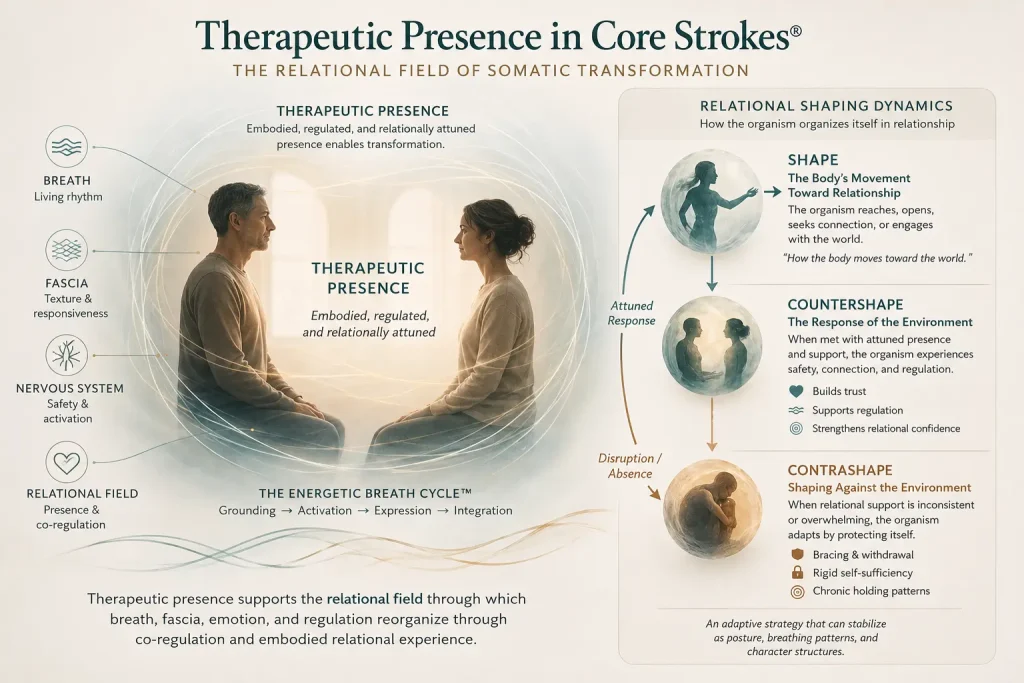
Within the Core Strokes® framework, therapeutic presence supports co-regulation, embodied awareness, breath continuity, fascial responsiveness, and the organism’s capacity for therapeutic transformation.
Introduction
Transformation in somatic psychotherapy does not arise through technique alone.
Change unfolds within a relational field where breath, body, emotional experience, and nervous system regulation can gradually reorganize in conditions of sufficient safety, responsiveness, and embodied participation.
Within Core Strokes®, transformation unfolds through a therapeutic field shaped by embodied presence, emotional regulation, breath, fascia, and co-regulation.
The practitioner’s capacity to remain grounded, responsive, and relationally attuned becomes one of the central conditions supporting therapeutic change.
Rather than directing the client’s experience toward predetermined outcomes, the practitioner supports the conditions in which the organism’s own self-organizing intelligence can gradually emerge and unfold.
In this way, therapeutic presence becomes the living context through which breath, fascia, emotional regulation, and relational participation reorganize over time.
Presence as Embodied Regulation
Therapeutic presence begins with the practitioner’s own embodied regulation.
Because the therapeutic field is relational, the practitioner’s nervous system continuously influences the client’s experience of safety, activation, openness, and regulation.
Within Core Strokes®, practitioners therefore cultivate awareness of breathing rhythm, bodily grounding, emotional resonance, relational contact, and energetic activation while remaining present during emotionally charged or vulnerable processes.
This regulated embodied presence becomes an orienting reference point within the relational field.
When the practitioner remains grounded and responsive, the client’s nervous system may gradually develop greater flexibility and tolerance for vulnerability, activation, and embodied participation.
In this sense, therapeutic presence supports co-regulation not through control or intervention alone, but through the organismic effects of embodied relational stability.
Presence as Relational Perception
Therapeutic presence also involves a refined form of embodied perception.
The practitioner learns to perceive subtle shifts in breath rhythm, posture, fascial tone, movement impulses, affective intensity, and relational contact as they emerge moment by moment within the therapeutic process.
These signals often appear before experience becomes fully verbalized or consciously recognized.
A small interruption in breathing, a change in muscular tone, subtle collapse within posture, or fluctuations in activation may all communicate important information about how the organism is organizing experience in the present moment.
Through embodied attention and relational attunement, practitioners gradually develop increasing sensitivity to these unfolding processes without imposing interpretation prematurely.
The body itself becomes part of the therapeutic dialogue.
The Therapeutic Field as a Living System
Human regulation develops through relationship.
From infancy onward, the organism learns safety, expression, contact, and emotional regulation through repeated experiences of co-regulation with others.
Within psychotherapy, the therapeutic relationship therefore becomes a living relational environment in which earlier patterns of regulation, defense, and participation may gradually reorganize.
The practitioner’s presence influences breathing rhythm, emotional safety, autonomic activation, and the organism’s capacity to remain present with experience.
When the therapeutic field becomes sufficiently stable and attuned, experiences that once felt overwhelming, fragmenting, or emotionally inaccessible may gradually become tolerable and metabolizable.
Within Core Strokes®, therapeutic presence therefore functions not simply as support, but as an active relational condition through which embodied transformation becomes possible.
Presence, Breath, and Fascial Responsiveness
Within Core Strokes®, therapeutic presence includes sensitivity to how breath and fascia participate in emotional and relational organization.
Breathing rhythms continuously reflect changes in activation, openness, defensive contraction, and energetic participation. Fascia likewise responds dynamically to emotional intensity, relational contact, and nervous system regulation.
Subtle changes in breathing continuity, tissue responsiveness, muscular holding, posture, or movement impulses often reveal shifts occurring within the organism long before they are consciously articulated.
Through therapeutic presence, practitioners learn to recognize these changes without forcing interpretation or imposing direction upon the process.
This sensitivity allows therapeutic pacing to remain aligned with the organism’s natural rhythms of activation, expression, settling, and integration.
As breath continuity increases and defensive organization softens, emotional expression and fascial responsiveness may gradually reorganize through the Neurofascial Transformation Process™.
Presence and Relational Organization
Therapeutic presence unfolds within a broader relational organization shaped by developmental history, attachment dynamics, and embodied patterns of participation.
Within the Core Strokes® framework, relational dynamics often express themselves through processes of shape, countershape, and contrashape — the organism’s ways of reaching, responding, adapting, defending, or withdrawing within relationship.
The therapeutic field therefore becomes a living space in which earlier relational organizations can gradually emerge into awareness and reorganize through new experiences of embodied contact.
Developmental needs related to safety, support, expression, autonomy, intimacy, and recognition may become visible through breathing, posture, movement, emotional expression, and relational orientation.
Therapeutic presence supports these processes not by forcing change, but by allowing previously restricted forms of participation to emerge within a more coherent relational field.
Attunement and Relational Contact
Therapeutic presence also involves attunement.
Attunement refers to the practitioner’s capacity to sense subtle shifts in the client’s breathing, posture, emotional tone, and energetic expression.
These signals may appear as:
- changes in breathing depth
- shifts in fascial tone
- alterations in posture or movement impulses
- variations in emotional expression
By remaining attentive to these signals, the practitioner supports the client’s process without imposing direction.
Therapy thus becomes a collaborative exploration rather than a corrective intervention.
Presence and Therapeutic Transformation
Within Core Strokes®, therapeutic transformation unfolds through increasing continuity between embodiment, emotional experience, relational participation, and organismic regulation.
As the therapeutic field becomes more stable and attuned, the organism may gradually develop greater capacity for openness, embodied regulation, vitality, relational contact, and authentic participation.
Breathing often becomes more continuous. Fascial responsiveness becomes more dynamic and alive. Emotional expression becomes increasingly metabolizable rather than overwhelming or defended.
The organism gradually becomes less organized around chronic protection, fragmentation, collapse, or defensive self-management and more capable of grounded relational participation.
Therapeutic presence therefore does not create transformation directly.
Rather, it supports the relational and organismic conditions through which transformation can unfold naturally.
Conclusion — Presence as the Ground of Transformation
Techniques and therapeutic concepts may guide the process, but transformation ultimately unfolds within the living field of relationship.
Therapeutic presence allows the organism to experience regulation, contact, expression, and embodied participation in new ways.
Within Core Strokes®, this embodied relational presence supports the gradual integration of breath, fascia, emotional life, nervous system regulation, and relational experience into increasing coherence.
Through this process, the organism may gradually rediscover greater capacity for vitality, connection, flexibility, authenticity, and embodied participation in life.
Part of the Core Strokes Foundational Framework
Core Strokes® integrates breath, fascia, relational presence, developmental psychology, and phenomenological observation into a unified framework of embodied organization and somatic psychotherapy.
Explore related dimensions of the framework:
→ Relational Field in Core Strokes®
→ Relational Attunement in Core Strokes®
→ Co-Regulation in Core Strokes®
→ Participation in Core Strokes®
→ Neurofascial Transformation Process™
→ Autonomic Regulation in Core Strokes®
→ Developmental Needs and Relational Regulation
Closing Invitation
Therapeutic presence is cultivated experientially throughout Core Strokes® workshops, trainings, and professional practice.
Practitioners gradually develop increasing sensitivity to breath, tissue responsiveness, emotional expression, nervous system regulation, and relational contact as they unfold within the therapeutic field.
Through embodied awareness, relational attunement, and phenomenological observation, participants learn how therapeutic transformation emerges not only through technique, but through the quality of embodied presence itself.
As this capacity deepens, the therapeutic relationship becomes less organized around correction or control and increasingly rooted in responsiveness, participation, regulation, and living relational contact.
Frequently Asked Questions
“Core Strokes® emerged through decades of clinical, developmental, and phenomenological exploration into the organization of embodied participation.”