Pelvic–Heart Integration® in Core Strokes®
Restoring Vitality Within Relational Coherence
By Dirk Marivoet, Founder of Core Strokes® · Psychotherapist · Teacher · Author
Pelvic–Heart Integration® — Core Definition
Pelvic–Heart Integration® refers to the developmental reorganization through which vitality and intimacy become increasingly coordinated within embodied participation.
Instinct, desire, emotional resonance, relational presence, expressive capacity, and embodied feeling gradually become capable of cooperating within a larger coherence. The organism develops increasing capacity to experience intensity without losing connection, openness without collapse, and desire without disconnection from relationship.
Within Core Strokes®, Pelvic–Heart Integration® is not understood as the integration of sexuality alone. It reflects a broader developmental process through which instinct and relationship, vitality and tenderness, desire and emotional presence become increasingly integrated within embodied life.
As this process unfolds, capacities that were once divided by trauma or defensive adaptation become capable of functioning together. The organism develops greater freedom to participate fully in relationship while remaining grounded in its own vitality, authenticity, and embodied presence.
Trauma and the Separation of Vitality and Intimacy
Developmental trauma frequently disrupts the natural relationship between vitality and intimacy.
Experiences that are overwhelming, intrusive, neglectful, shaming, emotionally inconsistent, or insufficiently supportive may teach the organism that aliveness is unsafe. Desire may become separated from connection, intensity from tenderness, sexuality from intimacy, or vitality from emotional presence.
In order to preserve attachment, safety, or continuity, the organism adapts. Some individuals learn to restrict desire and vitality in order to remain connected. Others amplify intensity while remaining emotionally defended. Still others withdraw from both vitality and intimacy through collapse, fragmentation, or dissociation.
Although these adaptations differ in appearance, they serve a common purpose: preserving continuity under conditions where full participation became difficult or impossible.
Over time, capacities that naturally belong together become increasingly divided. Vitality may lose its connection to relationship, while intimacy may become disconnected from embodied aliveness. The pelvic–heart axis gradually loses coherence, and the organism becomes organized around protection rather than participation.
Pelvic–Heart Integration® describes the developmental restoration of this continuity, allowing vitality and intimacy to cooperate once again within embodied life.
The Pelvic–Heart Axis as Embodied Organization
Within Core Strokes®, the pelvic–heart axis is not merely a symbolic idea.
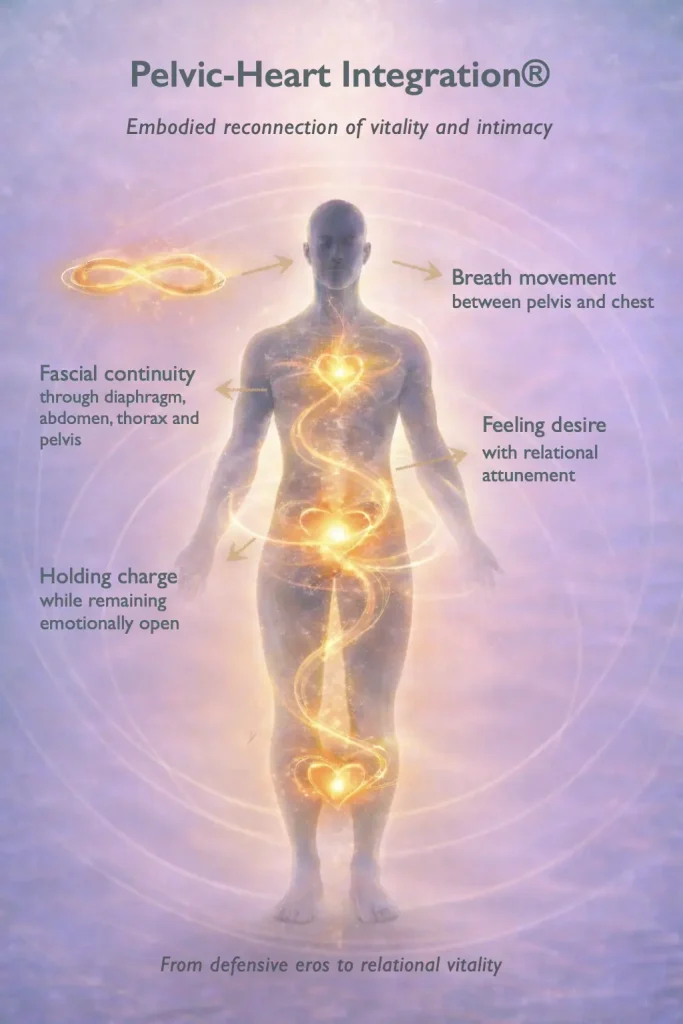
It can be observed in the movement of breath between pelvis and chest, in the continuity of fascial organization through the abdomen and diaphragm, in postural alignment, in the capacity to sustain intensity while remaining emotionally open, and in the ability to experience desire without losing relational attunement.
When regulation is flexible, vitality and intimacy remain connected. The organism can experience aliveness, emotional openness, relational contact, and expressive capacity as mutually supportive dimensions of experience. Desire can participate in connection, and connection can remain alive with vitality.
When trauma disrupts this axis, vitality and emotional resonance often become separated. Breath may fragment between upper and lower body. Desire may bypass emotional presence. Openness may become difficult to sustain under activation. The body gradually organizes around compensation rather than coherence.
As developmental repair unfolds, continuity between these dimensions gradually returns. Vitality becomes increasingly relational, intimacy increasingly embodied, and desire increasingly integrated with emotional presence. What was once divided becomes increasingly capable of functioning together within a larger coherence.
Pelvic–Heart Integration® restores continuity across these dimensions, allowing vitality and intimacy to cooperate within embodied participation rather than functioning in separation.
Breath as the Organizing Bridge
Breath plays a central role in Pelvic–Heart Integration®.
Breathing links grounding and expression, charge and containment, instinct and feeling. As breathing becomes increasingly continuous and adaptable, the organism develops greater capacity to sustain vitality while remaining emotionally present and relationally connected.
Within the Energetic Breath Cycle™, this developmental maturation becomes particularly visible through the progression from Free Breath to Excited Breath, Orgastic Breath, and Ecstatic Breath. Across these phases, receptivity and expression, vitality and intimacy, gradually become more coordinated and capable of functioning together within a larger coherence.
Breath therefore serves as a living bridge between pelvis and heart. As continuity develops, charge becomes more sustainable, contact more coherent, and vitality increasingly capable of participating in relationship. What was once organized around protection gradually becomes capable of supporting connection, intimacy, and embodied participation.
From Defensive Eros to Relational Vitality
When vitality becomes organized around survival, eros may lose its connection to relationship.
Desire may become compulsive, inhibited, emotionally defended, performative, or difficult to access. Intensity may function as protection rather than participation, and vitality may become separated from emotional presence and relational meaning.
As pelvic–heart coherence develops, vitality gradually reorganizes. Desire becomes increasingly relational, pleasure increasingly embodied, and intensity increasingly sustainable. Emotional openness and vitality cease to function as opposing forces and become capable of supporting one another.
Eros shifts from survival organization toward relational vitality. Desire no longer needs to defend against connection, and connection no longer requires the restriction of vitality. Intimacy becomes more alive, vitality more relational, and participation more fully embodied.
Neither suppressed nor uncontrolled.
Integrated.
Fascial Continuity and Structural Coherence
Pelvic–Heart Integration® is expressed not only emotionally but also structurally.
The fascia linking the pelvis, abdomen, diaphragm, chest, and throat participates in the transmission and modulation of charge throughout the body. Through breathing, movement, emotional experience, and relational participation, this network gradually becomes more responsive, adaptable, and coherent.
As fascial continuity increases, vitality can circulate with greater freedom rather than becoming trapped, fragmented, or disconnected across segments. The organism experiences increasing internal continuity as regions that were once divided gradually become linked through a more integrated organization of breath, movement, sensation, and feeling.
What was once organized primarily around protection becomes increasingly capable of supporting participation. Structural coherence and emotional coherence begin to reinforce one another, allowing vitality and intimacy to remain connected across a broader range of experience.
Pelvic–Heart Integration® and Relational Sovereignty
As vitality and intimacy become increasingly coordinated, new relational capacities emerge.
The organism develops greater ability to remain open without losing boundaries, to experience intensity without domination, to receive without collapse, and to express desire without sacrificing connection. Capacities that once appeared incompatible gradually become capable of cooperating within the same relational field.
Vitality no longer requires aggression. Intimacy no longer requires fusion. Autonomy no longer requires withdrawal. Instead, relationship becomes increasingly capable of supporting both individuality and mutuality, openness and self-definition, connection and freedom.
In this sense, Pelvic–Heart Integration® contributes directly to the development of relational sovereignty. The organism becomes increasingly able to participate in relationship without sacrificing either connection or selfhood.
Pelvic–Heart Integration®, Soul Organization, and Soul Coherence
As vitality and intimacy become increasingly integrated, the organism develops greater capacity for authenticity, tenderness, desire, creativity, relational depth, and meaningful participation.
The split between instinct and relationship gradually softens. Vitality no longer needs to bypass connection, and connection no longer requires the restriction of vitality. Capacities that were once organized in separation become increasingly capable of cooperating within a larger coherence.
Within Core Strokes®, this developmental reorganization contributes directly to Soul Organization and Soul Coherence. The organism becomes increasingly capable of participating in life through a more unified experience of body, emotion, energy, relationship, and meaning.
From Survival to Coherent Vitality
Trauma often separates capacities that naturally belong together. Vitality becomes separated from intimacy, desire from emotional presence, and instinct from relationship.
Developmental repair gradually restores continuity between these dimensions, allowing the organism to participate in life with increasing coherence, freedom, and embodied presence.
Pelvic–Heart Integration® therefore reflects the organism’s movement from survival organization toward coherent vitality. Breathing becomes more continuous, fascial organization more responsive, intensity more sustainable, and connection more authentic. Vitality and intimacy become increasingly capable of cooperating within embodied participation.
This is not merely trauma recovery.
It is the restoration of developmental capacity and the maturation of embodied participation.
Part of the Core Strokes Development & Integration Series
These articles explore how trauma recovery unfolds as a developmental process within the Core Strokes® framework. Together they describe how breath, fascia, intensity regulation, and relational presence reorganize the body toward safety, vitality, and authentic relational contact.
Continue exploring these concepts
Relationship as a Developmental Capacity — how self-regulation and co-regulation mature through relational contact
Relational Sovereignty— integration of self-regulation and co-regulation within embodied autonomy
Polarity as Developmental Maturation — how masculine and feminine dynamics evolve through embodied development
Pelvic-Heart Integration— restoring the vertical axis between instinct, emotion, and relational expression
Soul Textures™— the experiential qualities of embodied integration within the Core Strokes process
Trauma as Restricted Development — how overwhelm limits access to safety, contact, and vitality
Intensity as Capacity — meeting strong activation without overwhelm
Core Strokes Training Pathways
Development & Integration Hub
If you are beginning trauma recovery