Relational Capacity in Core Strokes®
How Regulation Emerges Through Embodied Relationship
Written by Dirk Marivoet, founder of Core Strokes®
Relational Capacity — Core Definition
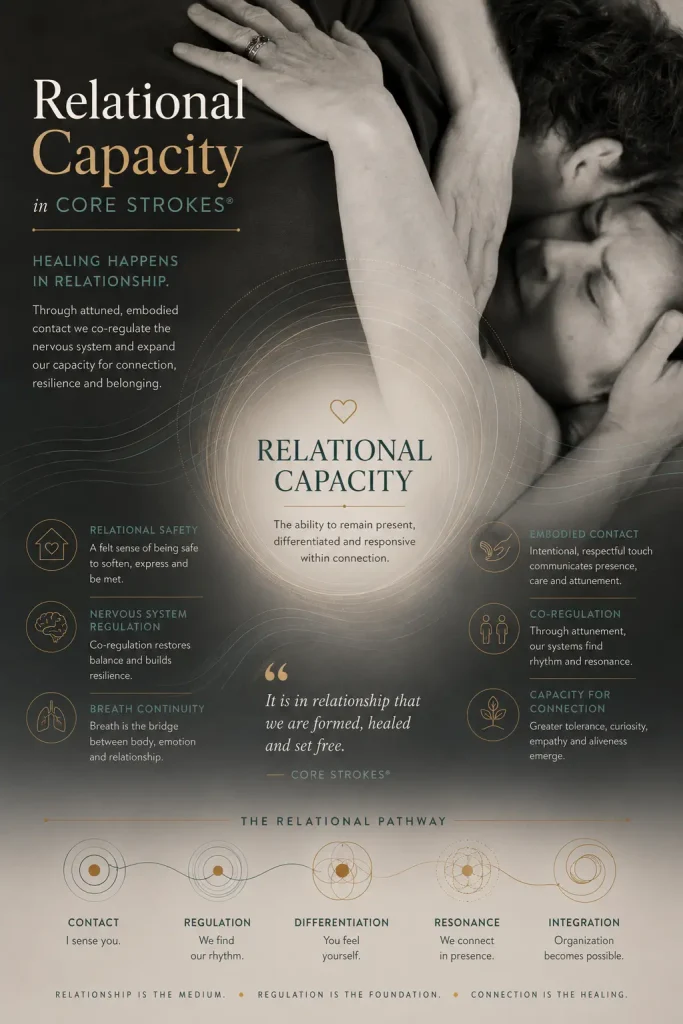
Relational capacity refers to the organism’s embodied ability to remain present, responsive, regulated, and coherent within contact with others.
Within the Core Strokes® framework, relational capacity develops through co-regulation, breath continuity, emotional responsiveness, nervous system regulation, fascial organization, and embodied relational experience.
Trauma may restrict relational capacity through defensive adaptations organized around withdrawal, hypervigilance, collapse, overadaptation, or loss of embodied continuity in contact.
Therapeutic transformation supports the gradual restoration of relational participation without loss of coherence, regulation, or selfhood.
Introduction
Trauma is often described as a failure of regulation.
Much therapeutic work therefore focuses on helping individuals calm, stabilize, and restore balance within their nervous system. While regulation is essential, this framing can unintentionally suggest that healing occurs primarily inside an isolated individual body through techniques applied to internal states.
Core Strokes® approaches regulation differently.
From a developmental and embodied perspective, regulation does not emerge solely within the individual organism. It develops between organisms, through relationship. The capacity to remain present, coherent, and responsive under intensity is not a solitary achievement. It is learned, shaped, and restored in contact.
Within this perspective, relational capacity becomes a developmental function of the organism itself — the embodied ability to remain present with another while experience unfolds.
Relationship as a Developmental Environment
Many traumatic experiences emerge within relationship.
This includes not only overt relational harm, but also more subtle forms of developmental disruption such as:
- overwhelming closeness
- absence of attuned support
- intrusive or mis-timed contact
- unpredictable presence
- repeated experiences of facing intensity alone
In such moments, the nervous system is not simply overwhelmed by stimulation. It is overwhelmed without sufficient relational support.
The organism gradually learns that intensity, vulnerability, closeness, or emotional activation cannot safely remain organized within contact.
Over time, the system adapts.
These adaptations may appear as:
- withdrawal or emotional distancing
- hyper-attunement or relational control
- collapse, compliance, or dissociation
- difficulty remaining connected during activation
Within Core Strokes®, these patterns are understood as developmental adaptations to relational conditions that exceeded the organism’s capacity for coherent participation rather than as failures of personality, attachment, or character.
Regulation Is Learned Through Relationship
Just as trauma develops in relationship, regulation is also learned in relationship.
In early development, the organism does not initially regulate itself independently. Safety, rhythm, soothing, activation, and emotional organization are first supported externally through voice, touch, pacing, contact, and presence.
Through repeated experiences of being met without overwhelm, accompanied through activation, and responded to within contact, the organism gradually internalizes regulatory capacity.
From this perspective, self-regulation is not a starting point. It is the developmental result of successful co-regulation over time.
When relational support becomes inconsistent, intrusive, emotionally unavailable, or overwhelming, the organism may instead develop strategies organized around self-protection, emotional inhibition, hypervigilance, withdrawal, collapse, or chronic self-reliance.
The body may learn how to regulate alone while remaining unable to sustain regulation within contact.
Regulation Does Not Happen Inside One Person Alone
A central implication of this perspective is that regulation is not purely intrapsychic.
Regulation emerges within a relational field shaped by:
- proximity and distance
- pacing and timing
- touch and restraint
- responsiveness and emotional availability
- the quality of embodied presence offered by another
Within Core Strokes®, regulation is understood as a living relational phenomenon emerging through breath, co-regulation, attunement, and embodied responsiveness between organisms.
This perspective does not negate individual capacity. Rather, it acknowledges that embodied self-regulation is formed, supported, and restored through relationship.
What can later be carried alone is first learned — and often repaired — in contact.
Practitioner Presence as a Regulatory Medium
Because relational capacity is developmental, practitioner presence becomes structurally part of the therapeutic process rather than merely supportive or secondary.
Within Core Strokes®, the practitioner does not regulate the client through control or technique alone. Instead, practitioner and client participate together within a relational field through which regulation, contact, and integration may gradually reorganize.
This regulatory presence becomes visible through grounded posture, connected breathing, emotional steadiness, clear boundaries, sensitive pacing, and responsiveness to the organism’s moment-to-moment process.
The practitioner continuously listens to how the client’s system responds through:
- changes in breathing rhythm and continuity
- shifts in tissue tone and fascial responsiveness
- fluctuations in activation and settling
- relational signals of approach, hesitation, collapse, or withdrawal
Rather than following predetermined protocols, the therapeutic process unfolds through ongoing responsiveness to developmental readiness in contact.
Developmental Readiness in Contact
One of the central distinctions within Core Strokes® work is the difference between possibility and readiness.
A person may be capable of emotional expression, physical release, vulnerability, or relational closeness, yet still remain unable to sustain these experiences within contact without fragmentation or overwhelm.
From this perspective, the therapeutic question is not:
“What should happen next?”
It becomes:
“What can be met here, now, together — without loss of coherence?”
Attention to developmental readiness shifts the work away from outcome and toward capacity. It allows growth to unfold without forcing, and contact to deepen without overwhelm.
It allows growth to unfold without forcing and contact to deepen without overwhelming the organism’s current ability to remain present.
Relationship, Breath, and Intensity
Relationship continuously interacts with breath and intensity.
As relational closeness increases, breathing may respond by:
- tightening
- becoming shallow
- fragmenting
- collapsing
- or losing continuity altogether
These responses do not necessarily indicate resistance or pathology.
They are often signals that relational intensity is exceeding the organism’s present capacity to remain embodied and regulated within contact.
Core Strokes® therefore does not attempt to override or correct these responses mechanically.
Instead, the work supports the conditions in which breathing can remain increasingly connected within relationship, allowing activation and emotional intensity to emerge without loss of contact or coherence.
Over time, this gradually restores a fundamental developmental capacity:
the ability to remain present with another as experience deepens.
From Co-Regulation to Relational Sovereignty
The aim of relational work within Core Strokes® is not dependency.
It is the gradual emergence of relational sovereignty — the embodied capacity to:
- remain present in contact
- experience intensity without collapse
- move toward or away with choice
- sustain differentiation within relationship
- remain oneself while connected to another
Relational sovereignty develops through repeated experiences of being met without intrusion and without abandonment.
Over time, regulation becomes increasingly internalized — no longer dependent upon the constant presence of another, yet fully available within relationship itself.
In this way, co-regulation is not the endpoint of the work.
It is the developmental pathway through which relational autonomy becomes possible.
Relationship as a Path of Integration
Within Core Strokes®, relationship is not merely a therapeutic context.
It is a developmental function of the organism itself — one that may become restricted through trauma and gradually restored through embodied relational experience.
When relationship is met with sufficient structure, pacing, responsiveness, and presence, it becomes a pathway through which breath, fascia, emotional activation, and embodied participation can reorganize.
Contact no longer leads automatically to fragmentation, collapse, or defensive withdrawal.
Experience can increasingly be felt, metabolized, organized, and integrated within connection.
Healing does not unfold outside relationship.
It emerges through embodied contact as the organism gradually rediscovers the capacity to remain present, responsive, and coherent with another without loss of self, regulation, or vitality.
Part of the Core Strokes® Foundational Framework
Core Strokes® explores how trauma restricts embodied capacities related to regulation, emotional continuity, breath, fascia, relational participation, and developmental integration.
Explore related dimensions of the framework:
→ Co-Regulation in Core Strokes®
→ Relational Field in Core Strokes®
→ Therapeutic Presence in Core Strokes®
→ Therapeutic Contact
→ Breath and Trauma
→ Fascia and Trauma
→ Intensity as Capacity
→ Developmental Needs and Relational Regulation
→ Shape, Countershape, and Contrashape
→ Character Structures
Closing Invitation
Relational capacity is explored experientially throughout Core Strokes® workshops, trainings, and therapeutic practice.
Participants gradually develop increasing awareness of how breath, fascia, emotional activation, nervous system regulation, posture, and relational contact continuously shape embodied experience within relationship.
Through embodied participation, therapeutic presence, and relational attunement, practitioners learn how regulation and transformation emerge not only within the individual organism, but through the living processes of embodied relational contact itself.
Frequently Asked Questions About Somatic Trauma Therapy and Core Strokes®
Below you’ll find clear answers to common questions about somatic trauma therapy, complex PTSD (C-PTSD), attachment trauma, and the Core Strokes® developmental framework.
Closing Perspective
Core Strokes® is a developmental somatic framework rooted in breath, fascia, and relational regulation.
It does not simply treat trauma.
It restores embodied capacity.From that restoration, integration unfolds.
And from integration, relational maturity becomes possible.