Somatic Segments in Core Strokes®
Mapping Breath, Charge, Expression, and Fascial Organization
Somatic Segments — Core Definition
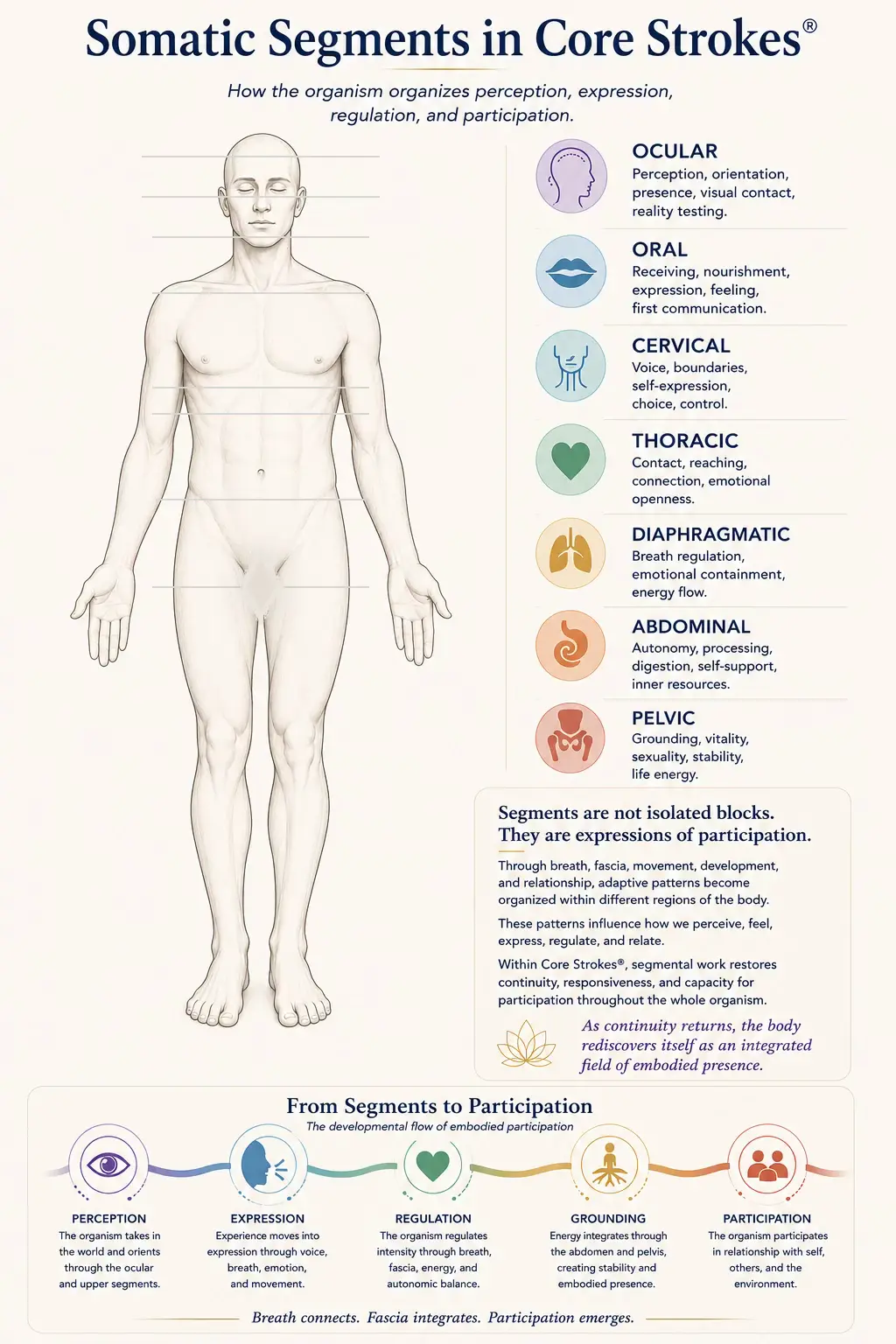
Somatic segments are functional regions through which the organism organizes perception, expression, regulation, movement, and relational participation.
Within Core Strokes®, segments are understood not merely as regions where tension accumulates, but as expressions of how the organism organizes participation. Each segment reflects an ongoing negotiation between perception and expression, protection and openness, differentiation and connection.
Each segment participates in the regulation of intensity, the expression of feeling, and the organization of contact with self, others, and the environment. Together, they form a living map through which developmental history, adaptive organization, and embodied participation become visible.
Segmental organization therefore provides a practical and phenomenological framework for understanding how experience becomes embodied throughout the organism.
The Body Organizes Experience Regionally
Body-oriented psychotherapy traditions have long recognized that emotional expression, defensive tension, and energetic organization tend to stabilize in recognizable patterns throughout the body.
The concept of somatic segments was first articulated within the work of Wilhelm Reich and later expanded by numerous body psychotherapy traditions. These approaches observed that different regions of the body participate in distinct aspects of perception, expression, protection, communication, grounding, sexuality, and relationship.
Rather than expressing experience uniformly, the organism organizes participation through a series of interconnected regions that influence how breath, movement, emotion, and contact unfold.
Traditionally, seven primary segments are described:
• Ocular
• Oral
• Cervical
• Thoracic
• Diaphragmatic
• Abdominal
• Pelvic
Together, these segments form a functional continuum through which perception, expression, regulation, grounding, and relational participation become organized throughout embodied life.
Within Core Strokes®, these segments are approached as dynamically interconnected regions participating within a larger field of breath, fascia, movement, autonomic regulation, and relational organization.
Within the Organization of Embodied Participation, segments reveal how different regions of the body contribute to perception, expression, regulation, grounding, and relationship. Rather than functioning independently, segments participate together in the organism’s ongoing engagement with self, others, and the environment.
Segments and Breath
Breathing rarely expands evenly throughout the organism.
The movement of breath travels through different regions of the body, engaging some segments more fully than others. Developmental adaptations, chronic tension patterns, trauma responses, and relational defenses all influence how breathing distributes itself throughout the organism.
At times, interruption appears around the throat, limiting vocal expression and communication. At other times, breathing may bypass the diaphragm, reducing emotional fluidity and energetic continuity. In still other cases, pelvic movement becomes restricted, diminishing grounding, vitality, and expressive capacity.
From a Core Strokes® perspective, these interruptions are not simply mechanical restrictions. They reveal how the organism has learned to regulate vulnerability, intensity, emotional expression, participation, and contact.
As continuity returns to the breath, segmental movement often becomes more coordinated, allowing expression, regulation, and participation to unfold with greater freedom.
Segments and Charge
Emotional and energetic charge rarely distributes itself evenly throughout the organism.
Instead, activation tends to organize through particular segmental regions, influencing how intensity is experienced, expressed, contained, or regulated. Some segments may become chronically overcharged, while others remain underactivated, restricted, or disconnected from the organism’s overall energetic flow.
Within Core Strokes®, charge is understood not as an abstract energy, but as the living experience of activation expressed through breathing, movement, emotional intensity, autonomic arousal, tissue responsiveness, and relational engagement.
Segmental organization influences how this activation moves throughout the body. The throat may constrain expression, the diaphragm may contain emotional intensity, the chest may amplify emotional expression and feeling, or the pelvis may limit grounding and vitality.
As breath continuity, fascial responsiveness, and regulatory capacity increase, charge often becomes more evenly distributed throughout the organism. Activation can then support expression, participation, vitality, and relationship rather than becoming organized primarily around protection or control.
Segments and Fascia
Fascia provides the living continuity through which segments remain interconnected.
Although segments may appear functionally distinct, they do not operate as separate compartments. Fascial continuity allows movement, tension, pressure, sensation, and energetic organization to propagate throughout the organism.
Changes in one region frequently influence distant areas of the body. Restriction within the jaw may alter breathing patterns throughout the chest. Diaphragmatic tension may influence posture, movement, and emotional expression throughout the organism. Pelvic rigidity may affect spinal organization, grounding, and relational presence.
Within the Fascia Texture Typology™, segmental organization often becomes visible through variations in tissue responsiveness, continuity, elasticity, density, hydration, and movement quality across different regions of the body.
Segmental work therefore involves not only local observation, but also appreciation of how each region participates within a larger fascial and regulatory field.
Segments and Developmental Organization
Developmental experience frequently stabilizes within particular segmental regions.
Patterns of withdrawal may become visible through the eyes, face, and upper body. Difficulties receiving support may influence the oral and thoracic regions. Conflicts around autonomy, expression, intimacy, vulnerability, or self-protection often appear through the chest, throat, diaphragm, abdomen, or pelvis.
Over time, these recurring organizations contribute to what body psychotherapy traditions describe as character structures.
From this perspective, character is not understood as a fixed personality category but as an embodied organization of breathing, movement, posture, emotional expression, energetic regulation, and relational participation.
Segmental organization therefore offers a valuable window into how developmental history becomes embodied throughout the organism.
Segments and Relational Contact
Every segment participates in relationship.
The organism does not contact others through the eyes alone, nor through words alone. Relationship emerges through the coordinated participation of the entire body. The ocular segment supports orientation, perception, and visual contact with the world. The oral and cervical segments support communication and expression. The thoracic region reaches toward contact and emotional connection. The diaphragm regulates intensity. The abdominal segment supports autonomy and self-support, while the pelvis provides grounding, vitality, and embodied presence.
Segmental organization therefore influences not only how the organism regulates itself, but also how it enters, sustains, and deepens relationship.
Segments as Expressions of Embodied Participation
Within Core Strokes®, segments are not viewed as isolated blocks that must be released or opened.
They are understood as living expressions of how the organism organizes participation.
Each segment reflects an ongoing negotiation between openness and protection, expression and containment, differentiation and connection. The question is therefore not simply which segment is restricted, but how that region contributes to the organism’s broader strategy for maintaining continuity, regulation, safety, expression, and relationship.
This perspective shifts segmental work away from correction and toward curiosity.
Rather than attempting to force change, the practitioner listens to the intelligence expressed through each region of the body.
Segmental organization becomes a doorway into understanding how the organism participates in life itself.
Working with Segments in Somatic Therapy
In Core Strokes®, segmental work aims to restore continuity rather than force release.
Through breath awareness, therapeutic touch, movement exploration, vocal expression, emotional processing, and relational attunement, segments gradually regain responsiveness, mobility, and regulatory flexibility.
As segmental organization becomes more coherent, the organism often develops greater capacity for emotional expression, energetic flow, embodied presence, differentiation, intimacy, and participation.
The goal is not simply to remove tension.
The goal is to support the organism’s capacity to remain present within an increasingly wide range of experience.
Conclusion — From Segments to Participation
Somatic segments reveal how the organism distributes perception, regulation, expression, protection, and contact throughout the body.
They offer a practical and phenomenological map for understanding how developmental history becomes organized through breathing, posture, movement, fascia, and relational participation.
Within Core Strokes®, segmental work is not primarily concerned with removing tension or opening blocked areas. Its purpose is to restore continuity across the living organism so that expression, regulation, vitality, and relationship can emerge with greater freedom.
As breath deepens, fascia becomes more responsive, and participation expands, the body is experienced less as a collection of separate regions and more as an integrated field of embodied presence.
The Core Strokes Framework
Core Strokes® integrates breath, fascia, relational presence, developmental psychology, and phenomenological observation into a unified framework of embodied organization and somatic psychotherapy.
Rather than approaching embodiment through isolated symptoms or fixed categories alone, Core Strokes® explores how human experience organizes through breath, movement, fascia, emotional regulation, energetic activation, and relational participation.
📘 Explore the foundational dimensions of the framework below:
→ The Organization of Embodied Participation
A phenomenological framework describing how continuity, coherence, permeability, metabolization, and defensive organization shape embodied and relational life.
→ Energetic Breath Cycle™
A developmental rhythm describing how breathing organizes safety, activation, emotional expression, surrender, and rest.
→ Fascia Texture Typology™
A phenomenological system recognizing recurring organizational tendencies through tissue responsiveness, movement, continuity, and regulation.
→ Soul Textures™
Qualitative states of embodied coherence emerging as defensive organizations gradually reorganize into integrated vitality and relational openness.
→Shadow Soul Textures™
Survival organizations that emerge when participation, continuity, and developmental integration become restricted or interrupted.
→ Neurofascial Transformation Process™
The therapeutic process through which breath continuity, fascial responsiveness, movement, and relational presence support lasting transformation.
→ Character Structures
Developmental adaptations that stabilize patterns of regulation.
🌿 These principles can also be explored directly through experiential practice within: