Defensive Organization in Core Strokes®
Survival, Protection, and the Preservation of Continuity
By Dirk Marivoet, Founder of Core Strokes®· Psychotherapist · Teacher · Author
Defensive Organization — Core Definition
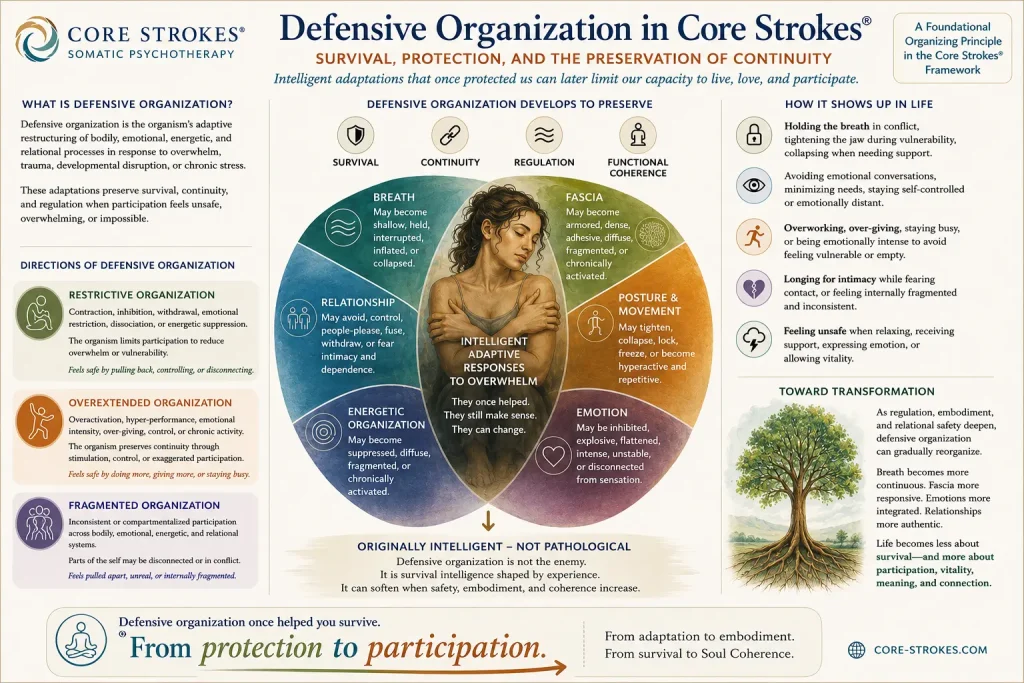
Defensive organization refers to the organism’s adaptive restructuring of bodily, emotional, energetic, relational, and experiential processes in order to maintain survival, continuity, and regulation under conditions of stress, overwhelm, trauma, developmental disruption, or relational instability.
Within the Core Strokes® framework, defensive organization describes how the organism limits, redirects, fragments, controls, suppresses, amplifies, or reorganizes participation in order to reduce perceived threat or preserve functional coherence.
Defensive organization is therefore not understood primarily as pathology, weakness, or dysfunction, but as an adaptive attempt to remain organized when full participation in life feels unsafe, overwhelming, or impossible.
Why Defensive Organization Matters
Living organisms continuously regulate their openness to life.
When experience becomes emotionally, relationally, energetically, or developmentally overwhelming, the organism must adapt in order to preserve continuity, protection, and survival.
A child growing up in chronic unpredictability may learn to remain hypervigilant, emotionally controlled, or highly self-reliant. Another may disconnect from bodily feeling to avoid overwhelming emotional pain. Someone else may adapt through pleasing, over-functioning, collapse, withdrawal, compulsive activation, emotional inhibition, or chronic relational accommodation.
What later appears as rigidity, emotional distance, hyper-control, chronic tension, overreactivity, collapse, dissociation, or relational instability often originally developed as an intelligent attempt to survive conditions that felt unsafe, overwhelming, intrusive, abandoning, or emotionally unmanageable.
Over time, these adaptations often become stabilized within breathing patterns, fascial organization, posture, movement habits, autonomic regulation, emotional expression, energetic organization, and relational participation.
A person may continue functioning outwardly — working, relating, caring for others, performing, or maintaining responsibilities — while inwardly organizing increasingly around protection rather than spontaneous participation in life.
Within Core Strokes®, therapeutic transformation therefore involves understanding defensive organization not as pathology to eliminate, but as adaptive survival intelligence that can gradually reorganize as safety, embodiment, regulation, and relational continuity increase.
Defensive Organization and the Body
Defensive organization is always embodied.
The body continuously reveals how the organism has learned to manage vulnerability, activation, emotion, relational contact, and energetic intensity.
A person may hold the breath during conflict, tighten the jaw during vulnerability, collapse in posture when needing support, or remain chronically activated and unable to relax. Others may appear physically present while emotionally distant, disconnected from sensation, or unable to remain grounded during intimacy or emotional contact.
Breathing may become shallow, interrupted, frozen, inflated, collapsed, or excessively controlled. Fascia may become armored, dense, adhesive, fragmented, diffuse, collapsed, or chronically activated.
Movement may lose spontaneity and become rigid, hesitant, hyperactive, mechanically repetitive, or disconnected from embodied feeling. Emotional expression may become excessively inhibited, emotionally explosive, flattened, or unstable.
Some individuals defend primarily through contraction and withdrawal. Others organize around overextension, performance, emotional intensity, control, compulsive activity, hyper-independence, or dissociation.
Defensive organization can also often be recognized relationally.
A person may struggle to receive support, fear dependence, avoid vulnerability, become chronically self-protective, overadapt to others, lose boundaries during intimacy, or oscillate between longing for connection and withdrawing from it.
Within Core Strokes®, the body is understood not merely as structure, but as a living expression of the organism’s adaptive survival organization.
Healthy Protection vs Defensive Organization
Not all protection is pathological.
Healthy organisms require boundaries, discernment, recovery, self-protection, and the ability to regulate exposure to overwhelming stimulation or relational intensity.
Healthy protection remains flexible, adaptive, and responsive to present conditions.
Defensive organization becomes restrictive when protective adaptations become chronically fixed, rigid, fragmented, or disconnected from current reality.
The organism may continue responding to present experience as though earlier overwhelming conditions are still occurring.
For example, intimacy may feel dangerous even within safe relationships. Relaxation may trigger anxiety or loss of control. Emotional expression may evoke shame, collapse, or panic. Receiving support may feel exposing or unsafe. Vitality itself may become associated with vulnerability, unpredictability, or danger.
The organism no longer organizes primarily around present participation, but around anticipated threat and defensive preservation.
Common Directions of Defensive Organization
Defensive organization may stabilize in different directions depending upon developmental conditions, relational history, temperament, nervous system organization, and adaptive necessity.
Restrictive Organization
Some individuals defend primarily through contraction, withdrawal, inhibition, emotional restriction, rigidity, dissociation, or energetic suppression.
The person may avoid emotional conversations, minimize needs, disconnect from bodily sensation, suppress anger or desire, remain chronically self-controlled, or retreat from intimacy and vulnerability in order to reduce overwhelm.
Others may appear calm, competent, or highly functional outwardly while inwardly feeling emotionally distant, numb, exhausted, disconnected, or unable to fully participate in relationships, pleasure, creativity, or embodied life.
The organism protects itself by limiting participation.
While this may temporarily reduce vulnerability or overstimulation, it often also restricts vitality, spontaneity, emotional flexibility, sensuality, and relational openness.
Overextended Organization
Other individuals defend through overactivation, hyper-performance, emotional intensity, compulsive relating, over-giving, chronic activity, inflated activation, or excessive energetic mobilization.
The person may remain constantly busy, emotionally activated, highly expressive, unable to rest, compulsively helpful, or chronically focused on others while losing contact with internal limits, needs, grounding, or continuity of self.
Some individuals organize around strength, productivity, control, sexuality, emotional intensity, or visibility in order to avoid collapse, helplessness, dependency, shame, emptiness, or vulnerability.
Although externally engaged and expressive, the organism may internally lack grounding, regulation, embodiment, or coherent participation.
Participation remains intense, but insufficiently organized.
Fragmented Organization
In some cases, defensive organization becomes inconsistent or fragmented.
Different dimensions of the organism may function with limited continuity between them.
A person may appear cognitively organized while emotionally dissociated. Another may express strong emotion while lacking grounding, self-regulation, or embodied continuity. Someone may appear socially engaged while inwardly feeling detached, unreal, or disconnected from authentic participation.
Contradictory tendencies may coexist simultaneously. The person may long deeply for intimacy while fearing vulnerability and contact. One part of the organism may seek visibility and expression while another withdraws protectively from exposure.
Participation therefore loses continuity across bodily, emotional, energetic, relational, and experiential systems.
This fragmentation often appears in trauma, structural dissociation, severe developmental disruption, unstable attachment organization, or chronic relational stress.
Within Core Strokes®, therapeutic work involves gradually restoring continuity between previously disconnected dimensions of experience so the organism can participate more coherently in life.
Defensive Organization and Character Structure
Within body psychotherapy traditions, defensive organizations often stabilize into recognizable characterological patterns.
Over time, recurring ways of protecting the self gradually shape breathing, posture, movement, emotional regulation, energetic expression, relational participation, and fascial organization.
A person who learned early that emotional needs were unsafe may organize around withdrawal, self-sufficiency, or emotional minimization. Another may organize around control, performance, hyper-independence, seduction, collapse, compliance, or chronic tension in order to preserve connection, protection, or continuity of self.
These organizations are not merely psychological attitudes. They become lived bodily realities expressed through the whole organism.
The body may tighten around vulnerability, disconnect from sensation, inflate around strength, collapse around helplessness, or fragment under overwhelming emotional intensity.
Within Core Strokes®, character structures are therefore understood as stabilized defensive organizations expressed through breath, fascia, posture, movement, energetic regulation, emotional process, and relational participation.
Therapeutic work involves helping these organizations gradually become more flexible, embodied, coherent, and capable of fuller participation in life.
Defensive Organization and Coherence
Defensive organization initially attempts to preserve coherence.
When experience becomes overwhelming, the organism reorganizes itself in order to maintain enough continuity for survival and functioning to continue.
A child who cannot safely express emotion may learn to suppress feeling in order to remain organized. Another may become chronically vigilant or emotionally controlled in order to prevent chaos, unpredictability, or relational rupture.
In this sense, defensive organization often protects the organism from fragmentation, collapse, or overwhelm.
However, what initially preserves coherence may later reduce flexibility, embodiment, emotional responsiveness, spontaneity, permeability, and relational participation.
The organism remains organized, but increasingly around protection rather than living engagement.
A person may appear highly controlled outwardly while feeling internally disconnected, emotionally restricted, or unable to relax into authentic participation.
Within Core Strokes®, therapeutic transformation therefore does not involve destroying defenses, but gradually increasing the organism’s capacity for safety, embodiment, regulation, flexibility, and coherent participation.
As coherence deepens, defensive structures no longer need to remain chronically rigid, overactivated, collapsed, or fragmented in order to preserve continuity.
Defensive Organization and the Energetic Breath Cycle™
Within the Energetic Breath Cycle™, defensive organizations often develop through repeated interruptions in developmental participation, emotional expression, energetic flow, relational safety, or embodied continuity.
Breath phases may gradually become restricted, inflated, fragmented, dissociated, compressed, collapsed, or chronically interrupted.
For example, a person who could not safely express excitement may begin inhibiting activation and spontaneity. Another may disconnect from surrender, vulnerability, or emotional openness because these experiences became associated with overwhelm, shame, intrusion, abandonment, or loss of control.
Over time, these adaptations shape breathing patterns, fascia organization, energetic regulation, emotional participation, posture, movement, and continuity of self-experience.
The distorted breath phases within Core Strokes® can therefore be understood partly as stabilized defensive organizations expressed through the organism’s breathing, energetic, relational, and developmental participation.
Therapeutic transformation involves gradually restoring continuity across these interrupted patterns so the organism can tolerate increasing participation in sensation, vitality, emotion, relationship, surrender, and embodied life.
Defensive Organization and Therapeutic Transformation
Within Core Strokes®, therapeutic transformation involves gradual reorganization rather than forced breakdown of defenses.
Defensive organization originally developed for important reasons.
The organism cannot safely relinquish defensive structures until sufficient grounding, regulation, relational safety, embodiment, energetic capacity, and coherence become available.
Forcing emotional exposure, catharsis, vulnerability, or energetic intensity too quickly may overwhelm the organism and reinforce defensive adaptation rather than soften it.
Transformation therefore involves helping the organism gradually tolerate increasing participation in sensation, emotion, movement, energetic activation, intimacy, vulnerability, and embodied presence.
As defensive organization softens, breathing often becomes more continuous, fascia more responsive, movement more spontaneous, emotional experience more integrated, and relational participation more flexible and authentic.
People frequently discover that what once felt like fixed personality traits were often adaptive survival strategies developed under overwhelming developmental or relational conditions.
The organism no longer needs to organize primarily around chronic protection, collapse, overcontrol, fragmentation, or defensive withdrawal.
Life gradually becomes less organized around survival and increasingly organized around participation, vitality, embodiment, relationship, creativity, meaning, and aliveness.
Defensive Organization and Soul Coherence
As defensive organizations gradually reorganize within a sufficiently coherent organism, life becomes less organized around survival and increasingly organized around authenticity, participation, embodiment, meaning, and relational presence.
The individual develops increasing capacity to remain open to sensation, emotion, energetic exchange, vulnerability, intimacy, creativity, and existential life without excessive fragmentation, collapse, defensive control, or withdrawal.
The person may begin feeling more present within the body, more emotionally available, more capable of receiving support, more grounded during intimacy, and more able to participate in life without chronic self-protection or defensive contraction.
In this sense, therapeutic transformation is not merely the removal of defenses, but the gradual emergence of Soul Coherence — the organism’s capacity to inhabit life with increasing integrity, responsiveness, flexibility, aliveness, and embodied participation.
In Summary
Within Core Strokes®, defensive organization refers to the organism’s adaptive restructuring of bodily, emotional, energetic, relational, and experiential life in order to preserve survival, continuity, and regulation under overwhelming conditions.
Although defensive organizations may later restrict vitality, embodiment, flexibility, spontaneity, and participation, they originally emerge as intelligent survival adaptations.
Therapeutic transformation therefore involves not destroying defenses, but gradually restoring sufficient safety, coherence, embodiment, regulation, and relational continuity for defensive organization to reorganize naturally.
As defensive structures soften, the organism becomes increasingly capable of grounded participation, emotional flexibility, embodied presence, vitality, intimacy, creativity, and meaningful involvement in life.
Defensive organization forms one of the foundational organizing principles underlying the Core Strokes® framework.
Explore Related Core Strokes® Concepts
→ The Organisation of Embodied Participation
The phenomenological foundation of Core Strokes®, describing how continuity, coherence, permeability, metabolisation, adaptive organisation, and relational geometry organise embodied life.
→ Defensive Organisation
A protective form of Adaptive Organisation in which participation becomes organised around experienced or anticipated threat, overwhelm, disruption, or loss of continuity.
→ Living Participation Observation System™ (LPOS™)
The observational methodology through which embodied and relational expressions are described before provisional organisational interpretations are developed.
→ Relational Field and Relational Geometry
The Relational Field is the embodied space of interaction. Relational Geometry describes how proximity, distance, boundaries, orientation, reciprocity, and differentiation are organised within it.
→ Energetic Breath Cycle™
A developmental map describing how breathing organises grounding, activation, emotional expression, surrender, and restoration throughout the organism.
→ Fascia Texture Typology™
A phenomenological framework for describing recurring tactile configurations and considering their possible organisational significance without treating them as diagnoses, personality types, or records of developmental history.
→ Neurofascial Encoding™
A proposed research framework exploring possible relationships among repeated participation, neural plasticity, behaviour, physiological regulation, movement, mechanical loading, and connective-tissue remodelling.
→ Neurofascial Transformation Process™
The therapeutic process through which breathing, fascia, movement, therapeutic touch and relational participation can contribute to embodied reorganisation and therapeutic transformation.
→ Therapeutic Touch
An embodied and relational practice guided by consent, clinical judgement, perceptual attention, and responsiveness rather than by mechanical intervention or predetermined interpretation.
→ Character Structures
A framework for exploring recurring developmental organisations of bodily, emotional, behavioural, and relational participation without reducing people to fixed types.
→ Soul Organisation, Soul Coherence, and Soul Textures ™
Interrelated dimensions of Core Strokes® concerned with authenticity, meaning, inner resonance, embodied presence, and relational participation. Soul Organisation names the wider qualitative domain; Soul Coherence describes increasing integrity among dimensions of experience; Soul Textures™ describe qualities of coherent participation; and Shadow Soul Textures™ describe qualitative expressions of protective, constrained, fragmented, or compensatory Adaptive Organisation.
These principles can also be explored directly through experiential practice within:
Closing Invitation
Defensive organization is explored experientially throughout Core Strokes® workshops, trainings, and therapeutic practice.
Through breath, movement, fascia-oriented work, emotional process, energetic activation, therapeutic touch, and relational presence, participants gradually begin recognizing how the organism has adapted to preserve continuity under conditions of overwhelm, vulnerability, instability, or developmental stress.
Within Core Strokes®, defenses are not approached as failures to eliminate or barriers to forcibly break through. They are understood as intelligent survival organizations that once helped preserve regulation, functioning, relationship, and continuity of self.
Therapeutic transformation therefore does not involve attacking defensive structures, but gradually expanding the organism’s capacity for safety, embodiment, flexibility, emotional metabolization, energetic responsiveness, and grounded participation.
As defensive organization softens, breathing often becomes more continuous, fascia more responsive, movement more spontaneous, emotional experience more integrated, and relational contact more stable and authentic.
Many people discover that what once felt like fixed personality traits, chronic tension, emotional shutdown, hypervigilance, collapse, overcontrol, or compulsive activation were often adaptive strategies developed to survive overwhelming conditions.
As regulation and embodiment deepen, the organism no longer needs to organize primarily around chronic protection, contraction, fragmentation, collapse, or defensive control.
Life gradually becomes less organized around survival and increasingly organized around participation, vitality, relationship, meaning, and embodied presence.
In this sense, healing is not the disappearance of protection, but the gradual restoration of sufficient coherence and safety for fuller participation in life to become possible again.