Core Strokes® Glossarium N–Z
Somatische Psychotherapie, Belichaming, Adem, Fascia & Relationeel Herstel
Door Dirk Marivoet, oprichter van Core Strokes® · Psychotherapeut · Trainer · Auteur
Het Core Strokes® Glossarium presenteert kernbegrippen die gebruikt worden binnen Bodymind Integration, somatische psychotherapie, ademgerichte benaderingen, fascia-geïnformeerde praktijk, ontwikkelingspsychologie en het bredere Core Strokes®-framework.
Het glossarium integreert fundamentele concepten uit lichaamspsychotherapie, Reichiaanse tradities, Bio-energetica, hechtingstheorie, traumastudies, fenomenologie, relationele psychotherapie en belichaamde ontwikkelingsbenaderingen, samen met originele concepten ontwikkeld binnen Core Strokes®, waaronder de Energetische Ademcyclus™ (Energetic Breath Cycle™), Neurofasciale Encodering™ (Neurofascial Encoding™), de Fasciale Textuurtypologie™ (Fascial Texture Typology™), Zielstexturen™ (Soul Textures™), Schaduw Zielstexturen™ (Shadow Soul Textures™) en het Neurofasciale Transformatieproces™ (Neurofascial Transformation Process™).
Deze definities zijn bedoeld als educatieve, conceptuele en klinische oriëntatie-instrumenten voor studenten, therapeuten, onderzoekers en lezers die belichaamde benaderingen van menselijke ontwikkeling, regulatie, therapeutische transformatie, relationele ervaring en de integratie van lichaam, emotie, bewustzijn en energetische participatie verkennen.
Verken het Glossarium
A · B · C · D · E · F · G · H · I · J · K · L · M
N · O · P · Q · R · S · T · U · V · W · X · Y · Z
N
Narcissism – A developmental and relational dimension of human functioning involving the formation, maintenance, regulation, protection, and organization of the self.
Healthy narcissism supports:
- self-cohesion,
- vitality,
- confidence,
- ambition,
- self-worth,
- differentiation,
- creativity,
- and the capacity to express one’s potentials and participate meaningfully in life and relationship.
Disturbances in narcissistic organization may emerge when developmental needs for attunement, mirroring, regulation, recognition, protection, validation, or relational participation are chronically disrupted or insufficiently met.
Compensatory narcissistic organizations may involve:
- grandiosity,
- hypercontrol,
- shame sensitivity,
- emotional disconnection,
- collapse,
- defensive superiority,
- excessive self-focus,
- compulsive achievement,
- admiration seeking,
- or impaired empathy and relational participation.
Within embodied approaches, narcissistic organization is expressed not only psychologically but also through posture, breathing, muscular organization, energetic presentation, relational style, emotional regulation, and embodied participation.
Within Core Strokes®, narcissistic dynamics are closely related to defensive organization, self-regulation, polarity imbalance, relational adaptation, and disruptions in coherent embodied participation.
See Self, Regulation, Defensive Organization, Participation, Differentiation
Negative Intentionality – A largely unconscious or semi-conscious investment in defensive, reactive, self-limiting, destructive, withholding, oppositional, or life-negating patterns of organization that persist despite the organism’s simultaneous longing for healing, participation, connection, vitality, or transformation.
Within embodied approaches, negative intentionality is understood not primarily as moral failure, but as an entrenched defensive adaptation organized around survival, protection, fear, shame, control, attachment injury, fragmentation, or unresolved developmental experience.
Negative intentionality may become expressed through:
- chronic resistance,
- self-sabotage,
- compulsive opposition,
- emotional withdrawal,
- hostility,
- collapse,
- hypercontrol,
- destructive relational patterns,
- chronic withholding,
- or refusal of participation, vulnerability, or openness.
These patterns often reflect protective attempts to avoid overwhelm, disappointment, dependency, shame, helplessness, vulnerability, or relational injury.
Within Core Strokes®, transformation involves bringing awareness, embodiment, regulation, differentiation, and compassionate understanding to these defensive organizations so that participation, vitality, and coherence can gradually emerge.
See Defensive Organization, Lower Self, Fragmentation, Participation, Regulation
Nervous System Capacity – The organism’s ability to tolerate, process, regulate, integrate, and participate coherently with increasing levels of emotional activation, energetic charge, sensory input, relational intensity, autonomic arousal, vulnerability, movement, and lived experience.
Nervous system capacity develops gradually through:
- attachment,
- co-regulation,
- developmental support,
- emotional integration,
- autonomic maturation,
- embodiment,
- movement,
- relational participation,
- and increasing coherence throughout the bodymind system.
Healthy nervous system capacity supports:
- resilience,
- flexibility,
- grounding,
- emotional tolerance,
- relational openness,
- integration,
- regulation,
- and embodied participation.
Reduced nervous system capacity may contribute to flooding, collapse, dissociation, fragmentation, chronic hypervigilance, emotional overwhelm, defensive constriction, or impaired participation.
Within Core Strokes®, nervous system capacity is closely related to regulation, containment, integration capacity, intensity regulation, and embodied participation.
See Regulation, Containment, Integration Capacity, Intensity Regulation, Participation
Nervous System Regulation – The organism’s capacity to organize, modulate, stabilize, recover, and flexibly coordinate autonomic, emotional, physiological, relational, energetic, and embodied states in response to internal and external experience.
Healthy nervous system regulation supports:
- emotional flexibility,
- grounding,
- adaptability,
- coherence,
- resilience,
- embodied presence,
- relational participation,
- and the capacity to tolerate activation, vulnerability, intensity, and change without excessive fragmentation or defensive collapse.
Nervous system regulation involves coordinated interaction between:
- sympathetic activation,
- parasympathetic settling,
- autonomic flexibility,
- breathing,
- fascia,
- movement,
- emotional processing,
- attachment,
- co-regulation,
- and embodied participation.
Disturbances in nervous system regulation may contribute to hyperarousal, collapse, dissociation, fragmentation, rigidity, chronic anxiety, emotional overwhelm, numbness, impaired grounding, or defensive adaptation.
Within Core Strokes®, nervous system regulation is foundational to breath organization, fascia organization, emotional integration, relational participation, and neurofascial transformation.
See Regulation, Co-Regulation, Autonomic Nervous System, Embodiment, Participation
Neurofascial Encoding™ – A Core Strokes® concept describing the process through which lived experience becomes organized, patterned, stored, and expressed throughout the interconnected systems of fascia, posture, movement, breathing, autonomic regulation, emotional organization, relational participation, and embodied experience.
Neurofascial Encoding™ reflects the principle that experience is not stored solely cognitively or neurologically, but is embodied throughout the living bodymind system through:
- fascial organization,
- autonomic patterning,
- movement tendencies,
- breathing organization,
- muscular tone,
- emotional regulation,
- posture,
- energetic organization,
- and relational participation.
Developmental experiences, attachment dynamics, trauma, emotional experience, chronic stress, defensive adaptations, and relational environments may all contribute to neurofascial pattern formation.
These patterns may later become expressed through:
- fascia textures,
- breathing patterns,
- posture,
- movement organization,
- emotional responsiveness,
- regulation styles,
- autonomic tendencies,
- and relational behavior.
Within Core Strokes®, Neurofascial Encoding™ forms a foundational principle linking fascia, breath, regulation, development, embodiment, and relational participation.
See Fascia, Defensive Organization, Regulation, Embodiment, Neurofascial Transformation Process™
Neurofascial Transformation Process™ – The therapeutic process through which defensive, fragmented, dysregulated, or chronically organized neurofascial patterns gradually reorganize toward increasing coherence, regulation, embodiment, vitality, integration, and relational participation.
The Neurofascial Transformation Process™ involves the interaction of:
- breathing,
- fascia,
- movement,
- autonomic regulation,
- emotional processing,
- relational attunement,
- co-regulation,
- embodied awareness,
- touch,
- symbolic integration,
- and conscious participation.
Transformation occurs gradually as previously interrupted, constricted, dissociated, fragmented, collapsed, or defensive organizations become increasingly:
- regulated,
- embodied,
- integrated,
- metabolized,
- differentiated,
- and coherently participatory.
Within Core Strokes®, the Neurofascial Transformation Process™ unfolds through progressive phases involving attunement, activation, unwinding, reorganization, integration, and embodied participation.
See Neurofascial Encoding™, Regulation, Integration, Embodiment, Participation
Nonverbal Communication – The ongoing exchange of emotional, autonomic, energetic, relational, and embodied information through posture, movement, facial expression, gesture, tone of voice, breathing, touch, energetic presence, timing, gaze, rhythm, and bodily organization.
Much human communication occurs nonverbally and often outside conscious awareness.
Within embodied approaches, nonverbal communication reflects the organism’s deeper autonomic, emotional, relational, and defensive organization and plays a central role in:
- attachment,
- co-regulation,
- attunement,
- emotional signaling,
- safety perception,
- relational participation,
- and therapeutic process.
Nonverbal communication may reveal:
- regulation,
- activation,
- collapse,
- tension,
- fragmentation,
- vulnerability,
- emotional openness,
- defensive organization,
- grounding,
- and embodied participation.
Within Core Strokes®, nonverbal communication is closely related to body reading, fascia organization, movement propagation, attunement, co-regulation, and embodied presence.
See Body Reading, Attunement, Co-Regulation, Embodied Presence, Participation
Nurturance – The embodied, emotional, relational, and developmental provision of care, support, nourishment, soothing, affirmation, protection, responsiveness, and co-regulation necessary for healthy growth, regulation, attachment, and participation.
Nurturance includes both literal and symbolic forms of nourishment, including:
- feeding,
- touch,
- holding,
- soothing,
- emotional responsiveness,
- affectionate contact,
- mirroring,
- validation,
- encouragement,
- relational availability,
- and embodied presence.
Healthy nurturance supports:
- attachment,
- regulation,
- grounding,
- self-worth,
- emotional development,
- embodiment,
- trust,
- vitality,
- and coherent participation in life and relationship.
Disturbances in nurturance may contribute to deprivation, collapse, compulsive self-sufficiency, dependency, shame, fragmentation, emotional hunger, attachment insecurity, or impaired regulation.
Within Core Strokes®, nurturance is closely related to Nurturing Breath, attachment, co-regulation, embodiment, and the organism’s capacity to receive support, nourishment, and relational participation.
See Attachment, Co-Regulation, Nurturing Breath, Embodiment, Participation
Nurturing Breath – The second phase of the Energetic Breath Cycle™ characterized by receiving, nourishment, co-regulation, embodied support, emotional holding, trust, and the organism’s developing capacity to safely take in life.
Nurturing Breath reflects the developmental movement through which the organism begins opening toward:
- contact,
- support,
- nurturance,
- emotional nourishment,
- attachment,
- regulation,
- and relational participation.
Within healthy organization, breathing becomes more receptive, fluid, supported, and absorptive. The organism develops increasing capacity to:
- receive,
- soften,
- trust support,
- metabolize nourishment,
- and participate within relationship without excessive fear, collapse, or defensive withdrawal.
This phase is associated with:
- attachment formation,
- co-regulation,
- oral development,
- embodied trust,
- relational openness,
- and the gradual development of internal support and regulation.
Disturbances in the Nurturing Breath phase may contribute to emotional hunger, dependency, collapse, deprivation, compulsive self-sufficiency, clinging, fragmentation, impaired receptivity, or defensive contraction around receiving support and nourishment.
Within Core Strokes®, Nurturing Breath is closely related to attachment, nurturance, co-regulation, embodiment, fascia organization, and the development of relational participation.
See Energetic Breath Cycle™, Nurturance, Attachment, Co-Regulation, Participation
O
Object Relations – A psychoanalytic and developmental concept referring to the internalized patterns of relationship between self and others that shape emotional life, attachment, identity, expectation, and interpersonal behavior.
Object relations are formed through early relational experience and become expressed through internal representations, attachment patterns, emotional expectations, relational defenses, and habitual ways of perceiving self and others.
Within embodied approaches, object relations are not only mental representations but may also become expressed through posture, breathing, autonomic regulation, movement tendencies, emotional responses, relational distance, and patterns of contact or withdrawal.
Within Core Strokes®, object relations are understood as embodied relational organizations shaped by development, attachment, regulation, breath organization, and defensive adaptation.
See Attachment, Internalization, Relational Field, Character Structure, Regulation
Oedipal Dynamics – Developmental and relational dynamics involving love, desire, rivalry, jealousy, exclusion, loyalty, identification, sexuality, boundaries, and triangulated relationship within the family or relational field.
In classical psychoanalysis, these dynamics were organized around the child’s unconscious wishes toward one parent and rivalry with the other. In contemporary embodied and relational approaches, oedipal dynamics are understood more broadly as the developmental field in which the child encounters desire, difference, gender, sexuality, love, limits, exclusion, belonging, and relational complexity.
Within body-oriented psychotherapy, unresolved oedipal dynamics may become expressed through splitting between heart and pelvis, inhibition of love or sexuality, seductiveness, jealousy, rivalry, shame, withholding, fear of vulnerability, or difficulty integrating tenderness, desire, and relational commitment.
Within Core Strokes®, oedipal dynamics are closely related to the heart–pelvis axis, Excited Breath, Orgastic Breath, polarity integration, erotic development, and the integration of love, sexuality, and relational truth.
See Heart–Pelvis Axis, Excited Breath, Orgastic Breath, Eros, Polarity
Organization – The dynamic manner in which bodily, emotional, autonomic, energetic, relational, cognitive, and behavioral processes arrange, coordinate, stabilize, regulate, and express themselves within a living organism.
Organization refers not merely to structure, but to the ongoing patterned functioning through which the organism maintains coherence, continuity, adaptation, regulation, identity, and participation in life.
Human experience is always organized simultaneously across multiple dimensions, including:
- posture,
- breathing,
- fascia,
- movement,
- autonomic regulation,
- emotional expression,
- perception,
- relational behavior,
- energetic flow,
- cognition,
- and meaning-making.
Healthy organization reflects increasing:
- coherence,
- flexibility,
- responsiveness,
- adaptability,
- permeability,
- energetic continuity,
- and embodied participation.
Disturbances in organization may appear as:
- fragmentation,
- rigidity,
- collapse,
- dysregulation,
- dissociation,
- chaotic discharge,
- chronic defensive effort,
- restricted movement propagation,
- or impaired relational participation.
Within Core Strokes®, therapeutic transformation is understood not merely as symptom reduction, but as progressive reorganization of the organism toward greater coherence, integration, responsiveness, vitality, and participation.
See Defensive Organization, Coherence, Regulation, Participation, Fragmentation, Integration
Organismic Self-Regulation – The living organism’s inherent capacity to organize, modulate, restore, balance, integrate, and adapt physiological, emotional, energetic, autonomic, relational, and behavioral processes in response to internal and external conditions.
Organismic self-regulation operates continuously through the interaction of:
- nervous system regulation,
- breathing,
- fascia,
- movement,
- emotional processing,
- attachment,
- energetic organization,
- perception,
- metabolism,
- and relational participation.
Healthy self-regulation supports:
- grounding,
- coherence,
- flexibility,
- vitality,
- emotional tolerance,
- recovery,
- adaptive responsiveness,
- and embodied participation.
Organismic self-regulation is not merely conscious control, but an emergent whole-body process involving automatic, relational, autonomic, emotional, and embodied forms of organization.
Disturbances in organismic self-regulation may contribute to chronic hyperarousal, collapse, fragmentation, rigidity, dissociation, emotional flooding, compulsive control, exhaustion, or impaired participation in life and relationship.
Within Core Strokes®, organismic self-regulation is foundational to Neurofascial Encoding™, movement propagation, nervous system capacity, breath organization, fascia organization, and the Neurofascial Transformation Process™.
See Regulation, Neurofascial Encoding™, Nervous System Regulation, Participation, Coherence
Orgasm Anxiety – Anxiety, fear, contraction, inhibition, dissociation, or defensive control that arises in relation to sexual surrender, pleasure, climax, involuntary movement, ego-softening, intimacy, vulnerability, or loss of control.
Orgasm anxiety may involve fear of emotional exposure, fear of losing control, fear of engulfment, shame, fear of dependency, fear of aggression, relational mistrust, body shame, trauma history, or difficulty tolerating erotic intensity.
Within embodied approaches, orgasm anxiety may be expressed through breath restriction, pelvic holding, muscular tension, dissociation, emotional withdrawal, overcontrol, collapse, or splitting between heart and pelvis.
Within Core Strokes®, orgasm anxiety is closely related to intensity regulation, heart–pelvis integration, erotic development, defensive organization, and the organism’s capacity to surrender without losing coherence.
See Intensity Regulation, Heart–Pelvis Axis, Orgastic Breath, Eros, Defensive Organization
Orgastic Breath – A Breath Phase within the Energetic Breath Cycle™ associated with surrender, fusion, deep pulsation, erotic-spiritual integration, heart–pelvis coherence, relational trust, and the organism’s capacity to participate in full-bodied pleasure and embodied union.
Orgastic Breath reflects the integration of excitation, love, sexuality, surrender, regulation, and relational participation. It is not limited to genital orgasm, but refers to a broader organismic capacity for pulsatory surrender, energetic union, emotional openness, and whole-body participation.
Disturbances in this phase may involve dissociation, orgasm anxiety, frozen pleasure, relational mistrust, sexual shame, heart–pelvis splitting, overcontrol, collapse, or inability to surrender into full-bodied experience.
Within Core Strokes®, Orgastic Breath is closely related to heart–pelvis integration, Streaming Union, erotic embodiment, pulsation, surrender, and the transformation of defensive splitting between love and sexuality.
See Energetic Breath Cycle™, Orgasm, Orgastic Potency, Heart–Pelvis Axis, Streaming Union
Orgastic Potency – A Reichian term referring to the organism’s capacity to surrender to involuntary pleasurable pulsation, sexual excitation, emotional openness, and full-bodied energetic discharge without chronic inhibition, fragmentation, or defensive control.
In Reich’s original theory, orgastic potency was central to psychological and somatic health. Within contemporary embodied approaches, the concept may be understood more broadly as the capacity for regulated surrender, pleasure, intimacy, pulsation, heart–pelvis integration, and whole-organism participation in erotic aliveness.
Within Core Strokes®, orgastic potency is not treated as a rigid standard of health, but as one expression of the organism’s capacity for trust, surrender, embodied pleasure, relational openness, and pulsatory coherence.
See Orgasm, Orgastic Breath, Eros, Pulsation, Heart–Pelvis Axis
Opening Up – The process through which the organism increases its capacity for emotional expression, embodied participation, relational contact, breathing, movement, energetic flow, and conscious awareness.
Within older bioenergetic traditions, opening up was often associated with releasing inhibition and increasing expressiveness. Within contemporary embodied approaches, opening must be supported by regulation, grounding, containment, relational safety, and pacing so that increased openness does not lead to flooding, fragmentation, dissociation, or collapse.
Healthy opening up involves greater flexibility, vitality, emotional availability, movement, breath continuity, relational responsiveness, and embodied coherence.
Within Core Strokes®, opening up is closely related to regulation, breath organization, embodied participation, fascial responsiveness, and the organism’s capacity to move toward life without losing continuity or safety.
See Regulation, Containment, Breath Organization, Embodied Participation, Expansion
Oral – A developmental term referring to early relational and embodied organization around receiving, nourishment, dependency, need, attachment, satisfaction, deprivation, and the capacity to take in support.
In classical psychoanalytic theory, the oral stage refers to early development in which the mouth and feeding relationship are central to pleasure and survival. In embodied and relational approaches, oral organization is understood more broadly through the development of trust, receptivity, nurturance, attachment, co-regulation, and the capacity to receive.
Disturbances in oral organization may involve emotional hunger, dependency, collapse, clinging, deprivation, compulsive self-sufficiency, difficulty receiving support, or fear of abandonment.
Within Core Strokes®, oral organization is closely related to Nurturing Breath, nurturance, attachment, co-regulation, receptivity, and the development of embodied trust.
See Nurturing Breath, Nurturance, Attachment, Co-Regulation, Receptivity
Orientation – The organism’s capacity to locate itself in relation to body, environment, time, space, relationship, sensation, emotional state, and present-moment reality.
Orientation supports safety, grounding, regulation, contact, movement, attention, and coherent participation in experience. It includes both external orientation toward the environment and internal orientation toward bodily sensation, breath, emotion, impulse, and meaning.
Within embodied approaches, orientation is understood as a whole-organism process involving perception, movement, posture, gaze, breathing, autonomic regulation, attention, relational awareness, and embodied presence.
Within Core Strokes®, orientation is closely related to grounding, regulation, embodied presence, the Pilot, and the organism’s capacity to participate safely and coherently in lived experience.
See Grounding, Regulation, Embodied Presence, Pilot, Contact
Orienting Reflex – An instinctive bodily, perceptual, and autonomic response through which the organism turns toward novelty, change, uncertainty, sound, movement, threat, or meaningful stimuli in the environment.
The orienting reflex supports survival, curiosity, learning, safety assessment, attention, and relational engagement. It may involve changes in gaze, head movement, posture, breathing, muscular tone, autonomic activation, and attentional focus.
Within embodied and trauma-informed approaches, orienting is an important regulatory process because it helps the organism assess present safety, distinguish past from present, and return from internal fixation, dissociation, or defensive activation toward contact with current reality.
Within Core Strokes®, orienting is closely related to grounding, regulation, safety, movement, and embodied participation.
See Orientation, Regulation, Grounding, Safety, Nervous System Regulation
Oscillation – The rhythmic movement, alternation, fluctuation, or dynamic shifting between complementary states, polarities, functions, energetic expressions, autonomic tendencies, or modes of participation within the living organism.
Oscillation is fundamental to life processes and may occur through:
- expansion and contraction,
- activation and settling,
- inhalation and exhalation,
- expression and receptivity,
- charge and discharge,
- movement and stillness,
- connection and differentiation,
- sympathetic and parasympathetic activation,
- inner and outer orientation,
- or masculine and feminine polarity dynamics.
Healthy oscillation supports:
- flexibility,
- regulation,
- pulsation,
- adaptability,
- vitality,
- integration,
- resilience,
- and coherent participation in life and relationship.
Disturbances in oscillatory capacity may involve rigidity, fixation, chronic overactivation, collapse, fragmentation, dissociation, compulsive repetition, emotional instability, or impaired adaptability.
Within embodied approaches, oscillation reflects the organism’s living capacity to move fluidly between states without losing coherence, continuity, grounding, or participation.
Within Core Strokes®, oscillation is closely related to pulsation, polarity integration, autonomic flexibility, the Free Breath phase, movement propagation, and embodied participation.
See Pulsation, Regulation, Free Breath, Polarity, Movement Propagation
Oscillating Veil – A Healthy Soul Texture™ associated with the Free Breath phase of the Energetic Breath Cycle™ characterized by fluid oscillation, rhythmic coherence, adaptive responsiveness, energetic mobility, relational flexibility, and dynamic embodied participation.
Oscillating Veil reflects the organism’s growing capacity to move fluidly between complementary states without becoming rigidly fixed, fragmented, collapsed, or defensively polarized.
Within this Soul Texture™, breathing, movement, fascia, emotional responsiveness, energetic organization, and relational participation develop increasing:
- fluidity,
- adaptability,
- rhythmic continuity,
- expressive mobility,
- coherence,
- and balanced alternation.
Oscillating Veil supports:
- flexibility,
- play,
- polarity integration,
- creative responsiveness,
- emotional movement,
- relational adaptability,
- and embodied freedom.
Disturbances associated with this developmental phase may contribute to conflicted oscillation, instability, sabotage, fragmentation, compulsive alternation, relational inconsistency, or defensive interference with natural movement between states.
Within Core Strokes®, Oscillating Veil is closely related to Free Breath, oscillation, movement continuity, polarity integration, pulsation, and embodied participation.
See Soul Textures™, Free Breath, Oscillation, Polarity, Movement Continuity
Overcharged – A state in which the organism carries more activation, excitation, emotional intensity, energetic charge, or autonomic arousal than it can comfortably regulate, contain, integrate, or express.
Overcharge may become expressed through restlessness, tension, anxiety, agitation, hyperarousal, impulsivity, emotional flooding, muscular contraction, sleep disturbance, irritability, excessive thinking, or difficulty grounding.
Within embodied approaches, overcharge does not simply require discharge; it often requires grounding, containment, pacing, regulation, integration, relational support, and increased nervous system capacity.
Within Core Strokes®, overcharge is closely related to intensity regulation, containment, breath organization, defensive effort, and the organism’s capacity to metabolize activation without fragmentation or collapse.
See Charge, Containment, Hyperarousal, Intensity Regulation, Regulation
P
Painter, Jack W., PhD – Jack W. Painter (1933–2010) was an American philosopher, psychologist, bodyworker, and founder of Postural Integration®, Energetic Integration®, and Pelvic-Heart Integration®.
Painter developed an integrative bodymind approach combining influences from:
- Wilhelm Reich,
- Gestalt Therapy,
- Ida Rolf,
- movement awareness,
- deep tissue bodywork,
- breathing,
- emotional expression,
- phenomenology,
- and energetic process.
He viewed the organism as a unified energetic wave process expressed simultaneously through:
- body,
- emotion,
- movement,
- cognition,
- sexuality,
- relationship,
- and consciousness.
Central themes in Painter’s work include:
- energetic pulsation,
- grounding,
- breathing,
- developmental organization,
- deep tissue release,
- emotional integration,
- and the integration of pelvis and heart.
Painter’s work strongly influenced the development of Bodymind Integration and later the emergence of Core Strokes®.
Within Core Strokes®, Painter’s influence is especially reflected in:
- Energetic Breath Cycle™ foundations,
- movement continuity,
- fascia-oriented bodywork,
- energetic organization,
- polarity integration,
- pelvic-heart dynamics,
- and wholebody participation.
See Postural Integration®, Pelvic-Heart Integration®, Energetic Integration®, Pulsation, Participation, Movement Propagation
Participation – The organism’s active embodied involvement in life, relationship, sensation, movement, emotional process, meaning, creativity, environment, and lived experience.
Participation is expressed through:
- breathing,
- movement,
- attention,
- emotional responsiveness,
- relational engagement,
- energetic exchange,
- sensory awareness,
- expression,
- perception,
- and embodied contact.
Healthy participation involves the organism’s capacity to remain engaged with experience while maintaining continuity, coherence, regulation, differentiation, and adaptability.
Disturbances in participation may involve withdrawal, dissociation, fragmentation, collapse, compulsive control, defensive isolation, hypervigilance, emotional inhibition, or impaired relational engagement.
Within Core Strokes®, participation is a foundational principle describing the organism’s capacity to enter, sustain, regulate, and metabolize embodied and relational experience. Embodied participation underlies regulation, transformation, fascia responsiveness, relational contact, and the movement of life energy through the organism.
See Embodied Participation, Presence, Regulation, Contact, Coherence
Pattern Formation – The process through which repeated experiences organize recurring physiological, emotional, autonomic, behavioral, relational, energetic, perceptual, and embodied tendencies within the living organism.
Pattern formation develops gradually through the interaction of:
- attachment,
- nervous system regulation,
- emotional experience,
- movement,
- breathing,
- fascia organization,
- relational participation,
- environmental conditions,
- procedural memory,
- and adaptive responses.
Patterns may become expressed through:
- posture,
- breathing styles,
- movement organization,
- emotional responses,
- relational behavior,
- autonomic tendencies,
- muscular holding,
- energetic organization,
- and fascia textures.
Healthy pattern formation supports:
- coherence,
- adaptability,
- regulation,
- resilience,
- continuity,
- participation,
- and integrated functioning.
When patterns become excessively rigid, defensive, fragmented, repetitive, or disconnected from present reality, they may contribute to suffering, dysregulation, impaired participation, or chronic defensive organization.
Within Core Strokes®, pattern formation is foundational to character structure, Neurofascial Encoding™, fascia organization, breath organization, and the Neurofascial Transformation Process™.
See Neurofascial Encoding™, Procedural Memory, Character Structure, Regulation, Coherence
Pattern Interruption – A therapeutic, relational, emotional, cognitive, autonomic, energetic, or embodied intervention that disrupts habitual defensive organization, repetitive reactions, unconscious procedural patterns, or rigid forms of participation in order to create the possibility for new awareness, regulation, responsiveness, integration, and adaptive organization.
Pattern interruption may occur through:
- movement,
- breath,
- touch,
- emotional expression,
- awareness,
- relational attunement,
- symbolic intervention,
- posture change,
- altered pacing,
- experiential exercises,
- nervous system regulation,
- or therapeutic dialogue.
Healthy pattern interruption creates space for:
- increased awareness,
- flexibility,
- differentiation,
- regulation,
- emotional metabolization,
- new procedural learning,
- and expanded embodied participation.
Within embodied approaches, pattern interruption is most effective when supported by sufficient grounding, regulation, safety, containment, and nervous system capacity so that disruption does not produce fragmentation, flooding, collapse, or defensive retraumatization.
Within Core Strokes®, pattern interruption is closely related to Neurofascial Transformation™, regulation, procedural memory reorganization, movement propagation, relational attunement, and embodied participation.
See Procedural Memory, Regulation, Neurofascial Transformation Process™, Embodied Participation, Differentiation
Permeability – The organism’s capacity to remain open, responsive, receptive, and capable of exchange with internal and external experience while maintaining sufficient coherence, boundaries, regulation, and organizational integrity.
Permeability involves the dynamic balance between:
- openness and protection,
- receptivity and differentiation,
- contact and boundary,
- participation and self-preservation.
Healthy permeability allows the organism to:
- receive sensation,
- experience emotion,
- engage relationally,
- metabolize experience,
- adapt flexibly,
- and participate in life without becoming overwhelmed, rigidly defended, flooded, fragmented, or collapsed.
Permeability may be expressed through:
- breathing,
- fascia responsiveness,
- emotional openness,
- movement adaptability,
- energetic exchange,
- relational attunement,
- sensory processing,
- and autonomic flexibility.
Disturbances in permeability may appear as:
- chronic armoring,
- emotional shutdown,
- excessive defensiveness,
- energetic leakage,
- enmeshment,
- overwhelm,
- fragmentation,
- dissociation,
- or impaired boundaries.
Within Core Strokes®, permeability is closely related to:
- regulation,
- grounding,
- fascia organization,
- energetic coherence,
- co-regulation,
- and embodied participation.
Therapeutic transformation involves increasing the organism’s capacity for flexible permeability — remaining open enough for contact, feeling, movement, and participation while maintaining sufficient coherence and regulation.
See Boundaries, Regulation, Co-Regulation, Participation, Fascial Responsiveness, Energetic Coherence
Pendulation – The natural rhythmic movement between states of activation and settling, expansion and contraction, engagement and withdrawal, or intensity and regulation within the nervous system and living organism.
Pendulation is a basic principle of organic life and may be observed in breathing, pulsation, emotional processing, autonomic regulation, movement, relational engagement, and energetic flow.
Within trauma-informed approaches, pendulation supports nervous system flexibility by helping the organism move gradually between difficult activation and resourced regulation without becoming overwhelmed, flooded, frozen, or collapsed.
Healthy pendulation increases:
- resilience,
- regulation,
- tolerance,
- adaptability,
- emotional integration,
- nervous system flexibility,
- and embodied coherence.
Within Core Strokes®, pendulation is closely related to oscillation, pulsation, autonomic flexibility, Free Breath, regulation, and embodied participation.
See Oscillation, Pulsation, Regulation, Free Breath, Nervous System Regulation
Pesso, Albert – Albert Pesso (1929–2016) was an American psychotherapist, movement teacher, and co-founder, together with Diane Boyden Pesso, of Pesso Boyden System Psychomotor (PBSP).
PBSP is an interactive bodymind psychotherapy approach integrating:
- developmental psychology,
- attachment theory,
- movement,
- emotional regulation,
- symbolic experience,
- memory reconsolidation,
- and relational repair.
Pesso emphasized the importance of:
- ideal developmental experiences,
- symbolic antidotes,
- bodily organization,
- relational witnessing,
- and the fulfillment of basic developmental needs.
Central PBSP concepts include:
- the Pilot,
- shape and countershape,
- holes in roles,
- witness figures,
- ideal figures,
- and synthetic or antidotal memory formation.
Pesso understood the organism as deeply shaped by unmet developmental needs and relational experience, while also emphasizing the psyche’s inherent drive toward organization, meaning, and healing.
Within Core Strokes®, Pesso’s influence is especially reflected in:
- developmental organization,
- relational participation,
- symbolic integration,
- shape-countershape dynamics,
- ideal repair experiences,
- and embodied transformation.
See PBSP, Pilot, Shape and Countershape, Witness Figure, Antidote, Participation
Pierrakos, Eva – Eva Pierrakos (1915–1979) was the originator and channel for the Pathwork teachings, a body of spiritual-developmental material exploring human consciousness, transformation, fear, defense, intentionality, love, embodiment, and the evolution of the soul.
Through the Pathwork Guide lectures, Eva Pierrakos articulated a detailed understanding of:
- the Lower Self,
- Mask Self,
- Higher Self,
- negative intentionality,
- purification,
- emotional truth,
- self-responsibility,
- transformation,
- and spiritual embodiment.
Her work emphasized that psychological and spiritual development require:
- honesty,
- emotional awareness,
- confrontation of defensive patterns,
- embodiment,
- and increasing participation in life and relationship.
After marrying John Pierrakos, the Pathwork teachings became increasingly integrated with body-oriented psychotherapy and energetic work, strongly influencing the development of Core Energetics.
Within Core Strokes®, Eva Pierrakos’ influence is especially reflected in:
- Lower Self dynamics,
- intentionality,
- transformational process,
- participation,
- polarity integration,
- and the understanding of embodiment as part of spiritual and relational development.
See Pathwork, Lower Self, Higher Self, Negative Intentionality, Participation, Transformation
Pierrakos, John C., MD – John Pierrakos (1921–2001) was an American psychiatrist, body psychotherapist, and co-founder of Bioenergetic Analysis together with Alexander Lowen following their work with Wilhelm Reich.
Pierrakos later developed Core Energetics, integrating:
- Reichian body psychotherapy,
- Bioenergetics,
- spirituality,
- relational transformation,
- energetic consciousness,
- and the teachings of the Pathwork.
Core Energetics expanded body psychotherapy beyond symptom release and emotional discharge toward:
- consciousness,
- intentionality,
- transformation,
- relational truth,
- and integration of the Higher Self.
Pierrakos emphasized:
- grounding,
- energetic movement,
- emotional expression,
- love,
- sexuality,
- vulnerability,
- and the transformation of the Lower Self.
He explored the relationship between:
- body,
- energy,
- consciousness,
- spirituality,
- character structure,
- and human development.
Within Core Strokes®, Pierrakos’ influence is especially present in:
- energetic participation,
- polarity work,
- embodiment,
- emotional truth,
- relational transformation,
- Lower Self / Higher Self dynamics,
- and integration between sexuality, heart, and consciousness.
See Core Energetics, Lower Self, Higher Self, Character Structure, Participation, Energetic Coherence
Plasmatic Streaming – A Reichian-derived concept referring to the living flow, movement, streaming, pulsation, and energetic responsiveness of the organism expressed through sensation, emotion, movement, breath, excitation, and whole-body participation.
Reich described plasmatic streaming as a fundamental expression of biological aliveness present throughout living organisms prior to the development of higher cognitive organization.
Within embodied approaches, plasmatic streaming may be experienced as:
- energetic movement,
- tingling,
- vibration,
- pulsation,
- warmth,
- emotional flow,
- involuntary movement,
- streaming sensation,
- wave-like excitation,
- or whole-body aliveness.
Healthy plasmatic streaming supports:
- vitality,
- pulsation,
- emotional responsiveness,
- sexual aliveness,
- movement continuity,
- energetic coherence,
- and embodied participation.
Disturbances in streaming may involve chronic contraction, rigidity, dissociation, fragmentation, numbness, collapse, defensive holding, energetic stagnation, or impaired pulsatory movement throughout the organism.
Within Core Strokes®, plasmatic streaming is closely related to pulsation, movement propagation, fascia responsiveness, energetic organization, Orgastic Breath, and embodied coherence.
See Pulsation, Movement Propagation, Orgastic Breath, Streaming Union, Embodied Participation
Poetic Knowing – A mode of embodied understanding in which meaning emerges through image, metaphor, atmosphere, resonance, sensation, symbol, rhythm, emotional tone, relational experience, and lived participation rather than through analytical reasoning alone.
Poetic knowing reflects the organism’s capacity to perceive and communicate dimensions of experience that may exceed purely conceptual or linear language.
Poetic knowing may arise through:
- bodily sensation,
- movement,
- breath,
- imagery,
- music,
- touch,
- symbolic experience,
- aesthetic perception,
- relational resonance,
- contemplative states,
- or subtle experiential shifts.
Within poetic knowing, the organism often recognizes meaning directly through felt experience before intellectual explanation fully forms.
Poetic language may therefore help articulate:
- subtle affective states,
- unnamed emotions,
- embodied atmospheres,
- relational truths,
- existential experience,
- and transformative processes that are difficult to express through purely technical or diagnostic language.
Within Bodymind Integration and Core Strokes®, poetic knowing is understood as an important dimension of embodied awareness and therapeutic process, helping bridge:
- sensation and meaning,
- body and imagination,
- emotional process and symbolic expression,
- and lived experience and language.
Poetic knowing complements rather than opposes analytical, scientific, or conceptual understanding.
See Felt Sense, Symbolic Process, Embodied Meaning, Imagination, Presence, Resonance
Polarity – The dynamic relationship between complementary yet differentiated forces, functions, tendencies, or modes of experience within the organism, relationship, or living system.
Examples of polarity include:
- expansion and contraction,
- activation and surrender,
- masculine and feminine,
- expression and receptivity,
- autonomy and connection,
- movement and stillness,
- structure and flow,
- grounding and transcendence,
- individuality and participation.
Healthy polarity allows movement, oscillation, dialogue, differentiation, attraction, integration, and creative tension between complementary dimensions of experience.
Disturbances in polarity may involve splitting, fixation, dominance, collapse, reversal, rigidity, dissociation, fusion, or chronic imbalance between opposing tendencies.
Within Core Strokes®, polarity is fundamental to the Energetic Breath Cycle™, relational dynamics, heart–pelvis integration, oscillation, pulsation, and the organism’s capacity for embodied coherence and transformation.
See Oscillation, Heart–Pelvis Axis, Pulsation, Masculine and Feminine, Integration
Propagation – The transmission, continuation, spreading, or movement of force, energy, movement, pulsation, vibration, emotional process, or organizational pattern through the living organism.
Within embodied approaches, propagation may occur through:
- fascia,
- breath waves,
- muscular continuity,
- nervous system signaling,
- movement chains,
- emotional resonance,
- vibratory transmission,
- relational fields,
- and energetic organization.
Healthy propagation reflects continuity, responsiveness, adaptability, coherence, and fluid transmission throughout the bodymind system.
Disturbances in propagation may involve interruption, fragmentation, rigidity, collapse, dissociation, energetic blocking, impaired movement continuity, or loss of coherent transmission through the organism.
Within Core Strokes®, propagation is central to understanding pulsation, movement continuity, fascial responsiveness, emotional expression, energetic organization, and the transmission of breath and movement through the organismic field.
See Pulsation, Fascia, Movement Continuity, Coherence, Embodied Participation
Protective Responses – Automatic physiological, emotional, behavioral, relational, cognitive, energetic, or embodied reactions organized by the organism to preserve survival, coherence, safety, continuity, attachment, regulation, or integrity in the face of perceived threat, overwhelm, deprivation, fragmentation, or relational disruption.
Protective responses may involve:
- fight,
- flight,
- freeze,
- collapse,
- fawn,
- withdrawal,
- dissociation,
- hypercontrol,
- muscular holding,
- emotional inhibition,
- defensive self-sufficiency,
- fragmentation,
- compulsive adaptation,
- or relational avoidance.
Within embodied approaches, protective responses are not viewed primarily as pathology, but as intelligent adaptive strategies developed within specific developmental, relational, autonomic, and environmental conditions.
Protective responses may become chronically organized throughout the bodymind system through:
- posture,
- breathing,
- autonomic regulation,
- fascia organization,
- movement tendencies,
- emotional patterning,
- procedural memory,
- and relational expectations.
Healthy transformation does not involve attacking or eliminating protective responses, but gradually increasing regulation, safety, awareness, flexibility, differentiation, and embodied participation so that defensive organizations no longer dominate the organism’s functioning.
Within Core Strokes®, protective responses are closely related to defensive organization, Neurofascial Encoding™, procedural memory, autonomic regulation, fascia texture organization, and embodied participation.
See Defensive Organization, Regulation, Procedural Memory, Neurofascial Encoding™, Participation
Pulsation – The rhythmic movement of expansion and contraction that characterizes living organisms and underlies breathing, circulation, emotional expression, energetic flow, movement, and organismic regulation.
Within Reichian approaches, pulsation refers to the fundamental biological movement between outward expansion and inward contraction occurring throughout the organism. Healthy pulsation supports vitality, responsiveness, emotional expression, movement continuity, energetic flow, and coherent participation in life.
Pulsation may be expressed through:
- breathing rhythms,
- autonomic shifts,
- emotional waves,
- movement propagation,
- fascial responsiveness,
- energetic streaming,
- sexual excitation,
- and relational engagement.
Disturbances in pulsation may involve chronic contraction, rigidity, collapse, fragmentation, dissociation, interruption of energetic flow, emotional inhibition, or impaired movement continuity.
Within Core Strokes®, pulsation is foundational to the Energetic Breath Cycle™, fascia organization, movement propagation, emotional expression, polarity integration, and embodied participation.
See Oscillation, Propagation, Energetic Breath Cycle™, Expansion, Contraction
Presence – The embodied capacity to remain consciously, emotionally, energetically, relationally, and somatically available within immediate experience.
Presence involves:
- awareness,
- grounding,
- attention,
- orientation,
- emotional availability,
- embodied participation,
- relational responsiveness,
- and contact with self, others, and environment.
Presence is not merely cognitive attention or observation, but a whole-organism state involving the coordinated participation of body, breath, nervous system, emotion, sensation, movement, perception, and consciousness.
Within embodied approaches, presence supports:
- regulation,
- co-regulation,
- therapeutic attunement,
- relational safety,
- intimacy,
- emotional metabolization,
- creativity,
- responsiveness,
- and coherent participation.
Disturbances in presence may involve dissociation, fragmentation, collapse, hypervigilance, compulsive thinking, emotional withdrawal, defensive over-control, or chronic disconnection from embodied experience.
Within Core Strokes®, presence is foundational to therapeutic contact, embodied participation, fascia responsiveness, regulation, movement propagation, and the Neurofascial Transformation Process™.
See Embodied Participation, Regulation, Co-Regulation, Contact, Awareness
Psychosomatics – The study and understanding of the dynamic interrelationship between psychological, emotional, relational, autonomic, energetic, developmental, and bodily processes.
Psychosomatic processes recognize that human experience is never purely “mental” or purely “physical,” but emerges through continuous interaction between body, nervous system, emotion, perception, meaning, relationship, physiology, movement, and environment.
Psychological experiences may influence bodily organization through:
- autonomic activation,
- muscular tension,
- hormonal processes,
- immune function,
- breathing,
- posture,
- fascia responsiveness,
- inflammatory processes,
- movement organization,
- and patterns of regulation or dysregulation.
Likewise, bodily states may influence:
- mood,
- cognition,
- emotional experience,
- perception,
- relational participation,
- identity,
- and consciousness.
Classical psychosomatic models often explored how unresolved emotional conflict may contribute to bodily symptoms or illness.
Contemporary embodied and trauma-informed perspectives understand psychosomatic organization more broadly as involving complex interactions between:
- nervous system regulation,
- developmental experience,
- attachment,
- trauma,
- embodiment,
- environmental stress,
- relational safety,
- physiological adaptation,
- and lived meaning.
Within Bodymind Integration and Core Strokes®, psychosomatic organization is understood phenomenologically through:
- breath,
- movement,
- fascia,
- posture,
- autonomic expression,
- energetic organization,
- relational participation,
- and embodied continuity.
Somatic symptoms are approached not merely as isolated pathology, but as meaningful expressions of organismic adaptation, regulation, interruption, defensive organization, or attempts toward restoration of coherence.
Therapeutic work may support increasing regulation, embodiment, participation, emotional integration, movement continuity, fascia responsiveness, relational safety, and psychosomatic coherence.
See Bodymind Integration, Somatization, Regulation, Autonomic Nervous System, Trauma, Fascia, Embodiment, Neurofascial Encoding™, Participation
Q
Qualia – The directly lived, subjective, felt qualities of conscious experience as it is personally sensed, perceived, embodied, and experienced from within.
Qualia refers to the immediate “what it feels like” dimension of experience, including:
- bodily sensation,
- emotional tone,
- texture,
- atmosphere,
- energetic feeling,
- color,
- pain,
- pleasure,
- warmth,
- contraction,
- openness,
- movement,
- or states of consciousness.
Within embodied approaches, qualia are not merely abstract mental experiences but are lived through the bodymind system and expressed through sensation, movement, emotion, breathing, fascia organization, and relational participation.
Within Core Strokes®, the direct sensing of embodied qualia is central to fascia texture perception, emotional awareness, embodied participation, therapeutic presence, and the development of experiential consciousness.
See Phenomenology, Embodiment, Presence, Sensation, Fascia Texture Typology™
Quality of Life – The overall degree of well-being, vitality, meaning, satisfaction, participation, health, relational fulfillment, emotional coherence, and embodied aliveness experienced by an individual within the conditions of daily living.
Quality of life includes not only physical functioning or material conditions, but also the organism’s lived experience of:
- embodiment,
- emotional well-being,
- relational connection,
- autonomy,
- vitality,
- purpose,
- pleasure,
- regulation,
- creativity,
- safety,
- intimacy,
- participation,
- and existential fulfillment.
Within embodied approaches, quality of life is deeply influenced by the interaction of:
- nervous system regulation,
- breathing,
- fascia organization,
- movement,
- emotional integration,
- relational participation,
- trauma history,
- environmental conditions,
- meaning-making,
- and organismic coherence.
A person may appear externally functional while experiencing poor quality of life internally through chronic contraction, fragmentation, numbness, defensive overcontrol, exhaustion, isolation, or disconnection from embodied vitality.
Within Core Strokes®, quality of life is closely related to embodied participation, coherence, vitality, regulation, relational fulfillment, and the organism’s capacity to participate freely and meaningfully in life.
See Vitality, Embodiment, Participation, Regulation, Coherence
Quality of Presence – The overall embodied, emotional, energetic, relational, and attentional tone through which a person participates in contact, relationship, therapeutic process, and lived experience.
Quality of presence may be experienced as:
- grounded,
- fragmented,
- open,
- defended,
- warm,
- distant,
- coherent,
- collapsed,
- attuned,
- constricted,
- receptive,
- agitated,
- embodied,
- or dissociated.
Within embodied approaches, quality of presence reflects the integrated organization of:
- nervous system regulation,
- breathing,
- posture,
- movement,
- emotional availability,
- energetic organization,
- fascia responsiveness,
- attention,
- and relational participation.
Within Core Strokes®, therapeutic transformation is influenced not only by technique, but by the quality of embodied presence brought into contact by both practitioner and client.
See Presence, Embodied Participation, Regulation, Attunement, Contact
Quantum Change – A profound, rapid, and transformative shift in perception, organization, meaning, identity, emotional experience, embodiment, or consciousness that significantly alters a person’s participation in life and relationship.
Quantum change may emerge gradually through cumulative developmental and therapeutic processes or arise suddenly through breakthrough experiences, crisis, insight, emotional release, relational transformation, spiritual opening, or deep embodied integration.
Within embodied approaches, quantum change is not viewed merely cognitively, but as involving reorganization throughout the bodymind system including:
- nervous system regulation,
- posture,
- breathing,
- emotional organization,
- energetic flow,
- relational participation,
- and embodied identity.
Within Core Strokes®, moments of deep neurofascial reorganization may produce transformative shifts in embodiment, regulation, coherence, and participation that alter long-standing procedural and defensive organizations.
See Transformation, Neurofascial Transformation Process™, Integration, Embodiment, Participation
Quiescence – A state of deep settling, quiet organization, reduced activation, restorative stillness, or calm physiological and emotional equilibrium within the organism.
Quiescence is not collapse, numbness, or dissociation, but a living state of relaxed coherence in which the organism remains present, responsive, grounded, and available while no longer dominated by excessive activation, defensive effort, or autonomic urgency.
Healthy quiescence supports:
- restoration,
- integration,
- healing,
- metabolic recovery,
- emotional settling,
- nervous system regulation,
- and embodied stillness.
Within Core Strokes®, quiescent states are closely related to Resting Breath, Lucid Stillness, parasympathetic settling, embodied presence, and post-defensive coherence.
See Resting Breath, Lucid Stillness, Regulation, Stillness, Presence
Quivering – Fine involuntary trembling, vibration, shaking, pulsation, or oscillatory movement occurring within muscles, fascia, breath, autonomic activation, emotional processing, or energetic release.
Quivering may arise through:
- activation,
- fear,
- pleasure,
- vulnerability,
- emotional release,
- discharge,
- cold,
- exhaustion,
- autonomic reorganization,
- sexual excitation,
- or therapeutic process.
Within embodied and trauma-informed approaches, quivering may reflect the organism’s attempt to regulate activation, discharge accumulated tension, restore pulsation, reorganize defensive holding, or metabolize emotional and autonomic intensity.
Healthy quivering may support:
- regulation,
- discharge,
- integration,
- grounding,
- pulsation,
- and restoration of movement continuity.
Within Core Strokes®, quivering is closely related to pulsation, energetic movement, fascial responsiveness, autonomic regulation, Orgastic Breath, and embodied release processes.
See Pulsation, Discharge, Regulation, Orgastic Breath, Movement Propagation
R
Real Self – The deeper integrated reality of the organism that exists beneath defensive adaptation, fragmentation, masking, conditioning, chronic armoring, and survival-based organization.
The Real Self reflects the organism’s authentic living continuity across:
- body,
- feeling,
- sensation,
- movement,
- consciousness,
- relational participation,
- energetic organization,
- meaning,
- and existential presence.
The Real Self is not an idealized perfection, fixed identity, or spiritual abstraction, but the living truth of the organism as it exists beneath distortion, self-alienation, defensive conditioning, and adaptive survival structures.
The Real Self includes:
- vulnerability,
- vitality,
- limitation,
- longing,
- creativity,
- emotional truth,
- instinct,
- relational need,
- pleasure,
- shadow aspects,
- and transformative potential.
Throughout development, the Real Self may become obscured through:
- trauma,
- chronic misattunement,
- shame,
- emotional invalidation,
- attachment disruption,
- defensive adaptation,
- cultural conditioning,
- or fragmentation.
Protective organizations such as the Mask Self, False Self, idealized identities, compulsive roles, and defensive character structures may gradually replace direct participation from the Real Self.
Within Core Strokes®, therapeutic transformation involves increasing restoration of contact with the Real Self through:
- embodiment,
- regulation,
- fascia responsiveness,
- emotional integration,
- relational repair,
- movement continuity,
- energetic coherence,
- and embodied participation.
The Real Self is experienced not as rigid self-definition, but as increasing aliveness, coherence, authenticity, responsiveness, grounded presence, and participation in life.
The Healthy Soul Textures™ may be understood as qualitative expressions of the organism increasingly organized around the Real Self rather than defensive survival structures.
See True Self, Higher Self, Soul, Mask Self, Soul Textures™, Defensive Effort, Particpation
Receptivity – The organism’s capacity to receive, allow, register, absorb, metabolize, and participate with internal and external experience without excessive defensive contraction, fragmentation, withdrawal, rigidity, or overwhelm.
Receptivity involves openness toward:
- sensation,
- emotion,
- nourishment,
- touch,
- support,
- relationship,
- movement,
- pleasure,
- meaning,
- energetic exchange,
- and embodied participation.
Healthy receptivity is not passive submission or collapse, but an active, regulated, differentiated openness that allows experience to be taken in, processed, integrated, and responded to coherently.
Receptivity depends upon sufficient:
- regulation,
- grounding,
- safety,
- containment,
- attachment security,
- nervous system capacity,
- and embodied coherence.
Disturbances in receptivity may involve defensive self-sufficiency, hypercontrol, numbness, collapse, emotional hunger, withdrawal, chronic guarding, fear of dependency, or difficulty receiving support, love, pleasure, or nourishment.
Within Core Strokes®, receptivity is closely related to Nurturing Breath, polarity integration, embodied participation, fascia responsiveness, co-regulation, and the organism’s capacity to receive life.
See Nurturing Breath, Participation, Regulation, Co-Regulation, Responsiveness
Regulation – The organism’s capacity to organize, modulate, stabilize, recover, integrate, and flexibly coordinate physiological, emotional, autonomic, energetic, relational, cognitive, and embodied processes in response to internal and external experience.
Regulation involves the coordinated interaction of:
- nervous system activity,
- breathing,
- movement,
- fascia organization,
- emotional processing,
- energetic flow,
- attachment,
- perception,
- relational participation,
- and embodied awareness.
Healthy regulation supports:
- grounding,
- flexibility,
- coherence,
- adaptability,
- resilience,
- emotional tolerance,
- vitality,
- and meaningful participation in life and relationship.
Regulation is not merely suppression or control of emotion, but the organism’s capacity to remain present, responsive, coherent, and participatory while moving through activation, vulnerability, intensity, and change.
Disturbances in regulation may involve:
- hyperarousal,
- collapse,
- dissociation,
- fragmentation,
- rigidity,
- flooding,
- emotional overwhelm,
- chronic tension,
- numbness,
- impulsivity,
- or defensive constriction.
Within Core Strokes®, regulation is foundational to the Energetic Breath Cycle™, Neurofascial Encoding™, fascia organization, embodied participation, movement propagation, therapeutic presence, and the Neurofascial Transformation Process™.
See Nervous System Regulation, Embodied Participation, Coherence, Containment, Pulsation
Reich, Wilhelm, MD – Wilhelm Reich (1897–1957) was an Austrian psychiatrist, psychoanalyst, and one of the foundational pioneers of body-oriented psychotherapy. Originally a student and colleague of Sigmund Freud, Reich progressively expanded psychoanalytic theory toward the direct study of character structure, emotional expression, breathing, bodily organization, sexuality, and energetic regulation.
Reich developed:
- Character Analysis,
- Character Analytic Vegetotherapy,
- the concepts of muscular armoring and segmental armoring,
- and an understanding of the organism as a pulsatory energetic system.
He viewed chronic muscular tension and restrictive breathing patterns as embodied defensive organizations that limit emotional expression, vitality, pleasure, and relational contact.
Central to Reich’s work were:
- pulsation,
- expansion and contraction,
- energetic charge and discharge,
- grounding,
- emotional expression,
- and orgastic potency.
Reich’s work profoundly influenced the later development of:
- Body Psychotherapy,
- Bioenergetics,
- Core Energetics,
- Gestalt Therapy,
- Postural Integration,
- Somatic Psychology,
- and many contemporary embodied and trauma-oriented approaches.
Within Core Strokes®, Reich’s influence is especially present in:
- breathing,
- energetic organization,
- character structures,
- segmental organization,
- pulsation,
- armoring,
- grounding,
- emotional expression,
- and embodied participation.
See Armoring, Character Structure, Vegetotherapy, Pulsation, Orgastic Potency, Energetic Breath Cycle™
Relational Field – The dynamic emotional, energetic, autonomic, psychological, embodied, symbolic, and participatory space that emerges between individuals in relationship.
The relational field is continuously shaped through:
- verbal and nonverbal communication,
- posture,
- breathing,
- emotional signaling,
- movement,
- energetic exchange,
- autonomic regulation,
- attachment patterns,
- perception,
- and embodied presence.
Within embodied approaches, the relational field is not viewed merely cognitively, but as a living interactive process involving co-regulation, resonance, affective exchange, nervous system interaction, and mutual embodied participation.
The relational field may support:
- safety,
- healing,
- attunement,
- intimacy,
- creativity,
- differentiation,
- emotional metabolization,
- and transformation.
It may also carry:
- tension,
- projection,
- defensive interaction,
- dysregulation,
- fragmentation,
- trauma activation,
- withdrawal,
- or unconscious repetition.
Within Core Strokes®, the relational field is foundational to therapeutic contact, embodied participation, movement propagation, fascia responsiveness, regulation, and neurofascial transformation.
See Co-Regulation, Presence, Attunement, Participation, Resonance
Relational Attunement – The organism’s capacity to perceive, sense, respond to, and participate sensitively and appropriately within the emotional, autonomic, energetic, somatic, and communicative states of another person while maintaining self-coherence and differentiation.
Attunement involves:
- emotional responsiveness,
- embodied perception,
- timing,
- gaze,
- posture,
- vocal tone,
- breathing,
- movement,
- nervous system responsiveness,
- and relational awareness.
Healthy relational attunement supports:
- attachment,
- safety,
- co-regulation,
- empathy,
- trust,
- emotional development,
- intimacy,
- and therapeutic process.
Disturbances in attunement may involve intrusion, emotional neglect, misattunement, collapse into the other, defensive withdrawal, hypervigilance, emotional blindness, or impaired relational participation.
Within Core Strokes®, relational attunement is foundational to therapeutic presence, embodied participation, co-regulation, fascia responsiveness, and the Neurofascial Transformation Process™.
See Attunement, Co-Regulation, Presence, Relational Field, Participation
Relational Pulsation – The rhythmic movement of approach and withdrawal, openness and protection, contact and differentiation, activation and settling that naturally occurs within human relationship and embodied participation.
Relational pulsation reflects the living oscillatory nature of intimacy, attachment, autonomy, emotional exchange, energetic contact, and co-regulation.
Healthy relational pulsation supports:
- intimacy,
- differentiation,
- trust,
- flexibility,
- vitality,
- emotional exchange,
- and coherent relational participation.
Disturbances in relational pulsation may involve:
- clinging,
- withdrawal,
- engulfment,
- avoidance,
- emotional fusion,
- chronic distancing,
- instability,
- defensive oscillation,
- or rigid relational positioning.
Within Core Strokes®, relational pulsation is closely related to polarity dynamics, oscillation, movement continuity, co-regulation, and embodied participation within the relational field.
See Pulsation, Oscillation, Co-Regulation, Attachment, Polarity
Relational Pulsation – The rhythmic movement of approach and withdrawal, openness and protection, contact and differentiation, activation and settling that naturally occurs within human relationship and embodied participation.
Relational pulsation reflects the living oscillatory nature of intimacy, attachment, autonomy, emotional exchange, energetic contact, and co-regulation.
Healthy relational pulsation supports:
- intimacy,
- differentiation,
- trust,
- flexibility,
- vitality,
- emotional exchange,
- and coherent relational participation.
Disturbances in relational pulsation may involve:
- clinging,
- withdrawal,
- engulfment,
- avoidance,
- emotional fusion,
- chronic distancing,
- instability,
- defensive oscillation,
- or rigid relational positioning.
Within Core Strokes®, relational pulsation is closely related to polarity dynamics, oscillation, movement continuity, co-regulation, and embodied participation within the relational field.
See Pulsation, Oscillation, Co-Regulation, Attachment, Polarity
Relational Repair – The restorative process through which relational rupture, misattunement, injury, disconnection, conflict, abandonment, emotional failure, or attachment disturbance is repaired through renewed contact, attunement, responsiveness, regulation, emotional truth, and embodied participation.
Relational repair supports the restoration of:
- safety,
- trust,
- attachment,
- emotional continuity,
- differentiation,
- intimacy,
- co-regulation,
- and relational coherence.
Healthy relational repair may involve:
- acknowledgment,
- emotional honesty,
- empathy,
- embodied presence,
- mutual responsiveness,
- accountability,
- repair of boundaries,
- nervous system settling,
- and renewed participation in contact.
Within developmental and embodied approaches, repeated experiences of successful relational repair are foundational to healthy attachment, nervous system regulation, emotional resilience, self-organization, and the capacity for intimacy.
Within Core Strokes®, relational repair is central to therapeutic process, co-regulation, embodied participation, fascia responsiveness, and the reorganization of defensive and neurofascial patterns.
See Co-Regulation, Attunement, Repair, Relational Field, Participation
Relational Sovereignty – The organism’s capacity to maintain coherent embodied selfhood while remaining open to authentic relational participation, emotional contact, mutual influence, and interpersonal connection.
Relational sovereignty involves the ability to remain present without fusion, differentiated without defensive isolation, open without collapse, and responsive without losing embodied coherence or self-contact. It reflects a mature balance between autonomy and connection, individuality and participation, self-definition and relational openness.
Within developmental and embodied perspectives, relational sovereignty emerges gradually through experiences of attachment, emotional regulation, boundary formation, embodied differentiation, relational safety, and increasing capacity for authentic participation within human relationship.
Relational sovereignty is not based on rigid independence, emotional withdrawal, domination, control, or defensive self-sufficiency. Nor does it involve chronic compliance, overadaptation, collapse into fusion, or loss of self within relationship. Rather, it reflects the organism’s growing ability to sustain embodiment, emotional truth, energetic coherence, mutuality, and grounded participation simultaneously.
Within Bodymind Integration and Core Strokes®, relational sovereignty is closely related to breathing organization, grounding, fascia responsiveness, co-regulation, energetic coherence, embodied participation, and mature relational functioning.
Therapeutic transformation often involves movement from defensive survival organizations toward increasing relational sovereignty, allowing deeper contact while preserving coherent selfhood, embodied presence, and authentic participation.
See Participation, Co-Regulation, Boundaries, Differentiation, Embodiment, Energetic Coherence, Authenticity
Resistance – In psychotherapy and embodied approaches, resistance refers to conscious or unconscious processes through which an organism avoids, limits, controls, defends against, or interrupts experiences perceived as threatening, overwhelming, disorganizing, painful, shameful, conflictual, or destabilizing.
Resistance may appear cognitively, emotionally, relationally, behaviorally, autonomically, energetically, or somatically.
Resistance can manifest through:
- muscular holding,
- breath restriction,
- intellectualization,
- withdrawal,
- distraction,
- dissociation,
- compliance,
- collapse,
- overactivation,
- joking,
- minimization,
- hostility,
- control,
- fragmentation,
- excessive talking,
- numbness,
- avoidance of sensation,
- or interruption of emotional or relational contact.
Classical psychoanalytic traditions often understood resistance as defenses protecting unconscious material from entering consciousness.
Within body psychotherapy and somatic approaches, resistance is also understood as an organismic survival strategy attempting to preserve regulation, continuity, identity, attachment, coherence, or energetic stability under conditions perceived as unsafe.
Within Core Energetics, resistance has often been described as resistance to grounding, truth, feeling, surrender, embodiment, vulnerability, responsibility, and participation in life.
Within contemporary trauma-informed and developmental perspectives, resistance is not viewed merely as opposition or unwillingness, but as an adaptive protective organization shaped through prior experience, nervous system learning, autonomic conditioning, attachment disruption, fear, shame, overwhelm, or fragmentation.
Within Core Strokes®, resistance may be reflected through:
- defensive breath patterns,
- fascial armoring,
- interrupted movement propagation,
- dysregulated energetic expression,
- defensive effort,
- relational withdrawal,
- fragmentation,
- collapse,
- or disruptions in embodied participation.
Therapeutic work involves approaching resistance with curiosity, pacing, regulation, safety, relational attunement, and embodied awareness rather than confrontation alone.
As regulation, containment, trust, and participation increase, defensive resistance may gradually reorganize into greater flexibility, responsiveness, coherence, and embodied choice.
See Defense, Defensive Effort, Grounding, Armoring, Regulation, Containment, Participation, Trauma, Resistance to Life, Character Structure
Resonance – The process through which emotional, energetic, autonomic, relational, or embodied states become amplified, reflected, shared, synchronized, or mutually influenced between organisms, systems, or aspects of experience.
Resonance may occur through:
- emotional exchange,
- nervous system interaction,
- movement,
- voice,
- breathing,
- energetic responsiveness,
- posture,
- fascia responsiveness,
- symbolic imagery,
- rhythm,
- or relational attunement.
Healthy resonance supports:
- empathy,
- attunement,
- co-regulation,
- relational depth,
- creativity,
- communication,
- healing,
- and embodied participation.
Disturbances in resonance may involve:
- emotional contagion,
- overwhelm,
- fusion,
- fragmentation,
- dissociation,
- hyperreactivity,
- or impaired differentiation.
Within Core Strokes®, resonance is foundational to therapeutic presence, movement propagation, fascia responsiveness, relational attunement, and embodied coherence.
See Attunement, Co-Regulation, Participation, Relational Field, Presence
Reverent Hum – A Healthy Soul Texture™ associated with the Surrendering Breath phase of the Energetic Breath Cycle™ characterized by yielding, grounded openness, rhythmic settling, devotional participation, embodied humility, and deep relational belonging.
Reverent Hum reflects the organism’s growing capacity to soften defensive control and participate within life through trust, surrender, receptivity, rhythmic coherence, and embodied presence.
Within this Soul Texture™, breathing, fascia, movement, emotional organization, energetic responsiveness, and relational participation develop increasing:
- softness,
- continuity,
- grounded surrender,
- rhythmic coherence,
- emotional openness,
- and participatory trust.
Reverent Hum supports:
- belonging,
- humility,
- receptivity,
- emotional integration,
- relational participation,
- devotional openness,
- and grounded embodied surrender.
Disturbances associated with this developmental phase may contribute to collapse, martyrdom, emotional overextension, loss of boundaries, depletion, dependency, or defensive surrender disconnected from embodied coherence.
Within Core Strokes®, Reverent Hum is closely related to Surrendering Breath, receptivity, rhythmic organization, co-regulation, and embodied participation within larger relational and existential fields.
See Soul Textures™, Surrendering Breath, Receptivity, Participation, Rhythmic Organization
Resonance – The process through which emotional, energetic, autonomic, relational, or embodied states become amplified, reflected, shared, synchronized, or mutually influenced between organisms, systems, or aspects of experience.
Resonance may occur through:
- emotional exchange,
- nervous system interaction,
- movement,
- voice,
- breathing,
- energetic responsiveness,
- posture,
- fascia responsiveness,
- symbolic imagery,
- rhythm,
- or relational attunement.
Healthy resonance supports:
- empathy,
- attunement,
- co-regulation,
- relational depth,
- creativity,
- communication,
- healing,
- and embodied participation.
Disturbances in resonance may involve:
- emotional contagion,
- overwhelm,
- fusion,
- fragmentation,
- dissociation,
- hyperreactivity,
- or impaired differentiation.
Within Core Strokes®, resonance is foundational to therapeutic presence, movement propagation, fascia responsiveness, relational attunement, and embodied coherence.
See Attunement, Co-Regulation, Participation, Relational Field, Presence
S
Somatic Intelligence – The organism’s innate embodied capacity to perceive, organize, regulate, interpret, respond to, and participate with life through bodily sensation, movement, autonomic responsiveness, emotional signaling, instinctive knowing, energetic organization, and lived embodied experience.
Somatic intelligence operates through:
- sensation,
- breathing,
- posture,
- fascia responsiveness,
- emotional awareness,
- movement,
- instinct,
- nervous system regulation,
- relational signaling,
- orienting,
- pulsation,
- and embodied perception.
Somatic intelligence is not merely cognitive understanding, but a living organismic knowing expressed through the bodymind system itself.
Healthy somatic intelligence supports:
- regulation,
- responsiveness,
- grounding,
- embodiment,
- relational attunement,
- vitality,
- participation,
- instinctual protection,
- emotional metabolization,
- and adaptive self-organization.
Disturbances in somatic intelligence may arise through trauma, chronic stress, dissociation, developmental disruption, emotional invalidation, chronic armoring, or disconnection from embodied experience.
Within Core Strokes®, somatic intelligence is foundational to fascia perception, embodied participation, Neurofascial Encoding™, movement propagation, regulation, therapeutic presence, and transformational process.
See Embodiment, Regulation, Participation, Neurofascial Encoding™, Presence
Shadow Soul Textures™ – Distorted or defensive qualitative states of embodied organization that arise when phases of the Energetic Breath Cycle™ become interrupted, defended against, fragmented, overcontrolled, collapsed, dissociated, or chronically dysregulated.
Shadow Soul Textures™ represent survival-based organizations of:
- breathing,
- fascia,
- movement,
- emotional processing,
- autonomic regulation,
- energetic expression,
- relational participation,
- and existential orientation.
They emerge as adaptive responses to developmental injury, trauma, chronic misattunement, relational disruption, overwhelm, neglect, fragmentation, or unresolved defensive organization.
Within Core Strokes®, Shadow Soul Textures™ include:
- Razor Wind,
- Explosive Chaos,
- Vampiric Flow,
- Clinging Abyss,
- Crystal Fortress,
- Tyrannical Flame,
- Saboteur Pulse,
- Twisted Tide,
- Seductive Trap,
- Broken Lure,
- Frozen Void,
- Hollow Mirage,
- Spectral Echo,
- False Halo,
- Martyr’s Ashes,
- Leaking Vessel,
- Frenzied Web,
- and Shattered Shell.
Shadow Soul Textures™ are not pathologies or identities, but organismic attempts to preserve continuity, protection, regulation, attachment, or survival under difficult developmental and relational conditions.
Within therapeutic process, increasing awareness, regulation, embodied participation, relational repair, and neurofascial transformation may gradually reorganize Shadow Soul Textures™ toward increasing coherence and Soul Texture™ integration.
See Soul Textures™, Energetic Breath Cycle™, Neurofascial Transformation Process™, Regulation, Participation
Somatic Coherence – The integrated, organized, responsive, and rhythmically coordinated functioning of the bodymind system across physiological, autonomic, emotional, energetic, cognitive, relational, and embodied domains.
Somatic coherence is expressed through:
- coordinated breathing,
- fluid movement,
- grounded posture,
- fascia responsiveness,
- emotional integration,
- nervous system flexibility,
- energetic continuity,
- relational attunement,
- and embodied participation.
Healthy somatic coherence supports:
- vitality,
- regulation,
- responsiveness,
- adaptability,
- resilience,
- emotional tolerance,
- clarity,
- intimacy,
- and meaningful participation in life.
Disturbances in somatic coherence may involve fragmentation, rigidity, collapse, dissociation, flooding, chronic tension, autonomic dysregulation, emotional disorganization, or impaired movement continuity.
Within Core Strokes®, somatic coherence is foundational to fascia organization, movement propagation, streaming, regulation, and the integration of body, emotion, mind, energy, and relationship.
See Coherence, Regulation, Streaming, Participation, Pulsation
Somatic Intelligence – The organism’s innate embodied capacity to perceive, organize, regulate, interpret, respond to, and participate with life through bodily sensation, movement, autonomic responsiveness, emotional signaling, instinctive knowing, energetic organization, and lived embodied experience.
Somatic intelligence operates through:
- sensation,
- breathing,
- posture,
- fascia responsiveness,
- emotional awareness,
- movement,
- instinct,
- nervous system regulation,
- relational signaling,
- orienting,
- pulsation,
- and embodied perception.
Somatic intelligence is not merely cognitive understanding, but a living organismic knowing expressed through the bodymind system itself.
Healthy somatic intelligence supports:
- regulation,
- responsiveness,
- grounding,
- embodiment,
- relational attunement,
- vitality,
- participation,
- instinctual protection,
- emotional metabolization,
- and adaptive self-organization.
Disturbances in somatic intelligence may arise through trauma, chronic stress, dissociation, developmental disruption, emotional invalidation, chronic armoring, or disconnection from embodied experience.
Within Core Strokes®, somatic intelligence is foundational to fascia perception, embodied participation, Neurofascial Encoding™, movement propagation, regulation, therapeutic presence, and transformational process.
See Embodiment, Regulation, Participation, Neurofascial Encoding™, Presence
Somatic Resonance – The embodied process through which bodily, emotional, autonomic, energetic, and relational states are sensed, mirrored, amplified, synchronized, or mutually influenced between organisms.
Somatic resonance may occur through:
- posture,
- movement,
- breathing,
- facial expression,
- voice,
- touch,
- fascia responsiveness,
- nervous system interaction,
- energetic exchange,
- and embodied presence.
Healthy somatic resonance supports:
- empathy,
- attunement,
- co-regulation,
- relational depth,
- therapeutic contact,
- movement synchronization,
- and emotional communication.
Within therapeutic settings, somatic resonance may allow practitioners and clients to perceive unconscious relational dynamics, defensive organization, activation patterns, emotional states, and embodied meaning through direct bodily awareness.
Within Core Strokes®, somatic resonance is foundational to therapeutic presence, movement propagation, fascia responsiveness, relational attunement, and embodied participation.
See Resonance, Attunement, Co-Regulation, Presence, Relational Field
Somatic Memory – The embodied retention and organization of lived experience within posture, movement, fascia, autonomic patterning, emotional responsiveness, procedural organization, muscular tension, nervous system activity, sensation, and embodied behavioral tendencies.
Somatic memory includes:
- procedural memory,
- emotional memory,
- attachment experience,
- defensive organization,
- autonomic conditioning,
- movement habits,
- relational expectation,
- and embodied survival responses.
Somatic memory is often nonverbal and may be expressed through:
- posture,
- tension,
- breathing patterns,
- emotional reactions,
- reflexive responses,
- movement organization,
- fascial texture,
- or relational behavior.
Within trauma and embodied approaches, somatic memory is not viewed as a literal storage of events in tissues, but as the organism’s ongoing embodied organization shaped through lived experience.
Within Core Strokes®, somatic memory is closely related to Neurofascial Encoding™, character organization, fascia texture formation, autonomic conditioning, and embodied participation.
See Neurofascial Encoding™, Fascia Texture Typology™, Procedural Memory, Embodiment, Regulation
Somatization – The process through which psychological, emotional, relational, developmental, autonomic, or traumatic distress becomes expressed through bodily sensations, symptoms, dysfunction, tension patterns, pain, physiological disturbance, or altered bodily organization.
Somatization does not imply that symptoms are “imaginary” or unreal. The bodily experience is real and may involve genuine physiological, autonomic, muscular, fascial, hormonal, immunological, or sensory processes.
Somatization may occur when experiences cannot be sufficiently:
- felt,
- regulated,
- symbolized,
- expressed,
- metabolized,
- relationally processed,
- or integrated psychologically and somatically.
Distress may then become increasingly organized through the body itself.
Somatic expressions may include:
- chronic tension,
- pain,
- fatigue,
- gastrointestinal disturbance,
- breathing restriction,
- headaches,
- dizziness,
- pelvic symptoms,
- cardiovascular activation,
- numbness,
- inflammation,
- functional disorders,
- collapse states,
- or diffuse bodily discomfort.
Within developmental and trauma-informed perspectives, somatization is often understood as an adaptive organismic process reflecting the inseparability of body, nervous system, affect, attachment, meaning, and lived experience.
Early relational trauma, chronic stress, emotional inhibition, shame, fear, attachment disruption, overwhelming activation, or unresolved defensive responses may contribute to psychosomatic organization.
Within Bodymind Integration and Core Strokes®, somatization may be reflected through:
- chronic armoring,
- defensive breath patterns,
- fascia disorganization,
- interrupted movement propagation,
- autonomic dysregulation,
- energetic constriction or leakage,
- segmental holding,
- and disruptions in embodied participation.
Rather than viewing somatic symptoms merely as pathology, embodied approaches often explore their regulatory, communicative, adaptive, protective, or organizational function within the total organism.
Therapeutic work may involve increasing:
- regulation,
- grounding,
- embodied awareness,
- emotional integration,
- movement continuity,
- fascia responsiveness,
- relational safety,
- symbolic meaning-making,
- and participation in lived experience.
See Psychosomatics, Trauma, Regulation, Armoring, Fascia, Embodiment, Defensive Effort, Neurofascial Encoding™, Participation
Soul Textures™ – The qualitative embodied states of coherence, integration, vitality, presence, meaning, relational participation, energetic organization, and existential expression that emerge as defensive organization softens and the organism regains fuller participation in life.
Soul Textures™ reflect the organism’s lived embodied expression across:
- breathing,
- fascia organization,
- emotional tone,
- movement,
- energetic responsiveness,
- relational participation,
- symbolic experience,
- and states of consciousness.
Within Core Strokes®, Soul Textures™ represent healthy developmental and post-defensive expressions within the Energetic Breath Cycle™ including:
- Sacred Ground,
- Quiet Flame,
- Emerging Spark,
- Oscillating Veil,
- Radiant Pulse,
- Streaming Union,
- Crystalline Clarity,
- Reverent Hum,
- and Lucid Stillness.
Soul Textures™ are not fixed personality types, but evolving organismic states reflecting increasing coherence, responsiveness, integration, embodiment, and participation.
See Shadow Soul Textures™, Energetic Breath Cycle™, Participation, Coherence, Streaming Union
SSovereignty – The capacity for coherent self-governance, embodied self-possession, and grounded participation in life. Sovereignty reflects the organism’s ability to maintain contact with its own experience, perception, values, boundaries, needs, emotions, movement, and direction while remaining responsive to reality, relationship, and lived circumstance.
Within embodied perspectives, sovereignty is not understood as domination, rigid independence, emotional control, or separation from others. Rather, it reflects increasing capacity for self-contact, regulation, discernment, responsibility, and participation without chronic collapse, fragmentation, defensive submission, compulsive adaptation, or loss of embodied coherence.
Sovereignty develops gradually through attachment, differentiation, emotional development, relational experience, boundary formation, nervous system regulation, and embodied participation in the world. Trauma, chronic invalidation, coercion, shame, domination, or developmental disruption may interfere with the organism’s capacity to experience itself as coherent, agentic, grounded, and self-directed.
Within Bodymind Integration and Core Strokes®, sovereignty is closely related to grounding, regulation, energetic coherence, embodiment, movement continuity, fascia responsiveness, emotional integration, and authentic participation.
Therapeutic transformation often involves restoring increasing sovereignty through embodiment, relational repair, emotional integration, regulation, and reconnection with the organism’s innate capacity for coherent participation in life.
See Relational Sovereignty, Participation, Boundaries, Differentiation, Embodiment, Regulation, Authenticity
Streaming – The experience of coherent energetic, emotional, sensory, autonomic, and embodied flow moving continuously through the organism with increasing vitality, pulsation, responsiveness, integration, and aliveness.
Streaming may be experienced as:
- warmth,
- vibration,
- pulsation,
- energetic movement,
- tingling,
- fluidity,
- emotional openness,
- pleasure,
- movement continuity,
- or wave-like flow throughout the body.
Within Reichian and post-Reichian approaches, streaming reflects increasing release of defensive interruption and restoration of organismic pulsation, energetic continuity, and embodied responsiveness.
Healthy streaming supports:
- vitality,
- pleasure,
- embodiment,
- emotional integration,
- movement propagation,
- energetic coherence,
- and relational participation.
Disturbances in streaming may involve chronic armoring, fragmentation, rigidity, collapse, dissociation, constriction, or autonomic dysregulation.
Within Core Strokes®, streaming is closely related to Streaming Union, movement propagation, fascia responsiveness, Orgastic Breath, pulsation, and neurofascial coherence.
See Pulsation, Orgastic Breath, Movement Propagation, Streaming Union, Coherence
Streaming Union – A Healthy Soul Texture™ associated with the Orgastic Breath phase of the Energetic Breath Cycle™ characterized by pulsatory continuity, embodied fusion, flowing reciprocity, energetic coherence, relational openness, and the integration of masculine and feminine polarities within a living unified field of participation.
Streaming Union reflects the organism’s increasing capacity to surrender to the uninterrupted movement of life energy through the bodymind system without excessive defensive interruption, fragmentation, control, collapse, or dissociation.
Within Streaming Union, breathing, fascia, movement, emotional expression, energetic flow, and relational participation become increasingly:
- fluid,
- pulsatory,
- coherent,
- responsive,
- reciprocal,
- embodied,
- and deeply interconnected.
The organism experiences itself not as rigidly separate or defensively protected, but as capable of maintaining differentiated selfhood while simultaneously participating in profound energetic, emotional, relational, erotic, and existential connection.
Streaming Union supports:
- intimacy,
- surrender,
- vitality,
- pleasure,
- embodied reciprocity,
- emotional transparency,
- energetic continuity,
- creative flow,
- and deep relational participation.
This Soul Texture™ is closely associated with:
- streaming sensations,
- wave-like movement,
- emotional openness,
- energetic circulation,
- fascia fluidity,
- spontaneous responsiveness,
- and coherent pulsation throughout the organism.
Disturbances associated with this developmental phase may contribute to defensive withdrawal, freezing, dissociation, orgasm anxiety, fragmentation, emotional withholding, collapse after intensity, or defensive spiritualization. Within the Shadow Soul Textures™, these distortions may appear as Frozen Void or Hollow Mirage.
Within Core Strokes®, Streaming Union reflects increasing integration of body, heart, sexuality, consciousness, polarity, and relational participation into a unified embodied field of aliveness.
See Orgastic Breath, Streaming, Pulsation, Soul Textures™, Polarity Integration
Structural Dissociation – A division or fragmentation within the organization of the personality, nervous system, emotional processing, bodily experience, and self-state continuity that develops in response to overwhelming stress, trauma, attachment disruption, or chronic dysregulation.
Structural dissociation may involve separation between:
- emotional states,
- bodily awareness,
- cognitive processing,
- action tendencies,
- relational participation,
- memory systems,
- or aspects of self-experience.
Rather than representing weakness or pathology alone, structural dissociation reflects an adaptive survival organization developed when the organism lacks sufficient regulation, support, integration, or relational safety to metabolize overwhelming experience.
Manifestations may include:
- dissociation,
- fragmentation,
- emotional numbing,
- depersonalization,
- contradictory self-states,
- somatic disconnection,
- memory discontinuity,
- or impaired participation in embodied life.
Within embodied and trauma-oriented approaches, healing involves increasing:
- regulation,
- safety,
- grounding,
- embodied awareness,
- relational attunement,
- continuity,
- and integration between previously separated aspects of experience.
Within Core Strokes®, structural dissociation may be expressed through breath interruption, fascia disorganization, fragmented movement propagation, defensive organization, and disruptions in embodied participation.
See Dissociation, Fragmentation, Regulation, Participation, Neurofascial Transformation Process™
Style of Life – A concept developed by Alfred Adler referring to the characteristic way an individual organizes perception, behavior, emotional adaptation, relational participation, goals, coping patterns, and orientation toward life.
Style of life reflects the organism’s evolving pattern of adaptation shaped through developmental experience, attachment, family dynamics, relational environment, perceived limitation, meaning-making, and attempts to establish safety, belonging, value, coherence, and participation.
Rather than being merely a conscious attitude or personality trait, style of life represents a broader organizing pattern expressed throughout the whole person — in thought, emotion, posture, movement, relational behavior, energetic organization, and embodied participation in the world.
Over time, these patterns may become increasingly stabilized through repetition, defensive organization, compensation, and lived experience. Some styles of life support flexibility, authenticity, resilience, creativity, relational depth, and adaptive participation. Others may become rigidly organized around fear, shame, defensive compensation, control, withdrawal, perfectionism, or chronic self-protection.
Within embodied and developmental perspectives, style of life may therefore be understood as an organismic pattern balancing protection and participation, regulation and expression, coherence and adaptation.
Within Core Strokes®, style of life relates closely to character structure, defensive organization, breath organization, fascia responsiveness, energetic coherence, and embodied participation.
See Adaptation, Character Structure, Participation, Compensation, Defensive Organization, Embodiment
Symbolic Process – The spontaneous emergence, organization, transformation, and communication of experience through symbols, images, metaphor, gesture, dreams, movement, fantasy, bodily expression, relational enactment, or imaginal forms.
Symbolic processes allow dimensions of experience that may not yet be fully conscious, verbalized, cognitively organized, or emotionally integrated to become experientially accessible.
Symbols often carry multiple layers of:
- emotional meaning,
- developmental history,
- bodily organization,
- archetypal resonance,
- relational experience,
- and existential significance simultaneously.
Symbolic process may emerge through:
- dreams,
- movement,
- spontaneous imagery,
- fantasy,
- creative expression,
- poetic language,
- therapeutic enactment,
- ritual,
- body sensation,
- fascia responsiveness,
- or emotional process.
Within embodied perspectives, symbolic process is not understood merely as mental representation, but as an organismic phenomenon involving the whole bodymind.
Within Bodymind Integration and Core Strokes®, symbolic process often unfolds through:
- breath,
- posture,
- movement continuity,
- fascia textures,
- energetic organization,
- relational fields,
- emotional expression,
- and embodied participation.
Therapeutically, symbolic processes may support:
- integration,
- emotional metabolization,
- meaning-making,
- creativity,
- transformation,
- and dialogue between conscious and unconscious dimensions of experience.
See Active Imagination, Archetype, Felt Sense, Imagination, Soul Textures™, Embodied Meaning
T
Temperament – The organism’s innate or early emerging patterns of responsiveness, regulation, sensitivity, affective tone, energetic intensity, rhythmicity, and behavioral tendency that shape how an individual perceives, processes, and responds to experience.
Temperament reflects biologically rooted tendencies involving:
- nervous system sensitivity,
- activation thresholds,
- emotional reactivity,
- adaptability,
- intensity of response,
- recovery capacity,
- rhythmic organization,
- and orientation toward stimulation or withdrawal.
Temperament interacts continuously with:
- attachment,
- development,
- relational experience,
- trauma,
- culture,
- embodiment,
- and environmental conditions.
Within embodied and developmental approaches, temperament is not viewed as fixed destiny, but as part of the organism’s foundational regulatory organization that influences personality formation, relational style, emotional processing, movement expression, and defensive adaptation.
Within Core Strokes®, temperament may influence:
- breath organization,
- fascia responsiveness,
- energetic expression,
- autonomic tone,
- texture tendencies,
- and movement propagation.
See Regulation, Character Structure, Autonomic Regulation, Fascia Texture Typology™
Texture – The qualitative felt-sense, responsiveness, density, elasticity, hydration, tone, organization, movement potential, and energetic expression perceived within bodily tissues, fascia, emotional states, relational patterns, or embodied experience.
Within fascia-oriented approaches, texture reflects the living organization of the bodymind system and may express:
- regulation,
- vitality,
- armoring,
- collapse,
- responsiveness,
- fragmentation,
- adaptation,
- trauma history,
- emotional organization,
- and developmental patterning.
Texture may be perceived through:
- touch,
- movement,
- posture,
- energetic responsiveness,
- breathing,
- tone,
- elasticity,
- density,
- vibration,
- and relational participation.
Within Core Strokes®, textures are organized through the Fascia Texture Typology™ and reflect dynamic states of embodied organization rather than fixed categories or diagnoses.
Textures continuously shift according to:
- nervous system regulation,
- energetic flow,
- emotional process,
- relational experience,
- developmental organization,
- and embodied participation.
See Fascia Texture Typology™, Responsiveness, Regulation, Streaming, Embodied Participation
Texture Reading – The perceptual and clinical process of sensing, tracking, interpreting, and responding to the qualitative organization of fascia, movement, posture, breathing, energetic expression, emotional tone, and embodied responsiveness within the bodymind system.
Texture reading involves perceiving qualities such as:
- density,
- elasticity,
- hydration,
- rigidity,
- responsiveness,
- fragmentation,
- pulsation,
- warmth,
- fluidity,
- collapse,
- vibration,
- and energetic organization.
Within embodied approaches, texture reading supports understanding of:
- autonomic regulation,
- developmental adaptation,
- defensive organization,
- trauma responses,
- emotional holding,
- movement continuity,
- and relational participation.
Texture reading is not merely anatomical observation, but an embodied relational process involving:
- touch,
- movement perception,
- energetic responsiveness,
- emotional attunement,
- nervous system awareness,
- and therapeutic presence.
Within Core Strokes®, texture reading is foundational to the Fascia Texture Typology™, Neurofascial Encoding™, and the Neurofascial Transformation Process™.
See Texture, Fascia Texture Typology™, Neurofascial Encoding™, Therapeutic Presence, Responsiveness
Therapeutic Alliance – The collaborative, relational, emotional, and embodied partnership between practitioner and client that supports therapeutic process, safety, exploration, regulation, transformation, and meaningful participation.
The therapeutic alliance involves:
- trust,
- attunement,
- mutual engagement,
- emotional safety,
- shared intention,
- relational responsiveness,
- and agreement regarding the goals and direction of the therapeutic process.
Within embodied and relational therapies, the therapeutic alliance is not merely cognitive agreement, but a living co-regulated relationship expressed through:
- posture,
- breathing,
- voice,
- gaze,
- pacing,
- movement,
- emotional resonance,
- energetic tone,
- and embodied participation.
A strong therapeutic alliance supports:
- nervous system regulation,
- emotional integration,
- trauma renegotiation,
- embodiment,
- relational repair,
- fascia responsiveness,
- and increasing participation in life.
Within Core Strokes®, the therapeutic alliance forms a foundational aspect of the therapeutic field and Neurofascial Transformation Process™.
See Therapeutic Presence, Therapeutic Field, Co-Regulation, Participation
Therapeutic Field – The dynamic relational, emotional, autonomic, energetic, perceptual, and embodied space co-created between practitioner and client during therapeutic interaction.
The therapeutic field includes:
- verbal communication,
- nonverbal exchange,
- nervous system interaction,
- emotional resonance,
- posture,
- breathing,
- movement,
- energetic tone,
- touch,
- pacing,
- attention,
- symbolic meaning,
- and relational participation.
Within embodied and relational therapies, therapeutic change is understood not solely as an individual internal process, but as unfolding within this continuously co-regulated interpersonal field.
The therapeutic field may support:
- safety,
- regulation,
- attachment repair,
- emotional metabolization,
- embodiment,
- movement reorganization,
- fascia responsiveness,
- energetic coherence,
- and transformational process.
Disturbances within the field may contribute to:
- dysregulation,
- reenactment,
- defensive activation,
- projection,
- withdrawal,
- dissociation,
- or relational rupture.
Within Core Strokes®, the therapeutic field plays a central role in:
- co-regulation,
- embodied participation,
- therapeutic presence,
- neurofascial transformation,
- and the reorganization of defensive patterns through relational contact.
See Therapeutic Presence, Co-Regulation, Participation, Relational Field, Resonance
Therapeutic Presence – The embodied, relational, emotional, autonomic, energetic, and conscious availability of the practitioner within the therapeutic relationship.
Therapeutic presence involves the capacity to remain:
- grounded,
- regulated,
- attuned,
- responsive,
- emotionally available,
- embodied,
- perceptive,
- and participatory
while remaining connected to both oneself and the client.
Therapeutic presence is expressed through:
- posture,
- breathing,
- gaze,
- voice,
- pacing,
- energetic tone,
- touch,
- movement,
- emotional resonance,
- nervous system regulation,
- and embodied responsiveness.
Within embodied and relational approaches, therapeutic presence itself becomes a major regulatory and transformational factor supporting:
- safety,
- co-regulation,
- trust,
- emotional metabolization,
- embodiment,
- relational repair,
- and neurofascial transformation.
Therapeutic presence is not merely a technique or intellectual stance, but a living participatory state involving the whole organism of the practitioner.
Within Core Strokes®, therapeutic presence is foundational to embodied participation, fascia responsiveness, movement propagation, relational attunement, and the Neurofascial Transformation Process™.
See Presence, Co-Regulation, Attunement, Participation, Relational Field
Therapeutic Contact – The embodied relational meeting between practitioner and client through which safety, regulation, responsiveness, attunement, participation, emotional communication, and transformational process become possible.
Therapeutic contact may occur through:
- verbal interaction,
- touch,
- movement,
- gaze,
- posture,
- emotional exchange,
- energetic resonance,
- breathing,
- silence,
- and embodied presence.
Healthy therapeutic contact supports:
- co-regulation,
- grounding,
- emotional integration,
- relational repair,
- embodiment,
- fascia responsiveness,
- nervous system flexibility,
- and increased participation in life.
Within body-oriented and relational therapies, therapeutic contact is not viewed merely as conversation, but as a living interaction between organisms continuously shaping one another through embodied communication.
Within Core Strokes®, therapeutic contact is foundational to Neurofascial Transformation™, relational attunement, movement propagation, and embodied coherence.
See Therapeutic Presence, Co-Regulation, Attunement, Participation, Resonance
Tissue Memory – The capacity of bodily tissues, particularly fascia and the autonomic nervous system, to retain and re-express patterns of organization shaped through developmental experience, relational interaction, emotional process, injury, trauma, movement repetition, posture, and adaptive survival responses.
Tissue memory does not imply that tissues literally “think” or store explicit narrative memories in the way the cortex does. Rather, it refers to the persistence of embodied procedural organization expressed through:
- posture,
- breathing,
- movement patterns,
- autonomic responses,
- fascial tension,
- energetic organization,
- muscular coordination,
- emotional responsiveness,
- and relational participation.
These embodied patterns may persist long after the original experiences that shaped them have faded from conscious awareness.
Tissue memory may be reflected through:
- chronic holding patterns,
- defensive armoring,
- restricted pulsation,
- altered movement propagation,
- pain syndromes,
- autonomic dysregulation,
- emotional triggering,
- or recurring relational patterns.
Within contemporary embodied perspectives, tissue memory overlaps with:
- procedural memory,
- implicit memory,
- autonomic conditioning,
- sensorimotor organization,
- and neurofascial adaptation.
Within Core Strokes®, tissue memory is closely related to Neurofascial Encoding™, referring to the ongoing shaping of fascia, breath, posture, movement, and energetic organization through lived experience.
Therapeutic transformation involves not only cognitive insight, but gradual reorganization of embodied memory through:
- regulation,
- touch,
- movement,
- emotional integration,
- relational repair,
- breathing,
- fascia responsiveness,
- and embodied participation.
See Neurofascial Encoding™, Implicit Memory, Procedural Memory, Armoring, Fascia Texture Typology™
Tissue Responsiveness – The capacity of bodily tissues, particularly fascia, musculature, breath structures, and connective tissue networks, to dynamically perceive, absorb, adapt, transmit, organize, and respond to internal and external stimuli.
Responsive tissue demonstrates qualities such as:
- elasticity,
- adaptability,
- pulsation,
- hydration,
- continuity,
- energetic conductivity,
- mobility,
- and coherent participation in movement and relational exchange.
Reduced tissue responsiveness may appear as:
- rigidity,
- collapse,
- fragmentation,
- adhesiveness,
- numbness,
- dissociation,
- chronic contraction,
- diminished pulsation,
- impaired energetic flow,
- or reduced adaptability.
Tissue responsiveness is influenced by:
- autonomic regulation,
- developmental experience,
- trauma history,
- emotional process,
- breathing,
- posture,
- movement,
- hydration,
- relational safety,
- and energetic organization.
Within Core Strokes®, tissue responsiveness is central to the Fascia Texture Typology™ and reflects the organism’s capacity for embodiment, regulation, participation, and transformation.
Changes in tissue responsiveness often accompany shifts in:
- emotional availability,
- movement continuity,
- energetic coherence,
- relational openness,
- and nervous system flexibility.
Therapeutic work aims not merely at mechanical release, but at restoring the organism’s capacity for living responsiveness.
See Fascia Texture Typology™, Regulation, Pulsation, Participation, Texture Reading
Titration – A gradual, carefully regulated approach to processing activation, emotion, traumatic material, energetic charge, sensation, relational intensity, or embodied experience in manageable increments that support integration rather than overwhelm.
Borrowed from chemistry, titration refers to working with small, tolerable amounts of activation at a time, allowing the organism to metabolize experience without becoming flooded, fragmented, dissociated, retraumatized, or excessively defended.
Titration supports:
- nervous system regulation,
- containment,
- embodiment,
- emotional processing,
- co-regulation,
- trauma renegotiation,
- fascia responsiveness,
- and increasing tolerance for activation and participation.
Within trauma-oriented and embodied approaches, titration involves tracking:
- breathing,
- posture,
- movement,
- autonomic shifts,
- emotional intensity,
- energetic activation,
- muscular tension,
- orientation,
- and relational responsiveness.
Healthy titration allows the organism to move gradually between activation and settling, contraction and expansion, contact and withdrawal, while maintaining increasing coherence and regulation.
Within Core Strokes®, titration is foundational to the Neurofascial Transformation Process™, movement propagation, fascia reorganization, co-regulation, and embodied participation.
See Regulation, Containment, Tracking, Co-Regulation, Neurofascial Transformation Process™
Tonicity – The ongoing state of muscular, fascial, autonomic, and energetic tone within the organism that supports posture, movement readiness, containment, responsiveness, grounding, and regulation.
Healthy tonicity reflects a dynamic balance between:
- activation and relaxation,
- contraction and expansion,
- stability and flexibility,
- mobilization and surrender.
Tonicity is not equivalent to muscular tension alone, but reflects the organism’s broader state of embodied organization and readiness for participation.
Disturbances in tonicity may appear as:
- chronic rigidity,
- collapse,
- hypertonicity,
- hypotonicity,
- bracing,
- freezing,
- fragmentation,
- flaccidity,
- or impaired movement continuity.
Tonicity is shaped through:
- developmental experience,
- attachment patterns,
- trauma,
- autonomic regulation,
- breathing,
- emotional expression,
- movement habits,
- and defensive adaptation.
Within Core Strokes®, tonicity is reflected in:
- fascia textures,
- breath patterns,
- postural organization,
- energetic containment,
- movement propagation,
- and relational participation.
Healthy tonicity supports vitality, adaptability, grounding, expressiveness, and coherent embodiment.
See Regulation, Grounding, Pulsation, Armoring, Fascia Texture Typology™
Touch – The embodied experience of physical contact through which regulation, communication, attachment, orientation, sensation, protection, connection, healing, organization, and relational participation are mediated.
Touch is one of the earliest and most fundamental forms of communication and plays a central role in:
- attachment,
- nervous system development,
- emotional regulation,
- body organization,
- fascia responsiveness,
- safety,
- grounding,
- intimacy,
- and co-regulation.
Touch may soothe, organize, awaken, support, regulate, orient, contain, stimulate, nourish, or mobilize the organism depending on:
- timing,
- intention,
- quality,
- relational context,
- nervous system state,
- developmental history,
- and embodied readiness.
Within body-oriented therapies, touch is not merely mechanical manipulation, but an embodied relational process involving communication between organisms.
Within Core Strokes®, touch is foundational to fascia responsiveness, therapeutic contact, embodied participation, movement propagation, regulation, and neurofascial transformation.
See Therapeutic Contact, Co-Regulation, Texture Reading, Presence, Participation
Tracking – The ongoing moment-to-moment observation and sensing of changes within bodily sensation, breathing, posture, movement, emotional tone, nervous system activation, energetic responsiveness, relational interaction, and embodied experience.
Tracking supports awareness of:
- activation,
- settling,
- contraction,
- expansion,
- regulation,
- dissociation,
- emotional shifts,
- movement impulses,
- energetic flow,
- and therapeutic process.
Tracking may include attention to:
- micro-movements,
- breathing changes,
- fascial responsiveness,
- gaze,
- voice,
- gesture,
- temperature,
- posture,
- autonomic signs,
- and emotional expression.
Within trauma-oriented and embodied therapies, tracking helps prevent overwhelm while supporting increasing regulation, integration, responsiveness, and participation.
Within Core Strokes®, tracking is foundational to therapeutic presence, fascia perception, Neurofascial Transformation™, movement propagation, and embodied awareness.
See Somatic Awareness, Regulation, Therapeutic Presence, Participation, Texture Reading
Transference–Countertransference – The reciprocal conscious and unconscious emotional, relational, bodily, energetic, symbolic, and perceptual processes that emerge between client and therapist within the therapeutic relationship.
Transference refers to the client’s tendency to experience, perceive, or respond to the therapist through patterns shaped by earlier attachment relationships, developmental experiences, unmet needs, expectations, fears, or unresolved emotional configurations.
Countertransference refers to the therapist’s emotional, bodily, energetic, relational, and psychological responses arising within interaction with the client.
Within contemporary embodied and relational approaches, transference and countertransference are understood not merely as distortions, but as meaningful expressions of the therapeutic field and relational organization.
These processes may appear through:
- emotional reactions,
- bodily sensations,
- movement impulses,
- energetic shifts,
- fantasies,
- attachment dynamics,
- autonomic activation,
- relational patterns,
- or symbolic imagery.
Within Core Strokes®, transference-countertransference processes are deeply connected to:
- therapeutic presence,
- embodied participation,
- co-regulation,
- somatic resonance,
- fascia responsiveness,
- and the therapeutic field.
See Therapeutic Field, Resonance, Somatic Transference, Co-Regulation, Participation
Transformation – A deep process of reorganization through which the organism gradually develops increasing coherence, regulation, responsiveness, embodiment, vitality, relational participation, integration, and alignment with its deeper potentials.
Transformation involves more than symptom reduction and may include changes across:
- nervous system organization,
- fascia responsiveness,
- breathing,
- movement,
- emotional processing,
- relational patterns,
- self-experience,
- energetic flow,
- identity,
- meaning,
- and consciousness.
Transformation often unfolds through cycles of:
- disruption,
- awareness,
- regulation,
- emotional metabolization,
- surrender,
- integration,
- and renewed participation.
Within Core Strokes®, transformation is understood as a neurofascial, relational, embodied, energetic, developmental, and existential process involving the gradual reorganization of defensive structures toward increasing Soul Texture™ coherence.
See Neurofascial Transformation Process™, Integration, Participation, Regulation, Soul Textures™
Trauma – A disruption of the organism’s capacity to regulate, integrate, process, or metabolize overwhelming experience.
Trauma occurs when an experience exceeds the organism’s available capacity for:
- regulation,
- orientation,
- protection,
- containment,
- emotional processing,
- energetic discharge,
- or relational support.
Trauma may result from:
- acute shock,
- chronic stress,
- attachment disruption,
- emotional neglect,
- abuse,
- violence,
- overwhelming fear,
- developmental deprivation,
- relational betrayal,
- medical procedures,
- systemic oppression,
- or cumulative dysregulation.
Traumatic experience may become expressed through:
- autonomic dysregulation,
- fragmentation,
- dissociation,
- chronic armoring,
- hypervigilance,
- collapse,
- emotional reactivity,
- restricted breathing,
- altered movement patterns,
- fascia disorganization,
- impaired relational participation,
- and defensive survival organization.
Within contemporary embodied perspectives, trauma is understood not solely as an event, but as an ongoing dysregulated physiological, emotional, relational, and embodied process.
Within Core Strokes®, trauma is reflected through disruptions in:
- breath organization,
- pulsation,
- fascia responsiveness,
- energetic coherence,
- movement continuity,
- and embodied participation.
Therapeutic transformation involves restoring increasing regulation, responsiveness, embodiment, relational safety, energetic coherence, and participation in life.
See Regulation, Fragmentation, Armoring, Neurofascial Encoding™, Participation
Trauma Vortex – A term originating in Somatic Experiencing® describing the self-reinforcing psychophysiological pull toward overwhelming activation, fear, helplessness, fragmentation, collapse, dissociation, or traumatic reenactment.
The trauma vortex reflects the organism repeatedly organizing around unresolved survival activation and defensive interruption.
Experiences associated with the trauma vortex may include:
- hyperarousal,
- panic,
- freezing,
- collapse,
- intrusive imagery,
- emotional overwhelm,
- fragmentation,
- dysregulation,
- constriction,
- dissociation,
- or compulsive reenactment.
Within embodied approaches, the trauma vortex is not approached through forceful catharsis or uncontrolled discharge, but through:
- titration,
- regulation,
- orientation,
- grounding,
- co-regulation,
- resourcing,
- and gradual renegotiation of overwhelming activation.
The trauma vortex is balanced by the healing vortex — the organism’s inherent movement toward integration, restoration, regulation, vitality, coherence, and participation.
Within Core Strokes®, trauma vortex dynamics may be reflected through defensive breath patterns, fascia disorganization, fragmentation, and Shadow Soul Textures™.
See Titration, Regulation, Healing Vortex, Fragmentation, Shadow Soul Textures™
True Self – The living, embodied, authentic, coherent, responsive, and participatory core of the organism that emerges when defensive organization, masking, fragmentation, chronic adaptation, and disconnection no longer dominate the expression of life.
The True Self is not a social performance, defensive identity, idealized image, or conditioned adaptation, but the organism’s deeper spontaneous aliveness expressed through:
- embodiment,
- feeling,
- movement,
- relational participation,
- creativity,
- vitality,
- responsiveness,
- authenticity,
- emotional truth,
- energetic coherence,
- and meaningful participation in life.
The True Self develops through sufficient:
- attunement,
- safety,
- regulation,
- recognition,
- emotional validation,
- relational repair,
- grounding,
- and embodied participation.
Disturbances in development may lead the organism to organize protective structures such as:
- the Mask Self,
- False Self,
- defensive identities,
- compulsive adaptation,
- emotional suppression,
- fragmentation,
- dissociation,
- or chronic self-alienation.
Within Core Strokes®, the True Self is not viewed as a static perfected state, but as a living unfolding process of increasing coherence, embodiment, participation, relational openness, energetic integration, and alignment with the organism’s deeper life movement.
The True Self becomes increasingly available as:
- defensive interruption softens,
- fascia regains responsiveness,
- breathing becomes more coherent,
- emotional truth is tolerated,
- regulation increases,
- and embodied participation deepens.
The Healthy Soul Textures™ may be understood as qualitative expressions of the organism living increasingly from the True Self rather than from defensive organization.
See Soul Textures™, Higher Self, Real Self, Embodied Participation, Coherence
Trust – The embodied experience of sufficient safety, continuity, support, responsiveness, and relational reliability that allows the organism to soften defensive vigilance and participate more fully in life, relationship, feeling, movement, and transformation.
Trust develops through repeated experiences of:
- attunement,
- regulation,
- emotional reliability,
- containment,
- truthful contact,
- embodied safety,
- and relational responsiveness.
Trust supports:
- grounding,
- surrender,
- openness,
- vulnerability,
- intimacy,
- exploration,
- creativity,
- and coherent participation.
Disturbances in trust may contribute to:
- hypervigilance,
- withdrawal,
- chronic control,
- defensive armoring,
- fragmentation,
- relational avoidance,
- collapse,
- or compulsive self-protection.
Within Core Strokes®, trust is deeply connected to:
- Secure Breath,
- grounding,
- fascia responsiveness,
- co-regulation,
- therapeutic contact,
- and embodied participation.
Trust is not merely cognitive belief, but an organismic state involving the nervous system, fascia, emotional organization, energetic coherence, and relational experience.
See Secure Breath, Co-Regulation, Grounding, Participation, Therapeutic Alliance
U
Unarmoring – The gradual softening, reorganization, dissolution, or transformation of chronic defensive holding patterns within the bodymind system.
Originally derived from Wilhelm Reich’s concept of muscular armor, unarmoring refers to the restoration of greater:
- pulsation,
- responsiveness,
- energetic flow,
- movement continuity,
- emotional availability,
- relational openness,
- and embodied participation.
Armoring develops as adaptive protection against overwhelming experience, fear, pain, trauma, emotional conflict, developmental disruption, or relational injury.
These defensive organizations may become expressed through:
- chronic muscular tension,
- restricted breathing,
- fascial rigidity,
- emotional suppression,
- movement inhibition,
- autonomic dysregulation,
- dissociation,
- postural fixation,
- or energetic constriction.
Unarmoring is not simply the removal of tension, but a complex reorganization involving:
- regulation,
- safety,
- embodiment,
- emotional integration,
- relational repair,
- movement restoration,
- energetic coherence,
- and nervous system flexibility.
Within Core Strokes®, unarmoring unfolds through the Neurofascial Transformation Process™ and may involve progressive shifts in:
- breath organization,
- fascia texture,
- movement propagation,
- emotional expression,
- grounding,
- and embodied participation.
Healthy unarmoring increases vitality without overwhelming the organism.
See Armoring, Regulation, Pulsation, Neurofascial Transformation Process™, Participation
Unconscious – The vast domain of mental, emotional, autonomic, energetic, imaginal, procedural, and embodied processes that operate outside immediate conscious awareness yet continuously influence perception, feeling, behavior, movement, relational participation, and self-organization.
Within psychoanalytic traditions, the unconscious originally referred to hidden or repressed mental contents, wishes, drives, memories, conflicts, and fantasies excluded from conscious awareness through defensive processes.
Freud emphasized the dynamic unconscious as a domain shaped by instinctual drives, repression, conflict, symbolic expression, dreams, slips of the tongue, and unconscious associative processes.
C. G. Jung distinguished between:
- the personal unconscious, shaped through individual experience, repression, forgotten material, and unresolved emotional life,
- and the collective unconscious, consisting of archetypal organizing patterns and symbolic potentials shared across humanity.
Contemporary embodied and developmental perspectives understand unconscious organization not only psychologically, but also:
- autonomically,
- relationally,
- sensorimotorically,
- emotionally,
- energetically,
- and somatically.
The unconscious may therefore be expressed through:
- posture,
- breathing,
- movement,
- fascia organization,
- emotional reactivity,
- dreams,
- symbolic imagery,
- attachment patterns,
- procedural habits,
- defensive responses,
- relational dynamics,
- and autonomic regulation.
Within Core Strokes®, unconscious organization is reflected through:
- defensive breath patterns,
- fascia textures,
- embodied relational styles,
- Shadow Soul Textures™,
- movement organization,
- energetic expression,
- and Neurofascial Encoding™.
Therapeutic transformation involves increasing awareness, embodiment, integration, regulation, and conscious participation in previously unconscious patterns of organization.
See Consciousness, Implicit Memory, Shadow, Neurofascial Encoding™, Participation
Undercharged – Refers to a state in which the organism lacks sufficient energetic activation, vitality, pulsation, aliveness, or embodied charge to support optimal responsiveness, movement, emotional expression, grounding, participation, and self-regulation.
Undercharging may appear through:
- collapse,
- fatigue,
- low vitality,
- diminished emotional intensity,
- reduced expressiveness,
- hypotonicity,
- flattened affect,
- withdrawal,
- low energetic containment,
- diminished movement propagation,
- or reduced contact with feeling and desire.
Undercharging may result from:
- chronic depletion,
- developmental deprivation,
- trauma,
- emotional suppression,
- defensive collapse,
- dissociation,
- prolonged stress,
- learned helplessness,
- autonomic shutdown,
- or restricted breathing.
Within embodied approaches, undercharging is not viewed merely as low energy, but as a broader reduction in the organism’s capacity for pulsatory participation in life.
Within Core Strokes®, undercharging may be reflected through:
- collapsed breath patterns,
- depleted fascia textures,
- diminished movement continuity,
- low energetic tone,
- and reduced embodied participation.
Therapeutic work aims to gradually restore vitality, grounding, responsiveness, energetic coherence, and regulated aliveness without overwhelming the organism.
See Charge, Collapse, Grounding, Regulation, Pulsation
Ungrounded – Refers to a state in which the organism lacks sufficient embodied contact, stability, regulation, orientation, energetic containment, or participation in present-moment reality.
Ungroundedness may appear through:
- dissociation,
- instability,
- fragmentation,
- hyperactivation,
- collapse,
- excessive cognitive orientation,
- anxiety,
- emotional flooding,
- disconnection from bodily sensation,
- impaired boundaries,
- or diminished contact with physical reality.
The organism may experience difficulty:
- sensing support,
- maintaining presence,
- regulating activation,
- tolerating feeling,
- orienting in space,
- containing energetic charge,
- or remaining connected to embodied experience.
Ungroundedness may result from:
- trauma,
- chronic fear,
- developmental disruption,
- defensive adaptation,
- fragmentation,
- excessive activation,
- undercharging,
- overcharging,
- chronic armoring,
- or impaired relational safety.
Within Core Strokes®, ungroundedness may be reflected through:
- disrupted breath organization,
- fragmented movement propagation,
- fascia disorganization,
- unstable energetic flow,
- defensive dissociation,
- and reduced embodied participation.
Grounding restores increasing:
- bodily contact,
- energetic containment,
- orientation,
- regulation,
- stability,
- responsiveness,
- and participation in life.
See Grounding, Regulation, Fragmentation, Dissociation, Charge
Unfolding – The gradual emergence, differentiation, organization, integration, and expression of the organism’s deeper potentials, capacities, vitality, awareness, embodiment, and participation through lived experience and developmental process.
Unfolding is not viewed as linear perfection or predetermined achievement, but as an ongoing dynamic process involving:
- growth,
- challenge,
- disruption,
- regulation,
- adaptation,
- integration,
- creativity,
- and transformation.
The unfolding process may involve:
- emotional development,
- nervous system maturation,
- embodied awareness,
- relational repair,
- energetic integration,
- movement evolution,
- symbolic emergence,
- existential meaning,
- and increasing coherence.
Within Core Strokes®, unfolding reflects the organism’s movement toward:
- embodied participation,
- energetic responsiveness,
- relational openness,
- fascia coherence,
- Soul Texture™ integration,
- and deeper alignment with the Real Self.
See Transformation, Participation, Soul Textures™, Integration, Regulation
Union – A state of increasing coherence, integration, participation, reciprocity, and living continuity within oneself, with others, with the body, with life, or with larger dimensions of existence.
Union does not imply fusion through loss of self, but the capacity for differentiated participation without defensive fragmentation, collapse, domination, or dissociation.
Union may occur:
- intrapsychically,
- relationally,
- energetically,
- sexually,
- emotionally,
- spiritually,
- or existentially.
Healthy union involves dynamic reciprocity between:
- autonomy and connection,
- receptivity and expression,
- grounding and expansion,
- individuality and participation,
- masculine and feminine polarities,
- self and other.
Disturbances in the capacity for union may contribute to:
- isolation,
- defensive autonomy,
- enmeshment,
- dissociation,
- domination,
- emotional withdrawal,
- fragmentation,
- or fear of surrender.
Within Core Strokes®, union is closely associated with:
- Orgastic Breath,
- Streaming Union,
- polarity integration,
- embodied intimacy,
- energetic reciprocity,
- and coherent participation in life.
See Streaming Union, Polarity Integration, Intimacy, Participation, Orgastic Breath
Unitive Consciousness – A state of consciousness characterized by a profound experience of interconnectedness, coherence, participation, non-separateness, and living continuity between self, others, nature, existence, or the larger field of life.
Within unitive consciousness, ordinary rigid distinctions between:
- self and other,
- inner and outer,
- body and mind,
- spirit and matter,
- individual and collective,
may soften into a direct experiential sense of relational participation and interconnected being.
Experiences of unitive consciousness may involve:
- deep presence,
- expanded awareness,
- embodied stillness,
- compassion,
- awe,
- reverence,
- energetic openness,
- timelessness,
- or profound existential coherence.
Within embodied approaches, unitive states are not viewed merely as abstract spiritual experiences, but as involving the whole organism through:
- nervous system regulation,
- breath,
- movement,
- fascia responsiveness,
- energetic organization,
- and embodied participation.
Within Core Strokes®, unitive consciousness may emerge through increasing integration of:
- body,
- heart,
- sexuality,
- relational participation,
- energetic coherence,
- and transpersonal awareness.
Distorted attempts at transcendence without embodiment may contribute to dissociation, spiritual bypassing, inflation, or Illusory Breath patterns.
See Ecstatic Breath, Crystalline Clarity, Streaming Union, Presence, Participation
Universal Life Force – The fundamental living energy, vitality, organizing intelligence, or animating principle understood across many spiritual, philosophical, somatic, and energetic traditions as underlying life, consciousness, movement, growth, participation, and transformation.
Different traditions have referred to this principle as:
- orgone,
- élan vital,
- chi,
- qi,
- prana,
- pneuma,
- life energy,
- Spirit,
- or vital force.
Within embodied perspectives, the life force is not understood merely abstractly, but as expressed through:
- breathing,
- pulsation,
- movement,
- vitality,
- sensation,
- emotional aliveness,
- sexuality,
- energetic responsiveness,
- relational participation,
- and creative expression.
Disturbances in the free organization of life force may contribute to:
- armoring,
- fragmentation,
- collapse,
- rigidity,
- dissociation,
- depletion,
- or impaired participation in life.
Within Core Strokes®, the Universal Life Force is reflected through:
- pulsatory movement,
- energetic breathing,
- fascia responsiveness,
- Soul Textures™,
- embodied coherence,
- and the organism’s movement toward increasing participation and integration.
See Life Force, Pulsation, Streaming Union, Soul, Participation
Unmet Needs – States of developmental, emotional, relational, physical, energetic, or existential deprivation that arise when essential needs for regulation, attachment, safety, nurturance, recognition, support, embodiment, protection, autonomy, or meaningful participation are insufficiently met.
Unmet needs may influence:
- nervous system organization,
- attachment style,
- emotional regulation,
- self-representation,
- defensive adaptation,
- relational patterns,
- energetic organization,
- breathing,
- fascia responsiveness,
- and embodied participation.
Persistent unmet needs may contribute to:
- chronic longing,
- emotional deprivation,
- compulsive adaptation,
- collapse,
- hypervigilance,
- dependency,
- narcissistic compensation,
- withdrawal,
- fragmentation,
- or distorted relational strategies.
Within developmental and embodied perspectives, unmet needs are not viewed as signs of weakness, but as indicators of incomplete regulation, insufficient attunement, disrupted support, or impaired developmental nourishment.
Within Core Strokes®, unmet needs may become organized through:
- defensive breath patterns,
- character structures,
- chronic armoring,
- Shadow Soul Textures™,
- relational compensations,
- and disrupted participation.
Therapeutic work supports increasing awareness, embodiment, regulation, relational repair, and the development of healthier capacities for receiving, expressing, and participating in life.
See Basic Needs, Attachment, Character Structure, Regulation, Participation
Upregulation – An increase in physiological, emotional, energetic, autonomic, cognitive, or behavioral activation within the organism.
Upregulation may involve increasing:
- sympathetic activation,
- energetic charge,
- emotional intensity,
- mobilization,
- movement readiness,
- alertness,
- expressiveness,
- pulsation,
- or defensive activation.
Healthy upregulation supports:
- vitality,
- engagement,
- movement,
- exploration,
- emotional expression,
- creativity,
- sexuality,
- assertiveness,
- and participation in life.
Excessive or dysregulated upregulation may contribute to:
- overwhelm,
- anxiety,
- hypervigilance,
- emotional flooding,
- fragmentation,
- impulsivity,
- panic,
- reactivity,
- or traumatic activation.
Within embodied approaches, therapeutic work does not aim simply to reduce activation, but to increase the organism’s capacity to regulate, contain, metabolize, and integrate activation coherently.
Within Core Strokes®, upregulation is closely related to:
- charging,
- pulsation,
- breath expansion,
- energetic mobilization,
- movement propagation,
- and emotional activation within the Energetic Breath Cycle™.
See Charge, Regulation, Titration, Pulsation, Energetic Breath Cycle™
V
Vegetative Nervous System – Older term for the autonomic nervous system emphasizing the organism’s involuntary physiological regulation and fundamental life-supporting functions.
The vegetative nervous system regulates:
- breathing,
- heart rate,
- digestion,
- circulation,
- arousal,
- muscular tone,
- hormonal activity,
- autonomic defense responses,
- and energetic mobilization.
Within Reichian traditions, the term “vegetative” emphasized the organism’s living biological pulsation and spontaneous energetic functioning.
Disturbances in vegetative regulation may contribute to:
- chronic tension,
- dysregulation,
- fragmentation,
- collapse,
- hyperactivation,
- autonomic rigidity,
- impaired pulsation,
- or emotional constriction.
Within Core Strokes®, autonomic and vegetative functioning are closely linked to:
- breath organization,
- fascia responsiveness,
- pulsation,
- movement propagation,
- emotional regulation,
- and embodied participation.
See Autonomic Nervous System, Pulsation, Regulation, Vegetotherapy
Vegetotherapy – Wilhelm Reich’s body-oriented therapeutic approach based on the understanding that emotional life, autonomic regulation, breathing, muscular armoring, energetic flow, and bodily expression are inseparably interconnected.
Character Analytic Vegetotherapy aimed to restore the organism’s natural pulsation, emotional responsiveness, energetic movement, and capacity for spontaneous expression through work with:
- breathing,
- posture,
- muscular holding,
- emotional expression,
- movement,
- autonomic activation,
- and segmental armoring.
Reich understood chronic muscular tension and defensive bodily organization as expressions of interrupted emotional and biological functioning.
Vegetotherapy sought to mobilize the organism’s “vegetative” or autonomic functioning through direct work with:
- breathing patterns,
- expressive impulses,
- involuntary movement,
- emotional discharge,
- and energetic activation.
Within contemporary embodied perspectives, Vegetotherapy is considered one of the foundational roots of:
- body psychotherapy,
- somatic psychology,
- Bioenergetics,
- Core Energetics,
- trauma-oriented bodywork,
- and fascia-oriented therapeutic approaches.
Within Core Strokes®, Reich’s understanding of pulsation, armoring, breathing, segmental organization, and energetic responsiveness continues to influence:
- the Energetic Breath Cycle™,
- fascia responsiveness,
- movement propagation,
- autonomic regulation,
- and embodied participation.
See Reich, Armoring, Pulsation, Segmental Armoring, Regulation
Ventral Vagal State – A regulated autonomic state associated with safety, social engagement, relational openness, emotional flexibility, grounded activation, and embodied participation.
Derived from Polyvagal Theory, the ventral vagal system supports the organism’s capacity for:
- connection,
- communication,
- co-regulation,
- play,
- curiosity,
- emotional responsiveness,
- and flexible engagement with life.
When ventral vagal regulation is dominant, the organism can simultaneously maintain:
- grounding,
- openness,
- emotional access,
- movement flexibility,
- and autonomic stability.
The ventral vagal state is often expressed through:
- relaxed facial tone,
- responsive gaze,
- fluid breathing,
- vocal warmth,
- emotional availability,
- balanced tonicity,
- and coherent movement organization.
Within Core Strokes®, ventral vagal regulation supports:
- fascia responsiveness,
- healthy pulsation,
- relational participation,
- movement continuity,
- emotional integration,
- and coherent energetic flow.
See Polyvagal Theory, Co-Regulation, Regulation, Participation, Grounding
Vertical Grounding – The organism’s capacity to establish coherent energetic, structural, emotional, and existential organization along the vertical axis of the body through the integration of grounding below and orientation above.
Whereas grounding is often associated primarily with contact toward the earth through the legs, pelvis, and lower body, vertical grounding includes the organization of the entire bodymind system through the vertical line connecting:
- feet,
- legs,
- pelvis,
- abdomen,
- heart,
- throat,
- head,
- and the organism’s orientation toward space, meaning, relationship, and existence.
Vertical grounding reflects the organism’s ability to:
- remain embodied while expanding upward,
- sustain openness without dissociation,
- maintain alignment during activation,
- tolerate energetic intensity,
- integrate feeling with awareness,
- and participate coherently between earth and expansion.
Healthy vertical grounding supports:
- uprightness,
- centeredness,
- orientation,
- emotional coherence,
- energetic continuity,
- relational presence,
- structural organization,
- and existential participation.
Disturbances in vertical grounding may appear as:
- collapse,
- disconnection between upper and lower body,
- excessive upward energetic displacement,
- dissociation,
- rigidity,
- fragmentation,
- instability,
- inflated states,
- or impaired energetic integration.
Within Core Strokes®, vertical grounding is closely related to:
- the Vertical Polarity Spiral,
- pelvic-heart integration,
- movement propagation,
- diaphragmatic continuity,
- energetic coherence,
- and the integration of grounding with expansion.
Vertical grounding supports the organism’s capacity to remain fully embodied while simultaneously open to relationship, expression, meaning, creativity, sexuality, and spiritual participation.
See Grounding, Horizontal Grounding, Vertical Polarity, Pelvic-Heart Integration, Participation
Vertical Polarity – The dynamic energetic, emotional, structural, and symbolic relationship between different levels of the body organized along the vertical axis.
Within Core Strokes®, vertical polarity reflects the integration and reciprocal movement between:
- grounding and expansion,
- earth and transcendence,
- pelvis and heart,
- instinct and meaning,
- embodiment and consciousness,
- receptivity and expression.
Vertical polarity is not a rigid hierarchy, but a living pulsatory relationship through which energy, feeling, movement, awareness, and participation organize across the bodymind system.
Healthy vertical polarity supports:
- uprightness,
- energetic coherence,
- centeredness,
- embodied openness,
- emotional integration,
- sexual-heart integration,
- and existential participation.
Disturbances in vertical polarity may appear as:
- dissociation,
- collapse,
- inflation,
- fragmentation,
- disconnection between upper and lower body,
- excessive upward energetic displacement,
- or impaired grounding.
Within Core Strokes®, vertical polarity is closely associated with:
- the Vertical Polarity Spiral,
- pelvic-heart integration,
- diaphragmatic continuity,
- movement propagation,
- and energetic coherence.
See Vertical Grounding, Pelvic-Heart Integration, Grounding, Participation, Polarity
Vibration – An involuntary oscillatory movement, trembling response, pulsatory activation, or rhythmic energetic expression occurring within muscles, fascia, connective tissue, breathing structures, or the organism as a whole.
Within body-oriented approaches, vibration often reflects increasing:
- energetic flow,
- autonomic discharge,
- muscular release,
- pulsation,
- circulation,
- responsiveness,
- and nervous system activation.
Vibration may emerge during:
- emotional release,
- grounding work,
- stress positions,
- trauma integration,
- energetic activation,
- deep relaxation,
- intense feeling states,
- or spontaneous autonomic discharge.
Healthy vibration is often associated with:
- increased aliveness,
- energetic mobility,
- fascia responsiveness,
- movement continuity,
- and restoration of pulsatory functioning.
Excessive or dysregulated vibration may also reflect:
- overwhelm,
- fear activation,
- fragmentation,
- autonomic dysregulation,
- traumatic discharge,
- or impaired containment.
Within Core Strokes®, vibration may be understood as an expression of increasing pulsatory organization, energetic responsiveness, and embodied participation within the bodymind system.
See Pulsation, Charge, Grounding, Regulation, Vegetotherapy
Vibration – An involuntary oscillatory movement, trembling response, pulsatory activation, or rhythmic energetic expression occurring within muscles, fascia, connective tissue, breathing structures, or the organism as a whole.
Within body-oriented approaches, vibration often reflects increasing:
- energetic flow,
- autonomic discharge,
- muscular release,
- pulsation,
- circulation,
- responsiveness,
- and nervous system activation.
Vibration may emerge during:
- emotional release,
- grounding work,
- stress positions,
- trauma integration,
- energetic activation,
- deep relaxation,
- intense feeling states,
- or spontaneous autonomic discharge.
Healthy vibration is often associated with:
- increased aliveness,
- energetic mobility,
- fascia responsiveness,
- movement continuity,
- and restoration of pulsatory functioning.
Excessive or dysregulated vibration may also reflect:
- overwhelm,
- fear activation,
- fragmentation,
- autonomic dysregulation,
- traumatic discharge,
- or impaired containment.
Within Core Strokes®, vibration may be understood as an expression of increasing pulsatory organization, energetic responsiveness, and embodied participation within the bodymind system.
See Pulsation, Charge, Grounding, Regulation, Vegetotherapy
Vicious Circle – A self-reinforcing pattern of emotional, cognitive, autonomic, energetic, relational, behavioral, or embodied organization in which defensive responses unintentionally recreate the very experiences they are attempting to avoid.
A vicious circle develops when protective adaptations, distorted perceptions, unconscious beliefs, defensive efforts, or survival strategies continuously reinforce one another over time.
Examples may include:
- fear leading to control,
- control generating relational tension,
- relational tension confirming fear,
- emotional withdrawal increasing loneliness,
- hypervigilance intensifying perceived threat,
- collapse reinforcing helplessness,
- or defensive aggression evoking rejection.
Vicious circles often operate largely outside conscious awareness and may become organized through:
- autonomic conditioning,
- procedural memory,
- character structure,
- attachment patterns,
- chronic armoring,
- defensive breath patterns,
- fascia organization,
- and embodied relational habits.
Within Core Strokes®, vicious circles may become reflected through:
- recurrent defensive efforts,
- chronic dysregulation,
- fragmented participation,
- repetitive movement organization,
- Shadow Soul Textures™,
- and disrupted energetic coherence.
Therapeutic transformation involves gradually interrupting these repetitive self-reinforcing patterns through:
- awareness,
- regulation,
- embodiment,
- emotional integration,
- relational repair,
- movement reorganization,
- and increasing participation in life.
See Defensive Effort, Character Structure, Regulation, Shadow Soul Textures™, Participation
Vital Charge – The organism’s available energetic activation, aliveness, mobilization, and pulsatory potential that supports movement, feeling, expression, regulation, sexuality, creativity, and participation in life.
Vital charge reflects the organism’s capacity to:
- mobilize energy,
- sustain activation,
- tolerate feeling,
- contain intensity,
- and discharge or integrate energetic experience coherently.
Healthy vital charge supports:
- vitality,
- expressiveness,
- emotional aliveness,
- grounding,
- movement propagation,
- sexual responsiveness,
- and relational participation.
Disturbances in vital charge may involve:
- overcharging,
- undercharging,
- fragmentation,
- chronic constriction,
- collapse,
- dysregulated activation,
- or impaired energetic containment.
Within Core Strokes®, vital charge is closely related to:
- charging,
- pulsation,
- energetic breathing,
- fascia responsiveness,
- movement continuity,
- and autonomic regulation.
See Charge, Pulsation, Overcharged, Undercharged, Regulation
Vitality – The organism’s felt sense of aliveness, energetic presence, responsiveness, movement potential, emotional availability, and participatory engagement with life.
Vitality reflects the degree to which the organism is able to:
- pulse,
- respond,
- express,
- metabolize experience,
- regulate activation,
- engage relationally,
- and participate meaningfully in existence.
Vitality is expressed through:
- breathing,
- movement,
- posture,
- fascia responsiveness,
- emotional expression,
- energetic tone,
- curiosity,
- creativity,
- sexuality,
- and embodied presence.
Vitality is not identical with hyperactivation or intensity. Healthy vitality includes:
- grounding,
- regulation,
- adaptability,
- coherence,
- flexibility,
- and restorative capacity.
Disturbances in vitality may appear as:
- collapse,
- depletion,
- chronic fatigue,
- fragmentation,
- emotional numbness,
- rigidity,
- dissociation,
- or diminished participation.
Within Core Strokes®, vitality is closely connected to:
- pulsation,
- energetic breathing,
- fascia organization,
- movement continuity,
- Soul Textures™,
- and increasing embodied participation.
See Life Force, Pulsation, Participation, Regulation, Charge
Vitality – The organism’s felt sense of aliveness, energetic presence, responsiveness, movement potential, emotional availability, and participatory engagement with life.
Vitality reflects the degree to which the organism is able to:
- pulse,
- respond,
- express,
- metabolize experience,
- regulate activation,
- engage relationally,
- and participate meaningfully in existence.
Vitality is expressed through:
- breathing,
- movement,
- posture,
- fascia responsiveness,
- emotional expression,
- energetic tone,
- curiosity,
- creativity,
- sexuality,
- and embodied presence.
Vitality is not identical with hyperactivation or intensity. Healthy vitality includes:
- grounding,
- regulation,
- adaptability,
- coherence,
- flexibility,
- and restorative capacity.
Disturbances in vitality may appear as:
- collapse,
- depletion,
- chronic fatigue,
- fragmentation,
- emotional numbness,
- rigidity,
- dissociation,
- or diminished participation.
Within Core Strokes®, vitality is closely connected to:
- pulsation,
- energetic breathing,
- fascia organization,
- movement continuity,
- Soul Textures™,
- and increasing embodied participation.
See Life Force, Pulsation, Participation, Regulation, Charge
Voice – The embodied expression of the organism through sound, tone, rhythm, resonance, vibration, language, emotional expression, energetic communication, and relational contact.
The voice reflects far more than speech alone. It expresses aspects of:
- autonomic regulation,
- emotional state,
- energetic organization,
- breathing,
- muscular tension,
- grounding,
- attachment patterns,
- identity,
- and relational participation.
The voice may communicate:
- vitality,
- fear,
- joy,
- sadness,
- authority,
- tenderness,
- collapse,
- longing,
- aggression,
- shame,
- openness,
- or defensive adaptation.
Restrictions in vocal expression may arise through:
- trauma,
- suppression,
- chronic inhibition,
- shame,
- fear of expression,
- muscular armoring,
- attachment disruption,
- or autonomic dysregulation.
Within body-oriented therapies, voice work may support:
- emotional release,
- energetic mobilization,
- grounding,
- self-expression,
- relational contact,
- and restoration of pulsatory flow.
Within Core Strokes®, the voice reflects the organism’s degree of embodied participation, energetic continuity, emotional coherence, and expressive integration.
See Expression, Breathing, Charge, Participation, Pulsation
Voice Expression – The conscious and unconscious communication of emotional, energetic, relational, symbolic, and embodied experience through vocal sound and speech.
Voice expression includes:
- speaking,
- sounding,
- crying,
- laughing,
- sighing,
- moaning,
- yelling,
- chanting,
- tonal variation,
- rhythm,
- pacing,
- resonance,
- and spontaneous vocalization.
Healthy voice expression reflects increasing integration between:
- breath,
- feeling,
- body,
- nervous system regulation,
- energetic flow,
- and relational participation.
Disturbances in voice expression may appear as:
- constricted speech,
- flattened tone,
- dissociated speech,
- chronic silence,
- forced positivity,
- aggressive projection,
- vocal collapse,
- choking,
- trembling,
- or restricted expressive range.
Within Core Strokes®, voice expression is closely related to:
- breathing,
- segmental organization,
- energetic charge,
- fascia responsiveness,
- emotional metabolization,
- and embodied participation.
The voice often reveals aspects of the organism not yet consciously recognized cognitively.
See Voice, Expression, Breathing, Regulation, Participation
Vulnerability – The organism’s capacity to remain emotionally, relationally, energetically, and bodily open to experience, feeling, contact, uncertainty, tenderness, need, longing, intimacy, and participation without excessive defensive closure or fragmentation.
Vulnerability is not weakness or helplessness, but a foundational aspect of:
- attachment,
- intimacy,
- emotional truth,
- creativity,
- love,
- authenticity,
- and embodied participation.
Healthy vulnerability allows the organism to:
- feel deeply,
- receive support,
- express need,
- tolerate uncertainty,
- remain emotionally present,
- and participate relationally without excessive defensive control.
When vulnerability has been associated with:
- shame,
- humiliation,
- abandonment,
- overwhelm,
- trauma,
- rejection,
- intrusion,
- or emotional injury,
the organism may develop defensive adaptations such as: - armoring,
- withdrawal,
- domination,
- masking,
- collapse,
- dissociation,
- or emotional constriction.
Within Core Strokes®, vulnerability is deeply connected to:
- grounding,
- heart opening,
- fascia softening,
- surrender,
- emotional integration,
- and coherent participation in life.
The capacity for vulnerability often expands as regulation, embodiment, relational safety, and energetic coherence increase.
See Trust, Intimacy, Participation, Heart Center, Regulation
W
Wave – A rhythmic pattern of movement, energetic propagation, activation, pulsation, transmission, or organization that unfolds through the bodymind system across time and space.
Wave organization is fundamental to living systems and may be observed through:
- breathing,
- circulation,
- emotional process,
- movement,
- autonomic cycling,
- sexual excitation,
- energetic transmission,
- sound,
- relational exchange,
- and nervous system regulation.
Healthy waves demonstrate:
- continuity,
- adaptability,
- rhythmic coherence,
- pulsatory flow,
- responsiveness,
- and integrated propagation through the organism.
Disturbances in wave organization may appear as:
- fragmentation,
- rigidity,
- collapse,
- interruption,
- dissociation,
- chaotic discharge,
- flattening,
- fixation,
- or impaired movement continuity.
Within Core Strokes®, wave dynamics are central to:
- the Energetic Breath Cycle™,
- fascia responsiveness,
- movement propagation,
- emotional metabolization,
- energetic organization,
- and embodied participation.
The organism is understood not as static structure, but as an ongoing living wave process continuously organizing through expansion, contraction, oscillation, streaming, activation, settling, and relational exchange.
See Pulsation, Movement Propagation, Streaming Union, Energetic Breath Cycle™, Participation
Whole Image – A concept referring to the organism’s integrated perception of oneself, others, relationship, and reality as complex, multidimensional, coherent, and dynamically interconnected rather than fragmented into split-off or polarized parts.
A whole image allows contradictory qualities, emotional complexity, developmental history, embodiment, vulnerability, limitation, strength, and relational nuance to coexist within a more integrated perception.
Disturbances in whole image formation may contribute to:
- splitting,
- idealization,
- devaluation,
- fragmentation,
- polarized identity organization,
- defensive simplification,
- or rigid characterological perception.
Within developmental processes, the capacity for whole image perception gradually emerges through:
- attachment security,
- emotional integration,
- nervous system maturation,
- relational repair,
- embodiment,
- and increasing tolerance for complexity.
Within therapeutic work, whole image development supports:
- emotional integration,
- shadow integration,
- compassion,
- relational realism,
- self-acceptance,
- and coherent participation.
Within Core Strokes®, whole image formation is closely related to:
- integration,
- embodied participation,
- movement continuity,
- emotional metabolization,
- and restoration of coherence across the bodymind system.
See Splitting, Integration, Self-Representation, Participation, Shadow
Wholebody Integration – The increasing organization, continuity, coherence, and participation of the organism as an interconnected bodymind system rather than as isolated parts, symptoms, segments, emotions, or cognitive processes.
Wholebody integration involves growing coordination between:
- sensation,
- movement,
- fascia,
- breathing,
- emotion,
- autonomic regulation,
- posture,
- energetic organization,
- consciousness,
- and relational participation.
Rather than functioning through fragmentation or disconnected compensations, the organism increasingly operates as a coherent living whole.
Healthy wholebody integration supports:
- movement continuity,
- emotional flexibility,
- energetic coherence,
- grounded presence,
- relational openness,
- adaptability,
- and resilient self-regulation.
Disturbances in wholebody integration may appear as:
- fragmentation,
- dissociation,
- chronic armoring,
- disconnected body regions,
- emotional splitting,
- autonomic dysregulation,
- postural compensation,
- or impaired participation.
Within Core Strokes®, wholebody integration is reflected through:
- coherent breathing,
- fascia responsiveness,
- integrated movement waves,
- diaphragmatic continuity,
- energetic streaming,
- and increasingly organized participation throughout the organism.
See Integration, Movement Propagation, Fascia Texture Typology™, Participation, Regulation
Will – The organism’s capacity for intentional direction, choice, orientation, commitment, mobilization, and participation in life.
Will is not merely forceful effort or conscious control, but a multidimensional function involving:
- intention,
- motivation,
- emotional alignment,
- embodiment,
- energetic organization,
- discernment,
- action,
- and relational participation.
Within the Pathwork and Core Energetics traditions, a distinction is made between:
- Outer Will,
- and Inner Will.
Outer Will refers to effort driven primarily by the ego, conscious control, fear, compensation, image maintenance, self-will, tension, or defensive adaptation. When overdeveloped, outer will may become rigid, compulsive, impatient, controlling, or disconnected from deeper truth and embodied responsiveness.
Inner Will refers to the organism’s deeper alignment with authenticity, truth, vitality, participation, and the Higher Self. Inner Will emerges less from force and more from integrated presence, embodied coherence, emotional truth, and meaningful direction.
Within contemporary embodied perspectives, distortions in will may arise through:
- trauma,
- shame,
- fragmentation,
- chronic fear,
- developmental disruption,
- dissociation,
- helplessness,
- compulsive control,
- or defensive adaptation.
Within Core Strokes®, healthy will reflects increasing integration between:
- body,
- feeling,
- grounding,
- energetic coherence,
- relational participation,
- emotional truth,
- and conscious action.
Healthy will supports:
- boundaries,
- choice,
- embodiment,
- creativity,
- responsibility,
- meaningful action,
- and participation in life without rigid domination or collapse.
See Higher Self, Self-Will, Participation, Regulation, Grounding
Window of Tolerance – A concept developed by Daniel Siegel describing the range of physiological, emotional, autonomic, and energetic activation within which the organism can remain sufficiently regulated, embodied, responsive, and integrated.
Within the window of tolerance, the organism is able to:
- feel emotion without overwhelm,
- remain present,
- think coherently,
- process experience,
- regulate activation,
- maintain relational contact,
- and participate adaptively in life.
When activation exceeds the upper boundary of the window, the organism may enter states of:
- hyperarousal,
- panic,
- hypervigilance,
- emotional flooding,
- impulsivity,
- rage,
- fragmentation,
- or overwhelming sympathetic activation.
When activation falls below the lower boundary, the organism may enter states of:
- collapse,
- numbness,
- dissociation,
- shutdown,
- depletion,
- helplessness,
- hypoarousal,
- or withdrawal.
Within embodied and trauma-oriented therapies, therapeutic work aims not simply at emotional expression or discharge, but at gradually expanding the organism’s capacity to remain regulated while processing increasingly intense experience.
Within Core Strokes®, the window of tolerance is closely related to:
- regulation,
- titration,
- grounding,
- fascia responsiveness,
- autonomic flexibility,
- co-regulation,
- and embodied participation.
See Regulation, Titration, Trauma, Co-Regulation, Grounding
Window of Tolerance – A concept developed by Daniel Siegel describing the range of physiological, emotional, autonomic, and energetic activation within which the organism can remain sufficiently regulated, embodied, responsive, and integrated.
Within the window of tolerance, the organism is able to:
- feel emotion without overwhelm,
- remain present,
- think coherently,
- process experience,
- regulate activation,
- maintain relational contact,
- and participate adaptively in life.
When activation exceeds the upper boundary of the window, the organism may enter states of:
- hyperarousal,
- panic,
- hypervigilance,
- emotional flooding,
- impulsivity,
- rage,
- fragmentation,
- or overwhelming sympathetic activation.
When activation falls below the lower boundary, the organism may enter states of:
- collapse,
- numbness,
- dissociation,
- shutdown,
- depletion,
- helplessness,
- hypoarousal,
- or withdrawal.
Within embodied and trauma-oriented therapies, therapeutic work aims not simply at emotional expression or discharge, but at gradually expanding the organism’s capacity to remain regulated while processing increasingly intense experience.
Within Core Strokes®, the window of tolerance is closely related to:
- regulation,
- titration,
- grounding,
- fascia responsiveness,
- autonomic flexibility,
- co-regulation,
- and embodied participation.
See Regulation, Titration, Trauma, Co-Regulation, Grounding
Wisdom – The embodied integration of knowledge, experience, discernment, emotional maturity, relational understanding, ethical sensitivity, and existential insight.
Wisdom involves not merely accumulation of information, but the capacity to:
- perceive deeply,
- understand context,
- tolerate complexity,
- integrate paradox,
- respond compassionately,
- regulate action,
- and participate meaningfully in life.
Wisdom develops through lived experience, reflection, emotional integration, relational encounter, suffering, embodiment, self-awareness, and increasing coherence between:
- thought,
- feeling,
- body,
- action,
- and participation.
Within embodied perspectives, wisdom is not purely intellectual, but includes:
- somatic knowing,
- intuitive perception,
- emotional intelligence,
- relational sensitivity,
- and organismic responsiveness.
Within Core Strokes®, wisdom emerges through increasing:
- embodiment,
- regulation,
- energetic coherence,
- integration of shadow aspects,
- relational participation,
- and alignment with the Real Self.
Wisdom includes humility regarding the limits of certainty and openness to continued unfolding.
See Knowledge, Higher Self, Participation, Integration, Real Self
Witness Figure – In PBSP (Pesso Boyden System Psychomotor), a symbolic or therapeutic figure who accurately perceives, acknowledges, names, validates, and contextualizes the emotional and embodied experience of another person without intrusion, judgment, abandonment, or overwhelm.
The witness function supports the organism’s need to feel:
- seen,
- recognized,
- emotionally understood,
- mirrored,
- and relationally acknowledged.
The Witness Figure may help metabolize experiences that previously occurred without sufficient:
- attunement,
- validation,
- protection,
- or relational recognition.
Within therapeutic work, witnessing may involve:
- emotional naming,
- embodied tracking,
- relational presence,
- reflective acknowledgment,
- empathic resonance,
- and accurate attunement to bodily and emotional states.
Within contemporary embodied perspectives, witnessing plays an important role in:
- co-regulation,
- attachment repair,
- trauma integration,
- emotional organization,
- self-recognition,
- and relational participation.
Within Core Strokes®, the witnessing function is closely related to:
- therapeutic presence,
- attunement,
- embodied participation,
- emotional metabolization,
- and restoration of relational safety.
See PBSP, Attunement, Co-Regulation, Therapeutic Presence, Participation
Working Memory – The temporary, actively maintained mental capacity that supports ongoing perception, attention, emotional processing, decision-making, problem-solving, relational tracking, and conscious organization of experience in the present moment.
Working memory allows the organism to:
- hold information temporarily,
- compare experiences,
- maintain attention,
- organize responses,
- regulate behavior,
- and integrate incoming stimuli with previous learning and present context.
Working memory is closely associated with:
- attention,
- executive functioning,
- cognitive flexibility,
- emotional regulation,
- and moment-to-moment awareness.
Stress, trauma, overwhelming activation, dissociation, fatigue, or autonomic dysregulation may impair working memory capacity.
Within embodied approaches, working memory interacts continuously with:
- emotional state,
- autonomic activation,
- bodily sensation,
- relational safety,
- and nervous system regulation.
See Memory, Regulation, Attention, Consciousness, Trauma
Working Through – The gradual therapeutic process through which insight, emotional awareness, embodied experience, relational understanding, and behavioral change become increasingly integrated throughout the personality and organism.
Working through involves repeatedly revisiting and metabolizing patterns of:
- feeling,
- defense,
- attachment,
- embodiment,
- perception,
- relational participation,
- and self-organization over time.
Insight alone is often insufficient for lasting transformation. Working through allows previously unconscious or dysregulated patterns to become progressively:
- embodied,
- regulated,
- integrated,
- reorganized,
- and lived differently.
The process may involve:
- repetition,
- emotional processing,
- relational repair,
- somatic awareness,
- movement reorganization,
- nervous system regulation,
- and increasing tolerance for previously defended experience.
Within Core Strokes®, working through occurs across:
- body,
- fascia,
- breathing,
- movement,
- emotion,
- energetic organization,
- relational participation,
- and consciousness.
Transformation unfolds gradually through repeated embodied participation rather than solely through intellectual understanding.
See Integration, Regulation, Participation, Embodiment, Neurofascial Transformation Process™
Worldview – The broader framework of beliefs, assumptions, values, meanings, perceptions, emotional orientations, and organizing principles through which an individual interprets self, others, life, reality, relationship, suffering, existence, and possibility.
Worldviews are shaped through:
- development,
- attachment,
- culture,
- family systems,
- trauma,
- education,
- religion,
- embodiment,
- relational experience,
- and social environment.
A worldview influences:
- perception,
- emotional interpretation,
- identity,
- behavior,
- relational expectations,
- morality,
- existential meaning,
- and participation in life.
Many worldview assumptions operate implicitly outside conscious awareness and may become embodied through:
- posture,
- emotional organization,
- autonomic regulation,
- movement patterns,
- energetic expression,
- and defensive adaptation.
Within therapeutic work, transformation may involve gradual shifts in worldview toward increasing:
- flexibility,
- coherence,
- embodiment,
- relational openness,
- complexity tolerance,
- compassion,
- and participation.
See Meaning, Self-Representation, Participation, Consciousness, Belief Systems
Wounding – The lasting emotional, relational, autonomic, energetic, developmental, or embodied impact of experiences that overwhelm, injure, invalidate, fragment, neglect, shame, abandon, exploit, or disrupt the organism’s natural movement toward coherent participation and aliveness.
Wounding may arise through:
- trauma,
- chronic misattunement,
- emotional neglect,
- attachment disruption,
- humiliation,
- violence,
- betrayal,
- deprivation,
- developmental interference,
- or repeated relational injury.
Wounds may become organized through:
- defensive adaptation,
- chronic armoring,
- autonomic dysregulation,
- distorted self-representation,
- emotional suppression,
- fragmentation,
- restrictive movement organization,
- or impaired relational participation.
Within embodied approaches, wounds are understood not merely psychologically, but also:
- somatically,
- autonomically,
- energetically,
- relationally,
- and developmentally.
Within Core Strokes®, wounding may become reflected through:
- defensive breath patterns,
- fascia textures,
- movement restriction,
- Shadow Soul Textures™,
- disrupted energetic flow,
- and impaired participation in life.
Therapeutic transformation involves not erasing the organism’s history, but restoring increasing regulation, embodiment, coherence, responsiveness, integration, and participation.
See Trauma, Defensive Effort, Fragmentation, Shadow Soul Textures™, Participation
X
Xenophobia – Fear, mistrust, avoidance, or hostility toward what is experienced as foreign, unfamiliar, different, unknown, or outside one’s perceived identity, group, worldview, or embodied sense of safety.
From an embodied and developmental perspective, xenophobia may reflect dysregulated responses to perceived threat, insecurity, fragmentation, unprocessed fear, identity instability, trauma, or defensive contraction around difference and uncertainty.
Xenophobic reactions may manifest:
- psychologically,
- socially,
- politically,
- culturally,
- relationally,
- or somatically.
Within embodied approaches, fear of “the other” may also reflect disconnection from disowned, split-off, or shadow aspects within oneself.
Increasing regulation, embodiment, relational participation, and tolerance for difference may support greater openness, complexity tolerance, compassion, and coexistence.
See Shadow, Projection, Fear, Participation
Y
Yielding – The organism’s capacity to soften, receive, adapt, surrender, absorb, or participate responsively without collapsing, fragmenting, losing coherence, or abandoning boundaries.
Healthy yielding reflects flexibility and living responsiveness rather than passive submission or helplessness.
Yielding may involve:
- emotional openness,
- bodily softening,
- relational receptivity,
- fascia adaptability,
- energetic surrender,
- movement continuity,
- or trust in support and participation.
Distorted yielding may appear as:
- collapse,
- submission,
- loss of self,
- appeasement,
- learned helplessness,
- dissociation,
- or defensive compliance.
Within Core Strokes®, healthy yielding is closely related to:
- surrender,
- grounding,
- co-regulation,
- fascia responsiveness,
- and the later phases of the Energetic Breath Cycle™.
See Surrendering Breath, Grounding, Vulnerability, Participation, Trust
Yin–Yang – A foundational principle within Chinese philosophy describing the dynamic interplay of complementary polarities that continuously influence, regulate, balance, and transform one another.
Yin qualities are often associated with:
- receptivity,
- yielding,
- inwardness,
- softness,
- containment,
- darkness,
- restoration,
- and embodiment.
Yang qualities are often associated with:
- activation,
- expression,
- outward movement,
- structure,
- assertion,
- expansion,
- and mobilization.
Rather than opposing absolutes, Yin and Yang exist in ongoing reciprocal movement and interdependence.
Within embodied perspectives, healthy functioning involves flexible oscillation and integration between complementary polarities rather than rigid fixation in one mode.
Within Core Strokes®, Yin–Yang dynamics may be reflected through:
- breathing cycles,
- pulsation,
- grounding and expansion,
- masculine and feminine polarity,
- contraction and expansion,
- movement waves,
- and energetic organization.
See Polarity, Pulsation, Masculine–Feminine Dynamics, Participation
Z
Zen – A contemplative tradition originating within Mahayana Buddhism that emphasizes direct experience, embodied presence, awareness, simplicity, non-conceptual perception, and participation in immediate reality.
Zen practice often involves:
- meditation,
- breath awareness,
- attentional training,
- embodied presence,
- disciplined simplicity,
- and direct observation of mind and experience.
Rather than focusing primarily on conceptual understanding, Zen emphasizes experiential realization through presence and awareness.
Within embodied perspectives, Zen may support:
- regulation,
- grounding,
- attentional stability,
- nervous system settling,
- increased bodily awareness,
- emotional spaciousness,
- and nonreactive participation.
Within Core Strokes®, certain qualities associated with Zen practice resonate with:
- Resting Breath,
- Presence,
- Lucid Stillness,
- embodied awareness,
- energetic coherence,
- and non-fragmented participation.
See Presence, Meditation, Lucid Stillness, Participation
Zone of Proximal Development – A developmental concept introduced by Lev Vygotsky describing the range between what an individual can presently accomplish independently and what becomes possible with appropriate support, guidance, co-regulation, or relational scaffolding.
Transformation and learning occur most effectively when experience unfolds within this developmental zone — sufficiently challenging to stimulate growth, yet sufficiently supported to avoid overwhelm or collapse.
Within embodied and therapeutic contexts, the zone of proximal development may involve:
- emotional regulation,
- movement learning,
- relational capacity,
- nervous system flexibility,
- self-awareness,
- expressive range,
- energetic containment,
- and embodied participation.
Within Core Strokes®, this principle closely parallels:
- Window of Transformation,
- titration,
- co-regulation,
- developmental support,
- and gradual expansion of embodied participation.
See Window of Transformation, Titration, Co-Regulation, Participation
Zoning Out – A temporary reduction in attentional presence, embodied awareness, relational contact, or environmental engagement often involving mild dissociation, withdrawal, attentional drifting, or reduced participation in present-moment experience.
Zoning out may occur:
- normally during fatigue or daydreaming,
- defensively during stress or overwhelm,
- or traumatically during states of excessive activation, helplessness, fragmentation, or autonomic dysregulation.
The organism may partially disengage from:
- bodily sensation,
- emotional intensity,
- relational contact,
- cognitive processing,
- or environmental awareness.
Within embodied approaches, zoning out is understood not simply as distraction, but sometimes as an adaptive protective strategy of the nervous system.
Within Core Strokes®, chronic zoning out may reflect:
- fragmentation,
- dissociation,
- disrupted grounding,
- impaired participation,
- defensive withdrawal,
- or diminished energetic coherence.
See Dissociation, Fragmentation, Grounding, Participation, Regulation
N
Narcissism refers to a developmental and relational dimension of human functioning involving the formation, maintenance, regulation, protection, cohesion, and organization of the self within relationship and participation in life.
Within developmental and embodied perspectives, narcissism is understood not solely as pathology, but as a fundamental aspect of organismic development related to identity, self-worth, vitality, differentiation, self-expression, relational recognition, and coherent participation within human existence.
Healthy narcissism supports self-cohesion, confidence, vitality, grounded ambition, creativity, self-respect, differentiation, emotional resilience, and the capacity to express one’s potentials while remaining capable of empathy, reciprocity, vulnerability, and relational participation.
The developing organism requires sufficient attunement, mirroring, emotional recognition, regulation, protection, validation, and relational participation in order to establish a stable and coherent sense of self.
Disturbances in narcissistic organization may emerge when these developmental conditions are chronically disrupted, inconsistent, intrusive, shaming, neglectful, emotionally deprived, or insufficiently regulating.
Compensatory narcissistic organization may therefore develop as an adaptive attempt to preserve self-cohesion, emotional survival, regulation, identity stability, protection from shame, or continuity of participation under conditions of relational disruption or developmental insufficiency.
Such compensatory organizations may involve grandiosity, hypercontrol, shame sensitivity, emotional disconnection, collapse, defensive superiority, compulsive achievement, admiration seeking, relational distancing, excessive self-focus, impaired empathy, vulnerability avoidance, inflated self-presentation, or chronic oscillation between superiority and inadequacy.
Within embodied approaches, narcissistic organization becomes expressed not only psychologically or cognitively, but also through posture, breathing organization, muscular holding, energetic presentation, movement style, emotional regulation, relational participation, autonomic organization, grounding patterns, and embodied responsiveness throughout the bodymind system.
Narcissistic dynamics may therefore become visible through energetic inflation, restricted vulnerability, defensive armoring, impaired grounding, overexpansion, emotional constriction, compensatory performance, disrupted relational reciprocity, or instability in embodied self-cohesion.
Within developmental perspectives, healthy narcissistic development involves increasing capacity for differentiation without isolation, self-valuing without grandiosity, confidence without domination, vulnerability without collapse, and relational participation without loss of self.
Within Core Strokes®, narcissistic dynamics are closely associated with defensive organization, self-regulation, polarity imbalance, relational adaptation, character structure organization, energetic coherence, grounding, emotional participation, and disruptions in coherent embodied participation throughout the organism.
Advanced integrative work within Core Strokes® explores how compensatory narcissistic structures may gradually reorganize through increasing grounding, emotional truth, embodiment, relational safety, energetic coherence, vulnerability tolerance, polarity integration, and restoration of authentic organismic participation.
Transformation therefore involves not destruction of the self, but increasing integration, differentiation, emotional openness, grounded vitality, relational reciprocity, and coherent participation within embodied life.
See: Self; Regulation; Defensive Organization; Participation; Differentiation.
Negative Intentionality refers to a largely unconscious or semi-conscious investment in defensive, reactive, self-limiting, destructive, withholding, oppositional, or life-negating patterns of organization that persist despite the organism’s simultaneous longing for healing, connection, vitality, participation, love, or transformation.
The concept originates primarily within the Pathwork teachings and was further integrated into Core Energetics through the work of Eva Pierrakos and John Pierrakos.
Within embodied and developmental perspectives, negative intentionality is understood not primarily as moral failure or conscious malice, but as an entrenched defensive organization emerging around survival, protection, shame, fear, unresolved attachment injury, fragmentation, helplessness, control, emotional pain, developmental disruption, or threatened self-cohesion.
Negative intentionality reflects the paradoxical tendency within the organism to simultaneously long for participation, intimacy, openness, vitality, healing, or transformation while also resisting, sabotaging, fearing, or defensively opposing these same possibilities.
Such defensive investment may become expressed through chronic resistance, self-sabotage, compulsive opposition, emotional withdrawal, hostility, collapse, hypercontrol, chronic withholding, relational destructiveness, rigidity, passivity, avoidance of vulnerability, refusal of participation, energetic constriction, or unconscious rejection of life-enhancing movement and contact.
Within embodied approaches, these patterns often represent protective attempts to avoid overwhelm, disappointment, dependency, shame, helplessness, fragmentation, emotional exposure, surrender, vulnerability, relational injury, or loss of defensive identity organization.
Negative intentionality may therefore become organized throughout the bodymind system through breathing patterns, muscular holding, autonomic rigidity, emotional constriction, energetic blocking, posture, relational participation styles, movement restriction, procedural memory, and chronic defensive organization.
Within developmental perspectives, defensive oppositionality often emerges when openness, need, vitality, vulnerability, spontaneity, or authentic participation were repeatedly associated with danger, shame, rejection, intrusion, deprivation, or emotional injury.
Within Core Strokes®, negative intentionality is closely associated with defensive organization, Lower Self dynamics, fragmentation, polarity imbalance, chronic armoring, Shadow Soul Textures™, autonomic dysregulation, disrupted participation, and interruptions in coherent organismic responsiveness.
Therapeutic transformation does not involve attacking, shaming, suppressing, or morally condemning negative intentionality.
Rather, transformation gradually supports increasing awareness, embodiment, grounding, regulation, emotional metabolization, differentiation, relational safety, energetic coherence, and compassionate understanding of the defensive functions these patterns originally served.
As organismic safety, participation, emotional truth, and embodied coherence increase, previously entrenched defensive investments may gradually reorganize into greater openness, vitality, reciprocity, flexibility, vulnerability, and conscious participation within life and relationship.
See: Defensive Organization; Lower Self; Fragmentation; Participation; Regulation.
Nonverbal Communication refers to the ongoing exchange of emotional, autonomic, energetic, relational, and embodied information through posture, movement, facial expression, gesture, tone of voice, breathing, touch, energetic presence, timing, gaze, rhythm, spatial organization, and whole-body participation.
Within embodied and organismic perspectives, much human communication occurs nonverbally and often outside conscious awareness.
Nonverbal communication continuously reflects the organism’s deeper autonomic regulation, emotional organization, energetic responsiveness, attachment dynamics, relational participation, defensive adaptations, and embodied state.
The body therefore communicates continuously through breathing rhythms, muscular tone, fascia organization, movement quality, energetic presentation, vocal resonance, eye contact, gesture, pacing, proximity, orientation, and patterns of tension, openness, contraction, or responsiveness.
Within embodied approaches, nonverbal communication plays a central role in attachment formation, co-regulation, attunement, emotional signaling, safety perception, relational participation, intimacy, conflict regulation, therapeutic process, and organismic adaptation throughout life.
Nonverbal communication may reveal regulation, activation, collapse, fragmentation, vulnerability, grounding, emotional openness, defensive organization, energetic coherence, dissociation, relational receptivity, autonomic activation, or interruption of embodied participation.
Because nonverbal communication often operates implicitly and procedurally, organisms frequently perceive and respond to one another’s autonomic and embodied states before conscious cognitive interpretation occurs.
Within developmental perspectives, healthy nonverbal communication develops through attachment, co-regulation, emotional safety, movement interaction, autonomic maturation, embodied mirroring, and repeated experiences of responsive relational participation.
Disturbances in nonverbal communication may arise through trauma, attachment disruption, chronic fear, emotional suppression, autonomic dysregulation, defensive armoring, dissociation, fragmentation, relational injury, or chronic interruption of embodied responsiveness.
Within therapeutic work, increasing awareness of nonverbal communication may support emotional integration, relational attunement, regulation, embodiment, movement continuity, energetic coherence, and restoration of more authentic organismic participation.
Within Core Strokes®, nonverbal communication is closely associated with body reading, fascia organization, movement propagation, energetic organization, therapeutic attunement, co-regulation, emotional metabolization, embodied presence, and the Neurofascial Transformation Process™.
The organism’s breathing, posture, fascia responsiveness, movement quality, energetic tone, and relational participation are understood as continuously communicating dimensions of embodied organization throughout the therapeutic and relational field.
Advanced integrative work within Core Strokes®, especially within Radiant Core and Luminous Core, explores increasingly refined perception of subtle nonverbal communication involving energetic resonance, symbolic participation, emotional atmosphere, relational field dynamics, and organismic coherence.
See: Body Reading; Attunement; Co-Regulation; Embodied Presence; Participation.
Nonverbal Strokes refers to the exchange of recognition, contact, acknowledgment, emotional signaling, energetic responsiveness, and relational participation communicated without words through embodied interaction.
The term “stroke” originates within Transactional Analysis, where it refers to units of recognition or acknowledgment exchanged between individuals.
Within embodied and organismic perspectives, nonverbal strokes occur continuously through posture, gaze, facial expression, gesture, touch, breathing, energetic presence, tone of voice, movement quality, timing, rhythm, proximity, attunement, and autonomic responsiveness.
Nonverbal strokes may communicate safety, warmth, openness, appreciation, welcome, curiosity, emotional availability, grounding, reassurance, attraction, tension, rejection, withdrawal, fear, domination, dismissal, or defensive organization often outside conscious awareness.
Healthy nonverbal strokes support attachment, co-regulation, emotional development, embodied recognition, relational participation, nervous system settling, vitality, and organismic coherence.
The organism continuously receives and interprets nonverbal strokes through autonomic perception, embodied resonance, energetic responsiveness, procedural memory, and relational participation.
Within developmental perspectives, early nonverbal strokes play a profound role in shaping attachment organization, self-experience, emotional regulation, body image, relational expectations, nervous system development, and embodied participation throughout life.
Deficits, inconsistencies, intrusions, or distortions in nonverbal stroking may contribute to shame, fragmentation, defensive adaptation, emotional deprivation, hypervigilance, collapse, relational confusion, impaired self-worth, or disturbances in embodied safety and participation.
Within embodied therapeutic work, healing often occurs not only through verbal interpretation, but through the quality of nonverbal strokes communicated within the relational field through attunement, grounding, pacing, breathing continuity, embodied presence, emotional resonance, touch, energetic responsiveness, and coherent participation.
Within Core Strokes®, nonverbal strokes are closely associated with therapeutic presence, attunement, co-regulation, fascia responsiveness, body reading, movement propagation, energetic coherence, and embodied participation.
The quality of nonverbal contact between practitioner and client may significantly influence regulation, safety, emotional openness, autonomic settling, symbolic participation, and the Neurofascial Transformation Process™.
Advanced integrative work within Core Strokes®, especially within Luminous Core, increasingly explores subtle dimensions of nonverbal stroking involving energetic resonance, symbolic atmosphere, emotional field organization, contemplative presence, and organismic participation beyond explicit verbal communication.
See: Nonverbal Communication; Attunement; Co-Regulation; Therapeutic Presence; Participation.
Nervous System Capacity refers to the organism’s ability to tolerate, process, regulate, integrate, and participate coherently with increasing levels of emotional activation, energetic charge, sensory input, relational intensity, autonomic arousal, vulnerability, movement, and lived experience without becoming overwhelmed, fragmented, dissociated, collapsed, or rigidly defended.
Within embodied and developmental perspectives, nervous system capacity reflects the overall resilience, flexibility, adaptability, and regulatory organization of the bodymind system across physiological, emotional, autonomic, relational, energetic, and embodied dimensions of experience.
Nervous system capacity develops gradually through attachment, co-regulation, developmental support, emotional integration, autonomic maturation, grounding, embodiment, movement organization, relational participation, energetic responsiveness, and increasing organismic coherence throughout life.
Healthy nervous system capacity supports resilience, grounding, emotional tolerance, energetic containment, movement continuity, flexibility, relational openness, autonomic regulation, symbolic integration, and coherent embodied participation during both activation and settling.
As nervous system capacity increases, the organism becomes progressively more capable of remaining present, responsive, emotionally available, grounded, and participatory while experiencing vulnerability, intensity, uncertainty, intimacy, conflict, energetic activation, emotional complexity, and changing life conditions.
Reduced nervous system capacity may contribute to flooding, collapse, dissociation, fragmentation, chronic hypervigilance, emotional overwhelm, autonomic rigidity, compulsive control, defensive constriction, impulsivity, energetic dysregulation, emotional numbing, or impaired participation within relationship and embodied life.
Within embodied approaches, nervous system capacity is understood not merely cognitively or neurologically, but as a whole-organism process involving breathing continuity, fascia responsiveness, movement propagation, autonomic flexibility, energetic organization, emotional metabolization, grounding, and relational participation.
Capacity therefore includes not only the ability to tolerate activation, but also the ability to settle, restore, integrate, recover, differentiate, and remain coherent within ongoing organismic participation.
Within Core Strokes®, nervous system capacity is closely associated with regulation, containment, integration capacity, intensity regulation, grounding, energetic coherence, movement continuity, fascia organization, emotional integration, and embodied participation throughout the bodymind system.
The Neurofascial Transformation Process™ may be understood partly as the gradual expansion of nervous system capacity through increasing organismic coherence, breathing continuity, emotional integration, relational safety, energetic responsiveness, and embodied participation.
Advanced integrative work within Core Strokes®, especially within Radiant Core and Luminous Core, explores how increasing nervous system capacity supports deeper emotional truth, energetic flow, vulnerability tolerance, polarity integration, relational openness, symbolic participation, and conscious participation within life.
See: Regulation; Containment; Integration Capacity; Intensity Regulation; Participation.
Nervous System Flexibility refers to the organism’s capacity to adapt fluidly, regulate responsively, recover efficiently, and move coherently between differing autonomic, emotional, energetic, relational, and embodied states according to changing conditions and experience.
Within embodied and organismic perspectives, nervous system flexibility reflects the dynamic adaptability of the bodymind system rather than rigid fixation within chronic hyperactivation, collapse, dissociation, defensive constriction, or autonomic immobility.
Healthy nervous system flexibility supports resilience, grounding, emotional responsiveness, regulation, recovery, vulnerability tolerance, energetic coherence, movement continuity, relational openness, and coherent participation throughout changing conditions of life.
Flexibility allows the organism to mobilize activation when necessary, settle when appropriate, tolerate intensity, recover from stress, maintain participation during vulnerability, and adapt fluidly across differing relational and environmental demands.
Within developmental perspectives, nervous system flexibility develops gradually through attachment, co-regulation, emotional safety, autonomic maturation, movement experience, grounding, relational participation, breathing continuity, and increasing organismic coherence.
Disturbances in nervous system flexibility may contribute to rigidity, chronic anxiety, hypervigilance, collapse, dissociation, emotional flooding, compulsive control, autonomic fixation, defensive withdrawal, impaired recovery, or restricted participation within life and relationship.
Within Core Strokes®, nervous system flexibility is closely associated with regulation, pulsation, movement propagation, fascia responsiveness, energetic coherence, emotional integration, grounding, and embodied participation throughout the bodymind system.
See: Nervous System Regulation; Pulsation; Regulation; Autonomic Flexibility; Participation.
Nervous System Regulation refers to the organism’s capacity to organize, modulate, stabilize, recover, and flexibly coordinate autonomic, emotional, physiological, relational, energetic, and embodied states in response to internal and external experience.
Within embodied and organismic perspectives, nervous system regulation reflects the ongoing dynamic process through which the bodymind system maintains coherence, responsiveness, adaptability, grounding, and participation across changing conditions of activation, vulnerability, relational contact, environmental demand, emotional intensity, and energetic flow.
Healthy nervous system regulation supports emotional flexibility, grounding, resilience, movement continuity, embodied presence, energetic coherence, relational openness, symbolic integration, adaptability, and the capacity to tolerate activation, intimacy, uncertainty, intensity, and change without excessive fragmentation, collapse, dissociation, rigidity, or defensive constriction.
Nervous system regulation involves coordinated interaction between sympathetic activation, parasympathetic settling, autonomic flexibility, breathing organization, fascia responsiveness, movement propagation, emotional processing, energetic organization, attachment experience, co-regulation, environmental orientation, and embodied participation throughout the organism.
Regulation therefore does not imply constant calmness or suppression of activation, but the organism’s capacity to move flexibly between differing autonomic, emotional, energetic, and relational states while maintaining sufficient coherence and participation.
Healthy regulation allows activation and settling, expansion and contraction, mobilization and restoration, emotional intensity and grounding, vulnerability and differentiation, openness and protection to coexist within a fluid organismic process.
Disturbances in nervous system regulation may contribute to hyperarousal, collapse, dissociation, fragmentation, chronic anxiety, autonomic rigidity, emotional flooding, numbness, impulsivity, defensive constriction, impaired grounding, hypervigilance, exhaustion, emotional withdrawal, compulsive control, or chronic dysregulation throughout the bodymind system.
Within developmental perspectives, nervous system regulation develops gradually through attachment, co-regulation, emotional safety, autonomic maturation, grounding, movement experience, relational participation, breathing continuity, energetic responsiveness, and repeated experiences of manageable activation and recovery.
Within embodied approaches, regulation is continuously expressed through posture, breathing rhythms, fascia organization, movement quality, energetic tone, emotional responsiveness, relational participation, autonomic flexibility, and the organism’s capacity for coherent embodied participation.
Within Core Strokes®, nervous system regulation forms a foundational principle underlying breath organization, fascia organization, movement propagation, emotional integration, energetic coherence, grounding, relational participation, polarity integration, and the Neurofascial Transformation Process™.
The Energetic Breath Cycle™ may itself be understood partly as an organismic map of rhythmic regulation through cycles of activation, expression, surrender, integration, restoration, and embodied participation.
Advanced integrative work within Core Strokes®, especially within Radiant Core and Luminous Core, explores increasingly refined regulation in which breathing, fascia responsiveness, energetic flow, emotional openness, symbolic participation, relational attunement, grounding, sexuality, consciousness, and organismic coherence become progressively integrated throughout the living bodymind system.
See: Regulation; Co-Regulation; Autonomic Nervous System; Embodiment; Participation.
Neuroception refers to the nervous system’s automatic, unconscious process of detecting and evaluating cues of safety, danger, threat, connection, or life support within the internal body, relational environment, and surrounding world.
The term was developed by Stephen Porges within Polyvagal Theory.
Unlike conscious perception, neuroception operates largely outside awareness and continuously shapes autonomic regulation, emotional responsiveness, relational participation, defensive organization, and embodied experience.
Neuroception influences whether the organism moves toward openness, connection, regulation, curiosity, and participation or toward defensive activation, withdrawal, collapse, hypervigilance, dissociation, or protective responses.
Within embodied approaches, neuroception occurs through ongoing interaction between autonomic signaling, posture, breathing, facial expression, tone of voice, movement, energetic presence, environmental conditions, memory, attachment history, and relational fields.
Disturbances in neuroception may contribute to chronic danger perception, defensive rigidity, trauma reactivity, relational mistrust, hypervigilance, autonomic dysregulation, impaired grounding, or difficulty receiving support and participation.
Within Core Strokes®, neuroception is closely related to regulation, co-regulation, embodied presence, fascia responsiveness, attachment organization, nervous system capacity, and relational participation.
See: Polyvagal Theory; Regulation; Co-Regulation; Protective Responses; Participation.
Neurofascial Coherence refers to the integrated, responsive, and coordinated organization of nervous system regulation, fascia responsiveness, breathing, movement, emotional process, energetic flow, posture, and embodied participation throughout the bodymind system.
Within Core Strokes®, neurofascial coherence reflects the degree to which autonomic regulation, fascia organization, emotional responsiveness, movement propagation, energetic continuity, and relational participation function together as an integrated living whole rather than as fragmented or defensive subsystems.
Healthy neurofascial coherence supports grounding, vitality, pulsation, emotional integration, energetic responsiveness, movement continuity, adaptability, relational openness, and coherent organismic participation.
Within coherent organization, activation, breathing, movement, sensation, emotion, fascia responsiveness, and energetic flow propagate fluidly throughout the organism without excessive interruption, rigidity, fragmentation, collapse, or defensive constriction.
Disturbances in neurofascial coherence may appear through autonomic dysregulation, fragmented movement organization, restricted breathing, fascia rigidity, energetic blocking, dissociation, collapse, emotional inhibition, impaired grounding, or chronic defensive organization.
Within Core Strokes®, restoration of neurofascial coherence forms a central aspect of the Neurofascial Transformation Process™ and is closely associated with pulsation, movement propagation, energetic organization, regulation, polarity integration, and embodied participation.
See: Neurofascial Encoding™; Coherence; Pulsation; Regulation; Participation.
Neurofascial Encoding™ is a Core Strokes® concept describing the process through which lived experience becomes organized, patterned, stored, and expressed throughout the interconnected systems of fascia, posture, movement, breathing, autonomic regulation, emotional organization, energetic responsiveness, relational participation, and embodied experience.
Within Core Strokes®, Neurofascial Encoding™ reflects the principle that human experience is not stored solely cognitively or neurologically, but becomes embodied throughout the living bodymind system through fascial organization, autonomic patterning, movement tendencies, breathing organization, muscular tone, emotional regulation, posture, energetic organization, symbolic process, and relational participation.
Developmental experience, attachment dynamics, trauma, emotional experience, chronic stress, environmental conditions, relational fields, defensive adaptations, cultural organization, and repeated procedural patterns may all contribute to neurofascial encoding processes throughout the organism.
Over time, these embodied organizations may become stabilized through recurring patterns of posture, breathing, movement, autonomic regulation, energetic responsiveness, emotional organization, procedural memory, relational expectation, and defensive participation.
Neurofascial Encoding™ therefore describes not merely “storage” of experience, but the ongoing organismic shaping of how experience becomes lived, regulated, perceived, expressed, defended, metabolized, and participated in throughout the bodymind system.
Encoded patterns may later become expressed through fascia textures, breathing styles, movement organization, postural tendencies, autonomic regulation patterns, emotional responsiveness, energetic tone, relational behavior, character structure organization, and embodied styles of participation within life and relationship.
Within embodied and organismic perspectives, neurofascial encoding reflects the dynamic interaction between nervous system regulation, fascia responsiveness, emotional process, movement continuity, energetic organization, attachment experience, and environmental participation throughout development.
The organism is therefore understood not as a passive storage system, but as a living adaptive process continuously organizing experience across body, emotion, movement, fascia, energy, relationship, and consciousness.
Within Core Strokes®, Neurofascial Encoding™ forms one of the foundational principles linking fascia, breath, autonomic regulation, emotional development, movement propagation, energetic organization, relational participation, embodiment, and the formation of defensive organization throughout the bodymind system.
Neurofascial Encoding™ also provides a framework for understanding how long-standing defensive and procedural organizations may gradually reorganize through regulation, emotional integration, breathing continuity, movement reorganization, relational safety, energetic coherence, fascia responsiveness, and embodied participation.
The Neurofascial Transformation Process™ may therefore be understood as the gradual reorganization and integration of previously encoded defensive patterns into increasing coherence, flexibility, vitality, grounding, relational openness, and organismic participation.
Advanced integrative work within Core Strokes®, especially within Radiant Core and Luminous Core, explores increasingly subtle dimensions of neurofascial organization involving energetic responsiveness, symbolic participation, polarity integration, emotional truth, contemplative embodiment, and organismic coherence throughout the living bodymind field.
See: Fascia; Defensive Organization; Regulation; Embodiment; Neurofascial Transformation Process™.
Neurofascial Resonance refers to the organism’s capacity for synchronized, responsive, and mutually influential interaction between nervous system regulation, fascia organization, emotional process, energetic responsiveness, movement, and relational participation.
Within embodied perspectives, resonance reflects the phenomenon through which organisms influence and attune to one another through autonomic signaling, posture, breathing rhythms, movement patterns, energetic tone, emotional atmosphere, vocal resonance, and embodied presence.
Within Core Strokes®, neurofascial resonance describes how fascia responsiveness, autonomic organization, emotional process, energetic flow, and relational participation may become synchronized or mutually regulated within therapeutic, relational, or group fields.
Healthy neurofascial resonance supports attunement, co-regulation, emotional safety, movement continuity, energetic coherence, grounding, relational participation, and embodied connection.
Disturbances in resonance may contribute to relational disconnection, autonomic mismatch, fragmentation, defensive withdrawal, emotional dysregulation, energetic incoherence, or impaired participation within relational fields.
Within Core Strokes®, neurofascial resonance is closely related to therapeutic presence, co-regulation, movement propagation, energetic organization, symbolic participation, and embodied attunement throughout the living relational field.
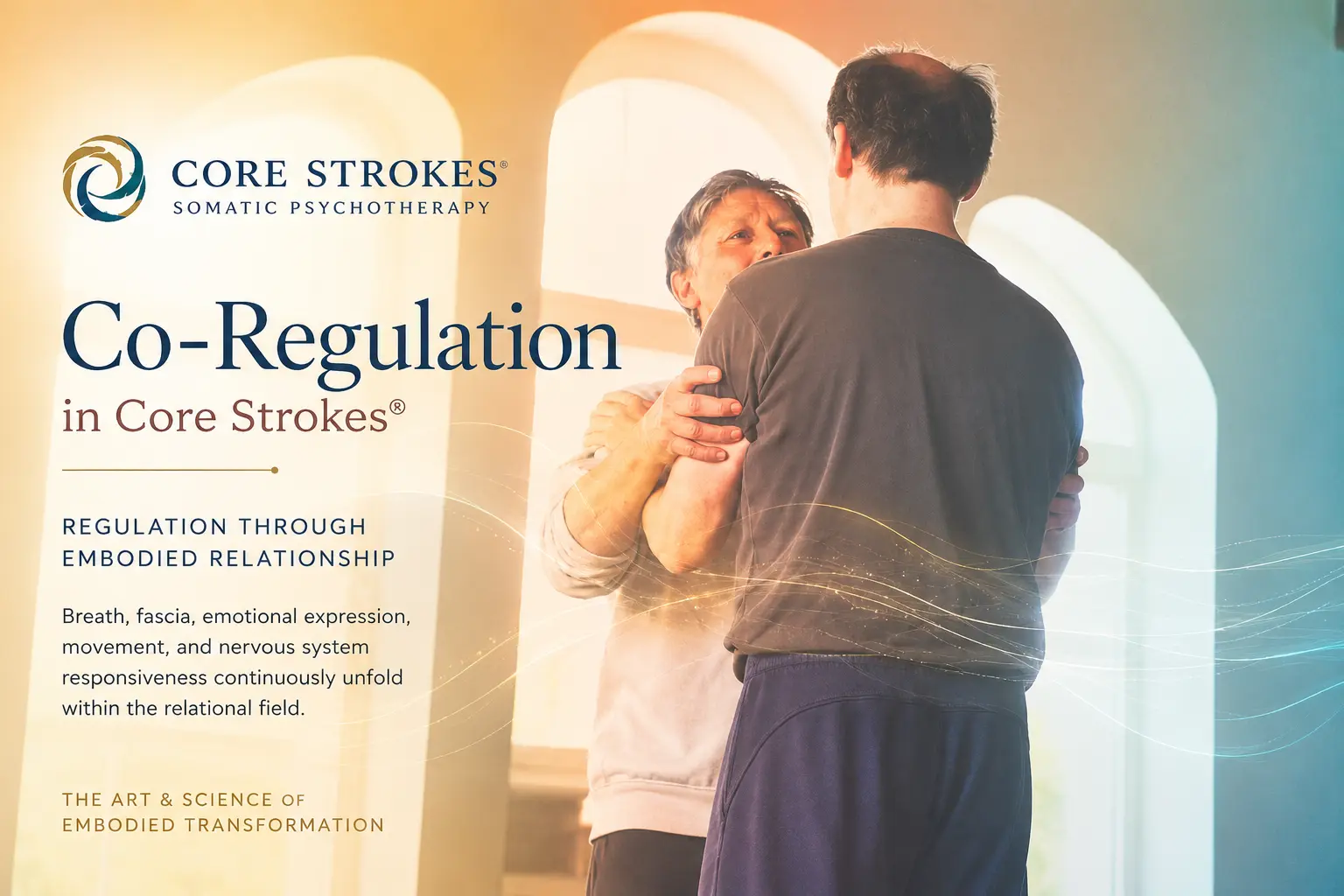
See: Resonance; Co-Regulation; Attunement; Participation; Energetic Coherence.
Neurofascial Responsiveness refers to the organism’s capacity for adaptive, flexible, and coherent responsiveness across the interconnected systems of fascia, nervous system regulation, breathing, movement, emotional process, energetic organization, and relational participation.
Within Core Strokes®, neurofascial responsiveness reflects the degree to which the bodymind system remains capable of sensing, adapting, regulating, responding, softening, mobilizing, integrating, and participating fluidly in relation to changing internal and external conditions.
Healthy neurofascial responsiveness supports grounding, movement continuity, emotional flexibility, energetic coherence, autonomic adaptability, fascia elasticity, pulsation, relational openness, and embodied participation.
Disturbances in neurofascial responsiveness may appear through rigidity, collapse, dissociation, chronic contraction, autonomic fixation, energetic blocking, emotional constriction, impaired movement propagation, or defensive organization throughout the bodymind system.
Within embodied approaches, responsiveness reflects not merely muscular reaction, but the organism’s whole-system participation through sensation, posture, breathing, fascia organization, energetic tone, emotional process, and autonomic regulation.
Within Core Strokes®, increasing neurofascial responsiveness forms a central aspect of transformation and is closely related to regulation, pulsation, fascia organization, movement propagation, energetic coherence, and embodied participation.
See: Fascial Responsiveness; Regulation; Pulsation; Coherence; Participation.
Neurofascial Transformation Process™ refers to the therapeutic process through which defensive, fragmented, dysregulated, collapsed, dissociated, or chronically organized neurofascial patterns gradually reorganize toward increasing coherence, regulation, embodiment, vitality, integration, flexibility, relational participation, and organismic responsiveness.
Within Core Strokes®, the Neurofascial Transformation Process™ reflects the understanding that transformation occurs not solely cognitively or emotionally, but throughout the interconnected systems of fascia, breathing, posture, movement, autonomic regulation, energetic organization, emotional process, relational participation, symbolic meaning, and embodied consciousness.
The process involves continuous interaction between breathing continuity, fascia responsiveness, movement propagation, autonomic regulation, emotional metabolization, relational attunement, co-regulation, embodied awareness, therapeutic contact, energetic responsiveness, symbolic integration, grounding, and conscious participation throughout the bodymind system.
Transformation unfolds gradually as previously interrupted, constricted, fragmented, dissociated, collapsed, rigidified, or defensive organizations become increasingly regulated, embodied, differentiated, integrated, metabolized, flexible, coherent, and participatory within lived experience and relationship.
Within embodied and developmental perspectives, the Neurofascial Transformation Process™ recognizes that long-standing defensive organizations are often stabilized procedurally through autonomic conditioning, fascial organization, breathing restriction, movement inhibition, energetic constriction, emotional suppression, relational expectation, and chronic patterns of organismic adaptation.
Therapeutic transformation therefore involves not simply symptom removal or emotional discharge, but progressive reorganization of the organism’s capacity for regulation, vitality, grounding, emotional openness, energetic coherence, relational participation, and embodied continuity.
Within Core Strokes®, the Neurofascial Transformation Process™ unfolds through progressive phases involving attunement, orientation, activation, unwinding, discharge, reorganization, integration, differentiation, stabilization, and embodied participation.
Throughout this process, previously unconscious or defensive organizations may gradually become available to awareness through sensation, movement, breathing, fascia texture perception, emotional process, symbolic emergence, relational participation, energetic responsiveness, and embodied presence.
The process often includes increasing tolerance for vulnerability, activation, intimacy, emotional truth, polarity integration, energetic flow, relational reciprocity, symbolic depth, and organismic participation without fragmentation or defensive collapse.
Within Core Strokes®, transformation is understood as an organismic process rather than a mechanical intervention imposed upon the body.
The organism itself participates actively in reorganization when sufficient regulation, grounding, attunement, safety, differentiation, energetic responsiveness, and participatory support become available.
The Neurofascial Transformation Process™ therefore reflects the organism’s intrinsic movement toward increasing coherence, vitality, participation, flexibility, integration, and embodied aliveness throughout body, emotion, fascia, movement, energy, relationship, and consciousness.
Advanced integrative work within Core Strokes®, especially within Radiant Core and Luminous Core, explores increasingly subtle dimensions of transformation involving polarity integration, energetic streaming, symbolic participation, contemplative embodiment, emotional truth, relational openness, and organismic coherence throughout the living bodymind field.
See: Neurofascial Encoding™; Regulation; Integration; Embodiment; Participation.
Neurofascial Unwinding refers to the gradual release, reorganization, softening, and transformation of chronically held defensive, autonomic, emotional, energetic, and fascial patterns throughout the bodymind system.
Within embodied and fascia-oriented approaches, neurofascial unwinding may involve spontaneous or facilitated movement, trembling, stretching, pulsation, emotional release, breathing changes, autonomic discharge, energetic streaming, symbolic emergence, or shifts in posture and movement organization.
Unwinding reflects the organism’s intrinsic movement toward restoring flexibility, regulation, pulsation, movement continuity, emotional responsiveness, energetic flow, and coherent participation following periods of defensive constriction, trauma, collapse, fragmentation, or chronic holding.
Within Core Strokes®, neurofascial unwinding is understood not merely mechanically, but as a whole-organism reorganization involving fascia, breathing, autonomic regulation, emotional process, movement propagation, energetic responsiveness, symbolic participation, and relational safety.
Healthy unwinding occurs gradually within sufficient grounding, containment, nervous system capacity, co-regulation, differentiation, and embodied participation.
Without adequate regulation and support, unwinding processes may become overwhelming, dysregulated, fragmenting, or destabilizing.
Within Core Strokes®, neurofascial unwinding is closely associated with the Neurofascial Transformation Process™, pulsation, movement propagation, energetic release, Orgastic Breath, and restoration of neurofascial coherence.
See: Neurofascial Transformation Process™; Pulsation; Regulation; Movement Propagation; Orgastic Breath.
Neurogenic Discharge refers to the organism’s involuntary release, discharge, redistribution, or reorganization of accumulated autonomic, muscular, emotional, or energetic activation through shaking, trembling, pulsation, breathing changes, movement, emotional release, autonomic settling, or spontaneous organismic responsiveness.
Within embodied and trauma-informed approaches, neurogenic discharge is understood as part of the organism’s intrinsic regulatory capacity through which unresolved activation, defensive mobilization, freeze energy, or accumulated stress may gradually reorganize and integrate.
Neurogenic discharge may occur through trembling, shaking, quivering, pulsatory movement, emotional release, autonomic shifts, energetic streaming, spontaneous movement, breathing changes, or wave-like discharge throughout the bodymind system.
Healthy neurogenic discharge may support regulation, grounding, emotional metabolization, autonomic flexibility, fascia softening, energetic release, restoration of pulsation, movement continuity, and coherent embodied participation.
Within Core Strokes®, neurogenic discharge is closely associated with pulsation, quivering, Orgastic Breath, neurofascial unwinding, energetic movement, autonomic regulation, and the Neurofascial Transformation Process™.
See: Neurogenic Tremors; Pulsation; Discharge; Regulation; Neurofascial Transformation Process™.
Neurogenic Tremors refers to involuntary rhythmic shaking, trembling, oscillation, or pulsatory discharge arising through activation and reorganization within the nervous system and bodymind organism.
Within embodied and trauma-informed perspectives, neurogenic tremors are understood as spontaneous autonomic and neuromuscular responses through which the organism may discharge activation, release defensive holding, reorganize tension patterns, restore pulsation, regulate overwhelm, and recover greater physiological and energetic flexibility.
Neurogenic tremors may emerge during stress release, grounding work, emotional processing, trauma integration, autonomic discharge, deep relaxation, intense activation, therapeutic process, energetic mobilization, or spontaneous organismic regulation.
They may be experienced as trembling, shaking, vibration, oscillation, quivering, pulsatory movement, wave-like discharge, involuntary muscular activation, or rhythmic movement spreading through muscles, fascia, breathing structures, pelvis, spine, diaphragm, legs, or the whole body.
Within healthy organismic regulation, neurogenic tremors may support autonomic discharge, energetic release, emotional metabolization, grounding, movement continuity, fascia softening, restoration of pulsation, nervous system flexibility, and increasing embodied participation.
Within trauma-informed approaches, neurogenic tremors are often viewed as part of the organism’s intrinsic self-regulatory capacity through which incomplete defensive activation or survival energy may gradually reorganize and integrate.
The organism may therefore utilize tremoring responses to reduce chronic autonomic overactivation, muscular bracing, freeze organization, energetic constriction, or accumulated physiological stress.
However, neurogenic tremors are not automatically therapeutic in all circumstances.
Without sufficient grounding, regulation, containment, relational safety, differentiation, and nervous system capacity, tremoring processes may become overwhelming, dysregulated, fragmenting, retraumatizing, compulsive, or destabilizing for some individuals.
Within embodied approaches, the meaning and function of neurogenic tremors are therefore understood contextually within the larger organization of the bodymind system rather than interpreted mechanically or universally.
Within Core Strokes®, neurogenic tremors are closely associated with pulsation, autonomic regulation, energetic discharge, fascia responsiveness, movement propagation, grounding, emotional integration, Orgastic Breath, and restoration of coherent organismic participation.
Tremoring processes may accompany phases of neurofascial unwinding and reorganization during the Neurofascial Transformation Process™, particularly when chronic holding patterns, defensive contraction, freeze responses, or energetic inhibition begin reorganizing toward greater fluidity and participation.
Advanced integrative work within Core Strokes®, especially within Radiant Core and Luminous Core, explores tremoring phenomena within the broader context of energetic organization, breathing continuity, emotional metabolization, polarity integration, symbolic participation, grounding, and organismic coherence.
Neurogenic tremors therefore reflect not merely mechanical shaking, but potentially meaningful expressions of autonomic, energetic, emotional, and organismic reorganization within the living bodymind system.
See: Quivering; Pulsation; Discharge; Regulation; Neurofascial Transformation Process™.
Neuroplasticity refers to the nervous system’s capacity to reorganize, adapt, modify, and form new neural pathways, regulatory patterns, perceptual organizations, emotional responses, and embodied participation throughout life.
Within contemporary neuroscience and embodied perspectives, neuroplasticity reflects the organism’s ongoing capacity for learning, adaptation, recovery, developmental change, and transformation in response to experience, environment, movement, relationship, emotional process, and conscious participation.
Neuroplastic change may occur through attachment experiences, therapeutic process, movement learning, emotional integration, co-regulation, embodied awareness, repetition, attention, breathing, relational participation, contemplative practice, and environmental interaction.
Within embodied approaches, neuroplasticity is understood not solely neurologically, but as deeply interconnected with autonomic regulation, fascia organization, movement continuity, emotional responsiveness, energetic organization, procedural memory, and relational participation throughout the bodymind system.
Healthy neuroplasticity supports flexibility, resilience, learning, regulation, adaptability, integration, emotional growth, and increasing organismic coherence.
Disturbances in neuroplastic functioning may contribute to rigid defensive organization, chronic dysregulation, repetitive procedural patterns, traumatic fixation, autonomic rigidity, emotional constriction, or impaired adaptation and participation.
Within Core Strokes®, neuroplasticity is closely associated with Neurofascial Encoding™, the Neurofascial Transformation Process™, regulation, movement reorganization, fascia responsiveness, emotional integration, and embodied participation.
See: Neurofascial Encoding™; Transformation; Regulation; Procedural Memory; Participation.
Nonlinear Process refers to patterns of development, regulation, transformation, learning, healing, emotional integration, or organismic change that do not unfold in a simple, predictable, sequential, or steadily progressive manner.
Within embodied and developmental perspectives, nonlinear process reflects the reality that transformation often unfolds through cycles, oscillations, regressions, breakthroughs, plateaus, reorganizations, destabilizations, and emergent shifts rather than through straight-line progression.
Nonlinear processes may involve repetition, spiraling development, fluctuating activation, changing regulatory states, alternating expansion and contraction, periods of integration and disorganization, or sudden reorganizations within the bodymind system.
Within Core Strokes®, transformation is understood fundamentally as a nonlinear organismic process involving breathing, fascia organization, emotional integration, autonomic regulation, movement propagation, energetic responsiveness, symbolic participation, and relational development.
The Energetic Breath Cycle™ itself reflects nonlinear pulsatory movement through phases of activation, receptivity, excitation, surrender, integration, and restoration rather than rigid linear sequencing.
Recognition of nonlinear process supports patience, regulation, differentiation, humility, therapeutic timing, and respect for the organism’s own rhythms of transformation and participation.
See: Transformation; Pulsation; Regulation; Neurofascial Transformation Process™; Participation.
Nonverbal Attunement refers to the organism’s capacity to perceive, respond to, synchronize with, and participate in the nonverbal emotional, autonomic, energetic, and embodied communication of another person.
Within embodied and developmental perspectives, nonverbal attunement forms a foundational aspect of attachment, co-regulation, emotional development, safety perception, relational participation, and therapeutic process.
Nonverbal attunement occurs through breathing rhythms, facial expression, gaze, posture, movement quality, tone of voice, timing, energetic presence, gesture, autonomic responsiveness, fascia organization, and embodied resonance often outside conscious awareness.
Healthy nonverbal attunement supports emotional safety, grounding, regulation, co-regulation, attachment security, relational openness, nervous system settling, energetic coherence, and embodied participation.
Disturbances in nonverbal attunement may contribute to attachment insecurity, emotional confusion, fragmentation, relational misattunement, chronic hypervigilance, defensive withdrawal, dysregulation, or impaired participation within relationship.
Within Core Strokes®, nonverbal attunement is closely associated with therapeutic presence, co-regulation, body reading, fascia responsiveness, movement propagation, energetic resonance, and embodied participation throughout the therapeutic field.
See: Attunement; Co-Regulation; Nonverbal Communication; Therapeutic Presence; Participation.
Nurturance refers to the embodied, emotional, relational, developmental, and organismic provision of care, support, nourishment, soothing, protection, responsiveness, affirmation, and co-regulation necessary for healthy growth, attachment, regulation, embodiment, and participation in life.
Within embodied and developmental perspectives, nurturance involves far more than physical care alone. It includes the ongoing relational experiences through which the organism feels received, supported, emotionally recognized, protected, valued, regulated, and safely held within relationship and environment.
Nurturance may occur through feeding, touch, holding, soothing, affectionate contact, emotional responsiveness, mirroring, validation, encouragement, breathing resonance, energetic warmth, relational availability, embodied presence, and consistent participation within caring relational exchange.
Healthy nurturance supports attachment security, autonomic regulation, grounding, emotional development, vitality, self-worth, embodiment, trust, energetic coherence, movement continuity, emotional openness, and coherent organismic participation throughout development and adult life.
Within embodied approaches, nurturance is understood as a whole-organism process involving breathing organization, autonomic settling, fascia responsiveness, emotional metabolization, energetic regulation, movement organization, relational attunement, and embodied participation.
The organism therefore receives nurturance not only cognitively, but physiologically, emotionally, energetically, relationally, and somatically.
Disturbances in nurturance may contribute to deprivation, collapse, emotional hunger, compulsive self-sufficiency, dependency, attachment insecurity, fragmentation, shame, dysregulation, impaired grounding, relational fear, emotional constriction, defensive adaptation, or difficulty receiving support, intimacy, nourishment, and participation.
Within developmental perspectives, early nurturance strongly shapes breathing organization, autonomic regulation, fascia responsiveness, emotional regulation, attachment style, body organization, energetic tone, and procedural expectations regarding support, contact, vulnerability, and relational participation.
Within Core Strokes®, nurturance is closely associated with Nurturing Breath, attachment organization, co-regulation, embodied receptivity, fascia softening, emotional nourishment, energetic settling, grounding, and the organism’s capacity to receive support, care, nourishment, and relational participation without collapse, fragmentation, or defensive withdrawal.
The Nurturing Breath phase particularly reflects the organism’s developing capacity to receive and metabolize supportive contact through breathing continuity, embodied receptivity, emotional openness, autonomic settling, and coherent relational participation.
Advanced integrative work within Core Strokes®, especially within Flowing Core and Luminous Core, explores increasingly refined dimensions of nurturance involving energetic resonance, emotional holding, symbolic nourishment, relational warmth, contemplative presence, and restoration of deep organismic receptivity and participation.
Nurturance therefore reflects a foundational life-supporting process through which the organism develops the capacity to trust, receive, regulate, grow, love, and participate coherently within embodied life and relationship.
See: Attachment; Co-Regulation; Nurturing Breath; Embodiment; Participation.
Nurturing Breath is the second phase of the Energetic Breath Cycle™ and is characterized by receiving, nourishment, co-regulation, embodied support, emotional holding, trust, and the organism’s developing capacity to safely take in life.
Within developmental and embodied perspectives, Nurturing Breath reflects the organism’s movement from basic existence and stabilization toward increasing receptivity, relational openness, emotional nourishment, and participatory connection with others and the environment.
This phase represents the developmental emergence of the capacity to receive contact, support, soothing, emotional responsiveness, attachment, nourishment, regulation, and relational participation without excessive fear, fragmentation, defensive withdrawal, or collapse.
Within healthy organization, breathing becomes more receptive, fluid, absorptive, rhythmic, and supported throughout the bodymind system.
The organism gradually develops increasing capacity to soften, trust support, metabolize nourishment, receive care, tolerate closeness, regulate through relationship, and remain emotionally and energetically open within contact and participation.
Nurturing Breath is closely associated with attachment formation, co-regulation, oral development, emotional nourishment, embodied trust, receptivity, fascia softening, relational openness, autonomic settling, and the gradual development of internal support and self-regulation.
Within embodied organization, this phase often expresses itself through softer breathing rhythms, increased emotional accessibility, greater bodily receptivity, improved grounding, increased fascia responsiveness, emotional warmth, and more fluid participation within relationship and environment.
The organism learns progressively that openness, need, vulnerability, receptivity, and participation may coexist with safety, support, regulation, and continuity of self.
Disturbances in the Nurturing Breath phase may contribute to emotional hunger, dependency, deprivation, collapse, attachment insecurity, compulsive self-sufficiency, clinging, impaired receptivity, defensive withdrawal, fragmentation, oral longing, emotional constriction, or chronic fear around receiving nourishment, support, intimacy, and relational participation.
Defensive adaptations within this phase may become embodied through breathing restriction, collapse tendencies, energetic depletion, fascia disorganization, emotional withholding, compensatory dependency, or defensive contraction around vulnerability and need.
Within Core Strokes®, Nurturing Breath is closely associated with nurturance, attachment, co-regulation, embodiment, fascia organization, emotional metabolization, energetic receptivity, grounding, relational participation, and the organism’s developing ability to safely receive and integrate support throughout the bodymind system.
The healthy Soul Texture associated with this phase is Quiet Flame, reflecting warm, receptive, emotionally alive, and regulated participation within supportive relational contact.
Within the distorted breath cycle, disruptions of Nurturing Breath may contribute to oralized defensive organizations and shadow dynamics associated with emotional hunger, dependency, collapse, clinging, deprivation, or compensatory self-protection.
Advanced integrative work within Core Strokes®, especially within Rooting Core and Flowing Core, explores restoration of healthy receptivity, embodied trust, fascia softening, emotional nourishment, energetic settling, relational openness, and coherent participation within the organism’s capacity to receive life.
Nurturing Breath therefore reflects the organism’s growing ability to take in support, nourishment, emotional contact, and relational participation while remaining embodied, regulated, differentiated, and alive.
See: Energetic Breath Cycle™; Nurturance; Attachment; Co-Regulation; Participation.
O
Object Relations – A psychoanalytic and developmental concept referring to the internalized patterns of relationship between self and others that shape emotional life, attachment, identity, expectation, and interpersonal behavior.
Object relations are formed through early relational experience and become expressed through internal representations, attachment patterns, emotional expectations, relational defenses, and habitual ways of perceiving self and others.
Within embodied approaches, object relations are not only mental representations but may also become expressed through posture, breathing, autonomic regulation, movement tendencies, emotional responses, relational distance, and patterns of contact or withdrawal.
Within Core Strokes®, object relations are understood as embodied relational organizations shaped by development, attachment, regulation, breath organization, and defensive adaptation.
See Attachment, Internalization, Relational Field, Character Structure, Regulation
Oedipal Dynamics – Developmental and relational dynamics involving love, desire, rivalry, jealousy, exclusion, loyalty, identification, sexuality, boundaries, and triangulated relationship within the family or relational field.
In classical psychoanalysis, these dynamics were organized around the child’s unconscious wishes toward one parent and rivalry with the other. In contemporary embodied and relational approaches, oedipal dynamics are understood more broadly as the developmental field in which the child encounters desire, difference, gender, sexuality, love, limits, exclusion, belonging, and relational complexity.
Within body-oriented psychotherapy, unresolved oedipal dynamics may become expressed through splitting between heart and pelvis, inhibition of love or sexuality, seductiveness, jealousy, rivalry, shame, withholding, fear of vulnerability, or difficulty integrating tenderness, desire, and relational commitment.
Within Core Strokes®, oedipal dynamics are closely related to the heart–pelvis axis, Excited Breath, Orgastic Breath, polarity integration, erotic development, and the integration of love, sexuality, and relational truth.
See Heart–Pelvis Axis, Excited Breath, Orgastic Breath, Eros, Polarity
Orgasm Anxiety refers to anxiety, fear, contraction, inhibition, dissociation, defensive control, or autonomic constriction arising in relation to sexual surrender, pleasure, climax, involuntary movement, vulnerability, intimacy, ego-softening, energetic intensity, or loss of conscious control.
Within embodied and developmental perspectives, orgasm anxiety reflects not merely fear of sexuality itself, but fear associated with the organism’s movement toward surrender, openness, energetic release, emotional exposure, relational participation, and reduction of defensive control.
Orgasm anxiety may involve fear of vulnerability, engulfment, dependency, emotional exposure, shame, relational betrayal, aggression, loss of boundaries, annihilation, humiliation, abandonment, fragmentation, trauma reactivation, or loss of identity organization during states of heightened erotic and emotional intensity.
Within embodied approaches, orgasm anxiety may become expressed through breath restriction, pelvic holding, muscular contraction, autonomic overcontrol, emotional withdrawal, energetic blocking, collapse, dissociation, compulsive performance, restricted movement propagation, or splitting between sexuality, emotional openness, and relational participation.
The organism may simultaneously long for pleasure, intimacy, surrender, energetic flow, and connection while defensively organizing against the intensity, vulnerability, and loss of control associated with these experiences.
Within developmental perspectives, orgasm anxiety may emerge through attachment disruption, shame-based sexual conditioning, trauma history, relational fear, emotional deprivation, punitive environments, body shame, chronic hypercontrol, unresolved dependency conflicts, or defensive separation between heart, pelvis, feeling, and embodied participation.
Within Reichian and body-oriented traditions, orgasm anxiety has often been associated with chronic armoring, restricted pulsation, impaired energetic streaming, defensive control, and interruption of the organism’s natural capacity for surrender, discharge, pleasure, and coherent erotic participation.
Within Core Strokes®, orgasm anxiety is closely associated with intensity regulation, heart–pelvis integration, erotic development, defensive organization, energetic coherence, polarity integration, autonomic regulation, and the organism’s capacity to surrender without losing grounding, differentiation, coherence, or embodied participation.
The Orgastic Breath phase particularly explores the organism’s capacity for pulsatory surrender, energetic streaming, emotional openness, erotic integration, and coherent participation within states of heightened activation and vulnerability.
Disturbances in this phase may contribute to defensive control, dissociation, fragmentation, compulsive excitation, collapse, emotional disconnection, fear of surrender, impaired erotic integration, or separation between sexuality, heart, embodiment, and consciousness.
Within therapeutic work, transformation does not involve forcing surrender or intensifying activation beyond nervous system capacity.
Rather, healing involves gradual development of regulation, grounding, emotional integration, energetic coherence, embodied safety, vulnerability tolerance, relational trust, polarity integration, and increasing organismic capacity to remain coherent during pleasure, intimacy, activation, surrender, and erotic participation.
Advanced integrative work within Core Strokes®, especially within Radiant Core and Luminous Core, explores orgasm anxiety within the broader context of energetic organization, polarity dynamics, emotional truth, spiritual embodiment, heart–pelvis integration, symbolic participation, and coherent organismic surrender within embodied life.
See: Intensity Regulation; Heart–Pelvis Axis; Orgastic Breath; Eros; Defensive Organization.
Orgastic Breath – A Breath Phase within the Energetic Breath Cycle™ associated with surrender, fusion, deep pulsation, erotic-spiritual integration, heart–pelvis coherence, relational trust, and the organism’s capacity to participate in full-bodied pleasure and embodied union.
Orgastic Breath reflects the integration of excitation, love, sexuality, surrender, regulation, and relational participation. It is not limited to genital orgasm, but refers to a broader organismic capacity for pulsatory surrender, energetic union, emotional openness, and whole-body participation.
Disturbances in this phase may involve dissociation, orgasm anxiety, frozen pleasure, relational mistrust, sexual shame, heart–pelvis splitting, overcontrol, collapse, or inability to surrender into full-bodied experience.
Within Core Strokes®, Orgastic Breath is closely related to heart–pelvis integration, Streaming Union, erotic embodiment, pulsation, surrender, and the transformation of defensive splitting between love and sexuality.
See Energetic Breath Cycle™, Orgasm, Orgastic Potency, Heart–Pelvis Axis, Streaming Union
Orgastic Potency – A Reichian term referring to the organism’s capacity to surrender to involuntary pleasurable pulsation, sexual excitation, emotional openness, and full-bodied energetic discharge without chronic inhibition, fragmentation, or defensive control.
In Reich’s original theory, orgastic potency was central to psychological and somatic health. Within contemporary embodied approaches, the concept may be understood more broadly as the capacity for regulated surrender, pleasure, intimacy, pulsation, heart–pelvis integration, and whole-organism participation in erotic aliveness.
Within Core Strokes®, orgastic potency is not treated as a rigid standard of health, but as one expression of the organism’s capacity for trust, surrender, embodied pleasure, relational openness, and pulsatory coherence.
See Orgasm, Orgastic Breath, Eros, Pulsation, Heart–Pelvis Axis
Opening Up – The process through which the organism increases its capacity for emotional expression, embodied participation, relational contact, breathing, movement, energetic flow, and conscious awareness.
Within older bioenergetic traditions, opening up was often associated with releasing inhibition and increasing expressiveness. Within contemporary embodied approaches, opening must be supported by regulation, grounding, containment, relational safety, and pacing so that increased openness does not lead to flooding, fragmentation, dissociation, or collapse.
Healthy opening up involves greater flexibility, vitality, emotional availability, movement, breath continuity, relational responsiveness, and embodied coherence.
Within Core Strokes®, opening up is closely related to regulation, breath organization, embodied participation, fascial responsiveness, and the organism’s capacity to move toward life without losing continuity or safety.
See Regulation, Containment, Breath Organization, Embodied Participation, Expansion
Oral – A developmental term referring to early relational and embodied organization around receiving, nourishment, dependency, need, attachment, satisfaction, deprivation, and the capacity to take in support.
In classical psychoanalytic theory, the oral stage refers to early development in which the mouth and feeding relationship are central to pleasure and survival. In embodied and relational approaches, oral organization is understood more broadly through the development of trust, receptivity, nurturance, attachment, co-regulation, and the capacity to receive.
Disturbances in oral organization may involve emotional hunger, dependency, collapse, clinging, deprivation, compulsive self-sufficiency, difficulty receiving support, or fear of abandonment.
Within Core Strokes®, oral organization is closely related to Nurturing Breath, nurturance, attachment, co-regulation, receptivity, and the development of embodied trust.
See Nurturing Breath, Nurturance, Attachment, Co-Regulation, Receptivity
Organismic refers to the understanding of the human being as a living, self-organizing, dynamically interconnected whole in which body, breath, movement, sensation, emotion, perception, autonomic regulation, energetic organization, relationship, cognition, and environment continuously interact as integrated aspects of a unified process.
Within organismic perspectives, human experience is not understood as the sum of isolated parts or separate systems functioning independently, but as an ongoing process of embodied participation, adaptation, regulation, differentiation, integration, and relational exchange throughout the living organism.
The organism continuously organizes itself through reciprocal interaction between internal processes and environmental conditions.
Breathing, posture, fascia responsiveness, movement propagation, emotional process, autonomic regulation, energetic organization, perception, relational participation, and meaning-making therefore influence one another continuously rather than functioning separately.
Within embodied and developmental approaches, organismic functioning reflects the organism’s inherent capacity for self-regulation, adaptation, responsiveness, pulsation, coherence, participation, and transformation.
Disturbances in organismic organization may appear through fragmentation, chronic defensive adaptation, dissociation, rigidity, collapse, impaired regulation, disrupted participation, or loss of continuity throughout embodied experience.
Within Core Strokes®, the organismic perspective forms a foundational principle underlying participation, regulation, fascia responsiveness, movement propagation, morphodynamic organization, relational process, energetic coherence, developmental integration, and therapeutic transformation.
Therapeutic work therefore supports not merely symptom reduction, but increasing coherence and participation throughout the organism as a living embodied process.
See: Participation; Coherence; Regulation; Morphodynamic Organization; Embodied Participation; Energetic Coherence.
Organismic Continuity refers to the ongoing coherent continuity of embodied experience, regulation, self-organization, participation, perception, movement, emotional process, energetic responsiveness, and relational existence throughout the living organism across time.
Within embodied and organismic perspectives, organismic continuity reflects the organism’s capacity to remain sufficiently connected to itself while moving through changing states of activation, emotion, vulnerability, relationship, transformation, and environmental conditions without excessive fragmentation, dissociation, collapse, or defensive disorganization.
Organismic continuity is expressed through the ongoing integration and participation of breathing, autonomic regulation, fascia responsiveness, movement continuity, emotional processing, energetic flow, symbolic participation, relational responsiveness, memory organization, perception, and embodied self-experience throughout the bodymind system.
Healthy organismic continuity supports grounding, coherence, emotional tolerance, energetic continuity, nervous system flexibility, movement propagation, relational openness, symbolic integration, identity continuity, vitality, and embodied participation within life.
Within lived experience, organismic continuity allows the individual to experience changing emotions, bodily states, relational experiences, developmental transitions, energetic activation, and existential challenges while maintaining sufficient coherence, orientation, regulation, and participatory connection to self and environment.
Organismic continuity therefore does not imply rigidity, sameness, or fixed identity, but reflects the organism’s capacity to remain dynamically coherent while continuously adapting, transforming, differentiating, and participating throughout changing conditions.
Within developmental perspectives, organismic continuity develops gradually through attachment, co-regulation, embodied safety, emotional recognition, movement freedom, nervous system maturation, relational participation, symbolic process, and increasing integration of bodily, emotional, autonomic, and relational experience.
Trauma, chronic dysregulation, attachment disruption, emotional neglect, overwhelming activation, dissociation, fragmentation, defensive adaptation, or prolonged relational unsafety may interrupt organismic continuity throughout the bodymind system.
Disruptions in organismic continuity may become expressed through fragmentation, dissociation, identity disturbance, autonomic dysregulation, emotional discontinuity, impaired grounding, movement interruption, symbolic fragmentation, energetic constriction, or disturbances in embodied participation.
Within embodied approaches, organismic continuity is not understood merely cognitively or psychologically, but as a living continuity expressed through breathing organization, posture, fascia responsiveness, movement propagation, emotional flow, energetic coherence, autonomic regulation, and relational participation.
Within therapeutic work, restoration of organismic continuity often involves increasing regulation, grounding, breathing continuity, fascia responsiveness, movement integration, emotional metabolization, symbolic participation, energetic coherence, relational safety, and embodied participation.
The organism gradually develops increasing capacity to remain present and participatory within activation, vulnerability, relational contact, emotional intensity, energetic movement, and transformational process without excessive fragmentation or defensive interruption.
Within Core Strokes®, organismic continuity forms a foundational principle underlying pulsation, movement propagation, fascia organization, Neurofascial Encoding™, regulation, symbolic process, energetic coherence, and the Neurofascial Transformation Process™.
The Energetic Breath Cycle™ itself may be understood as a map of organismic continuity through changing phases of activation, receptivity, expression, surrender, integration, and restoration within embodied participation.
Within Core Strokes®, disruptions in organismic continuity are often reflected through defensive breath interruption, fragmented movement propagation, fascia disorganization, autonomic dysregulation, energetic fragmentation, emotional splitting, dissociation, and disturbances in coherent participation throughout the organismic field.
The Healthy Soul Textures™ may themselves be understood as qualitative expressions of increasing organismic continuity throughout body, emotion, relationship, energy, symbolic process, and consciousness.
Advanced integrative work within the Core Strokes® Framework explores increasingly subtle dimensions of organismic continuity involving energetic resonance, contemplative embodiment, symbolic participation, polarity integration, relational field dynamics, existential grounding, erotic-spiritual integration, and organismic participation within larger dimensions of life and consciousness.
Organismic continuity therefore reflects the living coherent unfolding through which the organism remains participatory, responsive, embodied, and dynamically integrated throughout the changing movement of life.
See: Participation; Regulation; Pulsation; Organismic Process; Neurofascial Transformation Process™.
Organismic Intelligence refers to the inherent self-organizing capacity of the living organism to regulate, adapt, perceive, respond, integrate, differentiate, heal, and participate coherently within changing internal and external conditions.
Within organismic and embodied perspectives, intelligence is understood not solely as cognitive or intellectual functioning, but as a whole-organism process expressed through breathing, movement, fascia responsiveness, autonomic regulation, emotional processing, energetic organization, perception, relational participation, and embodied adaptation.
Organismic intelligence continuously coordinates posture, orientation, regulation, movement propagation, energetic distribution, emotional responsiveness, and relational participation throughout the bodymind system.
This intelligence often operates implicitly and preconceptually prior to conscious cognitive interpretation or deliberate control.
Healthy organismic intelligence supports adaptability, regulation, coherence, grounding, emotional integration, relational responsiveness, vitality, resilience, and embodied participation throughout lived experience.
Disturbances in organismic intelligence may appear through fragmentation, chronic defensive organization, dissociation, impaired regulation, compulsive reactivity, rigidity, collapse, loss of embodied responsiveness, or interruption of coherent participation within life and relationship.
Within Core Strokes®, organismic intelligence forms a foundational principle underlying fascia responsiveness, movement propagation, morphodynamic organization, energetic coherence, developmental integration, emotional metabolization, and therapeutic transformation.
Therapeutic work therefore supports not the imposition of external organization upon the organism, but the restoration of the organism’s inherent capacity for coherent self-organization, regulation, participation, and embodied responsiveness.
See: Organismic; Regulation; Participation; Morphodynamic Organization; Energetic Coherence; Embodied Participation; Organismic Process.
Organismic Participation – The living process through which the organism engages coherently with internal experience, relational life, environment, movement, emotion, sensation, energetic process, and embodied existence as an integrated whole.
Within organismic and embodied perspectives, participation is understood not merely as behavioral involvement or social interaction, but as the organism’s ongoing capacity for responsive engagement across bodily, emotional, autonomic, energetic, perceptual, relational, developmental, and existential dimensions of experience.
Organismic participation unfolds continuously through breathing, posture, movement, fascia responsiveness, autonomic regulation, emotional expression, energetic organization, perception, relational contact, and embodied awareness. The organism participates simultaneously within internal experience, relational exchange, and environmental interaction through ongoing processes of sensing, orienting, regulating, adapting, expressing, responding, and meaning-making.
Healthy organismic participation supports coherence, adaptability, grounding, vitality, differentiation, emotional integration, energetic continuity, relational responsiveness, and embodied presence across changing conditions and levels of activation.
Disturbances in organismic participation may appear through dissociation, defensive withdrawal, fragmentation, chronic adaptation, collapse, hypervigilance, rigidity, emotional disconnection, impaired responsiveness, or interruption of coherent engagement within life and relationship.
Within Core Strokes®, organismic participation forms a central organizing principle underlying regulation, grounding, movement propagation, fascia responsiveness, energetic coherence, morphodynamic organization, relational process, symbolic participation, and therapeutic transformation.
Transformation therefore involves increasing the organism’s capacity for coherent participation throughout embodied, emotional, energetic, relational, symbolic, and existential life.
See: Participation; Organismic; Embodied Participation; Coherence; Regulation; Relational Participation; Organismic Process.
Organismic Process refers to the continuous living movement through which the organism organizes, regulates, adapts, transforms, responds, participates, and evolves throughout embodied existence.
Within embodied and organismic perspectives, human experience is understood not as a collection of isolated mental, emotional, physiological, or behavioral events, but as an ongoing dynamic process involving the continuous interaction of body, nervous system, breathing, fascia, movement, emotion, energy, perception, relationship, symbolic meaning, and consciousness.
Organismic process reflects the living continuity through which the organism maintains coherence, responds to changing conditions, metabolizes experience, restores regulation, adapts to challenge, develops relational participation, and moves toward increasing integration and vitality.
This process unfolds simultaneously through autonomic regulation, breathing rhythms, movement propagation, emotional process, energetic responsiveness, attachment dynamics, symbolic participation, environmental interaction, and embodied self-organization throughout the bodymind system.
Within organismic process, states of contraction and expansion, activation and settling, openness and protection, differentiation and participation continuously interact as part of living adaptation and transformation.
Healthy organismic process supports pulsation, flexibility, grounding, responsiveness, emotional integration, energetic continuity, relational openness, symbolic participation, vitality, and coherent embodied participation within life.
Disturbances in organismic process may appear through fragmentation, rigidity, collapse, dissociation, chronic defensive organization, autonomic dysregulation, emotional constriction, disrupted pulsation, impaired movement continuity, energetic constriction, or reduced participation in embodied and relational existence.
Within developmental perspectives, organismic process unfolds continuously through interaction between innate regulatory tendencies and developmental, relational, environmental, cultural, and existential conditions.
Trauma, chronic stress, attachment disruption, emotional inhibition, overwhelming activation, or defensive adaptation may interrupt or distort organismic process throughout breathing, fascia organization, autonomic regulation, movement, emotional responsiveness, energetic flow, and relational participation.
Within embodied therapeutic work, transformation involves supporting the organism’s inherent movement toward increasing regulation, coherence, pulsation, responsiveness, differentiation, integration, vitality, and participation.
Within Core Strokes®, organismic process forms a foundational principle underlying the Energetic Breath Cycle™, Neurofascial Encoding™, fascia organization, movement propagation, energetic coherence, symbolic process, therapeutic presence, and the Neurofascial Transformation Process™.
Core Strokes® understands transformation not as mechanical correction imposed upon the organism, but as facilitation of the organism’s own participatory movement toward greater coherence, responsiveness, integration, and embodied aliveness.
The Healthy Soul Textures™ may themselves be understood as qualitative expressions of increasingly coherent organismic process throughout the bodymind system.
Within Core Strokes®, organismic process is understood simultaneously biologically, emotionally, autonomically, energetically, relationally, symbolically, developmentally, existentially, and spiritually.
Advanced integrative work within the Core Strokes® Framework explores increasingly subtle dimensions of organismic process involving energetic resonance, contemplative embodiment, symbolic participation, polarity integration, relational field dynamics, existential meaning, erotic-spiritual integration, and organismic participation within larger dimensions of life and consciousness.
Organismic process therefore reflects the living unfolding movement through which embodied life continuously organizes, transforms, participates, and expresses itself throughout the whole bodymind system.
See: Organismic Self-Regulation; Organismic Participation; Pulsation; Regulation; Transformation.
Organismic Regulation refers to the living self-organizing processes through which the organism continuously modulates activation, regulation, adaptation, integration, responsiveness, recovery, participation, and coherence throughout embodied experience.
Within organismic and embodied perspectives, regulation is understood not solely as nervous system control or symptom management, but as a whole-organism process involving breathing, fascia responsiveness, autonomic regulation, movement organization, emotional metabolization, energetic coherence, perception, relational participation, and environmental adaptation.
Organismic regulation continuously coordinates posture, tonicity, breathing rhythm, movement propagation, emotional responsiveness, energetic activation, orientation, and relational participation throughout the bodymind system.
Healthy organismic regulation supports flexibility, grounding, adaptability, pulsatory balance, vitality, emotional integration, coherent activation, recovery, and embodied participation without excessive fragmentation, collapse, rigidity, compulsive discharge, or defensive constriction.
The organism regulates not only internally, but relationally and environmentally through co-regulation, mutual regulation, sensory orientation, movement, energetic exchange, and embodied participation within life and relationship.
Disturbances in organismic regulation may appear through chronic dysregulation, hyperactivation, hypoarousal, fragmentation, dissociation, rigidity, collapse, impaired adaptability, emotional flooding, autonomic instability, or disruption of coherent embodied participation.
Within Core Strokes®, organismic regulation is closely associated with pulsation, grounding, fascia responsiveness, movement propagation, energetic coherence, morphodynamic organization, co-regulation, and embodied participation.
Therapeutic transformation gradually supports increasing organismic regulation through breathing continuity, relational attunement, movement organization, emotional metabolization, energetic integration, fascial adaptability, and restoration of coherent participation throughout the living organism.
See: Regulation; Organismic; Co-Regulation; Pulsation; Energetic Coherence; Embodied Participation.
Organismic Self-Regulation refers to the living organism’s inherent capacity to organize, modulate, restore, balance, integrate, and adapt physiological, emotional, autonomic, energetic, relational, behavioral, and embodied processes in response to changing internal and external conditions.
Within embodied and organismic perspectives, organismic self-regulation reflects the intrinsic self-organizing intelligence of living systems through which the organism continuously seeks coherence, adaptation, participation, recovery, balance, vitality, and continuity throughout life.
Organismic self-regulation operates continuously through the interaction of nervous system regulation, breathing organization, fascia responsiveness, movement propagation, emotional processing, attachment dynamics, energetic organization, perception, metabolism, environmental interaction, symbolic participation, and relational responsiveness.
Healthy organismic self-regulation supports grounding, coherence, flexibility, vitality, emotional tolerance, energetic responsiveness, adaptability, recovery, movement continuity, relational openness, symbolic integration, and embodied participation throughout changing conditions of life.
The organism therefore regulates not merely through conscious effort or cognitive control, but through ongoing whole-system interaction involving autonomic processes, emotional organization, energetic responsiveness, breathing rhythms, movement patterns, fascia organization, relational participation, and embodied intelligence.
Within healthy organization, activation and settling, expansion and contraction, mobilization and restoration, openness and protection, individuality and participation remain capable of fluid dynamic regulation throughout the bodymind system.
Disturbances in organismic self-regulation may contribute to chronic hyperarousal, collapse, fragmentation, rigidity, autonomic dysregulation, dissociation, emotional flooding, compulsive control, energetic constriction, chronic tension, exhaustion, emotional withdrawal, impaired grounding, or restricted participation within life and relationship.
Within developmental perspectives, organismic self-regulation gradually develops through attachment, co-regulation, emotional safety, autonomic maturation, grounding, movement experience, fascia organization, relational participation, environmental interaction, and increasing organismic coherence throughout development.
Early relational experience strongly shapes the organism’s later capacity for self-regulation through procedural organization of breathing, emotional responsiveness, energetic regulation, posture, movement continuity, attachment expectations, and autonomic flexibility.
Within embodied approaches, organismic self-regulation is continuously expressed through posture, breathing continuity, fascia responsiveness, energetic tone, emotional organization, autonomic flexibility, movement quality, relational participation, and the organism’s capacity to remain coherently embodied during changing states of activation and experience.
Within Core Strokes®, organismic self-regulation forms a foundational principle underlying Neurofascial Encoding™, fascia organization, breath organization, movement propagation, nervous system capacity, energetic coherence, emotional integration, grounding, polarity organization, and the Neurofascial Transformation Process™.
The Neurofascial Transformation Process™ may itself be understood as the gradual restoration and expansion of organismic self-regulation throughout breathing, fascia, movement, autonomic regulation, emotional participation, energetic responsiveness, and embodied life.
Advanced integrative work within Core Strokes®, especially within Radiant Core and Luminous Core, explores increasingly refined levels of organismic self-regulation involving energetic coherence, symbolic participation, contemplative embodiment, relational resonance, polarity integration, and conscious participation within the larger continuity of life.
Organismic self-regulation therefore reflects the living self-organizing intelligence through which the organism continuously restores, reorganizes, regulates, and participates within embodied existence.
See: Regulation; Neurofascial Encoding™; Nervous System Regulation; Participation; Coherence.
Organization refers to the dynamic manner in which bodily, emotional, autonomic, energetic, relational, cognitive, behavioral, symbolic, and existential processes arrange, coordinate, regulate, stabilize, and express themselves within a living organism.
Within embodied and organismic perspectives, organization refers not merely to static structure, but to the ongoing patterned functioning through which the organism maintains coherence, continuity, identity, adaptation, regulation, responsiveness, and participation within changing internal and external conditions.
Human experience is continuously organized simultaneously across posture, breathing, fascia responsiveness, movement propagation, autonomic regulation, emotional process, energetic flow, perception, cognition, relational behavior, symbolic meaning, consciousness, and embodied participation.
The organism is therefore understood not as a collection of isolated systems or symptoms, but as an interconnected living process continuously organizing itself across body, emotion, nervous system regulation, movement, energy, relationship, and environment.
Organization shapes how the organism breathes, moves, perceives, regulates, feels, responds, protects, relates, expresses vitality, tolerates vulnerability, and participates within life.
Within developmental perspectives, organization gradually emerges through attachment, co-regulation, emotional experience, movement interaction, autonomic maturation, environmental participation, symbolic process, relational safety, and repeated procedural patterns throughout development.
Healthy organization reflects increasing coherence, flexibility, responsiveness, adaptability, permeability, energetic continuity, differentiation, grounding, emotional integration, relational participation, and embodied vitality.
Within healthy organization, activation, movement, emotional process, energetic responsiveness, and relational participation propagate coherently throughout the organism without excessive fragmentation, rigidity, collapse, dissociation, or defensive interruption.
Disturbances in organization may appear through fragmentation, rigidity, dysregulation, collapse, autonomic fixation, dissociation, chaotic discharge, chronic defensive effort, energetic incoherence, impaired movement propagation, emotional constriction, relational disconnection, symbolic confusion, or reduced embodied participation.
Within embodied approaches, symptoms are often understood not merely as isolated pathology, but as expressions of broader organizational patterns throughout the bodymind system.
Organization therefore includes defensive organization, attachment organization, autonomic organization, emotional organization, energetic organization, movement organization, relational organization, and symbolic organization operating simultaneously within the living organism.
Within Core Strokes®, therapeutic transformation is understood fundamentally as progressive organismic reorganization toward greater coherence, integration, regulation, vitality, energetic responsiveness, movement continuity, fascia coherence, relational openness, symbolic participation, and embodied participation.
The Neurofascial Transformation Process™ reflects this gradual reorganization through increasing continuity between breathing, fascia, emotional process, movement propagation, autonomic regulation, energetic flow, relational participation, and conscious embodiment.
Advanced integrative work within Core Strokes®, especially within Radiant Core and Luminous Core, explores increasingly refined levels of organization involving energetic coherence, symbolic participation, contemplative embodiment, polarity integration, relational field dynamics, and organismic participation within larger dimensions of life and consciousness.
Organization therefore reflects the living patterned intelligence through which the organism continuously shapes, regulates, expresses, and transforms participation in embodied existence.
See: Defensive Organization; Coherence; Regulation; Participation; Fragmentation; Integration.
Organizational Dynamics refer to the fundamental movements through which living organization continuously develops, maintains, adapts, and reorganizes itself. Rather than describing static structures or enduring characteristics, organizational dynamics describe how living systems change over time through recurring processes of organization.
Within Core Strokes®, living human organization is understood as inherently dynamic. Every organism continuously organizes itself through rhythmic processes of differentiation and integration, regulation and adaptation, continuity and transformation. These dynamic processes are observable throughout breathing, movement, fascia, emotional experience, relationship, development, cognition, and consciousness.
The Organizational Dynamics describe these recurrent movements without reducing them to isolated biological, psychological, or social mechanisms. They provide a common language for understanding how living organization unfolds across multiple dimensions of embodied experience.
Within the current Core Strokes® framework, eight Organizational Dynamics are described:
- Continuity — maintaining connectedness across experience, time, and relationship.
- Pulsation — rhythmic alternation between expansion and contraction, activation and settling.
- Propagation — transmission of movement, information, sensation, and energetic processes throughout the organism.
- Differentiation — emergence of distinction, individuality, and increasingly refined organization.
- Integration — coordination of differentiated aspects into coherent functioning.
- Self-Organization — the intrinsic capacity of living systems to reorganize themselves without external control.
- Regulation — continuous modulation of activation, stability, recovery, and responsiveness.
- Adaptation — flexible reorganization in response to changing internal and external conditions.
These dynamics are not independent mechanisms but mutually interacting aspects of a single living organization. Every developmental process, therapeutic change, and relational encounter involves multiple dynamics operating simultaneously.
Within psychotherapy, observation of Organizational Dynamics shifts attention away from fixed diagnostic categories toward the ongoing processes through which living organization maintains itself, reorganizes, and transforms. Therapeutic work therefore seeks not to impose change from outside but to support the organism’s intrinsic dynamic capacities for self-organization and adaptive development.
The Organizational Dynamics provide one of the principal observational perspectives within the Core Strokes® framework and form an important foundation for LPOS™, the Living Participation Observation System™, where they contribute to understanding how living human organization changes over time.
See: Living Organization; Participation; LPOS™; Organizational Principles; Energetic Breath Cycle™; Neurofascial Transformation Process™.
Organizational Principles describe the enduring qualities through which living organization can be observed and understood. Rather than describing movement or developmental change, they provide an observational perspective on the fundamental characteristics that express how living human organization is presently organized.
Within Core Strokes®, living organization is not observed through isolated symptoms or psychological traits, but through recurring qualities that become visible across embodiment, relationship, development, emotional life, and environmental engagement. These qualities offer clinicians a coherent language for perceiving the current organization of a living system without reducing it to diagnostic categories.
The current Organizational Principles include:
- Continuity — the maintenance of connectedness across experience, relationship, and time.
- Permeability — the capacity for flexible exchange between self and environment.
- Coherence — the integration of multiple dimensions into an organized whole.
- Metabolization — the transformation and incorporation of experience into ongoing development.
- Defensive Organization — the protective organization through which the organism maintains stability while responding to challenge.
- Relational Geometry — the spatial, energetic, and interpersonal organization of relationship.
- Embodiment — the lived expression of experience through the body.
- Participation — the ongoing activity through which living organization engages with itself, others, and its environment.
These principles are not observed as fixed states but as continuously varying qualities of living organization. They may become more or less coherent, flexible, differentiated, or integrated depending upon developmental history, current circumstances, relational context, and therapeutic process.
Within LPOS™, these Organizational Principles provide major observational dimensions through which clinicians describe how living participation is currently organized. Rather than classifying individuals, they help articulate the organism’s present capacities for continuity, permeability, coherence, embodied participation, and adaptive functioning.
Together with the Organizational Dynamics, the Organizational Principles provide complementary perspectives on living organization. The Organizational Principles describe what qualities characterize the organization at a given moment, while the Organizational Dynamics describe the processes through which that organization continuously changes and reorganizes.
The Organizational Principles therefore contribute to a non-pathologizing observational language capable of describing living human organization across psychotherapy, body psychotherapy, education, supervision, coaching, and interdisciplinary research.
See: Living Organization; Participation; Organizational Dynamics; LPOS™; Embodied Participation; Energetic Breath Cycle™.
Orientation refers to the organism’s capacity to locate and organize itself in relation to body, environment, time, space, relationship, sensation, emotional state, and present-moment reality.
Within embodied and somatic perspectives, orientation is understood not merely as cognitive awareness of surroundings, but as a whole-organism process involving perception, movement, posture, gaze, breathing, autonomic regulation, sensory tracking, attention, relational responsiveness, energetic organization, and embodied presence.
Orientation supports grounding, safety, regulation, contact, movement continuity, attentional organization, relational participation, and coherent engagement within lived experience.
The organism continuously orients both externally and internally.
External orientation involves awareness of environment, spatial location, relational context, movement possibilities, and present-moment conditions.
Internal orientation involves awareness of bodily sensation, breathing rhythm, emotional state, impulse, energetic activation, posture, meaning, and embodied responsiveness.
Healthy orientation supports adaptability, environmental awareness, relational contact, coherent participation, and the capacity to remain present within changing internal and external conditions without excessive fragmentation, collapse, dissociation, or defensive hypervigilance.
Disturbances in orientation may appear through chronic scanning, disorganization, impaired grounding, dissociation, confusion, restricted awareness, hypervigilance, fragmentation, emotional disconnection, or difficulties sustaining coherent embodied participation.
Within Core Strokes®, orientation is closely associated with grounding, regulation, embodied presence, movement propagation, contact, the Pilot, and the organism’s capacity to participate safely and coherently within embodied and relational life.
Therapeutic processes often support increasing orientation through breath awareness, grounding, movement, sensory awareness, relational attunement, postural organization, and restoration of coherent embodied participation.
See: Grounding; Regulation; Embodied Presence; Pilot; Contact.
Orienting Reflex – An instinctive bodily, perceptual, and autonomic response through which the organism turns toward novelty, change, uncertainty, sound, movement, threat, or meaningful stimuli in the environment.
The orienting reflex supports survival, curiosity, learning, safety assessment, attention, and relational engagement. It may involve changes in gaze, head movement, posture, breathing, muscular tone, autonomic activation, and attentional focus.
Within embodied and trauma-informed approaches, orienting is an important regulatory process because it helps the organism assess present safety, distinguish past from present, and return from internal fixation, dissociation, or defensive activation toward contact with current reality.
Within Core Strokes®, orienting is closely related to grounding, regulation, safety, movement, and embodied participation.
See Orientation, Regulation, Grounding, Safety, Nervous System Regulation
Oscillation – The rhythmic movement, alternation, fluctuation, or dynamic shifting between complementary states, polarities, functions, energetic expressions, autonomic tendencies, or modes of participation within the living organism.
Oscillation is fundamental to life processes and may occur through:
- expansion and contraction,
- activation and settling,
- inhalation and exhalation,
- expression and receptivity,
- charge and discharge,
- movement and stillness,
- connection and differentiation,
- sympathetic and parasympathetic activation,
- inner and outer orientation,
- or masculine and feminine polarity dynamics.
Healthy oscillation supports:
- flexibility,
- regulation,
- pulsation,
- adaptability,
- vitality,
- integration,
- resilience,
- and coherent participation in life and relationship.
Disturbances in oscillatory capacity may involve rigidity, fixation, chronic overactivation, collapse, fragmentation, dissociation, compulsive repetition, emotional instability, or impaired adaptability.
Within embodied approaches, oscillation reflects the organism’s living capacity to move fluidly between states without losing coherence, continuity, grounding, or participation.
Within Core Strokes®, oscillation is closely related to pulsation, polarity integration, autonomic flexibility, the Free Breath phase, movement propagation, and embodied participation.
See Pulsation, Regulation, Free Breath, Polarity, Movement Propagation
Oscillating Veil – A Healthy Soul Texture™ associated with the Free Breath phase of the Energetic Breath Cycle™ characterized by fluid oscillation, rhythmic coherence, adaptive responsiveness, energetic mobility, relational flexibility, and dynamic embodied participation.
Oscillating Veil reflects the organism’s growing capacity to move fluidly between complementary states without becoming rigidly fixed, fragmented, collapsed, or defensively polarized.
Within this Soul Texture™, breathing, movement, fascia, emotional responsiveness, energetic organization, and relational participation develop increasing:
- fluidity,
- adaptability,
- rhythmic continuity,
- expressive mobility,
- coherence,
- and balanced alternation.
Oscillating Veil supports:
- flexibility,
- play,
- polarity integration,
- creative responsiveness,
- emotional movement,
- relational adaptability,
- and embodied freedom.
Disturbances associated with this developmental phase may contribute to conflicted oscillation, instability, sabotage, fragmentation, compulsive alternation, relational inconsistency, or defensive interference with natural movement between states.
Within Core Strokes®, Oscillating Veil is closely related to Free Breath, oscillation, movement continuity, polarity integration, pulsation, and embodied participation.
See Soul Textures™, Free Breath, Oscillation, Polarity, Movement Continuity
Overcharged – A state in which the organism carries more activation, excitation, emotional intensity, energetic charge, or autonomic arousal than it can comfortably regulate, contain, integrate, or express.
Overcharge may become expressed through restlessness, tension, anxiety, agitation, hyperarousal, impulsivity, emotional flooding, muscular contraction, sleep disturbance, irritability, excessive thinking, or difficulty grounding.
Within embodied approaches, overcharge does not simply require discharge; it often requires grounding, containment, pacing, regulation, integration, relational support, and increased nervous system capacity.
Within Core Strokes®, overcharge is closely related to intensity regulation, containment, breath organization, defensive effort, and the organism’s capacity to metabolize activation without fragmentation or collapse.
See Charge, Containment, Hyperarousal, Intensity Regulation, Regulation
P
Jack Painter (1933–2010) was an American philosopher, psychologist, bodyworker, and founder of Postural Integration®, Energetic Integration®, and Pelvic-Heart Integration®.
Painter developed an integrative bodymind approach combining influences from Wilhelm Reich, Gestalt Therapy, Ida Rolf, movement awareness, deep tissue bodywork, breathing, emotional expression, phenomenology, and energetic process.
His work emphasized that the organism functions as a unified energetic and relational process expressed simultaneously through body, emotion, movement, cognition, sexuality, relationship, energetic organization, and consciousness.
Painter viewed chronic muscular holding, postural organization, restricted breathing, emotional inhibition, and energetic constriction as interconnected expressions of developmental history, defensive adaptation, and interruption of natural organismic pulsation.
Central themes within his work include energetic pulsation, grounding, breathing, developmental organization, emotional integration, movement continuity, deep tissue release, relational participation, and integration between pelvis, heart, embodiment, sexuality, and consciousness.
Postural Integration® combined deep connective tissue work, Reichian breathing and emotional process, movement awareness, Gestalt dialogue, energetic expression, and phenomenological attention into an integrative therapeutic system emphasizing wholebody transformation rather than isolated symptom treatment.
Painter later developed Energetic Integration® and Pelvic-Heart Integration® to deepen work with energetic flow, erotic embodiment, relational openness, polarity integration, emotional participation, and the integration of sexuality and heart-centered consciousness.
Within embodied perspectives, Painter’s work represented an important bridge between structural bodywork, Reichian psychotherapy, energetic process, developmental understanding, phenomenology, movement awareness, and relational transformation.
Painter strongly emphasized direct lived embodied experience and organismic participation rather than purely interpretive or analytical therapeutic models.
Within Core Strokes®, Painter’s influence is especially reflected in the foundations of the Energetic Breath Cycle™, movement continuity, fascia-oriented bodywork, energetic organization, polarity integration, pulsation, pelvic-heart dynamics, wholebody participation, breathing continuity, and organismic transformation.
His understanding of the organism as a living pulsatory wave process continues to influence Core Strokes®’ integration of fascia, breath, movement, emotional process, energetic responsiveness, relational participation, and embodied consciousness.
Advanced dimensions of Core Strokes®, especially within Radiant Core and Luminous Core, further develop themes already central within Painter’s work, including polarity integration, energetic streaming, contemplative embodiment, erotic-spiritual integration, and coherent organismic participation.
See: Postural Integration®; Pelvic-Heart Integration®; Energetic Integration®; Pulsation; Participation; Movement Propagation.
Participation is the ongoing activity through which living organization engages with itself, others, and its environment, continuously shaping and being shaped through embodied experience.
Participation is not something an organism occasionally does. It is the activity through which living organization exists, develops, adapts, creates meaning, and transforms.
Participation is not merely behavioral involvement nor simply social interaction, but a whole-organism process expressed simultaneously through breathing, movement, attention, emotional responsiveness, energetic exchange, sensory awareness, perception, relational engagement, posture, fascia organization, symbolic process, consciousness, and embodied contact.
The organism continuously participates in relationship with self, others, environment, bodily sensation, emotional process, energetic movement, time, memory, imagination, culture, and the larger field of life.
Healthy participation is characterized by the capacity of living organization to remain engaged while maintaining sufficient continuity, coherence, permeability, differentiation, and flexibility to support ongoing adaptation and development.
Participation requires both openness and organizational coherence.
The organism must remain permeable enough for contact, movement, feeling, learning, intimacy, vulnerability, and transformation while also maintaining enough coherence to avoid fragmentation, collapse, overwhelm, or defensive disconnection.
Whenever a living organism participates, it is simultaneously influenced by that in which it participates. Participation therefore involves continuous mutual shaping between organism and world, self and other, body and environment, perception and action. Through participation, living organization both transforms and is transformed.
Within developmental perspectives, participation develops gradually through attachment, co-regulation, emotional safety, grounding, autonomic maturation, movement interaction, symbolic experience, environmental responsiveness, and repeated experiences of safe embodied engagement within relationship and life.
Disturbances in participation may appear through withdrawal, dissociation, fragmentation, collapse, compulsive control, emotional inhibition, hypervigilance, defensive isolation, rigidity, energetic constriction, relational avoidance, numbness, or impaired embodied engagement with life and relationship.
Within embodied approaches, disturbances in participation are often expressed throughout breathing organization, posture, fascia responsiveness, movement continuity, energetic flow, emotional availability, autonomic regulation, and relational contact.
Within Core Strokes®, participation is understood as one of the fundamental activities of living organization.
Embodied participation supports regulation, transformation, fascia responsiveness, pulsation, movement propagation, emotional integration, energetic coherence, relational openness, symbolic process, the movement of life energy throughout the organism, and organizational awareness.
The Energetic Breath Cycle™ may be understood as a living map describing the developmental organization of embodied participation.
Within Core Strokes®, therapeutic transformation is understood not merely as symptom reduction, but as the ongoing reorganization of living human organization through increasing embodied awareness, participation, and the growing capacity to consciously engage in one’s own development.
Advanced integrative work within Core Strokes® explores increasingly refined dimensions of participation involving energetic resonance, symbolic participation, polarity integration, relational field coherence, and organismic participation within larger dimensions of existence and consciousness.
Participation is the ongoing activity through which living organization continuously expresses itself through embodiment, responsive, relationally connected, energetically alive, and capable of continuous development throughout the unfolding movement of life.
Participatory Consciousness refers to a mode of awareness in which individuals experience themselves not as detached observers of life, but as conscious participants in the ongoing organization of living existence. Rather than standing outside experience, consciousness is understood as arising within the continuous embodied participation of the organism in itself, in relationship with others, and in the wider world.
Within Core Strokes®, living organization continuously participates in processes of embodiment, relationship, adaptation, meaning-making, and transformation. Participatory consciousness emerges as the growing capacity to become consciously aware of, actively participate in, and increasingly influence these ongoing processes. Awareness is therefore not separate from life but an expression of life becoming aware of its own organization.
Participation precedes conscious reflection. Every living organism participates continuously in its own existence through breathing, movement, sensation, energetic exchange, emotional responsiveness, environmental interaction, and relational engagement. Participatory consciousness allows these living processes to become increasingly available to awareness, enabling individuals to observe, experience, and consciously participate in their own unfolding organization.
Participatory consciousness therefore differs fundamentally from detached observation or purely abstract cognition. It develops through embodied experience, relational encounter, movement, breathing, emotional process, touch, symbolic expression, and lived participation within the ongoing flow of existence. Consciousness is not understood as isolated mental activity but as an embodied, relational, and participatory process.
Within embodied and organismic perspectives, participatory consciousness is continuously shaped through the dynamic interplay of breathing, fascia responsiveness, posture, movement, autonomic regulation, emotional process, energetic organization, symbolic participation, relational experience, environmental engagement, and existential orientation. As these dimensions become increasingly integrated, awareness itself becomes more coherent, differentiated, and embodied.
Participatory consciousness gradually allows increasing continuity between body and awareness, sensation and meaning, self and other, autonomy and reciprocity, individuality and interconnectedness, grounding and openness, emotional experience and reflective understanding. Rather than dissolving individuality, deeper participation supports increasing differentiation while simultaneously expanding the organism’s capacity for relationship and mutual influence.
Healthy participatory consciousness is characterized by embodied presence, emotional responsiveness, energetic vitality, organizational coherence, relational openness, symbolic depth, adaptability, compassion, existential engagement, and the growing capacity to perceive and consciously participate in one’s own living organization.
Disturbances in participatory consciousness may appear as dissociation, excessive mental abstraction, emotional detachment, fragmentation, rigid self-enclosure, defensive withdrawal, hyperindividualization, disembodiment, spiritual bypassing, loss of meaning, or reduced capacity to participate coherently in embodied and relational life. Such disturbances reflect interruptions in the organism’s capacity to become consciously aware of, and participate in, its own living organization.
From a developmental perspective, participatory consciousness gradually emerges through secure attachment, co-regulation, grounding, emotional integration, embodied awareness, movement, symbolic development, relational safety, and repeated experiences of meaningful participation. As development proceeds, individuals become increasingly capable of tolerating complexity, reciprocity, vulnerability, paradox, and mutual transformation without losing organizational coherence.
Within Core Strokes®, participatory consciousness represents an advanced mode of awareness through which living human organization becomes increasingly capable of consciously perceiving, participating in, and reorganizing itself. Therapeutic work therefore aims not merely to increase insight, but to cultivate the individual’s capacity to become a progressively more refined observer and participant in their own embodied organization. As awareness deepens, new possibilities for self-organization, adaptation, creativity, relationship, and transformation naturally emerge.
Within advanced integrative work explored throughout the Core Strokes® framework, and particularly within the Luminous Core module, participatory consciousness may deepen into experiences of unitive participation in which body, movement, feeling, relationship, energy, meaning, sexuality, soul, nature, and consciousness are experienced not as separate domains but as interconnected expressions of a single living process. Such experiences do not abolish individuality but reveal increasing continuity between personal existence and the larger unfolding organization of life.
Participatory consciousness therefore reflects not passive awareness but the living capacity to consciously participate in the ongoing organization of existence itself. It represents the progressive realization that human beings do not merely observe life from the outside but continuously participate in its unfolding through embodied awareness, relationship, creativity, and conscious engagement with the living world.
See: Participation; Embodied Participation; Living Organization; Presence; Embodiment; Organizational Awareness; Unitive Consciousness.
Pattern Formation refers to the process through which repeated experiences gradually organize recurring physiological, emotional, autonomic, behavioral, relational, energetic, perceptual, and embodied tendencies within the living organism.
Within embodied and developmental perspectives, pattern formation reflects the organism’s adaptive attempt to create continuity, regulation, protection, responsiveness, participation, and coherence in response to lived experience and environmental conditions.
Patterns emerge progressively through the interaction of attachment, nervous system regulation, emotional experience, movement organization, breathing, fascia responsiveness, relational participation, environmental influences, procedural memory, energetic organization, and adaptive survival responses throughout development and life.
Over time, these recurring organizational tendencies may become embodied through posture, breathing styles, movement organization, emotional responsiveness, relational behavior, autonomic tendencies, muscular holding, energetic flow, attentional orientation, fascia textures, and habitual modes of participation within life and relationship.
Healthy pattern formation supports adaptability, regulation, coherence, resilience, continuity, grounding, energetic responsiveness, emotional integration, movement flexibility, and coherent organismic participation.
The organism develops patterns not merely cognitively, but across body, emotion, autonomic regulation, relational participation, energetic organization, symbolic process, and embodied life as a whole.
When patterns become excessively rigid, defensive, repetitive, fragmented, dissociated, chronically constricted, or disconnected from present-moment reality, they may contribute to suffering, dysregulation, impaired participation, distorted perception, autonomic rigidity, emotional constriction, defensive organization, or interruption of organismic flexibility and responsiveness.
Within embodied approaches, many persistent psychological and relational difficulties can be understood as stabilized patterns of organismic organization that originally emerged adaptively but later restrict vitality, participation, differentiation, and embodied responsiveness.
Within Core Strokes®, pattern formation is foundational to character structure organization, Neurofascial Encoding™, fascia responsiveness, breathing organization, movement propagation, autonomic regulation, energetic coherence, Shadow Soul Textures™, and the Neurofascial Transformation Process™.
Therapeutic transformation gradually supports increasing awareness, embodiment, regulation, movement continuity, emotional metabolization, energetic integration, relational repair, and reorganization of previously restrictive patterns into more adaptive, flexible, coherent, and life-supportive forms of participation.
See: Neurofascial Encoding™; Procedural Memory; Character Structure; Regulation; Coherence.
Pattern Interruption refers to a therapeutic, relational, emotional, cognitive, autonomic, energetic, or embodied intervention that disrupts habitual defensive organization, repetitive reactions, unconscious procedural patterns, or rigid modes of participation in order to create the possibility for new awareness, regulation, responsiveness, integration, and adaptive reorganization.
Within embodied and developmental perspectives, pattern interruption involves temporarily interrupting automatic organismic organization so that previously unconscious, repetitive, or defensive patterns can become available for awareness, differentiation, emotional metabolization, relational responsiveness, and new forms of participation.
Pattern interruption may occur through movement, breathing shifts, touch, emotional expression, awareness practices, relational attunement, symbolic intervention, posture change, altered pacing, experiential exercises, autonomic regulation, energetic activation, therapeutic dialogue, environmental change, or interruption of habitual perceptual and relational organization.
Healthy pattern interruption creates space for increased awareness, flexibility, grounding, differentiation, emotional integration, nervous system regulation, energetic reorganization, new procedural learning, movement continuity, and expanded embodied participation.
Within embodied approaches, defensive patterns are often maintained not only cognitively, but through breathing organization, autonomic conditioning, fascia responsiveness, movement habits, relational expectations, emotional inhibition, energetic constriction, and procedural memory throughout the bodymind system.
Pattern interruption therefore becomes effective not merely through insight alone, but through experiential disruption of established organismic organization across multiple levels of participation.
Within therapeutic work, pattern interruption is most effective when supported by sufficient grounding, containment, regulation, relational safety, energetic coherence, and nervous system capacity so that disruption does not produce fragmentation, flooding, collapse, dissociation, retraumatization, or defensive overwhelm.
Within Core Strokes®, pattern interruption is closely associated with Neurofascial Transformation Process™, procedural memory reorganization, movement propagation, fascia responsiveness, emotional metabolization, relational attunement, energetic coherence, autonomic regulation, and increasing embodied participation throughout the organism.
Therapeutic transformation does not occur through disruption alone, but through the organism’s growing capacity to reorganize participation, regulation, responsiveness, emotional process, energetic flow, and embodied continuity following interruption of previously rigid defensive patterns.
As new forms of grounding, movement, emotional participation, relational safety, breathing continuity, and energetic organization become possible, previously repetitive defensive structures may gradually reorganize into more adaptive, flexible, and coherent forms of organismic participation.
See: Procedural Memory; Regulation; Neurofascial Transformation Process™; Embodied Participation; Differentiation.
PBSP stands for Pesso Boyden System Psychomotor, a bodymind psychotherapy approach developed by Albert Pesso and Diane Boyden Pesso.
PBSP integrates developmental psychology, attachment theory, embodiment, movement, emotional regulation, symbolic process, memory reconsolidation, and relational repair within a structured experiential therapeutic framework.
The approach is based on the understanding that human suffering often develops through unmet developmental needs, attachment disruption, relational injury, inadequate emotional support, or insufficient experiences of safety, protection, nurturance, recognition, and belonging during formative periods of development.
PBSP emphasizes that these unmet experiences become organized not only psychologically, but also procedurally, emotionally, autonomically, relationally, and bodily throughout the organism.
Therapeutic transformation occurs through carefully structured symbolic and embodied experiences supporting corrective emotional participation, developmental completion, relational repair, and increasing organismic coherence.
The work integrates embodied awareness, movement, posture, emotional expression, symbolic imagery, therapeutic witnessing, relational participation, and imaginal restructuring within an experiential process aimed at restoring unmet developmental experiences symbolically and emotionally.
Central PBSP concepts include the Pilot, shape and countershape, holes in roles, witness figures, ideal figures, antidotes, and synthetic memory formation.
PBSP places strong emphasis on the organism’s inherent movement toward regulation, meaning, attachment, organization, symbolic completion, and healing.
Within embodied perspectives, PBSP recognizes that developmental and relational experience become organized through posture, movement, emotional responsiveness, autonomic regulation, procedural memory, bodily organization, and relational participation.
Within Core Strokes®, PBSP strongly influences developmental organization, symbolic integration, relational participation, shape-countershape dynamics, ideal repair experiences, emotional metabolization, procedural reorganization, embodied transformation, and therapeutic participation.
PBSP’s integration of embodiment, symbolic process, attachment repair, and relational participation resonates closely with Core Strokes®’ emphasis on Neurofascial Transformation™, fascia organization, emotional integration, movement propagation, and restoration of coherent organismic functioning.
See: Albert Pesso; Pilot; Shape and Countershape; Witness Figure; Antidote; Participation.
Permeability refers to the organism’s capacity to remain open, responsive, receptive, and capable of exchange with internal and external experience while maintaining sufficient coherence, differentiation, boundaries, regulation, and organizational integrity.
Within embodied and organismic perspectives, permeability reflects the dynamic balance between openness and protection, receptivity and differentiation, contact and boundary, participation and self-preservation throughout the bodymind system.
Healthy permeability allows the organism to receive sensation, experience emotion, engage relationally, metabolize experience, adapt flexibly, tolerate vulnerability, participate energetically, and remain responsive to life without becoming overwhelmed, rigidly defended, flooded, fragmented, collapsed, or dissociated.
Permeability therefore involves neither defensive closure nor uncontrolled openness, but flexible organismic responsiveness capable of regulating contact, exchange, adaptation, and participation according to changing internal and external conditions.
Within embodied functioning, permeability may become expressed through breathing continuity, fascia responsiveness, emotional openness, movement adaptability, energetic exchange, autonomic flexibility, relational attunement, sensory processing, postural responsiveness, and the organism’s capacity to sustain coherent participation while remaining receptive to experience.
Healthy permeability supports grounding, emotional integration, energetic coherence, relational participation, adaptability, symbolic openness, movement continuity, autonomic flexibility, and increasing continuity between self, body, environment, feeling, and relational life.
Disturbances in permeability may appear through chronic armoring, emotional shutdown, rigid defensiveness, excessive self-protection, energetic leakage, enmeshment, overwhelm, fragmentation, dissociation, impaired boundaries, emotional flooding, hypersensitivity, relational fusion, or loss of coherent organismic organization.
Within developmental perspectives, permeability gradually develops through attachment, co-regulation, emotional safety, autonomic maturation, grounding, differentiation, relational participation, movement organization, and increasing capacity to tolerate feeling, intimacy, vulnerability, and environmental exchange without fragmentation or defensive collapse.
Within Core Strokes®, permeability is closely associated with regulation, grounding, fascia organization, energetic coherence, co-regulation, emotional metabolization, movement propagation, relational responsiveness, and embodied participation throughout the organism.
Therapeutic transformation gradually supports increasing flexible permeability so that the organism can remain sufficiently open for contact, feeling, energetic exchange, movement, intimacy, creativity, symbolic process, and participation while simultaneously maintaining coherence, grounding, differentiation, and regulatory stability.
Within advanced integrative work in Core Strokes®, especially within Luminous Core, permeability may deepen into increasingly refined forms of embodied openness in which organismic boundaries become more fluid, responsive, participatory, and energetically coherent without loss of grounded differentiation or embodied integrity.
See: Boundaries; Regulation; Co-Regulation; Participation; Fascial Responsiveness; Energetic Coherence.
Pendulation refers to the natural rhythmic movement between states of activation and settling, expansion and contraction, engagement and withdrawal, intensity and regulation, or mobilization and restoration within the nervous system and living organism.
Within embodied and organismic perspectives, pendulation reflects a foundational principle of life through which the organism continuously oscillates between differing states of activation, responsiveness, recovery, openness, protection, energetic mobilization, and restoration.
Pendulation may be observed through breathing rhythms, pulsation, emotional processing, autonomic regulation, movement organization, relational engagement, energetic flow, muscular tonicity, attentional shifts, and the organism’s changing modes of participation within life and relationship.
Healthy pendulation supports flexibility, resilience, regulation, adaptability, emotional integration, energetic coherence, nervous system responsiveness, movement continuity, and coherent embodied participation.
The organism is therefore able to move fluidly between activation and settling without becoming chronically fixed in hyperactivation, collapse, rigidity, dissociation, emotional flooding, defensive constriction, or autonomic shutdown.
Within trauma-informed approaches, pendulation supports nervous system flexibility by allowing the organism to move gradually between difficult activation and resourced regulation without becoming overwhelmed, fragmented, frozen, flooded, or retraumatized.
Pendulation therefore supports the gradual metabolization and integration of emotional, autonomic, energetic, and procedural activation through rhythmic movement between challenge and regulation.
Disturbances in pendulation may appear through chronic activation, rigidity, autonomic fixation, collapse, emotional flooding, restricted pulsation, compulsive discharge, dissociation, impaired recovery, emotional constriction, or loss of organismic flexibility and responsiveness.
Within developmental perspectives, healthy pendulation develops through attachment, co-regulation, breathing continuity, autonomic maturation, grounding, movement organization, emotional safety, energetic responsiveness, and repeated experiences of regulated participation within relational life.
Within Core Strokes®, pendulation is closely associated with oscillation, pulsation, autonomic flexibility, Free Breath, energetic breathing, fascia responsiveness, movement propagation, emotional metabolization, grounding, and embodied participation throughout the bodymind system.
The organism is understood not as static structure, but as a living rhythmic process continuously organizing through pendulatory movement across activation, feeling, movement, relationship, energy, consciousness, and participation.
See: Oscillation; Pulsation; Regulation; Free Breath; Nervous System Regulation.
Albert Pesso (1929–2016) was an American psychotherapist, movement teacher, dancer, and co-founder, together with Diane Boyden Pesso, of Pesso Boyden System Psychomotor (PBSP).
PBSP is an interactive bodymind psychotherapy approach integrating developmental psychology, attachment theory, movement, emotional regulation, symbolic experience, memory reconsolidation, relational repair, and embodied therapeutic process.
Pesso’s work emphasized the profound impact of unmet developmental needs, relational deprivation, attachment disruption, and procedural emotional organization upon the bodymind system throughout life.
At the same time, he emphasized the organism’s inherent drive toward organization, meaning, coherence, regulation, symbolic completion, and healing.
A central contribution of PBSP involves the creation of symbolic and corrective therapeutic experiences capable of addressing unmet developmental needs through embodied, relational, and imaginal participation.
Pesso emphasized the importance of ideal developmental experiences, symbolic antidotes, bodily organization, relational witnessing, emotional regulation, and the restoration of coherent participation within relationship and embodied life.
Important PBSP concepts include the Pilot, shape and countershape, holes in roles, witness figures, ideal figures, and synthetic or antidotal memory formation.
Within PBSP, emotional experience is approached not merely cognitively, but through posture, movement, autonomic organization, emotional process, symbolic imagery, relational interaction, and embodied participation throughout the organism.
Pesso’s work also highlighted how unconscious relational expectations and developmental deficits become organized procedurally within movement, emotional responsiveness, bodily organization, attachment dynamics, and self-representation.
Within Core Strokes®, Pesso’s influence is especially reflected in developmental organization, relational participation, symbolic integration, shape-countershape dynamics, ideal repair experiences, embodied transformation, procedural reorganization, emotional metabolization, and organismic participation within therapeutic process.
PBSP’s integration of embodiment, symbolic process, relational repair, and developmental completion resonates strongly with Core Strokes®’ emphasis on Neurofascial Transformation™, embodied participation, emotional integration, movement organization, and restoration of coherent organismic responsiveness.
See: PBSP; Pilot; Shape and Countershape; Witness Figure; Antidote; Participation.
Eva Pierrakos (1915–1979) was the originator and channel for the Pathwork teachings, a body of spiritual-developmental material exploring human consciousness, emotional transformation, fear, defense, intentionality, embodiment, love, relational participation, and the evolution of the soul.
Through the Pathwork Guide lectures, Eva Pierrakos articulated a detailed understanding of the Lower Self, Mask Self, Higher Self, negative intentionality, purification, emotional truth, self-responsibility, transformation, and spiritual embodiment.
Her work emphasized that authentic psychological and spiritual development requires increasing honesty, emotional awareness, confrontation of defensive organization, embodiment, relational participation, and willingness to encounter previously unconscious aspects of the self.
Within the Pathwork perspective, suffering is understood not merely as pathology, but as the consequence of distortions in consciousness, defensive separation from emotional truth, fear of vulnerability, avoidance of responsibility, and interruption of the organism’s natural movement toward love, coherence, participation, and aliveness.
Eva Pierrakos emphasized that transformation does not occur through idealization, repression, or spiritual escape, but through gradual integration of defended emotional material, increasing embodiment, conscious participation, and alignment with deeper truth and relational reality.
After marrying John Pierrakos, the Pathwork teachings became increasingly integrated with body-oriented psychotherapy, energetic work, and Reichian therapeutic approaches, strongly influencing the development of Core Energetics.
Within embodied perspectives, the Pathwork teachings contributed an important bridge between psychological development, emotional integration, energetic process, relational participation, spirituality, and embodied transformation.
Within Core Strokes®, Eva Pierrakos’ influence is especially reflected in Lower Self dynamics, intentionality, transformational process, participation, polarity integration, Soul Texture™ development, shadow integration, emotional truth, and the understanding of embodiment as inseparable from spiritual, emotional, relational, and organismic development.
Her work continues to influence contemporary approaches exploring the integration of body, psyche, relationship, energy, consciousness, and spiritual participation within therapeutic transformation.
See: Pathwork; Lower Self; Higher Self; Negative Intentionality; Participation; Transformation.
John Pierrakos (1921–2001) was an American psychiatrist, body psychotherapist, and pioneer in the development of body-oriented psychotherapy.
Following his work with Wilhelm Reich, Pierrakos became co-founder of Bioenergetic Analysis together with Alexander Lowen.
Pierrakos later developed Core Energetics, integrating Reichian body psychotherapy, Bioenergetics, spirituality, energetic consciousness, relational transformation, and the teachings of the Pathwork.
Core Energetics expanded body psychotherapy beyond symptom relief, muscular release, and emotional discharge toward deeper questions of consciousness, intentionality, relational truth, transformation, energetic participation, and integration of the Higher Self.
Pierrakos emphasized grounding, energetic movement, emotional expression, vulnerability, sexuality, love, relational openness, and transformation of the Lower Self as central dimensions of therapeutic and spiritual development.
His work explored the relationship between body, energy, consciousness, spirituality, character structure, emotional process, and human development, emphasizing that psychological transformation and spiritual growth are inseparable from embodiment and relational participation.
Within Core Energetics, Pierrakos integrated energetic perception, emotional expression, developmental understanding, relational process, and spiritual awareness into a unified therapeutic approach emphasizing conscious participation within life and relationship.
A central aspect of his work involved the understanding that defensive structures become embodied through posture, breathing, muscular organization, emotional inhibition, energetic constriction, and characterological adaptation, while healing involves restoration of energetic movement, emotional truth, grounding, vulnerability, love, and organismic coherence.
Within Core Strokes®, Pierrakos’ influence is especially reflected in energetic participation, polarity work, embodiment, emotional truth, relational transformation, Lower Self and Higher Self dynamics, grounding, energetic coherence, and integration between sexuality, heart, consciousness, and embodied participation.
His integration of Reichian body psychotherapy with spiritual-developmental perspectives continues to influence contemporary approaches exploring the relationship between body, emotion, energy, relational life, consciousness, and transformation.
See: Core Energetics; Lower Self; Higher Self; Character Structure; Participation; Energetic Coherence.
Plasmatic Streaming refers to the living flow, pulsation, energetic movement, and organismic responsiveness expressed through sensation, emotion, movement, breathing, excitation, and whole-body participation.
The concept originates within the work of Wilhelm Reich, who described plasmatic streaming as a fundamental expression of biological aliveness present throughout living organisms prior to higher cognitive organization.
Within Reichian and embodied perspectives, plasmatic streaming reflects the organism’s intrinsic pulsatory movement through which vitality, energetic responsiveness, emotional flow, excitation, regulation, and participation continuously organize throughout the bodymind system.
Plasmatic streaming may be experienced as energetic movement, tingling, vibration, pulsation, warmth, emotional flow, involuntary movement, wave-like excitation, energetic streaming sensations, or diffuse whole-body aliveness moving throughout the organism.
Healthy plasmatic streaming supports vitality, pulsation, emotional responsiveness, movement continuity, energetic coherence, sexual aliveness, autonomic flexibility, grounding, relational openness, and coherent embodied participation.
The organism is therefore experienced not as static structure, but as a living pulsatory process continuously moving through cycles of activation, expansion, streaming, discharge, settling, integration, and participation.
Within embodied approaches, plasmatic streaming is closely associated with breathing continuity, fascia responsiveness, autonomic regulation, movement propagation, energetic flow, emotional metabolization, and restoration of coherent organismic participation.
Disturbances in streaming may appear through chronic contraction, rigidity, fragmentation, numbness, dissociation, collapse, emotional inhibition, autonomic fixation, defensive holding, energetic stagnation, impaired pulsation, or interruption of movement continuity throughout the organism.
Within developmental and relational perspectives, disturbances in plasmatic streaming often emerge through trauma, chronic fear, attachment disruption, emotional suppression, autonomic dysregulation, defensive armoring, and interruption of natural organismic responsiveness.
Within Core Strokes®, plasmatic streaming is closely associated with pulsation, movement propagation, fascia responsiveness, energetic organization, energetic breathing, Orgastic Breath, Streaming Union, emotional integration, polarity dynamics, and embodied coherence throughout the bodymind system.
Advanced integrative work within Core Strokes®, especially within Radiant Core and Luminous Core, explores restoration of increasingly coherent streaming throughout body, sexuality, heart, movement, emotional life, consciousness, and relational participation so that the organism may participate more fully in living pulsatory continuity.
See: Pulsation; Movement Propagation; Orgastic Breath; Streaming Union; Embodied Participation.
Poetic Knowing refers to a mode of embodied understanding in which meaning emerges through image, metaphor, atmosphere, resonance, sensation, symbol, rhythm, emotional tone, relational experience, and lived participation rather than through analytical reasoning alone.
Within embodied and organismic perspectives, poetic knowing reflects the organism’s capacity to perceive, experience, and communicate dimensions of reality that may exceed purely conceptual, technical, diagnostic, or linear forms of language and cognition.
Poetic knowing allows subtle, implicit, emotional, symbolic, energetic, relational, and existential dimensions of experience to become sensed and articulated through embodied participation rather than solely through abstract explanation.
Such knowing may emerge through bodily sensation, movement, breathing, imagery, music, touch, symbolic experience, aesthetic perception, relational resonance, contemplative states, dreams, emotional atmosphere, energetic responsiveness, or subtle experiential shifts within the organism.
Within poetic knowing, meaning is often recognized directly through felt participation before intellectual explanation fully forms.
The organism therefore “knows” through resonance, imagery, emotional tone, bodily responsiveness, symbolic process, energetic movement, and participatory experience prior to conceptual interpretation or analytical organization.
Poetic language may help articulate subtle affective states, unnamed emotions, embodied atmospheres, relational truths, existential experience, symbolic transformation, spiritual process, and dimensions of lived participation difficult to express through purely technical or diagnostic language alone.
Within embodied therapeutic work, poetic knowing may support emotional metabolization, symbolic emergence, relational depth, imaginal participation, intuitive recognition, embodied awareness, and increasing continuity between sensation, feeling, imagination, meaning, and conscious participation.
Within Bodymind Integration and Core Strokes®, poetic knowing forms an important dimension of embodied awareness and therapeutic process, helping bridge sensation and meaning, body and imagination, emotional process and symbolic expression, energetic responsiveness and language, and lived experience and conscious articulation.
Poetic knowing complements rather than opposes analytical, scientific, developmental, or conceptual understanding.
Within Core Strokes®, both phenomenological precision and poetic resonance are understood as valuable ways of approaching the living complexity of embodied participation and organismic experience.
Advanced integrative work within Core Strokes®, especially within Luminous Core, increasingly values poetic knowing as part of the organism’s capacity to perceive and participate within subtle dimensions of embodiment, symbolism, emotional truth, energetic coherence, relational presence, and existential meaning.
See: Felt Sense; Symbolic Process; Embodied Meaning; Imagination; Presence; Resonance.
Polarity refers to the dynamic relationship between complementary yet differentiated forces, functions, tendencies, movements, or modes of experience within the organism, relationship, consciousness, or living system.
Within embodied and organismic perspectives, polarity reflects the principle that life continuously organizes through dynamic reciprocal interaction between differing yet interdependent dimensions of participation.
Examples of polarity include expansion and contraction, activation and surrender, masculine and feminine, expression and receptivity, autonomy and connection, movement and stillness, structure and flow, grounding and transcendence, individuality and participation.
Healthy polarity supports oscillation, movement, differentiation, attraction, reciprocity, creative tension, energetic exchange, adaptability, and integration between complementary dimensions of embodied experience.
Polarity therefore does not imply rigid opposition or separation, but living relationship and dynamic participation between differentiated aspects of organismic functioning.
Within healthy organismic organization, the organism remains capable of moving fluidly between differing poles without becoming chronically fixated, collapsed, fragmented, dissociated, rigidly identified, or defensively split.
Disturbances in polarity may appear through splitting, fixation, dominance, reversal, collapse, rigidity, fusion, dissociation, chronic imbalance, emotional polarization, energetic fragmentation, defensive overidentification, or interruption of coherent oscillation and reciprocity throughout the bodymind system.
Within developmental perspectives, healthy polarity gradually emerges through attachment, differentiation, grounding, emotional integration, autonomic regulation, relational participation, energetic maturation, movement continuity, and increasing tolerance for complexity, reciprocity, vulnerability, and embodied responsiveness.
Within embodied approaches, polarity becomes expressed through breathing rhythms, pulsation, movement organization, fascia responsiveness, energetic flow, emotional process, sexuality, relational interaction, symbolic organization, and organismic participation throughout life.
Within Core Strokes®, polarity forms a foundational organizing principle underlying the Energetic Breath Cycle™, oscillation, pulsation, relational dynamics, energetic coherence, movement propagation, vertical organization, heart–pelvis integration, masculine and feminine dynamics, and the organism’s capacity for embodied transformation and coherent participation.
Advanced integrative work within Core Strokes®, especially within Radiant Core and Luminous Core, explores restoration of increasingly fluid and integrated polarity organization so that grounding and expansion, sexuality and heart, embodiment and consciousness, receptivity and expression, individuality and participation may coexist within a coherent living organismic process.
See: Oscillation; Heart–Pelvis Axis; Pulsation; Masculine and Feminine; Integration.
Postural Integration originally refers to the body-oriented psychotherapeutic method developed by Jack Painter, integrating deep tissue bodywork, breath, emotional expression, movement, psychodynamic process, and relational awareness within a therapeutic framework.
Postural Integration emerged partly in dialogue with Ida Rolf’s Structural Integration approach, while expanding beyond structural alignment alone to include emotional process, developmental experience, energetic participation, relational dynamics, and psychotherapeutic transformation.
Jack Painter later continued developing these integrative approaches through Energetic Integration and Pelvic–Heart Integration®, further emphasizing emotional embodiment, energetic organization, relational participation, sexuality, grounding, and developmental integration.
Within broader embodied and developmental perspectives, postural integration also refers to the gradual organization and integration of posture, breathing, fascia responsiveness, movement propagation, autonomic regulation, emotional process, energetic organization, and relational participation throughout the bodymind system.
In this sense, posture is understood not merely as static structural alignment, but as a living expression of organismic adaptation, regulation, history, participation, and embodied responsiveness.
Healthy postural integration supports grounding, breathing continuity, movement fluidity, structural responsiveness, emotional participation, energetic coherence, regulation, and embodied participation without excessive rigidity, collapse, fragmentation, compensatory holding, or defensive bracing.
Within Core Strokes®, postural integration is closely associated with fascia responsiveness, movement propagation, grounding, structural holding, morphodynamic organization, autonomic regulation, and embodied participation.
See: Structural Integration; Energetic Integration; Pelvic–Heart Integration®; Postural Organization; Movement Propagation; Fascia Responsiveness; Participation.
Postural Integration as process refers to the gradual organization and integration of posture, breathing, fascia responsiveness, movement propagation, autonomic regulation, emotional process, energetic organization, and relational participation throughout the bodymind system.
Within embodied and developmental perspectives, posture is understood not merely as mechanical alignment or static structural positioning, but as a living expression of organismic adaptation, regulation, history, participation, and embodied responsiveness.
Postural integration therefore involves more than correcting posture externally.
It reflects the organism’s increasing capacity to sustain coherent support, grounding, breathing continuity, movement fluidity, energetic organization, emotional participation, and relational responsiveness without excessive rigidity, collapse, fragmentation, defensive bracing, or compensatory holding.
Healthy postural integration supports structural responsiveness, movement continuity, regulation, adaptability, grounding, vitality, energetic coherence, and embodied participation throughout changing internal and external conditions.
As postural integration develops, breathing, movement, fascia, tonicity, emotional expression, orientation, and relational participation become increasingly coordinated rather than operating through fragmented or defensive organization.
Disturbances in postural integration may appear through chronic tension, collapse, rigidity, postural fixation, impaired grounding, restricted breathing, fragmented movement propagation, compensatory organization, dissociation, or interruptions in coherent embodied participation.
Within Core Strokes®, postural integration is closely associated with fascia responsiveness, grounding, structural holding, movement propagation, autonomic regulation, morphodynamic organization, and embodied participation.
Therapeutic transformation gradually supports increasing postural integration through breathing continuity, fascial adaptability, movement exploration, relational regulation, energetic coherence, developmental repair, and embodied participation.
See: Postural Organization; Structural Holding; Grounding; Movement Propagation; Fascia Responsiveness; Participation.
Postural Organization refers to the dynamic arrangement and coordination of posture throughout the bodymind system as shaped by breathing, fascia responsiveness, autonomic regulation, emotional process, movement propagation, developmental adaptation, energetic organization, and relational participation.
Within embodied and developmental perspectives, posture is understood not as a fixed mechanical position alone, but as a living expression of organismic organization and adaptive participation within life and relationship.
Postural organization continuously reflects how the organism distributes support, tonicity, grounding, movement, protection, orientation, energetic expression, and relational responsiveness throughout the body.
Healthy postural organization supports coherence, grounding, adaptability, breathing continuity, structural responsiveness, movement fluidity, energetic propagation, emotional participation, and embodied integration.
Disturbances in postural organization may appear through rigidity, collapse, defensive bracing, fragmentation, chronic tension, impaired grounding, compensatory patterns, restricted breathing, postural fixation, dissociation, or disruptions in coherent embodied participation.
Within Core Strokes®, postural organization is closely associated with fascia responsiveness, movement propagation, structural holding, grounding, autonomic regulation, energetic coherence, developmental adaptation, and embodied participation.
Postural patterns may therefore provide important information regarding regulation, defensive organization, emotional process, developmental history, energetic organization, and relational participation throughout the organism.
See: Structural Holding; Movement Propagation; Fascia Responsiveness; Grounding; Participation.
Propagation refers to the transmission, continuation, spreading, or movement of force, energy, movement, pulsation, vibration, emotional process, sensation, or organizational pattern throughout the living organism.
Within embodied and organismic perspectives, propagation reflects the organism’s capacity for continuity and coherent transmission across the bodymind system rather than isolated or fragmented functioning.
Propagation may occur through fascia continuity, breathing waves, muscular organization, nervous system signaling, movement chains, autonomic responsiveness, emotional resonance, vibratory transmission, energetic organization, relational fields, symbolic participation, and whole-body pulsatory movement.
Healthy propagation supports movement continuity, energetic coherence, emotional responsiveness, autonomic integration, relational participation, adaptability, grounding, expressive fluidity, and coherent organismic functioning.
The organism is therefore understood not as a collection of disconnected parts, but as an integrated living system in which activation, movement, sensation, emotion, energy, and participation continuously transmit and reorganize throughout the whole bodymind field.
Within embodied approaches, propagation may be observed when movement initiated in one region of the body transmits fluidly through fascial networks, breathing continuity, muscular coordination, emotional process, energetic flow, and relational participation throughout the organism.
Propagation therefore reflects continuity of participation across body, emotion, autonomic regulation, energetic organization, movement, and consciousness.
Disturbances in propagation may appear through interruption, fragmentation, rigidity, collapse, dissociation, energetic blocking, impaired movement continuity, autonomic constriction, emotional inhibition, defensive segmentation, or loss of coherent transmission throughout the organism.
Within developmental perspectives, healthy propagation gradually develops through attachment, co-regulation, movement experience, grounding, breathing continuity, autonomic maturation, fascia responsiveness, emotional integration, and increasing organismic coherence.
Within Core Strokes®, propagation forms a central principle underlying pulsation, movement continuity, fascia responsiveness, emotional expression, energetic organization, breath transmission, relational participation, and the movement of activation throughout the organismic field.
The Energetic Breath Cycle™ may itself be understood as a propagatory process in which breathing, activation, feeling, movement, energetic responsiveness, and organismic participation unfold rhythmically throughout the bodymind system.
Advanced integrative work within Core Strokes®, especially within Radiant Core and Luminous Core, explores restoration of increasingly coherent propagation across fascia, breath, movement, sexuality, emotional process, energetic flow, symbolic participation, and consciousness so that the organism functions with greater continuity, integration, responsiveness, and embodied coherence.
See: Pulsation; Fascia; Movement Continuity; Coherence; Embodied Participation.
Protective Responses refers to automatic physiological, emotional, behavioral, relational, cognitive, energetic, autonomic, or embodied reactions organized by the organism to preserve survival, coherence, safety, attachment, regulation, continuity, or integrity in the face of perceived threat, overwhelm, deprivation, fragmentation, or relational disruption.
Within embodied and organismic perspectives, protective responses are understood not primarily as pathology, dysfunction, or weakness, but as intelligent adaptive strategies emerging under specific developmental, relational, autonomic, and environmental conditions.
Protective responses may involve fight, flight, freeze, collapse, fawn responses, withdrawal, dissociation, hypercontrol, muscular holding, emotional inhibition, compulsive adaptation, defensive self-sufficiency, fragmentation, energetic constriction, relational avoidance, or alterations in breathing, posture, movement, and autonomic regulation.
The organism continuously organizes protective responses in order to maintain survival, reduce overwhelm, preserve attachment, regulate activation, minimize vulnerability, protect identity, or sustain participation under conditions experienced as unsafe, threatening, destabilizing, intrusive, neglectful, or emotionally overwhelming.
Within embodied approaches, protective responses often become chronically organized throughout the bodymind system through posture, breathing organization, autonomic regulation, fascia responsiveness, movement tendencies, emotional patterning, energetic organization, procedural memory, relational expectations, attentional bias, and defensive participation styles.
Protective responses therefore shape not only behavior and cognition, but also muscular tonicity, breathing rhythms, energetic flow, emotional accessibility, grounding, movement continuity, relational openness, and organismic participation throughout life.
Healthy transformation does not involve attacking, shaming, forcibly removing, or prematurely dismantling protective responses.
Rather, therapeutic transformation gradually supports increasing regulation, grounding, safety, differentiation, emotional integration, autonomic flexibility, relational trust, energetic coherence, embodied awareness, and organismic participation so that defensive organizations no longer dominate the organism’s functioning rigidly or automatically.
As regulation and participation increase, previously necessary protective responses may gradually reorganize into more flexible, adaptive, conscious, and life-supportive forms of responsiveness.
Within Core Strokes®, protective responses are closely associated with defensive organization, Neurofascial Encoding™, procedural memory, autonomic regulation, fascia texture organization, energetic coherence, character structure, Shadow Soul Textures™, movement organization, and embodied participation throughout the bodymind system.
Advanced integrative work within Core Strokes® explores how protective responses become embodied across breathing, fascia, movement, emotional process, relational participation, energetic organization, and consciousness, while supporting increasing restoration of coherent organismic participation without retraumatization or defensive collapse.
See: Defensive Organization; Regulation; Procedural Memory; Neurofascial Encoding™; Participation.
Pulsation refers to the rhythmic movement of expansion and contraction underlying living organisms and organizing breathing, circulation, emotional expression, energetic flow, movement, autonomic regulation, and embodied participation throughout the bodymind system.
Within Reichian and organismic perspectives, pulsation is understood as a foundational principle of biological life through which the organism continuously oscillates between outward expansion and inward contraction, activation and settling, mobilization and restoration, expression and receptivity.
Healthy pulsation supports vitality, responsiveness, emotional expression, energetic coherence, movement continuity, autonomic flexibility, grounding, adaptability, relational participation, and coherent organismic functioning.
Pulsation may become expressed through breathing rhythms, autonomic shifts, emotional waves, movement propagation, fascia responsiveness, energetic streaming, sexual excitation, circulation, muscular tonicity, relational engagement, and rhythmic participation within life and environment.
The organism is therefore understood not as static structure, but as a living pulsatory process continuously organizing through rhythmic cycles of movement, responsiveness, energetic exchange, activation, discharge, settling, and integration.
Within embodied approaches, healthy pulsation allows the organism to tolerate intensity, move fluidly between states, metabolize emotional and energetic activation, maintain movement continuity, and participate coherently within relationship and embodied life.
Disturbances in pulsation may appear through chronic contraction, rigidity, collapse, fragmentation, autonomic fixation, dissociation, emotional inhibition, impaired energetic flow, defensive holding, restricted breathing continuity, compulsive discharge, flattening, or interruption of coherent movement and organismic participation.
Within developmental perspectives, healthy pulsatory organization gradually develops through attachment, co-regulation, grounding, breathing continuity, emotional safety, autonomic maturation, movement organization, energetic responsiveness, and relational participation.
Within Core Strokes®, pulsation forms one of the foundational principles underlying the Energetic Breath Cycle™, fascia organization, movement propagation, emotional expression, energetic coherence, polarity integration, autonomic regulation, and embodied participation throughout the bodymind system.
Advanced integrative work within Core Strokes®, especially within Radiant Core and Luminous Core, explores restoration of increasingly coherent pulsatory continuity throughout breathing, movement, fascia, emotional life, sexuality, relational participation, consciousness, and energetic organization.
Pulsation therefore reflects the organism’s living rhythmic participation within the ongoing movement of life itself.
See: Oscillation; Propagation; Energetic Breath Cycle™; Expansion; Contraction.
Presence refers to the embodied capacity to remain consciously, emotionally, energetically, relationally, and somatically available within immediate lived experience.
Within embodied and organismic perspectives, presence involves awareness, grounding, attention, orientation, emotional availability, embodied participation, relational responsiveness, and ongoing contact with self, others, environment, and present-moment reality.
Presence is not merely cognitive attention, detached observation, or mental focus, but a whole-organism state involving coordinated participation of breathing, posture, fascia responsiveness, autonomic regulation, emotional process, sensation, movement, energetic organization, perception, consciousness, and relational engagement.
Within healthy presence, the organism remains sufficiently grounded, regulated, differentiated, emotionally accessible, and responsive while participating consciously within changing internal and external experience.
Presence therefore reflects the organism’s capacity to remain connected to embodied reality without excessive fragmentation, dissociation, collapse, compulsive defensiveness, emotional withdrawal, hypervigilance, or rigid overcontrol.
Within embodied approaches, presence supports regulation, co-regulation, therapeutic attunement, relational safety, intimacy, emotional metabolization, creativity, responsiveness, symbolic participation, energetic coherence, and coherent organismic participation throughout life and relationship.
Presence allows increasing continuity between sensation, feeling, awareness, movement, breathing, energetic responsiveness, relational contact, and conscious participation.
Disturbances in presence may appear through dissociation, fragmentation, collapse, emotional numbing, compulsive thinking, defensive withdrawal, hypervigilance, chronic self-monitoring, energetic disconnection, excessive cognitive abstraction, autonomic dysregulation, or interruption of embodied participation.
Within developmental perspectives, presence gradually develops through attachment, co-regulation, grounding, emotional safety, autonomic maturation, movement organization, relational participation, symbolic integration, and increasing capacity to tolerate vulnerability, feeling, intimacy, uncertainty, and embodied responsiveness.
Within Core Strokes®, presence forms a foundational principle underlying therapeutic contact, embodied participation, fascia responsiveness, energetic coherence, regulation, movement propagation, emotional metabolization, relational attunement, and the Neurofascial Transformation Process™.
Advanced integrative work within Core Strokes®, especially within Luminous Core, explores increasingly refined forms of embodied presence in which awareness, grounding, energetic responsiveness, relational participation, emotional openness, symbolic depth, and existential coherence become progressively integrated throughout the organism.
Presence therefore reflects not static stillness, but living organismic participation within the unfolding continuity of embodied life.
See: Embodied Participation; Regulation; Co-Regulation; Contact; Awareness.
Psychosomatics refers to the study and understanding of the dynamic interrelationship between psychological, emotional, relational, autonomic, energetic, developmental, environmental, and bodily processes within the living organism.
Within psychosomatic perspectives, human experience is understood not as divided into separate “mind” and “body” domains, but as an interconnected bodymind process continuously organized through reciprocal interaction between physiology, emotion, perception, movement, meaning, nervous system regulation, relational participation, embodiment, and environment.
Psychological and emotional processes may influence bodily organization through autonomic activation, muscular tension, hormonal regulation, immune functioning, breathing organization, posture, fascia responsiveness, inflammatory processes, energetic organization, movement patterns, and ongoing states of regulation or dysregulation.
Likewise, bodily states continuously influence mood, cognition, emotional responsiveness, perception, identity, relational participation, consciousness, energetic tone, and organismic experience throughout life.
Classical psychosomatic approaches often explored how unresolved emotional conflict, repression, chronic stress, or unconscious psychological processes might contribute to bodily symptoms or illness.
Contemporary embodied, developmental, and trauma-informed perspectives understand psychosomatic organization more broadly as involving complex interaction between nervous system regulation, attachment, developmental experience, trauma, embodiment, environmental stress, relational safety, autonomic adaptation, energetic organization, symbolic meaning, and lived participation.
Within embodied approaches, symptoms are not viewed merely as isolated pathology or mechanical dysfunction, but often as meaningful expressions of organismic adaptation, defensive organization, interrupted regulation, unresolved activation, relational history, or attempts toward restoration of coherence and participation.
Psychosomatic organization therefore involves the whole organism across body, emotion, autonomic regulation, movement, breathing, fascia, energetic responsiveness, consciousness, relational participation, and environmental interaction.
Within Bodymind Integration and Core Strokes®, psychosomatic organization is approached phenomenologically through breathing, posture, movement organization, fascia responsiveness, autonomic expression, energetic coherence, relational participation, emotional process, and embodied continuity throughout the bodymind system.
Within Core Strokes®, psychosomatic patterns may become reflected through defensive breath organization, fascia textures, autonomic tendencies, movement restriction, emotional constriction, energetic imbalance, relational adaptation, Shadow Soul Textures™, and Neurofascial Encoding™.
Therapeutic transformation supports increasing regulation, embodiment, emotional metabolization, movement continuity, fascia responsiveness, grounding, relational safety, energetic coherence, organismic flexibility, and psychosomatic integration throughout the living bodymind process.
See: Bodymind Integration; Somatization; Regulation; Autonomic Nervous System; Trauma; Fascia; Embodiment; Neurofascial Encoding™; Participation.
Q
Qualia refers to the directly lived, subjective, felt qualities of conscious experience as it is personally sensed, perceived, embodied, and experienced from within.
The concept of qualia points to the immediate “what it feels like” dimension of experience — the direct experiential quality of sensation, emotion, perception, atmosphere, energetic tone, embodiment, and consciousness prior to abstract explanation or conceptual analysis.
Qualia may include the felt experience of bodily sensation, emotional tone, texture, atmosphere, energetic movement, warmth, contraction, openness, vibration, pleasure, pain, movement, color, spaciousness, tension, resonance, intimacy, fear, vitality, or altered states of consciousness.
Within phenomenological and embodied perspectives, qualia are not understood merely as abstract mental phenomena, but as lived organismic experiences emerging through the bodymind system and continuously shaped through breathing, fascia responsiveness, movement, autonomic regulation, emotional process, energetic organization, relational participation, and environmental interaction.
Qualia therefore reflects the organism’s direct experiential participation within lived reality rather than detached conceptual interpretation alone.
Within embodied approaches, therapeutic transformation often involves increasing awareness, differentiation, tolerance, regulation, and symbolic articulation of previously unconscious, overwhelming, fragmented, muted, or dissociated experiential qualities.
The development of embodied awareness may therefore deepen the organism’s capacity to perceive subtle experiential distinctions within sensation, movement, emotional process, energetic responsiveness, relational resonance, and states of consciousness.
Within Core Strokes®, direct sensing of embodied qualia is central to fascia texture perception, emotional awareness, therapeutic presence, embodied participation, energetic coherence, symbolic process, and phenomenological understanding of organismic experience.
The Fascia Texture Typology™ itself partly reflects differentiated qualitative sensing of embodied texture, tone, movement, energetic responsiveness, emotional atmosphere, and organismic organization throughout the living bodymind system.
Advanced integrative work within Core Strokes®, especially within Luminous Core, further refines sensitivity to subtle experiential qualia involving energetic resonance, symbolic participation, emotional atmosphere, embodied coherence, relational field dynamics, contemplative states, and organismic continuity.
Qualia therefore represents the living felt texture of conscious experience as directly embodied and participated within by the organism.
See: Phenomenology; Embodiment; Presence; Sensation; Fascia Texture Typology™.
Quality of Life refers to the overall degree of well-being, vitality, meaning, satisfaction, participation, health, emotional coherence, relational fulfillment, and embodied aliveness experienced by an individual within the conditions of daily living.
Within embodied and organismic perspectives, quality of life is understood not merely through external functioning, productivity, symptom reduction, material success, or physical health alone, but through the organism’s lived capacity for meaningful participation, emotional responsiveness, relational connection, embodiment, vitality, regulation, pleasure, creativity, autonomy, and existential fulfillment.
Quality of life therefore includes the organism’s direct lived experience of embodiment, emotional well-being, grounding, relational safety, intimacy, movement freedom, energetic responsiveness, purpose, adaptability, meaning-making, autonomy, coherence, and participation within life and relationship.
Within embodied approaches, quality of life is deeply shaped through the interaction of nervous system regulation, breathing organization, fascia responsiveness, movement continuity, emotional integration, attachment history, relational participation, trauma organization, energetic coherence, environmental conditions, symbolic meaning, and organismic flexibility throughout the bodymind system.
A person may appear externally functional while internally experiencing chronic contraction, fragmentation, numbness, exhaustion, emotional constriction, defensive overcontrol, dissociation, isolation, energetic depletion, impaired participation, or disconnection from embodied vitality and meaningful life experience.
Conversely, increasing quality of life often reflects growing organismic coherence in which regulation, vitality, emotional participation, grounding, relational openness, movement continuity, energetic responsiveness, meaning, creativity, and embodied aliveness become increasingly integrated throughout daily existence.
Within developmental and therapeutic perspectives, quality of life is therefore not solely determined by external conditions, but also by the organism’s capacity to regulate, participate, feel, adapt, connect, create meaning, tolerate vulnerability, metabolize experience, and remain embodied within changing life circumstances.
Within Core Strokes®, quality of life is closely associated with embodied participation, energetic coherence, grounding, fascia responsiveness, emotional integration, relational fulfillment, vitality, movement continuity, Soul Texture™ integration, and the organism’s increasing capacity to participate freely, meaningfully, and coherently within life.
Advanced integrative work within Core Strokes®, especially within Luminous Core, explores quality of life not only as symptom reduction or functional adaptation, but as increasing depth of embodied participation, relational aliveness, energetic coherence, existential meaning, emotional truth, organismic vitality, and conscious participation within the unfolding continuity of life itself.
See: Vitality; Embodiment; Participation; Regulation; Coherence.
Quality of Presence refers to the overall embodied, emotional, energetic, relational, autonomic, and attentional tone through which a person participates in contact, relationship, therapeutic process, and lived experience.
Within embodied and organismic perspectives, quality of presence reflects how the organism is organized moment by moment across breathing, posture, nervous system regulation, movement, emotional availability, energetic responsiveness, grounding, attention, fascia organization, and relational participation.
Quality of presence may therefore be experienced as grounded or fragmented, open or defended, warm or distant, coherent or collapsed, attuned or disconnected, receptive or constricted, emotionally available or dissociated, calm or agitated, embodied or cognitively overorganized.
The organism continuously communicates aspects of its internal organization through the quality of presence it brings into relationship and participation.
Within embodied approaches, quality of presence is understood not merely as a psychological attitude or interpersonal style, but as a whole-organism expression of regulation, embodiment, energetic coherence, emotional integration, relational safety, and participatory capacity.
Quality of presence influences how contact, attunement, co-regulation, communication, emotional metabolization, safety, intimacy, trust, and therapeutic process become experienced within relational interaction.
Disturbances in quality of presence may appear through fragmentation, dissociation, emotional withdrawal, hypervigilance, defensive overcontrol, energetic incoherence, collapse, chronic tension, compulsive performance, relational distancing, or interruption of embodied participation.
Within developmental perspectives, quality of presence gradually develops through attachment, co-regulation, grounding, emotional safety, autonomic maturation, movement continuity, relational participation, and increasing organismic coherence throughout embodied life.
Within Core Strokes®, therapeutic transformation is influenced not only by techniques or interventions, but profoundly by the quality of embodied presence brought into contact by both practitioner and client.
The practitioner’s presence may support regulation, grounding, emotional safety, energetic coherence, symbolic participation, fascia responsiveness, movement continuity, and restoration of organismic participation throughout the therapeutic field.
Within Core Strokes®, quality of presence is therefore closely associated with embodied participation, therapeutic attunement, emotional truth, grounding, energetic organization, relational responsiveness, and the organism’s capacity to remain consciously and somatically available within lived experience.
Advanced integrative work within Core Strokes®, especially within Luminous Core, increasingly refines sensitivity to subtle qualities of presence involving energetic resonance, symbolic atmosphere, relational field organization, embodied stillness, emotional openness, and organismic coherence.
See: Presence; Embodied Participation; Regulation; Attunement; Contact.
Quantum Change refers to a profound and transformative shift in perception, organization, meaning, identity, emotional experience, embodiment, consciousness, or organismic participation that significantly alters how a person experiences self, relationship, life, and reality.
Within embodied and organismic perspectives, quantum change reflects a major reorganization of the bodymind system in which previously established patterns, defensive structures, perceptual frameworks, autonomic organization, energetic processes, or relational participation reorganize into fundamentally new forms of coherence and lived experience.
Quantum change may emerge gradually through cumulative developmental, therapeutic, relational, contemplative, or embodied processes, or may arise more suddenly through breakthrough experiences, emotional release, crisis, symbolic realization, spiritual opening, relational transformation, deep insight, energetic integration, or profound embodied reorganization.
Such transformation often involves more than intellectual insight alone and may produce significant shifts in nervous system regulation, posture, breathing organization, movement continuity, emotional responsiveness, energetic flow, identity organization, relational participation, symbolic meaning, and embodied consciousness.
Within embodied approaches, quantum change is therefore understood as whole-organism transformation occurring simultaneously across body, emotion, autonomic regulation, energetic organization, movement, perception, consciousness, and participation.
Experiences of quantum change may alter long-standing procedural patterns, defensive organizations, relational expectations, emotional constriction, self-representation, energetic organization, and modes of participation that previously appeared fixed or chronically repetitive.
Within developmental and therapeutic perspectives, such transformative shifts are usually more sustainable when supported by sufficient grounding, regulation, embodiment, integration, relational safety, nervous system flexibility, and organismic coherence.
Without sufficient integration, intense transformative experiences may instead contribute to fragmentation, inflation, dissociation, overwhelm, spiritual bypassing, or destabilization of organismic functioning.
Within Core Strokes®, moments of deep neurofascial reorganization may produce significant shifts in embodiment, regulation, emotional organization, energetic coherence, relational participation, movement continuity, fascia responsiveness, and conscious participation throughout the bodymind system.
The Neurofascial Transformation Process™ may therefore involve periods in which long-standing defensive organizations reorganize rapidly into new forms of embodied participation and organismic coherence.
Advanced integrative work within Core Strokes®, especially within Radiant Core and Luminous Core, explores how profound transformation may emerge through increasing integration of breathing, fascia, emotional process, energetic responsiveness, grounding, sexuality, relational participation, symbolic awareness, and consciousness within the living organismic field.
Quantum change therefore reflects not merely sudden change, but deep reorganization of participation within self, body, relationship, consciousness, and life itself.
See: Transformation; Neurofascial Transformation Process™; Integration; Embodiment; Participation.
Quiescence refers to a state of deep settling, quiet organization, restorative stillness, reduced activation, and calm physiological, emotional, energetic, and autonomic equilibrium within the living organism.
Within embodied and organismic perspectives, quiescence is not collapse, numbness, dissociation, depletion, or defensive shutdown, but a living state of relaxed coherence in which the organism remains present, grounded, responsive, embodied, and available while no longer dominated by excessive activation, defensive effort, autonomic urgency, compulsive mobilization, or chronic tension.
Healthy quiescence reflects an organismic state in which regulation, breathing, pulsation, fascia responsiveness, emotional settling, energetic coherence, and embodied participation reorganize into quiet continuity and restorative integration.
Within quiescent states, the organism may experience stillness, spaciousness, softness, grounded openness, parasympathetic settling, emotional quieting, metabolic restoration, reduced defensive activation, and increased capacity for integration, healing, and coherent participation.
Quiescence therefore represents not absence of life or responsiveness, but a refined form of organismic regulation in which activation and participation remain available without compulsive overmobilization or fragmentation.
Healthy quiescence supports restoration, integration, healing, nervous system regulation, emotional metabolization, metabolic recovery, energetic settling, fascia softening, movement integration, contemplative awareness, and embodied stillness throughout the bodymind system.
Disturbances in quiescence may appear through chronic hyperactivation, compulsive tension, inability to settle, autonomic rigidity, emotional agitation, defensive overmobilization, collapse mistaken for rest, dissociative withdrawal, exhaustion, or loss of embodied presence during stillness.
Within developmental perspectives, healthy quiescence gradually develops through attachment safety, co-regulation, grounding, autonomic maturation, emotional integration, breathing continuity, embodied trust, and repeated experiences of safe settling within relationship and environment.
Within Core Strokes®, quiescent states are closely associated with Resting Breath, Lucid Stillness, parasympathetic settling, embodied presence, post-defensive coherence, energetic integration, and restoration of organismic continuity throughout the bodymind system.
Advanced integrative work within Core Strokes®, especially within Luminous Core, explores increasingly refined states of quiescent embodiment in which stillness, awareness, energetic coherence, emotional openness, symbolic participation, grounding, and organismic responsiveness coexist within a deeply integrated living presence.
Quiescence therefore reflects not passive inactivity, but a mature organismic capacity for restorative embodied stillness within the ongoing pulsatory movement of life.
See: Resting Breath; Lucid Stillness; Regulation; Stillness; Presence.
Quivering refers to fine involuntary trembling, vibration, shaking, pulsation, or oscillatory movement occurring within muscles, fascia, breathing structures, autonomic activation, emotional process, energetic flow, or whole-body organismic responsiveness.
Within embodied and organismic perspectives, quivering reflects a living expression of pulsatory movement and autonomic responsiveness occurring throughout the bodymind system during activation, discharge, regulation, emotional processing, energetic mobilization, or organismic reorganization.
Quivering may arise through fear, vulnerability, emotional release, pleasure, autonomic discharge, sexual excitation, energetic activation, therapeutic process, exhaustion, cold exposure, stress release, trauma integration, surrender, or restoration of previously inhibited movement and responsiveness.
Within trauma-informed and embodied approaches, quivering is often understood as part of the organism’s attempt to regulate activation, discharge accumulated tension, reorganize defensive holding, restore pulsation, metabolize emotional intensity, and reestablish coherent autonomic and energetic flow throughout the bodymind system.
Healthy quivering may therefore support regulation, discharge, grounding, pulsation, energetic responsiveness, emotional metabolization, movement continuity, fascia softening, autonomic flexibility, and restoration of organismic coherence.
The organism may experience quivering as subtle vibration, rhythmic trembling, involuntary oscillation, streaming movement, wave-like activation, or diffuse energetic responsiveness moving through breathing structures, musculature, fascia, emotional process, or whole-body participation.
Disturbances associated with quivering may appear when activation exceeds the organism’s regulatory capacity, leading to overwhelm, fragmentation, dissociation, panic, uncontrolled discharge, collapse, autonomic dysregulation, or fear of losing control.
Conversely, chronic inhibition of quivering and spontaneous pulsatory responsiveness may contribute to rigidity, emotional constriction, impaired discharge, chronic armoring, restricted movement propagation, diminished vitality, and interruption of organismic pulsation.
Within developmental perspectives, healthy tolerance for quivering and autonomic movement develops through grounding, co-regulation, emotional safety, breathing continuity, autonomic maturation, and increasing capacity to tolerate activation, vulnerability, emotional intensity, and embodied responsiveness without fragmentation.
Within Core Strokes®, quivering is closely associated with pulsation, energetic movement, fascia responsiveness, autonomic regulation, Orgastic Breath, movement propagation, energetic discharge, emotional release, and restoration of embodied participation throughout the organism.
Advanced integrative work within Core Strokes®, especially within Radiant Core and Luminous Core, explores how subtle and whole-body quivering may accompany deep neurofascial reorganization, energetic streaming, emotional integration, polarity activation, surrender, and restoration of coherent organismic pulsation.
Quivering therefore reflects not merely mechanical shaking, but a living pulsatory expression of organismic responsiveness, regulation, energetic movement, and embodied participation.
See: Pulsation; Discharge; Regulation; Orgastic Breath; Movement Propagation.
R
Real Self refers to the deeper integrated reality of the organism that exists beneath defensive adaptation, fragmentation, masking, conditioning, chronic armoring, and survival-based organization.
Within embodied and developmental perspectives, the Real Self reflects the organism’s authentic living continuity across body, feeling, sensation, movement, emotional truth, energetic organization, relational participation, consciousness, meaning, instinct, creativity, vulnerability, and existential presence.
The Real Self is not an idealized perfection, fixed identity, ego ideal, performance image, or abstract spiritual concept.
Rather, it refers to the living truth of the organism as it exists beneath defensive distortion, self-alienation, compulsive adaptation, survival conditioning, and chronic interruption of embodied participation.
The Real Self includes vulnerability, vitality, limitation, longing, creativity, emotional truth, instinctual aliveness, relational need, pleasure, shadow aspects, symbolic depth, erotic responsiveness, tenderness, aggression, grief, spontaneity, and transformative potential.
Within healthy organization, the Real Self expresses itself through increasing coherence between body, feeling, movement, awareness, energetic responsiveness, emotional participation, relational openness, grounding, and embodied authenticity.
Throughout development, however, the Real Self may become obscured, restricted, fragmented, defended against, or dissociated through trauma, chronic misattunement, shame, emotional invalidation, attachment disruption, neglect, developmental injury, cultural conditioning, relational fear, chronic insecurity, or defensive adaptation.
Protective organizations such as the Mask Self, False Self, idealized identities, compulsive roles, defensive character structures, chronic armoring, emotional suppression, or compensatory narcissistic organization may gradually replace direct participation from the Real Self.
Within embodied approaches, these defensive organizations are often expressed throughout posture, breathing restriction, autonomic dysregulation, fascia organization, movement inhibition, energetic constriction, emotional fragmentation, and impaired relational participation.
Within developmental perspectives, restoration of contact with the Real Self does not involve regression toward an idealized “pure self,” but increasing organismic capacity for embodiment, regulation, vulnerability, emotional truth, differentiation, relational participation, energetic coherence, symbolic integration, and conscious participation within lived experience.
The Real Self therefore includes both strength and vulnerability, autonomy and relational need, instinct and reflection, embodiment and consciousness, individuality and participation.
Within Core Strokes®, therapeutic transformation involves increasing restoration of contact with the Real Self through embodiment, grounding, regulation, fascia responsiveness, emotional integration, relational repair, movement continuity, energetic coherence, polarity integration, symbolic participation, and embodied participation throughout the bodymind system.
The Neurofascial Transformation Process™ may therefore be understood partly as the gradual reorganization of defensive survival structures into increasing participation from the Real Self.
The Real Self is experienced not as rigid self-definition, but as increasing aliveness, coherence, authenticity, grounded presence, emotional truth, energetic continuity, responsiveness, relational openness, vitality, and meaningful participation within life.
Within Core Strokes®, the Healthy Soul Textures™ may be understood as qualitative expressions of the organism increasingly organized around the Real Self rather than around chronic defensive survival structures and Shadow Soul Textures™.
Advanced integrative work within Core Strokes®, especially within Luminous Core, explores increasingly refined dimensions of the Real Self involving contemplative embodiment, symbolic participation, polarity integration, energetic coherence, relational transparency, existential presence, and organismic participation within larger dimensions of life and consciousness.
The Real Self therefore reflects the organism’s living embodied truth as it gradually emerges through increasing coherence, participation, integration, and freedom from defensive distortion.
See: True Self; Higher Self; Soul; Mask Self; Soul Textures™; Defensive Effort; Participation.
Receptivity refers to the organism’s capacity to receive, allow, register, absorb, metabolize, and participate with internal and external experience without excessive defensive contraction, fragmentation, withdrawal, rigidity, collapse, or overwhelm.
Within embodied and organismic perspectives, receptivity reflects an active and regulated openness through which the organism remains capable of taking in sensation, emotion, nourishment, support, relationship, touch, movement, pleasure, meaning, energetic exchange, symbolic experience, and participation within life.
Receptivity is therefore not passive submission, helplessness, collapse, or loss of self, but a differentiated embodied capacity for openness while maintaining grounding, regulation, coherence, boundaries, and organismic continuity.
Healthy receptivity allows experience to be received, processed, integrated, metabolized, responded to, and participated with coherently throughout the bodymind system.
The organism becomes capable of softening without disintegrating, opening without losing coherence, receiving without collapse, and participating relationally without defensive overcontrol or withdrawal.
Receptivity involves simultaneous interaction between nervous system regulation, fascia responsiveness, breathing continuity, emotional openness, energetic organization, movement adaptability, relational participation, grounding, and autonomic flexibility.
Within developmental perspectives, receptivity develops gradually through attachment, co-regulation, emotional safety, nurturance, embodied support, autonomic maturation, relational attunement, and repeated experiences of safe embodied participation.
Early experiences of nourishment, touch, responsiveness, protection, and emotional holding strongly shape the organism’s later capacity to receive support, intimacy, pleasure, emotional contact, energetic exchange, and relational participation.
Disturbances in receptivity may contribute to defensive self-sufficiency, hypercontrol, emotional numbness, collapse, deprivation, emotional hunger, chronic guarding, dissociation, fear of dependency, relational withdrawal, impaired pleasure, energetic constriction, or difficulty receiving love, nourishment, support, touch, or meaningful participation.
Within embodied approaches, impaired receptivity often becomes expressed through restricted breathing, fascia rigidity, autonomic dysregulation, emotional constriction, muscular holding, energetic blocking, defensive posture, relational distancing, or impaired movement continuity.
Within Core Strokes®, receptivity is closely associated with Nurturing Breath, polarity integration, fascia responsiveness, co-regulation, emotional nourishment, grounding, energetic coherence, embodied participation, and the organism’s developing capacity to receive life safely and coherently.
The Nurturing Breath phase particularly reflects the organism’s movement toward embodied receptivity through increasing openness to support, emotional nourishment, co-regulation, attachment, and relational participation.
Within the Energetic Breath Cycle™, healthy receptivity supports the organism’s capacity to move fluidly between receiving and expressing, grounding and expansion, surrender and differentiation, autonomy and relational participation.
Advanced integrative work within Core Strokes®, especially within Flowing Core and Luminous Core, explores increasingly refined forms of receptivity involving energetic resonance, symbolic participation, contemplative openness, emotional transparency, erotic receptivity, relational depth, and organismic participation within larger dimensions of life and consciousness.
Receptivity therefore reflects a foundational organismic capacity through which the living system remains open enough to receive nourishment, experience, transformation, relationship, meaning, and participation while maintaining sufficient coherence, grounding, and embodied integrity.
See: Nurturing Breath; Participation; Regulation; Co-Regulation; Responsiveness.
Regulation refers to the organism’s capacity to organize, modulate, stabilize, recover, integrate, and flexibly coordinate physiological, emotional, autonomic, energetic, relational, cognitive, and embodied processes in response to internal and external experience.
Within embodied and organismic perspectives, regulation reflects the ongoing dynamic process through which the living bodymind system maintains coherence, responsiveness, adaptability, grounding, vitality, and participation across changing conditions of activation, vulnerability, intensity, relationship, environmental demand, and emotional experience.
Regulation involves coordinated interaction between nervous system activity, breathing organization, fascia responsiveness, movement propagation, emotional processing, energetic flow, attachment organization, perception, cognition, metabolism, relational participation, symbolic process, and embodied awareness throughout the organism.
Healthy regulation supports grounding, flexibility, coherence, adaptability, resilience, emotional tolerance, energetic responsiveness, recovery, vitality, relational openness, movement continuity, and meaningful participation within life and relationship.
Regulation is therefore not merely suppression, inhibition, emotional control, or rigid management of experience.
Rather, regulation reflects the organism’s capacity to remain present, embodied, responsive, differentiated, coherent, and participatory while moving through activation, vulnerability, uncertainty, pleasure, intensity, emotional process, energetic movement, and change.
Healthy regulation allows activation and settling, expansion and contraction, mobilization and restoration, receptivity and expression, vulnerability and differentiation, individuality and participation to coexist dynamically throughout the bodymind system.
Within developmental perspectives, regulation develops gradually through attachment, co-regulation, emotional safety, autonomic maturation, movement experience, grounding, relational participation, environmental interaction, fascia organization, and repeated experiences of manageable activation and recovery.
Early relational experience strongly shapes later regulatory organization through procedural patterns involving breathing, posture, autonomic flexibility, emotional responsiveness, energetic tone, movement continuity, attachment expectation, and embodied participation.
Disturbances in regulation may involve hyperarousal, collapse, dissociation, fragmentation, rigidity, flooding, emotional overwhelm, impulsivity, autonomic dysregulation, chronic tension, numbness, defensive constriction, hypervigilance, compulsive control, energetic incoherence, exhaustion, or impaired participation within relationship and embodied life.
Within embodied approaches, regulation is continuously expressed through breathing rhythms, posture, fascia organization, movement quality, energetic responsiveness, emotional availability, autonomic flexibility, grounding, relational openness, and the organism’s capacity to sustain coherent embodied participation.
Regulation therefore includes both self-regulation and co-regulation operating continuously within relational and environmental contexts.
Within Core Strokes®, regulation forms one of the foundational principles underlying the Energetic Breath Cycle™, Neurofascial Encoding™, fascia organization, movement propagation, emotional integration, grounding, energetic coherence, therapeutic presence, embodied participation, and the Neurofascial Transformation Process™.
The Energetic Breath Cycle™ itself may be understood as a living map of rhythmic organismic regulation through cycles of receptivity, activation, expansion, excitation, surrender, integration, restoration, and participation.
Within Core Strokes®, therapeutic transformation is therefore understood partly as progressive expansion of the organism’s regulatory capacity across body, breathing, fascia, emotion, movement, energetic responsiveness, relational participation, and embodied consciousness.
Advanced integrative work within Core Strokes® explores increasingly refined dimensions of regulation involving energetic coherence, symbolic participation, contemplative embodiment, polarity integration, relational resonance, emotional transparency, and organismic participation within larger dimensions of life and consciousness.
Regulation therefore reflects the living self-organizing capacity through which the organism continuously restores coherence, responsiveness, vitality, flexibility, and embodied participation throughout the unfolding movement of life.
See: Nervous System Regulation; Embodied Participation; Coherence; Containment; Pulsation.
Wilhelm Reich (1897–1957) was an Austrian psychiatrist, psychoanalyst, researcher, and one of the foundational pioneers of body-oriented psychotherapy.
Originally a student and close colleague of Sigmund Freud, Reich progressively expanded psychoanalytic theory beyond symbolic interpretation and intrapsychic conflict toward the direct study of character structure, emotional expression, breathing, bodily organization, sexuality, autonomic regulation, and energetic functioning within the living organism.
Reich developed Character Analysis and later Character Analytic Vegetotherapy, introducing the understanding that emotional defenses become chronically organized not only psychologically, but also bodily through muscular holding, restricted breathing, postural adaptation, autonomic constriction, and interruption of natural organismic pulsation.
He formulated the concepts of muscular armoring and segmental armoring, describing how defensive organizations become patterned throughout different regions of the body and limit emotional expression, vitality, pleasure, movement continuity, energetic flow, and relational contact.
Reich viewed the organism as a living pulsatory energetic system continuously moving between expansion and contraction, activation and release, charge and discharge, openness and withdrawal.
Central themes within his work included pulsation, energetic movement, breathing, grounding, emotional expression, sexuality, orgastic potency, biological aliveness, and the restoration of coherent organismic functioning.
Reich understood chronic muscular tension and restrictive breathing patterns as embodied defensive organizations developed through developmental conflict, emotional inhibition, trauma, social repression, attachment disruption, and interruption of natural emotional and energetic expression.
Within his later work, Reich increasingly explored concepts of biological energy, vitality, emotional streaming, energetic charge, and what he termed orgone energy as a universal organizing life force underlying living systems.
Although some of Reich’s later theories became highly controversial and scientifically disputed, his early contributions profoundly influenced the emergence of body-oriented psychotherapy and contemporary embodied approaches.
Reich’s work strongly shaped the later development of Body Psychotherapy, Bioenergetic Analysis, Core Energetics, Gestalt Therapy, Postural Integration, Somatic Psychology, trauma-oriented bodywork, fascia-oriented approaches, and many contemporary embodied and relational therapeutic systems.
Within embodied and developmental perspectives, Reich is widely recognized for helping establish the understanding that body, emotion, nervous system regulation, sexuality, movement, character organization, and relational participation are inseparably interconnected dimensions of human functioning.
Within Core Strokes®, Reich’s influence is especially present in breathing organization, energetic responsiveness, character structures, segmental organization, pulsation, grounding, armoring, emotional expression, movement continuity, autonomic regulation, fascia responsiveness, energetic participation, and the organismic understanding underlying the Energetic Breath Cycle™.
The Core Strokes® emphasis on pulsatory movement, energetic organization, breathing continuity, embodied participation, emotional integration, and neurofascial organization continues to develop and expand organismic principles already central within Reich’s early work.
Advanced dimensions of Core Strokes®, further integrate Reichian foundations with contemporary developmental theory, attachment research, autonomic regulation, fascia research, relational embodiment, symbolic participation, and contemplative dimensions of organismic transformation.
See: Armoring; Character Structure; Vegetotherapy; Pulsation; Orgastic Potency; Energetic Breath Cycle™.
Relational Field refers to the dynamic emotional, energetic, autonomic, psychological, embodied, symbolic, and participatory space that emerges between individuals in relationship.
Within embodied and organismic perspectives, the relational field is understood not merely as subjective interpretation or interpersonal interaction, but as a living co-created process continuously shaped through mutual regulation, embodied presence, emotional signaling, energetic responsiveness, perception, movement, breathing, and relational participation.
The relational field develops moment by moment through verbal and nonverbal communication, posture, facial expression, breathing rhythms, movement quality, energetic tone, autonomic signaling, attachment organization, symbolic process, emotional responsiveness, timing, gaze, touch, and embodied presence.
Within embodied approaches, individuals continuously influence and organize one another’s nervous systems, emotional states, energetic organization, and embodied experience through processes of co-regulation, resonance, attunement, affective exchange, autonomic interaction, and mutual participation often occurring outside conscious awareness.
The relational field therefore represents a dynamic organismic process rather than a fixed interpersonal structure.
Within healthy organization, the relational field may support safety, grounding, attunement, healing, emotional openness, intimacy, co-regulation, differentiation, creativity, vulnerability tolerance, symbolic participation, emotional metabolization, energetic coherence, and transformation.
Healthy relational fields allow the organism to remain embodied, responsive, emotionally available, differentiated, and participatory while engaging intimacy, activation, emotional process, vulnerability, and mutual influence.
Disturbances within the relational field may involve tension, projection, defensive interaction, fragmentation, dysregulation, trauma activation, emotional withdrawal, enactment, collapse, energetic constriction, autonomic mismatch, unconscious repetition, relational confusion, defensive polarization, or impaired embodied participation.
Within developmental perspectives, the relational field plays a central role in shaping attachment organization, emotional regulation, nervous system development, procedural memory, embodied safety, symbolic meaning, and the organism’s later capacity for participation within relationship and life.
Within therapeutic work, the relational field becomes a primary medium through which regulation, attunement, emotional integration, symbolic repair, embodiment, energetic reorganization, and neurofascial transformation may occur.
Within Core Strokes®, the relational field is foundational to therapeutic contact, embodied participation, movement propagation, fascia responsiveness, regulation, energetic coherence, co-regulation, symbolic participation, and the Neurofascial Transformation Process™.
The organism’s breathing, posture, fascia organization, energetic tone, movement continuity, autonomic responsiveness, emotional process, and relational participation are understood as continuously contributing to and shaping the living therapeutic field.
Within Core Strokes®, transformation is therefore understood not only intrapsychically, but relationally, energetically, autonomically, symbolically, and organismically through participation within evolving relational fields.
Advanced integrative work within the Core Strokes® Framework explores increasingly subtle dimensions of the relational field involving energetic resonance, symbolic atmosphere, contemplative presence, polarity integration, erotic-spiritual participation, collective regulation, and organismic participation within larger relational and existential dimensions of life.
The relational field therefore reflects the living participatory space through which organisms continuously influence, regulate, perceive, transform, and encounter one another within embodied existence.
See: Co-Regulation; Presence; Attunement; Participation; Resonance.
Relational Attunement refers to the organism’s capacity to perceive, sense, respond to, and participate sensitively and appropriately within the emotional, autonomic, energetic, somatic, communicative, and relational states of another person while maintaining sufficient self-coherence, grounding, differentiation, and embodied presence.
Within embodied and developmental perspectives, relational attunement reflects the organism’s ability to resonate with another person’s experience without collapsing into fusion, defensive withdrawal, overidentification, domination, or loss of self-regulation.
Attunement involves emotional responsiveness, embodied perception, timing, gaze, facial expression, posture, vocal tone, breathing rhythms, movement quality, nervous system responsiveness, energetic resonance, symbolic sensitivity, and relational awareness operating continuously within interpersonal exchange.
Much relational attunement occurs implicitly and nonverbally through autonomic signaling, embodied resonance, affective exchange, energetic responsiveness, and procedural participation often outside conscious awareness.
Healthy relational attunement supports attachment security, emotional safety, co-regulation, empathy, trust, emotional development, grounding, differentiation, intimacy, nervous system organization, symbolic participation, and coherent embodied relationship.
Within developmental perspectives, early attunement between caregiver and infant strongly shapes nervous system development, emotional regulation, attachment organization, self-experience, body organization, emotional tolerance, and the organism’s later capacity for relationship and embodied participation.
Attuned relational environments help the organism develop the capacity to feel recognized, emotionally held, regulated, mirrored, differentiated, and safely participatory within relationship and life.
Disturbances in relational attunement may involve intrusion, emotional neglect, misattunement, collapse into the other, hypervigilance, emotional blindness, defensive withdrawal, autonomic mismatch, projection, fragmentation, compulsive adaptation, impaired empathy, or disrupted relational participation.
Within embodied approaches, disturbances in attunement may become organized throughout posture, breathing, fascia responsiveness, movement continuity, emotional signaling, autonomic regulation, energetic organization, and relational behavior.
Within therapeutic work, relational attunement forms one of the foundational conditions supporting regulation, co-regulation, emotional metabolization, embodied safety, symbolic integration, nervous system flexibility, and organismic transformation.
Within Core Strokes®, relational attunement is foundational to therapeutic presence, embodied participation, co-regulation, fascia responsiveness, movement propagation, energetic coherence, relational safety, symbolic participation, and the Neurofascial Transformation Process™.
The practitioner’s capacity for grounded, differentiated, embodied attunement significantly influences the organism’s ability to soften defensive organization, tolerate vulnerability, regulate activation, restore movement continuity, and participate more coherently within relational and embodied experience.
Advanced integrative work within the Core Strokes® Framework explores increasingly subtle dimensions of relational attunement involving energetic resonance, symbolic atmosphere, contemplative presence, polarity integration, collective regulation, and organismic participation within larger relational and existential dimensions of life.
Relational attunement therefore reflects a living participatory process through which organisms continuously sense, regulate, influence, receive, and transform one another within embodied relationship.
See: Attunement; Co-Regulation; Presence; Relational Field; Participation.
Relational Pulsation refers to the rhythmic movement of approach and withdrawal, openness and protection, contact and differentiation, activation and settling that naturally occurs within human relationship and embodied participation.
Within embodied and organismic perspectives, relational pulsation reflects the living oscillatory nature of intimacy, attachment, autonomy, emotional exchange, energetic contact, co-regulation, vulnerability, differentiation, and mutual participation within relationship.
Relational pulsation emerges through ongoing cycles of closeness and distance, expression and receptivity, engagement and retreat, merging and differentiation, activation and restoration, allowing relationship to remain alive, flexible, responsive, and developmentally adaptive.
Healthy relational pulsation supports intimacy, differentiation, trust, grounding, vitality, emotional exchange, energetic responsiveness, co-regulation, adaptability, mutual influence, symbolic participation, and coherent relational participation.
Within healthy organization, individuals remain capable of moving toward and away from one another without excessive fear of abandonment, engulfment, fragmentation, domination, collapse, or loss of self-coherence.
Relational pulsation therefore reflects not instability, but the organism’s natural rhythmic regulation within human connection and embodied participation.
Within developmental perspectives, healthy relational pulsation develops through attachment, co-regulation, emotional safety, nervous system maturation, embodied responsiveness, movement interaction, differentiation, and repeated experiences of safe relational oscillation.
Disturbances in relational pulsation may involve clinging, chronic withdrawal, engulfment anxiety, avoidance, emotional fusion, defensive isolation, compulsive distancing, relational instability, hypervigilance, rigid relational positioning, dissociation, controlling behavior, or chaotic oscillation between approach and retreat.
Within embodied approaches, disturbances in relational pulsation often become organized through breathing restriction, fascia rigidity, autonomic dysregulation, movement interruption, energetic constriction, emotional inhibition, posture, and defensive relational adaptation.
Within therapeutic work, restoration of healthy relational pulsation supports increasing capacity for intimacy, differentiation, emotional regulation, vulnerability tolerance, co-regulation, energetic exchange, grounded contact, and coherent participation within relationship.
Within Core Strokes®, relational pulsation is closely associated with polarity dynamics, oscillation, pulsation, movement continuity, co-regulation, energetic coherence, fascia responsiveness, attachment organization, and embodied participation within the relational field.
The Energetic Breath Cycle™ itself reflects pulsatory organismic principles that also operate relationally through cycles of receptivity, activation, expansion, surrender, restoration, and participation.
Within Core Strokes®, therapeutic transformation often involves restoring flexible relational pulsation where the organism can move fluidly between closeness and differentiation, vulnerability and grounding, surrender and autonomy, receptivity and expression without fragmentation or defensive rigidity.
Advanced integrative work within the Core Strokes® Framework explores increasingly subtle dimensions of relational pulsation involving energetic resonance, symbolic participation, contemplative presence, polarity integration, erotic-spiritual participation, collective regulation, and organismic participation within larger relational and existential dimensions of life.
Relational pulsation therefore reflects the living rhythmic movement through which organisms continuously regulate, encounter, influence, differentiate, and participate with one another within embodied relationship.
See: Pulsation; Oscillation; Co-Regulation; Attachment; Polarity.
Relational Pulsation refers to the rhythmic movement of approach and withdrawal, openness and protection, contact and differentiation, activation and settling that naturally occurs within human relationship and embodied participation.
Within embodied and organismic perspectives, relational pulsation reflects the living oscillatory nature of intimacy, attachment, autonomy, emotional exchange, energetic contact, vulnerability, differentiation, and co-regulation within relational life.
Human relationship is not static, but continuously organized through dynamic cycles of closeness and distance, receptivity and expression, engagement and retreat, activation and restoration, merging and differentiation.
Healthy relational pulsation allows individuals to move fluidly between connection and separateness while maintaining coherence, grounding, emotional openness, self-regulation, and embodied participation.
Relational pulsation therefore supports intimacy, differentiation, trust, flexibility, vitality, emotional exchange, energetic responsiveness, co-regulation, relational safety, and coherent participation within relationship.
Within healthy organization, the organism can approach contact without losing selfhood and differentiate without defensive isolation or emotional withdrawal.
Relational pulsation reflects a living balance between autonomy and participation, protection and openness, surrender and differentiation, individuality and connection.
Within developmental perspectives, healthy relational pulsation develops through attachment, emotional safety, co-regulation, nervous system maturation, embodied responsiveness, movement interaction, and repeated experiences of safe relational oscillation.
Disturbances in relational pulsation may involve clinging, chronic withdrawal, engulfment anxiety, avoidance, emotional fusion, defensive distancing, relational instability, hypervigilance, compulsive self-protection, defensive oscillation, rigid relational positioning, or difficulty tolerating intimacy and differentiation simultaneously.
Within embodied approaches, disturbances in relational pulsation often become organized through breathing restriction, fascia rigidity, autonomic dysregulation, energetic constriction, movement interruption, emotional inhibition, posture, and defensive relational adaptation.
Within therapeutic work, restoration of healthy relational pulsation supports increasing capacity for intimacy, differentiation, emotional regulation, vulnerability tolerance, energetic exchange, co-regulation, grounded contact, and coherent embodied participation within relationship.
Within Core Strokes®, relational pulsation is closely associated with polarity dynamics, oscillation, pulsation, movement continuity, co-regulation, fascia responsiveness, attachment organization, energetic coherence, and embodied participation within the relational field.
The Energetic Breath Cycle™ itself reflects pulsatory organismic principles that also manifest relationally through cycles of receptivity, activation, expansion, surrender, restoration, and participation.
Within Core Strokes®, therapeutic transformation often involves restoring flexible relational pulsation in which the organism can move fluidly between closeness and differentiation, vulnerability and grounding, receptivity and expression, surrender and autonomy without fragmentation or defensive rigidity.
Advanced integrative work within the Core Strokes® Framework explores increasingly subtle dimensions of relational pulsation involving energetic resonance, symbolic participation, contemplative presence, polarity integration, collective regulation, and organismic participation within larger relational and existential dimensions of life.
Relational pulsation therefore reflects the living rhythmic movement through which organisms continuously regulate, encounter, influence, differentiate, and participate with one another within embodied relationship.
See: Pulsation; Oscillation; Co-Regulation; Attachment; Polarity.
Relational Repair refers to the restorative process through which relational rupture, misattunement, injury, disconnection, conflict, abandonment, emotional failure, or attachment disturbance becomes gradually repaired through renewed contact, attunement, responsiveness, regulation, emotional truth, accountability, and embodied participation.
Within embodied and developmental perspectives, relational repair reflects the organism’s capacity to restore connection, trust, emotional continuity, differentiation, and participation following experiences of relational disruption or breakdown.
Relational repair is not the absence of rupture, conflict, misunderstanding, or emotional difficulty, but the organism’s capacity to move through these experiences without chronic fragmentation, defensive fixation, collapse, dissociation, or permanent relational disconnection.
Healthy relational repair supports restoration of safety, trust, attachment security, emotional continuity, nervous system regulation, intimacy, co-regulation, grounding, differentiation, emotional resilience, and coherent relational participation.
Repair processes may involve acknowledgment, emotional honesty, empathy, embodied presence, attunement, accountability, mutual responsiveness, regulation, repair of boundaries, emotional metabolization, nervous system settling, symbolic recognition, and renewed participation within contact and relationship.
Within developmental perspectives, repeated experiences of successful relational repair are foundational to healthy attachment organization, nervous system development, emotional resilience, self-coherence, emotional tolerance, differentiation, and the organism’s later capacity for intimacy, vulnerability, and relational participation.
When rupture occurs without repair, the organism may organize around chronic mistrust, defensive self-protection, hypervigilance, emotional withdrawal, compulsive adaptation, fragmentation, shame, attachment insecurity, autonomic dysregulation, or impaired relational participation.
Within embodied approaches, relational injury and repair are expressed throughout breathing organization, fascia responsiveness, movement continuity, emotional signaling, autonomic regulation, energetic organization, posture, and embodied presence.
Relational repair therefore involves not only cognitive understanding, but whole-organism reorganization through emotional, autonomic, energetic, somatic, and relational participation.
Within therapeutic work, repair often occurs through repeated experiences of safe attunement, co-regulation, emotional truth, embodied responsiveness, differentiation, consistency, grounding, and emotionally metabolizable contact within the therapeutic relationship.
Within Core Strokes®, relational repair is central to therapeutic process, co-regulation, embodied participation, fascia responsiveness, emotional integration, nervous system regulation, movement propagation, energetic coherence, and the reorganization of defensive and neurofascial patterns throughout the bodymind system.
The Neurofascial Transformation Process™ may itself be understood partly as a process of progressive relational repair through which previously encoded experiences of rupture, fragmentation, misattunement, abandonment, emotional constriction, or defensive isolation gradually reorganize toward greater coherence, vitality, trust, openness, and embodied participation.
Advanced integrative work within the Core Strokes® Framework explores increasingly subtle dimensions of relational repair involving energetic resonance, symbolic participation, contemplative presence, polarity integration, collective regulation, and organismic participation within larger relational and existential dimensions of life.
Relational repair therefore reflects the organism’s capacity to restore living continuity, trust, coherence, regulation, and participation within embodied relationship following experiences of rupture and disconnection.
See: Co-Regulation; Attunement; Repair; Relational Field; Participation.
Relational Sovereignty – The organism’s capacity to maintain coherent embodied selfhood while remaining open to authentic relational participation, emotional contact, mutual influence, and interpersonal connection.
Relational sovereignty involves the ability to remain present without fusion, differentiated without defensive isolation, open without collapse, and responsive without losing embodied coherence or self-contact. It reflects a mature balance between autonomy and connection, individuality and participation, self-definition and relational openness.
Within developmental and embodied perspectives, relational sovereignty emerges gradually through experiences of attachment, emotional regulation, boundary formation, embodied differentiation, relational safety, and increasing capacity for authentic participation within human relationship.
Relational sovereignty is not based on rigid independence, emotional withdrawal, domination, control, or defensive self-sufficiency. Nor does it involve chronic compliance, overadaptation, collapse into fusion, or loss of self within relationship. Rather, it reflects the organism’s growing ability to sustain embodiment, emotional truth, energetic coherence, mutuality, and grounded participation simultaneously.
Within Bodymind Integration and Core Strokes®, relational sovereignty is closely related to breathing organization, grounding, fascia responsiveness, co-regulation, energetic coherence, embodied participation, and mature relational functioning.
Therapeutic transformation often involves movement from defensive survival organizations toward increasing relational sovereignty, allowing deeper contact while preserving coherent selfhood, embodied presence, and authentic participation.
See Participation, Co-Regulation, Boundaries, Differentiation, Embodiment, Energetic Coherence, Authenticity
In psychotherapy and embodied approaches, Resistance refers to conscious or unconscious processes through which an organism avoids, limits, controls, defends against, or interrupts experiences perceived as threatening, overwhelming, disorganizing, painful, shameful, conflictual, or destabilizing.
Within embodied and developmental perspectives, resistance reflects the organism’s attempt to preserve regulation, continuity, identity, attachment, coherence, energetic stability, or survival organization under conditions experienced as unsafe, overwhelming, exposing, or emotionally intolerable.
Resistance is therefore understood not merely as opposition, unwillingness, negativity, or lack of motivation, but as an adaptive protective organization shaped through developmental experience, autonomic learning, trauma, attachment disruption, emotional injury, shame, fear, overwhelm, and procedural survival strategies.
Resistance may appear cognitively, emotionally, relationally, behaviorally, autonomically, energetically, symbolically, or somatically throughout the bodymind system.
It may manifest through muscular holding, breath restriction, intellectualization, withdrawal, distraction, dissociation, compliance, collapse, overactivation, joking, minimization, hostility, hypercontrol, fragmentation, compulsive talking, numbness, avoidance of sensation, emotional inhibition, energetic constriction, defensive smiling, relational distancing, or interruption of emotional or relational contact.
Within classical psychoanalytic traditions, resistance was often understood as defensive processes protecting unconscious material from entering conscious awareness.
Within body psychotherapy and embodied approaches, resistance is understood more broadly as a whole-organism survival response expressed through posture, breathing, fascia organization, autonomic regulation, movement interruption, emotional constriction, energetic organization, relational behavior, symbolic process, and embodied participation.
Resistance therefore frequently reflects the organism’s attempt to avoid fragmentation, helplessness, collapse, emotional flooding, shame exposure, vulnerability, loss of attachment, loss of identity organization, or perceived annihilation.
Within developmental perspectives, resistance often develops through repeated experiences in which openness, vulnerability, emotional truth, dependency, pleasure, expression, surrender, or participation became associated with danger, humiliation, abandonment, intrusion, punishment, dysregulation, or emotional injury.
Within embodied approaches, resistance is often expressed physically through chronic armoring, restricted pulsation, interrupted movement propagation, autonomic rigidity, energetic blocking, breathing constriction, emotional inhibition, posture, and fascia disorganization.
Within Core Energetics, resistance has often been described as resistance to grounding, truth, feeling, surrender, embodiment, vulnerability, responsibility, love, sexuality, and participation in life.
Within contemporary trauma-informed perspectives, resistance is approached with curiosity, pacing, regulation, relational safety, differentiation, and embodied awareness rather than confrontation, force, interpretation, or pressure alone.
The organism’s resistance is understood as meaningful communication reflecting protective intelligence and adaptive survival organization.
Within Core Strokes®, resistance may be reflected through defensive breath patterns, fascial armoring, interrupted movement propagation, autonomic dysregulation, energetic constriction, defensive effort, relational withdrawal, fragmentation, collapse, symbolic avoidance, or disruptions in embodied participation.
The Neurofascial Transformation Process™ often involves gradual softening and reorganization of resistance through increasing grounding, co-regulation, emotional tolerance, fascia responsiveness, nervous system flexibility, movement continuity, energetic coherence, symbolic participation, and relational safety.
As regulation, containment, differentiation, trust, embodiment, and participation increase, defensive resistance may gradually reorganize into greater flexibility, responsiveness, coherence, emotional truth, embodied choice, and organismic participation.
Advanced integrative work within the Core Strokes® Framework explores increasingly subtle dimensions of resistance involving polarity conflict, existential fear, symbolic organization, relational field dynamics, energetic defense, contemplative embodiment, and the organism’s relationship to vulnerability, surrender, participation, and transformation.
Resistance therefore reflects not merely opposition to change, but the organism’s attempt to preserve coherence and survival within conditions perceived as threatening to embodied continuity and participation.
See: Defense; Defensive Effort; Grounding; Armoring; Regulation; Containment; Participation; Trauma; Resistance to Life; Character Structure.
Resonance refers to the process through which emotional, energetic, autonomic, relational, symbolic, or embodied states become amplified, reflected, synchronized, shared, or mutually influenced between organisms, systems, environments, or dimensions of experience.
Within embodied and organismic perspectives, resonance reflects the living capacity of organisms to affect and be affected by one another through ongoing processes of relational participation, energetic responsiveness, autonomic interaction, emotional exchange, symbolic meaning, and embodied presence.
Resonance may occur through emotional exchange, nervous system interaction, movement, voice, breathing rhythms, energetic responsiveness, posture, fascia responsiveness, touch, symbolic imagery, rhythm, atmosphere, movement propagation, contemplative presence, or relational attunement.
Much resonance occurs implicitly and nonverbally through autonomic signaling, affective exchange, movement synchronization, energetic tone, emotional atmosphere, and embodied responsiveness operating outside conscious awareness.
Healthy resonance supports empathy, attunement, co-regulation, emotional openness, grounding, relational depth, creativity, communication, healing, symbolic participation, energetic coherence, movement continuity, and embodied participation.
Within healthy organization, resonance allows organisms to remain mutually responsive and relationally connected while maintaining differentiation, grounding, self-coherence, and regulatory stability.
Resonance therefore does not imply emotional fusion, enmeshment, or loss of boundaries, but dynamic relational responsiveness within differentiated participation.
Within developmental perspectives, resonance plays a foundational role in attachment formation, emotional development, nervous system maturation, co-regulation, symbolic learning, affective organization, and the development of embodied relational participation.
Early experiences of attuned resonance help organize emotional safety, relational trust, autonomic flexibility, embodied coherence, and the organism’s capacity for intimacy, participation, and emotional regulation.
Disturbances in resonance may involve emotional contagion, overwhelm, fusion, hyperreactivity, projection, fragmentation, dissociation, relational confusion, defensive withdrawal, autonomic dysregulation, energetic flooding, impaired differentiation, or chronic disconnection from relational participation.
Within embodied approaches, resonance is expressed throughout breathing organization, fascia responsiveness, movement continuity, posture, autonomic regulation, energetic organization, emotional signaling, vocal tone, relational atmosphere, and embodied presence.
Within therapeutic work, resonance forms an important aspect of co-regulation, emotional metabolization, attunement, symbolic participation, relational repair, nervous system regulation, and embodied transformation.
Within Core Strokes®, resonance is foundational to therapeutic presence, movement propagation, fascia responsiveness, energetic coherence, relational attunement, co-regulation, symbolic participation, and embodied coherence throughout the relational field.
The organism’s breathing rhythms, energetic tone, movement quality, emotional responsiveness, fascia organization, and autonomic states continuously participate in resonant exchange within therapeutic and relational environments.
Within Core Strokes®, resonance is understood not merely psychologically, but simultaneously autonomically, energetically, emotionally, relationally, symbolically, and organismically.
Advanced integrative work within the Core Strokes® Framework explores increasingly subtle dimensions of resonance involving energetic participation, symbolic atmosphere, contemplative embodiment, polarity integration, collective regulation, erotic-spiritual participation, and organismic participation within larger relational and existential dimensions of life.
Resonance therefore reflects the living participatory process through which organisms continuously influence, regulate, synchronize, perceive, and transform one another within embodied existence.
See: Attunement; Co-Regulation; Participation; Relational Field; Presence.
Reverent Hum is a Healthy Soul Texture™ associated with the Surrendering Breath phase of the Energetic Breath Cycle™ and is characterized by yielding, grounded openness, rhythmic settling, devotional participation, embodied humility, and deep relational belonging.
Within Core Strokes®, Reverent Hum reflects the organism’s growing capacity to soften defensive control and participate within life through trust, surrender, receptivity, rhythmic coherence, emotional integration, and embodied presence.
This Soul Texture™ emerges as the organism develops increasing capacity to remain grounded and coherent while yielding into larger rhythms of relationship, feeling, vulnerability, existence, and participation.
Reverent Hum does not reflect collapse, passivity, helplessness, or loss of self, but a regulated and embodied surrender in which the organism relaxes chronic defensive effort while maintaining grounding, differentiation, coherence, and presence.
Within this Soul Texture™, breathing, fascia organization, movement continuity, emotional responsiveness, energetic organization, autonomic regulation, and relational participation develop increasing softness, rhythmic continuity, grounded surrender, emotional openness, energetic settling, and participatory trust.
The organism becomes increasingly capable of resting within experience rather than compulsively controlling, resisting, withdrawing from, or defending against the ongoing movement of life.
Reverent Hum supports belonging, humility, receptivity, emotional integration, devotional openness, nervous system settling, symbolic participation, grounded surrender, relational participation, existential trust, and embodied continuity within larger relational and existential fields.
Within embodied organization, this texture often expresses itself through softened breathing rhythms, grounded vertical organization, fluid diaphragmatic continuity, warm energetic tone, relaxed muscular holding, fascia softening, emotional transparency, and a quiet sense of participatory presence.
The organism no longer organizes primarily around defensive striving, hypercontrol, fragmentation, or compulsive self-definition, but increasingly through rhythmic participation, embodied coherence, relational openness, and grounded existential trust.
Within the Energetic Breath Cycle™, Reverent Hum reflects maturation of the Surrendering Breath phase in which yielding becomes integrated with grounding, receptivity, differentiation, and embodied participation rather than collapse or defensive resignation.
Disturbances associated with this developmental territory may contribute to collapse, martyrdom, emotional overextension, depletion, loss of boundaries, dependency, emotional fusion, defensive surrender, spiritual bypassing, or forms of receptivity disconnected from grounding and embodied coherence.
Within the Shadow Soul Texture map, distortions associated with this phase may resonate with Martyr’s Ashes or Leaking Vessel when surrender loses differentiation, grounding, energetic containment, or coherent self-organization.
Within Core Strokes®, Reverent Hum is closely associated with Surrendering Breath, receptivity, rhythmic organization, co-regulation, emotional settling, polarity integration, embodied humility, energetic coherence, and organismic participation within larger relational and existential dimensions of life.
Advanced integrative work within the Core Strokes® Framework explores Reverent Hum as a refined state of embodied participation in which rhythmic surrender, contemplative presence, emotional transparency, energetic coherence, relational openness, and grounded existential participation become increasingly integrated throughout the bodymind system.
Reverent Hum therefore reflects a mature organismic state in which the individual participates in life with grounded softness, rhythmic coherence, emotional openness, humility, and embodied trust in the living movement of existence.
See: Soul Textures™; Surrendering Breath; Receptivity; Participation; Rhythmic Organization.
Rhythmic Organization refers to the coherent temporal patterning and cyclical coordination of physiological, emotional, autonomic, energetic, relational, behavioral, and embodied processes within the living organism.
Within embodied and organismic perspectives, rhythmic organization reflects the fundamental pulsatory nature of life through which breathing, movement, activation, settling, emotional flow, energetic exchange, sleep-wake cycles, relational contact, and organismic participation organize themselves rhythmically over time.
Rhythmic organization is expressed throughout breathing patterns, heart rhythms, autonomic oscillation, movement continuity, emotional waves, energetic pulsation, vocal expression, relational timing, fascia responsiveness, and cycles of activation and restoration.
Healthy rhythmic organization supports grounding, regulation, flexibility, vitality, coherence, recovery, emotional integration, energetic continuity, movement propagation, relational participation, and embodied presence.
Within healthy organization, the organism can move fluidly between expansion and contraction, activation and settling, receptivity and expression, engagement and withdrawal, surrender and mobilization without excessive fragmentation, rigidity, collapse, or dysregulation.
Rhythmic organization therefore reflects not rigid repetition, but adaptive living oscillation within the bodymind system.
Within developmental perspectives, rhythmic organization develops gradually through attachment, co-regulation, autonomic maturation, movement interaction, emotional safety, environmental consistency, relational responsiveness, and embodied participation.
Early relational rhythms strongly shape later regulation of breathing, emotional tolerance, energetic responsiveness, sleep, movement continuity, attachment organization, and nervous system flexibility.
Disturbances in rhythmic organization may contribute to dysregulation, fragmentation, chaotic activation, rigidity, collapse, emotional flooding, autonomic instability, compulsive overcontrol, exhaustion, disrupted movement continuity, energetic incoherence, relational instability, or impaired participation in life and relationship.
Within embodied approaches, impaired rhythmic organization often becomes expressed through restricted breathing, arrhythmic movement, fascia rigidity, autonomic dysregulation, emotional constriction, energetic fragmentation, disturbed pacing, or loss of pulsatory continuity throughout the organism.
Within Core Strokes®, rhythmic organization is foundational to the Energetic Breath Cycle™, pulsation, movement propagation, fascia responsiveness, nervous system regulation, co-regulation, emotional integration, energetic coherence, and embodied participation.
The Energetic Breath Cycle™ itself reflects a rhythmic organismic model in which breathing, activation, receptivity, excitation, surrender, restoration, and participation unfold through coherent oscillatory movement rather than static states.
Within Core Strokes®, therapeutic transformation often involves restoration of rhythmic organization throughout breathing, fascia, movement, emotional process, energetic flow, autonomic regulation, and relational participation.
The Neurofascial Transformation Process™ may therefore be understood partly as progressive reorganization of disrupted rhythms toward increasing pulsatory coherence, continuity, regulation, vitality, and embodied participation.
Advanced integrative work within the Core Strokes® Framework explores increasingly subtle dimensions of rhythmic organization involving energetic resonance, contemplative embodiment, symbolic participation, polarity integration, collective regulation, relational field dynamics, and organismic participation within larger existential rhythms of life.
Rhythmic organization therefore reflects the living temporal coherence through which the organism continuously regulates, adapts, participates, restores, and expresses itself within embodied existence.
See: Pulsation; Oscillation; Regulation; Movement Propagation; Energetic Breath Cycle™.
S
Safety refers to the organism’s lived sense of sufficient protection, regulation, support, orientation, continuity, and stability that allows embodied openness, participation, responsiveness, vulnerability, movement, emotional process, and relational engagement without overwhelming threat, fragmentation, or defensive disorganization.
Within embodied and developmental perspectives, safety is not merely the objective absence of danger, but a deeply physiological, autonomic, emotional, relational, energetic, and embodied experience shaped through nervous system regulation, attachment history, environmental conditions, relational interaction, bodily organization, and lived participation.
Safety is continuously assessed through conscious and unconscious processes involving neuroception, autonomic regulation, perception, breathing, posture, movement, emotional signaling, relational attunement, energetic responsiveness, environmental orientation, and embodied memory.
Healthy safety supports grounding, regulation, flexibility, emotional openness, vulnerability tolerance, energetic coherence, movement continuity, creativity, intimacy, exploration, symbolic participation, and embodied participation within life and relationship.
When sufficient safety is present, the organism can increasingly soften defensive contraction, tolerate activation, remain emotionally available, receive support, engage relationally, metabolize experience, and participate more coherently within changing conditions of life.
Within developmental perspectives, experiences of safety emerge gradually through attachment, co-regulation, emotional attunement, protection, nurturance, consistency, embodied responsiveness, environmental predictability, and repeated experiences of manageable activation and successful repair.
Disturbances in safety may contribute to hypervigilance, chronic tension, autonomic dysregulation, collapse, dissociation, defensive withdrawal, emotional constriction, compulsive control, fragmentation, energetic guarding, impaired grounding, relational mistrust, or chronic defensive organization.
Within embodied approaches, the organism’s sense of safety is expressed throughout breathing organization, fascia responsiveness, posture, movement continuity, autonomic tone, emotional availability, energetic flow, vocal expression, and relational participation.
Safety therefore does not imply permanent comfort, absence of challenge, or elimination of activation, but sufficient regulation and embodied support to remain coherent and participatory while moving through vulnerability, intensity, uncertainty, emotional process, and transformation.
Within therapeutic work, safety develops relationally through attunement, co-regulation, pacing, grounding, emotional honesty, containment, differentiation, embodied presence, nervous system responsiveness, and consistent relational participation.
Within Core Strokes®, safety is foundational to the Energetic Breath Cycle™, nervous system regulation, fascia organization, emotional integration, movement propagation, co-regulation, embodied participation, therapeutic presence, and the Neurofascial Transformation Process™.
The organism’s capacity to soften armoring, restore pulsation, increase receptivity, tolerate intensity, and reorganize defensive neurofascial patterns depends upon sufficient embodied and relational safety throughout the transformation process.
Within Core Strokes®, safety is understood not merely psychologically, but simultaneously autonomically, energetically, emotionally, relationally, symbolically, and organismically.
Advanced integrative work within the Core Strokes® Framework explores increasingly subtle dimensions of safety involving energetic resonance, contemplative embodiment, symbolic participation, polarity integration, collective regulation, existential trust, and organismic participation within larger relational and existential dimensions of life.
Safety therefore reflects the organism’s lived embodied sense that participation in life, relationship, feeling, movement, vulnerability, and transformation can occur without overwhelming threat to coherence, continuity, or existence itself.
See: Regulation; Co-Regulation; Neuroception; Grounding; Participation.
Shadow Soul Textures™ are distorted, defensive, fragmented, overcontrolled, collapsed, dissociated, or chronically dysregulated qualitative states of embodied organization that arise when phases of the Energetic Breath Cycle™ become interrupted, defended against, developmentally disrupted, or chronically organized around survival rather than coherent participation.
Within Core Strokes®, Shadow Soul Textures™ represent survival-based organizations of breathing, fascia, movement, emotional processing, autonomic regulation, energetic expression, relational participation, symbolic organization, and existential orientation throughout the bodymind system.
They emerge as adaptive organismic responses to developmental injury, trauma, chronic misattunement, attachment disruption, emotional overwhelm, neglect, fragmentation, relational insecurity, environmental instability, shame, defensive conditioning, or unresolved autonomic and emotional organization.
Shadow Soul Textures™ are therefore not viewed as fixed identities, moral failures, or pathological labels, but as intelligent protective organizations developed to preserve continuity, regulation, attachment, energetic stability, self-coherence, or survival under difficult developmental and relational conditions.
Each Shadow Soul Texture™ reflects a particular distortion in pulsation, breathing organization, energetic flow, emotional participation, fascia responsiveness, movement continuity, relational openness, and organismic participation.
Within Core Strokes®, the Shadow Soul Textures™ include:
- Razor Wind
- Explosive Chaos
- Vampiric Flow
- Clinging Abyss
- Crystal Fortress
- Tyrannical Flame
- Saboteur Pulse
- Twisted Tide
- Seductive Trap
- Broken Lure
- Frozen Void
- Hollow Mirage
- Spectral Echo
- False Halo
- Martyr’s Ashes
- Leaking Vessel
- Frenzied Web
- Shattered Shell
These textures correspond to disruptions within specific phases of the Energetic Breath Cycle™ and reflect distinct defensive organizations involving body, breath, fascia, movement, autonomic regulation, emotional process, energetic expression, attachment organization, symbolic participation, and existential adaptation.
Within embodied experience, Shadow Soul Textures™ may become expressed through posture, breathing patterns, fascia quality, movement tendencies, energetic tone, emotional responsiveness, relational behavior, autonomic organization, symbolic imagery, and lived patterns of participation within life and relationship.
Some Shadow Soul Textures™ reflect fragmentation and dissociation, others defensive inflation, collapse, compulsive attachment, emotional constriction, energetic overcontrol, distorted surrender, relational manipulation, existential disconnection, or chronic interruption of pulsatory coherence.
Within developmental perspectives, these textures often organize around unresolved needs for safety, attachment, regulation, nourishment, differentiation, emotional holding, grounding, recognition, erotic integration, or existential belonging.
Within Core Strokes®, Shadow Soul Textures™ are closely related to character structure, defensive effort, autonomic dysregulation, neurofascial organization, emotional interruption, energetic imbalance, polarity distortion, and disruptions in embodied participation.
Somatic Coherence refers to the integrated, organized, responsive, and rhythmically coordinated functioning of the bodymind system across physiological, autonomic, emotional, energetic, cognitive, relational, symbolic, and embodied domains.
Within embodied and organismic perspectives, somatic coherence reflects the degree to which breathing, movement, fascia organization, emotional process, nervous system regulation, energetic flow, perception, posture, relational participation, and consciousness function together as a coordinated living whole rather than as fragmented, dissociated, rigidly defended, or dysregulated subsystems.
Somatic coherence is expressed through coordinated breathing, fluid movement, grounded posture, fascia responsiveness, emotional integration, nervous system flexibility, energetic continuity, relational attunement, symbolic participation, and embodied presence.
Within healthy organization, activation, emotion, movement, energetic responsiveness, autonomic regulation, cognition, and relational participation propagate coherently throughout the organism without excessive interruption, fragmentation, collapse, or defensive constriction.
Healthy somatic coherence supports vitality, grounding, regulation, responsiveness, adaptability, resilience, emotional tolerance, energetic coherence, clarity, intimacy, creativity, movement continuity, symbolic integration, and meaningful participation within life and relationship.
Somatic coherence therefore reflects not rigid control or static balance, but dynamic living organization capable of adapting fluidly while maintaining continuity, regulation, responsiveness, and embodied participation.
Within developmental perspectives, somatic coherence develops gradually through attachment, co-regulation, emotional safety, autonomic maturation, movement interaction, grounding, fascia organization, symbolic experience, relational participation, and repeated experiences of manageable activation and successful integration.
Early developmental disruption, trauma, chronic misattunement, emotional inhibition, attachment injury, fragmentation, or defensive adaptation may interfere with the development of somatic coherence throughout the bodymind system.
Disturbances in somatic coherence may appear through fragmentation, rigidity, collapse, dissociation, emotional flooding, autonomic dysregulation, chronic tension, energetic constriction, movement interruption, emotional disorganization, impaired grounding, symbolic confusion, or restricted relational participation.
Within embodied approaches, diminished somatic coherence is often expressed throughout breathing organization, posture, fascia responsiveness, movement continuity, autonomic regulation, energetic tone, emotional availability, and relational presence.
Within therapeutic work, increasing somatic coherence supports regulation, emotional integration, nervous system flexibility, energetic responsiveness, symbolic participation, movement continuity, relational openness, and restoration of embodied participation.
Within Core Strokes®, somatic coherence is foundational to fascia organization, movement propagation, pulsation, energetic streaming, regulation, polarity integration, relational participation, and the integration of body, emotion, mind, energy, and relationship throughout the living organism.
The Neurofascial Transformation Process™ may itself be understood as a gradual movement toward increasing somatic coherence through reorganization of breathing, fascia, autonomic regulation, emotional process, energetic responsiveness, movement continuity, and relational participation.
Within the Energetic Breath Cycle™, healthy breath phases reflect progressively refined forms of somatic coherence involving rhythmic organization, pulsatory continuity, energetic integration, emotional openness, grounded participation, and organismic responsiveness.
Advanced integrative work within the Core Strokes® Framework explores increasingly subtle dimensions of somatic coherence involving energetic resonance, symbolic participation, contemplative embodiment, polarity integration, collective regulation, existential participation, and organismic coherence within larger relational and existential dimensions of life.
Somatic coherence therefore reflects the organism’s living capacity to function as an integrated, responsive, embodied, and participatory whole within the ongoing movement of life.
See: Coherence; Regulation; Streaming; Participation; Pulsation.
Somatic Experiencing® (SE™) is a body-oriented trauma therapy approach developed by Peter A. Levine that focuses on restoring nervous system regulation, resolving survival activation, and supporting the organism’s natural capacity for self-regulation and integration following traumatic or overwhelming experience.
Somatic Experiencing® understands trauma not primarily as the external event itself, but as unresolved autonomic activation and disrupted organismic regulation that remain incompletely metabolized within the bodymind system.
Within SE™, traumatic activation may become expressed through autonomic dysregulation, hyperarousal, collapse, dissociation, freezing, fragmentation, restricted breathing, defensive contraction, emotional overwhelm, disrupted movement impulses, or impaired embodied participation.
Central principles within Somatic Experiencing® include titration, pendulation, orientation, resourcing, nervous system regulation, renegotiation of survival responses, and gradual restoration of organismic flexibility and coherence.
Rather than emphasizing forceful catharsis or repeated emotional reliving, Somatic Experiencing® supports gradual processing of traumatic activation in manageable increments that allow increasing regulation, grounding, integration, and embodied participation without overwhelming the organism.
Within embodied therapeutic process, attention is given to bodily sensation, autonomic shifts, movement impulses, breathing organization, posture, emotional process, energetic responsiveness, and the organism’s moment-to-moment regulatory capacity.
Somatic Experiencing® places particular emphasis on the completion and integration of interrupted defensive and survival responses such as fight, flight, freezing, orienting, protective movement, or discharge.
Within developmental perspectives, SE™ also recognizes the role of attachment disruption, chronic dysregulation, emotional neglect, and relational trauma in shaping defensive autonomic organization throughout the bodymind system.
Within Core Strokes®, Somatic Experiencing® has influenced approaches to regulation, titration, pendulation, tracking, co-regulation, trauma renegotiation, autonomic flexibility, embodied participation, and the gradual restoration of pulsatory continuity.
Although Core Strokes® integrates broader developmental, fascia-oriented, energetic, relational, symbolic, and existential dimensions, important parallels exist between Somatic Experiencing® and the Neurofascial Transformation Process™ in their emphasis on regulation, organismic pacing, embodied awareness, and nervous system reorganization.
Within Core Strokes®, traumatic organization is additionally explored through breathing organization, fascia responsiveness, movement propagation, energetic coherence, relational participation, polarity dynamics, Soul Textures™, and Neurofascial Encoding™.
Advanced integrative work within the Core Strokes® Framework further explores trauma transformation through symbolic process, contemplative embodiment, energetic resonance, relational field dynamics, existential participation, and organismic participation within larger dimensions of life and consciousness.
Somatic Experiencing® therefore represents an important contemporary embodied approach to trauma resolution grounded in regulation, nervous system flexibility, embodied awareness, and restoration of organismic participation.
See: Trauma; Titration; Pendulation; Regulation; Nervous System Regulation; Neurofascial Transformation Process™.
Somatic Intelligence refers to the organism’s innate embodied capacity to perceive, organize, regulate, interpret, respond to, and participate with life through bodily sensation, movement, autonomic responsiveness, emotional signaling, instinctive knowing, energetic organization, and lived embodied experience.
Within embodied and organismic perspectives, somatic intelligence reflects the living wisdom of the bodymind system through which the organism continuously senses, adapts, regulates, protects, communicates, learns, transforms, and participates within changing internal and external conditions.
Somatic intelligence operates through sensation, breathing, posture, fascia responsiveness, emotional awareness, movement, instinct, nervous system regulation, relational signaling, orienting, pulsation, energetic responsiveness, symbolic perception, and embodied participation.
It functions continuously through both conscious and unconscious processes, often prior to conceptual thought or cognitive interpretation.
Somatic intelligence is therefore not merely intellectual understanding about the body, but a living organismic knowing expressed through the bodymind system itself.
The organism continuously perceives and organizes information through embodied sensation, autonomic shifts, emotional tone, energetic responsiveness, movement tendencies, relational resonance, muscular organization, breathing patterns, and subtle felt experience.
Healthy somatic intelligence supports regulation, grounding, responsiveness, adaptability, embodiment, relational attunement, vitality, emotional metabolization, instinctual protection, energetic coherence, symbolic participation, resilience, and adaptive self-organization.
Within healthy organization, the organism remains capable of sensing its own needs, limits, rhythms, activation states, vulnerabilities, impulses, emotional processes, energetic shifts, relational conditions, and environmental realities with increasing clarity and responsiveness.
Somatic intelligence therefore supports coherent embodied participation rather than dissociation from lived experience.
Within developmental perspectives, somatic intelligence develops through attachment, co-regulation, movement interaction, emotional safety, embodied exploration, environmental responsiveness, nervous system maturation, relational participation, and repeated experiences of successful regulation and participation.
Disturbances in somatic intelligence may arise through trauma, chronic stress, emotional invalidation, attachment disruption, dissociation, chronic armoring, hypercontrol, fragmentation, developmental injury, cultural conditioning, or prolonged disconnection from embodied experience.
Within embodied approaches, impairment of somatic intelligence may appear through restricted sensation, autonomic dysregulation, emotional confusion, impaired grounding, movement interruption, energetic constriction, relational misattunement, symbolic disconnection, compulsive cognition, or reduced embodied participation.
Within therapeutic work, restoration of somatic intelligence involves increasing awareness of bodily sensation, breathing continuity, emotional signaling, movement responsiveness, energetic organization, relational resonance, autonomic regulation, symbolic process, and organismic participation.
Within Core Strokes®, somatic intelligence is foundational to fascia perception, embodied participation, Neurofascial Encoding™, movement propagation, nervous system regulation, energetic coherence, therapeutic presence, symbolic participation, and transformational process throughout the bodymind system.
The Neurofascial Transformation Process™ may itself be understood partly as restoration and refinement of somatic intelligence through increasing coherence between breathing, fascia organization, emotional process, movement continuity, autonomic regulation, energetic responsiveness, relational participation, and embodied awareness.
Within Core Strokes®, somatic intelligence is closely related to the organism’s capacity to perceive and participate consciously with the subtle qualitative dimensions of embodied experience reflected through fascia textures, breath organization, emotional tone, energetic movement, rhythmic organization, and relational fields.
Advanced integrative work within the Core Strokes® Framework explores increasingly subtle dimensions of somatic intelligence involving energetic resonance, contemplative embodiment, symbolic perception, polarity integration, existential participation, relational field awareness, and organismic participation within larger dimensions of life and consciousness.
Somatic intelligence therefore reflects the living embodied wisdom through which the organism continuously senses, organizes, regulates, protects, transforms, and participates within the unfolding movement of life.
See: Embodiment; Regulation; Participation; Neurofascial Encoding™; Presence.
Somatic Resonance refers to the embodied process through which bodily, emotional, autonomic, energetic, relational, and symbolic states are sensed, mirrored, amplified, synchronized, or mutually influenced between organisms through direct embodied participation.
Within embodied and organismic perspectives, somatic resonance reflects the organism’s capacity to perceive and respond to the bodily and energetic presence of others through ongoing autonomic, emotional, relational, and sensory interaction occurring largely outside conscious cognition.
Somatic resonance may occur through posture, movement, breathing rhythms, facial expression, vocal tone, touch, fascia responsiveness, nervous system interaction, energetic exchange, emotional atmosphere, movement synchronization, symbolic perception, and embodied presence.
Within healthy relational organization, somatic resonance supports empathy, attunement, co-regulation, grounding, emotional communication, relational depth, therapeutic contact, movement continuity, energetic coherence, and embodied participation.
Somatic resonance allows organisms to sense and participate in one another’s emotional tone, autonomic state, energetic organization, relational openness, defensive positioning, activation level, vulnerability, and embodied presence through lived bodily awareness.
Within developmental perspectives, early somatic resonance between caregiver and infant contributes fundamentally to attachment formation, emotional regulation, nervous system development, body organization, symbolic learning, emotional safety, and the development of embodied selfhood.
Healthy early resonance helps organize emotional recognition, co-regulation, grounding, relational trust, and the organism’s later capacity for intimacy and embodied participation within relationship.
Disturbances in somatic resonance may involve emotional contagion, fusion, hyperreactivity, projection, overwhelm, autonomic dysregulation, defensive withdrawal, dissociation, impaired differentiation, relational confusion, emotional numbness, energetic flooding, or reduced embodied responsiveness.
Within embodied approaches, disturbances in resonance often become expressed through breathing restriction, fascia rigidity, autonomic mismatch, movement interruption, emotional constriction, energetic disorganization, posture, and impaired relational participation.
Within therapeutic settings, somatic resonance may allow practitioners and clients to perceive unconscious relational dynamics, defensive organization, activation patterns, emotional states, attachment themes, energetic shifts, symbolic atmosphere, and embodied meaning through direct bodily awareness and participatory sensing.
Somatic resonance therefore becomes an important dimension of therapeutic attunement, co-regulation, relational repair, emotional metabolization, symbolic participation, and organismic transformation.
Within Core Strokes®, somatic resonance is foundational to therapeutic presence, movement propagation, fascia responsiveness, energetic coherence, relational attunement, symbolic participation, and embodied participation within the relational field.
The practitioner’s own breathing organization, grounding, fascia responsiveness, nervous system regulation, emotional openness, energetic tone, and embodied coherence directly influence the quality of somatic resonance within therapeutic contact.
Within Core Strokes®, somatic resonance is understood not merely psychologically, but simultaneously autonomically, emotionally, energetically, relationally, symbolically, and organismically throughout the bodymind system.
Advanced integrative work within the Core Strokes® Framework explores increasingly subtle dimensions of somatic resonance involving energetic participation, contemplative embodiment, symbolic atmosphere, polarity integration, collective regulation, relational field sensitivity, and organismic participation within larger relational and existential dimensions of life.
Somatic resonance therefore reflects the living embodied process through which organisms continuously sense, influence, regulate, mirror, and participate with one another within relational existence.
See: Resonance; Attunement; Co-Regulation; Presence; Relational Field.
Somatic Memory refers to the embodied retention, organization, and expression of lived experience throughout posture, movement, fascia organization, autonomic patterning, emotional responsiveness, procedural organization, muscular tone, nervous system activity, sensation, energetic organization, and embodied behavioral tendencies.
Within embodied and developmental perspectives, somatic memory reflects the organism’s ongoing physiological, emotional, autonomic, relational, and behavioral organization shaped through lived experience over time.
Somatic memory includes procedural memory, emotional memory, attachment experience, defensive organization, autonomic conditioning, movement habits, relational expectation, energetic organization, symbolic association, and embodied survival responses throughout the bodymind system.
Much somatic memory operates outside conscious awareness and may become expressed nonverbally through posture, breathing patterns, muscular tension, fascia responsiveness, emotional reactions, reflexive responses, movement organization, energetic tone, vocal expression, relational behavior, symbolic imagery, or recurring embodied tendencies.
Within embodied approaches, somatic memory is not understood as a literal storage of autobiographical events within isolated tissues or body parts.
Rather, it reflects the organism’s ongoing embodied organization shaped through repeated emotional, relational, autonomic, energetic, developmental, and environmental experiences that become patterned throughout the bodymind system.
Experiences of attachment, trauma, nurturance, fear, pleasure, shame, overwhelm, emotional expression, regulation, relational participation, and defensive adaptation may all contribute to the formation of somatic memory.
Within developmental perspectives, early relational experience strongly shapes somatic memory through repeated organization of breathing, posture, movement, autonomic regulation, emotional responsiveness, fascia organization, energetic tone, attachment expectation, and embodied participation.
Somatic memory therefore reflects not only what the organism consciously remembers cognitively, but how it has learned to organize itself physiologically, emotionally, energetically, relationally, and behaviorally through lived participation in life.
Disturbances in somatic memory organization may contribute to chronic tension, autonomic dysregulation, fragmentation, collapse, dissociation, defensive armoring, emotional constriction, movement interruption, energetic rigidity, attachment insecurity, traumatic reactivity, or impaired embodied participation.
Within embodied approaches, unresolved somatic memory may continue influencing emotional reactions, bodily states, relational expectations, autonomic responses, energetic organization, and defensive participation long after the original experiences have passed.
Within therapeutic work, transformation involves increasing awareness, regulation, grounding, differentiation, emotional metabolization, movement continuity, fascia responsiveness, relational repair, energetic coherence, symbolic integration, and embodied participation so that previously rigid or defensive somatic organizations may gradually reorganize.
Within Core Strokes®, somatic memory is closely associated with Neurofascial Encoding™, fascia texture formation, character organization, autonomic conditioning, movement propagation, emotional organization, energetic responsiveness, and embodied participation throughout the bodymind system.
The Neurofascial Transformation Process™ may itself be understood partly as progressive reorganization of somatic memory through increasing coherence between breathing, fascia organization, emotional processing, autonomic regulation, movement continuity, energetic responsiveness, symbolic participation, and relational participation.
Within Core Strokes®, somatic memory is often reflected qualitatively through fascia textures, breath organization, movement tendencies, autonomic tone, emotional responsiveness, energetic flow, and relational participation patterns.
Advanced integrative work within the Core Strokes® Framework explores increasingly subtle dimensions of somatic memory involving symbolic participation, energetic resonance, contemplative embodiment, polarity organization, relational field dynamics, existential meaning, and organismic participation within larger dimensions of life and consciousness.
Somatic memory therefore reflects the living embodied continuity through which experience becomes organized, expressed, and participated throughout the organism across time.
See: Neurofascial Encoding™; Fascia Texture Typology™; Procedural Memory; Embodiment; Regulation.
Somatization refers to the process through which psychological, emotional, relational, developmental, autonomic, or traumatic distress becomes expressed through bodily sensation, symptoms, physiological disturbance, tension patterns, pain, altered movement organization, or disruptions in embodied functioning.
Within embodied and organismic perspectives, somatization reflects the inseparability of body, nervous system regulation, emotion, attachment, meaning, energetic organization, relational participation, and lived experience throughout the bodymind system.
Somatization does not imply that symptoms are imaginary, exaggerated, fabricated, or “only psychological.” The bodily experience is real and may involve genuine physiological, autonomic, muscular, fascial, hormonal, immunological, neurological, sensory, or regulatory processes.
Somatization may emerge when emotional, relational, autonomic, or traumatic experience cannot be sufficiently felt, regulated, symbolized, metabolized, expressed, or integrated within embodied participation.
Distress may then become increasingly organized through the body itself — through posture, breathing, fascia organization, autonomic activation, movement patterns, muscular holding, energetic constriction, physiological dysregulation, or chronic bodily symptoms.
Somatic expressions may include chronic tension, pain, fatigue, gastrointestinal disturbance, breathing restriction, headaches, dizziness, pelvic symptoms, cardiovascular activation, numbness, inflammatory activation, collapse states, diffuse bodily discomfort, or functional disorders.
Within developmental and trauma-informed perspectives, somatization is understood as an adaptive organismic process reflecting the bodymind system’s attempt to regulate, contain, communicate, protect, or organize overwhelming or unresolved experience.
Early relational trauma, chronic stress, emotional inhibition, shame, attachment disruption, overwhelming activation, developmental deprivation, autonomic dysregulation, or unresolved defensive responses may all contribute to psychosomatic organization.
The body may therefore express what the organism could not safely process, regulate, symbolize, or relationally integrate.
Somatic symptoms are therefore approached not merely as pathology, but as meaningful expressions of adaptation, regulation, protection, interruption, unresolved activation, or impaired participation within the living organism.
Within Bodymind Integration and Core Strokes®, somatization may be reflected through chronic armoring, defensive breath patterns, fascia disorganization, interrupted movement propagation, autonomic dysregulation, energetic constriction or leakage, segmental holding, emotional inhibition, and disruptions in embodied participation.
The organism’s breathing organization, posture, fascia responsiveness, autonomic tone, energetic flow, emotional process, and relational participation continuously shape psychosomatic organization throughout life.
Within Core Strokes®, somatization is closely related to Neurofascial Encoding™, character organization, autonomic conditioning, fascia texture formation, defensive organization, emotional interruption, and disruptions in coherent pulsatory participation.
Therapeutic work may involve increasing regulation, grounding, embodied awareness, emotional integration, nervous system flexibility, movement continuity, fascia responsiveness, relational safety, symbolic meaning-making, energetic coherence, differentiation, and embodied participation.
The Neurofascial Transformation Process™ may itself be understood partly as progressive reorganization of somatized defensive patterns toward increasing coherence, vitality, emotional openness, movement continuity, regulation, symbolic participation, and organismic participation.
Somatization therefore reflects the organism’s embodied expression of lived experience through the living continuity of body, nervous system, emotion, fascia, movement, energy, and relational participation.
See: Psychosomatics; Trauma; Regulation; Armoring; Fascia; Embodiment; Defensive Effort; Neurofascial Encoding™; Participation.
Soul Textures™ are the qualitative embodied states of coherence, integration, vitality, presence, meaning, relational participation, energetic organization, and existential expression that emerge as defensive organization softens and the organism regains fuller participation in life.
Within Core Strokes®, Soul Textures™ reflect the organism’s lived embodied expression across breathing, fascia organization, emotional tone, movement continuity, energetic responsiveness, relational participation, symbolic experience, and states of consciousness.
Soul Textures™ are not fixed personality types, idealized identities, or abstract spiritual states, but evolving organismic expressions reflecting increasing regulation, integration, embodiment, responsiveness, pulsatory coherence, and participation throughout the bodymind system.
They represent post-defensive or progressively integrated modes of organization in which breathing, movement, fascia responsiveness, emotional openness, energetic flow, autonomic regulation, and relational participation become increasingly coherent, differentiated, and alive.
Within embodied experience, Soul Textures™ may be perceived through qualities of posture, movement, breathing rhythms, energetic tone, emotional atmosphere, relational presence, fascia responsiveness, symbolic resonance, and embodied participation.
Each Soul Texture™ reflects a distinct qualitative organization of vitality, relational openness, pulsation, grounding, receptivity, energetic coherence, emotional integration, and existential participation associated with a corresponding phase of the Energetic Breath Cycle™.
Within Core Strokes®, the Healthy Soul Textures™ include:
- Sacred Ground
- Quiet Flame
- Emerging Spark
- Oscillating Veil
- Radiant Pulse
- Streaming Union
- Crystalline Clarity
- Reverent Hum
- Lucid Stillness
These textures reflect increasingly refined expressions of organismic participation as defensive contraction, fragmentation, dysregulation, armoring, collapse, or dissociation gradually reorganize toward greater coherence and embodied continuity.
Soul Textures™ therefore represent qualitative states of embodied being rather than rigid developmental achievements. The organism may move fluidly between textures depending upon context, relational conditions, regulation, developmental integration, environmental demands, and states of consciousness.
Within developmental and therapeutic perspectives, Soul Textures™ emerge gradually through regulation, grounding, emotional integration, relational repair, movement continuity, energetic responsiveness, fascia coherence, symbolic participation, contemplative embodiment, and increasing organismic participation in life.
Within Core Strokes®, Soul Textures™ are closely related to pulsation, polarity integration, nervous system flexibility, energetic coherence, movement propagation, emotional openness, fascia responsiveness, and the restoration of embodied participation throughout the bodymind system.
The Neurofascial Transformation Process™ may itself be understood partly as the organism’s gradual movement from defensive survival organization toward increasing embodiment of the Soul Textures™ associated with healthy pulsatory participation.
Each Soul Texture™ also carries symbolic, imaginal, existential, and phenomenological dimensions that may be experienced through atmosphere, imagery, relational tone, contemplative awareness, energetic resonance, or subtle embodied states of meaning and participation.
Within advanced integrative work in the Core Strokes® Framework, Soul Textures™ increasingly reflect refined states of organismic coherence involving energetic resonance, symbolic participation, contemplative presence, erotic-spiritual integration, relational openness, existential grounding, and embodied participation within larger dimensions of life and consciousness.
Soul Textures™ therefore reflect the living qualitative poetry of the organism as it progressively reorganizes toward greater vitality, coherence, openness, participation, and embodied aliveness.
See: Shadow Soul Textures™; Energetic Breath Cycle™; Participation; Coherence; Streaming Union.
Sovereignty – The capacity for coherent self-governance, embodied self-possession, and grounded participation in life. Sovereignty reflects the organism’s ability to maintain contact with its own experience, perception, values, boundaries, needs, emotions, movement, and direction while remaining responsive to reality, relationship, and lived circumstance.
Within embodied perspectives, sovereignty is not understood as domination, rigid independence, emotional control, or separation from others. Rather, it reflects increasing capacity for self-contact, regulation, discernment, responsibility, and participation without chronic collapse, fragmentation, defensive submission, compulsive adaptation, or loss of embodied coherence.
Sovereignty develops gradually through attachment, differentiation, emotional development, relational experience, boundary formation, nervous system regulation, and embodied participation in the world. Trauma, chronic invalidation, coercion, shame, domination, or developmental disruption may interfere with the organism’s capacity to experience itself as coherent, agentic, grounded, and self-directed.
Within Bodymind Integration and Core Strokes®, sovereignty is closely related to grounding, regulation, energetic coherence, embodiment, movement continuity, fascia responsiveness, emotional integration, and authentic participation.
Therapeutic transformation often involves restoring increasing sovereignty through embodiment, relational repair, emotional integration, regulation, and reconnection with the organism’s innate capacity for coherent participation in life.
See Relational Sovereignty, Participation, Boundaries, Differentiation, Embodiment, Regulation, Authenticity
Spatial Participation refers to the organism’s embodied capacity to orient, move, express, respond, and participate coherently within surrounding space, environment, and relational field.
Within embodied and somatic perspectives, spatial participation involves more than physical movement through space alone. It reflects the organism’s ongoing relationship with orientation, posture, movement propagation, energetic expression, relational responsiveness, differentiation, and environmental engagement.
The organism continuously organizes itself spatially through breathing, gaze, posture, gesture, movement, energetic directionality, autonomic regulation, and relational positioning.
Healthy spatial participation supports orientation, adaptability, expressive freedom, grounding, differentiation, relational responsiveness, coherent movement, energetic continuity, and embodied presence within environment and relationship.
Disturbances in spatial participation may appear through contraction, collapse, hypervigilance, defensive withdrawal, impaired orientation, restricted movement, dissociation, excessive expansion, spatial disorganization, or difficulties sustaining coherent embodied presence within relational and environmental space.
Within Core Strokes®, spatial participation is closely associated with upright organization, movement propagation, orientation, grounding, energetic coherence, postural organization, and embodied participation.
Therapeutic transformation may gradually support increasing spatial participation through movement exploration, grounding, breathing continuity, postural differentiation, relational attunement, and restoration of coherent organismic responsiveness within lived space.
See: Orientation; Upright Work; Movement Propagation; Grounding; Embodied Participation.
Streaming refers to the experience of coherent energetic, emotional, sensory, autonomic, and embodied flow moving continuously through the organism with increasing vitality, pulsation, responsiveness, integration, and aliveness.
Within embodied and organismic perspectives, streaming reflects the organism’s capacity for uninterrupted pulsatory movement throughout breathing, fascia organization, movement continuity, emotional process, energetic responsiveness, autonomic regulation, and relational participation.
Streaming may be experienced as warmth, vibration, pulsation, energetic movement, tingling, fluidity, emotional openness, pleasure, movement continuity, wave-like flow, or subtle currents of aliveness moving throughout the bodymind system.
Within Reichian and post-Reichian approaches, streaming reflects increasing release of defensive interruption and restoration of organismic pulsation, energetic continuity, emotional responsiveness, and embodied participation.
Streaming often becomes more available as chronic contraction, armoring, fragmentation, autonomic rigidity, emotional inhibition, energetic constriction, or defensive interruption gradually soften and reorganize.
Within healthy organization, streaming supports vitality, pleasure, grounding, embodiment, emotional integration, energetic coherence, movement propagation, relational openness, sensory aliveness, and participatory continuity throughout the organism.
Streaming therefore reflects not uncontrolled discharge or emotional flooding, but coherent energetic and organismic movement integrated with grounding, regulation, differentiation, and embodied presence.
Within embodied experience, streaming may occur through breathing waves, fascia responsiveness, involuntary movement, emotional flow, energetic pulsation, sexual excitation, expressive movement, autonomic settling, relational resonance, or contemplative states of embodied openness.
Disturbances in streaming may involve chronic armoring, rigidity, fragmentation, collapse, dissociation, emotional constriction, energetic blockage, autonomic dysregulation, interrupted movement continuity, numbness, or impaired embodied participation.
Within developmental perspectives, the organism’s capacity for healthy streaming develops through attachment, co-regulation, emotional safety, movement freedom, autonomic maturation, grounding, embodied receptivity, relational openness, and increasing tolerance for activation, pleasure, vulnerability, and participation.
Trauma, shame, chronic fear, emotional inhibition, attachment disruption, defensive overcontrol, or overwhelming activation may interfere with the organism’s capacity for coherent streaming throughout the bodymind system.
Within therapeutic work, restoration of streaming often accompanies increasing regulation, grounding, breathing continuity, fascia responsiveness, emotional metabolization, energetic coherence, movement propagation, relational safety, and embodied participation.
Within Core Strokes®, streaming is foundational to movement propagation, fascia responsiveness, neurofascial coherence, energetic organization, pulsation, emotional openness, and embodied participation throughout the Energetic Breath Cycle™.
Streaming becomes increasingly coherent, continuous, differentiated, and whole-organismic as defensive interruption, fragmentation, autonomic rigidity, and energetic constriction gradually reorganize.
The Orgastic Breath phase reflects one of the most amplified and whole-body expressions of coherent streaming within the Energetic Breath Cycle™.
The Neurofascial Transformation Process™ may itself be understood partly as restoration of coherent streaming through gradual reorganization of defensive interruption, fragmentation, autonomic dysregulation, energetic constriction, and impaired pulsatory continuity.
Advanced integrative work within the Core Strokes® Framework explores increasingly subtle dimensions of streaming involving energetic resonance, contemplative embodiment, symbolic participation, erotic-spiritual integration, relational openness, polarity coherence, and organismic participation within larger dimensions of life and consciousness.
Streaming therefore reflects the living continuity of pulsatory participation through which the organism experiences increasing vitality, coherence, openness, responsiveness, and embodied aliveness.
See: Pulsation; Orgastic Breath; Movement Propagation; Streaming Union; Coherence.
Streaming Union is a Healthy Soul Texture™ associated with the Orgastic Breath phase of the Energetic Breath Cycle™ and is characterized by pulsatory continuity, flowing reciprocity, energetic coherence, relational openness, embodied communion, and the integration of masculine and feminine polarities within a living unified field of participation.
Within Core Strokes®, Streaming Union reflects the organism’s increasing capacity to surrender to the uninterrupted movement of life energy throughout the bodymind system without excessive defensive interruption, fragmentation, rigid control, collapse, or dissociation.
Within this Soul Texture™, breathing, fascia organization, movement, emotional expression, energetic flow, and relational participation become increasingly fluid, pulsatory, coherent, responsive, reciprocal, and deeply interconnected.
The organism experiences itself not as rigidly separate or defensively protected, but as capable of maintaining differentiated selfhood while simultaneously participating in profound energetic, emotional, relational, erotic, and existential connection.
Streaming Union supports intimacy, surrender, vitality, pleasure, embodied reciprocity, emotional transparency, energetic continuity, creative flow, and deep relational participation.
This Soul Texture™ is often accompanied by streaming sensations, wave-like movement, emotional openness, energetic circulation, fascia fluidity, spontaneous responsiveness, and coherent pulsation throughout the organism.
Within the Orgastic Breath phase, streaming becomes increasingly whole-body, reciprocal, surrendered, and integrated, allowing energy, emotion, movement, sensation, and relational participation to propagate more continuously throughout the organismic field.
Disturbances associated with this developmental territory may contribute to defensive withdrawal, freezing, dissociation, orgasm anxiety, fragmentation, emotional withholding, collapse following intensity, or defensive spiritualization. Within the Shadow Soul Textures™, these distortions may appear as Frozen Void or Hollow Mirage.
Within Core Strokes®, Streaming Union reflects increasing integration of body, heart, sexuality, consciousness, polarity, energetic coherence, and relational participation within a unified embodied field of aliveness.
Advanced integrative work within the Core Strokes® Framework explores Streaming Union as a refined organismic state of pulsatory participation involving erotic-spiritual integration, energetic reciprocity, contemplative embodiment, symbolic participation, relational transparency, and deep experiential continuity within life.
Streaming Union therefore reflects the organism’s growing capacity to participate in life through coherent streaming, embodied surrender, differentiated union, and pulsatory aliveness.
See: Orgastic Breath; Streaming; Pulsation; Soul Textures™; Polarity Integration.
Strokes – Units of recognition, acknowledgment, contact, and relational confirmation exchanged between organisms through emotional, verbal, energetic, autonomic, behavioral, symbolic, and embodied interaction.
Originally introduced within Transactional Analysis by Eric Berne, the concept of strokes refers to the organism’s fundamental need for recognition and acknowledgment within relational life.
Within Core Strokes®, the concept is expanded beyond cognitive or social acknowledgment alone and includes embodied forms of recognition expressed through posture, gaze, touch, breathing, movement, emotional resonance, energetic responsiveness, relational attunement, symbolic participation, and therapeutic presence.
Strokes may be verbal or nonverbal, conscious or unconscious, supportive or injuring, regulating or dysregulating. They may communicate safety, visibility, value, acceptance, emotional reality, belonging, differentiation, desire, rejection, threat, neglect, or relational disconnection.
From an embodied perspective, strokes are not merely psychological interactions, but organismic events that influence nervous system regulation, emotional organization, fascia responsiveness, energetic coherence, relational participation, and embodied self-experience.
The absence, distortion, inconsistency, or conditionality of strokes during development may contribute to defensive organization, emotional deprivation, autonomic dysregulation, fragmentation, relational hunger, chronic adaptation, or disruptions in embodied participation.
Within therapeutic process, embodied and relational forms of recognition may support grounding, regulation, self-recognition, symbolic integration, emotional metabolization, organismic coherence, and restoration of participatory capacity within life and relationship.
Within Core Strokes®, strokes are closely related to embodied witnessing, therapeutic contact, co-regulation, relational attunement, participation, and organismic continuity.
See Embodied Witnessing, Therapeutic Contact, Relational Attunement, Participation, Co-Regulation, Organismic Continuity
Structural Dissociation refers to a division, fragmentation, or insufficient integration within the organization of the personality, nervous system, emotional processing, bodily experience, autonomic regulation, and continuity of self-experience that develops in response to overwhelming stress, trauma, attachment disruption, chronic fear, or persistent dysregulation.
Within embodied and trauma-oriented perspectives, structural dissociation reflects an adaptive survival organization that emerges when the organism lacks sufficient regulation, support, relational safety, differentiation, or integrative capacity to metabolize overwhelming experience coherently.
Rather than representing weakness, failure, or pathology alone, structural dissociation reflects the organism’s attempt to preserve survival, continuity, attachment, functioning, or defensive stability under conditions that exceed available regulatory and integrative capacities.
Structural dissociation may involve partial separation between emotional states, bodily awareness, cognitive processing, action tendencies, autonomic responses, memory systems, relational participation, energetic organization, symbolic experience, or aspects of selfhood.
Different self-states or organizational patterns may therefore become insufficiently integrated while continuing to influence perception, behavior, emotional process, bodily organization, and relational participation outside full conscious continuity.
Manifestations may include dissociation, fragmentation, emotional numbing, depersonalization, derealization, contradictory self-states, somatic disconnection, autonomic dysregulation, memory discontinuity, identity disturbance, emotional flooding, collapse states, or impaired participation in embodied and relational life.
Within embodied approaches, structural dissociation is expressed not only psychologically, but throughout breathing organization, posture, fascia responsiveness, movement continuity, autonomic regulation, energetic organization, emotional expression, and relational participation.
Traumatic or overwhelming experience may become segregated within procedural, autonomic, emotional, somatic, energetic, or symbolic forms of organization that remain insufficiently integrated within the organismic whole.
Within developmental perspectives, chronic misattunement, attachment disruption, emotional neglect, terror, abuse, overwhelming activation, or persistent lack of relational repair may contribute to dissociative organization throughout the bodymind system.
Within therapeutic work, healing involves gradual restoration of regulation, safety, grounding, embodied awareness, nervous system flexibility, relational attunement, emotional tolerance, symbolic integration, movement continuity, and increasing participation between previously separated aspects of experience.
Transformation requires sufficient pacing, containment, co-regulation, and embodied support so that previously dissociated material may become increasingly tolerable, metabolizable, and integrable without overwhelming the organism.
Within Core Strokes®, structural dissociation may become expressed through defensive breath interruption, fascia disorganization, fragmented movement propagation, autonomic dysregulation, energetic fragmentation, emotional discontinuity, defensive organization, symbolic splitting, and disruptions in embodied participation.
The Neurofascial Transformation Process™ may itself be understood partly as progressive restoration of continuity between previously fragmented bodily, emotional, autonomic, energetic, relational, and symbolic dimensions of experience.
Within Core Strokes®, structural dissociation is closely associated with fragmentation, disrupted pulsation, impaired grounding, dissociative breath patterns, defensive armoring, interrupted energetic streaming, and disturbances in coherent organismic participation.
Advanced integrative work within the Core Strokes® Framework explores increasingly subtle dimensions of structural dissociation involving relational field dynamics, polarity splitting, symbolic fragmentation, energetic discontinuity, existential rupture, contemplative embodiment, and the organism’s struggle to maintain continuity under overwhelming conditions.
Structural dissociation therefore reflects the organism’s adaptive fragmentation of experience in response to conditions that exceed available capacities for embodied integration and participation.
See: Dissociation; Fragmentation; Regulation; Participation; Neurofascial Transformation Process™.
Structural Holding refers to the organism’s capacity to maintain coherent support, organization, stability, tonicity, and embodied continuity throughout posture, movement, fascia, breathing, energetic organization, and relational participation.
Within embodied and fascia-oriented perspectives, structural holding does not refer merely to muscular tension or rigid control, but to the dynamic organization through which the organism sustains support, containment, grounding, adaptability, and anti-gravity participation.
Healthy structural holding allows the bodymind system to remain organized, responsive, and coherent without excessive collapse, rigidity, bracing, fragmentation, or defensive overcontrol.
Structural holding continuously emerges through the coordinated interaction of fascia responsiveness, breathing rhythm, postural organization, autonomic regulation, movement propagation, energetic tonicity, and embodied participation.
Disturbances in structural holding may appear through chronic tension, collapse, instability, rigidity, postural compression, defensive bracing, impaired grounding, energetic depletion, dissociation, or disrupted movement continuity.
Within Core Strokes®, structural holding is closely associated with grounding, fascia responsiveness, movement propagation, tonicity, suspension, regulation, and embodied participation.
Therapeutic transformation may gradually support increasing structural holding through improved breathing continuity, fascial adaptability, autonomic regulation, grounding, relational support, and coherent embodied organization.
See: Grounding; Tonicity; Suspension Work; Fascia Responsiveness; Movement Propagation; Participation.
Structural Integration refers to the body-oriented method originally developed by Ida Rolf emphasizing the organization of posture, movement, gravity relationship, and myofascial balance through systematic manual and movement-based intervention.
Structural Integration is based on the understanding that the body functions as an interconnected myofascial network rather than as isolated anatomical parts. The method explores how fascia, posture, movement, gravity, and structural organization influence efficiency, adaptability, balance, and embodied functioning throughout the organism.
Within Structural Integration, chronic tension, postural imbalance, restricted movement patterns, and compensatory organization are understood as affecting the body’s relationship to gravity, support, movement propagation, and structural coherence.
The work traditionally involves deep tissue manipulation, fascial mobilization, postural reorganization, movement education, and increasing awareness of bodily organization within gravitational space.
Healthy structural integration supports grounding, movement efficiency, postural responsiveness, breathing freedom, adaptability, coordinated force transmission, and increasing continuity throughout the bodymind system.
Although originally more structurally and biomechanically oriented, Structural Integration significantly influenced later fascia-oriented, embodied, and psychotherapeutic approaches integrating emotional process, autonomic regulation, movement, relational participation, and developmental organization.
Jack Painter’s Postural Integration expanded upon Structural Integration by integrating breath, emotional expression, psychodynamic process, energetic participation, and relational therapeutic work within a body psychotherapy framework.
Within Core Strokes®, Structural Integration is recognized as an important historical and conceptual lineage contributing to contemporary understandings of fascia responsiveness, movement propagation, postural organization, grounding, morphodynamic organization, and embodied participation.
See: Postural Integration (Jack Painter Method); Fascia Responsiveness; Myofascial Continuity; Movement Propagation; Grounding; Morphodynamic Organization.
Structural Integration (Organismic) refers to the ongoing process through which the organism develops increasing coherence, continuity, adaptability, and embodied organization across posture, breathing, fascia, movement, autonomic regulation, energetic organization, emotional participation, and relational life.
Within organismic and embodied perspectives, structural integration is understood not merely as mechanical alignment or anatomical correction, but as the dynamic coordination of the living bodymind system as a whole.
The organism continuously organizes and reorganizes structure through interaction between gravity, movement, fascia responsiveness, breathing rhythms, developmental experience, emotional process, energetic participation, relational exchange, and environmental adaptation.
Structural integration therefore reflects the organism’s increasing capacity to sustain coherent participation throughout changing internal and external conditions without excessive fragmentation, collapse, rigidity, compensatory bracing, dissociation, or defensive interruption.
Healthy structural integration supports grounding, movement continuity, postural responsiveness, energetic coherence, emotional regulation, breathing freedom, adaptability, relational participation, and embodied presence.
Within embodied approaches, structure is understood as living process rather than fixed form.
Posture, tonicity, movement organization, breathing patterns, fascial continuity, and energetic expression continuously influence one another throughout the organism’s ongoing participation within life and relationship.
Disturbances in structural integration may appear through chronic tension, postural fixation, impaired grounding, fragmented movement propagation, restricted breathing, energetic imbalance, collapse, rigidity, dissociation, compensatory organization, or disruption in embodied participation.
Within Core Strokes®, organismic structural integration is closely associated with fascia responsiveness, movement propagation, morphodynamic organization, postural integration, grounding, autonomic regulation, energetic coherence, and embodied participation.
Therapeutic transformation gradually supports increasing structural integration through breathing continuity, movement organization, fascial adaptability, relational regulation, energetic participation, and restoration of coherent organismic responsiveness.
See: Structural Integration; Postural Integration; Morphodynamic Organization; Fascia Responsiveness; Movement Propagation; Participation.
Style of Life – A concept developed by Alfred Adler referring to the characteristic way an individual organizes perception, behavior, emotional adaptation, relational participation, goals, coping patterns, and orientation toward life.
Style of life reflects the organism’s evolving pattern of adaptation shaped through developmental experience, attachment, family dynamics, relational environment, perceived limitation, meaning-making, and attempts to establish safety, belonging, value, coherence, and participation.
Rather than being merely a conscious attitude or personality trait, style of life represents a broader organizing pattern expressed throughout the whole person — in thought, emotion, posture, movement, relational behavior, energetic organization, and embodied participation in the world.
Over time, these patterns may become increasingly stabilized through repetition, defensive organization, compensation, and lived experience. Some styles of life support flexibility, authenticity, resilience, creativity, relational depth, and adaptive participation. Others may become rigidly organized around fear, shame, defensive compensation, control, withdrawal, perfectionism, or chronic self-protection.
Within embodied and developmental perspectives, style of life may therefore be understood as an organismic pattern balancing protection and participation, regulation and expression, coherence and adaptation.
Within Core Strokes®, style of life relates closely to character structure, defensive organization, breath organization, fascia responsiveness, energetic coherence, and embodied participation.
See Adaptation, Character Structure, Participation, Compensation, Defensive Organization, Embodiment
Symbolic Process refers to the spontaneous emergence, organization, transformation, and communication of experience through symbols, images, metaphor, gesture, dreams, movement, fantasy, bodily expression, relational enactment, or imaginal forms.
Within embodied and organismic perspectives, symbolic process reflects the organism’s capacity to express and metabolize dimensions of experience that may not yet be fully conscious, verbalized, cognitively organized, emotionally integrated, or directly accessible through conceptual language alone.
Symbolic processes allow emotional, developmental, autonomic, energetic, relational, existential, and unconscious dimensions of experience to become experientially accessible through imagery, bodily organization, movement, atmosphere, sensation, narrative, ritual, and embodied participation.
Symbols often carry multiple layers of meaning simultaneously, including emotional resonance, developmental history, bodily organization, archetypal patterning, relational experience, existential orientation, energetic tone, and unconscious organization.
Symbolic process may emerge through dreams, movement, spontaneous imagery, fantasy, creative expression, poetic language, therapeutic enactment, ritual, body sensation, fascia responsiveness, emotional process, contemplative states, energetic experience, or relational fields.
Within embodied approaches, symbolic process is not understood merely as abstract mental representation, but as a living organismic phenomenon involving breathing, posture, movement, nervous system regulation, fascia organization, emotional responsiveness, energetic participation, and embodied awareness throughout the bodymind system.
The organism often expresses symbolically what cannot yet be directly spoken, cognitively organized, emotionally tolerated, or relationally metabolized.
Within developmental perspectives, symbolic capacity develops gradually through attachment, imagination, emotional integration, movement experience, play, relational participation, nervous system maturation, and increasing differentiation between inner and outer experience.
Disturbances in symbolic process may contribute to concrete thinking, emotional constriction, fragmentation, dissociation, compulsive literalism, symbolic flooding, impaired meaning-making, rigid fantasy organization, spiritualization disconnected from embodiment, or reduced capacity to metabolize unconscious material through creative participation.
Within therapeutic work, symbolic process may support emotional integration, unconscious communication, meaning-making, creativity, relational repair, nervous system regulation, transformation, existential orientation, and dialogue between conscious and unconscious dimensions of experience.
Symbols may therefore function as transitional bridges between bodily experience, emotional process, autonomic organization, imagination, relational participation, and conscious awareness.
Within Bodymind Integration and Core Strokes®, symbolic process often unfolds through breathing, posture, movement continuity, fascia textures, energetic organization, emotional expression, relational fields, imaginal participation, ritualized movement, contemplative embodiment, and embodied participation.
The Energetic Breath Cycle™, Soul Textures™, Shadow Soul Textures™, and fascia textures themselves may all function symbolically as experiential maps through which organismic states become perceivable, communicable, and transformable.
Within Core Strokes®, symbolic process is closely associated with emotional metabolization, embodied meaning, relational participation, energetic resonance, contemplative embodiment, polarity integration, and the Neurofascial Transformation Process™.
Advanced integrative work within the Core Strokes® Framework explores increasingly subtle dimensions of symbolic process involving archetypal organization, energetic participation, ritual process, contemplative states, erotic-spiritual symbolism, relational field dynamics, existential meaning, and organismic participation within larger dimensions of life and consciousness.
Symbolic process therefore reflects the organism’s living capacity to express, organize, communicate, transform, and participate with experience through embodied meaning beyond purely conceptual language.
See: Active Imagination; Archetype; Felt Sense; Imagination; Soul Textures™; Embodied Meaning.
T
Temperament refers to the organism’s innate or early emerging patterns of responsiveness, regulation, sensitivity, affective tone, energetic intensity, rhythmic organization, and behavioral tendency that shape how an individual perceives, processes, and responds to experience.
Within embodied and developmental perspectives, temperament reflects biologically rooted tendencies involving nervous system sensitivity, activation thresholds, emotional reactivity, adaptability, recovery capacity, energetic tone, rhythmicity, sensory responsiveness, and orientation toward stimulation, contact, protection, or withdrawal.
Temperament forms part of the organism’s foundational regulatory organization and influences how experience becomes metabolized throughout breathing, movement, emotional process, autonomic regulation, energetic responsiveness, relational participation, and embodied self-organization.
Temperamental tendencies may influence the organism’s natural rhythm of activation and settling, openness and protection, receptivity and expression, stimulation seeking or avoidance, emotional intensity, movement style, sensory processing, and relational responsiveness.
Within developmental perspectives, temperament interacts continuously with attachment, relational experience, emotional environment, trauma history, culture, embodiment, family dynamics, environmental conditions, and lived participation throughout development.
Temperament is therefore not viewed as fixed destiny or rigid personality structure, but as an evolving organismic foundation that participates dynamically with developmental experience, regulation, adaptation, symbolic process, and relational participation.
Different temperamental organizations may contribute to differing vulnerabilities, strengths, sensitivities, defensive adaptations, emotional styles, energetic organizations, movement tendencies, and pathways of embodiment.
Within embodied approaches, temperament becomes expressed throughout posture, breathing organization, fascia responsiveness, autonomic tone, emotional signaling, energetic flow, movement continuity, sensory processing, relational participation, and patterns of self-regulation.
Disturbances in development, attachment, or regulation may amplify, constrict, fragment, overcontrol, or dysregulate innate temperamental tendencies throughout the bodymind system.
Within therapeutic work, increasing regulation, grounding, differentiation, emotional integration, nervous system flexibility, movement continuity, symbolic participation, and relational safety may support healthier expression and integration of temperament without suppressing organismic individuality.
Within Core Strokes®, temperament may influence breath organization, fascia responsiveness, energetic expression, autonomic tone, texture tendencies, movement propagation, emotional responsiveness, and patterns of embodied participation throughout the Energetic Breath Cycle™.
Temperament may therefore shape how different organisms experience activation, receptivity, pulsation, relational openness, energetic intensity, surrender, regulation, and participation within life.
Within Core Strokes®, temperament is understood not as separate from embodiment, but as continuously expressed through the living organization of body, nervous system, emotion, movement, fascia, energy, and relational participation.
Advanced integrative work within the Core Strokes® Framework explores increasingly subtle dimensions of temperament involving energetic sensitivity, rhythmic organization, symbolic orientation, polarity tendencies, contemplative embodiment, relational resonance, and organismic participation within larger existential dimensions of life.
Temperament therefore reflects the organism’s foundational embodied style of responsiveness and participation within the unfolding movement of life.
See: Regulation; Character Structure; Autonomic Regulation; Fascia Texture Typology™.
Texture refers to the qualitative felt-sense, responsiveness, density, elasticity, hydration, tone, organization, movement potential, and energetic expression perceived within bodily tissues, fascia, emotional states, relational patterns, or embodied experience.
Within embodied and fascia-oriented perspectives, texture reflects the living organization of the bodymind system and expresses how the organism regulates, adapts, protects, responds, participates, and organizes experience throughout the body.
Texture may therefore reveal qualities of vitality, grounding, armoring, collapse, responsiveness, fragmentation, emotional openness, energetic coherence, autonomic regulation, developmental organization, trauma adaptation, and relational participation.
Texture is not understood as a static anatomical property alone, but as a dynamic organismic expression shaped continuously through breathing, movement, emotional process, nervous system activity, energetic flow, relational experience, posture, autonomic regulation, and lived participation.
Texture may be perceived through touch, movement, posture, energetic responsiveness, breathing organization, tone, elasticity, density, vibration, fluidity, pulsation, emotional atmosphere, and relational presence.
Within embodied experience, textures may feel soft, dense, elastic, sticky, flowing, brittle, porous, constricted, vibrant, fragmented, yielding, rigid, pulsatory, or fluid depending upon the organism’s current state of regulation, activation, adaptation, and participation.
Within developmental and trauma-oriented perspectives, texture reflects accumulated patterns of attachment, emotional organization, autonomic conditioning, defensive adaptation, movement history, energetic organization, and lived embodied experience.
Trauma, chronic stress, emotional inhibition, developmental disruption, defensive contraction, collapse, dissociation, or chronic overactivation may all influence texture formation throughout fascia organization and bodily responsiveness.
Within embodied approaches, texture therefore functions as a phenomenological expression of organismic organization rather than merely a structural tissue quality.
Within therapeutic work, changes in texture may reflect shifts in regulation, grounding, emotional openness, energetic flow, movement continuity, autonomic flexibility, fascia responsiveness, relational safety, and embodied participation.
Within Core Strokes®, textures are organized through the Fascia Texture Typology™ and reflect dynamic states of embodied organization rather than fixed categories, diagnoses, or personality labels.
The Fascia Texture Typology™ explores how breathing organization, emotional process, autonomic regulation, energetic responsiveness, movement continuity, and developmental adaptation become expressed qualitatively throughout the bodymind system.
Textures continuously shift according to nervous system regulation, energetic flow, emotional process, relational experience, developmental organization, environmental conditions, symbolic participation, and embodied participation.
Within Core Strokes®, texture perception forms a foundational aspect of body reading, fascia-oriented therapeutic process, movement propagation, energetic organization, Neurofascial Encoding™, and the Neurofascial Transformation Process™.
Different textures may reflect varying degrees of pulsation, permeability, coherence, rigidity, collapse, vitality, receptivity, fragmentation, or streaming throughout the organismic field.
Advanced integrative work within the Core Strokes® Framework explores increasingly subtle dimensions of texture involving energetic resonance, symbolic atmosphere, contemplative embodiment, relational field dynamics, polarity organization, and organismic participation within larger dimensions of life and consciousness.
Texture therefore reflects the living qualitative organization of the organism as expressed through fascia, movement, breathing, emotional process, energetic responsiveness, relational participation, and embodied existence.
See: Fascia Texture Typology™; Responsiveness; Regulation; Streaming; Embodied Participation.
Texture Reading refers to the perceptual and clinical process of sensing, tracking, interpreting, and responding to the qualitative organization of fascia, movement, posture, breathing, energetic expression, emotional tone, autonomic regulation, and embodied responsiveness within the bodymind system.
Within embodied and fascia-oriented perspectives, texture reading reflects the capacity to perceive how lived experience becomes organized and expressed qualitatively throughout the organism through tissue responsiveness, movement continuity, energetic tone, breathing organization, emotional expression, and relational participation.
Texture reading involves perceiving qualities such as density, elasticity, hydration, rigidity, responsiveness, fragmentation, pulsation, warmth, fluidity, collapse, vibration, permeability, energetic coherence, and movement potential within the living organism.
These qualities may reveal patterns of regulation, vitality, defensive organization, autonomic activation, emotional holding, developmental adaptation, trauma organization, energetic constriction, relational openness, or embodied participation.
Within embodied approaches, texture reading is not merely anatomical observation or mechanical tissue assessment, but an embodied relational process involving touch, movement perception, energetic responsiveness, emotional attunement, nervous system awareness, relational participation, symbolic sensitivity, and therapeutic presence.
Texture reading therefore requires the practitioner’s own grounding, regulation, embodied awareness, fascia responsiveness, perceptual sensitivity, and relational attunement.
Within therapeutic process, texture reading may support understanding of autonomic regulation, developmental organization, defensive adaptation, trauma responses, emotional inhibition, energetic flow, movement continuity, attachment dynamics, and the organism’s current capacity for grounding, receptivity, activation, surrender, or participation.
Textures may shift dynamically in response to emotional process, breathing changes, movement, relational contact, autonomic activation, energetic release, symbolic participation, or changes in regulation and embodied safety.
Within developmental and trauma-oriented perspectives, texture reading helps reveal how attachment history, emotional experience, chronic stress, defensive effort, autonomic conditioning, and unresolved activation become organized throughout the bodymind system.
Texture reading may therefore support recognition of subtle organismic states that are not yet verbally articulated or consciously understood by the individual.
Within Core Strokes®, texture reading is foundational to the Fascia Texture Typology™, Neurofascial Encoding™, body reading, movement propagation, energetic organization, emotional integration, and the Neurofascial Transformation Process™.
Different textures may reflect varying degrees of pulsation, permeability, coherence, rigidity, collapse, fragmentation, vitality, receptivity, energetic streaming, or defensive interruption throughout the organismic field.
Within Core Strokes®, texture reading is understood not as rigid interpretation or diagnostic labeling, but as an ongoing phenomenological and participatory process of perceiving the organism’s living embodied organization.
The practitioner continuously tracks how breathing, movement, fascia responsiveness, energetic tone, emotional process, autonomic regulation, posture, symbolic expression, and relational participation interact dynamically throughout therapeutic process.
Advanced integrative work within the Core Strokes® Framework explores increasingly subtle dimensions of texture reading involving energetic resonance, symbolic atmosphere, contemplative embodiment, relational field sensitivity, polarity organization, existential participation, and organismic responsiveness within larger dimensions of life and consciousness.
Texture reading therefore reflects the living perceptual art of sensing and participating with the organism’s qualitative embodied organization as it expresses itself through fascia, movement, breath, energy, emotion, and relational presence.
See: Texture; Fascia Texture Typology™; Neurofascial Encoding™; Therapeutic Presence; Responsiveness.
Therapeutic Alliance refers to the collaborative, relational, emotional, and embodied partnership between practitioner and client that supports therapeutic process, safety, exploration, regulation, transformation, and meaningful participation.
Within psychotherapy and embodied approaches, the therapeutic alliance reflects the living relational foundation through which healing, integration, emotional metabolization, nervous system regulation, relational repair, and embodied transformation become possible.
The therapeutic alliance involves trust, attunement, emotional safety, mutual engagement, relational responsiveness, shared intention, and sufficient agreement regarding the goals, pacing, direction, and nature of the therapeutic process.
Within embodied and relational therapies, the therapeutic alliance is not understood merely as cognitive agreement or verbal collaboration, but as a living co-regulated relationship continuously expressed through posture, breathing, voice, gaze, pacing, movement, emotional resonance, energetic tone, autonomic interaction, symbolic participation, and embodied presence.
The organism continuously perceives safety, responsiveness, rupture, trustworthiness, regulation, emotional availability, and relational openness through both verbal and nonverbal dimensions of the therapeutic relationship.
Within developmental perspectives, the therapeutic alliance may support corrective relational experiences involving attunement, regulation, differentiation, repair, embodied safety, emotional recognition, and increasing participation within relationship.
A strong therapeutic alliance supports nervous system regulation, grounding, emotional integration, trauma renegotiation, movement continuity, fascia responsiveness, symbolic participation, emotional tolerance, relational openness, and increasing embodied participation in life.
Within embodied approaches, the therapeutic alliance also supports the organism’s capacity to tolerate vulnerability, activation, emotional truth, intimacy, surrender, differentiation, and transformation without excessive fragmentation, collapse, defensive withdrawal, or autonomic overwhelm.
Disturbances in the therapeutic alliance may involve mistrust, rupture, misattunement, projection, emotional withdrawal, defensive compliance, reenactment of attachment injury, autonomic dysregulation, energetic disconnection, relational confusion, or impaired participation within therapeutic process.
Within therapeutic work, relational ruptures are not necessarily failures, but may become important opportunities for relational repair, emotional integration, nervous system reorganization, differentiation, and transformation when approached with awareness, regulation, honesty, and embodied responsiveness.
Within Core Strokes®, the therapeutic alliance forms a foundational aspect of the therapeutic field and the Neurofascial Transformation Process™.
Transformation occurs not only through technique or intervention, but through the organism’s increasing capacity to participate safely and coherently within embodied relational contact.
Within Core Strokes®, the therapeutic alliance is closely related to therapeutic presence, co-regulation, movement propagation, fascia responsiveness, energetic resonance, emotional attunement, symbolic participation, and embodied participation throughout the therapeutic process.
The practitioner’s own grounding, regulation, breathing organization, emotional openness, nervous system flexibility, fascia responsiveness, energetic coherence, and embodied presence directly influence the quality of the therapeutic alliance and the organismic field of transformation.
Advanced integrative work within the Core Strokes® Framework explores increasingly subtle dimensions of therapeutic alliance involving energetic resonance, contemplative embodiment, relational field dynamics, symbolic atmosphere, polarity integration, erotic-spiritual transferences, existential participation, and organismic participation within larger dimensions of life and consciousness.
The therapeutic alliance therefore reflects the living relational field through which embodied transformation, integration, regulation, and participation become possible within therapeutic process.
See: Therapeutic Presence; Therapeutic Field; Co-Regulation; Participation.
Therapeutic Field refers to the dynamic relational, emotional, autonomic, energetic, perceptual, symbolic, and embodied space co-created between practitioner and client during therapeutic interaction.
Within embodied and relational approaches, the therapeutic field reflects the continuously evolving organismic interaction through which regulation, resonance, emotional process, relational participation, symbolic meaning, energetic exchange, and transformation unfold within therapeutic contact.
The therapeutic field includes verbal communication, nonverbal exchange, nervous system interaction, emotional resonance, posture, breathing, movement, energetic tone, touch, pacing, attention, symbolic meaning, relational participation, and the subtle atmospheres emerging within shared embodied experience.
Within embodied therapies, therapeutic change is not understood solely as an individual internal process, but as unfolding within this living co-regulated interpersonal field.
The organism continuously responds to the therapeutic field through autonomic regulation, breathing organization, fascia responsiveness, emotional signaling, movement tendencies, energetic shifts, symbolic participation, relational expectation, and embodied perception.
Within healthy therapeutic organization, the field may support safety, grounding, regulation, attachment repair, emotional metabolization, movement reorganization, fascia responsiveness, energetic coherence, symbolic integration, differentiation, embodied participation, and transformational process.
The therapeutic field may therefore become a relational environment in which previously defended, dissociated, fragmented, or dysregulated aspects of experience gradually become more tolerable, perceivable, metabolizable, and integrable.
Within developmental perspectives, the therapeutic field may provide corrective relational experiences involving attunement, co-regulation, emotional recognition, embodied safety, pacing, repair, differentiation, and participatory contact.
Disturbances within the therapeutic field may contribute to dysregulation, reenactment, defensive activation, projection, emotional withdrawal, fragmentation, energetic constriction, autonomic overwhelm, dissociation, relational rupture, symbolic confusion, or impaired participation.
Within embodied approaches, disruptions in the field are not viewed merely cognitively, but as organismic events expressed through breathing shifts, posture, emotional tone, energetic changes, movement interruption, fascia contraction, autonomic dysregulation, and alterations in relational participation.
Within therapeutic work, increasing awareness of the therapeutic field supports regulation, co-regulation, emotional integration, relational repair, symbolic participation, nervous system flexibility, energetic coherence, and embodied transformation.
Within Core Strokes®, the therapeutic field plays a central role in co-regulation, therapeutic presence, movement propagation, fascia responsiveness, emotional integration, energetic resonance, neurofascial transformation, and the reorganization of defensive patterns through relational contact.
The practitioner’s own grounding, regulation, breathing continuity, fascia responsiveness, emotional openness, energetic coherence, symbolic awareness, and embodied presence directly influence the quality and stability of the therapeutic field.
Within Core Strokes®, the therapeutic field is understood not merely psychologically, but simultaneously autonomically, emotionally, energetically, symbolically, relationally, and organismically throughout the bodymind system.
Advanced integrative work within the Core Strokes® Framework explores increasingly subtle dimensions of the therapeutic field involving energetic resonance, contemplative embodiment, symbolic atmosphere, relational field sensitivity, polarity integration, erotic-spiritual transferences, collective regulation, existential participation, and organismic participation within larger dimensions of life and consciousness.
The therapeutic field therefore reflects the living relational matrix through which embodied transformation, regulation, participation, and organismic reorganization become possible within therapeutic process.
See: Therapeutic Presence; Co-Regulation; Participation; Relational Field; Resonance.
Therapeutic Presence refers to the embodied, relational, emotional, autonomic, energetic, perceptual, and conscious availability of the practitioner within the therapeutic relationship.
Within embodied and relational approaches, therapeutic presence reflects the practitioner’s capacity to remain grounded, regulated, attuned, responsive, emotionally available, perceptive, embodied, and participatory while maintaining connection to both oneself and the client throughout therapeutic process.
Therapeutic presence is not merely a technique, professional role, intellectual stance, or observational position, but a living organismic state involving the coordinated participation of body, breathing, nervous system regulation, emotional openness, energetic organization, attention, symbolic awareness, relational responsiveness, and embodied consciousness.
The practitioner’s presence is continuously expressed through posture, breathing organization, gaze, voice, pacing, movement, touch, emotional resonance, energetic tone, autonomic regulation, fascia responsiveness, and embodied participation within the therapeutic field.
Within embodied approaches, the organism of the client continuously perceives and responds to the practitioner’s degree of grounding, regulation, openness, safety, coherence, emotional availability, and relational participation through both verbal and nonverbal communication.
Therapeutic presence therefore becomes a major regulatory and transformational factor within therapeutic process.
Healthy therapeutic presence supports safety, co-regulation, trust, emotional metabolization, nervous system settling, embodiment, relational repair, movement continuity, fascia responsiveness, symbolic participation, energetic coherence, and neurofascial transformation.
Within developmental and trauma-oriented perspectives, therapeutic presence may help restore experiences of attunement, emotional recognition, embodied safety, relational responsiveness, differentiation, pacing, and participatory contact that were insufficiently available during earlier developmental experience.
Therapeutic presence supports the organism’s capacity to tolerate activation, vulnerability, emotional truth, symbolic emergence, energetic intensity, surrender, and transformation without excessive fragmentation, collapse, dissociation, defensive withdrawal, or autonomic overwhelm.
Disturbances in therapeutic presence may contribute to relational disconnection, misattunement, autonomic dysregulation, emotional withdrawal, projection, defensive activation, energetic constriction, symbolic confusion, reenactment of attachment injury, or impaired participation within the therapeutic field.
Within therapeutic work, therapeutic presence involves ongoing regulation of attention, pacing, emotional responsiveness, bodily awareness, energetic participation, symbolic sensitivity, and relational openness while remaining sufficiently differentiated and grounded.
Within Core Strokes®, therapeutic presence is foundational to embodied participation, co-regulation, movement propagation, fascia responsiveness, energetic resonance, relational attunement, symbolic participation, and the Neurofascial Transformation Process™.
The practitioner’s own breathing continuity, grounding, autonomic regulation, fascia responsiveness, emotional openness, energetic coherence, and embodied awareness directly influence the organismic conditions through which transformation becomes possible.
Within Core Strokes®, therapeutic presence is understood not merely psychologically, but simultaneously autonomically, emotionally, energetically, symbolically, relationally, and organismically throughout the bodymind system.
Advanced integrative work within the Core Strokes® Framework explores increasingly subtle dimensions of therapeutic presence involving contemplative embodiment, energetic resonance, symbolic atmosphere, relational field sensitivity, polarity integration, existential participation, erotic-spiritual transferences, and organismic participation within larger dimensions of life and consciousness.
Therapeutic presence therefore reflects the living embodied participation of the practitioner within the relational field through which regulation, integration, transformation, and healing become possible.
See: Presence; Co-Regulation; Attunement; Participation; Relational Field.
Therapeutic Contact refers to the embodied relational meeting between practitioner and client through which safety, regulation, responsiveness, attunement, participation, emotional communication, and transformational process become possible.
Within embodied and relational approaches, therapeutic contact reflects the living organismic interaction through which two nervous systems, emotional worlds, embodied histories, energetic organizations, and relational processes meet and continuously influence one another within therapeutic process.
Therapeutic contact may occur through verbal interaction, touch, movement, gaze, posture, emotional exchange, energetic resonance, breathing, silence, pacing, symbolic participation, and embodied presence.
Within healthy therapeutic organization, contact supports grounding, co-regulation, emotional integration, relational repair, nervous system flexibility, fascia responsiveness, energetic coherence, movement continuity, embodied participation, and increasing capacity for relational openness and transformation.
Therapeutic contact is therefore not understood merely as conversation, intervention, or physical proximity, but as a living participatory process involving body, breathing, emotion, autonomic regulation, energetic responsiveness, symbolic meaning, and relational attunement throughout the therapeutic field.
The organism continuously perceives contact through posture, gaze, breathing rhythms, touch, energetic tone, pacing, emotional availability, vocal resonance, movement responsiveness, and nervous system interaction.
Within developmental perspectives, healthy therapeutic contact may help restore experiences of emotional recognition, embodied safety, attunement, regulation, differentiation, responsiveness, and participatory connection that were insufficiently available within earlier attachment relationships.
Therapeutic contact supports the organism’s capacity to remain present within vulnerability, emotional intensity, bodily sensation, symbolic emergence, energetic activation, and relational participation without excessive fragmentation, collapse, dissociation, defensive withdrawal, or autonomic overwhelm.
Disturbances in therapeutic contact may involve misattunement, emotional disconnection, defensive activation, projection, autonomic dysregulation, withdrawal, energetic constriction, relational rupture, symbolic confusion, boundary disturbance, or impaired participation within the therapeutic relationship.
Within embodied approaches, interruptions in contact are often expressed through breathing restriction, movement interruption, fascia contraction, autonomic shifts, energetic withdrawal, emotional constriction, posture changes, or disruptions in relational participation.
Within therapeutic work, contact is continuously negotiated, regulated, deepened, interrupted, repaired, differentiated, and transformed through ongoing embodied interaction between practitioner and client.
Within Core Strokes®, therapeutic contact is foundational to co-regulation, therapeutic presence, relational attunement, movement propagation, fascia responsiveness, energetic resonance, embodied participation, and the Neurofascial Transformation Process™.
Transformation occurs not solely through interpretation or technique, but through the organism’s increasing capacity to participate safely and coherently within embodied relational contact.
Within Core Strokes®, therapeutic contact is understood simultaneously as autonomic, emotional, energetic, symbolic, relational, and organismic participation throughout the bodymind system.
Advanced integrative work within the Core Strokes® Framework explores increasingly subtle dimensions of therapeutic contact involving energetic resonance, contemplative embodiment, symbolic atmosphere, relational field sensitivity, polarity integration, erotic-spiritual transferences, existential participation, and organismic participation within larger dimensions of life and consciousness.
Therapeutic contact therefore reflects the living embodied meeting through which regulation, participation, transformation, and relational healing become possible.
See: Therapeutic Presence; Co-Regulation; Attunement; Participation; Resonance.
Tissue Memory refers to the capacity of bodily tissues, particularly fascia and the autonomic nervous system, to retain and re-express patterns of organization shaped through developmental experience, relational interaction, emotional process, injury, trauma, movement repetition, posture, and adaptive survival responses.
Within embodied and organismic perspectives, tissue memory reflects the persistence of lived experience throughout the bodymind system as ongoing patterns of regulation, movement organization, autonomic responsiveness, energetic tone, emotional expression, fascia organization, and relational participation.
Tissue memory does not imply that tissues literally think, remember narratives, or store explicit autobiographical memory in the same manner as cortical cognitive processes.
Rather, it refers to the persistence of embodied procedural organization expressed through posture, breathing patterns, movement tendencies, autonomic responses, fascial tension, muscular coordination, energetic organization, emotional responsiveness, and relational participation.
These embodied patterns may continue shaping perception, regulation, movement, emotional process, energetic responsiveness, and relational behavior long after the original experiences that contributed to their formation have faded from conscious awareness.
Within embodied approaches, tissue memory is understood as a living organismic process involving continuous interaction between fascia, nervous system regulation, emotional conditioning, autonomic learning, movement repetition, energetic organization, attachment experience, and environmental adaptation.
Tissue memory may become reflected through chronic holding patterns, defensive armoring, restricted pulsation, altered movement propagation, autonomic dysregulation, emotional triggering, pain syndromes, energetic constriction, movement inhibition, relational repetition, or disruptions in embodied participation.
Within developmental and trauma-oriented perspectives, attachment disruption, chronic stress, emotional inhibition, fear, shame, injury, defensive adaptation, repetitive movement patterns, and unresolved autonomic activation may all contribute to the formation of tissue memory throughout the bodymind system.
Within contemporary embodied perspectives, tissue memory overlaps with procedural memory, implicit memory, autonomic conditioning, sensorimotor organization, emotional learning, and neurofascial adaptation.
Within therapeutic work, tissue memory may gradually reorganize through regulation, grounding, touch, movement, emotional integration, relational repair, breathing continuity, fascia responsiveness, energetic coherence, symbolic participation, and embodied participation.
Changes in tissue organization often accompany shifts in emotional tolerance, autonomic flexibility, movement continuity, energetic flow, relational openness, and embodied self-experience.
Within Core Strokes®, tissue memory is closely related to Neurofascial Encoding™, referring to the ongoing shaping of fascia, breathing organization, posture, movement, autonomic regulation, emotional process, and energetic organization through lived embodied experience.
The Neurofascial Transformation Process™ may itself be understood partly as progressive reorganization of tissue memory through increasing coherence between fascia responsiveness, breathing continuity, movement propagation, nervous system regulation, emotional integration, energetic participation, and relational participation.
Within Core Strokes®, tissue memory is reflected qualitatively through fascia textures, movement tendencies, autonomic tone, energetic organization, emotional responsiveness, and patterns of embodied participation throughout the organismic field.
Advanced integrative work within the Core Strokes® Framework explores increasingly subtle dimensions of tissue memory involving energetic resonance, symbolic participation, contemplative embodiment, relational field dynamics, polarity organization, existential adaptation, and organismic participation within larger dimensions of life and consciousness.
Tissue memory therefore reflects the living embodied continuity through which experience remains organized and expressed throughout fascia, movement, autonomic regulation, emotional process, energy, and relational participation across time.
See: Neurofascial Encoding™; Implicit Memory; Procedural Memory; Armoring; Fascia Texture Typology™.
Tissue Responsiveness refers to the capacity of bodily tissues, particularly fascia, musculature, breath structures, and connective tissue networks, to dynamically perceive, absorb, adapt, transmit, organize, and respond to internal and external stimuli throughout the living bodymind system.
Within embodied and fascia-oriented perspectives, tissue responsiveness reflects the organism’s capacity for adaptability, pulsation, regulation, energetic continuity, movement participation, and relational responsiveness as expressed through living tissue organization.
Responsive tissue demonstrates qualities such as elasticity, adaptability, pulsation, hydration, continuity, energetic conductivity, permeability, mobility, responsiveness, and coherent participation in movement, emotional process, autonomic regulation, and relational exchange.
Healthy tissue responsiveness allows breathing, movement, energetic flow, emotional expression, and autonomic adaptation to propagate fluidly throughout the organism without excessive interruption, rigidity, fragmentation, collapse, or defensive constriction.
Within embodied experience, responsive tissue often feels alive, dynamic, receptive, grounded, fluid, coherent, and capable of adapting to changing internal and external conditions while maintaining continuity and organization.
Reduced tissue responsiveness may appear through rigidity, collapse, fragmentation, adhesiveness, numbness, dissociation, chronic contraction, diminished pulsation, impaired energetic flow, restricted movement propagation, defensive armoring, autonomic rigidity, or reduced adaptability throughout the organismic field.
Within developmental and trauma-oriented perspectives, tissue responsiveness is continuously shaped through attachment experience, autonomic regulation, emotional process, breathing organization, movement history, relational participation, environmental conditions, energetic organization, injury, chronic stress, and adaptive survival responses.
Trauma, chronic fear, emotional inhibition, defensive overcontrol, autonomic dysregulation, developmental disruption, collapse, dissociation, or prolonged muscular holding may reduce the organism’s capacity for coherent tissue responsiveness.
Within embodied approaches, tissue responsiveness is not understood merely mechanically, but as an expression of the organism’s overall capacity for regulation, perception, adaptation, participation, energetic continuity, and embodied responsiveness.
Changes in tissue responsiveness may therefore reflect shifts in emotional availability, autonomic flexibility, movement continuity, energetic coherence, symbolic participation, relational openness, and embodied participation.
Within therapeutic work, restoration of tissue responsiveness often accompanies increasing grounding, regulation, emotional integration, breathing continuity, fascia hydration, movement propagation, energetic organization, nervous system flexibility, relational safety, and embodied participation.
Within Core Strokes®, tissue responsiveness is central to the Fascia Texture Typology™, texture reading, movement propagation, Neurofascial Encoding™, energetic organization, and the Neurofascial Transformation Process™.
Different fascia textures reflect varying degrees of responsiveness, pulsation, elasticity, permeability, energetic coherence, fragmentation, rigidity, collapse, receptivity, or streaming throughout the bodymind system.
Within Core Strokes®, therapeutic process aims not merely at mechanical release, but at restoring the organism’s capacity for living responsiveness, coherent participation, energetic continuity, emotional openness, and embodied adaptability.
The Neurofascial Transformation Process™ may itself be understood partly as progressive restoration of tissue responsiveness through reorganization of breathing, fascia organization, autonomic regulation, movement continuity, emotional process, energetic responsiveness, and relational participation.
Advanced integrative work within the Core Strokes® Framework explores increasingly subtle dimensions of tissue responsiveness involving energetic resonance, symbolic participation, contemplative embodiment, relational field sensitivity, polarity integration, existential participation, and organismic responsiveness within larger dimensions of life and consciousness.
Tissue responsiveness therefore reflects the living adaptability and participatory intelligence of the organism as expressed throughout fascia, movement, breathing, emotion, energy, and embodied existence.
See: Fascia Texture Typology™; Regulation; Pulsation; Participation; Texture Reading.
Titration refers to a gradual, carefully regulated approach to processing activation, emotion, traumatic material, energetic charge, sensation, relational intensity, or embodied experience in manageable increments that support integration rather than overwhelm.
Borrowed from chemistry, titration within embodied and trauma-oriented approaches involves working with tolerable amounts of activation at a time, allowing the organism to metabolize experience without becoming flooded, fragmented, dissociated, retraumatized, collapsed, or excessively defended.
Within organismic regulation, titration supports the gradual expansion of nervous system capacity, emotional tolerance, energetic responsiveness, embodied awareness, and participatory coherence throughout the bodymind system.
Titration supports nervous system regulation, containment, grounding, embodiment, emotional processing, co-regulation, trauma renegotiation, fascia responsiveness, movement continuity, energetic integration, and increasing capacity for activation, vulnerability, and embodied participation.
Within trauma-oriented and embodied approaches, titration involves ongoing tracking of breathing organization, posture, movement, autonomic shifts, emotional intensity, energetic activation, muscular tension, orientation, symbolic process, fascia responsiveness, and relational participation.
The practitioner continuously monitors whether activation remains within a tolerable and integrable range for the organism.
Healthy titration allows the organism to move gradually between activation and settling, contraction and expansion, contact and withdrawal, expression and regulation, while maintaining increasing coherence, grounding, differentiation, and embodied participation.
Within embodied approaches, titration reflects respect for the organism’s existing regulatory capacities and recognizes that excessive activation without sufficient support may reinforce fragmentation, defensive organization, autonomic dysregulation, or dissociation rather than promote integration.
Titration therefore involves pacing, modulation, relational attunement, co-regulation, and careful tracking of the organism’s moment-to-moment responses throughout therapeutic process.
Within developmental and trauma-oriented perspectives, titration helps restore the organism’s capacity to tolerate emotional intensity, bodily sensation, relational openness, energetic activation, movement freedom, symbolic emergence, and vulnerability without losing coherence or embodied continuity.
Within therapeutic work, titration may occur through breathing, movement, touch, emotional expression, imagery, relational contact, orientation, energetic activation, symbolic participation, pacing, and gradual exposure to previously overwhelming material.
Within Core Strokes®, titration is foundational to the Neurofascial Transformation Process™, movement propagation, fascia reorganization, emotional integration, energetic regulation, co-regulation, and embodied participation.
The organism’s breathing continuity, fascia responsiveness, autonomic flexibility, grounding, energetic organization, emotional tolerance, and relational participation continuously inform the pacing and depth of transformational process.
Within Core Strokes®, titration is closely associated with regulation, pendulation, nervous system capacity, therapeutic presence, movement continuity, energetic coherence, and the restoration of pulsatory participation throughout the bodymind system.
Advanced integrative work within the Core Strokes® Framework explores increasingly subtle dimensions of titration involving energetic resonance, symbolic emergence, contemplative embodiment, relational field sensitivity, polarity integration, existential participation, and organismic responsiveness within larger dimensions of life and consciousness.
Titration therefore reflects the organismically paced unfolding of transformation through manageable increments of embodied experience that support increasing regulation, integration, coherence, and participation.
See: Regulation; Containment; Tracking; Co-Regulation; Neurofascial Transformation Process™.
Tonicity refers to the ongoing state of muscular, fascial, autonomic, energetic, and postural tone within the organism that supports grounding, posture, movement readiness, containment, responsiveness, regulation, and embodied participation.
Within embodied and organismic perspectives, tonicity reflects the organism’s continuous background organization of activation, support, elasticity, pulsation, energetic containment, and movement potential throughout the bodymind system.
Healthy tonicity reflects a dynamic balance between activation and relaxation, contraction and expansion, stability and flexibility, mobilization and surrender, allowing the organism to remain responsive, adaptable, grounded, and capable of coherent participation within changing conditions.
Tonicity is therefore not equivalent to muscular tension alone, but reflects the organism’s broader state of embodied organization, autonomic regulation, energetic readiness, emotional responsiveness, and participatory capacity.
Within healthy organization, tonicity supports vitality, grounding, movement continuity, emotional expression, energetic coherence, postural integrity, relational openness, adaptability, and embodied responsiveness without excessive rigidity, collapse, fragmentation, or defensive bracing.
Tonicity is continuously expressed throughout posture, breathing organization, fascia responsiveness, movement quality, energetic tone, autonomic regulation, emotional signaling, and relational participation.
Within embodied experience, healthy tonicity often feels alive, elastic, grounded, responsive, contained, fluid, and capable of both mobilization and settling without chronic effort or collapse.
Disturbances in tonicity may appear through chronic rigidity, collapse, hypertonicity, hypotonicity, bracing, freezing, fragmentation, flaccidity, autonomic dysregulation, energetic constriction, impaired grounding, or reduced movement continuity throughout the organismic field.
Within developmental and trauma-oriented perspectives, tonicity is shaped continuously through attachment experience, autonomic regulation, emotional expression, breathing organization, movement habits, relational participation, trauma history, environmental conditions, and defensive adaptation.
Chronic fear, emotional inhibition, developmental disruption, dissociation, prolonged stress, collapse states, defensive overcontrol, or unresolved autonomic activation may all contribute to disturbances in tonic organization throughout the bodymind system.
Within embodied approaches, tonicity reflects not merely local muscular activation, but the organism’s overall capacity for regulation, containment, responsiveness, energetic participation, and coherent embodied functioning.
Changes in tonicity often accompany shifts in emotional availability, nervous system flexibility, energetic coherence, movement propagation, relational openness, symbolic participation, and embodied participation.
Within therapeutic work, increasing healthy tonicity involves restoring the organism’s capacity for grounded activation, flexible responsiveness, coherent support, energetic continuity, emotional expressiveness, and regulated participation rather than simply reducing muscular tension.
Within Core Strokes®, tonicity is reflected through fascia textures, breathing patterns, postural organization, energetic containment, movement propagation, autonomic tone, emotional organization, and relational participation throughout the Energetic Breath Cycle™.
Different textures and breath organizations may reflect differing tonic patterns involving rigidity, collapse, pulsatory vitality, receptivity, defensive holding, fragmentation, or energetic responsiveness.
Within Core Strokes®, healthy tonicity supports vitality, adaptability, grounding, pulsation, expressiveness, energetic coherence, and coherent embodied participation throughout the organismic field.
Advanced integrative work within the Core Strokes® Framework explores increasingly subtle dimensions of tonicity involving energetic resonance, contemplative embodiment, symbolic participation, polarity integration, relational field sensitivity, existential grounding, and organismic participation within larger dimensions of life and consciousness.
Tonicity therefore reflects the organism’s living background state of embodied readiness, support, responsiveness, and participatory organization throughout body, movement, emotion, fascia, energy, and relational existence.
See: Regulation; Grounding; Pulsation; Armoring; Fascia Texture Typology™.
Touch refers to the embodied experience of physical contact through which regulation, communication, attachment, orientation, sensation, protection, connection, healing, organization, and relational participation are mediated throughout the bodymind system.
Within embodied and developmental perspectives, touch is one of the earliest and most fundamental forms of organismic communication and plays a central role in attachment formation, nervous system development, emotional regulation, body organization, fascia responsiveness, grounding, safety, intimacy, co-regulation, and embodied participation.
Touch continuously influences autonomic regulation, breathing organization, muscular tone, fascia responsiveness, emotional process, energetic organization, movement continuity, relational perception, and embodied self-experience throughout life.
Within embodied experience, touch may soothe, organize, awaken, support, regulate, orient, contain, stimulate, nourish, mobilize, activate, or transform the organism depending upon timing, intention, quality, pacing, relational context, nervous system state, developmental history, embodied readiness, and the degree of safety and attunement within the relational field.
Touch therefore functions not merely mechanically, but as a multidimensional organismic process involving emotional, autonomic, energetic, symbolic, relational, and embodied communication.
Within developmental perspectives, early touch experiences profoundly shape attachment organization, autonomic regulation, emotional tolerance, grounding, body boundaries, movement development, sensory integration, relational trust, and the organism’s capacity for embodied participation.
Supportive and attuned touch may help organize regulation, emotional safety, differentiation, bodily coherence, and relational openness, while intrusive, neglectful, inconsistent, violent, or dysregulated touch may contribute to defensive organization, fragmentation, autonomic dysregulation, dissociation, body alienation, or disturbances in relational participation.
Within body-oriented therapies, touch is understood not merely as manipulation of tissue, but as a living relational interaction between organisms involving nervous system communication, emotional resonance, energetic responsiveness, fascia organization, movement perception, symbolic participation, and embodied presence.
The quality of touch continuously influences how the organism responds through breathing shifts, autonomic activation, emotional openness, energetic flow, muscular tone, fascia responsiveness, movement continuity, and relational participation.
Healthy therapeutic touch supports grounding, co-regulation, embodiment, emotional integration, fascia responsiveness, movement propagation, energetic coherence, symbolic participation, nervous system flexibility, and relational repair.
Within therapeutic work, touch requires careful attention to pacing, consent, regulation, boundaries, developmental readiness, trauma history, relational attunement, autonomic responsiveness, and the organism’s capacity for embodied participation.
Disturbances related to touch may involve hypersensitivity, numbness, defensive bracing, collapse, withdrawal, fragmentation, fear of contact, autonomic overwhelm, dissociation, compulsive touch-seeking, impaired boundaries, or disruptions in embodied participation.
Within Core Strokes®, touch is foundational to fascia responsiveness, therapeutic contact, texture reading, movement propagation, co-regulation, energetic organization, embodied participation, and the Neurofascial Transformation Process™.
Touch within Core Strokes® is understood as a participatory and responsive process in which fascia, breathing, posture, movement, emotional organization, energetic tone, and nervous system regulation continuously interact within the therapeutic field.
The Neurofascial Transformation Process™ may itself be understood partly as reorganization of embodied and relational experience through increasingly regulated, coherent, attuned, and participatory forms of contact.
Advanced integrative work within the Core Strokes® Framework explores increasingly subtle dimensions of touch involving energetic resonance, contemplative embodiment, symbolic atmosphere, polarity integration, relational field sensitivity, erotic-spiritual participation, existential grounding, and organismic participation within larger dimensions of life and consciousness.
Touch therefore reflects one of the organism’s most fundamental modes of embodied communication, regulation, participation, and relational transformation.
See: Therapeutic Contact; Co-Regulation; Texture Reading; Presence; Participation.
Tracking refers to the ongoing moment-to-moment observation, sensing, and awareness of changes occurring within bodily sensation, breathing, posture, movement, emotional tone, autonomic activation, energetic responsiveness, relational interaction, and embodied experience.
Within embodied and trauma-oriented approaches, tracking reflects the organism’s capacity to remain consciously and somatically connected to unfolding experience without becoming excessively overwhelmed, dissociated, reactive, collapsed, or disconnected from embodied participation.
Tracking supports awareness of activation, settling, contraction, expansion, regulation, dissociation, emotional shifts, energetic flow, movement impulses, relational dynamics, symbolic emergence, and transformational process as they arise within the bodymind system.
Tracking may include attention to micro-movements, breathing changes, fascia responsiveness, gaze, posture, gesture, temperature shifts, autonomic signs, emotional expression, energetic tone, muscular activation, pacing, orientation, voice quality, movement continuity, and changes within the relational field.
Within embodied approaches, tracking is not merely cognitive observation, but a participatory embodied process involving sensation, perception, autonomic awareness, emotional responsiveness, energetic sensitivity, relational attunement, and organismic participation.
The organism continuously communicates shifts in regulation, safety, activation, emotional process, energetic organization, and relational openness through subtle changes in bodily organization and embodied expression.
Within trauma-oriented therapies, tracking helps prevent overwhelm, flooding, fragmentation, dissociation, collapse, or defensive overactivation by supporting gradual awareness, pacing, titration, grounding, and increasing regulation.
Healthy tracking supports nervous system flexibility, emotional integration, movement continuity, energetic coherence, symbolic participation, relational responsiveness, embodied awareness, and increasing capacity for participation within lived experience.
Tracking also supports recognition of subtle transitions between regulation and dysregulation, openness and protection, activation and settling, engagement and withdrawal, or coherence and fragmentation within the organism.
Within therapeutic process, both practitioner and client may engage in tracking as part of co-regulation, attunement, emotional metabolization, movement perception, fascia responsiveness, and relational participation.
Within developmental perspectives, the capacity for healthy tracking develops through attachment, co-regulation, emotional recognition, embodied safety, nervous system maturation, attentional development, movement exploration, and relational participation.
Disturbances in tracking may involve dissociation, emotional blindness, hypervigilance, compulsive monitoring, fragmentation, numbness, disconnection from bodily signals, impaired interoception, or difficulty remaining present with unfolding experience.
Within therapeutic work, tracking often helps the organism recognize previously unconscious defensive patterns, autonomic shifts, emotional processes, movement impulses, energetic constrictions, symbolic meanings, or relational tendencies.
Within Core Strokes®, tracking is foundational to therapeutic presence, texture reading, fascia perception, movement propagation, energetic organization, embodied participation, Neurofascial Encoding™, and the Neurofascial Transformation Process™.
Tracking supports the practitioner’s capacity to perceive how breathing, posture, movement, fascia responsiveness, emotional process, autonomic regulation, energetic tone, and relational participation continuously interact throughout therapeutic process.
Within Core Strokes®, tracking is understood not merely diagnostically, but phenomenologically and participatorily as part of the organism’s ongoing movement toward increasing coherence, regulation, responsiveness, and embodied participation.
Advanced integrative work within the Core Strokes® Framework explores increasingly subtle dimensions of tracking involving energetic resonance, symbolic atmosphere, contemplative embodiment, relational field sensitivity, polarity dynamics, existential participation, and organismic responsiveness within larger dimensions of life and consciousness.
Tracking therefore reflects the living embodied practice of remaining present to the unfolding movement of organismic experience moment by moment within therapeutic process and life itself.
See: Somatic Awareness; Regulation; Therapeutic Presence; Participation; Texture Reading.
Transference–Countertransference refers to the reciprocal conscious and unconscious emotional, relational, bodily, autonomic, energetic, symbolic, and perceptual processes that emerge between client and therapist within the therapeutic relationship.
Within psychodynamic, relational, and embodied approaches, these processes reflect the living interaction between two organisms continuously influencing and responding to one another within the therapeutic field.
Transference refers to the client’s tendency to experience, perceive, feel, or respond to the therapist through patterns shaped by earlier attachment relationships, developmental experiences, unmet needs, relational expectations, fears, emotional conflicts, defensive organizations, or unresolved experiential configurations.
The therapist may therefore become experienced consciously or unconsciously through emotional meanings and relational patterns originating in prior relationships rather than solely through present-moment reality.
Countertransference refers to the therapist’s emotional, bodily, energetic, autonomic, symbolic, relational, and psychological responses arising within interaction with the client.
These responses may reflect the therapist’s own history, defensive organization, emotional tendencies, unresolved material, relational sensitivities, or direct resonance with the client’s emotional, autonomic, energetic, and embodied process within the therapeutic field.
Within contemporary embodied and relational approaches, transference and countertransference are not understood merely as distortions or obstacles, but as meaningful expressions of relational organization, attachment process, emotional communication, autonomic interaction, embodied resonance, and unconscious participation within therapeutic process.
These processes may become expressed through emotional reactions, bodily sensations, movement impulses, energetic shifts, fantasies, attachment dynamics, autonomic activation, symbolic imagery, breathing changes, fascia responsiveness, movement interruption, relational positioning, emotional atmospheres, or shifts within the therapeutic field.
Within embodied approaches, transference–countertransference processes are understood not merely cognitively, but simultaneously through posture, breathing organization, autonomic regulation, emotional signaling, energetic responsiveness, movement continuity, fascia organization, symbolic participation, and embodied relational participation.
The organism continuously communicates relational expectations, attachment strategies, defensive patterns, unmet developmental needs, emotional conflicts, fears, longings, and survival organizations through embodied participation within the therapeutic relationship.
Within developmental perspectives, transference–countertransference dynamics often reflect attempts to recreate, resolve, repair, master, defend against, or reorganize earlier relational experiences within present therapeutic contact.
Within therapeutic work, increasing awareness of transference–countertransference processes may support emotional integration, relational repair, co-regulation, differentiation, symbolic understanding, nervous system regulation, embodied awareness, and transformation of defensive organization.
Healthy therapeutic process requires the practitioner to maintain sufficient grounding, regulation, differentiation, embodied awareness, symbolic sensitivity, emotional openness, ethical clarity, and reflective capacity while participating within these relational dynamics.
Disturbances within transference–countertransference processes may contribute to enactment, fusion, withdrawal, projection, defensive collusion, emotional overwhelm, relational confusion, dissociation, energetic entanglement, idealization, devaluation, boundary disturbance, or impaired therapeutic participation.
Within Core Strokes®, transference–countertransference processes are deeply connected to therapeutic presence, embodied participation, co-regulation, somatic resonance, fascia responsiveness, energetic organization, symbolic process, and the therapeutic field.
The Neurofascial Transformation Process™ may itself involve gradual reorganization of relational and embodied patterns that emerge through transference–countertransference dynamics within therapeutic contact.
Within Core Strokes®, these processes are understood simultaneously psychologically, autonomically, emotionally, energetically, symbolically, relationally, and organismically throughout the bodymind system.
Advanced integrative work within the Core Strokes® Framework explores increasingly subtle dimensions of transference–countertransference involving energetic resonance, symbolic atmosphere, contemplative embodiment, polarity dynamics, erotic-spiritual transferences, existential participation, collective regulation, and organismic participation within larger dimensions of life and consciousness.
Transference–countertransference therefore reflects the living reciprocal relational process through which unconscious organization, embodied memory, emotional meaning, energetic participation, and transformational possibility emerge within therapeutic relationship.
See: Therapeutic Field; Resonance; Somatic Transference; Co-Regulation; Participation.
Transformation refers to a deep process of organismic reorganization through which the bodymind system gradually develops increasing coherence, regulation, responsiveness, embodiment, vitality, relational participation, integration, and alignment with its deeper potentials for living participation.
Within embodied and developmental perspectives, transformation involves far more than symptom reduction, behavioral change, cognitive insight, or emotional release alone. It reflects a progressive reorganization of how the organism breathes, regulates, moves, feels, perceives, relates, responds, participates, and experiences itself within life.
Transformation may involve changes throughout nervous system organization, fascia responsiveness, breathing patterns, movement continuity, emotional processing, energetic flow, relational participation, symbolic meaning, posture, autonomic regulation, self-experience, identity organization, consciousness, and existential orientation.
Within organismic process, transformation often unfolds gradually through cycles of disruption, awareness, activation, regulation, emotional metabolization, surrender, differentiation, integration, reorganization, and renewed participation.
Periods of instability, fragmentation, uncertainty, emotional intensity, defensive activation, or disorientation may therefore accompany transformational process as older organizations soften and new forms of coherence emerge.
Within embodied approaches, transformation is not understood merely cognitively or psychologically, but simultaneously autonomically, emotionally, energetically, relationally, symbolically, developmentally, and somatically throughout the bodymind system.
Transformation often involves progressive reorganization of defensive structures, autonomic conditioning, movement patterns, emotional holding, energetic constriction, relational expectations, symbolic organization, and embodied survival adaptations that were originally developed to preserve continuity, attachment, protection, or regulation.
Within developmental perspectives, transformation may include increasing capacity for grounding, emotional tolerance, nervous system flexibility, embodied awareness, relational openness, differentiation, receptivity, vitality, pleasure, symbolic participation, and coherent participation in life.
Transformation does not necessarily proceed linearly. The organism may move repeatedly through phases of activation and settling, openness and protection, regression and integration, contraction and expansion, or coherence and fragmentation as new capacities gradually stabilize.
Within therapeutic work, transformation often emerges through regulation, co-regulation, relational repair, embodied awareness, movement continuity, fascia responsiveness, energetic participation, symbolic process, emotional integration, contemplative embodiment, and increasing participation within lived experience.
Within Core Strokes®, transformation is understood as a neurofascial, relational, embodied, energetic, developmental, symbolic, and existential process involving the gradual reorganization of defensive structures toward increasing Soul Texture™ coherence and organismic participation.
The Neurofascial Transformation Process™ specifically explores how breathing organization, fascia responsiveness, autonomic regulation, movement propagation, emotional process, energetic continuity, relational participation, and symbolic integration reorganize progressively throughout therapeutic process.
Transformation within Core Strokes® is therefore not viewed as transcendence of the body or elimination of vulnerability, but as increasing capacity to remain embodied, responsive, coherent, differentiated, relationally participatory, emotionally alive, energetically open, and grounded within lived existence.
The Healthy Soul Textures™ may themselves be understood as qualitative expressions of increasingly integrated transformational organization throughout the bodymind system.
Advanced integrative work within the Core Strokes® Framework explores increasingly subtle dimensions of transformation involving energetic resonance, contemplative embodiment, symbolic participation, polarity integration, relational field dynamics, erotic-spiritual integration, existential participation, and organismic participation within larger dimensions of life and consciousness.
Transformation therefore reflects the organism’s ongoing movement toward greater coherence, vitality, openness, participation, embodiment, and living continuity throughout body, emotion, relationship, energy, meaning, and consciousness.
See: Neurofascial Transformation Process™; Integration; Participation; Regulation; Soul Textures™.
Trauma refers to a disruption of the organism’s capacity to regulate, integrate, process, metabolize, or participate coherently with overwhelming experience.
Within embodied and developmental perspectives, trauma occurs when an experience exceeds the organism’s available capacity for regulation, orientation, protection, containment, emotional processing, energetic discharge, relational support, differentiation, or embodied participation.
Trauma may result from acute shock, chronic stress, attachment disruption, emotional neglect, abuse, violence, overwhelming fear, developmental deprivation, relational betrayal, medical procedures, systemic oppression, environmental instability, cumulative dysregulation, or prolonged conditions of unsafety and disconnection.
Within contemporary embodied approaches, trauma is not understood solely as an external event, but as an ongoing dysregulated physiological, emotional, autonomic, energetic, relational, and embodied process that continues shaping the organism after overwhelming experience has occurred.
Traumatic experience may become organized throughout breathing, posture, fascia responsiveness, autonomic regulation, emotional processing, energetic organization, movement continuity, symbolic process, perception, and relational participation.
Trauma may therefore become expressed through autonomic dysregulation, fragmentation, dissociation, chronic armoring, hypervigilance, collapse, emotional reactivity, restricted breathing, altered movement patterns, energetic constriction, fascia disorganization, defensive survival organization, impaired grounding, relational withdrawal, symbolic disruption, or diminished embodied participation.
Within developmental perspectives, trauma often reflects not only overwhelming events themselves, but the absence of sufficient co-regulation, protection, repair, emotional recognition, embodied safety, attachment support, or relational participation necessary for metabolizing overwhelming experience.
The organism may therefore adapt through defensive contraction, dissociation, fragmentation, autonomic rigidity, collapse, emotional inhibition, hyperactivation, compulsive control, withdrawal, or other survival organizations intended to preserve continuity and protection under overwhelming conditions.
Within embodied approaches, traumatic organization is understood as living throughout the bodymind system rather than existing solely cognitively or psychologically.
Trauma may therefore continue shaping sensation, breathing, posture, movement, fascia responsiveness, emotional tone, energetic flow, symbolic participation, autonomic regulation, relational expectation, and embodied self-experience long after the original conditions have passed.
Within therapeutic work, healing involves gradual restoration of regulation, grounding, nervous system flexibility, breathing continuity, fascia responsiveness, movement propagation, emotional integration, energetic coherence, symbolic participation, relational safety, and embodied participation.
Transformation requires sufficient pacing, co-regulation, containment, attunement, differentiation, and embodied support so that previously overwhelming experience may gradually become tolerable, metabolizable, and integrable without retraumatization or excessive fragmentation.
Within Core Strokes®, trauma is reflected through disruptions in breathing organization, pulsation, fascia responsiveness, energetic coherence, movement continuity, autonomic regulation, symbolic participation, and embodied participation throughout the organismic field.
The Neurofascial Transformation Process™ specifically explores how traumatic organization may gradually reorganize through regulation, relational attunement, movement continuity, energetic responsiveness, emotional metabolization, fascia reorganization, and increasing participation in life.
Within Core Strokes®, trauma is closely associated with defensive organization, fragmentation, autonomic dysregulation, movement interruption, energetic constriction, impaired pulsation, disrupted relational participation, and disturbances in coherent organismic continuity.
Advanced integrative work within the Core Strokes® Framework explores increasingly subtle dimensions of trauma involving relational field dynamics, energetic resonance, symbolic fragmentation, polarity disruption, existential rupture, contemplative embodiment, collective regulation, and organismic participation within larger dimensions of life and consciousness.
Trauma therefore reflects the organism’s disrupted capacity to participate coherently, responsively, and integratively with overwhelming experience across body, nervous system, emotion, energy, relationship, and embodied existence.
See: Regulation; Fragmentation; Armoring; Neurofascial Encoding™; Participation.
Trauma Vortex is a term originating in Peter A. Levine’s Somatic Experiencing® describing the self-reinforcing psychophysiological pull toward overwhelming activation, fear, helplessness, fragmentation, collapse, dissociation, or traumatic reenactment.
Within embodied and trauma-oriented perspectives, the trauma vortex reflects the organism repeatedly organizing around unresolved survival activation, defensive interruption, autonomic dysregulation, and incomplete protective responses that were unable to resolve coherently during overwhelming experience.
The trauma vortex may therefore function as a gravitational center of unresolved activation within the bodymind system, drawing perception, emotion, autonomic regulation, attention, movement, energetic organization, and relational participation toward defensive survival states.
Experiences associated with the trauma vortex may include hyperarousal, panic, freezing, collapse, intrusive imagery, emotional overwhelm, fragmentation, dysregulation, constriction, dissociation, autonomic instability, defensive contraction, emotional flooding, compulsive reenactment, or disruptions in embodied participation.
Within embodied experience, individuals may feel repeatedly pulled toward states of fear, constriction, helplessness, disorganization, numbness, collapse, or defensive activation despite conscious attempts to regulate or move beyond traumatic patterns.
Within trauma-oriented approaches, the trauma vortex is not understood as pathology alone, but as the organism’s attempt to manage unresolved activation, incomplete defensive responses, autonomic overwhelm, and disrupted participation under conditions that exceeded available capacities for regulation and integration.
Traumatic organization may therefore continue shaping breathing, fascia responsiveness, posture, emotional process, movement continuity, energetic organization, autonomic regulation, symbolic process, relational participation, and embodied self-experience long after the original conditions have passed.
Within embodied approaches, work with the trauma vortex does not emphasize forceful catharsis, uncontrolled discharge, or overwhelming emotional exposure.
Instead, therapeutic process emphasizes titration, regulation, orientation, grounding, pacing, co-regulation, resourcing, nervous system flexibility, embodied awareness, and gradual renegotiation of overwhelming activation.
Healthy therapeutic work supports the organism’s increasing capacity to remain present with manageable activation while maintaining coherence, differentiation, grounding, embodied participation, and relational responsiveness.
Within Somatic Experiencing®, the trauma vortex is balanced by the healing vortex — the organism’s inherent movement toward regulation, integration, restoration, vitality, coherence, pulsation, responsiveness, and participation.
Within developmental and embodied perspectives, healing involves progressively strengthening the organism’s capacity for regulation, grounding, movement continuity, emotional tolerance, energetic responsiveness, symbolic integration, relational openness, and embodied participation so that traumatic organization no longer dominates the organismic field.
Within Core Strokes®, trauma vortex dynamics may become reflected through defensive breath patterns, fascia disorganization, autonomic dysregulation, fragmented movement propagation, energetic constriction, dissociation, collapse patterns, defensive organization, and the emergence of Shadow Soul Textures™.
The Neurofascial Transformation Process™ may itself be understood partly as gradual reorganization of trauma vortex dynamics through increasing regulation, breathing continuity, fascia responsiveness, movement propagation, emotional metabolization, energetic coherence, symbolic participation, and embodied relational participation.
Within Core Strokes®, trauma vortex processes are understood simultaneously autonomically, emotionally, energetically, relationally, symbolically, developmentally, and organismically throughout the bodymind system.
Advanced integrative work within the Core Strokes® Framework explores increasingly subtle dimensions of trauma vortex dynamics involving energetic resonance, relational field activation, symbolic fragmentation, polarity disruption, existential fear, contemplative embodiment, collective regulation, and organismic participation within larger dimensions of life and consciousness.
The trauma vortex therefore reflects the organism’s self-reinforcing organization around unresolved overwhelming experience and disrupted participation within embodied life.
See: Titration; Regulation; Healing Vortex; Fragmentation; Shadow Soul Textures™; Organismic Process.
True Self refers to the living, embodied, authentic, coherent, responsive, and participatory core of the organism that emerges when defensive organization, masking, fragmentation, chronic adaptation, and disconnection no longer dominate the expression of life.
Within embodied and developmental perspectives, the True Self reflects the organism’s deeper spontaneous aliveness expressed through embodiment, feeling, movement, relational participation, creativity, vitality, responsiveness, authenticity, emotional truth, energetic coherence, symbolic participation, and meaningful engagement with life.
The True Self is not a social performance, defensive identity, idealized image, conditioned adaptation, spiritual persona, or externally constructed self-definition, but the organism’s living participatory continuity beneath chronic defensive organization and self-alienation.
Within lived experience, the True Self is often sensed through increasing vitality, grounded presence, emotional honesty, spontaneous responsiveness, relational openness, energetic coherence, movement continuity, symbolic resonance, and alignment with the organism’s deeper life movement.
The True Self includes vulnerability, instinct, desire, emotional sensitivity, pleasure, creativity, relational longing, assertiveness, receptivity, embodiment, limitation, shadow aspects, and the organism’s evolving potential for participation and transformation.
Within developmental perspectives, the True Self develops through sufficient attunement, safety, co-regulation, emotional recognition, grounding, embodied support, relational participation, differentiation, nervous system regulation, and freedom for spontaneous organismic expression.
When developmental conditions fail to sufficiently support embodiment, regulation, emotional authenticity, or relational safety, the organism may increasingly organize protective structures such as the Mask Self, False Self, compulsive adaptation, defensive identities, emotional suppression, fragmentation, dissociation, energetic constriction, or chronic self-alienation.
These defensive organizations originally function as adaptive survival strategies intended to preserve attachment, protection, continuity, regulation, or social participation under difficult developmental conditions.
Within embodied approaches, disturbances in True Self expression may become reflected throughout breathing organization, posture, fascia responsiveness, emotional inhibition, autonomic dysregulation, movement interruption, energetic constriction, symbolic fragmentation, and impaired embodied participation.
The True Self therefore does not disappear entirely beneath defensive adaptation, but may become partially obscured, constricted, dissociated, overcontrolled, fragmented, or disconnected from conscious embodied participation.
Within therapeutic work, increasing regulation, grounding, emotional integration, nervous system flexibility, fascia responsiveness, movement continuity, symbolic participation, energetic coherence, relational repair, and embodied participation may gradually restore contact with the True Self.
The organism develops increasing capacity to tolerate emotional truth, vulnerability, vitality, intimacy, pleasure, energetic openness, symbolic participation, and authentic relational participation without excessive defensive interruption or fragmentation.
Within Core Strokes®, the True Self is not viewed as a static perfected state or fixed identity, but as a living unfolding organismic process of increasing coherence, embodiment, responsiveness, relational openness, energetic integration, symbolic participation, and alignment with the organism’s deeper movement of life.
The True Self becomes increasingly available as defensive interruption softens, fascia regains responsiveness, breathing becomes more coherent, pulsation deepens, emotional truth becomes more tolerable, regulation stabilizes, energetic continuity increases, and embodied participation expands throughout the bodymind system.
The Healthy Soul Textures™ may themselves be understood as qualitative expressions of the organism increasingly organized around the True Self rather than around defensive survival structures.
Within Core Strokes®, the True Self is closely associated with organismic continuity, embodied participation, pulsation, energetic coherence, emotional authenticity, symbolic integration, contemplative embodiment, and the Neurofascial Transformation Process™.
Advanced integrative work within the Core Strokes® Framework explores increasingly subtle dimensions of the True Self involving energetic resonance, symbolic participation, contemplative presence, polarity integration, existential grounding, erotic-spiritual integration, relational field participation, and organismic participation within larger dimensions of life and consciousness.
The True Self therefore reflects the organism’s living authentic participation in embodied existence through increasing coherence, vitality, responsiveness, openness, and relationally grounded aliveness.
See: Soul Textures™; Higher Self; Real Self; Embodied Participation; Coherence.
Trust refers to the embodied experience of sufficient safety, continuity, support, responsiveness, and relational reliability that allows the organism to soften defensive vigilance and participate more fully in life, relationship, feeling, movement, transformation, and embodied existence.
Within embodied and developmental perspectives, trust is not merely cognitive belief, optimism, or conscious expectation, but a living organismic state involving nervous system regulation, fascia responsiveness, emotional organization, energetic coherence, relational participation, and embodied perception throughout the bodymind system.
Trust develops gradually through repeated experiences of attunement, co-regulation, emotional reliability, containment, truthful contact, embodied safety, relational responsiveness, repair, grounding, and participatory connection.
Within developmental experience, trust emerges when the organism repeatedly encounters sufficient consistency, responsiveness, protection, emotional recognition, and embodied support to allow increasing openness, receptivity, differentiation, and participation without excessive fear, fragmentation, collapse, or defensive contraction.
Healthy trust supports grounding, surrender, openness, vulnerability, receptivity, exploration, intimacy, creativity, emotional participation, energetic responsiveness, symbolic participation, movement freedom, and coherent participation within life and relationship.
Trust allows the organism to remain more available to sensation, emotion, movement, energetic flow, relational contact, and transformational process without excessive defensive interruption or autonomic overprotection.
Within embodied experience, trust may become expressed through breathing continuity, softened defensive holding, fascia responsiveness, emotional openness, grounded posture, movement fluidity, energetic coherence, autonomic flexibility, relational participation, and increasing tolerance for vulnerability and contact.
Disturbances in trust may contribute to hypervigilance, withdrawal, chronic control, defensive armoring, fragmentation, relational avoidance, collapse, compulsive self-protection, dissociation, emotional constriction, impaired receptivity, or disruptions in embodied participation.
Within developmental and trauma-oriented perspectives, attachment disruption, emotional inconsistency, betrayal, neglect, chronic fear, violence, manipulation, relational unreliability, overwhelming activation, or repeated misattunement may impair the organism’s capacity for trust throughout the bodymind system.
The organism may therefore organize defensive structures intended to preserve safety, continuity, protection, regulation, or relational survival under conditions perceived as unsafe or unpredictable.
Within therapeutic work, trust develops gradually through consistency, regulation, pacing, relational attunement, truthful contact, embodied responsiveness, emotional reliability, co-regulation, and repeated experiences of safe participatory contact.
Trust cannot be imposed cognitively or demanded through willpower alone, but emerges progressively as the organism experiences increasing regulation, safety, coherence, and embodied continuity within relationship.
Within Core Strokes®, trust is deeply connected to Secure Breath , grounding, fascia responsiveness, co-regulation, therapeutic contact, energetic coherence, movement continuity, emotional openness, and embodied participation.
The Secure Breath phase particularly reflects the organism’s foundational developmental experience of safety, support, grounding, and participatory continuity from which deeper trust and relational openness may emerge.
Within Core Strokes®, disturbances in trust may become expressed through defensive breath interruption, fascia contraction, autonomic rigidity, emotional withdrawal, energetic constriction, fragmented movement propagation, relational guarding, or disruptions in coherent embodied participation.
The Neurofascial Transformation Process™ may itself be understood partly as restoration of the organism’s capacity for trust through increasing regulation, breathing continuity, fascia responsiveness, emotional integration, energetic coherence, relational repair, and embodied participation.
Advanced integrative work within the Core Strokes® Framework explores increasingly subtle dimensions of trust involving energetic resonance, contemplative embodiment, symbolic participation, polarity integration, relational field sensitivity, existential surrender, erotic-spiritual openness, and organismic participation within larger dimensions of life and consciousness.
Trust therefore reflects the organism’s living embodied willingness to participate openly, responsively, and coherently within relationship, transformation, and life itself.
See: Secure Breath; Co-Regulation; Grounding; Participation; Therapeutic Alliance.
U
Unarmoring refers to the gradual softening, reorganization, dissolution, or transformation of chronic defensive holding patterns throughout the bodymind system.
Originally derived from the work of Wilhelm Reich, unarmoring describes the organism’s progressive restoration of pulsation, responsiveness, energetic flow, movement continuity, emotional availability, autonomic flexibility, relational openness, and embodied participation as defensive contraction and chronic protective organization soften.
Within embodied and developmental perspectives, armoring develops as an adaptive survival response to overwhelming experience, fear, pain, trauma, attachment disruption, emotional conflict, developmental deprivation, chronic stress, relational injury, or conditions perceived as unsafe for spontaneous organismic participation.
These defensive organizations may become expressed through chronic muscular tension, restricted breathing, fascial rigidity, emotional suppression, autonomic dysregulation, movement inhibition, energetic constriction, dissociation, postural fixation, symbolic constriction, impaired grounding, or disruptions in embodied participation.
Within embodied approaches, armoring is understood not merely mechanically, but as a multidimensional organismic organization involving nervous system regulation, emotional processing, energetic adaptation, movement organization, fascia responsiveness, symbolic meaning, relational participation, and embodied survival strategy.
Unarmoring therefore does not simply involve “releasing tension,” removing defenses, or intensifying emotional discharge.
Rather, it reflects a complex organismic reorganization involving regulation, safety, grounding, embodiment, emotional integration, movement restoration, energetic coherence, nervous system flexibility, symbolic participation, relational repair, and increasing capacity for coherent participation within life.
Within healthy therapeutic process, unarmoring unfolds gradually and rhythmically according to the organism’s available capacity for regulation, integration, differentiation, emotional tolerance, energetic responsiveness, and embodied participation.
Excessively rapid or forceful attempts at unarmoring may overwhelm the organism and contribute to fragmentation, dysregulation, retraumatization, collapse, dissociation, flooding, or defensive destabilization.
Within trauma-informed and developmental approaches, healthy unarmoring therefore emphasizes pacing, titration, co-regulation, tracking, grounding, nervous system flexibility, relational safety, and organismic readiness rather than forceful catharsis or uncontrolled activation.
As armoring softens, the organism may experience increasing breathing continuity, pulsation, emotional openness, energetic responsiveness, fascia hydration, movement fluidity, symbolic emergence, autonomic flexibility, relational participation, pleasure capacity, vulnerability, vitality, and embodied aliveness.
Periods of activation, emotional intensity, vulnerability, disorientation, grief, trembling, energetic movement, symbolic emergence, or transitional instability may accompany phases of unarmoring as older defensive organizations reorganize throughout the bodymind system.
Within embodied approaches, unarmoring often involves restoration of interrupted movement impulses, defensive responses, emotional expression, energetic circulation, and relational participation that were previously inhibited or constrained.
Within Core Strokes®, unarmoring unfolds through the Neurofascial Transformation Process™ and may involve progressive shifts in breathing organization, fascia texture, autonomic regulation, movement propagation, emotional expression, energetic coherence, grounding, symbolic participation, relational openness, and embodied participation.
Different fascia textures may reflect varying forms of armoring involving rigidity, fragmentation, collapse, constriction, defensive holding, energetic interruption, or impaired responsiveness throughout the organismic field.
Within Core Strokes®, healthy unarmoring increases vitality, pulsation, responsiveness, emotional participation, energetic continuity, and relational openness without overwhelming the organism’s capacity for coherence and regulation.
The Healthy Soul Textures™ may themselves be understood as qualitative expressions of increasingly integrated and participatory organization emerging through progressive unarmoring throughout the bodymind system.
Advanced integrative work within the Core Strokes® Framework explores increasingly subtle dimensions of unarmoring involving energetic resonance, symbolic participation, contemplative embodiment, polarity integration, relational field sensitivity, existential transformation, erotic-spiritual integration, and organismic participation within larger dimensions of life and consciousness.
Unarmoring therefore reflects the organism’s gradual restoration of coherent embodied participation as defensive survival organizations soften and life energy regains increasing continuity throughout body, emotion, movement, relationship, and consciousness.
See: Armoring; Regulation; Pulsation; Neurofascial Transformation Process™; Participation.
Unconscious refers to the vast domain of mental, emotional, autonomic, energetic, imaginal, procedural, relational, and embodied processes operating outside immediate conscious awareness while continuously influencing perception, feeling, behavior, movement, regulation, relational participation, and organismic self-organization.
Within psychoanalytic traditions, the unconscious originally referred to hidden or repressed wishes, drives, conflicts, fantasies, memories, and emotional material excluded from conscious awareness through defensive processes.
Sigmund Freud emphasized the dynamic unconscious as a domain shaped by instinctual drives, repression, symbolic expression, conflict, dreams, slips of the tongue, fantasy formation, and unconscious associative processes influencing conscious life and behavior.
Carl Jung later distinguished between the personal unconscious, shaped through individual experience, forgotten material, repression, emotional conflict, and unresolved developmental experience, and the collective unconscious, consisting of archetypal organizing patterns, symbolic structures, and inherited potentials shared across humanity.
Contemporary embodied, developmental, and relational perspectives understand unconscious organization not solely psychologically or cognitively, but also autonomically, relationally, sensorimotorically, emotionally, energetically, procedurally, and somatically throughout the bodymind system.
The unconscious may therefore become expressed through posture, breathing organization, movement patterns, fascia responsiveness, emotional reactivity, autonomic activation, dreams, symbolic imagery, attachment dynamics, procedural habits, defensive adaptations, relational positioning, energetic organization, implicit memory, and embodied participation.
Within embodied approaches, the organism often “knows,” reacts, protects, anticipates, or organizes experience prior to conscious conceptual awareness.
Unconscious organization may therefore influence how the organism regulates activation, perceives safety, sustains boundaries, responds relationally, metabolizes emotion, organizes energetic flow, tolerates vulnerability, or participates within life and relationship.
Within Core Strokes®, unconscious organization becomes reflected through defensive breathing patterns, fascia textures, embodied relational styles, movement organization, autonomic tendencies, energetic expression, Shadow Soul Textures™, character structures, and Neurofascial Encoding™ throughout the bodymind system.
The unconscious is therefore approached not merely as hidden mental content, but as a living embodied organization continuously shaping participation, regulation, perception, emotional responsiveness, energetic coherence, and organismic adaptation.
Therapeutic transformation involves increasing awareness, grounding, embodiment, emotional integration, symbolic recognition, relational participation, energetic coherence, and conscious participation within previously unconscious patterns of organization and defensive adaptation.
Advanced integrative work within the Core Strokes® Framework explores increasingly subtle dimensions of unconscious organization and embodied experience that gradually become metabolized not only cognitively, but throughout breathing, movement, fascia responsiveness, emotional process, symbolic emergence, energetic integration, relational participation, and the restoration of organismic coherence.
See: Consciousness; Implicit Memory; Shadow; Neurofascial Encoding™; Participation.
Undercharged refers to a state in which the organism lacks sufficient energetic activation, vitality, pulsation, embodied charge, or mobilized aliveness to support optimal responsiveness, movement, emotional expression, grounding, self-regulation, and participation in life.
Within embodied and organismic perspectives, undercharging reflects not merely “low energy,” but a broader reduction in the organism’s capacity for pulsatory responsiveness, emotional engagement, energetic participation, movement continuity, and embodied aliveness throughout relational and existential experience.
Undercharged states may appear through collapse, fatigue, diminished vitality, flattened affect, reduced expressiveness, hypotonicity, withdrawal, emotional numbing, low energetic containment, restricted breathing, reduced movement propagation, impaired grounding, diminished sexual responsiveness, low motivation, or reduced contact with feeling, desire, impulse, vitality, and relational engagement.
The organism may experience difficulty mobilizing energy, sustaining activation, tolerating intensity, initiating action, maintaining presence, expressing emotion, engaging relationally, or participating coherently within embodied life.
Undercharging may arise through chronic depletion, developmental deprivation, trauma, emotional suppression, defensive collapse, dissociation, autonomic shutdown, prolonged stress, learned helplessness, restricted breathing organization, chronic armoring, relational defeat, impaired grounding, or disruption of coherent energetic organization throughout the bodymind system.
Within embodied approaches, undercharging is often associated with diminished pulsation, reduced energetic streaming, restricted breathing amplitude, impaired autonomic responsiveness, emotional constriction, and interruption of movement continuity and organismic coherence.
Within Core Strokes®, undercharging may become reflected through collapsed breathing patterns, depleted fascia textures, diminished movement propagation, low energetic tone, impaired pulsatory organization, emotional flattening, reduced grounding, and decreased embodied participation throughout the organismic field.
Therapeutic work does not aim to force activation prematurely, but gradually supports restoration of vitality, grounding, breathing continuity, energetic responsiveness, emotional engagement, movement propagation, autonomic flexibility, and coherent organismic participation without overwhelming the system.
As regulation, embodiment, relational safety, fascia responsiveness, energetic coherence, and pulsatory continuity increase, the organism may gradually regain access to vitality, emotional aliveness, responsiveness, desire, expressive capacity, and participatory engagement with life.
See: Charge; Collapse; Grounding; Regulation; Pulsation.
Ungrounded refers to a state in which the organism lacks sufficient embodied contact, grounding, stability, regulation, orientation, energetic containment, or coherent participation in present-moment reality.
Within embodied and organismic perspectives, ungroundedness reflects disruption in the organism’s capacity to remain connected to bodily sensation, breathing continuity, emotional process, movement organization, relational participation, and environmental orientation simultaneously.
Ungrounded states may appear through dissociation, instability, fragmentation, hyperactivation, collapse, excessive cognitive orientation, emotional flooding, anxiety, impaired boundaries, energetic incoherence, disconnection from bodily sensation, reduced embodied presence, or diminished contact with physical and relational reality.
The organism may experience difficulty sensing support, maintaining presence, regulating activation, tolerating feeling, orienting in space, containing energetic charge, sustaining movement continuity, or remaining connected to embodied experience during activation, vulnerability, relational contact, or emotional intensity.
Within embodied approaches, ungroundedness may involve both overactivation and underorganization of the organism.
Some ungrounded states appear through excessive upward energetic displacement, chronic mentalization, overstimulation, impulsivity, fragmentation, or anxious activation.
Other forms may involve collapse, depletion, dissociation, hypoarousal, emotional withdrawal, numbness, or loss of energetic responsiveness and participation.
Ungroundedness may arise through trauma, chronic fear, developmental disruption, attachment insecurity, fragmentation, defensive adaptation, chronic armoring, impaired co-regulation, excessive activation, undercharging, overcharging, relational instability, or insufficient embodied support throughout development and lived experience.
Within Core Strokes®, ungroundedness may become reflected through disrupted breathing organization, fragmented movement propagation, fascia disorganization, impaired diaphragmatic continuity, unstable energetic flow, autonomic dysregulation, defensive dissociation, emotional constriction, impaired pulsation, and reduced embodied participation throughout the bodymind system.
Grounding gradually restores increasing bodily contact, energetic containment, orientation, emotional regulation, structural stability, fascia responsiveness, autonomic coherence, movement continuity, energetic integration, and participatory connection with self, others, environment, and lived reality.
Within therapeutic work, restoration of grounding supports increasing capacity for embodiment, regulation, emotional metabolization, energetic coherence, relational openness, and sustained organismic participation without fragmentation, collapse, or defensive disconnection.
See: Grounding; Regulation; Fragmentation; Dissociation; Charge.
Unfolding refers to the gradual emergence, differentiation, organization, integration, and expression of the organism’s deeper potentials, vitality, awareness, embodiment, participation, and living coherence through developmental process and lived experience.
Within embodied and organismic perspectives, unfolding is not understood as linear perfection, fixed self-improvement, or predetermined achievement, but as an ongoing dynamic process through which the organism continuously reorganizes, adapts, integrates, matures, and participates within life.
Unfolding involves the gradual movement from constriction toward responsiveness, from fragmentation toward coherence, from defensive organization toward increasing embodiment, vitality, emotional integration, relational openness, and organismic participation.
The unfolding process may involve growth, challenge, disruption, regulation, adaptation, emotional metabolization, creativity, differentiation, surrender, integration, symbolic emergence, relational repair, energetic maturation, existential questioning, and transformation across multiple dimensions of embodied life.
Within healthy unfolding, the organism gradually develops increasing capacity for grounding, emotional tolerance, energetic responsiveness, movement continuity, relational participation, self-awareness, embodiment, flexibility, meaning-making, and coherent participation within changing internal and external conditions.
Unfolding therefore reflects not merely psychological development, but a whole-organism process involving breathing, fascia responsiveness, autonomic regulation, movement organization, emotional process, energetic coherence, consciousness, relational experience, and existential participation.
Disturbances in unfolding may arise through trauma, chronic dysregulation, fragmentation, defensive adaptation, developmental interruption, dissociation, rigid characterological organization, impaired grounding, emotional constriction, relational injury, or disruption of coherent organismic participation.
Within Core Strokes®, unfolding reflects the organism’s movement toward embodied participation, energetic responsiveness, emotional integration, fascia coherence, relational openness, polarity integration, Soul Texture™ integration, and increasing alignment with the Real Self.
The unfolding process is understood as inherently living, relational, pulsatory, and developmental rather than mechanical or purely cognitive.
Within advanced integrative work explored in Core Strokes®, especially within Luminous Core, unfolding may also involve increasing continuity between embodiment, consciousness, sexuality, emotional truth, relational participation, energetic coherence, symbolic meaning, and existential presence.
See: Transformation; Participation; Soul Textures™; Integration; Regulation.
Union refers to a state of increasing coherence, integration, reciprocity, participation, and living continuity within oneself, with others, with the body, with life, or with larger dimensions of existence.
Within embodied and organismic perspectives, union does not imply fusion through loss of self, collapse of differentiation, dependency, or dissolution of individuality.
Rather, union reflects the organism’s capacity for differentiated participation in which connection, intimacy, reciprocity, openness, and continuity can coexist with grounding, autonomy, embodiment, boundaries, and coherent self-organization.
Union may emerge intrapsychically, relationally, emotionally, energetically, sexually, spiritually, existentially, or organismically throughout embodied and relational life.
Healthy union involves dynamic reciprocity between autonomy and connection, receptivity and expression, grounding and expansion, individuality and participation, embodiment and transcendence, masculine and feminine polarities, self and other.
Within healthy organismic participation, union remains fluid, alive, responsive, and pulsatory rather than rigidly fused, possessive, idealized, or symbiotically collapsed.
The organism remains capable of openness without losing coherence, intimacy without engulfment, surrender without helplessness, participation without fragmentation, and connection without defensive self-loss.
Disturbances in the capacity for union may contribute to isolation, defensive autonomy, enmeshment, dissociation, domination, emotional withdrawal, fragmentation, fear of surrender, compulsive self-protection, relational avoidance, inflated independence, or collapse into fusion and loss of differentiation.
Within developmental and embodied perspectives, difficulties with union often emerge through disruptions in attachment, co-regulation, grounding, emotional safety, polarity integration, relational trust, embodiment, energetic coherence, and organismic participation.
Within Core Strokes®, union is closely associated with Orgastic Breath, Streaming Union, polarity integration, embodied intimacy, energetic reciprocity, grounding, emotional integration, sexual-heart integration, and coherent participation throughout the bodymind system.
Advanced integrative processes within Core Strokes®, especially within Luminous Core, explore increasing organismic capacity for union across body, heart, sexuality, consciousness, relational participation, energetic coherence, and existential life without fragmentation, dissociation, inflation, or loss of embodied grounding.
Union therefore reflects not static fusion, but a living pulsatory process of coherent participation within self, relationship, embodiment, energy, and existence itself.
See: Streaming Union; Polarity Integration; Intimacy; Participation; Orgastic Breath.
Unitive Consciousness refers to a state of consciousness characterized by a profound experiential sense of interconnectedness, coherence, participation, non-separateness, and living continuity between self, others, nature, existence, and the larger field of life.
Within unitive consciousness, rigid distinctions between self and other, inner and outer, body and mind, spirit and matter, individual and collective, subject and environment may soften into a direct lived experience of relational participation and interconnected being.
Within embodied and organismic perspectives, unitive consciousness is not understood merely as an abstract spiritual idea or altered cognitive state, but as a whole-organism experience involving nervous system regulation, breathing continuity, energetic coherence, fascia responsiveness, emotional openness, movement continuity, relational participation, embodied presence, and expanded awareness throughout the bodymind system.
Experiences of unitive consciousness may involve deep presence, embodied stillness, compassion, awe, reverence, energetic openness, timelessness, expanded awareness, profound existential coherence, increased permeability between self and environment, or direct experiential participation within a larger living process.
Healthy unitive states generally emerge alongside sufficient grounding, regulation, embodiment, emotional integration, differentiation, relational safety, and organismic coherence.
Within embodied approaches, authentic unitive consciousness does not eliminate individuality, embodiment, emotional reality, boundaries, or differentiation, but allows individuality and interconnectedness to coexist within a more integrated form of participation.
Disturbances or defensive distortions related to unitive experience may appear through dissociation, spiritual bypassing, inflation, boundary collapse, fragmentation, escapist transcendence, disembodied idealization, psychotic decompensation, or attempts to avoid unresolved emotional, relational, developmental, or embodied realities through premature spiritual identification.
Within Core Strokes®, unitive consciousness may gradually emerge through increasing integration of body, heart, sexuality, grounding, energetic coherence, relational participation, emotional metabolization, transpersonal awareness, and restoration of coherent organismic continuity throughout the bodymind system.
Experiences associated with Ecstatic Breath, Streaming Union, Crystalline Clarity, surrender, deep presence, and advanced organismic integration may reflect aspects of unitive consciousness when sufficiently grounded and embodied.
Within advanced integrative processes explored in Core Strokes®, especially within Luminous Core, unitive consciousness is approached not as escape from embodiment, but as increasing capacity to participate consciously within the interconnected living continuity of body, relationship, energy, nature, soul, and existence itself.
See: Ecstatic Breath; Crystalline Clarity; Streaming Union; Presence; Participation.
Universal Life Force refers to the fundamental living energy, vitality, organizing intelligence, or animating principle understood across many spiritual, philosophical, somatic, organismic, and energetic traditions as underlying life, consciousness, movement, growth, participation, transformation, and embodied existence.
Across cultures and historical traditions, this principle has been described through different concepts and symbolic languages including orgone, élan vital, chi, qi, prana, pneuma, life energy, Spirit, and vital force.
Within embodied and organismic perspectives, the Universal Life Force is understood not merely as an abstract metaphysical idea, but as a living process expressed through breathing, pulsation, movement, vitality, sensation, emotional aliveness, sexuality, energetic responsiveness, creativity, relational participation, consciousness, and organismic adaptation throughout life.
The organism is therefore approached not as a mechanical structure alone, but as a living energetic process continuously organizing through movement, oscillation, participation, responsiveness, regulation, embodiment, and relational exchange.
Healthy expression of the life force supports vitality, pulsatory coherence, emotional responsiveness, energetic flow, grounding, creativity, movement continuity, relational openness, embodied participation, and increasing integration throughout the bodymind system.
Disturbances in the organization or flow of the life force may contribute to armoring, fragmentation, collapse, rigidity, dissociation, emotional constriction, depletion, autonomic dysregulation, impaired pulsation, energetic incoherence, loss of vitality, or interruption of meaningful participation in life and relationship.
Within embodied traditions, many therapeutic, meditative, energetic, and developmental approaches seek to restore increasing continuity, regulation, responsiveness, and coherent participation of the organism within this living energetic process.
Within Core Strokes®, the Universal Life Force is reflected through pulsatory movement, energetic breathing, fascia responsiveness, emotional aliveness, movement propagation, energetic coherence, Soul Textures™, grounding, embodied continuity, and the organism’s movement toward increasing participation, integration, vitality, and coherent organismic functioning.
Rather than viewing life force as separate from embodiment, Core Strokes® approaches vitality, energy, consciousness, emotion, breathing, fascia, movement, and participation as interwoven dimensions of a unified living process continuously organizing throughout the bodymind system.
See: Life Force; Pulsation; Streaming Union; Soul; Participation.
Unmet Needs refers to states of developmental, emotional, relational, physical, energetic, existential, or organismic deprivation arising when essential needs for safety, regulation, attachment, nurturance, recognition, support, protection, embodiment, autonomy, differentiation, belonging, expression, or meaningful participation are insufficiently met throughout development or relational life.
Within developmental and embodied perspectives, unmet needs are understood not as signs of weakness or dependency alone, but as indicators of incomplete regulation, insufficient attunement, disrupted support, impaired developmental nourishment, or interruptions in coherent organismic participation.
Human development depends upon the ongoing fulfillment of fundamental organismic needs involving safety, contact, co-regulation, emotional mirroring, grounding, protection, support, autonomy, differentiation, expressive participation, exploration, love, and embodied relational continuity.
When such needs remain chronically unmet, the organism may gradually organize adaptive survival strategies attempting to preserve coherence, attachment, regulation, identity, or participation under conditions of insufficient support.
Unmet needs may therefore influence nervous system organization, attachment style, emotional regulation, self-representation, autonomic responsiveness, energetic organization, breathing patterns, fascia responsiveness, movement organization, relational participation, and defensive adaptation throughout the bodymind system.
Persistent unmet needs may contribute to chronic longing, emotional deprivation, compulsive adaptation, collapse, hypervigilance, dependency, narcissistic compensation, withdrawal, fragmentation, emotional constriction, compulsive self-sufficiency, impaired grounding, or distorted relational strategies attempting to secure connection, recognition, regulation, or safety.
Within embodied approaches, unmet needs often become organized not only psychologically, but somatically, autonomically, energetically, relationally, and developmentally throughout posture, breathing, movement, fascia organization, emotional responsiveness, and embodied participation.
Within Core Strokes®, unmet needs may become visible through defensive breath patterns, character structures, chronic armoring, Shadow Soul Textures™, relational compensations, energetic constriction, disrupted movement propagation, impaired grounding, and interruptions in coherent participation within life and relationship.
Therapeutic transformation gradually supports increasing awareness, regulation, embodiment, emotional integration, relational repair, grounding, energetic coherence, and development of healthier capacities for receiving, expressing, differentiating, and participating authentically within embodied and relational life.
As organismic regulation and relational safety increase, previously unmet needs may become increasingly recognized, metabolized, symbolized, integrated, and responded to within more coherent forms of participation and self-organization.
See: Basic Needs; Attachment; Character Structure; Regulation; Participation.
Upregulation refers to an increase in physiological, emotional, autonomic, energetic, cognitive, behavioral, or organismic activation within the bodymind system.
Within embodied and organismic perspectives, upregulation reflects the organism’s mobilization toward activation, responsiveness, engagement, protection, movement, expression, exploration, or participation in response to internal processes or environmental conditions.
Upregulation may involve increasing sympathetic activation, energetic charge, emotional intensity, alertness, mobilization, movement readiness, pulsation, expressive activation, attentional focus, relational responsiveness, or defensive activation throughout the organism.
Healthy upregulation supports vitality, engagement, exploration, emotional expression, creativity, sexuality, movement, assertiveness, energetic responsiveness, adaptive mobilization, and meaningful participation within life and relationship.
Within healthy organismic functioning, activation remains sufficiently regulated, grounded, integrated, and coherent so that increased energetic intensity can coexist with emotional responsiveness, relational participation, autonomic flexibility, and embodied awareness.
Excessive, dysregulated, or poorly integrated upregulation may contribute to overwhelm, anxiety, hypervigilance, panic, emotional flooding, fragmentation, impulsivity, traumatic activation, autonomic dysregulation, defensive reactivity, energetic incoherence, or disruption of coherent embodied participation.
Within embodied approaches, therapeutic work does not aim simply to suppress activation or reduce intensity, but to increase the organism’s capacity to regulate, tolerate, contain, metabolize, organize, and integrate activation coherently throughout the bodymind system.
Within Core Strokes®, upregulation is closely associated with charging, pulsation, energetic breathing, breath expansion, emotional activation, movement propagation, energetic mobilization, autonomic responsiveness, and the dynamic activation phases of the Energetic Breath Cycle™.
As grounding, regulation, fascia responsiveness, emotional integration, energetic coherence, and relational participation increase, the organism may gradually sustain greater activation without fragmentation, collapse, dissociation, or defensive interruption.
See: Charge; Regulation; Titration; Pulsation; Energetic Breath Cycle™.
V
Vegetative Nervous System refers to the autonomic regulatory system governing involuntary physiological regulation, organismic responsiveness, energetic mobilization, biological pulsation, and fundamental life-supporting processes throughout the bodymind system.
The term “vegetative” was historically used within Reichian traditions to emphasize the organism’s living biological functioning, spontaneous pulsation, energetic responsiveness, and self-regulating autonomic processes rather than merely mechanical physiological control.
The vegetative nervous system continuously regulates breathing, heart rate, circulation, digestion, muscular tone, hormonal activity, arousal, autonomic defense responses, energetic mobilization, recovery processes, and physiological adaptation throughout changing internal and external conditions.
Within embodied and organismic perspectives, vegetative functioning is inseparably connected with emotional process, breathing organization, movement, energetic activation, relational participation, posture, fascia responsiveness, and organismic regulation.
Healthy vegetative regulation supports pulsation, grounding, autonomic flexibility, emotional responsiveness, energetic coherence, movement continuity, restorative capacity, embodied presence, and coherent participation throughout life and relationship.
Disturbances in vegetative regulation may contribute to chronic tension, dysregulation, fragmentation, collapse, hyperactivation, autonomic rigidity, emotional constriction, impaired pulsation, dissociation, disrupted breathing continuity, energetic imbalance, or interruption of coherent embodied participation.
Within Reichian and body-oriented traditions, many emotional and psychological difficulties were understood as disturbances in vegetative pulsation and autonomic functioning throughout the organism.
Within Core Strokes®, autonomic and vegetative functioning are closely associated with breathing organization, fascia responsiveness, pulsation, energetic coherence, movement propagation, emotional metabolization, grounding, autonomic regulation, and embodied participation throughout the bodymind system.
Therapeutic transformation therefore supports not merely cognitive insight, but restoration of increasing vegetative flexibility, pulsatory continuity, energetic responsiveness, and coherent organismic participation.
See: Autonomic Nervous System; Pulsation; Regulation; Vegetotherapy.
Vegetotherapy refers to Wilhelm Reich’s body-oriented therapeutic approach based on the understanding that emotional life, autonomic regulation, breathing, muscular armoring, energetic flow, and bodily expression are inseparably interconnected throughout the living organism.
Originally developed as Character Analytic Vegetotherapy, the approach sought to restore the organism’s natural pulsation, emotional responsiveness, energetic movement, autonomic flexibility, and capacity for spontaneous embodied expression through direct work with breathing, posture, muscular holding, emotional expression, movement, autonomic activation, and segmental armoring.
Reich understood chronic muscular tension, restricted breathing, emotional inhibition, and defensive bodily organization as expressions of interrupted biological, emotional, and energetic functioning within the organism.
Within Vegetotherapy, defensive organization was viewed not merely psychologically, but as embodied throughout musculature, autonomic regulation, posture, movement, emotional expression, sexuality, and energetic responsiveness.
The work aimed to mobilize the organism’s “vegetative” or autonomic functioning through direct engagement with breathing patterns, expressive impulses, involuntary movement, emotional discharge, muscular release, energetic activation, and restoration of pulsatory movement throughout the bodymind system.
A central aspect of Reich’s work involved the understanding of segmental armoring, in which defensive holding patterns become organized across different bodily segments, restricting breathing continuity, emotional flow, energetic propagation, movement responsiveness, and relational participation.
Within embodied and developmental perspectives, Vegetotherapy became one of the foundational roots of body psychotherapy, somatic psychology, Bioenergetics, Core Energetics, trauma-oriented bodywork, fascia-oriented therapeutic approaches, and contemporary embodied psychotherapy traditions.
Within Core Strokes®, Reich’s understanding of pulsation, breathing continuity, armoring, energetic responsiveness, autonomic regulation, segmental organization, and organismic participation continues to influence the Energetic Breath Cycle™, fascia responsiveness, movement propagation, grounding, emotional metabolization, energetic coherence, and embodied participation throughout the bodymind system.
At the same time, Core Strokes® expands beyond classical Vegetotherapy by integrating contemporary understandings of fascia, developmental psychology, attachment, relational regulation, phenomenology, neurobiology, embodied participation, and organismic integration.
See: Reich; Armoring; Pulsation; Segmental Armoring; Regulation.
Ventral Vagal State refers to a regulated autonomic state associated with safety, social engagement, relational openness, emotional flexibility, grounded activation, and coherent embodied participation.
The concept derives from Stephen Porges’ Polyvagal Theory, which describes the ventral vagal system as supporting the organism’s capacity for connection, communication, co-regulation, play, curiosity, emotional responsiveness, exploration, and flexible participation within relational and environmental life.
Within a ventral vagal state, the organism is generally able to remain simultaneously grounded, emotionally accessible, energetically responsive, relationally open, physiologically regulated, and adaptively engaged without excessive hyperactivation, collapse, fragmentation, or defensive withdrawal.
Healthy ventral vagal regulation supports coherent integration between breathing, autonomic organization, emotional process, movement, fascia responsiveness, energetic flow, social engagement, and embodied awareness throughout the bodymind system.
The ventral vagal state often becomes expressed through relaxed facial tone, responsive gaze, vocal warmth, fluid breathing, balanced muscular tonicity, emotional availability, spontaneous movement, grounded openness, social reciprocity, and coherent relational participation.
Within embodied and developmental perspectives, ventral vagal regulation develops through attachment, co-regulation, relational safety, emotional attunement, grounding, movement continuity, autonomic maturation, and repeated experiences of safe embodied participation.
Disturbances in ventral vagal regulation may contribute to hypervigilance, defensive mobilization, collapse, dissociation, emotional constriction, impaired social engagement, autonomic dysregulation, fragmented participation, or chronic difficulty sustaining openness and regulation simultaneously.
Within Core Strokes®, ventral vagal regulation is closely associated with grounding, fascia responsiveness, healthy pulsation, movement continuity, energetic coherence, emotional integration, relational participation, breathing continuity, and the organism’s increasing capacity for coherent embodied responsiveness.
As regulation, embodiment, relational safety, emotional integration, and energetic coherence increase, the organism may gradually sustain greater flexibility between activation and settling while remaining grounded, relationally open, emotionally responsive, and participatory within life.
See: Polyvagal Theory; Co-Regulation; Regulation; Participation; Grounding.
Vertical Grounding refers to the organism’s capacity to establish coherent energetic, structural, emotional, relational, and existential organization along the vertical axis of the body through the integration of grounding below and orientation above.
Within embodied and organismic perspectives, grounding is not understood solely as downward contact through the feet, legs, pelvis, and lower body, but as the coordinated organization of the entire bodymind system throughout the vertical line connecting feet, legs, pelvis, abdomen, diaphragm, heart, throat, head, posture, breathing, awareness, spatial orientation, and existential participation.
Vertical grounding therefore reflects the organism’s capacity to remain embodied while simultaneously open to expansion, relationship, expression, meaning, consciousness, creativity, sexuality, and participation within life.
Healthy vertical grounding supports the organism’s ability to remain centered during activation, sustain openness without dissociation, tolerate energetic intensity without fragmentation, integrate feeling with awareness, maintain uprightness without rigidity, and participate coherently between grounding and expansion.
Within healthy organismic functioning, breathing, fascia responsiveness, movement propagation, energetic flow, emotional process, posture, autonomic regulation, and consciousness are able to organize coherently throughout the vertical axis rather than becoming split, collapsed, inflated, dissociated, or defensively displaced.
Healthy vertical grounding supports uprightness, centeredness, emotional coherence, orientation, energetic continuity, relational presence, structural organization, diaphragmatic continuity, movement integration, existential participation, and increasing continuity between instinct, embodiment, feeling, awareness, sexuality, heart, and consciousness.
Disturbances in vertical grounding may appear through collapse, fragmentation, disconnection between upper and lower body, excessive upward energetic displacement, dissociation, instability, inflated states, chronic mentalization, rigidity, impaired grounding, disrupted energetic integration, or interruption of coherent embodied participation.
Within developmental and relational perspectives, vertical grounding gradually develops through attachment, grounding, movement organization, breathing continuity, emotional integration, autonomic regulation, relational safety, polarity integration, energetic maturation, and increasing tolerance for embodied participation throughout all levels of experience.
Within Core Strokes®, vertical grounding is closely associated with the Vertical Polarity Spiral, Pelvic–Heart Integration®, diaphragmatic continuity, grounding, movement propagation, energetic coherence, polarity integration, and the organism’s capacity for coherent participation throughout body, feeling, relationship, sexuality, consciousness, and existential life.
Advanced integrative work within Core Strokes®, particularly within Luminous Core, explores restoration of vertical continuity throughout the organism so that grounding and expansion, embodiment and awareness, instinct and meaning, sexuality and heart, rootedness and transcendence may increasingly coexist within unified organismic participation.
See: Grounding; Horizontal Grounding; Vertical Polarity; Pelvic–Heart Integration®; Participation.
Vertical Polarity refers to the dynamic energetic, emotional, structural, developmental, and symbolic relationship between different levels of the body organized along the vertical axis of the organism.
Within Core Strokes®, vertical polarity reflects the living reciprocal movement between grounding and expansion, earth and transcendence, pelvis and heart, instinct and meaning, embodiment and consciousness, receptivity and expression, rootedness and upward participation.
Vertical polarity is not understood as a rigid hierarchy or split between “higher” and “lower” functions, but as an integrated pulsatory relationship through which breathing, movement, feeling, energetic flow, awareness, sexuality, emotional process, posture, and organismic participation continuously organize throughout the bodymind system.
Healthy vertical polarity supports uprightness, grounding, centeredness, energetic coherence, diaphragmatic continuity, emotional integration, embodied openness, sexual-heart integration, movement continuity, existential participation, and increasing continuity between instinctual life, emotional truth, relational participation, and consciousness.
Within embodied participation, energy and awareness are able to move fluidly throughout the organism rather than becoming chronically split, fixated, collapsed, inflated, dissociated, or defensively displaced.
Disturbances in vertical polarity may appear through dissociation, collapse, fragmentation, excessive upward energetic displacement, disconnection between upper and lower body, chronic mentalization, impaired grounding, emotional cutoff, rigid spiritualization, restricted pelvic responsiveness, heart closure, or disruption of coherent organismic participation.
Within developmental and relational perspectives, vertical polarity gradually develops through grounding, attachment, emotional integration, breathing continuity, autonomic regulation, relational safety, differentiation, movement organization, energetic maturation, and increasing capacity to tolerate instinct, feeling, vulnerability, love, sexuality, and embodied consciousness within integrated participation.
Within Core Strokes®, vertical polarity is closely associated with the Vertical Polarity Spiral, Pelvic–Heart Integration®, diaphragmatic continuity, grounding, movement propagation, energetic coherence, polarity integration, and the organism’s increasing capacity for coherent embodied participation throughout all levels of experience.
Advanced integrative work within Core Strokes®, particularly within Luminous Core, explores the restoration of vertical continuity throughout the organism so that sexuality, heart, grounding, emotional truth, consciousness, embodiment, energetic responsiveness, and relational participation may increasingly coexist within a unified organismic process.
See: Vertical Grounding; Pelvic–Heart Integration®; Grounding; Participation; Polarity.
Vibration refers to involuntary oscillatory movement, trembling response, pulsatory activation, rhythmic energetic expression, or subtle wave-like motion occurring within muscles, fascia, connective tissue, breathing structures, autonomic processes, or the organism as a whole.
Within embodied and organismic perspectives, vibration is understood not merely as muscular shaking, but as a living expression of pulsation, energetic activation, autonomic responsiveness, movement propagation, regulation, and organismic participation throughout the bodymind system.
Vibration may emerge through emotional release, grounding work, stress positions, trauma integration, energetic activation, deep relaxation, autonomic discharge, intense feeling states, breathing expansion, sexual excitation, or spontaneous organismic reorganization.
Healthy vibration is often associated with increasing energetic flow, autonomic discharge, muscular release, circulation, fascia responsiveness, pulsatory continuity, movement propagation, grounding, emotional metabolization, and restoration of coherent organismic responsiveness.
Within embodied approaches, vibration may reflect the organism’s attempt to reorganize activation, discharge excessive tension, restore regulation, metabolize emotional intensity, or re-establish pulsatory continuity following chronic constriction, immobilization, defensive holding, or traumatic interruption.
Vibratory responses may vary from subtle internal oscillation and micro-movements to visible trembling, shaking, streaming sensations, rhythmic pulsation, or wave-like propagation throughout the organism.
Healthy vibration generally unfolds within sufficient grounding, containment, regulation, and organismic coherence.
Excessive, chaotic, dysregulated, or overwhelming vibration may instead reflect fear activation, fragmentation, autonomic dysregulation, traumatic discharge, impaired containment, overactivation, or disruption of coherent participation and regulation.
Within Core Strokes®, vibration is closely associated with pulsation, energetic breathing, fascia responsiveness, movement propagation, grounding, emotional metabolization, energetic coherence, autonomic regulation, and increasing embodied participation throughout the bodymind system.
Vibration may therefore be understood as one expression of the organism’s movement toward increasing pulsatory organization, energetic responsiveness, embodied aliveness, and restoration of coherent organismic participation.
See: Pulsation; Charge; Grounding; Regulation; Vegetotherapy.
Visceral Awareness refers to the organism’s capacity to sense, perceive, feel, and remain consciously connected to internal bodily experience arising from the viscera and internal physiological processes of the body.
Within embodied and organismic perspectives, visceral awareness includes sensitivity to internal sensations such as breathing movement, heartbeat, gut sensation, internal pressure, fullness, contraction, warmth, pulsation, nausea, tension, settling, activation, emptiness, energetic movement, and autonomic shifts throughout the organism.
Visceral awareness forms an important dimension of interoception and contributes to grounding, self-regulation, emotional awareness, orientation, embodiment, autonomic responsiveness, and coherent participation within lived experience.
The organism continuously receives visceral information regarding safety, activation, emotional state, energetic organization, physiological need, relational responsiveness, and internal regulation.
Healthy visceral awareness supports emotional integration, autonomic flexibility, self-recognition, embodied presence, intuitive responsiveness, energetic coherence, and increasing continuity between sensation, feeling, regulation, movement, and consciousness.
Within embodied approaches, emotions are often experienced viscerally before becoming fully conceptualized cognitively.
Fear may appear as tightening in the abdomen or chest.
Grief may emerge through heaviness or contraction.
Excitement may arise through activation, warmth, expansion, or energetic mobilization throughout the organism.
Disturbances in visceral awareness may appear through numbness, dissociation, chronic hypervigilance, fragmentation, impaired interoception, emotional disconnection, autonomic dysregulation, excessive cognitive abstraction, collapse, or difficulties sensing internal states and needs coherently.
Within Core Strokes®, visceral awareness is closely associated with breathing continuity, grounding, autonomic regulation, emotional metabolization, fascia responsiveness, energetic coherence, embodied participation, and restoration of organismic continuity throughout the bodymind system.
Therapeutic work may gradually support increasing visceral awareness through grounding, breathing, movement, emotional processing, fascia responsiveness, relational safety, attentional regulation, and increasing tolerance for embodied feeling and organismic participation.
See: Interoception; Embodiment; Regulation; Grounding; Participation.
Vicious Circle refers to a self-reinforcing pattern of emotional, cognitive, autonomic, energetic, relational, behavioral, or embodied organization in which defensive responses unintentionally recreate or intensify the very experiences they are attempting to avoid.
Within developmental and embodied perspectives, vicious circles emerge when protective adaptations, distorted perceptions, unconscious expectations, defensive efforts, autonomic reactions, or survival strategies repeatedly reinforce one another over time, gradually stabilizing into chronic patterns of participation, regulation, and relational organization.
The organism attempts to preserve safety, coherence, protection, attachment, control, or regulation, yet the defensive strategy itself often contributes to the continuation of distress, dysregulation, fragmentation, relational difficulty, or embodied suffering.
Examples may include fear leading to excessive control, control generating relational tension, relational tension reinforcing fear, emotional withdrawal increasing loneliness, hypervigilance intensifying perceived threat, collapse reinforcing helplessness, or defensive aggression evoking rejection and disconnection.
Vicious circles frequently operate largely outside conscious awareness and may become deeply organized through autonomic conditioning, procedural memory, attachment dynamics, character structure, emotional learning, chronic armoring, defensive breathing patterns, fascia organization, movement habits, energetic constriction, and repetitive relational participation.
Within embodied approaches, vicious circles are understood not merely cognitively, but as organismic patterns involving breathing, posture, movement, emotional regulation, energetic organization, autonomic activation, relational responsiveness, and embodied participation throughout the bodymind system.
Within Core Strokes®, vicious circles may become visible through recurrent defensive efforts, chronic dysregulation, fragmented participation, repetitive movement organization, restrictive fascia patterns, defensive energetic strategies, Shadow Soul Textures™, impaired pulsation, and disruptions in energetic coherence and relational continuity.
Therapeutic transformation involves gradually interrupting these repetitive self-reinforcing cycles through awareness, grounding, regulation, breathing continuity, emotional metabolization, relational repair, movement reorganization, fascia responsiveness, energetic integration, and increasing capacity for coherent organismic participation.
As new forms of embodied regulation, relational experience, emotional integration, and participation become possible, previously rigid vicious circles may gradually reorganize into more adaptive, flexible, and life-supportive patterns.
See: Defensive Effort; Character Structure; Regulation; Shadow Soul Textures™; Participation.
Vital Charge refers to the organism’s available energetic activation, aliveness, mobilization, and pulsatory potential supporting movement, feeling, expression, regulation, sexuality, creativity, embodiment, and participation in life.
Within embodied and organismic perspectives, vital charge reflects the organism’s capacity to generate, sustain, contain, distribute, tolerate, express, discharge, and integrate energetic activation coherently throughout the bodymind system.
Vital charge continuously participates in breathing rhythms, autonomic activation, emotional process, movement propagation, fascia responsiveness, energetic streaming, sexual excitation, relational engagement, and organismic responsiveness.
Healthy vital charge supports vitality, emotional aliveness, grounding, expressive freedom, movement continuity, energetic coherence, creativity, sexual responsiveness, emotional metabolization, relational participation, and adaptive regulation across changing states of activation and experience.
Vital charge therefore involves not merely the quantity of energetic activation within the organism, but also the organism’s capacity to regulate, integrate, contain, and participate coherently with energetic intensity without fragmentation, collapse, rigidity, dissociation, compulsive discharge, or defensive constriction.
Disturbances in vital charge may appear through overcharging, undercharging, chronic tension, energetic fragmentation, emotional flooding, collapse, autonomic dysregulation, impaired energetic containment, restricted pulsation, diminished vitality, compulsive activation, emotional inhibition, or disruption of coherent embodied participation.
Within embodied approaches, disturbances in charge organization often reflect interruptions in breathing continuity, grounding, emotional regulation, fascia responsiveness, developmental integration, relational safety, and organismic participation.
Within Core Strokes®, vital charge is closely associated with charging, pulsation, energetic breathing, fascia responsiveness, movement continuity, energetic coherence, autonomic regulation, grounding, polarity integration, and the organism’s capacity for coherent participation within life and relationship.
As regulation, embodiment, grounding, emotional integration, energetic organization, and relational participation increase, vital charge may become increasingly available as a sustainable and integrated expression of organismic aliveness.
See: Charge; Pulsation; Overcharged; Undercharged; Regulation.
Vitality refers to the organism’s felt sense of aliveness, energetic presence, responsiveness, movement potential, emotional availability, creative participation, and embodied engagement with life.
Within embodied and organismic perspectives, vitality reflects the degree to which the organism is able to pulse, respond, express, metabolize experience, regulate activation, adapt, engage relationally, and participate meaningfully within embodied and relational existence.
Vitality becomes expressed through breathing, movement, posture, fascia responsiveness, emotional expression, energetic tone, curiosity, creativity, sexuality, attentional presence, relational openness, and organismic participation throughout daily life.
Healthy vitality is not identical with hyperactivation, intensity, performance, or constant stimulation.
Rather, healthy vitality includes grounding, regulation, adaptability, flexibility, restorative capacity, energetic coherence, emotional responsiveness, and the organism’s capacity to move fluidly between activation, expression, surrender, rest, and participation.
Vitality therefore reflects not merely the quantity of energy within the organism, but the quality, coherence, continuity, and integration of organismic participation throughout bodily, emotional, autonomic, energetic, relational, and existential life.
Disturbances in vitality may appear through collapse, depletion, chronic fatigue, fragmentation, emotional numbness, rigidity, dissociation, constriction, autonomic dysregulation, impaired pulsation, diminished movement continuity, loss of meaning, reduced energetic responsiveness, or interruption of embodied participation.
Within embodied approaches, vitality is closely associated with breathing continuity, pulsatory flow, emotional metabolization, grounding, movement propagation, energetic organization, fascia responsiveness, and relational participation.
Within Core Strokes®, vitality is deeply connected to pulsation, energetic breathing, fascia organization, movement continuity, Soul Textures™, grounding, polarity integration, energetic coherence, and increasing organismic participation throughout the bodymind system.
As regulation, embodiment, emotional integration, relational safety, energetic organization, and movement continuity increase, vitality often becomes increasingly available as a coherent and sustainable expression of embodied aliveness.
See: Life Force; Pulsation; Participation; Regulation; Charge.
Vital Pulsation refers to the organism’s living rhythmic movement of expansion and contraction through which vitality, breathing, energetic activation, emotional process, regulation, movement, relational participation, and embodied responsiveness continuously organize throughout the bodymind system.
Within organismic and embodied perspectives, vital pulsation is understood as a foundational principle of life itself.
The living organism continuously oscillates between activation and settling, expression and receptivity, mobilization and release, differentiation and connection, charge and discharge, outward participation and inward restoration.
Vital pulsation becomes visible through breathing rhythms, autonomic cycling, circulation, fascia responsiveness, movement propagation, energetic streaming, emotional expression, sexual excitation, relational exchange, and organismic participation throughout lived experience.
Healthy vital pulsation supports grounding, regulation, adaptability, energetic coherence, movement continuity, emotional flexibility, relational responsiveness, recovery, vitality, and coherent embodied participation.
Vital pulsation therefore reflects not merely energetic intensity, but the organism’s capacity to sustain rhythmic continuity and integrated movement throughout changing states of activation, emotion, intimacy, expression, surrender, and rest.
Disturbances in vital pulsation may appear through chronic constriction, flattening, rigidity, fragmentation, collapse, dissociation, compulsive discharge, autonomic dysregulation, emotional inhibition, impaired streaming, restricted breathing continuity, energetic incoherence, or interruption of embodied participation.
Within embodied approaches, many defensive organizations can be understood as disruptions, restrictions, distortions, or fragmentations of the organism’s natural pulsatory movement.
Within Core Strokes®, vital pulsation forms a foundational principle underlying the Energetic Breath Cycle™, movement propagation, fascia responsiveness, energetic coherence, emotional metabolization, grounding, vitality, polarity integration, and organismic participation.
The organism is therefore approached not as static structure, but as a living pulsatory process continuously organizing through rhythmic participation within body, relationship, emotion, energy, environment, and consciousness.
As therapeutic transformation unfolds, breathing continuity, fascia adaptability, energetic streaming, emotional responsiveness, grounding, and relational participation may gradually reorganize into increasingly coherent forms of vital pulsation throughout the organism.
See: Pulsation; Vitality; Energetic Breath Cycle™; Participation; Movement Propagation.
Voice refers to the embodied expression of the organism through sound, tone, rhythm, resonance, vibration, language, energetic communication, emotional expression, and relational contact.
Within embodied and organismic perspectives, the voice is understood not merely as speech production, but as a living expression of breathing, autonomic regulation, emotional process, energetic organization, grounding, relational participation, and organismic responsiveness throughout the bodymind system.
The voice continuously reflects interaction between breath rhythm, muscular organization, fascia responsiveness, emotional state, autonomic activation, energetic flow, attachment organization, posture, identity, consciousness, and relational experience.
Through tone, resonance, pacing, vibration, silence, intensity, rhythm, and vocal presence, the organism may communicate vitality, fear, sadness, tenderness, joy, longing, openness, authority, aggression, collapse, shame, vulnerability, defensive adaptation, emotional truth, or relational positioning often prior to conscious cognitive awareness.
Healthy voice organization supports authenticity, emotional integration, energetic coherence, expressive flexibility, grounding, relational responsiveness, symbolic communication, and coherent participation within embodied and relational life.
Disturbances in voice organization may arise through trauma, emotional suppression, shame, chronic inhibition, fear of expression, muscular armoring, attachment disruption, dissociation, autonomic dysregulation, energetic constriction, or defensive interruption of embodied participation.
Such disturbances may appear through constricted tone, flattened affect, restricted resonance, vocal collapse, chronic silence, compulsive talking, dissociated speech, trembling, choking, forced positivity, aggressive projection, impaired breathing continuity, or disconnection between feeling and expression.
Within body-oriented and somatic therapies, voice work may support emotional metabolization, energetic mobilization, grounding, breathing continuity, self-expression, relational contact, movement propagation, and restoration of pulsatory coherence throughout the organism.
Within Core Strokes®, the voice reflects the organism’s degree of embodied participation, emotional integration, energetic continuity, fascia responsiveness, grounding, expressive freedom, and organismic coherence.
The voice therefore becomes not only a communication instrument, but a living expression of how the organism participates within self, relationship, embodiment, and life itself.
See: Expression; Breathing; Charge; Participation; Pulsation.
Voice Expression refers to the conscious and unconscious communication of emotional, energetic, relational, symbolic, and embodied experience through vocal sound, speech, resonance, and expressive participation.
Within embodied and organismic perspectives, voice expression is understood not merely as verbal communication, but as a living extension of breathing, emotional process, autonomic regulation, energetic organization, relational participation, and embodied presence throughout the organism.
Voice expression may include speaking, sounding, crying, laughing, sighing, moaning, yelling, chanting, tonal variation, pacing, rhythm, resonance, spontaneous vocalization, silence, and nonverbal vocal communication.
The voice continuously reflects interaction between breathing rhythm, muscular organization, emotional process, fascia responsiveness, autonomic activation, energetic flow, grounding, expressive capacity, and relational participation.
Healthy voice expression supports emotional integration, authenticity, regulation, energetic coherence, relational contact, symbolic communication, embodied presence, and increasing continuity between feeling, body, consciousness, and expression.
The organism’s voice therefore becomes not merely a communication tool, but a living expression of participation, regulation, vulnerability, emotional truth, and organismic responsiveness.
Disturbances in voice expression may appear through constricted speech, flattened tone, dissociated communication, chronic silence, forced positivity, vocal collapse, trembling, choking, restricted expressive range, compulsive talking, aggressive projection, impaired resonance, emotional inhibition, or disruption between feeling and vocal expression.
Within embodied approaches, restrictions in voice expression often reflect broader disturbances in breathing continuity, grounding, emotional metabolization, autonomic regulation, relational safety, energetic organization, and embodied participation.
Within Core Strokes®, voice expression is closely associated with breathing organization, segmental process, energetic charge, fascia responsiveness, emotional metabolization, grounding, polarity dynamics, and movement propagation throughout the bodymind system.
The voice often reveals aspects of the organism not yet fully conscious cognitively, including emotional states, defensive adaptations, autonomic activation, relational positioning, energetic constriction, developmental organization, and implicit embodied experience.
Therapeutic work may therefore support increasing freedom, resonance, regulation, emotional truth, grounding, expressive flexibility, and coherent organismic participation through restoration of breathing continuity, embodied awareness, energetic integration, relational safety, and vocal responsiveness.
See: Voice; Expression; Breathing; Regulation; Participation.
Vulnerability refers to the organism’s capacity to remain emotionally, relationally, energetically, and bodily open to experience, feeling, contact, uncertainty, tenderness, intimacy, longing, need, and participation without excessive defensive closure, fragmentation, collapse, or loss of coherence.
Within embodied and developmental perspectives, vulnerability is not understood as weakness, passivity, helplessness, or deficiency, but as a foundational dimension of attachment, intimacy, emotional truth, creativity, authenticity, love, relational participation, and embodied aliveness.
Healthy vulnerability allows the organism to feel deeply, express need, receive support, tolerate uncertainty, remain emotionally present, and participate relationally without excessive defensive control, emotional constriction, compulsive self-protection, or disconnection from embodied experience.
Vulnerability therefore reflects the organism’s willingness and capacity to remain open to participation despite the inherent uncertainty, exposure, tenderness, and emotional risk involved in embodied and relational life.
When vulnerability becomes associated with shame, humiliation, abandonment, intrusion, overwhelm, rejection, trauma, emotional injury, or unsafe relational experience, the organism may gradually develop defensive adaptations such as chronic armoring, withdrawal, domination, masking, compulsive self-sufficiency, collapse, dissociation, emotional constriction, hypervigilance, or restriction of relational participation.
Within embodied approaches, vulnerability becomes expressed not only psychologically, but also through breathing organization, fascia responsiveness, posture, movement, emotional openness, autonomic regulation, energetic permeability, and relational contact.
Within Core Strokes®, vulnerability is deeply associated with grounding, heart opening, surrender, fascia softening, emotional integration, energetic coherence, relational safety, and coherent embodied participation throughout the organism.
The organism’s capacity for vulnerability often expands gradually as regulation, embodiment, grounding, co-regulation, emotional metabolization, energetic integration, and relational trust increase.
Healthy vulnerability therefore supports increasing authenticity, intimacy, compassion, emotional flexibility, relational depth, organismic responsiveness, and participation within life and relationship.
See: Trust; Intimacy; Participation; Heart Center; Regulation.
W
Wave refers to a rhythmic pattern of movement, energetic propagation, activation, pulsation, transmission, or organismic organization unfolding throughout the bodymind system across time, space, relationship, and lived experience.
Within embodied and organismic perspectives, wave organization is understood as a fundamental principle of living systems rather than as a purely mechanical or isolated movement phenomenon.
The organism continuously organizes through rhythmic oscillation, expansion, contraction, activation, settling, transmission, streaming, and relational exchange.
Wave dynamics may become visible through breathing rhythms, circulation, emotional process, movement propagation, autonomic cycling, energetic transmission, sexual excitation, sound, fascia responsiveness, relational exchange, attentional flow, and nervous system regulation.
Healthy wave organization supports continuity, adaptability, pulsatory coherence, energetic responsiveness, rhythmic regulation, movement fluidity, emotional metabolization, relational participation, and integrated propagation throughout the organism.
Within healthy organismic functioning, waves are able to emerge, build, travel, reorganize, settle, and integrate without excessive interruption, rigidity, fragmentation, collapse, fixation, dissociation, flattening, or chaotic discharge.
Disturbances in wave organization may therefore appear through fragmented propagation, restricted pulsation, chronic holding, impaired streaming, autonomic dysregulation, emotional constriction, energetic incoherence, collapse, rigidity, or disruption of coherent embodied participation.
Within Core Strokes®, wave dynamics form a central organizing principle underlying the Energetic Breath Cycle™, movement propagation, fascia responsiveness, emotional metabolization, energetic organization, grounding, polarity integration, and embodied participation.
The organism is therefore understood not as static structure, but as an ongoing living wave process continuously organizing through pulsation, oscillation, streaming, activation, surrender, settling, relational exchange, and organismic participation.
Within advanced integrative processes explored in Core Strokes®, increasing coherence of wave organization reflects growing continuity between breathing, fascia, movement, emotion, energetic transmission, consciousness, and relational participation throughout the living organism.
See: Pulsation; Movement Propagation; Streaming Union; Energetic Breath Cycle™; Participation.
Whole Image refers to the organism’s capacity to perceive self, others, relationship, and reality in an integrated, differentiated, and coherent manner rather than through fragmentation, splitting, idealization, devaluation, or polarized perception.
Within developmental and relational perspectives, whole image formation involves the gradual capacity to recognize complexity, ambiguity, contradiction, vulnerability, limitation, strength, emotional nuance, and developmental history within oneself and others without reducing experience to rigid opposites or defensive simplifications.
A whole image allows contradictory qualities, emotional complexity, embodiment, relational nuance, developmental history, vulnerability, limitation, vitality, and strength to coexist within increasingly integrated perception and participation.
Healthy whole image formation supports emotional integration, relational realism, compassion, differentiation, self-acceptance, shadow integration, complexity tolerance, and coherent participation within embodied and relational life.
Disturbances in whole image formation may contribute to splitting, idealization, devaluation, fragmentation, polarized identity organization, rigid characterological perception, defensive simplification, relational instability, or impaired tolerance for ambiguity and complexity.
Within developmental processes, the capacity for whole image perception gradually emerges through attachment security, nervous system maturation, emotional integration, relational repair, embodiment, differentiation, and increasing capacity to tolerate complexity without fragmentation or defensive collapse.
Within therapeutic work, whole image development supports increasing coherence between perception, emotional process, embodiment, relational participation, and self-representation.
Within advanced stages of embodied integration, whole image perception also reflects the organism’s increasing capacity to perceive reality, self, relationship, and experience as dynamically interconnected rather than fragmented into rigid opposites, isolated parts, or defensive polarities.
Within Core Strokes®, this capacity becomes especially important in the deeper integrative processes explored in Luminous Core, where emotional complexity, shadow aspects, vulnerability, energetic coherence, embodiment, relational truth, and existential participation gradually become capable of coexisting within a more unified organismic perception.
Whole image therefore reflects not merely cognitive integration, but increasing continuity across perception, embodiment, emotional process, energetic organization, relational participation, and consciousness itself.
Within Core Strokes®, whole image formation is closely associated with integration, emotional metabolization, embodied participation, movement continuity, shadow integration, energetic coherence, and restoration of continuity throughout the bodymind system.
Therapeutic transformation gradually supports the organism’s increasing capacity to perceive and participate within reality as complex, dynamic, relational, and embodied rather than rigidly polarized or defensively fragmented.
See: Splitting; Integration; Self-Representation; Participation; Shadow.
Wholebody Integration refers to the increasing organization, continuity, coherence, and participatory functioning of the organism as an interconnected bodymind system rather than as isolated parts, symptoms, segments, emotions, behaviors, or cognitive processes functioning independently.
Within embodied and organismic perspectives, wholebody integration reflects the organism’s growing capacity to coordinate sensation, movement, fascia responsiveness, breathing, emotional process, autonomic regulation, posture, energetic organization, consciousness, relational participation, and meaning-making within coherent embodied participation.
Rather than operating through fragmentation, compensatory organization, chronic defensive adaptation, or disconnected bodily and psychological processes, the organism increasingly functions as a living integrated whole.
Healthy wholebody integration supports movement continuity, diaphragmatic coherence, energetic streaming, emotional flexibility, grounding, adaptability, relational openness, embodied presence, resilient self-regulation, and coordinated participation throughout changing internal and external conditions.
Disturbances in wholebody integration may appear through fragmentation, dissociation, chronic armoring, disconnected body regions, emotional splitting, postural compensation, autonomic dysregulation, impaired movement propagation, energetic incoherence, restricted breathing continuity, or disruption of embodied participation throughout the organism.
Within Core Strokes®, wholebody integration becomes visible through coherent breathing organization, fascia responsiveness, integrated movement waves, diaphragmatic continuity, energetic coherence, relational participation, and increasing continuity between body, feeling, movement, consciousness, and embodied life.
Therapeutic transformation gradually supports increasing wholebody integration through grounding, breathing continuity, movement organization, emotional metabolization, fascia adaptability, energetic integration, autonomic regulation, relational attunement, and restoration of coherent organismic participation.
See: Integration; Movement Propagation; Fascia Texture Typology™; Participation; Regulation.
Will refers to the organism’s capacity for intentional direction, orientation, choice, commitment, mobilization, discernment, and coherent participation within life and relationship.
Within embodied and developmental perspectives, will is not understood merely as forceful effort, conscious control, or mental determination alone, but as a multidimensional organismic function involving intention, motivation, emotional alignment, embodiment, energetic organization, grounding, action, meaning, and relational participation.
Healthy will supports the organism’s capacity to orient toward meaningful participation while remaining connected to emotional truth, embodied responsiveness, relational awareness, and coherent self-organization.
Within the Pathwork and Core Energetics traditions, an important distinction is made between Outer Will and Inner Will.
Outer Will refers to forms of effort primarily organized through ego control, fear, compensation, image maintenance, self-will, defensive adaptation, tension, or rigid self-management. When overdeveloped, outer will may become compulsive, impatient, controlling, forceful, disconnected from embodied responsiveness, or excessively identified with performance, control, or protection.
Inner Will refers to the organism’s deeper alignment with authenticity, vitality, participation, emotional truth, meaning, embodied coherence, and the Higher Self. Inner Will emerges less through force and more through grounded presence, organismic responsiveness, relational participation, emotional integration, and alignment between body, feeling, consciousness, and action.
Within embodied approaches, disturbances in will may arise through trauma, shame, fragmentation, developmental disruption, helplessness, chronic fear, dissociation, compulsive control, emotional suppression, collapse, or defensive adaptation.
Such disturbances may appear through passivity, indecision, chronic self-inhibition, compulsive overcontrol, rigidity, reactive forcefulness, impaired boundaries, collapse of motivation, disconnection from desire, or difficulties sustaining coherent participation within life and relationship.
Within Core Strokes®, healthy will reflects increasing integration between grounding, embodiment, energetic coherence, emotional truth, relational participation, conscious action, differentiation, and organismic responsiveness.
Healthy will supports boundaries, creativity, responsibility, authentic expression, meaningful action, differentiation, and participatory engagement with life without rigid domination, compulsive force, collapse, or defensive self-control.
See: Higher Self; Self-Will; Participation; Regulation; Grounding.
Window of Tolerance is a concept developed by Daniel Siegel describing the range of physiological, emotional, autonomic, and energetic activation within which the organism can remain sufficiently regulated, embodied, responsive, and integrated.
Within the Window of Tolerance, the organism is generally able to remain present, think coherently, process experience, regulate activation, maintain relational contact, metabolize emotion, and participate adaptively within life and relationship.
When activation exceeds the upper boundary of the window, the organism may enter states of hyperarousal involving panic, hypervigilance, emotional flooding, impulsivity, rage, fragmentation, overwhelming sympathetic activation, or loss of coherent participation.
When activation falls below the lower boundary, the organism may enter states of collapse, numbness, dissociation, shutdown, depletion, helplessness, hypoarousal, withdrawal, or reduced embodied presence.
Within embodied and trauma-oriented therapies, therapeutic work aims not merely at emotional expression or energetic discharge alone, but at gradually expanding the organism’s capacity to remain regulated while processing increasingly intense emotional, autonomic, relational, and embodied experience.
Within Core Strokes®, the Window of Tolerance is closely associated with regulation, grounding, fascia responsiveness, titration, autonomic flexibility, co-regulation, energetic coherence, and embodied participation.
The Core Strokes® concept of the Window of Transformation expands upon the Window of Tolerance by emphasizing the organism’s capacity not merely to tolerate activation, but to participate coherently within transformative embodied reorganization and developmental integration.
See: Regulation; Titration; Trauma; Co-Regulation; Grounding.
Window of Transformation refers to the range of physiological, emotional, autonomic, energetic, relational, and embodied activation within which the organism can remain sufficiently regulated, present, participatory, and integrated for meaningful transformation to occur.
Within embodied and developmental perspectives, transformation unfolds most effectively when activation remains neither too overwhelming nor too restricted.
If activation exceeds the organism’s current regulatory and integrative capacity, fragmentation, dissociation, collapse, flooding, defensive reactivity, or loss of coherent participation may occur.
If activation remains too limited, defended, constricted, or under-engaged, developmental reorganization, emotional metabolization, energetic integration, and embodied transformation may remain restricted.
The Window of Transformation therefore reflects the organism’s dynamic zone of workable activation and participation in which challenge, regulation, support, differentiation, vulnerability, emotional process, and embodied responsiveness can coexist without excessive destabilization.
This window continuously fluctuates according to the organism’s developmental history, grounding, autonomic regulation, emotional tolerance, relational safety, trauma activation, energetic organization, embodied support, co-regulation, and current capacity for participation and integration.
Healthy therapeutic work supports gradual expansion of the Window of Transformation through titration, relational attunement, grounding, co-regulation, movement organization, breathing continuity, emotional integration, fascia responsiveness, and increasing embodied participation.
Within Core Strokes®, the Window of Transformation is closely associated with organismic regulation, co-regulation, developmental support, emotional metabolization, energetic coherence, and the Neurofascial Transformation Process™.
Within Core Strokes®, the Window of Transformation expands upon trauma-oriented concepts such as Dan Siegel’s Window of Tolerance by emphasizing the organism’s capacity not merely to tolerate activation, but to participate coherently in transformative embodied reorganization.
Transformation therefore occurs not through force, overwhelm, or cathartic intensity alone, but through regulated participation within an organismic range where new forms of embodiment, regulation, relational responsiveness, and integration can gradually emerge.
See: Titration; Co-Regulation; Regulation; Participation; Neurofascial Transformation Process™.
Wisdom refers to the embodied integration of knowledge, experience, discernment, emotional maturity, relational understanding, ethical sensitivity, existential insight, and organismic responsiveness throughout lived experience.
Within developmental and embodied perspectives, wisdom involves far more than the accumulation of information, intellectual sophistication, or abstract understanding alone.
Wisdom reflects the organism’s increasing capacity to perceive deeply, understand context, tolerate complexity, integrate paradox, regulate action, remain grounded amidst uncertainty, respond compassionately, and participate meaningfully within life and relationship.
Wisdom develops gradually through lived experience, reflection, emotional integration, embodiment, relational encounter, suffering, self-awareness, developmental maturation, and increasing coherence between thought, feeling, body, action, values, and participation.
Within embodied approaches, wisdom includes somatic knowing, intuitive perception, emotional intelligence, ethical discernment, relational sensitivity, symbolic understanding, organismic regulation, and the capacity to respond flexibly rather than reactively.
Wisdom therefore becomes expressed not only cognitively, but through posture, breathing, emotional regulation, energetic coherence, relational behavior, grounded presence, embodied responsiveness, and increasing continuity throughout the bodymind system.
Within Core Strokes®, wisdom emerges through increasing embodiment, regulation, emotional integration, energetic coherence, shadow integration, relational participation, organismic maturity, and alignment with the Real Self.
Wisdom includes humility regarding the limits of certainty, openness to continued unfolding, tolerance for ambiguity, and the capacity to remain participatory within the complexities of embodied and relational life.
Rather than seeking rigid control, absolute certainty, or defensive closure, wisdom supports coherent participation within reality as living process.
See: Knowledge; Higher Self; Participation; Integration; Real Self.
Witness Figure refers, within PBSP (Pesso Boyden System Psychomotor), to a symbolic or therapeutic figure who accurately perceives, acknowledges, names, validates, and contextualizes the emotional and embodied experience of another person without intrusion, judgment, abandonment, overwhelm, or distortion.
The witnessing function supports the organism’s fundamental need to feel seen, recognized, emotionally understood, mirrored, relationally acknowledged, and experientially validated within coherent human contact.
Within PBSP, the Witness Figure helps create corrective relational experiences by accurately recognizing experiences that may previously have occurred without sufficient attunement, validation, protection, emotional recognition, contextual understanding, or relational support.
Witnessing may involve emotional naming, embodied tracking, reflective acknowledgment, empathic resonance, relational presence, nervous system attunement, symbolic recognition, and accurate perception of bodily, emotional, developmental, and relational states.
Healthy witnessing allows previously fragmented, unrecognized, dissociated, invalidated, or emotionally isolated experiences to become increasingly metabolized, symbolized, regulated, integrated, and relationally held.
Within embodied and relational perspectives, the witnessing function plays an important role in co-regulation, attachment repair, emotional organization, trauma integration, self-recognition, relational participation, and restoration of embodied continuity.
Within Core Strokes®, witnessing is closely associated with therapeutic presence, attunement, embodied participation, emotional metabolization, relational safety, co-regulation, and the organism’s increasing capacity to remain present within embodied and relational experience.
Witnessing does not impose interpretation or control upon experience, but supports the organism’s capacity to recognize, tolerate, symbolize, and integrate lived experience within safe relational participation.
See: PBSP; Attunement; Co-Regulation; Therapeutic Presence; Participation.
Working Memory refers to the temporary and actively maintained mental capacity supporting ongoing perception, attention, emotional processing, decision-making, problem-solving, relational tracking, and conscious organization of present-moment experience.
Working memory allows the organism to temporarily hold, organize, compare, update, and integrate information while responding to changing internal and external conditions.
It plays an important role in maintaining attention, regulating behavior, organizing responses, tracking relational interaction, integrating incoming stimuli with previous learning, and sustaining coherent participation within present-moment awareness.
Within psychological and neurodevelopmental perspectives, working memory is closely associated with attention, executive functioning, cognitive flexibility, emotional regulation, self-organization, and conscious awareness.
Working memory continuously interacts with emotional state, autonomic activation, bodily sensation, relational safety, attentional stability, and nervous system regulation.
Stress, trauma, overwhelming activation, dissociation, fragmentation, fatigue, chronic hypervigilance, emotional flooding, or autonomic dysregulation may significantly impair working memory capacity and reduce the organism’s ability to sustain coherent attention, integration, regulation, and participation.
Within embodied approaches, working memory is understood not solely cognitively, but as influenced by the ongoing interaction between nervous system organization, emotional process, embodied awareness, relational participation, physiological activation, and organismic regulation.
Within Core Strokes®, disruptions in working memory may therefore reflect not only cognitive overload, but broader disturbances in grounding, regulation, orientation, emotional integration, autonomic coherence, and embodied participation.
Therapeutic processes supporting regulation, grounding, orientation, attentional stability, co-regulation, and embodied continuity may gradually improve the organism’s capacity to sustain coherent working memory and present-moment participation.
See: Memory; Regulation; Attention; Consciousness; Trauma.
Working Through refers to the gradual therapeutic and developmental process through which insight, emotional awareness, embodied experience, relational understanding, regulation, and behavioral change become increasingly integrated throughout the personality and organism.
Within psychological, embodied, and developmental perspectives, lasting transformation rarely occurs through insight alone.
Working through involves the repeated revisiting, metabolization, regulation, embodiment, and reorganization of patterns related to feeling, defense, attachment, perception, relational participation, self-representation, movement organization, emotional process, and embodied adaptation over time.
Previously unconscious, fragmented, dysregulated, defended, or dissociated aspects of experience gradually become increasingly embodied, tolerated, symbolized, regulated, integrated, and lived differently within relationship and everyday participation.
The process may involve repetition, emotional processing, relational repair, somatic awareness, movement reorganization, energetic integration, nervous system regulation, symbolic process, developmental repair, and increasing tolerance for previously avoided or defended experience.
Working through therefore reflects not merely intellectual understanding, but progressive organismic transformation across emotional, autonomic, relational, energetic, somatic, and existential dimensions of life.
Within Core Strokes®, working through unfolds through breathing, fascia responsiveness, movement propagation, autonomic regulation, emotional metabolization, energetic organization, relational participation, grounding, and increasing embodied continuity throughout the bodymind system.
Transformation develops gradually through repeated embodied participation rather than through cognitive insight, catharsis, or isolated peak experiences alone.
As working through progresses, defensive organization may soften, regulation may stabilize, relational responsiveness may expand, and the organism gradually develops increasing coherence, flexibility, participation, and embodied freedom.
See: Integration; Regulation; Participation; Embodiment; Neurofascial Transformation Process™.
Worldview refers to the broader framework of beliefs, assumptions, values, meanings, perceptions, emotional orientations, and organizing principles through which an individual interprets self, others, relationship, existence, suffering, reality, possibility, and participation within life.
Within developmental and embodied perspectives, worldview is not formed solely through abstract cognition or conscious philosophy, but gradually emerges through attachment, developmental experience, embodiment, culture, family systems, trauma, relational participation, education, social environment, symbolic process, and lived experience.
A worldview continuously influences perception, emotional interpretation, identity formation, relational expectations, morality, behavior, existential orientation, meaning-making, and participation within the world.
Many worldview assumptions operate implicitly outside conscious awareness and may become organized throughout the bodymind system through posture, autonomic regulation, emotional organization, movement patterns, energetic expression, attentional tendencies, relational behavior, and defensive adaptation.
Worldviews may therefore shape not only what individuals think, but also how they breathe, orient, perceive threat and safety, organize emotional responsiveness, tolerate complexity, relate to difference, experience vulnerability, and participate within embodied and relational life.
Rigid, fragmented, fear-based, or defensive worldviews may contribute to constriction, chronic reactivity, dissociation, polarization, impaired relational participation, diminished flexibility, or interruptions in coherent embodied participation.
Within therapeutic and developmental processes, transformation may involve gradual shifts in worldview toward increasing flexibility, embodiment, coherence, complexity tolerance, emotional integration, relational openness, compassion, organismic responsiveness, and participatory engagement with life.
Within Core Strokes®, worldview is closely associated with meaning-making, self-representation, embodied participation, emotional organization, relational process, and organismic adaptation.
See: Meaning; Self-Representation; Participation; Consciousness; Belief Systems.
Wounding refers to the lasting emotional, relational, autonomic, energetic, developmental, or embodied impact of experiences that overwhelm, injure, invalidate, fragment, neglect, shame, abandon, exploit, or disrupt the organism’s natural movement toward coherent participation, vitality, regulation, and aliveness.
Wounding may arise through trauma, chronic misattunement, attachment disruption, emotional neglect, humiliation, violence, betrayal, deprivation, developmental interference, relational inconsistency, invasive control, or repeated experiences of fear, rejection, helplessness, or disconnection.
Within embodied and developmental perspectives, wounds are understood not merely psychologically, but also somatically, autonomically, energetically, relationally, developmentally, and organismically.
Experiences of wounding may gradually become organized throughout the bodymind system through defensive adaptation, chronic armoring, autonomic dysregulation, emotional suppression, fragmentation, distorted self-representation, restrictive movement organization, energetic constriction, impaired grounding, disrupted participation, or limitations in relational responsiveness and embodied expression.
The organism continuously attempts to preserve coherence and survival under conditions where full participation, vulnerability, expression, differentiation, safety, or connection could not be adequately supported.
Within Core Strokes®, wounding may become visible through defensive breath organization, fascia textures, movement restriction, energetic imbalance, autonomic dysregulation, Shadow Soul Textures™, disrupted pulsation, relational defenses, and interruptions in embodied participation.
Wounds therefore reflect not weakness or failure, but adaptive responses organized within the organism under conditions of insufficient support, safety, regulation, attunement, or developmental integration.
Therapeutic transformation does not erase the organism’s history, but gradually supports increasing regulation, grounding, coherence, differentiation, embodiment, energetic integration, responsiveness, relational participation, and restoration of organismic continuity.
As integration develops, previously wounded aspects of experience may become increasingly metabolized, embodied, symbolized, relationally held, and reintegrated within coherent participation in life.
See: Trauma; Defensive Effort; Fragmentation; Shadow Soul Textures™; Participation.
X
Xenophobia refers to fear, mistrust, avoidance, hostility, or defensive reactivity toward what is experienced as foreign, unfamiliar, different, unknown, or outside one’s perceived identity, group, worldview, or embodied sense of safety.
Within psychological, developmental, and embodied perspectives, xenophobia may reflect dysregulated responses to perceived threat, insecurity, fragmentation, identity instability, unresolved fear, traumatic conditioning, defensive contraction, or impaired tolerance for uncertainty, difference, and complexity.
Xenophobic responses may manifest psychologically, socially, politically, culturally, relationally, energetically, or somatically through withdrawal, rigidity, dehumanization, defensive projection, hostility, chronic mistrust, hypervigilance, or attempts to restore perceived safety through exclusion or control.
Within embodied approaches, fear of “the other” may also reflect disconnection from disowned, split-off, vulnerable, or shadow aspects within oneself.
The organism may defensively externalize unresolved fear, insecurity, fragmentation, or inner conflict onto individuals, groups, identities, or experiences perceived as unfamiliar or threatening.
Within developmental and relational perspectives, increasing regulation, grounding, embodiment, emotional integration, relational participation, differentiation, and tolerance for complexity may gradually support greater openness, curiosity, compassion, flexibility, coexistence, and capacity for coherent participation across difference.
Within Core Strokes®, xenophobia may therefore be understood not only socially or politically, but also phenomenologically as a disturbance in embodied participation, regulation, differentiation, and relational responsiveness under conditions of perceived threat or defensive contraction.
See: Shadow; Projection; Fear; Participation.
Y
YielYielding refers to the organism’s capacity to soften, receive, adapt, surrender, absorb, or participate responsively without collapsing, fragmenting, losing coherence, or abandoning differentiation and boundaries.
Within embodied and somatic perspectives, healthy yielding reflects flexibility, responsiveness, trust, and adaptive participation rather than passivity, helplessness, submission, or loss of self.
Yielding allows the organism to release unnecessary defensive holding while remaining coherent, embodied, regulated, and relationally present.
Yielding may become expressed through emotional openness, bodily softening, relational receptivity, fascia adaptability, energetic surrender, movement continuity, breathing softening, gravitational settling, or increasing capacity to receive support and participate within relationship and environment.
Healthy yielding supports grounding, regulation, co-regulation, emotional metabolization, movement propagation, restorative pulsation, energetic coherence, and embodied participation.
Disturbances in yielding may appear through chronic bracing, rigidity, fear of surrender, compulsive self-protection, inability to receive support, collapse, defensive compliance, appeasement, dissociation, learned helplessness, fragmentation, or loss of differentiation within relationship.
Within Core Strokes®, yielding is closely associated with grounding, surrender, fascia responsiveness, co-regulation, floor support, structural holding, and the later phases of the Energetic Breath Cycle™, particularly Surrendering Breath and Resting Breath.
Healthy yielding allows the organism to soften into support while maintaining continuity, responsiveness, vitality, and coherent participation.
See: Surrendering Breath; Grounding; Vulnerability; Participation; Trust.
Yield Support Cycle refers to the organism’s rhythmic capacity to soften, yield, receive support, reorganize, rebound, and re-engage within embodied and relational participation.
Within embodied and developmental perspectives, yielding is not understood as collapse, passivity, helplessness, or loss of differentiation, but as an adaptive process through which the organism temporarily releases excessive holding in order to receive support, restore regulation, and reorganize participation.
The yield support cycle reflects a fundamental organismic rhythm underlying grounding, breathing, movement propagation, emotional regulation, fascia responsiveness, relational participation, and developmental integration.
Healthy yielding allows the organism to soften unnecessary tension, distribute weight coherently, receive support through gravity and relationship, metabolize activation, and restore embodied continuity.
As sufficient support becomes available, the organism may gradually rebound into renewed movement, differentiation, expression, vitality, and participation.
Disturbances in the yield support cycle may appear through chronic bracing, defensive rigidity, collapse, fear of surrender, impaired grounding, dissociation, compulsive self-support, inability to receive support, or difficulties transitioning between activation and settling.
Within Core Strokes®, the yield support cycle is closely associated with grounding, floor support, fascia responsiveness, surrender, regulation, pulsation, structural holding, and embodied participation.
The cycle plays an important role in developmental regulation, trauma integration, emotional metabolization, restorative pulsation, and the organism’s increasing capacity for coherent participation within life and relationship.
See: Grounding; Floor Support; Surrender; Regulation; Structural Holding; Participation.
Yin–Yang – A foundational principle within Chinese philosophy describing the dynamic interplay of complementary polarities that continuously influence, regulate, balance, and transform one another.
Yin qualities are often associated with:
- receptivity,
- yielding,
- inwardness,
- softness,
- containment,
- darkness,
- restoration,
- and embodiment.
Yang qualities are often associated with:
- activation,
- expression,
- outward movement,
- structure,
- assertion,
- expansion,
- and mobilization.
Rather than opposing absolutes, Yin and Yang exist in ongoing reciprocal movement and interdependence.
Within embodied perspectives, healthy functioning involves flexible oscillation and integration between complementary polarities rather than rigid fixation in one mode.
Within Core Strokes®, Yin–Yang dynamics may be reflected through:
- breathing cycles,
- pulsation,
- grounding and expansion,
- masculine and feminine polarity,
- contraction and expansion,
- movement waves,
- and energetic organization.
See Polarity, Pulsation, Masculine–Feminine Dynamics, Participation
Z
Zen refers to a contemplative tradition originating within Mahayana Buddhism that emphasizes direct experience, embodied presence, awareness, simplicity, non-conceptual perception, and participatory engagement with immediate reality.
Within Zen practice, emphasis is placed not primarily upon abstract conceptual understanding, but upon experiential realization through awareness, presence, disciplined attention, and direct participation within lived experience.
Zen practices often involve meditation, breath awareness, attentional training, embodied stillness, posture, disciplined simplicity, sensory awareness, and direct observation of mind, body, perception, and experience.
Within embodied and organismic perspectives, Zen may support grounding, regulation, attentional stability, nervous system settling, emotional spaciousness, sensory clarity, embodied awareness, nonreactive participation, and increasing continuity of presence.
Zen practice often cultivates the capacity to remain present with experience without excessive grasping, avoidance, conceptual fixation, compulsive reactivity, or fragmentation.
Within Core Strokes®, certain experiential qualities associated with Zen resonate with Resting Breath, Lucid Stillness, embodied awareness, energetic coherence, contemplative participation, organismic settling, and non-fragmented presence within immediate experience.
Although Core Strokes® is not a Zen tradition, parallels may be recognized in the emphasis upon embodied presence, direct participation, awareness, regulation, and coherent organismic responsiveness.
See: Presence; Meditation; Lucid Stillness; Participation.
Zone of Proximal Development is a developmental concept introduced by Lev Vygotsky describing the range between what an individual can presently accomplish independently and what becomes possible through appropriate support, guidance, co-regulation, relational scaffolding, or developmental participation.
Within developmental and embodied perspectives, transformation and learning occur most effectively when experience unfolds within this zone — sufficiently challenging to stimulate growth, differentiation, adaptation, and integration, yet sufficiently supported to avoid overwhelm, fragmentation, collapse, helplessness, or defensive withdrawal.
The zone of proximal development reflects the organism’s dynamic edge of emerging capacity.
As support, regulation, participation, and integration increase, new forms of movement, awareness, emotional tolerance, relational responsiveness, energetic organization, self-regulation, and embodied participation gradually become possible.
Within embodied and therapeutic contexts, the zone of proximal development may involve emotional regulation, movement learning, nervous system flexibility, relational capacity, expressive range, energetic containment, self-awareness, grounding, differentiation, and increasing capacity for coherent participation within lived experience.
Healthy developmental support within this zone allows the organism to expand participation without excessive destabilization or defensive interruption.
When experience exceeds the organism’s current regulatory and integrative capacity, fragmentation, overwhelm, dissociation, collapse, defensive adaptation, or impaired participation may occur.
Within Core Strokes®, the zone of proximal development closely relates to the Window of Transformation, titration, co-regulation, developmental support, embodied participation, and the gradual expansion of organismic capacity through regulated relational experience.
Therapeutic transformation therefore unfolds most sustainably when activation, challenge, support, regulation, and participation remain sufficiently balanced to allow coherent developmental integration.
See: Window of Transformation; Titration; Co-Regulation; Participation.
Zoning Out refers to a temporary reduction in attentional presence, embodied awareness, relational contact, or environmental engagement often involving mild dissociation, attentional drifting, withdrawal, or diminished participation within present-moment experience.
Within embodied and somatic perspectives, zoning out is understood not merely as distraction or absent-mindedness, but as a shift in organismic participation that may arise through fatigue, overstimulation, stress, emotional overwhelm, autonomic dysregulation, or defensive adaptation.
The organism may partially disengage from bodily sensation, emotional intensity, relational contact, cognitive processing, environmental awareness, energetic responsiveness, or present-moment participation in order to reduce activation, vulnerability, tension, or overload.
Zoning out may occur:
- naturally during rest, fantasy, imagination, or daydreaming,
- adaptively during periods of stress or excessive stimulation,
- or defensively during states of overwhelm, helplessness, fragmentation, trauma activation, or relational threat.
Temporary and flexible zoning out may function as a normal regulatory process within the nervous system.
However, chronic or rigid zoning out may contribute to dissociation, fragmentation, impaired grounding, diminished embodiment, emotional disconnection, reduced energetic coherence, defensive withdrawal, or difficulties sustaining coherent participation within relationship and environment.
Within Core Strokes®, zoning out is closely associated with dissociation, grounding disturbances, fragmentation, autonomic dysregulation, interrupted participation, and defensive reduction of embodied presence.
Therapeutic processes may gradually support increasing orientation, grounding, embodied awareness, regulation, relational participation, and coherent organismic presence without overwhelming the system’s capacity for integration.
See: Dissociation; Fragmentation; Grounding; Participation; Regulation.
N
Narcissism refers to a developmental and relational dimension of human functioning involving the formation, maintenance, regulation, protection, cohesion, and organization of the self within relationship and participation in life.
Within developmental and embodied perspectives, narcissism is understood not solely as pathology, but as a fundamental aspect of organismic development related to identity, self-worth, vitality, differentiation, self-expression, relational recognition, and coherent participation within human existence.
Healthy narcissism supports self-cohesion, confidence, vitality, grounded ambition, creativity, self-respect, differentiation, emotional resilience, and the capacity to express one’s potentials while remaining capable of empathy, reciprocity, vulnerability, and relational participation.
The developing organism requires sufficient attunement, mirroring, emotional recognition, regulation, protection, validation, and relational participation in order to establish a stable and coherent sense of self.
Disturbances in narcissistic organization may emerge when these developmental conditions are chronically disrupted, inconsistent, intrusive, shaming, neglectful, emotionally deprived, or insufficiently regulating.
Compensatory narcissistic organization may therefore develop as an adaptive attempt to preserve self-cohesion, emotional survival, regulation, identity stability, protection from shame, or continuity of participation under conditions of relational disruption or developmental insufficiency.
Such compensatory organizations may involve grandiosity, hypercontrol, shame sensitivity, emotional disconnection, collapse, defensive superiority, compulsive achievement, admiration seeking, relational distancing, excessive self-focus, impaired empathy, vulnerability avoidance, inflated self-presentation, or chronic oscillation between superiority and inadequacy.
Within embodied approaches, narcissistic organization becomes expressed not only psychologically or cognitively, but also through posture, breathing organization, muscular holding, energetic presentation, movement style, emotional regulation, relational participation, autonomic organization, grounding patterns, and embodied responsiveness throughout the bodymind system.
Narcissistic dynamics may therefore become visible through energetic inflation, restricted vulnerability, defensive armoring, impaired grounding, overexpansion, emotional constriction, compensatory performance, disrupted relational reciprocity, or instability in embodied self-cohesion.
Within developmental perspectives, healthy narcissistic development involves increasing capacity for differentiation without isolation, self-valuing without grandiosity, confidence without domination, vulnerability without collapse, and relational participation without loss of self.
Within Core Strokes®, narcissistic dynamics are closely associated with defensive organization, self-regulation, polarity imbalance, relational adaptation, character structure organization, energetic coherence, grounding, emotional participation, and disruptions in coherent embodied participation throughout the organism.
Advanced integrative work within Core Strokes® explores how compensatory narcissistic structures may gradually reorganize through increasing grounding, emotional truth, embodiment, relational safety, energetic coherence, vulnerability tolerance, polarity integration, and restoration of authentic organismic participation.
Transformation therefore involves not destruction of the self, but increasing integration, differentiation, emotional openness, grounded vitality, relational reciprocity, and coherent participation within embodied life.
See: Self; Regulation; Defensive Organization; Participation; Differentiation.
Negative Intentionality refers to a largely unconscious or semi-conscious investment in defensive, reactive, self-limiting, destructive, withholding, oppositional, or life-negating patterns of organization that persist despite the organism’s simultaneous longing for healing, connection, vitality, participation, love, or transformation.
The concept originates primarily within the Pathwork teachings and was further integrated into Core Energetics through the work of Eva Pierrakos and John Pierrakos.
Within embodied and developmental perspectives, negative intentionality is understood not primarily as moral failure or conscious malice, but as an entrenched defensive organization emerging around survival, protection, shame, fear, unresolved attachment injury, fragmentation, helplessness, control, emotional pain, developmental disruption, or threatened self-cohesion.
Negative intentionality reflects the paradoxical tendency within the organism to simultaneously long for participation, intimacy, openness, vitality, healing, or transformation while also resisting, sabotaging, fearing, or defensively opposing these same possibilities.
Such defensive investment may become expressed through chronic resistance, self-sabotage, compulsive opposition, emotional withdrawal, hostility, collapse, hypercontrol, chronic withholding, relational destructiveness, rigidity, passivity, avoidance of vulnerability, refusal of participation, energetic constriction, or unconscious rejection of life-enhancing movement and contact.
Within embodied approaches, these patterns often represent protective attempts to avoid overwhelm, disappointment, dependency, shame, helplessness, fragmentation, emotional exposure, surrender, vulnerability, relational injury, or loss of defensive identity organization.
Negative intentionality may therefore become organized throughout the bodymind system through breathing patterns, muscular holding, autonomic rigidity, emotional constriction, energetic blocking, posture, relational participation styles, movement restriction, procedural memory, and chronic defensive organization.
Within developmental perspectives, defensive oppositionality often emerges when openness, need, vitality, vulnerability, spontaneity, or authentic participation were repeatedly associated with danger, shame, rejection, intrusion, deprivation, or emotional injury.
Within Core Strokes®, negative intentionality is closely associated with defensive organization, Lower Self dynamics, fragmentation, polarity imbalance, chronic armoring, Shadow Soul Textures™, autonomic dysregulation, disrupted participation, and interruptions in coherent organismic responsiveness.
Therapeutic transformation does not involve attacking, shaming, suppressing, or morally condemning negative intentionality.
Rather, transformation gradually supports increasing awareness, embodiment, grounding, regulation, emotional metabolization, differentiation, relational safety, energetic coherence, and compassionate understanding of the defensive functions these patterns originally served.
As organismic safety, participation, emotional truth, and embodied coherence increase, previously entrenched defensive investments may gradually reorganize into greater openness, vitality, reciprocity, flexibility, vulnerability, and conscious participation within life and relationship.
See: Defensive Organization; Lower Self; Fragmentation; Participation; Regulation.
Nonverbal Communication refers to the ongoing exchange of emotional, autonomic, energetic, relational, and embodied information through posture, movement, facial expression, gesture, tone of voice, breathing, touch, energetic presence, timing, gaze, rhythm, spatial organization, and whole-body participation.
Within embodied and organismic perspectives, much human communication occurs nonverbally and often outside conscious awareness.
Nonverbal communication continuously reflects the organism’s deeper autonomic regulation, emotional organization, energetic responsiveness, attachment dynamics, relational participation, defensive adaptations, and embodied state.
The body therefore communicates continuously through breathing rhythms, muscular tone, fascia organization, movement quality, energetic presentation, vocal resonance, eye contact, gesture, pacing, proximity, orientation, and patterns of tension, openness, contraction, or responsiveness.
Within embodied approaches, nonverbal communication plays a central role in attachment formation, co-regulation, attunement, emotional signaling, safety perception, relational participation, intimacy, conflict regulation, therapeutic process, and organismic adaptation throughout life.
Nonverbal communication may reveal regulation, activation, collapse, fragmentation, vulnerability, grounding, emotional openness, defensive organization, energetic coherence, dissociation, relational receptivity, autonomic activation, or interruption of embodied participation.
Because nonverbal communication often operates implicitly and procedurally, organisms frequently perceive and respond to one another’s autonomic and embodied states before conscious cognitive interpretation occurs.
Within developmental perspectives, healthy nonverbal communication develops through attachment, co-regulation, emotional safety, movement interaction, autonomic maturation, embodied mirroring, and repeated experiences of responsive relational participation.
Disturbances in nonverbal communication may arise through trauma, attachment disruption, chronic fear, emotional suppression, autonomic dysregulation, defensive armoring, dissociation, fragmentation, relational injury, or chronic interruption of embodied responsiveness.
Within therapeutic work, increasing awareness of nonverbal communication may support emotional integration, relational attunement, regulation, embodiment, movement continuity, energetic coherence, and restoration of more authentic organismic participation.
Within Core Strokes®, nonverbal communication is closely associated with body reading, fascia organization, movement propagation, energetic organization, therapeutic attunement, co-regulation, emotional metabolization, embodied presence, and the Neurofascial Transformation Process™.
The organism’s breathing, posture, fascia responsiveness, movement quality, energetic tone, and relational participation are understood as continuously communicating dimensions of embodied organization throughout the therapeutic and relational field.
Advanced integrative work within Core Strokes®, especially within Radiant Core and Luminous Core, explores increasingly refined perception of subtle nonverbal communication involving energetic resonance, symbolic participation, emotional atmosphere, relational field dynamics, and organismic coherence.
See: Body Reading; Attunement; Co-Regulation; Embodied Presence; Participation.
Nonverbal Strokes refers to the exchange of recognition, contact, acknowledgment, emotional signaling, energetic responsiveness, and relational participation communicated without words through embodied interaction.
The term “stroke” originates within Transactional Analysis, where it refers to units of recognition or acknowledgment exchanged between individuals.
Within embodied and organismic perspectives, nonverbal strokes occur continuously through posture, gaze, facial expression, gesture, touch, breathing, energetic presence, tone of voice, movement quality, timing, rhythm, proximity, attunement, and autonomic responsiveness.
Nonverbal strokes may communicate safety, warmth, openness, appreciation, welcome, curiosity, emotional availability, grounding, reassurance, attraction, tension, rejection, withdrawal, fear, domination, dismissal, or defensive organization often outside conscious awareness.
Healthy nonverbal strokes support attachment, co-regulation, emotional development, embodied recognition, relational participation, nervous system settling, vitality, and organismic coherence.
The organism continuously receives and interprets nonverbal strokes through autonomic perception, embodied resonance, energetic responsiveness, procedural memory, and relational participation.
Within developmental perspectives, early nonverbal strokes play a profound role in shaping attachment organization, self-experience, emotional regulation, body image, relational expectations, nervous system development, and embodied participation throughout life.
Deficits, inconsistencies, intrusions, or distortions in nonverbal stroking may contribute to shame, fragmentation, defensive adaptation, emotional deprivation, hypervigilance, collapse, relational confusion, impaired self-worth, or disturbances in embodied safety and participation.
Within embodied therapeutic work, healing often occurs not only through verbal interpretation, but through the quality of nonverbal strokes communicated within the relational field through attunement, grounding, pacing, breathing continuity, embodied presence, emotional resonance, touch, energetic responsiveness, and coherent participation.
Within Core Strokes®, nonverbal strokes are closely associated with therapeutic presence, attunement, co-regulation, fascia responsiveness, body reading, movement propagation, energetic coherence, and embodied participation.
The quality of nonverbal contact between practitioner and client may significantly influence regulation, safety, emotional openness, autonomic settling, symbolic participation, and the Neurofascial Transformation Process™.
Advanced integrative work within Core Strokes®, especially within Luminous Core, increasingly explores subtle dimensions of nonverbal stroking involving energetic resonance, symbolic atmosphere, emotional field organization, contemplative presence, and organismic participation beyond explicit verbal communication.
See: Nonverbal Communication; Attunement; Co-Regulation; Therapeutic Presence; Participation.
Nervous System Capacity refers to the organism’s ability to tolerate, process, regulate, integrate, and participate coherently with increasing levels of emotional activation, energetic charge, sensory input, relational intensity, autonomic arousal, vulnerability, movement, and lived experience without becoming overwhelmed, fragmented, dissociated, collapsed, or rigidly defended.
Within embodied and developmental perspectives, nervous system capacity reflects the overall resilience, flexibility, adaptability, and regulatory organization of the bodymind system across physiological, emotional, autonomic, relational, energetic, and embodied dimensions of experience.
Nervous system capacity develops gradually through attachment, co-regulation, developmental support, emotional integration, autonomic maturation, grounding, embodiment, movement organization, relational participation, energetic responsiveness, and increasing organismic coherence throughout life.
Healthy nervous system capacity supports resilience, grounding, emotional tolerance, energetic containment, movement continuity, flexibility, relational openness, autonomic regulation, symbolic integration, and coherent embodied participation during both activation and settling.
As nervous system capacity increases, the organism becomes progressively more capable of remaining present, responsive, emotionally available, grounded, and participatory while experiencing vulnerability, intensity, uncertainty, intimacy, conflict, energetic activation, emotional complexity, and changing life conditions.
Reduced nervous system capacity may contribute to flooding, collapse, dissociation, fragmentation, chronic hypervigilance, emotional overwhelm, autonomic rigidity, compulsive control, defensive constriction, impulsivity, energetic dysregulation, emotional numbing, or impaired participation within relationship and embodied life.
Within embodied approaches, nervous system capacity is understood not merely cognitively or neurologically, but as a whole-organism process involving breathing continuity, fascia responsiveness, movement propagation, autonomic flexibility, energetic organization, emotional metabolization, grounding, and relational participation.
Capacity therefore includes not only the ability to tolerate activation, but also the ability to settle, restore, integrate, recover, differentiate, and remain coherent within ongoing organismic participation.
Within Core Strokes®, nervous system capacity is closely associated with regulation, containment, integration capacity, intensity regulation, grounding, energetic coherence, movement continuity, fascia organization, emotional integration, and embodied participation throughout the bodymind system.
The Neurofascial Transformation Process™ may be understood partly as the gradual expansion of nervous system capacity through increasing organismic coherence, breathing continuity, emotional integration, relational safety, energetic responsiveness, and embodied participation.
Advanced integrative work within Core Strokes®, especially within Radiant Core and Luminous Core, explores how increasing nervous system capacity supports deeper emotional truth, energetic flow, vulnerability tolerance, polarity integration, relational openness, symbolic participation, and conscious participation within life.
See: Regulation; Containment; Integration Capacity; Intensity Regulation; Participation.
Nervous System Flexibility refers to the organism’s capacity to adapt fluidly, regulate responsively, recover efficiently, and move coherently between differing autonomic, emotional, energetic, relational, and embodied states according to changing conditions and experience.
Within embodied and organismic perspectives, nervous system flexibility reflects the dynamic adaptability of the bodymind system rather than rigid fixation within chronic hyperactivation, collapse, dissociation, defensive constriction, or autonomic immobility.
Healthy nervous system flexibility supports resilience, grounding, emotional responsiveness, regulation, recovery, vulnerability tolerance, energetic coherence, movement continuity, relational openness, and coherent participation throughout changing conditions of life.
Flexibility allows the organism to mobilize activation when necessary, settle when appropriate, tolerate intensity, recover from stress, maintain participation during vulnerability, and adapt fluidly across differing relational and environmental demands.
Within developmental perspectives, nervous system flexibility develops gradually through attachment, co-regulation, emotional safety, autonomic maturation, movement experience, grounding, relational participation, breathing continuity, and increasing organismic coherence.
Disturbances in nervous system flexibility may contribute to rigidity, chronic anxiety, hypervigilance, collapse, dissociation, emotional flooding, compulsive control, autonomic fixation, defensive withdrawal, impaired recovery, or restricted participation within life and relationship.
Within Core Strokes®, nervous system flexibility is closely associated with regulation, pulsation, movement propagation, fascia responsiveness, energetic coherence, emotional integration, grounding, and embodied participation throughout the bodymind system.
See: Nervous System Regulation; Pulsation; Regulation; Autonomic Flexibility; Participation.
Nervous System Regulation refers to the organism’s capacity to organize, modulate, stabilize, recover, and flexibly coordinate autonomic, emotional, physiological, relational, energetic, and embodied states in response to internal and external experience.
Within embodied and organismic perspectives, nervous system regulation reflects the ongoing dynamic process through which the bodymind system maintains coherence, responsiveness, adaptability, grounding, and participation across changing conditions of activation, vulnerability, relational contact, environmental demand, emotional intensity, and energetic flow.
Healthy nervous system regulation supports emotional flexibility, grounding, resilience, movement continuity, embodied presence, energetic coherence, relational openness, symbolic integration, adaptability, and the capacity to tolerate activation, intimacy, uncertainty, intensity, and change without excessive fragmentation, collapse, dissociation, rigidity, or defensive constriction.
Nervous system regulation involves coordinated interaction between sympathetic activation, parasympathetic settling, autonomic flexibility, breathing organization, fascia responsiveness, movement propagation, emotional processing, energetic organization, attachment experience, co-regulation, environmental orientation, and embodied participation throughout the organism.
Regulation therefore does not imply constant calmness or suppression of activation, but the organism’s capacity to move flexibly between differing autonomic, emotional, energetic, and relational states while maintaining sufficient coherence and participation.
Healthy regulation allows activation and settling, expansion and contraction, mobilization and restoration, emotional intensity and grounding, vulnerability and differentiation, openness and protection to coexist within a fluid organismic process.
Disturbances in nervous system regulation may contribute to hyperarousal, collapse, dissociation, fragmentation, chronic anxiety, autonomic rigidity, emotional flooding, numbness, impulsivity, defensive constriction, impaired grounding, hypervigilance, exhaustion, emotional withdrawal, compulsive control, or chronic dysregulation throughout the bodymind system.
Within developmental perspectives, nervous system regulation develops gradually through attachment, co-regulation, emotional safety, autonomic maturation, grounding, movement experience, relational participation, breathing continuity, energetic responsiveness, and repeated experiences of manageable activation and recovery.
Within embodied approaches, regulation is continuously expressed through posture, breathing rhythms, fascia organization, movement quality, energetic tone, emotional responsiveness, relational participation, autonomic flexibility, and the organism’s capacity for coherent embodied participation.
Within Core Strokes®, nervous system regulation forms a foundational principle underlying breath organization, fascia organization, movement propagation, emotional integration, energetic coherence, grounding, relational participation, polarity integration, and the Neurofascial Transformation Process™.
The Energetic Breath Cycle™ may itself be understood partly as an organismic map of rhythmic regulation through cycles of activation, expression, surrender, integration, restoration, and embodied participation.
Advanced integrative work within Core Strokes®, especially within Radiant Core and Luminous Core, explores increasingly refined regulation in which breathing, fascia responsiveness, energetic flow, emotional openness, symbolic participation, relational attunement, grounding, sexuality, consciousness, and organismic coherence become progressively integrated throughout the living bodymind system.
See: Regulation; Co-Regulation; Autonomic Nervous System; Embodiment; Participation.
Neuroception refers to the nervous system’s automatic, unconscious process of detecting and evaluating cues of safety, danger, threat, connection, or life support within the internal body, relational environment, and surrounding world.
The term was developed by Stephen Porges within Polyvagal Theory.
Unlike conscious perception, neuroception operates largely outside awareness and continuously shapes autonomic regulation, emotional responsiveness, relational participation, defensive organization, and embodied experience.
Neuroception influences whether the organism moves toward openness, connection, regulation, curiosity, and participation or toward defensive activation, withdrawal, collapse, hypervigilance, dissociation, or protective responses.
Within embodied approaches, neuroception occurs through ongoing interaction between autonomic signaling, posture, breathing, facial expression, tone of voice, movement, energetic presence, environmental conditions, memory, attachment history, and relational fields.
Disturbances in neuroception may contribute to chronic danger perception, defensive rigidity, trauma reactivity, relational mistrust, hypervigilance, autonomic dysregulation, impaired grounding, or difficulty receiving support and participation.
Within Core Strokes®, neuroception is closely related to regulation, co-regulation, embodied presence, fascia responsiveness, attachment organization, nervous system capacity, and relational participation.
See: Polyvagal Theory; Regulation; Co-Regulation; Protective Responses; Participation.
Neurofascial Coherence refers to the integrated, responsive, and coordinated organization of nervous system regulation, fascia responsiveness, breathing, movement, emotional process, energetic flow, posture, and embodied participation throughout the bodymind system.
Within Core Strokes®, neurofascial coherence reflects the degree to which autonomic regulation, fascia organization, emotional responsiveness, movement propagation, energetic continuity, and relational participation function together as an integrated living whole rather than as fragmented or defensive subsystems.
Healthy neurofascial coherence supports grounding, vitality, pulsation, emotional integration, energetic responsiveness, movement continuity, adaptability, relational openness, and coherent organismic participation.
Within coherent organization, activation, breathing, movement, sensation, emotion, fascia responsiveness, and energetic flow propagate fluidly throughout the organism without excessive interruption, rigidity, fragmentation, collapse, or defensive constriction.
Disturbances in neurofascial coherence may appear through autonomic dysregulation, fragmented movement organization, restricted breathing, fascia rigidity, energetic blocking, dissociation, collapse, emotional inhibition, impaired grounding, or chronic defensive organization.
Within Core Strokes®, restoration of neurofascial coherence forms a central aspect of the Neurofascial Transformation Process™ and is closely associated with pulsation, movement propagation, energetic organization, regulation, polarity integration, and embodied participation.
See: Neurofascial Encoding™; Coherence; Pulsation; Regulation; Participation.
Neurofascial Encoding™ is a Core Strokes® concept describing the process through which lived experience becomes organized, patterned, stored, and expressed throughout the interconnected systems of fascia, posture, movement, breathing, autonomic regulation, emotional organization, energetic responsiveness, relational participation, and embodied experience.
Within Core Strokes®, Neurofascial Encoding™ reflects the principle that human experience is not stored solely cognitively or neurologically, but becomes embodied throughout the living bodymind system through fascial organization, autonomic patterning, movement tendencies, breathing organization, muscular tone, emotional regulation, posture, energetic organization, symbolic process, and relational participation.
Developmental experience, attachment dynamics, trauma, emotional experience, chronic stress, environmental conditions, relational fields, defensive adaptations, cultural organization, and repeated procedural patterns may all contribute to neurofascial encoding processes throughout the organism.
Over time, these embodied organizations may become stabilized through recurring patterns of posture, breathing, movement, autonomic regulation, energetic responsiveness, emotional organization, procedural memory, relational expectation, and defensive participation.
Neurofascial Encoding™ therefore describes not merely “storage” of experience, but the ongoing organismic shaping of how experience becomes lived, regulated, perceived, expressed, defended, metabolized, and participated in throughout the bodymind system.
Encoded patterns may later become expressed through fascia textures, breathing styles, movement organization, postural tendencies, autonomic regulation patterns, emotional responsiveness, energetic tone, relational behavior, character structure organization, and embodied styles of participation within life and relationship.
Within embodied and organismic perspectives, neurofascial encoding reflects the dynamic interaction between nervous system regulation, fascia responsiveness, emotional process, movement continuity, energetic organization, attachment experience, and environmental participation throughout development.
The organism is therefore understood not as a passive storage system, but as a living adaptive process continuously organizing experience across body, emotion, movement, fascia, energy, relationship, and consciousness.
Within Core Strokes®, Neurofascial Encoding™ forms one of the foundational principles linking fascia, breath, autonomic regulation, emotional development, movement propagation, energetic organization, relational participation, embodiment, and the formation of defensive organization throughout the bodymind system.
Neurofascial Encoding™ also provides a framework for understanding how long-standing defensive and procedural organizations may gradually reorganize through regulation, emotional integration, breathing continuity, movement reorganization, relational safety, energetic coherence, fascia responsiveness, and embodied participation.
The Neurofascial Transformation Process™ may therefore be understood as the gradual reorganization and integration of previously encoded defensive patterns into increasing coherence, flexibility, vitality, grounding, relational openness, and organismic participation.
Advanced integrative work within Core Strokes®, especially within Radiant Core and Luminous Core, explores increasingly subtle dimensions of neurofascial organization involving energetic responsiveness, symbolic participation, polarity integration, emotional truth, contemplative embodiment, and organismic coherence throughout the living bodymind field.
See: Fascia; Defensive Organization; Regulation; Embodiment; Neurofascial Transformation Process™.
Neurofascial Resonance refers to the organism’s capacity for synchronized, responsive, and mutually influential interaction between nervous system regulation, fascia organization, emotional process, energetic responsiveness, movement, and relational participation.
Within embodied perspectives, resonance reflects the phenomenon through which organisms influence and attune to one another through autonomic signaling, posture, breathing rhythms, movement patterns, energetic tone, emotional atmosphere, vocal resonance, and embodied presence.
Within Core Strokes®, neurofascial resonance describes how fascia responsiveness, autonomic organization, emotional process, energetic flow, and relational participation may become synchronized or mutually regulated within therapeutic, relational, or group fields.
Healthy neurofascial resonance supports attunement, co-regulation, emotional safety, movement continuity, energetic coherence, grounding, relational participation, and embodied connection.
Disturbances in resonance may contribute to relational disconnection, autonomic mismatch, fragmentation, defensive withdrawal, emotional dysregulation, energetic incoherence, or impaired participation within relational fields.
Within Core Strokes®, neurofascial resonance is closely related to therapeutic presence, co-regulation, movement propagation, energetic organization, symbolic participation, and embodied attunement throughout the living relational field.
See: Resonance; Co-Regulation; Attunement; Participation; Energetic Coherence.
Neurofascial Responsiveness refers to the organism’s capacity for adaptive, flexible, and coherent responsiveness across the interconnected systems of fascia, nervous system regulation, breathing, movement, emotional process, energetic organization, and relational participation.
Within Core Strokes®, neurofascial responsiveness reflects the degree to which the bodymind system remains capable of sensing, adapting, regulating, responding, softening, mobilizing, integrating, and participating fluidly in relation to changing internal and external conditions.
Healthy neurofascial responsiveness supports grounding, movement continuity, emotional flexibility, energetic coherence, autonomic adaptability, fascia elasticity, pulsation, relational openness, and embodied participation.
Disturbances in neurofascial responsiveness may appear through rigidity, collapse, dissociation, chronic contraction, autonomic fixation, energetic blocking, emotional constriction, impaired movement propagation, or defensive organization throughout the bodymind system.
Within embodied approaches, responsiveness reflects not merely muscular reaction, but the organism’s whole-system participation through sensation, posture, breathing, fascia organization, energetic tone, emotional process, and autonomic regulation.
Within Core Strokes®, increasing neurofascial responsiveness forms a central aspect of transformation and is closely related to regulation, pulsation, fascia organization, movement propagation, energetic coherence, and embodied participation.
See: Fascial Responsiveness; Regulation; Pulsation; Coherence; Participation.
Neurofascial Transformation Process™ refers to the therapeutic process through which defensive, fragmented, dysregulated, collapsed, dissociated, or chronically organized neurofascial patterns gradually reorganize toward increasing coherence, regulation, embodiment, vitality, integration, flexibility, relational participation, and organismic responsiveness.
Within Core Strokes®, the Neurofascial Transformation Process™ reflects the understanding that transformation occurs not solely cognitively or emotionally, but throughout the interconnected systems of fascia, breathing, posture, movement, autonomic regulation, energetic organization, emotional process, relational participation, symbolic meaning, and embodied consciousness.
The process involves continuous interaction between breathing continuity, fascia responsiveness, movement propagation, autonomic regulation, emotional metabolization, relational attunement, co-regulation, embodied awareness, therapeutic contact, energetic responsiveness, symbolic integration, grounding, and conscious participation throughout the bodymind system.
Transformation unfolds gradually as previously interrupted, constricted, fragmented, dissociated, collapsed, rigidified, or defensive organizations become increasingly regulated, embodied, differentiated, integrated, metabolized, flexible, coherent, and participatory within lived experience and relationship.
Within embodied and developmental perspectives, the Neurofascial Transformation Process™ recognizes that long-standing defensive organizations are often stabilized procedurally through autonomic conditioning, fascial organization, breathing restriction, movement inhibition, energetic constriction, emotional suppression, relational expectation, and chronic patterns of organismic adaptation.
Therapeutic transformation therefore involves not simply symptom removal or emotional discharge, but progressive reorganization of the organism’s capacity for regulation, vitality, grounding, emotional openness, energetic coherence, relational participation, and embodied continuity.
Within Core Strokes®, the Neurofascial Transformation Process™ unfolds through progressive phases involving attunement, orientation, activation, unwinding, discharge, reorganization, integration, differentiation, stabilization, and embodied participation.
Throughout this process, previously unconscious or defensive organizations may gradually become available to awareness through sensation, movement, breathing, fascia texture perception, emotional process, symbolic emergence, relational participation, energetic responsiveness, and embodied presence.
The process often includes increasing tolerance for vulnerability, activation, intimacy, emotional truth, polarity integration, energetic flow, relational reciprocity, symbolic depth, and organismic participation without fragmentation or defensive collapse.
Within Core Strokes®, transformation is understood as an organismic process rather than a mechanical intervention imposed upon the body.
The organism itself participates actively in reorganization when sufficient regulation, grounding, attunement, safety, differentiation, energetic responsiveness, and participatory support become available.
The Neurofascial Transformation Process™ therefore reflects the organism’s intrinsic movement toward increasing coherence, vitality, participation, flexibility, integration, and embodied aliveness throughout body, emotion, fascia, movement, energy, relationship, and consciousness.
Advanced integrative work within Core Strokes®, especially within Radiant Core and Luminous Core, explores increasingly subtle dimensions of transformation involving polarity integration, energetic streaming, symbolic participation, contemplative embodiment, emotional truth, relational openness, and organismic coherence throughout the living bodymind field.
See: Neurofascial Encoding™; Regulation; Integration; Embodiment; Participation.
Neurofascial Unwinding refers to the gradual release, reorganization, softening, and transformation of chronically held defensive, autonomic, emotional, energetic, and fascial patterns throughout the bodymind system.
Within embodied and fascia-oriented approaches, neurofascial unwinding may involve spontaneous or facilitated movement, trembling, stretching, pulsation, emotional release, breathing changes, autonomic discharge, energetic streaming, symbolic emergence, or shifts in posture and movement organization.
Unwinding reflects the organism’s intrinsic movement toward restoring flexibility, regulation, pulsation, movement continuity, emotional responsiveness, energetic flow, and coherent participation following periods of defensive constriction, trauma, collapse, fragmentation, or chronic holding.
Within Core Strokes®, neurofascial unwinding is understood not merely mechanically, but as a whole-organism reorganization involving fascia, breathing, autonomic regulation, emotional process, movement propagation, energetic responsiveness, symbolic participation, and relational safety.
Healthy unwinding occurs gradually within sufficient grounding, containment, nervous system capacity, co-regulation, differentiation, and embodied participation.
Without adequate regulation and support, unwinding processes may become overwhelming, dysregulated, fragmenting, or destabilizing.
Within Core Strokes®, neurofascial unwinding is closely associated with the Neurofascial Transformation Process™, pulsation, movement propagation, energetic release, Orgastic Breath, and restoration of neurofascial coherence.
See: Neurofascial Transformation Process™; Pulsation; Regulation; Movement Propagation; Orgastic Breath.
Neurogenic Discharge refers to the organism’s involuntary release, discharge, redistribution, or reorganization of accumulated autonomic, muscular, emotional, or energetic activation through shaking, trembling, pulsation, breathing changes, movement, emotional release, autonomic settling, or spontaneous organismic responsiveness.
Within embodied and trauma-informed approaches, neurogenic discharge is understood as part of the organism’s intrinsic regulatory capacity through which unresolved activation, defensive mobilization, freeze energy, or accumulated stress may gradually reorganize and integrate.
Neurogenic discharge may occur through trembling, shaking, quivering, pulsatory movement, emotional release, autonomic shifts, energetic streaming, spontaneous movement, breathing changes, or wave-like discharge throughout the bodymind system.
Healthy neurogenic discharge may support regulation, grounding, emotional metabolization, autonomic flexibility, fascia softening, energetic release, restoration of pulsation, movement continuity, and coherent embodied participation.
Within Core Strokes®, neurogenic discharge is closely associated with pulsation, quivering, Orgastic Breath, neurofascial unwinding, energetic movement, autonomic regulation, and the Neurofascial Transformation Process™.
See: Neurogenic Tremors; Pulsation; Discharge; Regulation; Neurofascial Transformation Process™.
Neurogenic Tremors refers to involuntary rhythmic shaking, trembling, oscillation, or pulsatory discharge arising through activation and reorganization within the nervous system and bodymind organism.
Within embodied and trauma-informed perspectives, neurogenic tremors are understood as spontaneous autonomic and neuromuscular responses through which the organism may discharge activation, release defensive holding, reorganize tension patterns, restore pulsation, regulate overwhelm, and recover greater physiological and energetic flexibility.
Neurogenic tremors may emerge during stress release, grounding work, emotional processing, trauma integration, autonomic discharge, deep relaxation, intense activation, therapeutic process, energetic mobilization, or spontaneous organismic regulation.
They may be experienced as trembling, shaking, vibration, oscillation, quivering, pulsatory movement, wave-like discharge, involuntary muscular activation, or rhythmic movement spreading through muscles, fascia, breathing structures, pelvis, spine, diaphragm, legs, or the whole body.
Within healthy organismic regulation, neurogenic tremors may support autonomic discharge, energetic release, emotional metabolization, grounding, movement continuity, fascia softening, restoration of pulsation, nervous system flexibility, and increasing embodied participation.
Within trauma-informed approaches, neurogenic tremors are often viewed as part of the organism’s intrinsic self-regulatory capacity through which incomplete defensive activation or survival energy may gradually reorganize and integrate.
The organism may therefore utilize tremoring responses to reduce chronic autonomic overactivation, muscular bracing, freeze organization, energetic constriction, or accumulated physiological stress.
However, neurogenic tremors are not automatically therapeutic in all circumstances.
Without sufficient grounding, regulation, containment, relational safety, differentiation, and nervous system capacity, tremoring processes may become overwhelming, dysregulated, fragmenting, retraumatizing, compulsive, or destabilizing for some individuals.
Within embodied approaches, the meaning and function of neurogenic tremors are therefore understood contextually within the larger organization of the bodymind system rather than interpreted mechanically or universally.
Within Core Strokes®, neurogenic tremors are closely associated with pulsation, autonomic regulation, energetic discharge, fascia responsiveness, movement propagation, grounding, emotional integration, Orgastic Breath, and restoration of coherent organismic participation.
Tremoring processes may accompany phases of neurofascial unwinding and reorganization during the Neurofascial Transformation Process™, particularly when chronic holding patterns, defensive contraction, freeze responses, or energetic inhibition begin reorganizing toward greater fluidity and participation.
Advanced integrative work within Core Strokes®, especially within Radiant Core and Luminous Core, explores tremoring phenomena within the broader context of energetic organization, breathing continuity, emotional metabolization, polarity integration, symbolic participation, grounding, and organismic coherence.
Neurogenic tremors therefore reflect not merely mechanical shaking, but potentially meaningful expressions of autonomic, energetic, emotional, and organismic reorganization within the living bodymind system.
See: Quivering; Pulsation; Discharge; Regulation; Neurofascial Transformation Process™.
Neuroplasticity refers to the nervous system’s capacity to reorganize, adapt, modify, and form new neural pathways, regulatory patterns, perceptual organizations, emotional responses, and embodied participation throughout life.
Within contemporary neuroscience and embodied perspectives, neuroplasticity reflects the organism’s ongoing capacity for learning, adaptation, recovery, developmental change, and transformation in response to experience, environment, movement, relationship, emotional process, and conscious participation.
Neuroplastic change may occur through attachment experiences, therapeutic process, movement learning, emotional integration, co-regulation, embodied awareness, repetition, attention, breathing, relational participation, contemplative practice, and environmental interaction.
Within embodied approaches, neuroplasticity is understood not solely neurologically, but as deeply interconnected with autonomic regulation, fascia organization, movement continuity, emotional responsiveness, energetic organization, procedural memory, and relational participation throughout the bodymind system.
Healthy neuroplasticity supports flexibility, resilience, learning, regulation, adaptability, integration, emotional growth, and increasing organismic coherence.
Disturbances in neuroplastic functioning may contribute to rigid defensive organization, chronic dysregulation, repetitive procedural patterns, traumatic fixation, autonomic rigidity, emotional constriction, or impaired adaptation and participation.
Within Core Strokes®, neuroplasticity is closely associated with Neurofascial Encoding™, the Neurofascial Transformation Process™, regulation, movement reorganization, fascia responsiveness, emotional integration, and embodied participation.
See: Neurofascial Encoding™; Transformation; Regulation; Procedural Memory; Participation.
Nonlinear Process refers to patterns of development, regulation, transformation, learning, healing, emotional integration, or organismic change that do not unfold in a simple, predictable, sequential, or steadily progressive manner.
Within embodied and developmental perspectives, nonlinear process reflects the reality that transformation often unfolds through cycles, oscillations, regressions, breakthroughs, plateaus, reorganizations, destabilizations, and emergent shifts rather than through straight-line progression.
Nonlinear processes may involve repetition, spiraling development, fluctuating activation, changing regulatory states, alternating expansion and contraction, periods of integration and disorganization, or sudden reorganizations within the bodymind system.
Within Core Strokes®, transformation is understood fundamentally as a nonlinear organismic process involving breathing, fascia organization, emotional integration, autonomic regulation, movement propagation, energetic responsiveness, symbolic participation, and relational development.
The Energetic Breath Cycle™ itself reflects nonlinear pulsatory movement through phases of activation, receptivity, excitation, surrender, integration, and restoration rather than rigid linear sequencing.
Recognition of nonlinear process supports patience, regulation, differentiation, humility, therapeutic timing, and respect for the organism’s own rhythms of transformation and participation.
See: Transformation; Pulsation; Regulation; Neurofascial Transformation Process™; Participation.
Nonverbal Attunement refers to the organism’s capacity to perceive, respond to, synchronize with, and participate in the nonverbal emotional, autonomic, energetic, and embodied communication of another person.
Within embodied and developmental perspectives, nonverbal attunement forms a foundational aspect of attachment, co-regulation, emotional development, safety perception, relational participation, and therapeutic process.
Nonverbal attunement occurs through breathing rhythms, facial expression, gaze, posture, movement quality, tone of voice, timing, energetic presence, gesture, autonomic responsiveness, fascia organization, and embodied resonance often outside conscious awareness.
Healthy nonverbal attunement supports emotional safety, grounding, regulation, co-regulation, attachment security, relational openness, nervous system settling, energetic coherence, and embodied participation.
Disturbances in nonverbal attunement may contribute to attachment insecurity, emotional confusion, fragmentation, relational misattunement, chronic hypervigilance, defensive withdrawal, dysregulation, or impaired participation within relationship.
Within Core Strokes®, nonverbal attunement is closely associated with therapeutic presence, co-regulation, body reading, fascia responsiveness, movement propagation, energetic resonance, and embodied participation throughout the therapeutic field.
See: Attunement; Co-Regulation; Nonverbal Communication; Therapeutic Presence; Participation.
Nurturance refers to the embodied, emotional, relational, developmental, and organismic provision of care, support, nourishment, soothing, protection, responsiveness, affirmation, and co-regulation necessary for healthy growth, attachment, regulation, embodiment, and participation in life.
Within embodied and developmental perspectives, nurturance involves far more than physical care alone. It includes the ongoing relational experiences through which the organism feels received, supported, emotionally recognized, protected, valued, regulated, and safely held within relationship and environment.
Nurturance may occur through feeding, touch, holding, soothing, affectionate contact, emotional responsiveness, mirroring, validation, encouragement, breathing resonance, energetic warmth, relational availability, embodied presence, and consistent participation within caring relational exchange.
Healthy nurturance supports attachment security, autonomic regulation, grounding, emotional development, vitality, self-worth, embodiment, trust, energetic coherence, movement continuity, emotional openness, and coherent organismic participation throughout development and adult life.
Within embodied approaches, nurturance is understood as a whole-organism process involving breathing organization, autonomic settling, fascia responsiveness, emotional metabolization, energetic regulation, movement organization, relational attunement, and embodied participation.
The organism therefore receives nurturance not only cognitively, but physiologically, emotionally, energetically, relationally, and somatically.
Disturbances in nurturance may contribute to deprivation, collapse, emotional hunger, compulsive self-sufficiency, dependency, attachment insecurity, fragmentation, shame, dysregulation, impaired grounding, relational fear, emotional constriction, defensive adaptation, or difficulty receiving support, intimacy, nourishment, and participation.
Within developmental perspectives, early nurturance strongly shapes breathing organization, autonomic regulation, fascia responsiveness, emotional regulation, attachment style, body organization, energetic tone, and procedural expectations regarding support, contact, vulnerability, and relational participation.
Within Core Strokes®, nurturance is closely associated with Nurturing Breath, attachment organization, co-regulation, embodied receptivity, fascia softening, emotional nourishment, energetic settling, grounding, and the organism’s capacity to receive support, care, nourishment, and relational participation without collapse, fragmentation, or defensive withdrawal.
The Nurturing Breath phase particularly reflects the organism’s developing capacity to receive and metabolize supportive contact through breathing continuity, embodied receptivity, emotional openness, autonomic settling, and coherent relational participation.
Advanced integrative work within Core Strokes®, especially within Flowing Core and Luminous Core, explores increasingly refined dimensions of nurturance involving energetic resonance, emotional holding, symbolic nourishment, relational warmth, contemplative presence, and restoration of deep organismic receptivity and participation.
Nurturance therefore reflects a foundational life-supporting process through which the organism develops the capacity to trust, receive, regulate, grow, love, and participate coherently within embodied life and relationship.
See: Attachment; Co-Regulation; Nurturing Breath; Embodiment; Participation.
Nurturing Breath is the second phase of the Energetic Breath Cycle™ and is characterized by receiving, nourishment, co-regulation, embodied support, emotional holding, trust, and the organism’s developing capacity to safely take in life.
Within developmental and embodied perspectives, Nurturing Breath reflects the organism’s movement from basic existence and stabilization toward increasing receptivity, relational openness, emotional nourishment, and participatory connection with others and the environment.
This phase represents the developmental emergence of the capacity to receive contact, support, soothing, emotional responsiveness, attachment, nourishment, regulation, and relational participation without excessive fear, fragmentation, defensive withdrawal, or collapse.
Within healthy organization, breathing becomes more receptive, fluid, absorptive, rhythmic, and supported throughout the bodymind system.
The organism gradually develops increasing capacity to soften, trust support, metabolize nourishment, receive care, tolerate closeness, regulate through relationship, and remain emotionally and energetically open within contact and participation.
Nurturing Breath is closely associated with attachment formation, co-regulation, oral development, emotional nourishment, embodied trust, receptivity, fascia softening, relational openness, autonomic settling, and the gradual development of internal support and self-regulation.
Within embodied organization, this phase often expresses itself through softer breathing rhythms, increased emotional accessibility, greater bodily receptivity, improved grounding, increased fascia responsiveness, emotional warmth, and more fluid participation within relationship and environment.
The organism learns progressively that openness, need, vulnerability, receptivity, and participation may coexist with safety, support, regulation, and continuity of self.
Disturbances in the Nurturing Breath phase may contribute to emotional hunger, dependency, deprivation, collapse, attachment insecurity, compulsive self-sufficiency, clinging, impaired receptivity, defensive withdrawal, fragmentation, oral longing, emotional constriction, or chronic fear around receiving nourishment, support, intimacy, and relational participation.
Defensive adaptations within this phase may become embodied through breathing restriction, collapse tendencies, energetic depletion, fascia disorganization, emotional withholding, compensatory dependency, or defensive contraction around vulnerability and need.
Within Core Strokes®, Nurturing Breath is closely associated with nurturance, attachment, co-regulation, embodiment, fascia organization, emotional metabolization, energetic receptivity, grounding, relational participation, and the organism’s developing ability to safely receive and integrate support throughout the bodymind system.
The healthy Soul Texture associated with this phase is Quiet Flame, reflecting warm, receptive, emotionally alive, and regulated participation within supportive relational contact.
Within the distorted breath cycle, disruptions of Nurturing Breath may contribute to oralized defensive organizations and shadow dynamics associated with emotional hunger, dependency, collapse, clinging, deprivation, or compensatory self-protection.
Advanced integrative work within Core Strokes®, especially within Rooting Core and Flowing Core, explores restoration of healthy receptivity, embodied trust, fascia softening, emotional nourishment, energetic settling, relational openness, and coherent participation within the organism’s capacity to receive life.
Nurturing Breath therefore reflects the organism’s growing ability to take in support, nourishment, emotional contact, and relational participation while remaining embodied, regulated, differentiated, and alive.
See: Energetic Breath Cycle™; Nurturance; Attachment; Co-Regulation; Participation.
O
Object Relations – A psychoanalytic and developmental concept referring to the internalized patterns of relationship between self and others that shape emotional life, attachment, identity, expectation, and interpersonal behavior.
Object relations are formed through early relational experience and become expressed through internal representations, attachment patterns, emotional expectations, relational defenses, and habitual ways of perceiving self and others.
Within embodied approaches, object relations are not only mental representations but may also become expressed through posture, breathing, autonomic regulation, movement tendencies, emotional responses, relational distance, and patterns of contact or withdrawal.
Within Core Strokes®, object relations are understood as embodied relational organizations shaped by development, attachment, regulation, breath organization, and defensive adaptation.
See Attachment, Internalization, Relational Field, Character Structure, Regulation
Oedipal Dynamics – Developmental and relational dynamics involving love, desire, rivalry, jealousy, exclusion, loyalty, identification, sexuality, boundaries, and triangulated relationship within the family or relational field.
In classical psychoanalysis, these dynamics were organized around the child’s unconscious wishes toward one parent and rivalry with the other. In contemporary embodied and relational approaches, oedipal dynamics are understood more broadly as the developmental field in which the child encounters desire, difference, gender, sexuality, love, limits, exclusion, belonging, and relational complexity.
Within body-oriented psychotherapy, unresolved oedipal dynamics may become expressed through splitting between heart and pelvis, inhibition of love or sexuality, seductiveness, jealousy, rivalry, shame, withholding, fear of vulnerability, or difficulty integrating tenderness, desire, and relational commitment.
Within Core Strokes®, oedipal dynamics are closely related to the heart–pelvis axis, Excited Breath, Orgastic Breath, polarity integration, erotic development, and the integration of love, sexuality, and relational truth.
See Heart–Pelvis Axis, Excited Breath, Orgastic Breath, Eros, Polarity
Orgasm Anxiety refers to anxiety, fear, contraction, inhibition, dissociation, defensive control, or autonomic constriction arising in relation to sexual surrender, pleasure, climax, involuntary movement, vulnerability, intimacy, ego-softening, energetic intensity, or loss of conscious control.
Within embodied and developmental perspectives, orgasm anxiety reflects not merely fear of sexuality itself, but fear associated with the organism’s movement toward surrender, openness, energetic release, emotional exposure, relational participation, and reduction of defensive control.
Orgasm anxiety may involve fear of vulnerability, engulfment, dependency, emotional exposure, shame, relational betrayal, aggression, loss of boundaries, annihilation, humiliation, abandonment, fragmentation, trauma reactivation, or loss of identity organization during states of heightened erotic and emotional intensity.
Within embodied approaches, orgasm anxiety may become expressed through breath restriction, pelvic holding, muscular contraction, autonomic overcontrol, emotional withdrawal, energetic blocking, collapse, dissociation, compulsive performance, restricted movement propagation, or splitting between sexuality, emotional openness, and relational participation.
The organism may simultaneously long for pleasure, intimacy, surrender, energetic flow, and connection while defensively organizing against the intensity, vulnerability, and loss of control associated with these experiences.
Within developmental perspectives, orgasm anxiety may emerge through attachment disruption, shame-based sexual conditioning, trauma history, relational fear, emotional deprivation, punitive environments, body shame, chronic hypercontrol, unresolved dependency conflicts, or defensive separation between heart, pelvis, feeling, and embodied participation.
Within Reichian and body-oriented traditions, orgasm anxiety has often been associated with chronic armoring, restricted pulsation, impaired energetic streaming, defensive control, and interruption of the organism’s natural capacity for surrender, discharge, pleasure, and coherent erotic participation.
Within Core Strokes®, orgasm anxiety is closely associated with intensity regulation, heart–pelvis integration, erotic development, defensive organization, energetic coherence, polarity integration, autonomic regulation, and the organism’s capacity to surrender without losing grounding, differentiation, coherence, or embodied participation.
The Orgastic Breath phase particularly explores the organism’s capacity for pulsatory surrender, energetic streaming, emotional openness, erotic integration, and coherent participation within states of heightened activation and vulnerability.
Disturbances in this phase may contribute to defensive control, dissociation, fragmentation, compulsive excitation, collapse, emotional disconnection, fear of surrender, impaired erotic integration, or separation between sexuality, heart, embodiment, and consciousness.
Within therapeutic work, transformation does not involve forcing surrender or intensifying activation beyond nervous system capacity.
Rather, healing involves gradual development of regulation, grounding, emotional integration, energetic coherence, embodied safety, vulnerability tolerance, relational trust, polarity integration, and increasing organismic capacity to remain coherent during pleasure, intimacy, activation, surrender, and erotic participation.
Advanced integrative work within Core Strokes®, especially within Radiant Core and Luminous Core, explores orgasm anxiety within the broader context of energetic organization, polarity dynamics, emotional truth, spiritual embodiment, heart–pelvis integration, symbolic participation, and coherent organismic surrender within embodied life.
See: Intensity Regulation; Heart–Pelvis Axis; Orgastic Breath; Eros; Defensive Organization.
Orgastic Breath – A Breath Phase within the Energetic Breath Cycle™ associated with surrender, fusion, deep pulsation, erotic-spiritual integration, heart–pelvis coherence, relational trust, and the organism’s capacity to participate in full-bodied pleasure and embodied union.
Orgastic Breath reflects the integration of excitation, love, sexuality, surrender, regulation, and relational participation. It is not limited to genital orgasm, but refers to a broader organismic capacity for pulsatory surrender, energetic union, emotional openness, and whole-body participation.
Disturbances in this phase may involve dissociation, orgasm anxiety, frozen pleasure, relational mistrust, sexual shame, heart–pelvis splitting, overcontrol, collapse, or inability to surrender into full-bodied experience.
Within Core Strokes®, Orgastic Breath is closely related to heart–pelvis integration, Streaming Union, erotic embodiment, pulsation, surrender, and the transformation of defensive splitting between love and sexuality.
See Energetic Breath Cycle™, Orgasm, Orgastic Potency, Heart–Pelvis Axis, Streaming Union
Orgastic Potency – A Reichian term referring to the organism’s capacity to surrender to involuntary pleasurable pulsation, sexual excitation, emotional openness, and full-bodied energetic discharge without chronic inhibition, fragmentation, or defensive control.
In Reich’s original theory, orgastic potency was central to psychological and somatic health. Within contemporary embodied approaches, the concept may be understood more broadly as the capacity for regulated surrender, pleasure, intimacy, pulsation, heart–pelvis integration, and whole-organism participation in erotic aliveness.
Within Core Strokes®, orgastic potency is not treated as a rigid standard of health, but as one expression of the organism’s capacity for trust, surrender, embodied pleasure, relational openness, and pulsatory coherence.
See Orgasm, Orgastic Breath, Eros, Pulsation, Heart–Pelvis Axis
Opening Up – The process through which the organism increases its capacity for emotional expression, embodied participation, relational contact, breathing, movement, energetic flow, and conscious awareness.
Within older bioenergetic traditions, opening up was often associated with releasing inhibition and increasing expressiveness. Within contemporary embodied approaches, opening must be supported by regulation, grounding, containment, relational safety, and pacing so that increased openness does not lead to flooding, fragmentation, dissociation, or collapse.
Healthy opening up involves greater flexibility, vitality, emotional availability, movement, breath continuity, relational responsiveness, and embodied coherence.
Within Core Strokes®, opening up is closely related to regulation, breath organization, embodied participation, fascial responsiveness, and the organism’s capacity to move toward life without losing continuity or safety.
See Regulation, Containment, Breath Organization, Embodied Participation, Expansion
Oral – A developmental term referring to early relational and embodied organization around receiving, nourishment, dependency, need, attachment, satisfaction, deprivation, and the capacity to take in support.
In classical psychoanalytic theory, the oral stage refers to early development in which the mouth and feeding relationship are central to pleasure and survival. In embodied and relational approaches, oral organization is understood more broadly through the development of trust, receptivity, nurturance, attachment, co-regulation, and the capacity to receive.
Disturbances in oral organization may involve emotional hunger, dependency, collapse, clinging, deprivation, compulsive self-sufficiency, difficulty receiving support, or fear of abandonment.
Within Core Strokes®, oral organization is closely related to Nurturing Breath, nurturance, attachment, co-regulation, receptivity, and the development of embodied trust.
See Nurturing Breath, Nurturance, Attachment, Co-Regulation, Receptivity
Organismic refers to the understanding of the human being as a living, self-organizing, dynamically interconnected whole in which body, breath, movement, sensation, emotion, perception, autonomic regulation, energetic organization, relationship, cognition, and environment continuously interact as integrated aspects of a unified process.
Within organismic perspectives, human experience is not understood as the sum of isolated parts or separate systems functioning independently, but as an ongoing process of embodied participation, adaptation, regulation, differentiation, integration, and relational exchange throughout the living organism.
The organism continuously organizes itself through reciprocal interaction between internal processes and environmental conditions.
Breathing, posture, fascia responsiveness, movement propagation, emotional process, autonomic regulation, energetic organization, perception, relational participation, and meaning-making therefore influence one another continuously rather than functioning separately.
Within embodied and developmental approaches, organismic functioning reflects the organism’s inherent capacity for self-regulation, adaptation, responsiveness, pulsation, coherence, participation, and transformation.
Disturbances in organismic organization may appear through fragmentation, chronic defensive adaptation, dissociation, rigidity, collapse, impaired regulation, disrupted participation, or loss of continuity throughout embodied experience.
Within Core Strokes®, the organismic perspective forms a foundational principle underlying participation, regulation, fascia responsiveness, movement propagation, morphodynamic organization, relational process, energetic coherence, developmental integration, and therapeutic transformation.
Therapeutic work therefore supports not merely symptom reduction, but increasing coherence and participation throughout the organism as a living embodied process.
See: Participation; Coherence; Regulation; Morphodynamic Organization; Embodied Participation; Energetic Coherence.
Organismic Continuity refers to the ongoing coherent continuity of embodied experience, regulation, self-organization, participation, perception, movement, emotional process, energetic responsiveness, and relational existence throughout the living organism across time.
Within embodied and organismic perspectives, organismic continuity reflects the organism’s capacity to remain sufficiently connected to itself while moving through changing states of activation, emotion, vulnerability, relationship, transformation, and environmental conditions without excessive fragmentation, dissociation, collapse, or defensive disorganization.
Organismic continuity is expressed through the ongoing integration and participation of breathing, autonomic regulation, fascia responsiveness, movement continuity, emotional processing, energetic flow, symbolic participation, relational responsiveness, memory organization, perception, and embodied self-experience throughout the bodymind system.
Healthy organismic continuity supports grounding, coherence, emotional tolerance, energetic continuity, nervous system flexibility, movement propagation, relational openness, symbolic integration, identity continuity, vitality, and embodied participation within life.
Within lived experience, organismic continuity allows the individual to experience changing emotions, bodily states, relational experiences, developmental transitions, energetic activation, and existential challenges while maintaining sufficient coherence, orientation, regulation, and participatory connection to self and environment.
Organismic continuity therefore does not imply rigidity, sameness, or fixed identity, but reflects the organism’s capacity to remain dynamically coherent while continuously adapting, transforming, differentiating, and participating throughout changing conditions.
Within developmental perspectives, organismic continuity develops gradually through attachment, co-regulation, embodied safety, emotional recognition, movement freedom, nervous system maturation, relational participation, symbolic process, and increasing integration of bodily, emotional, autonomic, and relational experience.
Trauma, chronic dysregulation, attachment disruption, emotional neglect, overwhelming activation, dissociation, fragmentation, defensive adaptation, or prolonged relational unsafety may interrupt organismic continuity throughout the bodymind system.
Disruptions in organismic continuity may become expressed through fragmentation, dissociation, identity disturbance, autonomic dysregulation, emotional discontinuity, impaired grounding, movement interruption, symbolic fragmentation, energetic constriction, or disturbances in embodied participation.
Within embodied approaches, organismic continuity is not understood merely cognitively or psychologically, but as a living continuity expressed through breathing organization, posture, fascia responsiveness, movement propagation, emotional flow, energetic coherence, autonomic regulation, and relational participation.
Within therapeutic work, restoration of organismic continuity often involves increasing regulation, grounding, breathing continuity, fascia responsiveness, movement integration, emotional metabolization, symbolic participation, energetic coherence, relational safety, and embodied participation.
The organism gradually develops increasing capacity to remain present and participatory within activation, vulnerability, relational contact, emotional intensity, energetic movement, and transformational process without excessive fragmentation or defensive interruption.
Within Core Strokes®, organismic continuity forms a foundational principle underlying pulsation, movement propagation, fascia organization, Neurofascial Encoding™, regulation, symbolic process, energetic coherence, and the Neurofascial Transformation Process™.
The Energetic Breath Cycle™ itself may be understood as a map of organismic continuity through changing phases of activation, receptivity, expression, surrender, integration, and restoration within embodied participation.
Within Core Strokes®, disruptions in organismic continuity are often reflected through defensive breath interruption, fragmented movement propagation, fascia disorganization, autonomic dysregulation, energetic fragmentation, emotional splitting, dissociation, and disturbances in coherent participation throughout the organismic field.
The Healthy Soul Textures™ may themselves be understood as qualitative expressions of increasing organismic continuity throughout body, emotion, relationship, energy, symbolic process, and consciousness.
Advanced integrative work within the Core Strokes® Framework explores increasingly subtle dimensions of organismic continuity involving energetic resonance, contemplative embodiment, symbolic participation, polarity integration, relational field dynamics, existential grounding, erotic-spiritual integration, and organismic participation within larger dimensions of life and consciousness.
Organismic continuity therefore reflects the living coherent unfolding through which the organism remains participatory, responsive, embodied, and dynamically integrated throughout the changing movement of life.
See: Participation; Regulation; Pulsation; Organismic Process; Neurofascial Transformation Process™.
Organismic Intelligence refers to the inherent self-organizing capacity of the living organism to regulate, adapt, perceive, respond, integrate, differentiate, heal, and participate coherently within changing internal and external conditions.
Within organismic and embodied perspectives, intelligence is understood not solely as cognitive or intellectual functioning, but as a whole-organism process expressed through breathing, movement, fascia responsiveness, autonomic regulation, emotional processing, energetic organization, perception, relational participation, and embodied adaptation.
Organismic intelligence continuously coordinates posture, orientation, regulation, movement propagation, energetic distribution, emotional responsiveness, and relational participation throughout the bodymind system.
This intelligence often operates implicitly and preconceptually prior to conscious cognitive interpretation or deliberate control.
Healthy organismic intelligence supports adaptability, regulation, coherence, grounding, emotional integration, relational responsiveness, vitality, resilience, and embodied participation throughout lived experience.
Disturbances in organismic intelligence may appear through fragmentation, chronic defensive organization, dissociation, impaired regulation, compulsive reactivity, rigidity, collapse, loss of embodied responsiveness, or interruption of coherent participation within life and relationship.
Within Core Strokes®, organismic intelligence forms a foundational principle underlying fascia responsiveness, movement propagation, morphodynamic organization, energetic coherence, developmental integration, emotional metabolization, and therapeutic transformation.
Therapeutic work therefore supports not the imposition of external organization upon the organism, but the restoration of the organism’s inherent capacity for coherent self-organization, regulation, participation, and embodied responsiveness.
See: Organismic; Regulation; Participation; Morphodynamic Organization; Energetic Coherence; Embodied Participation; Organismic Process.
Organismic Participation – The living process through which the organism engages coherently with internal experience, relational life, environment, movement, emotion, sensation, energetic process, and embodied existence as an integrated whole.
Within organismic and embodied perspectives, participation is understood not merely as behavioral involvement or social interaction, but as the organism’s ongoing capacity for responsive engagement across bodily, emotional, autonomic, energetic, perceptual, relational, developmental, and existential dimensions of experience.
Organismic participation unfolds continuously through breathing, posture, movement, fascia responsiveness, autonomic regulation, emotional expression, energetic organization, perception, relational contact, and embodied awareness. The organism participates simultaneously within internal experience, relational exchange, and environmental interaction through ongoing processes of sensing, orienting, regulating, adapting, expressing, responding, and meaning-making.
Healthy organismic participation supports coherence, adaptability, grounding, vitality, differentiation, emotional integration, energetic continuity, relational responsiveness, and embodied presence across changing conditions and levels of activation.
Disturbances in organismic participation may appear through dissociation, defensive withdrawal, fragmentation, chronic adaptation, collapse, hypervigilance, rigidity, emotional disconnection, impaired responsiveness, or interruption of coherent engagement within life and relationship.
Within Core Strokes®, organismic participation forms a central organizing principle underlying regulation, grounding, movement propagation, fascia responsiveness, energetic coherence, morphodynamic organization, relational process, symbolic participation, and therapeutic transformation.
Transformation therefore involves increasing the organism’s capacity for coherent participation throughout embodied, emotional, energetic, relational, symbolic, and existential life.
See: Participation; Organismic; Embodied Participation; Coherence; Regulation; Relational Participation; Organismic Process.
Organismic Process refers to the continuous living movement through which the organism organizes, regulates, adapts, transforms, responds, participates, and evolves throughout embodied existence.
Within embodied and organismic perspectives, human experience is understood not as a collection of isolated mental, emotional, physiological, or behavioral events, but as an ongoing dynamic process involving the continuous interaction of body, nervous system, breathing, fascia, movement, emotion, energy, perception, relationship, symbolic meaning, and consciousness.
Organismic process reflects the living continuity through which the organism maintains coherence, responds to changing conditions, metabolizes experience, restores regulation, adapts to challenge, develops relational participation, and moves toward increasing integration and vitality.
This process unfolds simultaneously through autonomic regulation, breathing rhythms, movement propagation, emotional process, energetic responsiveness, attachment dynamics, symbolic participation, environmental interaction, and embodied self-organization throughout the bodymind system.
Within organismic process, states of contraction and expansion, activation and settling, openness and protection, differentiation and participation continuously interact as part of living adaptation and transformation.
Healthy organismic process supports pulsation, flexibility, grounding, responsiveness, emotional integration, energetic continuity, relational openness, symbolic participation, vitality, and coherent embodied participation within life.
Disturbances in organismic process may appear through fragmentation, rigidity, collapse, dissociation, chronic defensive organization, autonomic dysregulation, emotional constriction, disrupted pulsation, impaired movement continuity, energetic constriction, or reduced participation in embodied and relational existence.
Within developmental perspectives, organismic process unfolds continuously through interaction between innate regulatory tendencies and developmental, relational, environmental, cultural, and existential conditions.
Trauma, chronic stress, attachment disruption, emotional inhibition, overwhelming activation, or defensive adaptation may interrupt or distort organismic process throughout breathing, fascia organization, autonomic regulation, movement, emotional responsiveness, energetic flow, and relational participation.
Within embodied therapeutic work, transformation involves supporting the organism’s inherent movement toward increasing regulation, coherence, pulsation, responsiveness, differentiation, integration, vitality, and participation.
Within Core Strokes®, organismic process forms a foundational principle underlying the Energetic Breath Cycle™, Neurofascial Encoding™, fascia organization, movement propagation, energetic coherence, symbolic process, therapeutic presence, and the Neurofascial Transformation Process™.
Core Strokes® understands transformation not as mechanical correction imposed upon the organism, but as facilitation of the organism’s own participatory movement toward greater coherence, responsiveness, integration, and embodied aliveness.
The Healthy Soul Textures™ may themselves be understood as qualitative expressions of increasingly coherent organismic process throughout the bodymind system.
Within Core Strokes®, organismic process is understood simultaneously biologically, emotionally, autonomically, energetically, relationally, symbolically, developmentally, existentially, and spiritually.
Advanced integrative work within the Core Strokes® Framework explores increasingly subtle dimensions of organismic process involving energetic resonance, contemplative embodiment, symbolic participation, polarity integration, relational field dynamics, existential meaning, erotic-spiritual integration, and organismic participation within larger dimensions of life and consciousness.
Organismic process therefore reflects the living unfolding movement through which embodied life continuously organizes, transforms, participates, and expresses itself throughout the whole bodymind system.
See: Organismic Self-Regulation; Organismic Participation; Pulsation; Regulation; Transformation.
Organismic Regulation refers to the living self-organizing processes through which the organism continuously modulates activation, regulation, adaptation, integration, responsiveness, recovery, participation, and coherence throughout embodied experience.
Within organismic and embodied perspectives, regulation is understood not solely as nervous system control or symptom management, but as a whole-organism process involving breathing, fascia responsiveness, autonomic regulation, movement organization, emotional metabolization, energetic coherence, perception, relational participation, and environmental adaptation.
Organismic regulation continuously coordinates posture, tonicity, breathing rhythm, movement propagation, emotional responsiveness, energetic activation, orientation, and relational participation throughout the bodymind system.
Healthy organismic regulation supports flexibility, grounding, adaptability, pulsatory balance, vitality, emotional integration, coherent activation, recovery, and embodied participation without excessive fragmentation, collapse, rigidity, compulsive discharge, or defensive constriction.
The organism regulates not only internally, but relationally and environmentally through co-regulation, mutual regulation, sensory orientation, movement, energetic exchange, and embodied participation within life and relationship.
Disturbances in organismic regulation may appear through chronic dysregulation, hyperactivation, hypoarousal, fragmentation, dissociation, rigidity, collapse, impaired adaptability, emotional flooding, autonomic instability, or disruption of coherent embodied participation.
Within Core Strokes®, organismic regulation is closely associated with pulsation, grounding, fascia responsiveness, movement propagation, energetic coherence, morphodynamic organization, co-regulation, and embodied participation.
Therapeutic transformation gradually supports increasing organismic regulation through breathing continuity, relational attunement, movement organization, emotional metabolization, energetic integration, fascial adaptability, and restoration of coherent participation throughout the living organism.
See: Regulation; Organismic; Co-Regulation; Pulsation; Energetic Coherence; Embodied Participation.
Organismic Self-Regulation refers to the living organism’s inherent capacity to organize, modulate, restore, balance, integrate, and adapt physiological, emotional, autonomic, energetic, relational, behavioral, and embodied processes in response to changing internal and external conditions.
Within embodied and organismic perspectives, organismic self-regulation reflects the intrinsic self-organizing intelligence of living systems through which the organism continuously seeks coherence, adaptation, participation, recovery, balance, vitality, and continuity throughout life.
Organismic self-regulation operates continuously through the interaction of nervous system regulation, breathing organization, fascia responsiveness, movement propagation, emotional processing, attachment dynamics, energetic organization, perception, metabolism, environmental interaction, symbolic participation, and relational responsiveness.
Healthy organismic self-regulation supports grounding, coherence, flexibility, vitality, emotional tolerance, energetic responsiveness, adaptability, recovery, movement continuity, relational openness, symbolic integration, and embodied participation throughout changing conditions of life.
The organism therefore regulates not merely through conscious effort or cognitive control, but through ongoing whole-system interaction involving autonomic processes, emotional organization, energetic responsiveness, breathing rhythms, movement patterns, fascia organization, relational participation, and embodied intelligence.
Within healthy organization, activation and settling, expansion and contraction, mobilization and restoration, openness and protection, individuality and participation remain capable of fluid dynamic regulation throughout the bodymind system.
Disturbances in organismic self-regulation may contribute to chronic hyperarousal, collapse, fragmentation, rigidity, autonomic dysregulation, dissociation, emotional flooding, compulsive control, energetic constriction, chronic tension, exhaustion, emotional withdrawal, impaired grounding, or restricted participation within life and relationship.
Within developmental perspectives, organismic self-regulation gradually develops through attachment, co-regulation, emotional safety, autonomic maturation, grounding, movement experience, fascia organization, relational participation, environmental interaction, and increasing organismic coherence throughout development.
Early relational experience strongly shapes the organism’s later capacity for self-regulation through procedural organization of breathing, emotional responsiveness, energetic regulation, posture, movement continuity, attachment expectations, and autonomic flexibility.
Within embodied approaches, organismic self-regulation is continuously expressed through posture, breathing continuity, fascia responsiveness, energetic tone, emotional organization, autonomic flexibility, movement quality, relational participation, and the organism’s capacity to remain coherently embodied during changing states of activation and experience.
Within Core Strokes®, organismic self-regulation forms a foundational principle underlying Neurofascial Encoding™, fascia organization, breath organization, movement propagation, nervous system capacity, energetic coherence, emotional integration, grounding, polarity organization, and the Neurofascial Transformation Process™.
The Neurofascial Transformation Process™ may itself be understood as the gradual restoration and expansion of organismic self-regulation throughout breathing, fascia, movement, autonomic regulation, emotional participation, energetic responsiveness, and embodied life.
Advanced integrative work within Core Strokes®, especially within Radiant Core and Luminous Core, explores increasingly refined levels of organismic self-regulation involving energetic coherence, symbolic participation, contemplative embodiment, relational resonance, polarity integration, and conscious participation within the larger continuity of life.
Organismic self-regulation therefore reflects the living self-organizing intelligence through which the organism continuously restores, reorganizes, regulates, and participates within embodied existence.
See: Regulation; Neurofascial Encoding™; Nervous System Regulation; Participation; Coherence.
Organization refers to the dynamic manner in which bodily, emotional, autonomic, energetic, relational, cognitive, behavioral, symbolic, and existential processes arrange, coordinate, regulate, stabilize, and express themselves within a living organism.
Within embodied and organismic perspectives, organization refers not merely to static structure, but to the ongoing patterned functioning through which the organism maintains coherence, continuity, identity, adaptation, regulation, responsiveness, and participation within changing internal and external conditions.
Human experience is continuously organized simultaneously across posture, breathing, fascia responsiveness, movement propagation, autonomic regulation, emotional process, energetic flow, perception, cognition, relational behavior, symbolic meaning, consciousness, and embodied participation.
The organism is therefore understood not as a collection of isolated systems or symptoms, but as an interconnected living process continuously organizing itself across body, emotion, nervous system regulation, movement, energy, relationship, and environment.
Organization shapes how the organism breathes, moves, perceives, regulates, feels, responds, protects, relates, expresses vitality, tolerates vulnerability, and participates within life.
Within developmental perspectives, organization gradually emerges through attachment, co-regulation, emotional experience, movement interaction, autonomic maturation, environmental participation, symbolic process, relational safety, and repeated procedural patterns throughout development.
Healthy organization reflects increasing coherence, flexibility, responsiveness, adaptability, permeability, energetic continuity, differentiation, grounding, emotional integration, relational participation, and embodied vitality.
Within healthy organization, activation, movement, emotional process, energetic responsiveness, and relational participation propagate coherently throughout the organism without excessive fragmentation, rigidity, collapse, dissociation, or defensive interruption.
Disturbances in organization may appear through fragmentation, rigidity, dysregulation, collapse, autonomic fixation, dissociation, chaotic discharge, chronic defensive effort, energetic incoherence, impaired movement propagation, emotional constriction, relational disconnection, symbolic confusion, or reduced embodied participation.
Within embodied approaches, symptoms are often understood not merely as isolated pathology, but as expressions of broader organizational patterns throughout the bodymind system.
Organization therefore includes defensive organization, attachment organization, autonomic organization, emotional organization, energetic organization, movement organization, relational organization, and symbolic organization operating simultaneously within the living organism.
Within Core Strokes®, therapeutic transformation is understood fundamentally as progressive organismic reorganization toward greater coherence, integration, regulation, vitality, energetic responsiveness, movement continuity, fascia coherence, relational openness, symbolic participation, and embodied participation.
The Neurofascial Transformation Process™ reflects this gradual reorganization through increasing continuity between breathing, fascia, emotional process, movement propagation, autonomic regulation, energetic flow, relational participation, and conscious embodiment.
Advanced integrative work within Core Strokes®, especially within Radiant Core and Luminous Core, explores increasingly refined levels of organization involving energetic coherence, symbolic participation, contemplative embodiment, polarity integration, relational field dynamics, and organismic participation within larger dimensions of life and consciousness.
Organization therefore reflects the living patterned intelligence through which the organism continuously shapes, regulates, expresses, and transforms participation in embodied existence.
See: Defensive Organization; Coherence; Regulation; Participation; Fragmentation; Integration.
Organizational Dynamics refer to the fundamental movements through which living organization continuously develops, maintains, adapts, and reorganizes itself. Rather than describing static structures or enduring characteristics, organizational dynamics describe how living systems change over time through recurring processes of organization.
Within Core Strokes®, living human organization is understood as inherently dynamic. Every organism continuously organizes itself through rhythmic processes of differentiation and integration, regulation and adaptation, continuity and transformation. These dynamic processes are observable throughout breathing, movement, fascia, emotional experience, relationship, development, cognition, and consciousness.
The Organizational Dynamics describe these recurrent movements without reducing them to isolated biological, psychological, or social mechanisms. They provide a common language for understanding how living organization unfolds across multiple dimensions of embodied experience.
Within the current Core Strokes® framework, eight Organizational Dynamics are described:
- Continuity — maintaining connectedness across experience, time, and relationship.
- Pulsation — rhythmic alternation between expansion and contraction, activation and settling.
- Propagation — transmission of movement, information, sensation, and energetic processes throughout the organism.
- Differentiation — emergence of distinction, individuality, and increasingly refined organization.
- Integration — coordination of differentiated aspects into coherent functioning.
- Self-Organization — the intrinsic capacity of living systems to reorganize themselves without external control.
- Regulation — continuous modulation of activation, stability, recovery, and responsiveness.
- Adaptation — flexible reorganization in response to changing internal and external conditions.
These dynamics are not independent mechanisms but mutually interacting aspects of a single living organization. Every developmental process, therapeutic change, and relational encounter involves multiple dynamics operating simultaneously.
Within psychotherapy, observation of Organizational Dynamics shifts attention away from fixed diagnostic categories toward the ongoing processes through which living organization maintains itself, reorganizes, and transforms. Therapeutic work therefore seeks not to impose change from outside but to support the organism’s intrinsic dynamic capacities for self-organization and adaptive development.
The Organizational Dynamics provide one of the principal observational perspectives within the Core Strokes® framework and form an important foundation for LPOS™, the Living Participation Observation System™, where they contribute to understanding how living human organization changes over time.
See: Living Organization; Participation; LPOS™; Organizational Principles; Energetic Breath Cycle™; Neurofascial Transformation Process™.
Organizational Principles describe the enduring qualities through which living organization can be observed and understood. Rather than describing movement or developmental change, they provide an observational perspective on the fundamental characteristics that express how living human organization is presently organized.
Within Core Strokes®, living organization is not observed through isolated symptoms or psychological traits, but through recurring qualities that become visible across embodiment, relationship, development, emotional life, and environmental engagement. These qualities offer clinicians a coherent language for perceiving the current organization of a living system without reducing it to diagnostic categories.
The current Organizational Principles include:
- Continuity — the maintenance of connectedness across experience, relationship, and time.
- Permeability — the capacity for flexible exchange between self and environment.
- Coherence — the integration of multiple dimensions into an organized whole.
- Metabolization — the transformation and incorporation of experience into ongoing development.
- Defensive Organization — the protective organization through which the organism maintains stability while responding to challenge.
- Relational Geometry — the spatial, energetic, and interpersonal organization of relationship.
- Embodiment — the lived expression of experience through the body.
- Participation — the ongoing activity through which living organization engages with itself, others, and its environment.
These principles are not observed as fixed states but as continuously varying qualities of living organization. They may become more or less coherent, flexible, differentiated, or integrated depending upon developmental history, current circumstances, relational context, and therapeutic process.
Within LPOS™, these Organizational Principles provide major observational dimensions through which clinicians describe how living participation is currently organized. Rather than classifying individuals, they help articulate the organism’s present capacities for continuity, permeability, coherence, embodied participation, and adaptive functioning.
Together with the Organizational Dynamics, the Organizational Principles provide complementary perspectives on living organization. The Organizational Principles describe what qualities characterize the organization at a given moment, while the Organizational Dynamics describe the processes through which that organization continuously changes and reorganizes.
The Organizational Principles therefore contribute to a non-pathologizing observational language capable of describing living human organization across psychotherapy, body psychotherapy, education, supervision, coaching, and interdisciplinary research.
See: Living Organization; Participation; Organizational Dynamics; LPOS™; Embodied Participation; Energetic Breath Cycle™.
Orientation refers to the organism’s capacity to locate and organize itself in relation to body, environment, time, space, relationship, sensation, emotional state, and present-moment reality.
Within embodied and somatic perspectives, orientation is understood not merely as cognitive awareness of surroundings, but as a whole-organism process involving perception, movement, posture, gaze, breathing, autonomic regulation, sensory tracking, attention, relational responsiveness, energetic organization, and embodied presence.
Orientation supports grounding, safety, regulation, contact, movement continuity, attentional organization, relational participation, and coherent engagement within lived experience.
The organism continuously orients both externally and internally.
External orientation involves awareness of environment, spatial location, relational context, movement possibilities, and present-moment conditions.
Internal orientation involves awareness of bodily sensation, breathing rhythm, emotional state, impulse, energetic activation, posture, meaning, and embodied responsiveness.
Healthy orientation supports adaptability, environmental awareness, relational contact, coherent participation, and the capacity to remain present within changing internal and external conditions without excessive fragmentation, collapse, dissociation, or defensive hypervigilance.
Disturbances in orientation may appear through chronic scanning, disorganization, impaired grounding, dissociation, confusion, restricted awareness, hypervigilance, fragmentation, emotional disconnection, or difficulties sustaining coherent embodied participation.
Within Core Strokes®, orientation is closely associated with grounding, regulation, embodied presence, movement propagation, contact, the Pilot, and the organism’s capacity to participate safely and coherently within embodied and relational life.
Therapeutic processes often support increasing orientation through breath awareness, grounding, movement, sensory awareness, relational attunement, postural organization, and restoration of coherent embodied participation.
See: Grounding; Regulation; Embodied Presence; Pilot; Contact.
Orienting Reflex – An instinctive bodily, perceptual, and autonomic response through which the organism turns toward novelty, change, uncertainty, sound, movement, threat, or meaningful stimuli in the environment.
The orienting reflex supports survival, curiosity, learning, safety assessment, attention, and relational engagement. It may involve changes in gaze, head movement, posture, breathing, muscular tone, autonomic activation, and attentional focus.
Within embodied and trauma-informed approaches, orienting is an important regulatory process because it helps the organism assess present safety, distinguish past from present, and return from internal fixation, dissociation, or defensive activation toward contact with current reality.
Within Core Strokes®, orienting is closely related to grounding, regulation, safety, movement, and embodied participation.
See Orientation, Regulation, Grounding, Safety, Nervous System Regulation
Oscillation – The rhythmic movement, alternation, fluctuation, or dynamic shifting between complementary states, polarities, functions, energetic expressions, autonomic tendencies, or modes of participation within the living organism.
Oscillation is fundamental to life processes and may occur through:
- expansion and contraction,
- activation and settling,
- inhalation and exhalation,
- expression and receptivity,
- charge and discharge,
- movement and stillness,
- connection and differentiation,
- sympathetic and parasympathetic activation,
- inner and outer orientation,
- or masculine and feminine polarity dynamics.
Healthy oscillation supports:
- flexibility,
- regulation,
- pulsation,
- adaptability,
- vitality,
- integration,
- resilience,
- and coherent participation in life and relationship.
Disturbances in oscillatory capacity may involve rigidity, fixation, chronic overactivation, collapse, fragmentation, dissociation, compulsive repetition, emotional instability, or impaired adaptability.
Within embodied approaches, oscillation reflects the organism’s living capacity to move fluidly between states without losing coherence, continuity, grounding, or participation.
Within Core Strokes®, oscillation is closely related to pulsation, polarity integration, autonomic flexibility, the Free Breath phase, movement propagation, and embodied participation.
See Pulsation, Regulation, Free Breath, Polarity, Movement Propagation
Oscillating Veil – A Healthy Soul Texture™ associated with the Free Breath phase of the Energetic Breath Cycle™ characterized by fluid oscillation, rhythmic coherence, adaptive responsiveness, energetic mobility, relational flexibility, and dynamic embodied participation.
Oscillating Veil reflects the organism’s growing capacity to move fluidly between complementary states without becoming rigidly fixed, fragmented, collapsed, or defensively polarized.
Within this Soul Texture™, breathing, movement, fascia, emotional responsiveness, energetic organization, and relational participation develop increasing:
- fluidity,
- adaptability,
- rhythmic continuity,
- expressive mobility,
- coherence,
- and balanced alternation.
Oscillating Veil supports:
- flexibility,
- play,
- polarity integration,
- creative responsiveness,
- emotional movement,
- relational adaptability,
- and embodied freedom.
Disturbances associated with this developmental phase may contribute to conflicted oscillation, instability, sabotage, fragmentation, compulsive alternation, relational inconsistency, or defensive interference with natural movement between states.
Within Core Strokes®, Oscillating Veil is closely related to Free Breath, oscillation, movement continuity, polarity integration, pulsation, and embodied participation.
See Soul Textures™, Free Breath, Oscillation, Polarity, Movement Continuity
Overcharged – A state in which the organism carries more activation, excitation, emotional intensity, energetic charge, or autonomic arousal than it can comfortably regulate, contain, integrate, or express.
Overcharge may become expressed through restlessness, tension, anxiety, agitation, hyperarousal, impulsivity, emotional flooding, muscular contraction, sleep disturbance, irritability, excessive thinking, or difficulty grounding.
Within embodied approaches, overcharge does not simply require discharge; it often requires grounding, containment, pacing, regulation, integration, relational support, and increased nervous system capacity.
Within Core Strokes®, overcharge is closely related to intensity regulation, containment, breath organization, defensive effort, and the organism’s capacity to metabolize activation without fragmentation or collapse.
See Charge, Containment, Hyperarousal, Intensity Regulation, Regulation
P
Jack Painter (1933–2010) was an American philosopher, psychologist, bodyworker, and founder of Postural Integration®, Energetic Integration®, and Pelvic-Heart Integration®.
Painter developed an integrative bodymind approach combining influences from Wilhelm Reich, Gestalt Therapy, Ida Rolf, movement awareness, deep tissue bodywork, breathing, emotional expression, phenomenology, and energetic process.
His work emphasized that the organism functions as a unified energetic and relational process expressed simultaneously through body, emotion, movement, cognition, sexuality, relationship, energetic organization, and consciousness.
Painter viewed chronic muscular holding, postural organization, restricted breathing, emotional inhibition, and energetic constriction as interconnected expressions of developmental history, defensive adaptation, and interruption of natural organismic pulsation.
Central themes within his work include energetic pulsation, grounding, breathing, developmental organization, emotional integration, movement continuity, deep tissue release, relational participation, and integration between pelvis, heart, embodiment, sexuality, and consciousness.
Postural Integration® combined deep connective tissue work, Reichian breathing and emotional process, movement awareness, Gestalt dialogue, energetic expression, and phenomenological attention into an integrative therapeutic system emphasizing wholebody transformation rather than isolated symptom treatment.
Painter later developed Energetic Integration® and Pelvic-Heart Integration® to deepen work with energetic flow, erotic embodiment, relational openness, polarity integration, emotional participation, and the integration of sexuality and heart-centered consciousness.
Within embodied perspectives, Painter’s work represented an important bridge between structural bodywork, Reichian psychotherapy, energetic process, developmental understanding, phenomenology, movement awareness, and relational transformation.
Painter strongly emphasized direct lived embodied experience and organismic participation rather than purely interpretive or analytical therapeutic models.
Within Core Strokes®, Painter’s influence is especially reflected in the foundations of the Energetic Breath Cycle™, movement continuity, fascia-oriented bodywork, energetic organization, polarity integration, pulsation, pelvic-heart dynamics, wholebody participation, breathing continuity, and organismic transformation.
His understanding of the organism as a living pulsatory wave process continues to influence Core Strokes®’ integration of fascia, breath, movement, emotional process, energetic responsiveness, relational participation, and embodied consciousness.
Advanced dimensions of Core Strokes®, especially within Radiant Core and Luminous Core, further develop themes already central within Painter’s work, including polarity integration, energetic streaming, contemplative embodiment, erotic-spiritual integration, and coherent organismic participation.
See: Postural Integration®; Pelvic-Heart Integration®; Energetic Integration®; Pulsation; Participation; Movement Propagation.
Participation is the ongoing activity through which living organization engages with itself, others, and its environment, continuously shaping and being shaped through embodied experience.
Participation is not something an organism occasionally does. It is the activity through which living organization exists, develops, adapts, creates meaning, and transforms.
Participation is not merely behavioral involvement nor simply social interaction, but a whole-organism process expressed simultaneously through breathing, movement, attention, emotional responsiveness, energetic exchange, sensory awareness, perception, relational engagement, posture, fascia organization, symbolic process, consciousness, and embodied contact.
The organism continuously participates in relationship with self, others, environment, bodily sensation, emotional process, energetic movement, time, memory, imagination, culture, and the larger field of life.
Healthy participation is characterized by the capacity of living organization to remain engaged while maintaining sufficient continuity, coherence, permeability, differentiation, and flexibility to support ongoing adaptation and development.
Participation requires both openness and organizational coherence.
The organism must remain permeable enough for contact, movement, feeling, learning, intimacy, vulnerability, and transformation while also maintaining enough coherence to avoid fragmentation, collapse, overwhelm, or defensive disconnection.
Whenever a living organism participates, it is simultaneously influenced by that in which it participates. Participation therefore involves continuous mutual shaping between organism and world, self and other, body and environment, perception and action. Through participation, living organization both transforms and is transformed.
Within developmental perspectives, participation develops gradually through attachment, co-regulation, emotional safety, grounding, autonomic maturation, movement interaction, symbolic experience, environmental responsiveness, and repeated experiences of safe embodied engagement within relationship and life.
Disturbances in participation may appear through withdrawal, dissociation, fragmentation, collapse, compulsive control, emotional inhibition, hypervigilance, defensive isolation, rigidity, energetic constriction, relational avoidance, numbness, or impaired embodied engagement with life and relationship.
Within embodied approaches, disturbances in participation are often expressed throughout breathing organization, posture, fascia responsiveness, movement continuity, energetic flow, emotional availability, autonomic regulation, and relational contact.
Within Core Strokes®, participation is understood as one of the fundamental activities of living organization.
Embodied participation supports regulation, transformation, fascia responsiveness, pulsation, movement propagation, emotional integration, energetic coherence, relational openness, symbolic process, the movement of life energy throughout the organism, and organizational awareness.
The Energetic Breath Cycle™ may be understood as a living map describing the developmental organization of embodied participation.
Within Core Strokes®, therapeutic transformation is understood not merely as symptom reduction, but as the ongoing reorganization of living human organization through increasing embodied awareness, participation, and the growing capacity to consciously engage in one’s own development.
Advanced integrative work within Core Strokes® explores increasingly refined dimensions of participation involving energetic resonance, symbolic participation, polarity integration, relational field coherence, and organismic participation within larger dimensions of existence and consciousness.
Participation is the ongoing activity through which living organization continuously expresses itself through embodiment, responsive, relationally connected, energetically alive, and capable of continuous development throughout the unfolding movement of life.
Participatory Consciousness refers to a mode of awareness in which individuals experience themselves not as detached observers of life, but as conscious participants in the ongoing organization of living existence. Rather than standing outside experience, consciousness is understood as arising within the continuous embodied participation of the organism in itself, in relationship with others, and in the wider world.
Within Core Strokes®, living organization continuously participates in processes of embodiment, relationship, adaptation, meaning-making, and transformation. Participatory consciousness emerges as the growing capacity to become consciously aware of, actively participate in, and increasingly influence these ongoing processes. Awareness is therefore not separate from life but an expression of life becoming aware of its own organization.
Participation precedes conscious reflection. Every living organism participates continuously in its own existence through breathing, movement, sensation, energetic exchange, emotional responsiveness, environmental interaction, and relational engagement. Participatory consciousness allows these living processes to become increasingly available to awareness, enabling individuals to observe, experience, and consciously participate in their own unfolding organization.
Participatory consciousness therefore differs fundamentally from detached observation or purely abstract cognition. It develops through embodied experience, relational encounter, movement, breathing, emotional process, touch, symbolic expression, and lived participation within the ongoing flow of existence. Consciousness is not understood as isolated mental activity but as an embodied, relational, and participatory process.
Within embodied and organismic perspectives, participatory consciousness is continuously shaped through the dynamic interplay of breathing, fascia responsiveness, posture, movement, autonomic regulation, emotional process, energetic organization, symbolic participation, relational experience, environmental engagement, and existential orientation. As these dimensions become increasingly integrated, awareness itself becomes more coherent, differentiated, and embodied.
Participatory consciousness gradually allows increasing continuity between body and awareness, sensation and meaning, self and other, autonomy and reciprocity, individuality and interconnectedness, grounding and openness, emotional experience and reflective understanding. Rather than dissolving individuality, deeper participation supports increasing differentiation while simultaneously expanding the organism’s capacity for relationship and mutual influence.
Healthy participatory consciousness is characterized by embodied presence, emotional responsiveness, energetic vitality, organizational coherence, relational openness, symbolic depth, adaptability, compassion, existential engagement, and the growing capacity to perceive and consciously participate in one’s own living organization.
Disturbances in participatory consciousness may appear as dissociation, excessive mental abstraction, emotional detachment, fragmentation, rigid self-enclosure, defensive withdrawal, hyperindividualization, disembodiment, spiritual bypassing, loss of meaning, or reduced capacity to participate coherently in embodied and relational life. Such disturbances reflect interruptions in the organism’s capacity to become consciously aware of, and participate in, its own living organization.
From a developmental perspective, participatory consciousness gradually emerges through secure attachment, co-regulation, grounding, emotional integration, embodied awareness, movement, symbolic development, relational safety, and repeated experiences of meaningful participation. As development proceeds, individuals become increasingly capable of tolerating complexity, reciprocity, vulnerability, paradox, and mutual transformation without losing organizational coherence.
Within Core Strokes®, participatory consciousness represents an advanced mode of awareness through which living human organization becomes increasingly capable of consciously perceiving, participating in, and reorganizing itself. Therapeutic work therefore aims not merely to increase insight, but to cultivate the individual’s capacity to become a progressively more refined observer and participant in their own embodied organization. As awareness deepens, new possibilities for self-organization, adaptation, creativity, relationship, and transformation naturally emerge.
Within advanced integrative work explored throughout the Core Strokes® framework, and particularly within the Luminous Core module, participatory consciousness may deepen into experiences of unitive participation in which body, movement, feeling, relationship, energy, meaning, sexuality, soul, nature, and consciousness are experienced not as separate domains but as interconnected expressions of a single living process. Such experiences do not abolish individuality but reveal increasing continuity between personal existence and the larger unfolding organization of life.
Participatory consciousness therefore reflects not passive awareness but the living capacity to consciously participate in the ongoing organization of existence itself. It represents the progressive realization that human beings do not merely observe life from the outside but continuously participate in its unfolding through embodied awareness, relationship, creativity, and conscious engagement with the living world.
See: Participation; Embodied Participation; Living Organization; Presence; Embodiment; Organizational Awareness; Unitive Consciousness.
Pattern Formation refers to the process through which repeated experiences gradually organize recurring physiological, emotional, autonomic, behavioral, relational, energetic, perceptual, and embodied tendencies within the living organism.
Within embodied and developmental perspectives, pattern formation reflects the organism’s adaptive attempt to create continuity, regulation, protection, responsiveness, participation, and coherence in response to lived experience and environmental conditions.
Patterns emerge progressively through the interaction of attachment, nervous system regulation, emotional experience, movement organization, breathing, fascia responsiveness, relational participation, environmental influences, procedural memory, energetic organization, and adaptive survival responses throughout development and life.
Over time, these recurring organizational tendencies may become embodied through posture, breathing styles, movement organization, emotional responsiveness, relational behavior, autonomic tendencies, muscular holding, energetic flow, attentional orientation, fascia textures, and habitual modes of participation within life and relationship.
Healthy pattern formation supports adaptability, regulation, coherence, resilience, continuity, grounding, energetic responsiveness, emotional integration, movement flexibility, and coherent organismic participation.
The organism develops patterns not merely cognitively, but across body, emotion, autonomic regulation, relational participation, energetic organization, symbolic process, and embodied life as a whole.
When patterns become excessively rigid, defensive, repetitive, fragmented, dissociated, chronically constricted, or disconnected from present-moment reality, they may contribute to suffering, dysregulation, impaired participation, distorted perception, autonomic rigidity, emotional constriction, defensive organization, or interruption of organismic flexibility and responsiveness.
Within embodied approaches, many persistent psychological and relational difficulties can be understood as stabilized patterns of organismic organization that originally emerged adaptively but later restrict vitality, participation, differentiation, and embodied responsiveness.
Within Core Strokes®, pattern formation is foundational to character structure organization, Neurofascial Encoding™, fascia responsiveness, breathing organization, movement propagation, autonomic regulation, energetic coherence, Shadow Soul Textures™, and the Neurofascial Transformation Process™.
Therapeutic transformation gradually supports increasing awareness, embodiment, regulation, movement continuity, emotional metabolization, energetic integration, relational repair, and reorganization of previously restrictive patterns into more adaptive, flexible, coherent, and life-supportive forms of participation.
See: Neurofascial Encoding™; Procedural Memory; Character Structure; Regulation; Coherence.
Pattern Interruption refers to a therapeutic, relational, emotional, cognitive, autonomic, energetic, or embodied intervention that disrupts habitual defensive organization, repetitive reactions, unconscious procedural patterns, or rigid modes of participation in order to create the possibility for new awareness, regulation, responsiveness, integration, and adaptive reorganization.
Within embodied and developmental perspectives, pattern interruption involves temporarily interrupting automatic organismic organization so that previously unconscious, repetitive, or defensive patterns can become available for awareness, differentiation, emotional metabolization, relational responsiveness, and new forms of participation.
Pattern interruption may occur through movement, breathing shifts, touch, emotional expression, awareness practices, relational attunement, symbolic intervention, posture change, altered pacing, experiential exercises, autonomic regulation, energetic activation, therapeutic dialogue, environmental change, or interruption of habitual perceptual and relational organization.
Healthy pattern interruption creates space for increased awareness, flexibility, grounding, differentiation, emotional integration, nervous system regulation, energetic reorganization, new procedural learning, movement continuity, and expanded embodied participation.
Within embodied approaches, defensive patterns are often maintained not only cognitively, but through breathing organization, autonomic conditioning, fascia responsiveness, movement habits, relational expectations, emotional inhibition, energetic constriction, and procedural memory throughout the bodymind system.
Pattern interruption therefore becomes effective not merely through insight alone, but through experiential disruption of established organismic organization across multiple levels of participation.
Within therapeutic work, pattern interruption is most effective when supported by sufficient grounding, containment, regulation, relational safety, energetic coherence, and nervous system capacity so that disruption does not produce fragmentation, flooding, collapse, dissociation, retraumatization, or defensive overwhelm.
Within Core Strokes®, pattern interruption is closely associated with Neurofascial Transformation Process™, procedural memory reorganization, movement propagation, fascia responsiveness, emotional metabolization, relational attunement, energetic coherence, autonomic regulation, and increasing embodied participation throughout the organism.
Therapeutic transformation does not occur through disruption alone, but through the organism’s growing capacity to reorganize participation, regulation, responsiveness, emotional process, energetic flow, and embodied continuity following interruption of previously rigid defensive patterns.
As new forms of grounding, movement, emotional participation, relational safety, breathing continuity, and energetic organization become possible, previously repetitive defensive structures may gradually reorganize into more adaptive, flexible, and coherent forms of organismic participation.
See: Procedural Memory; Regulation; Neurofascial Transformation Process™; Embodied Participation; Differentiation.
PBSP stands for Pesso Boyden System Psychomotor, a bodymind psychotherapy approach developed by Albert Pesso and Diane Boyden Pesso.
PBSP integrates developmental psychology, attachment theory, embodiment, movement, emotional regulation, symbolic process, memory reconsolidation, and relational repair within a structured experiential therapeutic framework.
The approach is based on the understanding that human suffering often develops through unmet developmental needs, attachment disruption, relational injury, inadequate emotional support, or insufficient experiences of safety, protection, nurturance, recognition, and belonging during formative periods of development.
PBSP emphasizes that these unmet experiences become organized not only psychologically, but also procedurally, emotionally, autonomically, relationally, and bodily throughout the organism.
Therapeutic transformation occurs through carefully structured symbolic and embodied experiences supporting corrective emotional participation, developmental completion, relational repair, and increasing organismic coherence.
The work integrates embodied awareness, movement, posture, emotional expression, symbolic imagery, therapeutic witnessing, relational participation, and imaginal restructuring within an experiential process aimed at restoring unmet developmental experiences symbolically and emotionally.
Central PBSP concepts include the Pilot, shape and countershape, holes in roles, witness figures, ideal figures, antidotes, and synthetic memory formation.
PBSP places strong emphasis on the organism’s inherent movement toward regulation, meaning, attachment, organization, symbolic completion, and healing.
Within embodied perspectives, PBSP recognizes that developmental and relational experience become organized through posture, movement, emotional responsiveness, autonomic regulation, procedural memory, bodily organization, and relational participation.
Within Core Strokes®, PBSP strongly influences developmental organization, symbolic integration, relational participation, shape-countershape dynamics, ideal repair experiences, emotional metabolization, procedural reorganization, embodied transformation, and therapeutic participation.
PBSP’s integration of embodiment, symbolic process, attachment repair, and relational participation resonates closely with Core Strokes®’ emphasis on Neurofascial Transformation™, fascia organization, emotional integration, movement propagation, and restoration of coherent organismic functioning.
See: Albert Pesso; Pilot; Shape and Countershape; Witness Figure; Antidote; Participation.
Permeability refers to the organism’s capacity to remain open, responsive, receptive, and capable of exchange with internal and external experience while maintaining sufficient coherence, differentiation, boundaries, regulation, and organizational integrity.
Within embodied and organismic perspectives, permeability reflects the dynamic balance between openness and protection, receptivity and differentiation, contact and boundary, participation and self-preservation throughout the bodymind system.
Healthy permeability allows the organism to receive sensation, experience emotion, engage relationally, metabolize experience, adapt flexibly, tolerate vulnerability, participate energetically, and remain responsive to life without becoming overwhelmed, rigidly defended, flooded, fragmented, collapsed, or dissociated.
Permeability therefore involves neither defensive closure nor uncontrolled openness, but flexible organismic responsiveness capable of regulating contact, exchange, adaptation, and participation according to changing internal and external conditions.
Within embodied functioning, permeability may become expressed through breathing continuity, fascia responsiveness, emotional openness, movement adaptability, energetic exchange, autonomic flexibility, relational attunement, sensory processing, postural responsiveness, and the organism’s capacity to sustain coherent participation while remaining receptive to experience.
Healthy permeability supports grounding, emotional integration, energetic coherence, relational participation, adaptability, symbolic openness, movement continuity, autonomic flexibility, and increasing continuity between self, body, environment, feeling, and relational life.
Disturbances in permeability may appear through chronic armoring, emotional shutdown, rigid defensiveness, excessive self-protection, energetic leakage, enmeshment, overwhelm, fragmentation, dissociation, impaired boundaries, emotional flooding, hypersensitivity, relational fusion, or loss of coherent organismic organization.
Within developmental perspectives, permeability gradually develops through attachment, co-regulation, emotional safety, autonomic maturation, grounding, differentiation, relational participation, movement organization, and increasing capacity to tolerate feeling, intimacy, vulnerability, and environmental exchange without fragmentation or defensive collapse.
Within Core Strokes®, permeability is closely associated with regulation, grounding, fascia organization, energetic coherence, co-regulation, emotional metabolization, movement propagation, relational responsiveness, and embodied participation throughout the organism.
Therapeutic transformation gradually supports increasing flexible permeability so that the organism can remain sufficiently open for contact, feeling, energetic exchange, movement, intimacy, creativity, symbolic process, and participation while simultaneously maintaining coherence, grounding, differentiation, and regulatory stability.
Within advanced integrative work in Core Strokes®, especially within Luminous Core, permeability may deepen into increasingly refined forms of embodied openness in which organismic boundaries become more fluid, responsive, participatory, and energetically coherent without loss of grounded differentiation or embodied integrity.
See: Boundaries; Regulation; Co-Regulation; Participation; Fascial Responsiveness; Energetic Coherence.
Pendulation refers to the natural rhythmic movement between states of activation and settling, expansion and contraction, engagement and withdrawal, intensity and regulation, or mobilization and restoration within the nervous system and living organism.
Within embodied and organismic perspectives, pendulation reflects a foundational principle of life through which the organism continuously oscillates between differing states of activation, responsiveness, recovery, openness, protection, energetic mobilization, and restoration.
Pendulation may be observed through breathing rhythms, pulsation, emotional processing, autonomic regulation, movement organization, relational engagement, energetic flow, muscular tonicity, attentional shifts, and the organism’s changing modes of participation within life and relationship.
Healthy pendulation supports flexibility, resilience, regulation, adaptability, emotional integration, energetic coherence, nervous system responsiveness, movement continuity, and coherent embodied participation.
The organism is therefore able to move fluidly between activation and settling without becoming chronically fixed in hyperactivation, collapse, rigidity, dissociation, emotional flooding, defensive constriction, or autonomic shutdown.
Within trauma-informed approaches, pendulation supports nervous system flexibility by allowing the organism to move gradually between difficult activation and resourced regulation without becoming overwhelmed, fragmented, frozen, flooded, or retraumatized.
Pendulation therefore supports the gradual metabolization and integration of emotional, autonomic, energetic, and procedural activation through rhythmic movement between challenge and regulation.
Disturbances in pendulation may appear through chronic activation, rigidity, autonomic fixation, collapse, emotional flooding, restricted pulsation, compulsive discharge, dissociation, impaired recovery, emotional constriction, or loss of organismic flexibility and responsiveness.
Within developmental perspectives, healthy pendulation develops through attachment, co-regulation, breathing continuity, autonomic maturation, grounding, movement organization, emotional safety, energetic responsiveness, and repeated experiences of regulated participation within relational life.
Within Core Strokes®, pendulation is closely associated with oscillation, pulsation, autonomic flexibility, Free Breath, energetic breathing, fascia responsiveness, movement propagation, emotional metabolization, grounding, and embodied participation throughout the bodymind system.
The organism is understood not as static structure, but as a living rhythmic process continuously organizing through pendulatory movement across activation, feeling, movement, relationship, energy, consciousness, and participation.
See: Oscillation; Pulsation; Regulation; Free Breath; Nervous System Regulation.
Albert Pesso (1929–2016) was an American psychotherapist, movement teacher, dancer, and co-founder, together with Diane Boyden Pesso, of Pesso Boyden System Psychomotor (PBSP).
PBSP is an interactive bodymind psychotherapy approach integrating developmental psychology, attachment theory, movement, emotional regulation, symbolic experience, memory reconsolidation, relational repair, and embodied therapeutic process.
Pesso’s work emphasized the profound impact of unmet developmental needs, relational deprivation, attachment disruption, and procedural emotional organization upon the bodymind system throughout life.
At the same time, he emphasized the organism’s inherent drive toward organization, meaning, coherence, regulation, symbolic completion, and healing.
A central contribution of PBSP involves the creation of symbolic and corrective therapeutic experiences capable of addressing unmet developmental needs through embodied, relational, and imaginal participation.
Pesso emphasized the importance of ideal developmental experiences, symbolic antidotes, bodily organization, relational witnessing, emotional regulation, and the restoration of coherent participation within relationship and embodied life.
Important PBSP concepts include the Pilot, shape and countershape, holes in roles, witness figures, ideal figures, and synthetic or antidotal memory formation.
Within PBSP, emotional experience is approached not merely cognitively, but through posture, movement, autonomic organization, emotional process, symbolic imagery, relational interaction, and embodied participation throughout the organism.
Pesso’s work also highlighted how unconscious relational expectations and developmental deficits become organized procedurally within movement, emotional responsiveness, bodily organization, attachment dynamics, and self-representation.
Within Core Strokes®, Pesso’s influence is especially reflected in developmental organization, relational participation, symbolic integration, shape-countershape dynamics, ideal repair experiences, embodied transformation, procedural reorganization, emotional metabolization, and organismic participation within therapeutic process.
PBSP’s integration of embodiment, symbolic process, relational repair, and developmental completion resonates strongly with Core Strokes®’ emphasis on Neurofascial Transformation™, embodied participation, emotional integration, movement organization, and restoration of coherent organismic responsiveness.
See: PBSP; Pilot; Shape and Countershape; Witness Figure; Antidote; Participation.
Eva Pierrakos (1915–1979) was the originator and channel for the Pathwork teachings, a body of spiritual-developmental material exploring human consciousness, emotional transformation, fear, defense, intentionality, embodiment, love, relational participation, and the evolution of the soul.
Through the Pathwork Guide lectures, Eva Pierrakos articulated a detailed understanding of the Lower Self, Mask Self, Higher Self, negative intentionality, purification, emotional truth, self-responsibility, transformation, and spiritual embodiment.
Her work emphasized that authentic psychological and spiritual development requires increasing honesty, emotional awareness, confrontation of defensive organization, embodiment, relational participation, and willingness to encounter previously unconscious aspects of the self.
Within the Pathwork perspective, suffering is understood not merely as pathology, but as the consequence of distortions in consciousness, defensive separation from emotional truth, fear of vulnerability, avoidance of responsibility, and interruption of the organism’s natural movement toward love, coherence, participation, and aliveness.
Eva Pierrakos emphasized that transformation does not occur through idealization, repression, or spiritual escape, but through gradual integration of defended emotional material, increasing embodiment, conscious participation, and alignment with deeper truth and relational reality.
After marrying John Pierrakos, the Pathwork teachings became increasingly integrated with body-oriented psychotherapy, energetic work, and Reichian therapeutic approaches, strongly influencing the development of Core Energetics.
Within embodied perspectives, the Pathwork teachings contributed an important bridge between psychological development, emotional integration, energetic process, relational participation, spirituality, and embodied transformation.
Within Core Strokes®, Eva Pierrakos’ influence is especially reflected in Lower Self dynamics, intentionality, transformational process, participation, polarity integration, Soul Texture™ development, shadow integration, emotional truth, and the understanding of embodiment as inseparable from spiritual, emotional, relational, and organismic development.
Her work continues to influence contemporary approaches exploring the integration of body, psyche, relationship, energy, consciousness, and spiritual participation within therapeutic transformation.
See: Pathwork; Lower Self; Higher Self; Negative Intentionality; Participation; Transformation.
John Pierrakos (1921–2001) was an American psychiatrist, body psychotherapist, and pioneer in the development of body-oriented psychotherapy.
Following his work with Wilhelm Reich, Pierrakos became co-founder of Bioenergetic Analysis together with Alexander Lowen.
Pierrakos later developed Core Energetics, integrating Reichian body psychotherapy, Bioenergetics, spirituality, energetic consciousness, relational transformation, and the teachings of the Pathwork.
Core Energetics expanded body psychotherapy beyond symptom relief, muscular release, and emotional discharge toward deeper questions of consciousness, intentionality, relational truth, transformation, energetic participation, and integration of the Higher Self.
Pierrakos emphasized grounding, energetic movement, emotional expression, vulnerability, sexuality, love, relational openness, and transformation of the Lower Self as central dimensions of therapeutic and spiritual development.
His work explored the relationship between body, energy, consciousness, spirituality, character structure, emotional process, and human development, emphasizing that psychological transformation and spiritual growth are inseparable from embodiment and relational participation.
Within Core Energetics, Pierrakos integrated energetic perception, emotional expression, developmental understanding, relational process, and spiritual awareness into a unified therapeutic approach emphasizing conscious participation within life and relationship.
A central aspect of his work involved the understanding that defensive structures become embodied through posture, breathing, muscular organization, emotional inhibition, energetic constriction, and characterological adaptation, while healing involves restoration of energetic movement, emotional truth, grounding, vulnerability, love, and organismic coherence.
Within Core Strokes®, Pierrakos’ influence is especially reflected in energetic participation, polarity work, embodiment, emotional truth, relational transformation, Lower Self and Higher Self dynamics, grounding, energetic coherence, and integration between sexuality, heart, consciousness, and embodied participation.
His integration of Reichian body psychotherapy with spiritual-developmental perspectives continues to influence contemporary approaches exploring the relationship between body, emotion, energy, relational life, consciousness, and transformation.
See: Core Energetics; Lower Self; Higher Self; Character Structure; Participation; Energetic Coherence.
Plasmatic Streaming refers to the living flow, pulsation, energetic movement, and organismic responsiveness expressed through sensation, emotion, movement, breathing, excitation, and whole-body participation.
The concept originates within the work of Wilhelm Reich, who described plasmatic streaming as a fundamental expression of biological aliveness present throughout living organisms prior to higher cognitive organization.
Within Reichian and embodied perspectives, plasmatic streaming reflects the organism’s intrinsic pulsatory movement through which vitality, energetic responsiveness, emotional flow, excitation, regulation, and participation continuously organize throughout the bodymind system.
Plasmatic streaming may be experienced as energetic movement, tingling, vibration, pulsation, warmth, emotional flow, involuntary movement, wave-like excitation, energetic streaming sensations, or diffuse whole-body aliveness moving throughout the organism.
Healthy plasmatic streaming supports vitality, pulsation, emotional responsiveness, movement continuity, energetic coherence, sexual aliveness, autonomic flexibility, grounding, relational openness, and coherent embodied participation.
The organism is therefore experienced not as static structure, but as a living pulsatory process continuously moving through cycles of activation, expansion, streaming, discharge, settling, integration, and participation.
Within embodied approaches, plasmatic streaming is closely associated with breathing continuity, fascia responsiveness, autonomic regulation, movement propagation, energetic flow, emotional metabolization, and restoration of coherent organismic participation.
Disturbances in streaming may appear through chronic contraction, rigidity, fragmentation, numbness, dissociation, collapse, emotional inhibition, autonomic fixation, defensive holding, energetic stagnation, impaired pulsation, or interruption of movement continuity throughout the organism.
Within developmental and relational perspectives, disturbances in plasmatic streaming often emerge through trauma, chronic fear, attachment disruption, emotional suppression, autonomic dysregulation, defensive armoring, and interruption of natural organismic responsiveness.
Within Core Strokes®, plasmatic streaming is closely associated with pulsation, movement propagation, fascia responsiveness, energetic organization, energetic breathing, Orgastic Breath, Streaming Union, emotional integration, polarity dynamics, and embodied coherence throughout the bodymind system.
Advanced integrative work within Core Strokes®, especially within Radiant Core and Luminous Core, explores restoration of increasingly coherent streaming throughout body, sexuality, heart, movement, emotional life, consciousness, and relational participation so that the organism may participate more fully in living pulsatory continuity.
See: Pulsation; Movement Propagation; Orgastic Breath; Streaming Union; Embodied Participation.
Poetic Knowing refers to a mode of embodied understanding in which meaning emerges through image, metaphor, atmosphere, resonance, sensation, symbol, rhythm, emotional tone, relational experience, and lived participation rather than through analytical reasoning alone.
Within embodied and organismic perspectives, poetic knowing reflects the organism’s capacity to perceive, experience, and communicate dimensions of reality that may exceed purely conceptual, technical, diagnostic, or linear forms of language and cognition.
Poetic knowing allows subtle, implicit, emotional, symbolic, energetic, relational, and existential dimensions of experience to become sensed and articulated through embodied participation rather than solely through abstract explanation.
Such knowing may emerge through bodily sensation, movement, breathing, imagery, music, touch, symbolic experience, aesthetic perception, relational resonance, contemplative states, dreams, emotional atmosphere, energetic responsiveness, or subtle experiential shifts within the organism.
Within poetic knowing, meaning is often recognized directly through felt participation before intellectual explanation fully forms.
The organism therefore “knows” through resonance, imagery, emotional tone, bodily responsiveness, symbolic process, energetic movement, and participatory experience prior to conceptual interpretation or analytical organization.
Poetic language may help articulate subtle affective states, unnamed emotions, embodied atmospheres, relational truths, existential experience, symbolic transformation, spiritual process, and dimensions of lived participation difficult to express through purely technical or diagnostic language alone.
Within embodied therapeutic work, poetic knowing may support emotional metabolization, symbolic emergence, relational depth, imaginal participation, intuitive recognition, embodied awareness, and increasing continuity between sensation, feeling, imagination, meaning, and conscious participation.
Within Bodymind Integration and Core Strokes®, poetic knowing forms an important dimension of embodied awareness and therapeutic process, helping bridge sensation and meaning, body and imagination, emotional process and symbolic expression, energetic responsiveness and language, and lived experience and conscious articulation.
Poetic knowing complements rather than opposes analytical, scientific, developmental, or conceptual understanding.
Within Core Strokes®, both phenomenological precision and poetic resonance are understood as valuable ways of approaching the living complexity of embodied participation and organismic experience.
Advanced integrative work within Core Strokes®, especially within Luminous Core, increasingly values poetic knowing as part of the organism’s capacity to perceive and participate within subtle dimensions of embodiment, symbolism, emotional truth, energetic coherence, relational presence, and existential meaning.
See: Felt Sense; Symbolic Process; Embodied Meaning; Imagination; Presence; Resonance.
Polarity refers to the dynamic relationship between complementary yet differentiated forces, functions, tendencies, movements, or modes of experience within the organism, relationship, consciousness, or living system.
Within embodied and organismic perspectives, polarity reflects the principle that life continuously organizes through dynamic reciprocal interaction between differing yet interdependent dimensions of participation.
Examples of polarity include expansion and contraction, activation and surrender, masculine and feminine, expression and receptivity, autonomy and connection, movement and stillness, structure and flow, grounding and transcendence, individuality and participation.
Healthy polarity supports oscillation, movement, differentiation, attraction, reciprocity, creative tension, energetic exchange, adaptability, and integration between complementary dimensions of embodied experience.
Polarity therefore does not imply rigid opposition or separation, but living relationship and dynamic participation between differentiated aspects of organismic functioning.
Within healthy organismic organization, the organism remains capable of moving fluidly between differing poles without becoming chronically fixated, collapsed, fragmented, dissociated, rigidly identified, or defensively split.
Disturbances in polarity may appear through splitting, fixation, dominance, reversal, collapse, rigidity, fusion, dissociation, chronic imbalance, emotional polarization, energetic fragmentation, defensive overidentification, or interruption of coherent oscillation and reciprocity throughout the bodymind system.
Within developmental perspectives, healthy polarity gradually emerges through attachment, differentiation, grounding, emotional integration, autonomic regulation, relational participation, energetic maturation, movement continuity, and increasing tolerance for complexity, reciprocity, vulnerability, and embodied responsiveness.
Within embodied approaches, polarity becomes expressed through breathing rhythms, pulsation, movement organization, fascia responsiveness, energetic flow, emotional process, sexuality, relational interaction, symbolic organization, and organismic participation throughout life.
Within Core Strokes®, polarity forms a foundational organizing principle underlying the Energetic Breath Cycle™, oscillation, pulsation, relational dynamics, energetic coherence, movement propagation, vertical organization, heart–pelvis integration, masculine and feminine dynamics, and the organism’s capacity for embodied transformation and coherent participation.
Advanced integrative work within Core Strokes®, especially within Radiant Core and Luminous Core, explores restoration of increasingly fluid and integrated polarity organization so that grounding and expansion, sexuality and heart, embodiment and consciousness, receptivity and expression, individuality and participation may coexist within a coherent living organismic process.
See: Oscillation; Heart–Pelvis Axis; Pulsation; Masculine and Feminine; Integration.
Postural Integration originally refers to the body-oriented psychotherapeutic method developed by Jack Painter, integrating deep tissue bodywork, breath, emotional expression, movement, psychodynamic process, and relational awareness within a therapeutic framework.
Postural Integration emerged partly in dialogue with Ida Rolf’s Structural Integration approach, while expanding beyond structural alignment alone to include emotional process, developmental experience, energetic participation, relational dynamics, and psychotherapeutic transformation.
Jack Painter later continued developing these integrative approaches through Energetic Integration and Pelvic–Heart Integration®, further emphasizing emotional embodiment, energetic organization, relational participation, sexuality, grounding, and developmental integration.
Within broader embodied and developmental perspectives, postural integration also refers to the gradual organization and integration of posture, breathing, fascia responsiveness, movement propagation, autonomic regulation, emotional process, energetic organization, and relational participation throughout the bodymind system.
In this sense, posture is understood not merely as static structural alignment, but as a living expression of organismic adaptation, regulation, history, participation, and embodied responsiveness.
Healthy postural integration supports grounding, breathing continuity, movement fluidity, structural responsiveness, emotional participation, energetic coherence, regulation, and embodied participation without excessive rigidity, collapse, fragmentation, compensatory holding, or defensive bracing.
Within Core Strokes®, postural integration is closely associated with fascia responsiveness, movement propagation, grounding, structural holding, morphodynamic organization, autonomic regulation, and embodied participation.
See: Structural Integration; Energetic Integration; Pelvic–Heart Integration®; Postural Organization; Movement Propagation; Fascia Responsiveness; Participation.
Postural Integration as process refers to the gradual organization and integration of posture, breathing, fascia responsiveness, movement propagation, autonomic regulation, emotional process, energetic organization, and relational participation throughout the bodymind system.
Within embodied and developmental perspectives, posture is understood not merely as mechanical alignment or static structural positioning, but as a living expression of organismic adaptation, regulation, history, participation, and embodied responsiveness.
Postural integration therefore involves more than correcting posture externally.
It reflects the organism’s increasing capacity to sustain coherent support, grounding, breathing continuity, movement fluidity, energetic organization, emotional participation, and relational responsiveness without excessive rigidity, collapse, fragmentation, defensive bracing, or compensatory holding.
Healthy postural integration supports structural responsiveness, movement continuity, regulation, adaptability, grounding, vitality, energetic coherence, and embodied participation throughout changing internal and external conditions.
As postural integration develops, breathing, movement, fascia, tonicity, emotional expression, orientation, and relational participation become increasingly coordinated rather than operating through fragmented or defensive organization.
Disturbances in postural integration may appear through chronic tension, collapse, rigidity, postural fixation, impaired grounding, restricted breathing, fragmented movement propagation, compensatory organization, dissociation, or interruptions in coherent embodied participation.
Within Core Strokes®, postural integration is closely associated with fascia responsiveness, grounding, structural holding, movement propagation, autonomic regulation, morphodynamic organization, and embodied participation.
Therapeutic transformation gradually supports increasing postural integration through breathing continuity, fascial adaptability, movement exploration, relational regulation, energetic coherence, developmental repair, and embodied participation.
See: Postural Organization; Structural Holding; Grounding; Movement Propagation; Fascia Responsiveness; Participation.
Postural Organization refers to the dynamic arrangement and coordination of posture throughout the bodymind system as shaped by breathing, fascia responsiveness, autonomic regulation, emotional process, movement propagation, developmental adaptation, energetic organization, and relational participation.
Within embodied and developmental perspectives, posture is understood not as a fixed mechanical position alone, but as a living expression of organismic organization and adaptive participation within life and relationship.
Postural organization continuously reflects how the organism distributes support, tonicity, grounding, movement, protection, orientation, energetic expression, and relational responsiveness throughout the body.
Healthy postural organization supports coherence, grounding, adaptability, breathing continuity, structural responsiveness, movement fluidity, energetic propagation, emotional participation, and embodied integration.
Disturbances in postural organization may appear through rigidity, collapse, defensive bracing, fragmentation, chronic tension, impaired grounding, compensatory patterns, restricted breathing, postural fixation, dissociation, or disruptions in coherent embodied participation.
Within Core Strokes®, postural organization is closely associated with fascia responsiveness, movement propagation, structural holding, grounding, autonomic regulation, energetic coherence, developmental adaptation, and embodied participation.
Postural patterns may therefore provide important information regarding regulation, defensive organization, emotional process, developmental history, energetic organization, and relational participation throughout the organism.
See: Structural Holding; Movement Propagation; Fascia Responsiveness; Grounding; Participation.
Propagation refers to the transmission, continuation, spreading, or movement of force, energy, movement, pulsation, vibration, emotional process, sensation, or organizational pattern throughout the living organism.
Within embodied and organismic perspectives, propagation reflects the organism’s capacity for continuity and coherent transmission across the bodymind system rather than isolated or fragmented functioning.
Propagation may occur through fascia continuity, breathing waves, muscular organization, nervous system signaling, movement chains, autonomic responsiveness, emotional resonance, vibratory transmission, energetic organization, relational fields, symbolic participation, and whole-body pulsatory movement.
Healthy propagation supports movement continuity, energetic coherence, emotional responsiveness, autonomic integration, relational participation, adaptability, grounding, expressive fluidity, and coherent organismic functioning.
The organism is therefore understood not as a collection of disconnected parts, but as an integrated living system in which activation, movement, sensation, emotion, energy, and participation continuously transmit and reorganize throughout the whole bodymind field.
Within embodied approaches, propagation may be observed when movement initiated in one region of the body transmits fluidly through fascial networks, breathing continuity, muscular coordination, emotional process, energetic flow, and relational participation throughout the organism.
Propagation therefore reflects continuity of participation across body, emotion, autonomic regulation, energetic organization, movement, and consciousness.
Disturbances in propagation may appear through interruption, fragmentation, rigidity, collapse, dissociation, energetic blocking, impaired movement continuity, autonomic constriction, emotional inhibition, defensive segmentation, or loss of coherent transmission throughout the organism.
Within developmental perspectives, healthy propagation gradually develops through attachment, co-regulation, movement experience, grounding, breathing continuity, autonomic maturation, fascia responsiveness, emotional integration, and increasing organismic coherence.
Within Core Strokes®, propagation forms a central principle underlying pulsation, movement continuity, fascia responsiveness, emotional expression, energetic organization, breath transmission, relational participation, and the movement of activation throughout the organismic field.
The Energetic Breath Cycle™ may itself be understood as a propagatory process in which breathing, activation, feeling, movement, energetic responsiveness, and organismic participation unfold rhythmically throughout the bodymind system.
Advanced integrative work within Core Strokes®, especially within Radiant Core and Luminous Core, explores restoration of increasingly coherent propagation across fascia, breath, movement, sexuality, emotional process, energetic flow, symbolic participation, and consciousness so that the organism functions with greater continuity, integration, responsiveness, and embodied coherence.
See: Pulsation; Fascia; Movement Continuity; Coherence; Embodied Participation.
Protective Responses refers to automatic physiological, emotional, behavioral, relational, cognitive, energetic, autonomic, or embodied reactions organized by the organism to preserve survival, coherence, safety, attachment, regulation, continuity, or integrity in the face of perceived threat, overwhelm, deprivation, fragmentation, or relational disruption.
Within embodied and organismic perspectives, protective responses are understood not primarily as pathology, dysfunction, or weakness, but as intelligent adaptive strategies emerging under specific developmental, relational, autonomic, and environmental conditions.
Protective responses may involve fight, flight, freeze, collapse, fawn responses, withdrawal, dissociation, hypercontrol, muscular holding, emotional inhibition, compulsive adaptation, defensive self-sufficiency, fragmentation, energetic constriction, relational avoidance, or alterations in breathing, posture, movement, and autonomic regulation.
The organism continuously organizes protective responses in order to maintain survival, reduce overwhelm, preserve attachment, regulate activation, minimize vulnerability, protect identity, or sustain participation under conditions experienced as unsafe, threatening, destabilizing, intrusive, neglectful, or emotionally overwhelming.
Within embodied approaches, protective responses often become chronically organized throughout the bodymind system through posture, breathing organization, autonomic regulation, fascia responsiveness, movement tendencies, emotional patterning, energetic organization, procedural memory, relational expectations, attentional bias, and defensive participation styles.
Protective responses therefore shape not only behavior and cognition, but also muscular tonicity, breathing rhythms, energetic flow, emotional accessibility, grounding, movement continuity, relational openness, and organismic participation throughout life.
Healthy transformation does not involve attacking, shaming, forcibly removing, or prematurely dismantling protective responses.
Rather, therapeutic transformation gradually supports increasing regulation, grounding, safety, differentiation, emotional integration, autonomic flexibility, relational trust, energetic coherence, embodied awareness, and organismic participation so that defensive organizations no longer dominate the organism’s functioning rigidly or automatically.
As regulation and participation increase, previously necessary protective responses may gradually reorganize into more flexible, adaptive, conscious, and life-supportive forms of responsiveness.
Within Core Strokes®, protective responses are closely associated with defensive organization, Neurofascial Encoding™, procedural memory, autonomic regulation, fascia texture organization, energetic coherence, character structure, Shadow Soul Textures™, movement organization, and embodied participation throughout the bodymind system.
Advanced integrative work within Core Strokes® explores how protective responses become embodied across breathing, fascia, movement, emotional process, relational participation, energetic organization, and consciousness, while supporting increasing restoration of coherent organismic participation without retraumatization or defensive collapse.
See: Defensive Organization; Regulation; Procedural Memory; Neurofascial Encoding™; Participation.
Pulsation refers to the rhythmic movement of expansion and contraction underlying living organisms and organizing breathing, circulation, emotional expression, energetic flow, movement, autonomic regulation, and embodied participation throughout the bodymind system.
Within Reichian and organismic perspectives, pulsation is understood as a foundational principle of biological life through which the organism continuously oscillates between outward expansion and inward contraction, activation and settling, mobilization and restoration, expression and receptivity.
Healthy pulsation supports vitality, responsiveness, emotional expression, energetic coherence, movement continuity, autonomic flexibility, grounding, adaptability, relational participation, and coherent organismic functioning.
Pulsation may become expressed through breathing rhythms, autonomic shifts, emotional waves, movement propagation, fascia responsiveness, energetic streaming, sexual excitation, circulation, muscular tonicity, relational engagement, and rhythmic participation within life and environment.
The organism is therefore understood not as static structure, but as a living pulsatory process continuously organizing through rhythmic cycles of movement, responsiveness, energetic exchange, activation, discharge, settling, and integration.
Within embodied approaches, healthy pulsation allows the organism to tolerate intensity, move fluidly between states, metabolize emotional and energetic activation, maintain movement continuity, and participate coherently within relationship and embodied life.
Disturbances in pulsation may appear through chronic contraction, rigidity, collapse, fragmentation, autonomic fixation, dissociation, emotional inhibition, impaired energetic flow, defensive holding, restricted breathing continuity, compulsive discharge, flattening, or interruption of coherent movement and organismic participation.
Within developmental perspectives, healthy pulsatory organization gradually develops through attachment, co-regulation, grounding, breathing continuity, emotional safety, autonomic maturation, movement organization, energetic responsiveness, and relational participation.
Within Core Strokes®, pulsation forms one of the foundational principles underlying the Energetic Breath Cycle™, fascia organization, movement propagation, emotional expression, energetic coherence, polarity integration, autonomic regulation, and embodied participation throughout the bodymind system.
Advanced integrative work within Core Strokes®, especially within Radiant Core and Luminous Core, explores restoration of increasingly coherent pulsatory continuity throughout breathing, movement, fascia, emotional life, sexuality, relational participation, consciousness, and energetic organization.
Pulsation therefore reflects the organism’s living rhythmic participation within the ongoing movement of life itself.
See: Oscillation; Propagation; Energetic Breath Cycle™; Expansion; Contraction.
Presence refers to the embodied capacity to remain consciously, emotionally, energetically, relationally, and somatically available within immediate lived experience.
Within embodied and organismic perspectives, presence involves awareness, grounding, attention, orientation, emotional availability, embodied participation, relational responsiveness, and ongoing contact with self, others, environment, and present-moment reality.
Presence is not merely cognitive attention, detached observation, or mental focus, but a whole-organism state involving coordinated participation of breathing, posture, fascia responsiveness, autonomic regulation, emotional process, sensation, movement, energetic organization, perception, consciousness, and relational engagement.
Within healthy presence, the organism remains sufficiently grounded, regulated, differentiated, emotionally accessible, and responsive while participating consciously within changing internal and external experience.
Presence therefore reflects the organism’s capacity to remain connected to embodied reality without excessive fragmentation, dissociation, collapse, compulsive defensiveness, emotional withdrawal, hypervigilance, or rigid overcontrol.
Within embodied approaches, presence supports regulation, co-regulation, therapeutic attunement, relational safety, intimacy, emotional metabolization, creativity, responsiveness, symbolic participation, energetic coherence, and coherent organismic participation throughout life and relationship.
Presence allows increasing continuity between sensation, feeling, awareness, movement, breathing, energetic responsiveness, relational contact, and conscious participation.
Disturbances in presence may appear through dissociation, fragmentation, collapse, emotional numbing, compulsive thinking, defensive withdrawal, hypervigilance, chronic self-monitoring, energetic disconnection, excessive cognitive abstraction, autonomic dysregulation, or interruption of embodied participation.
Within developmental perspectives, presence gradually develops through attachment, co-regulation, grounding, emotional safety, autonomic maturation, movement organization, relational participation, symbolic integration, and increasing capacity to tolerate vulnerability, feeling, intimacy, uncertainty, and embodied responsiveness.
Within Core Strokes®, presence forms a foundational principle underlying therapeutic contact, embodied participation, fascia responsiveness, energetic coherence, regulation, movement propagation, emotional metabolization, relational attunement, and the Neurofascial Transformation Process™.
Advanced integrative work within Core Strokes®, especially within Luminous Core, explores increasingly refined forms of embodied presence in which awareness, grounding, energetic responsiveness, relational participation, emotional openness, symbolic depth, and existential coherence become progressively integrated throughout the organism.
Presence therefore reflects not static stillness, but living organismic participation within the unfolding continuity of embodied life.
See: Embodied Participation; Regulation; Co-Regulation; Contact; Awareness.
Psychosomatics refers to the study and understanding of the dynamic interrelationship between psychological, emotional, relational, autonomic, energetic, developmental, environmental, and bodily processes within the living organism.
Within psychosomatic perspectives, human experience is understood not as divided into separate “mind” and “body” domains, but as an interconnected bodymind process continuously organized through reciprocal interaction between physiology, emotion, perception, movement, meaning, nervous system regulation, relational participation, embodiment, and environment.
Psychological and emotional processes may influence bodily organization through autonomic activation, muscular tension, hormonal regulation, immune functioning, breathing organization, posture, fascia responsiveness, inflammatory processes, energetic organization, movement patterns, and ongoing states of regulation or dysregulation.
Likewise, bodily states continuously influence mood, cognition, emotional responsiveness, perception, identity, relational participation, consciousness, energetic tone, and organismic experience throughout life.
Classical psychosomatic approaches often explored how unresolved emotional conflict, repression, chronic stress, or unconscious psychological processes might contribute to bodily symptoms or illness.
Contemporary embodied, developmental, and trauma-informed perspectives understand psychosomatic organization more broadly as involving complex interaction between nervous system regulation, attachment, developmental experience, trauma, embodiment, environmental stress, relational safety, autonomic adaptation, energetic organization, symbolic meaning, and lived participation.
Within embodied approaches, symptoms are not viewed merely as isolated pathology or mechanical dysfunction, but often as meaningful expressions of organismic adaptation, defensive organization, interrupted regulation, unresolved activation, relational history, or attempts toward restoration of coherence and participation.
Psychosomatic organization therefore involves the whole organism across body, emotion, autonomic regulation, movement, breathing, fascia, energetic responsiveness, consciousness, relational participation, and environmental interaction.
Within Bodymind Integration and Core Strokes®, psychosomatic organization is approached phenomenologically through breathing, posture, movement organization, fascia responsiveness, autonomic expression, energetic coherence, relational participation, emotional process, and embodied continuity throughout the bodymind system.
Within Core Strokes®, psychosomatic patterns may become reflected through defensive breath organization, fascia textures, autonomic tendencies, movement restriction, emotional constriction, energetic imbalance, relational adaptation, Shadow Soul Textures™, and Neurofascial Encoding™.
Therapeutic transformation supports increasing regulation, embodiment, emotional metabolization, movement continuity, fascia responsiveness, grounding, relational safety, energetic coherence, organismic flexibility, and psychosomatic integration throughout the living bodymind process.
See: Bodymind Integration; Somatization; Regulation; Autonomic Nervous System; Trauma; Fascia; Embodiment; Neurofascial Encoding™; Participation.
Q
Qualia refers to the directly lived, subjective, felt qualities of conscious experience as it is personally sensed, perceived, embodied, and experienced from within.
The concept of qualia points to the immediate “what it feels like” dimension of experience — the direct experiential quality of sensation, emotion, perception, atmosphere, energetic tone, embodiment, and consciousness prior to abstract explanation or conceptual analysis.
Qualia may include the felt experience of bodily sensation, emotional tone, texture, atmosphere, energetic movement, warmth, contraction, openness, vibration, pleasure, pain, movement, color, spaciousness, tension, resonance, intimacy, fear, vitality, or altered states of consciousness.
Within phenomenological and embodied perspectives, qualia are not understood merely as abstract mental phenomena, but as lived organismic experiences emerging through the bodymind system and continuously shaped through breathing, fascia responsiveness, movement, autonomic regulation, emotional process, energetic organization, relational participation, and environmental interaction.
Qualia therefore reflects the organism’s direct experiential participation within lived reality rather than detached conceptual interpretation alone.
Within embodied approaches, therapeutic transformation often involves increasing awareness, differentiation, tolerance, regulation, and symbolic articulation of previously unconscious, overwhelming, fragmented, muted, or dissociated experiential qualities.
The development of embodied awareness may therefore deepen the organism’s capacity to perceive subtle experiential distinctions within sensation, movement, emotional process, energetic responsiveness, relational resonance, and states of consciousness.
Within Core Strokes®, direct sensing of embodied qualia is central to fascia texture perception, emotional awareness, therapeutic presence, embodied participation, energetic coherence, symbolic process, and phenomenological understanding of organismic experience.
The Fascia Texture Typology™ itself partly reflects differentiated qualitative sensing of embodied texture, tone, movement, energetic responsiveness, emotional atmosphere, and organismic organization throughout the living bodymind system.
Advanced integrative work within Core Strokes®, especially within Luminous Core, further refines sensitivity to subtle experiential qualia involving energetic resonance, symbolic participation, emotional atmosphere, embodied coherence, relational field dynamics, contemplative states, and organismic continuity.
Qualia therefore represents the living felt texture of conscious experience as directly embodied and participated within by the organism.
See: Phenomenology; Embodiment; Presence; Sensation; Fascia Texture Typology™.
Quality of Life refers to the overall degree of well-being, vitality, meaning, satisfaction, participation, health, emotional coherence, relational fulfillment, and embodied aliveness experienced by an individual within the conditions of daily living.
Within embodied and organismic perspectives, quality of life is understood not merely through external functioning, productivity, symptom reduction, material success, or physical health alone, but through the organism’s lived capacity for meaningful participation, emotional responsiveness, relational connection, embodiment, vitality, regulation, pleasure, creativity, autonomy, and existential fulfillment.
Quality of life therefore includes the organism’s direct lived experience of embodiment, emotional well-being, grounding, relational safety, intimacy, movement freedom, energetic responsiveness, purpose, adaptability, meaning-making, autonomy, coherence, and participation within life and relationship.
Within embodied approaches, quality of life is deeply shaped through the interaction of nervous system regulation, breathing organization, fascia responsiveness, movement continuity, emotional integration, attachment history, relational participation, trauma organization, energetic coherence, environmental conditions, symbolic meaning, and organismic flexibility throughout the bodymind system.
A person may appear externally functional while internally experiencing chronic contraction, fragmentation, numbness, exhaustion, emotional constriction, defensive overcontrol, dissociation, isolation, energetic depletion, impaired participation, or disconnection from embodied vitality and meaningful life experience.
Conversely, increasing quality of life often reflects growing organismic coherence in which regulation, vitality, emotional participation, grounding, relational openness, movement continuity, energetic responsiveness, meaning, creativity, and embodied aliveness become increasingly integrated throughout daily existence.
Within developmental and therapeutic perspectives, quality of life is therefore not solely determined by external conditions, but also by the organism’s capacity to regulate, participate, feel, adapt, connect, create meaning, tolerate vulnerability, metabolize experience, and remain embodied within changing life circumstances.
Within Core Strokes®, quality of life is closely associated with embodied participation, energetic coherence, grounding, fascia responsiveness, emotional integration, relational fulfillment, vitality, movement continuity, Soul Texture™ integration, and the organism’s increasing capacity to participate freely, meaningfully, and coherently within life.
Advanced integrative work within Core Strokes®, especially within Luminous Core, explores quality of life not only as symptom reduction or functional adaptation, but as increasing depth of embodied participation, relational aliveness, energetic coherence, existential meaning, emotional truth, organismic vitality, and conscious participation within the unfolding continuity of life itself.
See: Vitality; Embodiment; Participation; Regulation; Coherence.
Quality of Presence refers to the overall embodied, emotional, energetic, relational, autonomic, and attentional tone through which a person participates in contact, relationship, therapeutic process, and lived experience.
Within embodied and organismic perspectives, quality of presence reflects how the organism is organized moment by moment across breathing, posture, nervous system regulation, movement, emotional availability, energetic responsiveness, grounding, attention, fascia organization, and relational participation.
Quality of presence may therefore be experienced as grounded or fragmented, open or defended, warm or distant, coherent or collapsed, attuned or disconnected, receptive or constricted, emotionally available or dissociated, calm or agitated, embodied or cognitively overorganized.
The organism continuously communicates aspects of its internal organization through the quality of presence it brings into relationship and participation.
Within embodied approaches, quality of presence is understood not merely as a psychological attitude or interpersonal style, but as a whole-organism expression of regulation, embodiment, energetic coherence, emotional integration, relational safety, and participatory capacity.
Quality of presence influences how contact, attunement, co-regulation, communication, emotional metabolization, safety, intimacy, trust, and therapeutic process become experienced within relational interaction.
Disturbances in quality of presence may appear through fragmentation, dissociation, emotional withdrawal, hypervigilance, defensive overcontrol, energetic incoherence, collapse, chronic tension, compulsive performance, relational distancing, or interruption of embodied participation.
Within developmental perspectives, quality of presence gradually develops through attachment, co-regulation, grounding, emotional safety, autonomic maturation, movement continuity, relational participation, and increasing organismic coherence throughout embodied life.
Within Core Strokes®, therapeutic transformation is influenced not only by techniques or interventions, but profoundly by the quality of embodied presence brought into contact by both practitioner and client.
The practitioner’s presence may support regulation, grounding, emotional safety, energetic coherence, symbolic participation, fascia responsiveness, movement continuity, and restoration of organismic participation throughout the therapeutic field.
Within Core Strokes®, quality of presence is therefore closely associated with embodied participation, therapeutic attunement, emotional truth, grounding, energetic organization, relational responsiveness, and the organism’s capacity to remain consciously and somatically available within lived experience.
Advanced integrative work within Core Strokes®, especially within Luminous Core, increasingly refines sensitivity to subtle qualities of presence involving energetic resonance, symbolic atmosphere, relational field organization, embodied stillness, emotional openness, and organismic coherence.
See: Presence; Embodied Participation; Regulation; Attunement; Contact.
Quantum Change refers to a profound and transformative shift in perception, organization, meaning, identity, emotional experience, embodiment, consciousness, or organismic participation that significantly alters how a person experiences self, relationship, life, and reality.
Within embodied and organismic perspectives, quantum change reflects a major reorganization of the bodymind system in which previously established patterns, defensive structures, perceptual frameworks, autonomic organization, energetic processes, or relational participation reorganize into fundamentally new forms of coherence and lived experience.
Quantum change may emerge gradually through cumulative developmental, therapeutic, relational, contemplative, or embodied processes, or may arise more suddenly through breakthrough experiences, emotional release, crisis, symbolic realization, spiritual opening, relational transformation, deep insight, energetic integration, or profound embodied reorganization.
Such transformation often involves more than intellectual insight alone and may produce significant shifts in nervous system regulation, posture, breathing organization, movement continuity, emotional responsiveness, energetic flow, identity organization, relational participation, symbolic meaning, and embodied consciousness.
Within embodied approaches, quantum change is therefore understood as whole-organism transformation occurring simultaneously across body, emotion, autonomic regulation, energetic organization, movement, perception, consciousness, and participation.
Experiences of quantum change may alter long-standing procedural patterns, defensive organizations, relational expectations, emotional constriction, self-representation, energetic organization, and modes of participation that previously appeared fixed or chronically repetitive.
Within developmental and therapeutic perspectives, such transformative shifts are usually more sustainable when supported by sufficient grounding, regulation, embodiment, integration, relational safety, nervous system flexibility, and organismic coherence.
Without sufficient integration, intense transformative experiences may instead contribute to fragmentation, inflation, dissociation, overwhelm, spiritual bypassing, or destabilization of organismic functioning.
Within Core Strokes®, moments of deep neurofascial reorganization may produce significant shifts in embodiment, regulation, emotional organization, energetic coherence, relational participation, movement continuity, fascia responsiveness, and conscious participation throughout the bodymind system.
The Neurofascial Transformation Process™ may therefore involve periods in which long-standing defensive organizations reorganize rapidly into new forms of embodied participation and organismic coherence.
Advanced integrative work within Core Strokes®, especially within Radiant Core and Luminous Core, explores how profound transformation may emerge through increasing integration of breathing, fascia, emotional process, energetic responsiveness, grounding, sexuality, relational participation, symbolic awareness, and consciousness within the living organismic field.
Quantum change therefore reflects not merely sudden change, but deep reorganization of participation within self, body, relationship, consciousness, and life itself.
See: Transformation; Neurofascial Transformation Process™; Integration; Embodiment; Participation.
Quiescence refers to a state of deep settling, quiet organization, restorative stillness, reduced activation, and calm physiological, emotional, energetic, and autonomic equilibrium within the living organism.
Within embodied and organismic perspectives, quiescence is not collapse, numbness, dissociation, depletion, or defensive shutdown, but a living state of relaxed coherence in which the organism remains present, grounded, responsive, embodied, and available while no longer dominated by excessive activation, defensive effort, autonomic urgency, compulsive mobilization, or chronic tension.
Healthy quiescence reflects an organismic state in which regulation, breathing, pulsation, fascia responsiveness, emotional settling, energetic coherence, and embodied participation reorganize into quiet continuity and restorative integration.
Within quiescent states, the organism may experience stillness, spaciousness, softness, grounded openness, parasympathetic settling, emotional quieting, metabolic restoration, reduced defensive activation, and increased capacity for integration, healing, and coherent participation.
Quiescence therefore represents not absence of life or responsiveness, but a refined form of organismic regulation in which activation and participation remain available without compulsive overmobilization or fragmentation.
Healthy quiescence supports restoration, integration, healing, nervous system regulation, emotional metabolization, metabolic recovery, energetic settling, fascia softening, movement integration, contemplative awareness, and embodied stillness throughout the bodymind system.
Disturbances in quiescence may appear through chronic hyperactivation, compulsive tension, inability to settle, autonomic rigidity, emotional agitation, defensive overmobilization, collapse mistaken for rest, dissociative withdrawal, exhaustion, or loss of embodied presence during stillness.
Within developmental perspectives, healthy quiescence gradually develops through attachment safety, co-regulation, grounding, autonomic maturation, emotional integration, breathing continuity, embodied trust, and repeated experiences of safe settling within relationship and environment.
Within Core Strokes®, quiescent states are closely associated with Resting Breath, Lucid Stillness, parasympathetic settling, embodied presence, post-defensive coherence, energetic integration, and restoration of organismic continuity throughout the bodymind system.
Advanced integrative work within Core Strokes®, especially within Luminous Core, explores increasingly refined states of quiescent embodiment in which stillness, awareness, energetic coherence, emotional openness, symbolic participation, grounding, and organismic responsiveness coexist within a deeply integrated living presence.
Quiescence therefore reflects not passive inactivity, but a mature organismic capacity for restorative embodied stillness within the ongoing pulsatory movement of life.
See: Resting Breath; Lucid Stillness; Regulation; Stillness; Presence.
Quivering refers to fine involuntary trembling, vibration, shaking, pulsation, or oscillatory movement occurring within muscles, fascia, breathing structures, autonomic activation, emotional process, energetic flow, or whole-body organismic responsiveness.
Within embodied and organismic perspectives, quivering reflects a living expression of pulsatory movement and autonomic responsiveness occurring throughout the bodymind system during activation, discharge, regulation, emotional processing, energetic mobilization, or organismic reorganization.
Quivering may arise through fear, vulnerability, emotional release, pleasure, autonomic discharge, sexual excitation, energetic activation, therapeutic process, exhaustion, cold exposure, stress release, trauma integration, surrender, or restoration of previously inhibited movement and responsiveness.
Within trauma-informed and embodied approaches, quivering is often understood as part of the organism’s attempt to regulate activation, discharge accumulated tension, reorganize defensive holding, restore pulsation, metabolize emotional intensity, and reestablish coherent autonomic and energetic flow throughout the bodymind system.
Healthy quivering may therefore support regulation, discharge, grounding, pulsation, energetic responsiveness, emotional metabolization, movement continuity, fascia softening, autonomic flexibility, and restoration of organismic coherence.
The organism may experience quivering as subtle vibration, rhythmic trembling, involuntary oscillation, streaming movement, wave-like activation, or diffuse energetic responsiveness moving through breathing structures, musculature, fascia, emotional process, or whole-body participation.
Disturbances associated with quivering may appear when activation exceeds the organism’s regulatory capacity, leading to overwhelm, fragmentation, dissociation, panic, uncontrolled discharge, collapse, autonomic dysregulation, or fear of losing control.
Conversely, chronic inhibition of quivering and spontaneous pulsatory responsiveness may contribute to rigidity, emotional constriction, impaired discharge, chronic armoring, restricted movement propagation, diminished vitality, and interruption of organismic pulsation.
Within developmental perspectives, healthy tolerance for quivering and autonomic movement develops through grounding, co-regulation, emotional safety, breathing continuity, autonomic maturation, and increasing capacity to tolerate activation, vulnerability, emotional intensity, and embodied responsiveness without fragmentation.
Within Core Strokes®, quivering is closely associated with pulsation, energetic movement, fascia responsiveness, autonomic regulation, Orgastic Breath, movement propagation, energetic discharge, emotional release, and restoration of embodied participation throughout the organism.
Advanced integrative work within Core Strokes®, especially within Radiant Core and Luminous Core, explores how subtle and whole-body quivering may accompany deep neurofascial reorganization, energetic streaming, emotional integration, polarity activation, surrender, and restoration of coherent organismic pulsation.
Quivering therefore reflects not merely mechanical shaking, but a living pulsatory expression of organismic responsiveness, regulation, energetic movement, and embodied participation.
See: Pulsation; Discharge; Regulation; Orgastic Breath; Movement Propagation.
R
Real Self refers to the deeper integrated reality of the organism that exists beneath defensive adaptation, fragmentation, masking, conditioning, chronic armoring, and survival-based organization.
Within embodied and developmental perspectives, the Real Self reflects the organism’s authentic living continuity across body, feeling, sensation, movement, emotional truth, energetic organization, relational participation, consciousness, meaning, instinct, creativity, vulnerability, and existential presence.
The Real Self is not an idealized perfection, fixed identity, ego ideal, performance image, or abstract spiritual concept.
Rather, it refers to the living truth of the organism as it exists beneath defensive distortion, self-alienation, compulsive adaptation, survival conditioning, and chronic interruption of embodied participation.
The Real Self includes vulnerability, vitality, limitation, longing, creativity, emotional truth, instinctual aliveness, relational need, pleasure, shadow aspects, symbolic depth, erotic responsiveness, tenderness, aggression, grief, spontaneity, and transformative potential.
Within healthy organization, the Real Self expresses itself through increasing coherence between body, feeling, movement, awareness, energetic responsiveness, emotional participation, relational openness, grounding, and embodied authenticity.
Throughout development, however, the Real Self may become obscured, restricted, fragmented, defended against, or dissociated through trauma, chronic misattunement, shame, emotional invalidation, attachment disruption, neglect, developmental injury, cultural conditioning, relational fear, chronic insecurity, or defensive adaptation.
Protective organizations such as the Mask Self, False Self, idealized identities, compulsive roles, defensive character structures, chronic armoring, emotional suppression, or compensatory narcissistic organization may gradually replace direct participation from the Real Self.
Within embodied approaches, these defensive organizations are often expressed throughout posture, breathing restriction, autonomic dysregulation, fascia organization, movement inhibition, energetic constriction, emotional fragmentation, and impaired relational participation.
Within developmental perspectives, restoration of contact with the Real Self does not involve regression toward an idealized “pure self,” but increasing organismic capacity for embodiment, regulation, vulnerability, emotional truth, differentiation, relational participation, energetic coherence, symbolic integration, and conscious participation within lived experience.
The Real Self therefore includes both strength and vulnerability, autonomy and relational need, instinct and reflection, embodiment and consciousness, individuality and participation.
Within Core Strokes®, therapeutic transformation involves increasing restoration of contact with the Real Self through embodiment, grounding, regulation, fascia responsiveness, emotional integration, relational repair, movement continuity, energetic coherence, polarity integration, symbolic participation, and embodied participation throughout the bodymind system.
The Neurofascial Transformation Process™ may therefore be understood partly as the gradual reorganization of defensive survival structures into increasing participation from the Real Self.
The Real Self is experienced not as rigid self-definition, but as increasing aliveness, coherence, authenticity, grounded presence, emotional truth, energetic continuity, responsiveness, relational openness, vitality, and meaningful participation within life.
Within Core Strokes®, the Healthy Soul Textures™ may be understood as qualitative expressions of the organism increasingly organized around the Real Self rather than around chronic defensive survival structures and Shadow Soul Textures™.
Advanced integrative work within Core Strokes®, especially within Luminous Core, explores increasingly refined dimensions of the Real Self involving contemplative embodiment, symbolic participation, polarity integration, energetic coherence, relational transparency, existential presence, and organismic participation within larger dimensions of life and consciousness.
The Real Self therefore reflects the organism’s living embodied truth as it gradually emerges through increasing coherence, participation, integration, and freedom from defensive distortion.
See: True Self; Higher Self; Soul; Mask Self; Soul Textures™; Defensive Effort; Participation.
Receptivity refers to the organism’s capacity to receive, allow, register, absorb, metabolize, and participate with internal and external experience without excessive defensive contraction, fragmentation, withdrawal, rigidity, collapse, or overwhelm.
Within embodied and organismic perspectives, receptivity reflects an active and regulated openness through which the organism remains capable of taking in sensation, emotion, nourishment, support, relationship, touch, movement, pleasure, meaning, energetic exchange, symbolic experience, and participation within life.
Receptivity is therefore not passive submission, helplessness, collapse, or loss of self, but a differentiated embodied capacity for openness while maintaining grounding, regulation, coherence, boundaries, and organismic continuity.
Healthy receptivity allows experience to be received, processed, integrated, metabolized, responded to, and participated with coherently throughout the bodymind system.
The organism becomes capable of softening without disintegrating, opening without losing coherence, receiving without collapse, and participating relationally without defensive overcontrol or withdrawal.
Receptivity involves simultaneous interaction between nervous system regulation, fascia responsiveness, breathing continuity, emotional openness, energetic organization, movement adaptability, relational participation, grounding, and autonomic flexibility.
Within developmental perspectives, receptivity develops gradually through attachment, co-regulation, emotional safety, nurturance, embodied support, autonomic maturation, relational attunement, and repeated experiences of safe embodied participation.
Early experiences of nourishment, touch, responsiveness, protection, and emotional holding strongly shape the organism’s later capacity to receive support, intimacy, pleasure, emotional contact, energetic exchange, and relational participation.
Disturbances in receptivity may contribute to defensive self-sufficiency, hypercontrol, emotional numbness, collapse, deprivation, emotional hunger, chronic guarding, dissociation, fear of dependency, relational withdrawal, impaired pleasure, energetic constriction, or difficulty receiving love, nourishment, support, touch, or meaningful participation.
Within embodied approaches, impaired receptivity often becomes expressed through restricted breathing, fascia rigidity, autonomic dysregulation, emotional constriction, muscular holding, energetic blocking, defensive posture, relational distancing, or impaired movement continuity.
Within Core Strokes®, receptivity is closely associated with Nurturing Breath, polarity integration, fascia responsiveness, co-regulation, emotional nourishment, grounding, energetic coherence, embodied participation, and the organism’s developing capacity to receive life safely and coherently.
The Nurturing Breath phase particularly reflects the organism’s movement toward embodied receptivity through increasing openness to support, emotional nourishment, co-regulation, attachment, and relational participation.
Within the Energetic Breath Cycle™, healthy receptivity supports the organism’s capacity to move fluidly between receiving and expressing, grounding and expansion, surrender and differentiation, autonomy and relational participation.
Advanced integrative work within Core Strokes®, especially within Flowing Core and Luminous Core, explores increasingly refined forms of receptivity involving energetic resonance, symbolic participation, contemplative openness, emotional transparency, erotic receptivity, relational depth, and organismic participation within larger dimensions of life and consciousness.
Receptivity therefore reflects a foundational organismic capacity through which the living system remains open enough to receive nourishment, experience, transformation, relationship, meaning, and participation while maintaining sufficient coherence, grounding, and embodied integrity.
See: Nurturing Breath; Participation; Regulation; Co-Regulation; Responsiveness.
Regulation refers to the organism’s capacity to organize, modulate, stabilize, recover, integrate, and flexibly coordinate physiological, emotional, autonomic, energetic, relational, cognitive, and embodied processes in response to internal and external experience.
Within embodied and organismic perspectives, regulation reflects the ongoing dynamic process through which the living bodymind system maintains coherence, responsiveness, adaptability, grounding, vitality, and participation across changing conditions of activation, vulnerability, intensity, relationship, environmental demand, and emotional experience.
Regulation involves coordinated interaction between nervous system activity, breathing organization, fascia responsiveness, movement propagation, emotional processing, energetic flow, attachment organization, perception, cognition, metabolism, relational participation, symbolic process, and embodied awareness throughout the organism.
Healthy regulation supports grounding, flexibility, coherence, adaptability, resilience, emotional tolerance, energetic responsiveness, recovery, vitality, relational openness, movement continuity, and meaningful participation within life and relationship.
Regulation is therefore not merely suppression, inhibition, emotional control, or rigid management of experience.
Rather, regulation reflects the organism’s capacity to remain present, embodied, responsive, differentiated, coherent, and participatory while moving through activation, vulnerability, uncertainty, pleasure, intensity, emotional process, energetic movement, and change.
Healthy regulation allows activation and settling, expansion and contraction, mobilization and restoration, receptivity and expression, vulnerability and differentiation, individuality and participation to coexist dynamically throughout the bodymind system.
Within developmental perspectives, regulation develops gradually through attachment, co-regulation, emotional safety, autonomic maturation, movement experience, grounding, relational participation, environmental interaction, fascia organization, and repeated experiences of manageable activation and recovery.
Early relational experience strongly shapes later regulatory organization through procedural patterns involving breathing, posture, autonomic flexibility, emotional responsiveness, energetic tone, movement continuity, attachment expectation, and embodied participation.
Disturbances in regulation may involve hyperarousal, collapse, dissociation, fragmentation, rigidity, flooding, emotional overwhelm, impulsivity, autonomic dysregulation, chronic tension, numbness, defensive constriction, hypervigilance, compulsive control, energetic incoherence, exhaustion, or impaired participation within relationship and embodied life.
Within embodied approaches, regulation is continuously expressed through breathing rhythms, posture, fascia organization, movement quality, energetic responsiveness, emotional availability, autonomic flexibility, grounding, relational openness, and the organism’s capacity to sustain coherent embodied participation.
Regulation therefore includes both self-regulation and co-regulation operating continuously within relational and environmental contexts.
Within Core Strokes®, regulation forms one of the foundational principles underlying the Energetic Breath Cycle™, Neurofascial Encoding™, fascia organization, movement propagation, emotional integration, grounding, energetic coherence, therapeutic presence, embodied participation, and the Neurofascial Transformation Process™.
The Energetic Breath Cycle™ itself may be understood as a living map of rhythmic organismic regulation through cycles of receptivity, activation, expansion, excitation, surrender, integration, restoration, and participation.
Within Core Strokes®, therapeutic transformation is therefore understood partly as progressive expansion of the organism’s regulatory capacity across body, breathing, fascia, emotion, movement, energetic responsiveness, relational participation, and embodied consciousness.
Advanced integrative work within Core Strokes® explores increasingly refined dimensions of regulation involving energetic coherence, symbolic participation, contemplative embodiment, polarity integration, relational resonance, emotional transparency, and organismic participation within larger dimensions of life and consciousness.
Regulation therefore reflects the living self-organizing capacity through which the organism continuously restores coherence, responsiveness, vitality, flexibility, and embodied participation throughout the unfolding movement of life.
See: Nervous System Regulation; Embodied Participation; Coherence; Containment; Pulsation.
Wilhelm Reich (1897–1957) was an Austrian psychiatrist, psychoanalyst, researcher, and one of the foundational pioneers of body-oriented psychotherapy.
Originally a student and close colleague of Sigmund Freud, Reich progressively expanded psychoanalytic theory beyond symbolic interpretation and intrapsychic conflict toward the direct study of character structure, emotional expression, breathing, bodily organization, sexuality, autonomic regulation, and energetic functioning within the living organism.
Reich developed Character Analysis and later Character Analytic Vegetotherapy, introducing the understanding that emotional defenses become chronically organized not only psychologically, but also bodily through muscular holding, restricted breathing, postural adaptation, autonomic constriction, and interruption of natural organismic pulsation.
He formulated the concepts of muscular armoring and segmental armoring, describing how defensive organizations become patterned throughout different regions of the body and limit emotional expression, vitality, pleasure, movement continuity, energetic flow, and relational contact.
Reich viewed the organism as a living pulsatory energetic system continuously moving between expansion and contraction, activation and release, charge and discharge, openness and withdrawal.
Central themes within his work included pulsation, energetic movement, breathing, grounding, emotional expression, sexuality, orgastic potency, biological aliveness, and the restoration of coherent organismic functioning.
Reich understood chronic muscular tension and restrictive breathing patterns as embodied defensive organizations developed through developmental conflict, emotional inhibition, trauma, social repression, attachment disruption, and interruption of natural emotional and energetic expression.
Within his later work, Reich increasingly explored concepts of biological energy, vitality, emotional streaming, energetic charge, and what he termed orgone energy as a universal organizing life force underlying living systems.
Although some of Reich’s later theories became highly controversial and scientifically disputed, his early contributions profoundly influenced the emergence of body-oriented psychotherapy and contemporary embodied approaches.
Reich’s work strongly shaped the later development of Body Psychotherapy, Bioenergetic Analysis, Core Energetics, Gestalt Therapy, Postural Integration, Somatic Psychology, trauma-oriented bodywork, fascia-oriented approaches, and many contemporary embodied and relational therapeutic systems.
Within embodied and developmental perspectives, Reich is widely recognized for helping establish the understanding that body, emotion, nervous system regulation, sexuality, movement, character organization, and relational participation are inseparably interconnected dimensions of human functioning.
Within Core Strokes®, Reich’s influence is especially present in breathing organization, energetic responsiveness, character structures, segmental organization, pulsation, grounding, armoring, emotional expression, movement continuity, autonomic regulation, fascia responsiveness, energetic participation, and the organismic understanding underlying the Energetic Breath Cycle™.
The Core Strokes® emphasis on pulsatory movement, energetic organization, breathing continuity, embodied participation, emotional integration, and neurofascial organization continues to develop and expand organismic principles already central within Reich’s early work.
Advanced dimensions of Core Strokes®, further integrate Reichian foundations with contemporary developmental theory, attachment research, autonomic regulation, fascia research, relational embodiment, symbolic participation, and contemplative dimensions of organismic transformation.
See: Armoring; Character Structure; Vegetotherapy; Pulsation; Orgastic Potency; Energetic Breath Cycle™.
Relational Field refers to the dynamic emotional, energetic, autonomic, psychological, embodied, symbolic, and participatory space that emerges between individuals in relationship.
Within embodied and organismic perspectives, the relational field is understood not merely as subjective interpretation or interpersonal interaction, but as a living co-created process continuously shaped through mutual regulation, embodied presence, emotional signaling, energetic responsiveness, perception, movement, breathing, and relational participation.
The relational field develops moment by moment through verbal and nonverbal communication, posture, facial expression, breathing rhythms, movement quality, energetic tone, autonomic signaling, attachment organization, symbolic process, emotional responsiveness, timing, gaze, touch, and embodied presence.
Within embodied approaches, individuals continuously influence and organize one another’s nervous systems, emotional states, energetic organization, and embodied experience through processes of co-regulation, resonance, attunement, affective exchange, autonomic interaction, and mutual participation often occurring outside conscious awareness.
The relational field therefore represents a dynamic organismic process rather than a fixed interpersonal structure.
Within healthy organization, the relational field may support safety, grounding, attunement, healing, emotional openness, intimacy, co-regulation, differentiation, creativity, vulnerability tolerance, symbolic participation, emotional metabolization, energetic coherence, and transformation.
Healthy relational fields allow the organism to remain embodied, responsive, emotionally available, differentiated, and participatory while engaging intimacy, activation, emotional process, vulnerability, and mutual influence.
Disturbances within the relational field may involve tension, projection, defensive interaction, fragmentation, dysregulation, trauma activation, emotional withdrawal, enactment, collapse, energetic constriction, autonomic mismatch, unconscious repetition, relational confusion, defensive polarization, or impaired embodied participation.
Within developmental perspectives, the relational field plays a central role in shaping attachment organization, emotional regulation, nervous system development, procedural memory, embodied safety, symbolic meaning, and the organism’s later capacity for participation within relationship and life.
Within therapeutic work, the relational field becomes a primary medium through which regulation, attunement, emotional integration, symbolic repair, embodiment, energetic reorganization, and neurofascial transformation may occur.
Within Core Strokes®, the relational field is foundational to therapeutic contact, embodied participation, movement propagation, fascia responsiveness, regulation, energetic coherence, co-regulation, symbolic participation, and the Neurofascial Transformation Process™.
The organism’s breathing, posture, fascia organization, energetic tone, movement continuity, autonomic responsiveness, emotional process, and relational participation are understood as continuously contributing to and shaping the living therapeutic field.
Within Core Strokes®, transformation is therefore understood not only intrapsychically, but relationally, energetically, autonomically, symbolically, and organismically through participation within evolving relational fields.
Advanced integrative work within the Core Strokes® Framework explores increasingly subtle dimensions of the relational field involving energetic resonance, symbolic atmosphere, contemplative presence, polarity integration, erotic-spiritual participation, collective regulation, and organismic participation within larger relational and existential dimensions of life.
The relational field therefore reflects the living participatory space through which organisms continuously influence, regulate, perceive, transform, and encounter one another within embodied existence.
See: Co-Regulation; Presence; Attunement; Participation; Resonance.
Relational Attunement refers to the organism’s capacity to perceive, sense, respond to, and participate sensitively and appropriately within the emotional, autonomic, energetic, somatic, communicative, and relational states of another person while maintaining sufficient self-coherence, grounding, differentiation, and embodied presence.
Within embodied and developmental perspectives, relational attunement reflects the organism’s ability to resonate with another person’s experience without collapsing into fusion, defensive withdrawal, overidentification, domination, or loss of self-regulation.
Attunement involves emotional responsiveness, embodied perception, timing, gaze, facial expression, posture, vocal tone, breathing rhythms, movement quality, nervous system responsiveness, energetic resonance, symbolic sensitivity, and relational awareness operating continuously within interpersonal exchange.
Much relational attunement occurs implicitly and nonverbally through autonomic signaling, embodied resonance, affective exchange, energetic responsiveness, and procedural participation often outside conscious awareness.
Healthy relational attunement supports attachment security, emotional safety, co-regulation, empathy, trust, emotional development, grounding, differentiation, intimacy, nervous system organization, symbolic participation, and coherent embodied relationship.
Within developmental perspectives, early attunement between caregiver and infant strongly shapes nervous system development, emotional regulation, attachment organization, self-experience, body organization, emotional tolerance, and the organism’s later capacity for relationship and embodied participation.
Attuned relational environments help the organism develop the capacity to feel recognized, emotionally held, regulated, mirrored, differentiated, and safely participatory within relationship and life.
Disturbances in relational attunement may involve intrusion, emotional neglect, misattunement, collapse into the other, hypervigilance, emotional blindness, defensive withdrawal, autonomic mismatch, projection, fragmentation, compulsive adaptation, impaired empathy, or disrupted relational participation.
Within embodied approaches, disturbances in attunement may become organized throughout posture, breathing, fascia responsiveness, movement continuity, emotional signaling, autonomic regulation, energetic organization, and relational behavior.
Within therapeutic work, relational attunement forms one of the foundational conditions supporting regulation, co-regulation, emotional metabolization, embodied safety, symbolic integration, nervous system flexibility, and organismic transformation.
Within Core Strokes®, relational attunement is foundational to therapeutic presence, embodied participation, co-regulation, fascia responsiveness, movement propagation, energetic coherence, relational safety, symbolic participation, and the Neurofascial Transformation Process™.
The practitioner’s capacity for grounded, differentiated, embodied attunement significantly influences the organism’s ability to soften defensive organization, tolerate vulnerability, regulate activation, restore movement continuity, and participate more coherently within relational and embodied experience.
Advanced integrative work within the Core Strokes® Framework explores increasingly subtle dimensions of relational attunement involving energetic resonance, symbolic atmosphere, contemplative presence, polarity integration, collective regulation, and organismic participation within larger relational and existential dimensions of life.
Relational attunement therefore reflects a living participatory process through which organisms continuously sense, regulate, influence, receive, and transform one another within embodied relationship.
See: Attunement; Co-Regulation; Presence; Relational Field; Participation.
Relational Pulsation refers to the rhythmic movement of approach and withdrawal, openness and protection, contact and differentiation, activation and settling that naturally occurs within human relationship and embodied participation.
Within embodied and organismic perspectives, relational pulsation reflects the living oscillatory nature of intimacy, attachment, autonomy, emotional exchange, energetic contact, co-regulation, vulnerability, differentiation, and mutual participation within relationship.
Relational pulsation emerges through ongoing cycles of closeness and distance, expression and receptivity, engagement and retreat, merging and differentiation, activation and restoration, allowing relationship to remain alive, flexible, responsive, and developmentally adaptive.
Healthy relational pulsation supports intimacy, differentiation, trust, grounding, vitality, emotional exchange, energetic responsiveness, co-regulation, adaptability, mutual influence, symbolic participation, and coherent relational participation.
Within healthy organization, individuals remain capable of moving toward and away from one another without excessive fear of abandonment, engulfment, fragmentation, domination, collapse, or loss of self-coherence.
Relational pulsation therefore reflects not instability, but the organism’s natural rhythmic regulation within human connection and embodied participation.
Within developmental perspectives, healthy relational pulsation develops through attachment, co-regulation, emotional safety, nervous system maturation, embodied responsiveness, movement interaction, differentiation, and repeated experiences of safe relational oscillation.
Disturbances in relational pulsation may involve clinging, chronic withdrawal, engulfment anxiety, avoidance, emotional fusion, defensive isolation, compulsive distancing, relational instability, hypervigilance, rigid relational positioning, dissociation, controlling behavior, or chaotic oscillation between approach and retreat.
Within embodied approaches, disturbances in relational pulsation often become organized through breathing restriction, fascia rigidity, autonomic dysregulation, movement interruption, energetic constriction, emotional inhibition, posture, and defensive relational adaptation.
Within therapeutic work, restoration of healthy relational pulsation supports increasing capacity for intimacy, differentiation, emotional regulation, vulnerability tolerance, co-regulation, energetic exchange, grounded contact, and coherent participation within relationship.
Within Core Strokes®, relational pulsation is closely associated with polarity dynamics, oscillation, pulsation, movement continuity, co-regulation, energetic coherence, fascia responsiveness, attachment organization, and embodied participation within the relational field.
The Energetic Breath Cycle™ itself reflects pulsatory organismic principles that also operate relationally through cycles of receptivity, activation, expansion, surrender, restoration, and participation.
Within Core Strokes®, therapeutic transformation often involves restoring flexible relational pulsation where the organism can move fluidly between closeness and differentiation, vulnerability and grounding, surrender and autonomy, receptivity and expression without fragmentation or defensive rigidity.
Advanced integrative work within the Core Strokes® Framework explores increasingly subtle dimensions of relational pulsation involving energetic resonance, symbolic participation, contemplative presence, polarity integration, erotic-spiritual participation, collective regulation, and organismic participation within larger relational and existential dimensions of life.
Relational pulsation therefore reflects the living rhythmic movement through which organisms continuously regulate, encounter, influence, differentiate, and participate with one another within embodied relationship.
See: Pulsation; Oscillation; Co-Regulation; Attachment; Polarity.
Relational Pulsation refers to the rhythmic movement of approach and withdrawal, openness and protection, contact and differentiation, activation and settling that naturally occurs within human relationship and embodied participation.
Within embodied and organismic perspectives, relational pulsation reflects the living oscillatory nature of intimacy, attachment, autonomy, emotional exchange, energetic contact, vulnerability, differentiation, and co-regulation within relational life.
Human relationship is not static, but continuously organized through dynamic cycles of closeness and distance, receptivity and expression, engagement and retreat, activation and restoration, merging and differentiation.
Healthy relational pulsation allows individuals to move fluidly between connection and separateness while maintaining coherence, grounding, emotional openness, self-regulation, and embodied participation.
Relational pulsation therefore supports intimacy, differentiation, trust, flexibility, vitality, emotional exchange, energetic responsiveness, co-regulation, relational safety, and coherent participation within relationship.
Within healthy organization, the organism can approach contact without losing selfhood and differentiate without defensive isolation or emotional withdrawal.
Relational pulsation reflects a living balance between autonomy and participation, protection and openness, surrender and differentiation, individuality and connection.
Within developmental perspectives, healthy relational pulsation develops through attachment, emotional safety, co-regulation, nervous system maturation, embodied responsiveness, movement interaction, and repeated experiences of safe relational oscillation.
Disturbances in relational pulsation may involve clinging, chronic withdrawal, engulfment anxiety, avoidance, emotional fusion, defensive distancing, relational instability, hypervigilance, compulsive self-protection, defensive oscillation, rigid relational positioning, or difficulty tolerating intimacy and differentiation simultaneously.
Within embodied approaches, disturbances in relational pulsation often become organized through breathing restriction, fascia rigidity, autonomic dysregulation, energetic constriction, movement interruption, emotional inhibition, posture, and defensive relational adaptation.
Within therapeutic work, restoration of healthy relational pulsation supports increasing capacity for intimacy, differentiation, emotional regulation, vulnerability tolerance, energetic exchange, co-regulation, grounded contact, and coherent embodied participation within relationship.
Within Core Strokes®, relational pulsation is closely associated with polarity dynamics, oscillation, pulsation, movement continuity, co-regulation, fascia responsiveness, attachment organization, energetic coherence, and embodied participation within the relational field.
The Energetic Breath Cycle™ itself reflects pulsatory organismic principles that also manifest relationally through cycles of receptivity, activation, expansion, surrender, restoration, and participation.
Within Core Strokes®, therapeutic transformation often involves restoring flexible relational pulsation in which the organism can move fluidly between closeness and differentiation, vulnerability and grounding, receptivity and expression, surrender and autonomy without fragmentation or defensive rigidity.
Advanced integrative work within the Core Strokes® Framework explores increasingly subtle dimensions of relational pulsation involving energetic resonance, symbolic participation, contemplative presence, polarity integration, collective regulation, and organismic participation within larger relational and existential dimensions of life.
Relational pulsation therefore reflects the living rhythmic movement through which organisms continuously regulate, encounter, influence, differentiate, and participate with one another within embodied relationship.
See: Pulsation; Oscillation; Co-Regulation; Attachment; Polarity.
Relational Repair refers to the restorative process through which relational rupture, misattunement, injury, disconnection, conflict, abandonment, emotional failure, or attachment disturbance becomes gradually repaired through renewed contact, attunement, responsiveness, regulation, emotional truth, accountability, and embodied participation.
Within embodied and developmental perspectives, relational repair reflects the organism’s capacity to restore connection, trust, emotional continuity, differentiation, and participation following experiences of relational disruption or breakdown.
Relational repair is not the absence of rupture, conflict, misunderstanding, or emotional difficulty, but the organism’s capacity to move through these experiences without chronic fragmentation, defensive fixation, collapse, dissociation, or permanent relational disconnection.
Healthy relational repair supports restoration of safety, trust, attachment security, emotional continuity, nervous system regulation, intimacy, co-regulation, grounding, differentiation, emotional resilience, and coherent relational participation.
Repair processes may involve acknowledgment, emotional honesty, empathy, embodied presence, attunement, accountability, mutual responsiveness, regulation, repair of boundaries, emotional metabolization, nervous system settling, symbolic recognition, and renewed participation within contact and relationship.
Within developmental perspectives, repeated experiences of successful relational repair are foundational to healthy attachment organization, nervous system development, emotional resilience, self-coherence, emotional tolerance, differentiation, and the organism’s later capacity for intimacy, vulnerability, and relational participation.
When rupture occurs without repair, the organism may organize around chronic mistrust, defensive self-protection, hypervigilance, emotional withdrawal, compulsive adaptation, fragmentation, shame, attachment insecurity, autonomic dysregulation, or impaired relational participation.
Within embodied approaches, relational injury and repair are expressed throughout breathing organization, fascia responsiveness, movement continuity, emotional signaling, autonomic regulation, energetic organization, posture, and embodied presence.
Relational repair therefore involves not only cognitive understanding, but whole-organism reorganization through emotional, autonomic, energetic, somatic, and relational participation.
Within therapeutic work, repair often occurs through repeated experiences of safe attunement, co-regulation, emotional truth, embodied responsiveness, differentiation, consistency, grounding, and emotionally metabolizable contact within the therapeutic relationship.
Within Core Strokes®, relational repair is central to therapeutic process, co-regulation, embodied participation, fascia responsiveness, emotional integration, nervous system regulation, movement propagation, energetic coherence, and the reorganization of defensive and neurofascial patterns throughout the bodymind system.
The Neurofascial Transformation Process™ may itself be understood partly as a process of progressive relational repair through which previously encoded experiences of rupture, fragmentation, misattunement, abandonment, emotional constriction, or defensive isolation gradually reorganize toward greater coherence, vitality, trust, openness, and embodied participation.
Advanced integrative work within the Core Strokes® Framework explores increasingly subtle dimensions of relational repair involving energetic resonance, symbolic participation, contemplative presence, polarity integration, collective regulation, and organismic participation within larger relational and existential dimensions of life.
Relational repair therefore reflects the organism’s capacity to restore living continuity, trust, coherence, regulation, and participation within embodied relationship following experiences of rupture and disconnection.
See: Co-Regulation; Attunement; Repair; Relational Field; Participation.
Relational Sovereignty – The organism’s capacity to maintain coherent embodied selfhood while remaining open to authentic relational participation, emotional contact, mutual influence, and interpersonal connection.
Relational sovereignty involves the ability to remain present without fusion, differentiated without defensive isolation, open without collapse, and responsive without losing embodied coherence or self-contact. It reflects a mature balance between autonomy and connection, individuality and participation, self-definition and relational openness.
Within developmental and embodied perspectives, relational sovereignty emerges gradually through experiences of attachment, emotional regulation, boundary formation, embodied differentiation, relational safety, and increasing capacity for authentic participation within human relationship.
Relational sovereignty is not based on rigid independence, emotional withdrawal, domination, control, or defensive self-sufficiency. Nor does it involve chronic compliance, overadaptation, collapse into fusion, or loss of self within relationship. Rather, it reflects the organism’s growing ability to sustain embodiment, emotional truth, energetic coherence, mutuality, and grounded participation simultaneously.
Within Bodymind Integration and Core Strokes®, relational sovereignty is closely related to breathing organization, grounding, fascia responsiveness, co-regulation, energetic coherence, embodied participation, and mature relational functioning.
Therapeutic transformation often involves movement from defensive survival organizations toward increasing relational sovereignty, allowing deeper contact while preserving coherent selfhood, embodied presence, and authentic participation.
See Participation, Co-Regulation, Boundaries, Differentiation, Embodiment, Energetic Coherence, Authenticity
In psychotherapy and embodied approaches, Resistance refers to conscious or unconscious processes through which an organism avoids, limits, controls, defends against, or interrupts experiences perceived as threatening, overwhelming, disorganizing, painful, shameful, conflictual, or destabilizing.
Within embodied and developmental perspectives, resistance reflects the organism’s attempt to preserve regulation, continuity, identity, attachment, coherence, energetic stability, or survival organization under conditions experienced as unsafe, overwhelming, exposing, or emotionally intolerable.
Resistance is therefore understood not merely as opposition, unwillingness, negativity, or lack of motivation, but as an adaptive protective organization shaped through developmental experience, autonomic learning, trauma, attachment disruption, emotional injury, shame, fear, overwhelm, and procedural survival strategies.
Resistance may appear cognitively, emotionally, relationally, behaviorally, autonomically, energetically, symbolically, or somatically throughout the bodymind system.
It may manifest through muscular holding, breath restriction, intellectualization, withdrawal, distraction, dissociation, compliance, collapse, overactivation, joking, minimization, hostility, hypercontrol, fragmentation, compulsive talking, numbness, avoidance of sensation, emotional inhibition, energetic constriction, defensive smiling, relational distancing, or interruption of emotional or relational contact.
Within classical psychoanalytic traditions, resistance was often understood as defensive processes protecting unconscious material from entering conscious awareness.
Within body psychotherapy and embodied approaches, resistance is understood more broadly as a whole-organism survival response expressed through posture, breathing, fascia organization, autonomic regulation, movement interruption, emotional constriction, energetic organization, relational behavior, symbolic process, and embodied participation.
Resistance therefore frequently reflects the organism’s attempt to avoid fragmentation, helplessness, collapse, emotional flooding, shame exposure, vulnerability, loss of attachment, loss of identity organization, or perceived annihilation.
Within developmental perspectives, resistance often develops through repeated experiences in which openness, vulnerability, emotional truth, dependency, pleasure, expression, surrender, or participation became associated with danger, humiliation, abandonment, intrusion, punishment, dysregulation, or emotional injury.
Within embodied approaches, resistance is often expressed physically through chronic armoring, restricted pulsation, interrupted movement propagation, autonomic rigidity, energetic blocking, breathing constriction, emotional inhibition, posture, and fascia disorganization.
Within Core Energetics, resistance has often been described as resistance to grounding, truth, feeling, surrender, embodiment, vulnerability, responsibility, love, sexuality, and participation in life.
Within contemporary trauma-informed perspectives, resistance is approached with curiosity, pacing, regulation, relational safety, differentiation, and embodied awareness rather than confrontation, force, interpretation, or pressure alone.
The organism’s resistance is understood as meaningful communication reflecting protective intelligence and adaptive survival organization.
Within Core Strokes®, resistance may be reflected through defensive breath patterns, fascial armoring, interrupted movement propagation, autonomic dysregulation, energetic constriction, defensive effort, relational withdrawal, fragmentation, collapse, symbolic avoidance, or disruptions in embodied participation.
The Neurofascial Transformation Process™ often involves gradual softening and reorganization of resistance through increasing grounding, co-regulation, emotional tolerance, fascia responsiveness, nervous system flexibility, movement continuity, energetic coherence, symbolic participation, and relational safety.
As regulation, containment, differentiation, trust, embodiment, and participation increase, defensive resistance may gradually reorganize into greater flexibility, responsiveness, coherence, emotional truth, embodied choice, and organismic participation.
Advanced integrative work within the Core Strokes® Framework explores increasingly subtle dimensions of resistance involving polarity conflict, existential fear, symbolic organization, relational field dynamics, energetic defense, contemplative embodiment, and the organism’s relationship to vulnerability, surrender, participation, and transformation.
Resistance therefore reflects not merely opposition to change, but the organism’s attempt to preserve coherence and survival within conditions perceived as threatening to embodied continuity and participation.
See: Defense; Defensive Effort; Grounding; Armoring; Regulation; Containment; Participation; Trauma; Resistance to Life; Character Structure.
Resonance refers to the process through which emotional, energetic, autonomic, relational, symbolic, or embodied states become amplified, reflected, synchronized, shared, or mutually influenced between organisms, systems, environments, or dimensions of experience.
Within embodied and organismic perspectives, resonance reflects the living capacity of organisms to affect and be affected by one another through ongoing processes of relational participation, energetic responsiveness, autonomic interaction, emotional exchange, symbolic meaning, and embodied presence.
Resonance may occur through emotional exchange, nervous system interaction, movement, voice, breathing rhythms, energetic responsiveness, posture, fascia responsiveness, touch, symbolic imagery, rhythm, atmosphere, movement propagation, contemplative presence, or relational attunement.
Much resonance occurs implicitly and nonverbally through autonomic signaling, affective exchange, movement synchronization, energetic tone, emotional atmosphere, and embodied responsiveness operating outside conscious awareness.
Healthy resonance supports empathy, attunement, co-regulation, emotional openness, grounding, relational depth, creativity, communication, healing, symbolic participation, energetic coherence, movement continuity, and embodied participation.
Within healthy organization, resonance allows organisms to remain mutually responsive and relationally connected while maintaining differentiation, grounding, self-coherence, and regulatory stability.
Resonance therefore does not imply emotional fusion, enmeshment, or loss of boundaries, but dynamic relational responsiveness within differentiated participation.
Within developmental perspectives, resonance plays a foundational role in attachment formation, emotional development, nervous system maturation, co-regulation, symbolic learning, affective organization, and the development of embodied relational participation.
Early experiences of attuned resonance help organize emotional safety, relational trust, autonomic flexibility, embodied coherence, and the organism’s capacity for intimacy, participation, and emotional regulation.
Disturbances in resonance may involve emotional contagion, overwhelm, fusion, hyperreactivity, projection, fragmentation, dissociation, relational confusion, defensive withdrawal, autonomic dysregulation, energetic flooding, impaired differentiation, or chronic disconnection from relational participation.
Within embodied approaches, resonance is expressed throughout breathing organization, fascia responsiveness, movement continuity, posture, autonomic regulation, energetic organization, emotional signaling, vocal tone, relational atmosphere, and embodied presence.
Within therapeutic work, resonance forms an important aspect of co-regulation, emotional metabolization, attunement, symbolic participation, relational repair, nervous system regulation, and embodied transformation.
Within Core Strokes®, resonance is foundational to therapeutic presence, movement propagation, fascia responsiveness, energetic coherence, relational attunement, co-regulation, symbolic participation, and embodied coherence throughout the relational field.
The organism’s breathing rhythms, energetic tone, movement quality, emotional responsiveness, fascia organization, and autonomic states continuously participate in resonant exchange within therapeutic and relational environments.
Within Core Strokes®, resonance is understood not merely psychologically, but simultaneously autonomically, energetically, emotionally, relationally, symbolically, and organismically.
Advanced integrative work within the Core Strokes® Framework explores increasingly subtle dimensions of resonance involving energetic participation, symbolic atmosphere, contemplative embodiment, polarity integration, collective regulation, erotic-spiritual participation, and organismic participation within larger relational and existential dimensions of life.
Resonance therefore reflects the living participatory process through which organisms continuously influence, regulate, synchronize, perceive, and transform one another within embodied existence.
See: Attunement; Co-Regulation; Participation; Relational Field; Presence.
Reverent Hum is a Healthy Soul Texture™ associated with the Surrendering Breath phase of the Energetic Breath Cycle™ and is characterized by yielding, grounded openness, rhythmic settling, devotional participation, embodied humility, and deep relational belonging.
Within Core Strokes®, Reverent Hum reflects the organism’s growing capacity to soften defensive control and participate within life through trust, surrender, receptivity, rhythmic coherence, emotional integration, and embodied presence.
This Soul Texture™ emerges as the organism develops increasing capacity to remain grounded and coherent while yielding into larger rhythms of relationship, feeling, vulnerability, existence, and participation.
Reverent Hum does not reflect collapse, passivity, helplessness, or loss of self, but a regulated and embodied surrender in which the organism relaxes chronic defensive effort while maintaining grounding, differentiation, coherence, and presence.
Within this Soul Texture™, breathing, fascia organization, movement continuity, emotional responsiveness, energetic organization, autonomic regulation, and relational participation develop increasing softness, rhythmic continuity, grounded surrender, emotional openness, energetic settling, and participatory trust.
The organism becomes increasingly capable of resting within experience rather than compulsively controlling, resisting, withdrawing from, or defending against the ongoing movement of life.
Reverent Hum supports belonging, humility, receptivity, emotional integration, devotional openness, nervous system settling, symbolic participation, grounded surrender, relational participation, existential trust, and embodied continuity within larger relational and existential fields.
Within embodied organization, this texture often expresses itself through softened breathing rhythms, grounded vertical organization, fluid diaphragmatic continuity, warm energetic tone, relaxed muscular holding, fascia softening, emotional transparency, and a quiet sense of participatory presence.
The organism no longer organizes primarily around defensive striving, hypercontrol, fragmentation, or compulsive self-definition, but increasingly through rhythmic participation, embodied coherence, relational openness, and grounded existential trust.
Within the Energetic Breath Cycle™, Reverent Hum reflects maturation of the Surrendering Breath phase in which yielding becomes integrated with grounding, receptivity, differentiation, and embodied participation rather than collapse or defensive resignation.
Disturbances associated with this developmental territory may contribute to collapse, martyrdom, emotional overextension, depletion, loss of boundaries, dependency, emotional fusion, defensive surrender, spiritual bypassing, or forms of receptivity disconnected from grounding and embodied coherence.
Within the Shadow Soul Texture map, distortions associated with this phase may resonate with Martyr’s Ashes or Leaking Vessel when surrender loses differentiation, grounding, energetic containment, or coherent self-organization.
Within Core Strokes®, Reverent Hum is closely associated with Surrendering Breath, receptivity, rhythmic organization, co-regulation, emotional settling, polarity integration, embodied humility, energetic coherence, and organismic participation within larger relational and existential dimensions of life.
Advanced integrative work within the Core Strokes® Framework explores Reverent Hum as a refined state of embodied participation in which rhythmic surrender, contemplative presence, emotional transparency, energetic coherence, relational openness, and grounded existential participation become increasingly integrated throughout the bodymind system.
Reverent Hum therefore reflects a mature organismic state in which the individual participates in life with grounded softness, rhythmic coherence, emotional openness, humility, and embodied trust in the living movement of existence.
See: Soul Textures™; Surrendering Breath; Receptivity; Participation; Rhythmic Organization.
Rhythmic Organization refers to the coherent temporal patterning and cyclical coordination of physiological, emotional, autonomic, energetic, relational, behavioral, and embodied processes within the living organism.
Within embodied and organismic perspectives, rhythmic organization reflects the fundamental pulsatory nature of life through which breathing, movement, activation, settling, emotional flow, energetic exchange, sleep-wake cycles, relational contact, and organismic participation organize themselves rhythmically over time.
Rhythmic organization is expressed throughout breathing patterns, heart rhythms, autonomic oscillation, movement continuity, emotional waves, energetic pulsation, vocal expression, relational timing, fascia responsiveness, and cycles of activation and restoration.
Healthy rhythmic organization supports grounding, regulation, flexibility, vitality, coherence, recovery, emotional integration, energetic continuity, movement propagation, relational participation, and embodied presence.
Within healthy organization, the organism can move fluidly between expansion and contraction, activation and settling, receptivity and expression, engagement and withdrawal, surrender and mobilization without excessive fragmentation, rigidity, collapse, or dysregulation.
Rhythmic organization therefore reflects not rigid repetition, but adaptive living oscillation within the bodymind system.
Within developmental perspectives, rhythmic organization develops gradually through attachment, co-regulation, autonomic maturation, movement interaction, emotional safety, environmental consistency, relational responsiveness, and embodied participation.
Early relational rhythms strongly shape later regulation of breathing, emotional tolerance, energetic responsiveness, sleep, movement continuity, attachment organization, and nervous system flexibility.
Disturbances in rhythmic organization may contribute to dysregulation, fragmentation, chaotic activation, rigidity, collapse, emotional flooding, autonomic instability, compulsive overcontrol, exhaustion, disrupted movement continuity, energetic incoherence, relational instability, or impaired participation in life and relationship.
Within embodied approaches, impaired rhythmic organization often becomes expressed through restricted breathing, arrhythmic movement, fascia rigidity, autonomic dysregulation, emotional constriction, energetic fragmentation, disturbed pacing, or loss of pulsatory continuity throughout the organism.
Within Core Strokes®, rhythmic organization is foundational to the Energetic Breath Cycle™, pulsation, movement propagation, fascia responsiveness, nervous system regulation, co-regulation, emotional integration, energetic coherence, and embodied participation.
The Energetic Breath Cycle™ itself reflects a rhythmic organismic model in which breathing, activation, receptivity, excitation, surrender, restoration, and participation unfold through coherent oscillatory movement rather than static states.
Within Core Strokes®, therapeutic transformation often involves restoration of rhythmic organization throughout breathing, fascia, movement, emotional process, energetic flow, autonomic regulation, and relational participation.
The Neurofascial Transformation Process™ may therefore be understood partly as progressive reorganization of disrupted rhythms toward increasing pulsatory coherence, continuity, regulation, vitality, and embodied participation.
Advanced integrative work within the Core Strokes® Framework explores increasingly subtle dimensions of rhythmic organization involving energetic resonance, contemplative embodiment, symbolic participation, polarity integration, collective regulation, relational field dynamics, and organismic participation within larger existential rhythms of life.
Rhythmic organization therefore reflects the living temporal coherence through which the organism continuously regulates, adapts, participates, restores, and expresses itself within embodied existence.
See: Pulsation; Oscillation; Regulation; Movement Propagation; Energetic Breath Cycle™.
S
Safety refers to the organism’s lived sense of sufficient protection, regulation, support, orientation, continuity, and stability that allows embodied openness, participation, responsiveness, vulnerability, movement, emotional process, and relational engagement without overwhelming threat, fragmentation, or defensive disorganization.
Within embodied and developmental perspectives, safety is not merely the objective absence of danger, but a deeply physiological, autonomic, emotional, relational, energetic, and embodied experience shaped through nervous system regulation, attachment history, environmental conditions, relational interaction, bodily organization, and lived participation.
Safety is continuously assessed through conscious and unconscious processes involving neuroception, autonomic regulation, perception, breathing, posture, movement, emotional signaling, relational attunement, energetic responsiveness, environmental orientation, and embodied memory.
Healthy safety supports grounding, regulation, flexibility, emotional openness, vulnerability tolerance, energetic coherence, movement continuity, creativity, intimacy, exploration, symbolic participation, and embodied participation within life and relationship.
When sufficient safety is present, the organism can increasingly soften defensive contraction, tolerate activation, remain emotionally available, receive support, engage relationally, metabolize experience, and participate more coherently within changing conditions of life.
Within developmental perspectives, experiences of safety emerge gradually through attachment, co-regulation, emotional attunement, protection, nurturance, consistency, embodied responsiveness, environmental predictability, and repeated experiences of manageable activation and successful repair.
Disturbances in safety may contribute to hypervigilance, chronic tension, autonomic dysregulation, collapse, dissociation, defensive withdrawal, emotional constriction, compulsive control, fragmentation, energetic guarding, impaired grounding, relational mistrust, or chronic defensive organization.
Within embodied approaches, the organism’s sense of safety is expressed throughout breathing organization, fascia responsiveness, posture, movement continuity, autonomic tone, emotional availability, energetic flow, vocal expression, and relational participation.
Safety therefore does not imply permanent comfort, absence of challenge, or elimination of activation, but sufficient regulation and embodied support to remain coherent and participatory while moving through vulnerability, intensity, uncertainty, emotional process, and transformation.
Within therapeutic work, safety develops relationally through attunement, co-regulation, pacing, grounding, emotional honesty, containment, differentiation, embodied presence, nervous system responsiveness, and consistent relational participation.
Within Core Strokes®, safety is foundational to the Energetic Breath Cycle™, nervous system regulation, fascia organization, emotional integration, movement propagation, co-regulation, embodied participation, therapeutic presence, and the Neurofascial Transformation Process™.
The organism’s capacity to soften armoring, restore pulsation, increase receptivity, tolerate intensity, and reorganize defensive neurofascial patterns depends upon sufficient embodied and relational safety throughout the transformation process.
Within Core Strokes®, safety is understood not merely psychologically, but simultaneously autonomically, energetically, emotionally, relationally, symbolically, and organismically.
Advanced integrative work within the Core Strokes® Framework explores increasingly subtle dimensions of safety involving energetic resonance, contemplative embodiment, symbolic participation, polarity integration, collective regulation, existential trust, and organismic participation within larger relational and existential dimensions of life.
Safety therefore reflects the organism’s lived embodied sense that participation in life, relationship, feeling, movement, vulnerability, and transformation can occur without overwhelming threat to coherence, continuity, or existence itself.
See: Regulation; Co-Regulation; Neuroception; Grounding; Participation.
Shadow Soul Textures™ are distorted, defensive, fragmented, overcontrolled, collapsed, dissociated, or chronically dysregulated qualitative states of embodied organization that arise when phases of the Energetic Breath Cycle™ become interrupted, defended against, developmentally disrupted, or chronically organized around survival rather than coherent participation.
Within Core Strokes®, Shadow Soul Textures™ represent survival-based organizations of breathing, fascia, movement, emotional processing, autonomic regulation, energetic expression, relational participation, symbolic organization, and existential orientation throughout the bodymind system.
They emerge as adaptive organismic responses to developmental injury, trauma, chronic misattunement, attachment disruption, emotional overwhelm, neglect, fragmentation, relational insecurity, environmental instability, shame, defensive conditioning, or unresolved autonomic and emotional organization.
Shadow Soul Textures™ are therefore not viewed as fixed identities, moral failures, or pathological labels, but as intelligent protective organizations developed to preserve continuity, regulation, attachment, energetic stability, self-coherence, or survival under difficult developmental and relational conditions.
Each Shadow Soul Texture™ reflects a particular distortion in pulsation, breathing organization, energetic flow, emotional participation, fascia responsiveness, movement continuity, relational openness, and organismic participation.
Within Core Strokes®, the Shadow Soul Textures™ include:
- Razor Wind
- Explosive Chaos
- Vampiric Flow
- Clinging Abyss
- Crystal Fortress
- Tyrannical Flame
- Saboteur Pulse
- Twisted Tide
- Seductive Trap
- Broken Lure
- Frozen Void
- Hollow Mirage
- Spectral Echo
- False Halo
- Martyr’s Ashes
- Leaking Vessel
- Frenzied Web
- Shattered Shell
These textures correspond to disruptions within specific phases of the Energetic Breath Cycle™ and reflect distinct defensive organizations involving body, breath, fascia, movement, autonomic regulation, emotional process, energetic expression, attachment organization, symbolic participation, and existential adaptation.
Within embodied experience, Shadow Soul Textures™ may become expressed through posture, breathing patterns, fascia quality, movement tendencies, energetic tone, emotional responsiveness, relational behavior, autonomic organization, symbolic imagery, and lived patterns of participation within life and relationship.
Some Shadow Soul Textures™ reflect fragmentation and dissociation, others defensive inflation, collapse, compulsive attachment, emotional constriction, energetic overcontrol, distorted surrender, relational manipulation, existential disconnection, or chronic interruption of pulsatory coherence.
Within developmental perspectives, these textures often organize around unresolved needs for safety, attachment, regulation, nourishment, differentiation, emotional holding, grounding, recognition, erotic integration, or existential belonging.
Within Core Strokes®, Shadow Soul Textures™ are closely related to character structure, defensive effort, autonomic dysregulation, neurofascial organization, emotional interruption, energetic imbalance, polarity distortion, and disruptions in embodied participation.
Somatic Coherence refers to the integrated, organized, responsive, and rhythmically coordinated functioning of the bodymind system across physiological, autonomic, emotional, energetic, cognitive, relational, symbolic, and embodied domains.
Within embodied and organismic perspectives, somatic coherence reflects the degree to which breathing, movement, fascia organization, emotional process, nervous system regulation, energetic flow, perception, posture, relational participation, and consciousness function together as a coordinated living whole rather than as fragmented, dissociated, rigidly defended, or dysregulated subsystems.
Somatic coherence is expressed through coordinated breathing, fluid movement, grounded posture, fascia responsiveness, emotional integration, nervous system flexibility, energetic continuity, relational attunement, symbolic participation, and embodied presence.
Within healthy organization, activation, emotion, movement, energetic responsiveness, autonomic regulation, cognition, and relational participation propagate coherently throughout the organism without excessive interruption, fragmentation, collapse, or defensive constriction.
Healthy somatic coherence supports vitality, grounding, regulation, responsiveness, adaptability, resilience, emotional tolerance, energetic coherence, clarity, intimacy, creativity, movement continuity, symbolic integration, and meaningful participation within life and relationship.
Somatic coherence therefore reflects not rigid control or static balance, but dynamic living organization capable of adapting fluidly while maintaining continuity, regulation, responsiveness, and embodied participation.
Within developmental perspectives, somatic coherence develops gradually through attachment, co-regulation, emotional safety, autonomic maturation, movement interaction, grounding, fascia organization, symbolic experience, relational participation, and repeated experiences of manageable activation and successful integration.
Early developmental disruption, trauma, chronic misattunement, emotional inhibition, attachment injury, fragmentation, or defensive adaptation may interfere with the development of somatic coherence throughout the bodymind system.
Disturbances in somatic coherence may appear through fragmentation, rigidity, collapse, dissociation, emotional flooding, autonomic dysregulation, chronic tension, energetic constriction, movement interruption, emotional disorganization, impaired grounding, symbolic confusion, or restricted relational participation.
Within embodied approaches, diminished somatic coherence is often expressed throughout breathing organization, posture, fascia responsiveness, movement continuity, autonomic regulation, energetic tone, emotional availability, and relational presence.
Within therapeutic work, increasing somatic coherence supports regulation, emotional integration, nervous system flexibility, energetic responsiveness, symbolic participation, movement continuity, relational openness, and restoration of embodied participation.
Within Core Strokes®, somatic coherence is foundational to fascia organization, movement propagation, pulsation, energetic streaming, regulation, polarity integration, relational participation, and the integration of body, emotion, mind, energy, and relationship throughout the living organism.
The Neurofascial Transformation Process™ may itself be understood as a gradual movement toward increasing somatic coherence through reorganization of breathing, fascia, autonomic regulation, emotional process, energetic responsiveness, movement continuity, and relational participation.
Within the Energetic Breath Cycle™, healthy breath phases reflect progressively refined forms of somatic coherence involving rhythmic organization, pulsatory continuity, energetic integration, emotional openness, grounded participation, and organismic responsiveness.
Advanced integrative work within the Core Strokes® Framework explores increasingly subtle dimensions of somatic coherence involving energetic resonance, symbolic participation, contemplative embodiment, polarity integration, collective regulation, existential participation, and organismic coherence within larger relational and existential dimensions of life.
Somatic coherence therefore reflects the organism’s living capacity to function as an integrated, responsive, embodied, and participatory whole within the ongoing movement of life.
See: Coherence; Regulation; Streaming; Participation; Pulsation.
Somatic Experiencing® (SE™) is a body-oriented trauma therapy approach developed by Peter A. Levine that focuses on restoring nervous system regulation, resolving survival activation, and supporting the organism’s natural capacity for self-regulation and integration following traumatic or overwhelming experience.
Somatic Experiencing® understands trauma not primarily as the external event itself, but as unresolved autonomic activation and disrupted organismic regulation that remain incompletely metabolized within the bodymind system.
Within SE™, traumatic activation may become expressed through autonomic dysregulation, hyperarousal, collapse, dissociation, freezing, fragmentation, restricted breathing, defensive contraction, emotional overwhelm, disrupted movement impulses, or impaired embodied participation.
Central principles within Somatic Experiencing® include titration, pendulation, orientation, resourcing, nervous system regulation, renegotiation of survival responses, and gradual restoration of organismic flexibility and coherence.
Rather than emphasizing forceful catharsis or repeated emotional reliving, Somatic Experiencing® supports gradual processing of traumatic activation in manageable increments that allow increasing regulation, grounding, integration, and embodied participation without overwhelming the organism.
Within embodied therapeutic process, attention is given to bodily sensation, autonomic shifts, movement impulses, breathing organization, posture, emotional process, energetic responsiveness, and the organism’s moment-to-moment regulatory capacity.
Somatic Experiencing® places particular emphasis on the completion and integration of interrupted defensive and survival responses such as fight, flight, freezing, orienting, protective movement, or discharge.
Within developmental perspectives, SE™ also recognizes the role of attachment disruption, chronic dysregulation, emotional neglect, and relational trauma in shaping defensive autonomic organization throughout the bodymind system.
Within Core Strokes®, Somatic Experiencing® has influenced approaches to regulation, titration, pendulation, tracking, co-regulation, trauma renegotiation, autonomic flexibility, embodied participation, and the gradual restoration of pulsatory continuity.
Although Core Strokes® integrates broader developmental, fascia-oriented, energetic, relational, symbolic, and existential dimensions, important parallels exist between Somatic Experiencing® and the Neurofascial Transformation Process™ in their emphasis on regulation, organismic pacing, embodied awareness, and nervous system reorganization.
Within Core Strokes®, traumatic organization is additionally explored through breathing organization, fascia responsiveness, movement propagation, energetic coherence, relational participation, polarity dynamics, Soul Textures™, and Neurofascial Encoding™.
Advanced integrative work within the Core Strokes® Framework further explores trauma transformation through symbolic process, contemplative embodiment, energetic resonance, relational field dynamics, existential participation, and organismic participation within larger dimensions of life and consciousness.
Somatic Experiencing® therefore represents an important contemporary embodied approach to trauma resolution grounded in regulation, nervous system flexibility, embodied awareness, and restoration of organismic participation.
See: Trauma; Titration; Pendulation; Regulation; Nervous System Regulation; Neurofascial Transformation Process™.
Somatic Intelligence refers to the organism’s innate embodied capacity to perceive, organize, regulate, interpret, respond to, and participate with life through bodily sensation, movement, autonomic responsiveness, emotional signaling, instinctive knowing, energetic organization, and lived embodied experience.
Within embodied and organismic perspectives, somatic intelligence reflects the living wisdom of the bodymind system through which the organism continuously senses, adapts, regulates, protects, communicates, learns, transforms, and participates within changing internal and external conditions.
Somatic intelligence operates through sensation, breathing, posture, fascia responsiveness, emotional awareness, movement, instinct, nervous system regulation, relational signaling, orienting, pulsation, energetic responsiveness, symbolic perception, and embodied participation.
It functions continuously through both conscious and unconscious processes, often prior to conceptual thought or cognitive interpretation.
Somatic intelligence is therefore not merely intellectual understanding about the body, but a living organismic knowing expressed through the bodymind system itself.
The organism continuously perceives and organizes information through embodied sensation, autonomic shifts, emotional tone, energetic responsiveness, movement tendencies, relational resonance, muscular organization, breathing patterns, and subtle felt experience.
Healthy somatic intelligence supports regulation, grounding, responsiveness, adaptability, embodiment, relational attunement, vitality, emotional metabolization, instinctual protection, energetic coherence, symbolic participation, resilience, and adaptive self-organization.
Within healthy organization, the organism remains capable of sensing its own needs, limits, rhythms, activation states, vulnerabilities, impulses, emotional processes, energetic shifts, relational conditions, and environmental realities with increasing clarity and responsiveness.
Somatic intelligence therefore supports coherent embodied participation rather than dissociation from lived experience.
Within developmental perspectives, somatic intelligence develops through attachment, co-regulation, movement interaction, emotional safety, embodied exploration, environmental responsiveness, nervous system maturation, relational participation, and repeated experiences of successful regulation and participation.
Disturbances in somatic intelligence may arise through trauma, chronic stress, emotional invalidation, attachment disruption, dissociation, chronic armoring, hypercontrol, fragmentation, developmental injury, cultural conditioning, or prolonged disconnection from embodied experience.
Within embodied approaches, impairment of somatic intelligence may appear through restricted sensation, autonomic dysregulation, emotional confusion, impaired grounding, movement interruption, energetic constriction, relational misattunement, symbolic disconnection, compulsive cognition, or reduced embodied participation.
Within therapeutic work, restoration of somatic intelligence involves increasing awareness of bodily sensation, breathing continuity, emotional signaling, movement responsiveness, energetic organization, relational resonance, autonomic regulation, symbolic process, and organismic participation.
Within Core Strokes®, somatic intelligence is foundational to fascia perception, embodied participation, Neurofascial Encoding™, movement propagation, nervous system regulation, energetic coherence, therapeutic presence, symbolic participation, and transformational process throughout the bodymind system.
The Neurofascial Transformation Process™ may itself be understood partly as restoration and refinement of somatic intelligence through increasing coherence between breathing, fascia organization, emotional process, movement continuity, autonomic regulation, energetic responsiveness, relational participation, and embodied awareness.
Within Core Strokes®, somatic intelligence is closely related to the organism’s capacity to perceive and participate consciously with the subtle qualitative dimensions of embodied experience reflected through fascia textures, breath organization, emotional tone, energetic movement, rhythmic organization, and relational fields.
Advanced integrative work within the Core Strokes® Framework explores increasingly subtle dimensions of somatic intelligence involving energetic resonance, contemplative embodiment, symbolic perception, polarity integration, existential participation, relational field awareness, and organismic participation within larger dimensions of life and consciousness.
Somatic intelligence therefore reflects the living embodied wisdom through which the organism continuously senses, organizes, regulates, protects, transforms, and participates within the unfolding movement of life.
See: Embodiment; Regulation; Participation; Neurofascial Encoding™; Presence.
Somatic Resonance refers to the embodied process through which bodily, emotional, autonomic, energetic, relational, and symbolic states are sensed, mirrored, amplified, synchronized, or mutually influenced between organisms through direct embodied participation.
Within embodied and organismic perspectives, somatic resonance reflects the organism’s capacity to perceive and respond to the bodily and energetic presence of others through ongoing autonomic, emotional, relational, and sensory interaction occurring largely outside conscious cognition.
Somatic resonance may occur through posture, movement, breathing rhythms, facial expression, vocal tone, touch, fascia responsiveness, nervous system interaction, energetic exchange, emotional atmosphere, movement synchronization, symbolic perception, and embodied presence.
Within healthy relational organization, somatic resonance supports empathy, attunement, co-regulation, grounding, emotional communication, relational depth, therapeutic contact, movement continuity, energetic coherence, and embodied participation.
Somatic resonance allows organisms to sense and participate in one another’s emotional tone, autonomic state, energetic organization, relational openness, defensive positioning, activation level, vulnerability, and embodied presence through lived bodily awareness.
Within developmental perspectives, early somatic resonance between caregiver and infant contributes fundamentally to attachment formation, emotional regulation, nervous system development, body organization, symbolic learning, emotional safety, and the development of embodied selfhood.
Healthy early resonance helps organize emotional recognition, co-regulation, grounding, relational trust, and the organism’s later capacity for intimacy and embodied participation within relationship.
Disturbances in somatic resonance may involve emotional contagion, fusion, hyperreactivity, projection, overwhelm, autonomic dysregulation, defensive withdrawal, dissociation, impaired differentiation, relational confusion, emotional numbness, energetic flooding, or reduced embodied responsiveness.
Within embodied approaches, disturbances in resonance often become expressed through breathing restriction, fascia rigidity, autonomic mismatch, movement interruption, emotional constriction, energetic disorganization, posture, and impaired relational participation.
Within therapeutic settings, somatic resonance may allow practitioners and clients to perceive unconscious relational dynamics, defensive organization, activation patterns, emotional states, attachment themes, energetic shifts, symbolic atmosphere, and embodied meaning through direct bodily awareness and participatory sensing.
Somatic resonance therefore becomes an important dimension of therapeutic attunement, co-regulation, relational repair, emotional metabolization, symbolic participation, and organismic transformation.
Within Core Strokes®, somatic resonance is foundational to therapeutic presence, movement propagation, fascia responsiveness, energetic coherence, relational attunement, symbolic participation, and embodied participation within the relational field.
The practitioner’s own breathing organization, grounding, fascia responsiveness, nervous system regulation, emotional openness, energetic tone, and embodied coherence directly influence the quality of somatic resonance within therapeutic contact.
Within Core Strokes®, somatic resonance is understood not merely psychologically, but simultaneously autonomically, emotionally, energetically, relationally, symbolically, and organismically throughout the bodymind system.
Advanced integrative work within the Core Strokes® Framework explores increasingly subtle dimensions of somatic resonance involving energetic participation, contemplative embodiment, symbolic atmosphere, polarity integration, collective regulation, relational field sensitivity, and organismic participation within larger relational and existential dimensions of life.
Somatic resonance therefore reflects the living embodied process through which organisms continuously sense, influence, regulate, mirror, and participate with one another within relational existence.
See: Resonance; Attunement; Co-Regulation; Presence; Relational Field.
Somatic Memory refers to the embodied retention, organization, and expression of lived experience throughout posture, movement, fascia organization, autonomic patterning, emotional responsiveness, procedural organization, muscular tone, nervous system activity, sensation, energetic organization, and embodied behavioral tendencies.
Within embodied and developmental perspectives, somatic memory reflects the organism’s ongoing physiological, emotional, autonomic, relational, and behavioral organization shaped through lived experience over time.
Somatic memory includes procedural memory, emotional memory, attachment experience, defensive organization, autonomic conditioning, movement habits, relational expectation, energetic organization, symbolic association, and embodied survival responses throughout the bodymind system.
Much somatic memory operates outside conscious awareness and may become expressed nonverbally through posture, breathing patterns, muscular tension, fascia responsiveness, emotional reactions, reflexive responses, movement organization, energetic tone, vocal expression, relational behavior, symbolic imagery, or recurring embodied tendencies.
Within embodied approaches, somatic memory is not understood as a literal storage of autobiographical events within isolated tissues or body parts.
Rather, it reflects the organism’s ongoing embodied organization shaped through repeated emotional, relational, autonomic, energetic, developmental, and environmental experiences that become patterned throughout the bodymind system.
Experiences of attachment, trauma, nurturance, fear, pleasure, shame, overwhelm, emotional expression, regulation, relational participation, and defensive adaptation may all contribute to the formation of somatic memory.
Within developmental perspectives, early relational experience strongly shapes somatic memory through repeated organization of breathing, posture, movement, autonomic regulation, emotional responsiveness, fascia organization, energetic tone, attachment expectation, and embodied participation.
Somatic memory therefore reflects not only what the organism consciously remembers cognitively, but how it has learned to organize itself physiologically, emotionally, energetically, relationally, and behaviorally through lived participation in life.
Disturbances in somatic memory organization may contribute to chronic tension, autonomic dysregulation, fragmentation, collapse, dissociation, defensive armoring, emotional constriction, movement interruption, energetic rigidity, attachment insecurity, traumatic reactivity, or impaired embodied participation.
Within embodied approaches, unresolved somatic memory may continue influencing emotional reactions, bodily states, relational expectations, autonomic responses, energetic organization, and defensive participation long after the original experiences have passed.
Within therapeutic work, transformation involves increasing awareness, regulation, grounding, differentiation, emotional metabolization, movement continuity, fascia responsiveness, relational repair, energetic coherence, symbolic integration, and embodied participation so that previously rigid or defensive somatic organizations may gradually reorganize.
Within Core Strokes®, somatic memory is closely associated with Neurofascial Encoding™, fascia texture formation, character organization, autonomic conditioning, movement propagation, emotional organization, energetic responsiveness, and embodied participation throughout the bodymind system.
The Neurofascial Transformation Process™ may itself be understood partly as progressive reorganization of somatic memory through increasing coherence between breathing, fascia organization, emotional processing, autonomic regulation, movement continuity, energetic responsiveness, symbolic participation, and relational participation.
Within Core Strokes®, somatic memory is often reflected qualitatively through fascia textures, breath organization, movement tendencies, autonomic tone, emotional responsiveness, energetic flow, and relational participation patterns.
Advanced integrative work within the Core Strokes® Framework explores increasingly subtle dimensions of somatic memory involving symbolic participation, energetic resonance, contemplative embodiment, polarity organization, relational field dynamics, existential meaning, and organismic participation within larger dimensions of life and consciousness.
Somatic memory therefore reflects the living embodied continuity through which experience becomes organized, expressed, and participated throughout the organism across time.
See: Neurofascial Encoding™; Fascia Texture Typology™; Procedural Memory; Embodiment; Regulation.
Somatization refers to the process through which psychological, emotional, relational, developmental, autonomic, or traumatic distress becomes expressed through bodily sensation, symptoms, physiological disturbance, tension patterns, pain, altered movement organization, or disruptions in embodied functioning.
Within embodied and organismic perspectives, somatization reflects the inseparability of body, nervous system regulation, emotion, attachment, meaning, energetic organization, relational participation, and lived experience throughout the bodymind system.
Somatization does not imply that symptoms are imaginary, exaggerated, fabricated, or “only psychological.” The bodily experience is real and may involve genuine physiological, autonomic, muscular, fascial, hormonal, immunological, neurological, sensory, or regulatory processes.
Somatization may emerge when emotional, relational, autonomic, or traumatic experience cannot be sufficiently felt, regulated, symbolized, metabolized, expressed, or integrated within embodied participation.
Distress may then become increasingly organized through the body itself — through posture, breathing, fascia organization, autonomic activation, movement patterns, muscular holding, energetic constriction, physiological dysregulation, or chronic bodily symptoms.
Somatic expressions may include chronic tension, pain, fatigue, gastrointestinal disturbance, breathing restriction, headaches, dizziness, pelvic symptoms, cardiovascular activation, numbness, inflammatory activation, collapse states, diffuse bodily discomfort, or functional disorders.
Within developmental and trauma-informed perspectives, somatization is understood as an adaptive organismic process reflecting the bodymind system’s attempt to regulate, contain, communicate, protect, or organize overwhelming or unresolved experience.
Early relational trauma, chronic stress, emotional inhibition, shame, attachment disruption, overwhelming activation, developmental deprivation, autonomic dysregulation, or unresolved defensive responses may all contribute to psychosomatic organization.
The body may therefore express what the organism could not safely process, regulate, symbolize, or relationally integrate.
Somatic symptoms are therefore approached not merely as pathology, but as meaningful expressions of adaptation, regulation, protection, interruption, unresolved activation, or impaired participation within the living organism.
Within Bodymind Integration and Core Strokes®, somatization may be reflected through chronic armoring, defensive breath patterns, fascia disorganization, interrupted movement propagation, autonomic dysregulation, energetic constriction or leakage, segmental holding, emotional inhibition, and disruptions in embodied participation.
The organism’s breathing organization, posture, fascia responsiveness, autonomic tone, energetic flow, emotional process, and relational participation continuously shape psychosomatic organization throughout life.
Within Core Strokes®, somatization is closely related to Neurofascial Encoding™, character organization, autonomic conditioning, fascia texture formation, defensive organization, emotional interruption, and disruptions in coherent pulsatory participation.
Therapeutic work may involve increasing regulation, grounding, embodied awareness, emotional integration, nervous system flexibility, movement continuity, fascia responsiveness, relational safety, symbolic meaning-making, energetic coherence, differentiation, and embodied participation.
The Neurofascial Transformation Process™ may itself be understood partly as progressive reorganization of somatized defensive patterns toward increasing coherence, vitality, emotional openness, movement continuity, regulation, symbolic participation, and organismic participation.
Somatization therefore reflects the organism’s embodied expression of lived experience through the living continuity of body, nervous system, emotion, fascia, movement, energy, and relational participation.
See: Psychosomatics; Trauma; Regulation; Armoring; Fascia; Embodiment; Defensive Effort; Neurofascial Encoding™; Participation.
Soul Textures™ are the qualitative embodied states of coherence, integration, vitality, presence, meaning, relational participation, energetic organization, and existential expression that emerge as defensive organization softens and the organism regains fuller participation in life.
Within Core Strokes®, Soul Textures™ reflect the organism’s lived embodied expression across breathing, fascia organization, emotional tone, movement continuity, energetic responsiveness, relational participation, symbolic experience, and states of consciousness.
Soul Textures™ are not fixed personality types, idealized identities, or abstract spiritual states, but evolving organismic expressions reflecting increasing regulation, integration, embodiment, responsiveness, pulsatory coherence, and participation throughout the bodymind system.
They represent post-defensive or progressively integrated modes of organization in which breathing, movement, fascia responsiveness, emotional openness, energetic flow, autonomic regulation, and relational participation become increasingly coherent, differentiated, and alive.
Within embodied experience, Soul Textures™ may be perceived through qualities of posture, movement, breathing rhythms, energetic tone, emotional atmosphere, relational presence, fascia responsiveness, symbolic resonance, and embodied participation.
Each Soul Texture™ reflects a distinct qualitative organization of vitality, relational openness, pulsation, grounding, receptivity, energetic coherence, emotional integration, and existential participation associated with a corresponding phase of the Energetic Breath Cycle™.
Within Core Strokes®, the Healthy Soul Textures™ include:
- Sacred Ground
- Quiet Flame
- Emerging Spark
- Oscillating Veil
- Radiant Pulse
- Streaming Union
- Crystalline Clarity
- Reverent Hum
- Lucid Stillness
These textures reflect increasingly refined expressions of organismic participation as defensive contraction, fragmentation, dysregulation, armoring, collapse, or dissociation gradually reorganize toward greater coherence and embodied continuity.
Soul Textures™ therefore represent qualitative states of embodied being rather than rigid developmental achievements. The organism may move fluidly between textures depending upon context, relational conditions, regulation, developmental integration, environmental demands, and states of consciousness.
Within developmental and therapeutic perspectives, Soul Textures™ emerge gradually through regulation, grounding, emotional integration, relational repair, movement continuity, energetic responsiveness, fascia coherence, symbolic participation, contemplative embodiment, and increasing organismic participation in life.
Within Core Strokes®, Soul Textures™ are closely related to pulsation, polarity integration, nervous system flexibility, energetic coherence, movement propagation, emotional openness, fascia responsiveness, and the restoration of embodied participation throughout the bodymind system.
The Neurofascial Transformation Process™ may itself be understood partly as the organism’s gradual movement from defensive survival organization toward increasing embodiment of the Soul Textures™ associated with healthy pulsatory participation.
Each Soul Texture™ also carries symbolic, imaginal, existential, and phenomenological dimensions that may be experienced through atmosphere, imagery, relational tone, contemplative awareness, energetic resonance, or subtle embodied states of meaning and participation.
Within advanced integrative work in the Core Strokes® Framework, Soul Textures™ increasingly reflect refined states of organismic coherence involving energetic resonance, symbolic participation, contemplative presence, erotic-spiritual integration, relational openness, existential grounding, and embodied participation within larger dimensions of life and consciousness.
Soul Textures™ therefore reflect the living qualitative poetry of the organism as it progressively reorganizes toward greater vitality, coherence, openness, participation, and embodied aliveness.
See: Shadow Soul Textures™; Energetic Breath Cycle™; Participation; Coherence; Streaming Union.
Sovereignty – The capacity for coherent self-governance, embodied self-possession, and grounded participation in life. Sovereignty reflects the organism’s ability to maintain contact with its own experience, perception, values, boundaries, needs, emotions, movement, and direction while remaining responsive to reality, relationship, and lived circumstance.
Within embodied perspectives, sovereignty is not understood as domination, rigid independence, emotional control, or separation from others. Rather, it reflects increasing capacity for self-contact, regulation, discernment, responsibility, and participation without chronic collapse, fragmentation, defensive submission, compulsive adaptation, or loss of embodied coherence.
Sovereignty develops gradually through attachment, differentiation, emotional development, relational experience, boundary formation, nervous system regulation, and embodied participation in the world. Trauma, chronic invalidation, coercion, shame, domination, or developmental disruption may interfere with the organism’s capacity to experience itself as coherent, agentic, grounded, and self-directed.
Within Bodymind Integration and Core Strokes®, sovereignty is closely related to grounding, regulation, energetic coherence, embodiment, movement continuity, fascia responsiveness, emotional integration, and authentic participation.
Therapeutic transformation often involves restoring increasing sovereignty through embodiment, relational repair, emotional integration, regulation, and reconnection with the organism’s innate capacity for coherent participation in life.
See Relational Sovereignty, Participation, Boundaries, Differentiation, Embodiment, Regulation, Authenticity
Spatial Participation refers to the organism’s embodied capacity to orient, move, express, respond, and participate coherently within surrounding space, environment, and relational field.
Within embodied and somatic perspectives, spatial participation involves more than physical movement through space alone. It reflects the organism’s ongoing relationship with orientation, posture, movement propagation, energetic expression, relational responsiveness, differentiation, and environmental engagement.
The organism continuously organizes itself spatially through breathing, gaze, posture, gesture, movement, energetic directionality, autonomic regulation, and relational positioning.
Healthy spatial participation supports orientation, adaptability, expressive freedom, grounding, differentiation, relational responsiveness, coherent movement, energetic continuity, and embodied presence within environment and relationship.
Disturbances in spatial participation may appear through contraction, collapse, hypervigilance, defensive withdrawal, impaired orientation, restricted movement, dissociation, excessive expansion, spatial disorganization, or difficulties sustaining coherent embodied presence within relational and environmental space.
Within Core Strokes®, spatial participation is closely associated with upright organization, movement propagation, orientation, grounding, energetic coherence, postural organization, and embodied participation.
Therapeutic transformation may gradually support increasing spatial participation through movement exploration, grounding, breathing continuity, postural differentiation, relational attunement, and restoration of coherent organismic responsiveness within lived space.
See: Orientation; Upright Work; Movement Propagation; Grounding; Embodied Participation.
Streaming refers to the experience of coherent energetic, emotional, sensory, autonomic, and embodied flow moving continuously through the organism with increasing vitality, pulsation, responsiveness, integration, and aliveness.
Within embodied and organismic perspectives, streaming reflects the organism’s capacity for uninterrupted pulsatory movement throughout breathing, fascia organization, movement continuity, emotional process, energetic responsiveness, autonomic regulation, and relational participation.
Streaming may be experienced as warmth, vibration, pulsation, energetic movement, tingling, fluidity, emotional openness, pleasure, movement continuity, wave-like flow, or subtle currents of aliveness moving throughout the bodymind system.
Within Reichian and post-Reichian approaches, streaming reflects increasing release of defensive interruption and restoration of organismic pulsation, energetic continuity, emotional responsiveness, and embodied participation.
Streaming often becomes more available as chronic contraction, armoring, fragmentation, autonomic rigidity, emotional inhibition, energetic constriction, or defensive interruption gradually soften and reorganize.
Within healthy organization, streaming supports vitality, pleasure, grounding, embodiment, emotional integration, energetic coherence, movement propagation, relational openness, sensory aliveness, and participatory continuity throughout the organism.
Streaming therefore reflects not uncontrolled discharge or emotional flooding, but coherent energetic and organismic movement integrated with grounding, regulation, differentiation, and embodied presence.
Within embodied experience, streaming may occur through breathing waves, fascia responsiveness, involuntary movement, emotional flow, energetic pulsation, sexual excitation, expressive movement, autonomic settling, relational resonance, or contemplative states of embodied openness.
Disturbances in streaming may involve chronic armoring, rigidity, fragmentation, collapse, dissociation, emotional constriction, energetic blockage, autonomic dysregulation, interrupted movement continuity, numbness, or impaired embodied participation.
Within developmental perspectives, the organism’s capacity for healthy streaming develops through attachment, co-regulation, emotional safety, movement freedom, autonomic maturation, grounding, embodied receptivity, relational openness, and increasing tolerance for activation, pleasure, vulnerability, and participation.
Trauma, shame, chronic fear, emotional inhibition, attachment disruption, defensive overcontrol, or overwhelming activation may interfere with the organism’s capacity for coherent streaming throughout the bodymind system.
Within therapeutic work, restoration of streaming often accompanies increasing regulation, grounding, breathing continuity, fascia responsiveness, emotional metabolization, energetic coherence, movement propagation, relational safety, and embodied participation.
Within Core Strokes®, streaming is foundational to movement propagation, fascia responsiveness, neurofascial coherence, energetic organization, pulsation, emotional openness, and embodied participation throughout the Energetic Breath Cycle™.
Streaming becomes increasingly coherent, continuous, differentiated, and whole-organismic as defensive interruption, fragmentation, autonomic rigidity, and energetic constriction gradually reorganize.
The Orgastic Breath phase reflects one of the most amplified and whole-body expressions of coherent streaming within the Energetic Breath Cycle™.
The Neurofascial Transformation Process™ may itself be understood partly as restoration of coherent streaming through gradual reorganization of defensive interruption, fragmentation, autonomic dysregulation, energetic constriction, and impaired pulsatory continuity.
Advanced integrative work within the Core Strokes® Framework explores increasingly subtle dimensions of streaming involving energetic resonance, contemplative embodiment, symbolic participation, erotic-spiritual integration, relational openness, polarity coherence, and organismic participation within larger dimensions of life and consciousness.
Streaming therefore reflects the living continuity of pulsatory participation through which the organism experiences increasing vitality, coherence, openness, responsiveness, and embodied aliveness.
See: Pulsation; Orgastic Breath; Movement Propagation; Streaming Union; Coherence.
Streaming Union is a Healthy Soul Texture™ associated with the Orgastic Breath phase of the Energetic Breath Cycle™ and is characterized by pulsatory continuity, flowing reciprocity, energetic coherence, relational openness, embodied communion, and the integration of masculine and feminine polarities within a living unified field of participation.
Within Core Strokes®, Streaming Union reflects the organism’s increasing capacity to surrender to the uninterrupted movement of life energy throughout the bodymind system without excessive defensive interruption, fragmentation, rigid control, collapse, or dissociation.
Within this Soul Texture™, breathing, fascia organization, movement, emotional expression, energetic flow, and relational participation become increasingly fluid, pulsatory, coherent, responsive, reciprocal, and deeply interconnected.
The organism experiences itself not as rigidly separate or defensively protected, but as capable of maintaining differentiated selfhood while simultaneously participating in profound energetic, emotional, relational, erotic, and existential connection.
Streaming Union supports intimacy, surrender, vitality, pleasure, embodied reciprocity, emotional transparency, energetic continuity, creative flow, and deep relational participation.
This Soul Texture™ is often accompanied by streaming sensations, wave-like movement, emotional openness, energetic circulation, fascia fluidity, spontaneous responsiveness, and coherent pulsation throughout the organism.
Within the Orgastic Breath phase, streaming becomes increasingly whole-body, reciprocal, surrendered, and integrated, allowing energy, emotion, movement, sensation, and relational participation to propagate more continuously throughout the organismic field.
Disturbances associated with this developmental territory may contribute to defensive withdrawal, freezing, dissociation, orgasm anxiety, fragmentation, emotional withholding, collapse following intensity, or defensive spiritualization. Within the Shadow Soul Textures™, these distortions may appear as Frozen Void or Hollow Mirage.
Within Core Strokes®, Streaming Union reflects increasing integration of body, heart, sexuality, consciousness, polarity, energetic coherence, and relational participation within a unified embodied field of aliveness.
Advanced integrative work within the Core Strokes® Framework explores Streaming Union as a refined organismic state of pulsatory participation involving erotic-spiritual integration, energetic reciprocity, contemplative embodiment, symbolic participation, relational transparency, and deep experiential continuity within life.
Streaming Union therefore reflects the organism’s growing capacity to participate in life through coherent streaming, embodied surrender, differentiated union, and pulsatory aliveness.
See: Orgastic Breath; Streaming; Pulsation; Soul Textures™; Polarity Integration.
Strokes – Units of recognition, acknowledgment, contact, and relational confirmation exchanged between organisms through emotional, verbal, energetic, autonomic, behavioral, symbolic, and embodied interaction.
Originally introduced within Transactional Analysis by Eric Berne, the concept of strokes refers to the organism’s fundamental need for recognition and acknowledgment within relational life.
Within Core Strokes®, the concept is expanded beyond cognitive or social acknowledgment alone and includes embodied forms of recognition expressed through posture, gaze, touch, breathing, movement, emotional resonance, energetic responsiveness, relational attunement, symbolic participation, and therapeutic presence.
Strokes may be verbal or nonverbal, conscious or unconscious, supportive or injuring, regulating or dysregulating. They may communicate safety, visibility, value, acceptance, emotional reality, belonging, differentiation, desire, rejection, threat, neglect, or relational disconnection.
From an embodied perspective, strokes are not merely psychological interactions, but organismic events that influence nervous system regulation, emotional organization, fascia responsiveness, energetic coherence, relational participation, and embodied self-experience.
The absence, distortion, inconsistency, or conditionality of strokes during development may contribute to defensive organization, emotional deprivation, autonomic dysregulation, fragmentation, relational hunger, chronic adaptation, or disruptions in embodied participation.
Within therapeutic process, embodied and relational forms of recognition may support grounding, regulation, self-recognition, symbolic integration, emotional metabolization, organismic coherence, and restoration of participatory capacity within life and relationship.
Within Core Strokes®, strokes are closely related to embodied witnessing, therapeutic contact, co-regulation, relational attunement, participation, and organismic continuity.
See Embodied Witnessing, Therapeutic Contact, Relational Attunement, Participation, Co-Regulation, Organismic Continuity
Structural Dissociation refers to a division, fragmentation, or insufficient integration within the organization of the personality, nervous system, emotional processing, bodily experience, autonomic regulation, and continuity of self-experience that develops in response to overwhelming stress, trauma, attachment disruption, chronic fear, or persistent dysregulation.
Within embodied and trauma-oriented perspectives, structural dissociation reflects an adaptive survival organization that emerges when the organism lacks sufficient regulation, support, relational safety, differentiation, or integrative capacity to metabolize overwhelming experience coherently.
Rather than representing weakness, failure, or pathology alone, structural dissociation reflects the organism’s attempt to preserve survival, continuity, attachment, functioning, or defensive stability under conditions that exceed available regulatory and integrative capacities.
Structural dissociation may involve partial separation between emotional states, bodily awareness, cognitive processing, action tendencies, autonomic responses, memory systems, relational participation, energetic organization, symbolic experience, or aspects of selfhood.
Different self-states or organizational patterns may therefore become insufficiently integrated while continuing to influence perception, behavior, emotional process, bodily organization, and relational participation outside full conscious continuity.
Manifestations may include dissociation, fragmentation, emotional numbing, depersonalization, derealization, contradictory self-states, somatic disconnection, autonomic dysregulation, memory discontinuity, identity disturbance, emotional flooding, collapse states, or impaired participation in embodied and relational life.
Within embodied approaches, structural dissociation is expressed not only psychologically, but throughout breathing organization, posture, fascia responsiveness, movement continuity, autonomic regulation, energetic organization, emotional expression, and relational participation.
Traumatic or overwhelming experience may become segregated within procedural, autonomic, emotional, somatic, energetic, or symbolic forms of organization that remain insufficiently integrated within the organismic whole.
Within developmental perspectives, chronic misattunement, attachment disruption, emotional neglect, terror, abuse, overwhelming activation, or persistent lack of relational repair may contribute to dissociative organization throughout the bodymind system.
Within therapeutic work, healing involves gradual restoration of regulation, safety, grounding, embodied awareness, nervous system flexibility, relational attunement, emotional tolerance, symbolic integration, movement continuity, and increasing participation between previously separated aspects of experience.
Transformation requires sufficient pacing, containment, co-regulation, and embodied support so that previously dissociated material may become increasingly tolerable, metabolizable, and integrable without overwhelming the organism.
Within Core Strokes®, structural dissociation may become expressed through defensive breath interruption, fascia disorganization, fragmented movement propagation, autonomic dysregulation, energetic fragmentation, emotional discontinuity, defensive organization, symbolic splitting, and disruptions in embodied participation.
The Neurofascial Transformation Process™ may itself be understood partly as progressive restoration of continuity between previously fragmented bodily, emotional, autonomic, energetic, relational, and symbolic dimensions of experience.
Within Core Strokes®, structural dissociation is closely associated with fragmentation, disrupted pulsation, impaired grounding, dissociative breath patterns, defensive armoring, interrupted energetic streaming, and disturbances in coherent organismic participation.
Advanced integrative work within the Core Strokes® Framework explores increasingly subtle dimensions of structural dissociation involving relational field dynamics, polarity splitting, symbolic fragmentation, energetic discontinuity, existential rupture, contemplative embodiment, and the organism’s struggle to maintain continuity under overwhelming conditions.
Structural dissociation therefore reflects the organism’s adaptive fragmentation of experience in response to conditions that exceed available capacities for embodied integration and participation.
See: Dissociation; Fragmentation; Regulation; Participation; Neurofascial Transformation Process™.
Structural Holding refers to the organism’s capacity to maintain coherent support, organization, stability, tonicity, and embodied continuity throughout posture, movement, fascia, breathing, energetic organization, and relational participation.
Within embodied and fascia-oriented perspectives, structural holding does not refer merely to muscular tension or rigid control, but to the dynamic organization through which the organism sustains support, containment, grounding, adaptability, and anti-gravity participation.
Healthy structural holding allows the bodymind system to remain organized, responsive, and coherent without excessive collapse, rigidity, bracing, fragmentation, or defensive overcontrol.
Structural holding continuously emerges through the coordinated interaction of fascia responsiveness, breathing rhythm, postural organization, autonomic regulation, movement propagation, energetic tonicity, and embodied participation.
Disturbances in structural holding may appear through chronic tension, collapse, instability, rigidity, postural compression, defensive bracing, impaired grounding, energetic depletion, dissociation, or disrupted movement continuity.
Within Core Strokes®, structural holding is closely associated with grounding, fascia responsiveness, movement propagation, tonicity, suspension, regulation, and embodied participation.
Therapeutic transformation may gradually support increasing structural holding through improved breathing continuity, fascial adaptability, autonomic regulation, grounding, relational support, and coherent embodied organization.
See: Grounding; Tonicity; Suspension Work; Fascia Responsiveness; Movement Propagation; Participation.
Structural Integration refers to the body-oriented method originally developed by Ida Rolf emphasizing the organization of posture, movement, gravity relationship, and myofascial balance through systematic manual and movement-based intervention.
Structural Integration is based on the understanding that the body functions as an interconnected myofascial network rather than as isolated anatomical parts. The method explores how fascia, posture, movement, gravity, and structural organization influence efficiency, adaptability, balance, and embodied functioning throughout the organism.
Within Structural Integration, chronic tension, postural imbalance, restricted movement patterns, and compensatory organization are understood as affecting the body’s relationship to gravity, support, movement propagation, and structural coherence.
The work traditionally involves deep tissue manipulation, fascial mobilization, postural reorganization, movement education, and increasing awareness of bodily organization within gravitational space.
Healthy structural integration supports grounding, movement efficiency, postural responsiveness, breathing freedom, adaptability, coordinated force transmission, and increasing continuity throughout the bodymind system.
Although originally more structurally and biomechanically oriented, Structural Integration significantly influenced later fascia-oriented, embodied, and psychotherapeutic approaches integrating emotional process, autonomic regulation, movement, relational participation, and developmental organization.
Jack Painter’s Postural Integration expanded upon Structural Integration by integrating breath, emotional expression, psychodynamic process, energetic participation, and relational therapeutic work within a body psychotherapy framework.
Within Core Strokes®, Structural Integration is recognized as an important historical and conceptual lineage contributing to contemporary understandings of fascia responsiveness, movement propagation, postural organization, grounding, morphodynamic organization, and embodied participation.
See: Postural Integration (Jack Painter Method); Fascia Responsiveness; Myofascial Continuity; Movement Propagation; Grounding; Morphodynamic Organization.
Structural Integration (Organismic) refers to the ongoing process through which the organism develops increasing coherence, continuity, adaptability, and embodied organization across posture, breathing, fascia, movement, autonomic regulation, energetic organization, emotional participation, and relational life.
Within organismic and embodied perspectives, structural integration is understood not merely as mechanical alignment or anatomical correction, but as the dynamic coordination of the living bodymind system as a whole.
The organism continuously organizes and reorganizes structure through interaction between gravity, movement, fascia responsiveness, breathing rhythms, developmental experience, emotional process, energetic participation, relational exchange, and environmental adaptation.
Structural integration therefore reflects the organism’s increasing capacity to sustain coherent participation throughout changing internal and external conditions without excessive fragmentation, collapse, rigidity, compensatory bracing, dissociation, or defensive interruption.
Healthy structural integration supports grounding, movement continuity, postural responsiveness, energetic coherence, emotional regulation, breathing freedom, adaptability, relational participation, and embodied presence.
Within embodied approaches, structure is understood as living process rather than fixed form.
Posture, tonicity, movement organization, breathing patterns, fascial continuity, and energetic expression continuously influence one another throughout the organism’s ongoing participation within life and relationship.
Disturbances in structural integration may appear through chronic tension, postural fixation, impaired grounding, fragmented movement propagation, restricted breathing, energetic imbalance, collapse, rigidity, dissociation, compensatory organization, or disruption in embodied participation.
Within Core Strokes®, organismic structural integration is closely associated with fascia responsiveness, movement propagation, morphodynamic organization, postural integration, grounding, autonomic regulation, energetic coherence, and embodied participation.
Therapeutic transformation gradually supports increasing structural integration through breathing continuity, movement organization, fascial adaptability, relational regulation, energetic participation, and restoration of coherent organismic responsiveness.
See: Structural Integration; Postural Integration; Morphodynamic Organization; Fascia Responsiveness; Movement Propagation; Participation.
Style of Life – A concept developed by Alfred Adler referring to the characteristic way an individual organizes perception, behavior, emotional adaptation, relational participation, goals, coping patterns, and orientation toward life.
Style of life reflects the organism’s evolving pattern of adaptation shaped through developmental experience, attachment, family dynamics, relational environment, perceived limitation, meaning-making, and attempts to establish safety, belonging, value, coherence, and participation.
Rather than being merely a conscious attitude or personality trait, style of life represents a broader organizing pattern expressed throughout the whole person — in thought, emotion, posture, movement, relational behavior, energetic organization, and embodied participation in the world.
Over time, these patterns may become increasingly stabilized through repetition, defensive organization, compensation, and lived experience. Some styles of life support flexibility, authenticity, resilience, creativity, relational depth, and adaptive participation. Others may become rigidly organized around fear, shame, defensive compensation, control, withdrawal, perfectionism, or chronic self-protection.
Within embodied and developmental perspectives, style of life may therefore be understood as an organismic pattern balancing protection and participation, regulation and expression, coherence and adaptation.
Within Core Strokes®, style of life relates closely to character structure, defensive organization, breath organization, fascia responsiveness, energetic coherence, and embodied participation.
See Adaptation, Character Structure, Participation, Compensation, Defensive Organization, Embodiment
Symbolic Process refers to the spontaneous emergence, organization, transformation, and communication of experience through symbols, images, metaphor, gesture, dreams, movement, fantasy, bodily expression, relational enactment, or imaginal forms.
Within embodied and organismic perspectives, symbolic process reflects the organism’s capacity to express and metabolize dimensions of experience that may not yet be fully conscious, verbalized, cognitively organized, emotionally integrated, or directly accessible through conceptual language alone.
Symbolic processes allow emotional, developmental, autonomic, energetic, relational, existential, and unconscious dimensions of experience to become experientially accessible through imagery, bodily organization, movement, atmosphere, sensation, narrative, ritual, and embodied participation.
Symbols often carry multiple layers of meaning simultaneously, including emotional resonance, developmental history, bodily organization, archetypal patterning, relational experience, existential orientation, energetic tone, and unconscious organization.
Symbolic process may emerge through dreams, movement, spontaneous imagery, fantasy, creative expression, poetic language, therapeutic enactment, ritual, body sensation, fascia responsiveness, emotional process, contemplative states, energetic experience, or relational fields.
Within embodied approaches, symbolic process is not understood merely as abstract mental representation, but as a living organismic phenomenon involving breathing, posture, movement, nervous system regulation, fascia organization, emotional responsiveness, energetic participation, and embodied awareness throughout the bodymind system.
The organism often expresses symbolically what cannot yet be directly spoken, cognitively organized, emotionally tolerated, or relationally metabolized.
Within developmental perspectives, symbolic capacity develops gradually through attachment, imagination, emotional integration, movement experience, play, relational participation, nervous system maturation, and increasing differentiation between inner and outer experience.
Disturbances in symbolic process may contribute to concrete thinking, emotional constriction, fragmentation, dissociation, compulsive literalism, symbolic flooding, impaired meaning-making, rigid fantasy organization, spiritualization disconnected from embodiment, or reduced capacity to metabolize unconscious material through creative participation.
Within therapeutic work, symbolic process may support emotional integration, unconscious communication, meaning-making, creativity, relational repair, nervous system regulation, transformation, existential orientation, and dialogue between conscious and unconscious dimensions of experience.
Symbols may therefore function as transitional bridges between bodily experience, emotional process, autonomic organization, imagination, relational participation, and conscious awareness.
Within Bodymind Integration and Core Strokes®, symbolic process often unfolds through breathing, posture, movement continuity, fascia textures, energetic organization, emotional expression, relational fields, imaginal participation, ritualized movement, contemplative embodiment, and embodied participation.
The Energetic Breath Cycle™, Soul Textures™, Shadow Soul Textures™, and fascia textures themselves may all function symbolically as experiential maps through which organismic states become perceivable, communicable, and transformable.
Within Core Strokes®, symbolic process is closely associated with emotional metabolization, embodied meaning, relational participation, energetic resonance, contemplative embodiment, polarity integration, and the Neurofascial Transformation Process™.
Advanced integrative work within the Core Strokes® Framework explores increasingly subtle dimensions of symbolic process involving archetypal organization, energetic participation, ritual process, contemplative states, erotic-spiritual symbolism, relational field dynamics, existential meaning, and organismic participation within larger dimensions of life and consciousness.
Symbolic process therefore reflects the organism’s living capacity to express, organize, communicate, transform, and participate with experience through embodied meaning beyond purely conceptual language.
See: Active Imagination; Archetype; Felt Sense; Imagination; Soul Textures™; Embodied Meaning.
T
Temperament refers to the organism’s innate or early emerging patterns of responsiveness, regulation, sensitivity, affective tone, energetic intensity, rhythmic organization, and behavioral tendency that shape how an individual perceives, processes, and responds to experience.
Within embodied and developmental perspectives, temperament reflects biologically rooted tendencies involving nervous system sensitivity, activation thresholds, emotional reactivity, adaptability, recovery capacity, energetic tone, rhythmicity, sensory responsiveness, and orientation toward stimulation, contact, protection, or withdrawal.
Temperament forms part of the organism’s foundational regulatory organization and influences how experience becomes metabolized throughout breathing, movement, emotional process, autonomic regulation, energetic responsiveness, relational participation, and embodied self-organization.
Temperamental tendencies may influence the organism’s natural rhythm of activation and settling, openness and protection, receptivity and expression, stimulation seeking or avoidance, emotional intensity, movement style, sensory processing, and relational responsiveness.
Within developmental perspectives, temperament interacts continuously with attachment, relational experience, emotional environment, trauma history, culture, embodiment, family dynamics, environmental conditions, and lived participation throughout development.
Temperament is therefore not viewed as fixed destiny or rigid personality structure, but as an evolving organismic foundation that participates dynamically with developmental experience, regulation, adaptation, symbolic process, and relational participation.
Different temperamental organizations may contribute to differing vulnerabilities, strengths, sensitivities, defensive adaptations, emotional styles, energetic organizations, movement tendencies, and pathways of embodiment.
Within embodied approaches, temperament becomes expressed throughout posture, breathing organization, fascia responsiveness, autonomic tone, emotional signaling, energetic flow, movement continuity, sensory processing, relational participation, and patterns of self-regulation.
Disturbances in development, attachment, or regulation may amplify, constrict, fragment, overcontrol, or dysregulate innate temperamental tendencies throughout the bodymind system.
Within therapeutic work, increasing regulation, grounding, differentiation, emotional integration, nervous system flexibility, movement continuity, symbolic participation, and relational safety may support healthier expression and integration of temperament without suppressing organismic individuality.
Within Core Strokes®, temperament may influence breath organization, fascia responsiveness, energetic expression, autonomic tone, texture tendencies, movement propagation, emotional responsiveness, and patterns of embodied participation throughout the Energetic Breath Cycle™.
Temperament may therefore shape how different organisms experience activation, receptivity, pulsation, relational openness, energetic intensity, surrender, regulation, and participation within life.
Within Core Strokes®, temperament is understood not as separate from embodiment, but as continuously expressed through the living organization of body, nervous system, emotion, movement, fascia, energy, and relational participation.
Advanced integrative work within the Core Strokes® Framework explores increasingly subtle dimensions of temperament involving energetic sensitivity, rhythmic organization, symbolic orientation, polarity tendencies, contemplative embodiment, relational resonance, and organismic participation within larger existential dimensions of life.
Temperament therefore reflects the organism’s foundational embodied style of responsiveness and participation within the unfolding movement of life.
See: Regulation; Character Structure; Autonomic Regulation; Fascia Texture Typology™.
Texture refers to the qualitative felt-sense, responsiveness, density, elasticity, hydration, tone, organization, movement potential, and energetic expression perceived within bodily tissues, fascia, emotional states, relational patterns, or embodied experience.
Within embodied and fascia-oriented perspectives, texture reflects the living organization of the bodymind system and expresses how the organism regulates, adapts, protects, responds, participates, and organizes experience throughout the body.
Texture may therefore reveal qualities of vitality, grounding, armoring, collapse, responsiveness, fragmentation, emotional openness, energetic coherence, autonomic regulation, developmental organization, trauma adaptation, and relational participation.
Texture is not understood as a static anatomical property alone, but as a dynamic organismic expression shaped continuously through breathing, movement, emotional process, nervous system activity, energetic flow, relational experience, posture, autonomic regulation, and lived participation.
Texture may be perceived through touch, movement, posture, energetic responsiveness, breathing organization, tone, elasticity, density, vibration, fluidity, pulsation, emotional atmosphere, and relational presence.
Within embodied experience, textures may feel soft, dense, elastic, sticky, flowing, brittle, porous, constricted, vibrant, fragmented, yielding, rigid, pulsatory, or fluid depending upon the organism’s current state of regulation, activation, adaptation, and participation.
Within developmental and trauma-oriented perspectives, texture reflects accumulated patterns of attachment, emotional organization, autonomic conditioning, defensive adaptation, movement history, energetic organization, and lived embodied experience.
Trauma, chronic stress, emotional inhibition, developmental disruption, defensive contraction, collapse, dissociation, or chronic overactivation may all influence texture formation throughout fascia organization and bodily responsiveness.
Within embodied approaches, texture therefore functions as a phenomenological expression of organismic organization rather than merely a structural tissue quality.
Within therapeutic work, changes in texture may reflect shifts in regulation, grounding, emotional openness, energetic flow, movement continuity, autonomic flexibility, fascia responsiveness, relational safety, and embodied participation.
Within Core Strokes®, textures are organized through the Fascia Texture Typology™ and reflect dynamic states of embodied organization rather than fixed categories, diagnoses, or personality labels.
The Fascia Texture Typology™ explores how breathing organization, emotional process, autonomic regulation, energetic responsiveness, movement continuity, and developmental adaptation become expressed qualitatively throughout the bodymind system.
Textures continuously shift according to nervous system regulation, energetic flow, emotional process, relational experience, developmental organization, environmental conditions, symbolic participation, and embodied participation.
Within Core Strokes®, texture perception forms a foundational aspect of body reading, fascia-oriented therapeutic process, movement propagation, energetic organization, Neurofascial Encoding™, and the Neurofascial Transformation Process™.
Different textures may reflect varying degrees of pulsation, permeability, coherence, rigidity, collapse, vitality, receptivity, fragmentation, or streaming throughout the organismic field.
Advanced integrative work within the Core Strokes® Framework explores increasingly subtle dimensions of texture involving energetic resonance, symbolic atmosphere, contemplative embodiment, relational field dynamics, polarity organization, and organismic participation within larger dimensions of life and consciousness.
Texture therefore reflects the living qualitative organization of the organism as expressed through fascia, movement, breathing, emotional process, energetic responsiveness, relational participation, and embodied existence.
See: Fascia Texture Typology™; Responsiveness; Regulation; Streaming; Embodied Participation.
Texture Reading refers to the perceptual and clinical process of sensing, tracking, interpreting, and responding to the qualitative organization of fascia, movement, posture, breathing, energetic expression, emotional tone, autonomic regulation, and embodied responsiveness within the bodymind system.
Within embodied and fascia-oriented perspectives, texture reading reflects the capacity to perceive how lived experience becomes organized and expressed qualitatively throughout the organism through tissue responsiveness, movement continuity, energetic tone, breathing organization, emotional expression, and relational participation.
Texture reading involves perceiving qualities such as density, elasticity, hydration, rigidity, responsiveness, fragmentation, pulsation, warmth, fluidity, collapse, vibration, permeability, energetic coherence, and movement potential within the living organism.
These qualities may reveal patterns of regulation, vitality, defensive organization, autonomic activation, emotional holding, developmental adaptation, trauma organization, energetic constriction, relational openness, or embodied participation.
Within embodied approaches, texture reading is not merely anatomical observation or mechanical tissue assessment, but an embodied relational process involving touch, movement perception, energetic responsiveness, emotional attunement, nervous system awareness, relational participation, symbolic sensitivity, and therapeutic presence.
Texture reading therefore requires the practitioner’s own grounding, regulation, embodied awareness, fascia responsiveness, perceptual sensitivity, and relational attunement.
Within therapeutic process, texture reading may support understanding of autonomic regulation, developmental organization, defensive adaptation, trauma responses, emotional inhibition, energetic flow, movement continuity, attachment dynamics, and the organism’s current capacity for grounding, receptivity, activation, surrender, or participation.
Textures may shift dynamically in response to emotional process, breathing changes, movement, relational contact, autonomic activation, energetic release, symbolic participation, or changes in regulation and embodied safety.
Within developmental and trauma-oriented perspectives, texture reading helps reveal how attachment history, emotional experience, chronic stress, defensive effort, autonomic conditioning, and unresolved activation become organized throughout the bodymind system.
Texture reading may therefore support recognition of subtle organismic states that are not yet verbally articulated or consciously understood by the individual.
Within Core Strokes®, texture reading is foundational to the Fascia Texture Typology™, Neurofascial Encoding™, body reading, movement propagation, energetic organization, emotional integration, and the Neurofascial Transformation Process™.
Different textures may reflect varying degrees of pulsation, permeability, coherence, rigidity, collapse, fragmentation, vitality, receptivity, energetic streaming, or defensive interruption throughout the organismic field.
Within Core Strokes®, texture reading is understood not as rigid interpretation or diagnostic labeling, but as an ongoing phenomenological and participatory process of perceiving the organism’s living embodied organization.
The practitioner continuously tracks how breathing, movement, fascia responsiveness, energetic tone, emotional process, autonomic regulation, posture, symbolic expression, and relational participation interact dynamically throughout therapeutic process.
Advanced integrative work within the Core Strokes® Framework explores increasingly subtle dimensions of texture reading involving energetic resonance, symbolic atmosphere, contemplative embodiment, relational field sensitivity, polarity organization, existential participation, and organismic responsiveness within larger dimensions of life and consciousness.
Texture reading therefore reflects the living perceptual art of sensing and participating with the organism’s qualitative embodied organization as it expresses itself through fascia, movement, breath, energy, emotion, and relational presence.
See: Texture; Fascia Texture Typology™; Neurofascial Encoding™; Therapeutic Presence; Responsiveness.
Therapeutic Alliance refers to the collaborative, relational, emotional, and embodied partnership between practitioner and client that supports therapeutic process, safety, exploration, regulation, transformation, and meaningful participation.
Within psychotherapy and embodied approaches, the therapeutic alliance reflects the living relational foundation through which healing, integration, emotional metabolization, nervous system regulation, relational repair, and embodied transformation become possible.
The therapeutic alliance involves trust, attunement, emotional safety, mutual engagement, relational responsiveness, shared intention, and sufficient agreement regarding the goals, pacing, direction, and nature of the therapeutic process.
Within embodied and relational therapies, the therapeutic alliance is not understood merely as cognitive agreement or verbal collaboration, but as a living co-regulated relationship continuously expressed through posture, breathing, voice, gaze, pacing, movement, emotional resonance, energetic tone, autonomic interaction, symbolic participation, and embodied presence.
The organism continuously perceives safety, responsiveness, rupture, trustworthiness, regulation, emotional availability, and relational openness through both verbal and nonverbal dimensions of the therapeutic relationship.
Within developmental perspectives, the therapeutic alliance may support corrective relational experiences involving attunement, regulation, differentiation, repair, embodied safety, emotional recognition, and increasing participation within relationship.
A strong therapeutic alliance supports nervous system regulation, grounding, emotional integration, trauma renegotiation, movement continuity, fascia responsiveness, symbolic participation, emotional tolerance, relational openness, and increasing embodied participation in life.
Within embodied approaches, the therapeutic alliance also supports the organism’s capacity to tolerate vulnerability, activation, emotional truth, intimacy, surrender, differentiation, and transformation without excessive fragmentation, collapse, defensive withdrawal, or autonomic overwhelm.
Disturbances in the therapeutic alliance may involve mistrust, rupture, misattunement, projection, emotional withdrawal, defensive compliance, reenactment of attachment injury, autonomic dysregulation, energetic disconnection, relational confusion, or impaired participation within therapeutic process.
Within therapeutic work, relational ruptures are not necessarily failures, but may become important opportunities for relational repair, emotional integration, nervous system reorganization, differentiation, and transformation when approached with awareness, regulation, honesty, and embodied responsiveness.
Within Core Strokes®, the therapeutic alliance forms a foundational aspect of the therapeutic field and the Neurofascial Transformation Process™.
Transformation occurs not only through technique or intervention, but through the organism’s increasing capacity to participate safely and coherently within embodied relational contact.
Within Core Strokes®, the therapeutic alliance is closely related to therapeutic presence, co-regulation, movement propagation, fascia responsiveness, energetic resonance, emotional attunement, symbolic participation, and embodied participation throughout the therapeutic process.
The practitioner’s own grounding, regulation, breathing organization, emotional openness, nervous system flexibility, fascia responsiveness, energetic coherence, and embodied presence directly influence the quality of the therapeutic alliance and the organismic field of transformation.
Advanced integrative work within the Core Strokes® Framework explores increasingly subtle dimensions of therapeutic alliance involving energetic resonance, contemplative embodiment, relational field dynamics, symbolic atmosphere, polarity integration, erotic-spiritual transferences, existential participation, and organismic participation within larger dimensions of life and consciousness.
The therapeutic alliance therefore reflects the living relational field through which embodied transformation, integration, regulation, and participation become possible within therapeutic process.
See: Therapeutic Presence; Therapeutic Field; Co-Regulation; Participation.
Therapeutic Field refers to the dynamic relational, emotional, autonomic, energetic, perceptual, symbolic, and embodied space co-created between practitioner and client during therapeutic interaction.
Within embodied and relational approaches, the therapeutic field reflects the continuously evolving organismic interaction through which regulation, resonance, emotional process, relational participation, symbolic meaning, energetic exchange, and transformation unfold within therapeutic contact.
The therapeutic field includes verbal communication, nonverbal exchange, nervous system interaction, emotional resonance, posture, breathing, movement, energetic tone, touch, pacing, attention, symbolic meaning, relational participation, and the subtle atmospheres emerging within shared embodied experience.
Within embodied therapies, therapeutic change is not understood solely as an individual internal process, but as unfolding within this living co-regulated interpersonal field.
The organism continuously responds to the therapeutic field through autonomic regulation, breathing organization, fascia responsiveness, emotional signaling, movement tendencies, energetic shifts, symbolic participation, relational expectation, and embodied perception.
Within healthy therapeutic organization, the field may support safety, grounding, regulation, attachment repair, emotional metabolization, movement reorganization, fascia responsiveness, energetic coherence, symbolic integration, differentiation, embodied participation, and transformational process.
The therapeutic field may therefore become a relational environment in which previously defended, dissociated, fragmented, or dysregulated aspects of experience gradually become more tolerable, perceivable, metabolizable, and integrable.
Within developmental perspectives, the therapeutic field may provide corrective relational experiences involving attunement, co-regulation, emotional recognition, embodied safety, pacing, repair, differentiation, and participatory contact.
Disturbances within the therapeutic field may contribute to dysregulation, reenactment, defensive activation, projection, emotional withdrawal, fragmentation, energetic constriction, autonomic overwhelm, dissociation, relational rupture, symbolic confusion, or impaired participation.
Within embodied approaches, disruptions in the field are not viewed merely cognitively, but as organismic events expressed through breathing shifts, posture, emotional tone, energetic changes, movement interruption, fascia contraction, autonomic dysregulation, and alterations in relational participation.
Within therapeutic work, increasing awareness of the therapeutic field supports regulation, co-regulation, emotional integration, relational repair, symbolic participation, nervous system flexibility, energetic coherence, and embodied transformation.
Within Core Strokes®, the therapeutic field plays a central role in co-regulation, therapeutic presence, movement propagation, fascia responsiveness, emotional integration, energetic resonance, neurofascial transformation, and the reorganization of defensive patterns through relational contact.
The practitioner’s own grounding, regulation, breathing continuity, fascia responsiveness, emotional openness, energetic coherence, symbolic awareness, and embodied presence directly influence the quality and stability of the therapeutic field.
Within Core Strokes®, the therapeutic field is understood not merely psychologically, but simultaneously autonomically, emotionally, energetically, symbolically, relationally, and organismically throughout the bodymind system.
Advanced integrative work within the Core Strokes® Framework explores increasingly subtle dimensions of the therapeutic field involving energetic resonance, contemplative embodiment, symbolic atmosphere, relational field sensitivity, polarity integration, erotic-spiritual transferences, collective regulation, existential participation, and organismic participation within larger dimensions of life and consciousness.
The therapeutic field therefore reflects the living relational matrix through which embodied transformation, regulation, participation, and organismic reorganization become possible within therapeutic process.
See: Therapeutic Presence; Co-Regulation; Participation; Relational Field; Resonance.
Therapeutic Presence refers to the embodied, relational, emotional, autonomic, energetic, perceptual, and conscious availability of the practitioner within the therapeutic relationship.
Within embodied and relational approaches, therapeutic presence reflects the practitioner’s capacity to remain grounded, regulated, attuned, responsive, emotionally available, perceptive, embodied, and participatory while maintaining connection to both oneself and the client throughout therapeutic process.
Therapeutic presence is not merely a technique, professional role, intellectual stance, or observational position, but a living organismic state involving the coordinated participation of body, breathing, nervous system regulation, emotional openness, energetic organization, attention, symbolic awareness, relational responsiveness, and embodied consciousness.
The practitioner’s presence is continuously expressed through posture, breathing organization, gaze, voice, pacing, movement, touch, emotional resonance, energetic tone, autonomic regulation, fascia responsiveness, and embodied participation within the therapeutic field.
Within embodied approaches, the organism of the client continuously perceives and responds to the practitioner’s degree of grounding, regulation, openness, safety, coherence, emotional availability, and relational participation through both verbal and nonverbal communication.
Therapeutic presence therefore becomes a major regulatory and transformational factor within therapeutic process.
Healthy therapeutic presence supports safety, co-regulation, trust, emotional metabolization, nervous system settling, embodiment, relational repair, movement continuity, fascia responsiveness, symbolic participation, energetic coherence, and neurofascial transformation.
Within developmental and trauma-oriented perspectives, therapeutic presence may help restore experiences of attunement, emotional recognition, embodied safety, relational responsiveness, differentiation, pacing, and participatory contact that were insufficiently available during earlier developmental experience.
Therapeutic presence supports the organism’s capacity to tolerate activation, vulnerability, emotional truth, symbolic emergence, energetic intensity, surrender, and transformation without excessive fragmentation, collapse, dissociation, defensive withdrawal, or autonomic overwhelm.
Disturbances in therapeutic presence may contribute to relational disconnection, misattunement, autonomic dysregulation, emotional withdrawal, projection, defensive activation, energetic constriction, symbolic confusion, reenactment of attachment injury, or impaired participation within the therapeutic field.
Within therapeutic work, therapeutic presence involves ongoing regulation of attention, pacing, emotional responsiveness, bodily awareness, energetic participation, symbolic sensitivity, and relational openness while remaining sufficiently differentiated and grounded.
Within Core Strokes®, therapeutic presence is foundational to embodied participation, co-regulation, movement propagation, fascia responsiveness, energetic resonance, relational attunement, symbolic participation, and the Neurofascial Transformation Process™.
The practitioner’s own breathing continuity, grounding, autonomic regulation, fascia responsiveness, emotional openness, energetic coherence, and embodied awareness directly influence the organismic conditions through which transformation becomes possible.
Within Core Strokes®, therapeutic presence is understood not merely psychologically, but simultaneously autonomically, emotionally, energetically, symbolically, relationally, and organismically throughout the bodymind system.
Advanced integrative work within the Core Strokes® Framework explores increasingly subtle dimensions of therapeutic presence involving contemplative embodiment, energetic resonance, symbolic atmosphere, relational field sensitivity, polarity integration, existential participation, erotic-spiritual transferences, and organismic participation within larger dimensions of life and consciousness.
Therapeutic presence therefore reflects the living embodied participation of the practitioner within the relational field through which regulation, integration, transformation, and healing become possible.
See: Presence; Co-Regulation; Attunement; Participation; Relational Field.
Therapeutic Contact refers to the embodied relational meeting between practitioner and client through which safety, regulation, responsiveness, attunement, participation, emotional communication, and transformational process become possible.
Within embodied and relational approaches, therapeutic contact reflects the living organismic interaction through which two nervous systems, emotional worlds, embodied histories, energetic organizations, and relational processes meet and continuously influence one another within therapeutic process.
Therapeutic contact may occur through verbal interaction, touch, movement, gaze, posture, emotional exchange, energetic resonance, breathing, silence, pacing, symbolic participation, and embodied presence.
Within healthy therapeutic organization, contact supports grounding, co-regulation, emotional integration, relational repair, nervous system flexibility, fascia responsiveness, energetic coherence, movement continuity, embodied participation, and increasing capacity for relational openness and transformation.
Therapeutic contact is therefore not understood merely as conversation, intervention, or physical proximity, but as a living participatory process involving body, breathing, emotion, autonomic regulation, energetic responsiveness, symbolic meaning, and relational attunement throughout the therapeutic field.
The organism continuously perceives contact through posture, gaze, breathing rhythms, touch, energetic tone, pacing, emotional availability, vocal resonance, movement responsiveness, and nervous system interaction.
Within developmental perspectives, healthy therapeutic contact may help restore experiences of emotional recognition, embodied safety, attunement, regulation, differentiation, responsiveness, and participatory connection that were insufficiently available within earlier attachment relationships.
Therapeutic contact supports the organism’s capacity to remain present within vulnerability, emotional intensity, bodily sensation, symbolic emergence, energetic activation, and relational participation without excessive fragmentation, collapse, dissociation, defensive withdrawal, or autonomic overwhelm.
Disturbances in therapeutic contact may involve misattunement, emotional disconnection, defensive activation, projection, autonomic dysregulation, withdrawal, energetic constriction, relational rupture, symbolic confusion, boundary disturbance, or impaired participation within the therapeutic relationship.
Within embodied approaches, interruptions in contact are often expressed through breathing restriction, movement interruption, fascia contraction, autonomic shifts, energetic withdrawal, emotional constriction, posture changes, or disruptions in relational participation.
Within therapeutic work, contact is continuously negotiated, regulated, deepened, interrupted, repaired, differentiated, and transformed through ongoing embodied interaction between practitioner and client.
Within Core Strokes®, therapeutic contact is foundational to co-regulation, therapeutic presence, relational attunement, movement propagation, fascia responsiveness, energetic resonance, embodied participation, and the Neurofascial Transformation Process™.
Transformation occurs not solely through interpretation or technique, but through the organism’s increasing capacity to participate safely and coherently within embodied relational contact.
Within Core Strokes®, therapeutic contact is understood simultaneously as autonomic, emotional, energetic, symbolic, relational, and organismic participation throughout the bodymind system.
Advanced integrative work within the Core Strokes® Framework explores increasingly subtle dimensions of therapeutic contact involving energetic resonance, contemplative embodiment, symbolic atmosphere, relational field sensitivity, polarity integration, erotic-spiritual transferences, existential participation, and organismic participation within larger dimensions of life and consciousness.
Therapeutic contact therefore reflects the living embodied meeting through which regulation, participation, transformation, and relational healing become possible.
See: Therapeutic Presence; Co-Regulation; Attunement; Participation; Resonance.
Tissue Memory refers to the capacity of bodily tissues, particularly fascia and the autonomic nervous system, to retain and re-express patterns of organization shaped through developmental experience, relational interaction, emotional process, injury, trauma, movement repetition, posture, and adaptive survival responses.
Within embodied and organismic perspectives, tissue memory reflects the persistence of lived experience throughout the bodymind system as ongoing patterns of regulation, movement organization, autonomic responsiveness, energetic tone, emotional expression, fascia organization, and relational participation.
Tissue memory does not imply that tissues literally think, remember narratives, or store explicit autobiographical memory in the same manner as cortical cognitive processes.
Rather, it refers to the persistence of embodied procedural organization expressed through posture, breathing patterns, movement tendencies, autonomic responses, fascial tension, muscular coordination, energetic organization, emotional responsiveness, and relational participation.
These embodied patterns may continue shaping perception, regulation, movement, emotional process, energetic responsiveness, and relational behavior long after the original experiences that contributed to their formation have faded from conscious awareness.
Within embodied approaches, tissue memory is understood as a living organismic process involving continuous interaction between fascia, nervous system regulation, emotional conditioning, autonomic learning, movement repetition, energetic organization, attachment experience, and environmental adaptation.
Tissue memory may become reflected through chronic holding patterns, defensive armoring, restricted pulsation, altered movement propagation, autonomic dysregulation, emotional triggering, pain syndromes, energetic constriction, movement inhibition, relational repetition, or disruptions in embodied participation.
Within developmental and trauma-oriented perspectives, attachment disruption, chronic stress, emotional inhibition, fear, shame, injury, defensive adaptation, repetitive movement patterns, and unresolved autonomic activation may all contribute to the formation of tissue memory throughout the bodymind system.
Within contemporary embodied perspectives, tissue memory overlaps with procedural memory, implicit memory, autonomic conditioning, sensorimotor organization, emotional learning, and neurofascial adaptation.
Within therapeutic work, tissue memory may gradually reorganize through regulation, grounding, touch, movement, emotional integration, relational repair, breathing continuity, fascia responsiveness, energetic coherence, symbolic participation, and embodied participation.
Changes in tissue organization often accompany shifts in emotional tolerance, autonomic flexibility, movement continuity, energetic flow, relational openness, and embodied self-experience.
Within Core Strokes®, tissue memory is closely related to Neurofascial Encoding™, referring to the ongoing shaping of fascia, breathing organization, posture, movement, autonomic regulation, emotional process, and energetic organization through lived embodied experience.
The Neurofascial Transformation Process™ may itself be understood partly as progressive reorganization of tissue memory through increasing coherence between fascia responsiveness, breathing continuity, movement propagation, nervous system regulation, emotional integration, energetic participation, and relational participation.
Within Core Strokes®, tissue memory is reflected qualitatively through fascia textures, movement tendencies, autonomic tone, energetic organization, emotional responsiveness, and patterns of embodied participation throughout the organismic field.
Advanced integrative work within the Core Strokes® Framework explores increasingly subtle dimensions of tissue memory involving energetic resonance, symbolic participation, contemplative embodiment, relational field dynamics, polarity organization, existential adaptation, and organismic participation within larger dimensions of life and consciousness.
Tissue memory therefore reflects the living embodied continuity through which experience remains organized and expressed throughout fascia, movement, autonomic regulation, emotional process, energy, and relational participation across time.
See: Neurofascial Encoding™; Implicit Memory; Procedural Memory; Armoring; Fascia Texture Typology™.
Tissue Responsiveness refers to the capacity of bodily tissues, particularly fascia, musculature, breath structures, and connective tissue networks, to dynamically perceive, absorb, adapt, transmit, organize, and respond to internal and external stimuli throughout the living bodymind system.
Within embodied and fascia-oriented perspectives, tissue responsiveness reflects the organism’s capacity for adaptability, pulsation, regulation, energetic continuity, movement participation, and relational responsiveness as expressed through living tissue organization.
Responsive tissue demonstrates qualities such as elasticity, adaptability, pulsation, hydration, continuity, energetic conductivity, permeability, mobility, responsiveness, and coherent participation in movement, emotional process, autonomic regulation, and relational exchange.
Healthy tissue responsiveness allows breathing, movement, energetic flow, emotional expression, and autonomic adaptation to propagate fluidly throughout the organism without excessive interruption, rigidity, fragmentation, collapse, or defensive constriction.
Within embodied experience, responsive tissue often feels alive, dynamic, receptive, grounded, fluid, coherent, and capable of adapting to changing internal and external conditions while maintaining continuity and organization.
Reduced tissue responsiveness may appear through rigidity, collapse, fragmentation, adhesiveness, numbness, dissociation, chronic contraction, diminished pulsation, impaired energetic flow, restricted movement propagation, defensive armoring, autonomic rigidity, or reduced adaptability throughout the organismic field.
Within developmental and trauma-oriented perspectives, tissue responsiveness is continuously shaped through attachment experience, autonomic regulation, emotional process, breathing organization, movement history, relational participation, environmental conditions, energetic organization, injury, chronic stress, and adaptive survival responses.
Trauma, chronic fear, emotional inhibition, defensive overcontrol, autonomic dysregulation, developmental disruption, collapse, dissociation, or prolonged muscular holding may reduce the organism’s capacity for coherent tissue responsiveness.
Within embodied approaches, tissue responsiveness is not understood merely mechanically, but as an expression of the organism’s overall capacity for regulation, perception, adaptation, participation, energetic continuity, and embodied responsiveness.
Changes in tissue responsiveness may therefore reflect shifts in emotional availability, autonomic flexibility, movement continuity, energetic coherence, symbolic participation, relational openness, and embodied participation.
Within therapeutic work, restoration of tissue responsiveness often accompanies increasing grounding, regulation, emotional integration, breathing continuity, fascia hydration, movement propagation, energetic organization, nervous system flexibility, relational safety, and embodied participation.
Within Core Strokes®, tissue responsiveness is central to the Fascia Texture Typology™, texture reading, movement propagation, Neurofascial Encoding™, energetic organization, and the Neurofascial Transformation Process™.
Different fascia textures reflect varying degrees of responsiveness, pulsation, elasticity, permeability, energetic coherence, fragmentation, rigidity, collapse, receptivity, or streaming throughout the bodymind system.
Within Core Strokes®, therapeutic process aims not merely at mechanical release, but at restoring the organism’s capacity for living responsiveness, coherent participation, energetic continuity, emotional openness, and embodied adaptability.
The Neurofascial Transformation Process™ may itself be understood partly as progressive restoration of tissue responsiveness through reorganization of breathing, fascia organization, autonomic regulation, movement continuity, emotional process, energetic responsiveness, and relational participation.
Advanced integrative work within the Core Strokes® Framework explores increasingly subtle dimensions of tissue responsiveness involving energetic resonance, symbolic participation, contemplative embodiment, relational field sensitivity, polarity integration, existential participation, and organismic responsiveness within larger dimensions of life and consciousness.
Tissue responsiveness therefore reflects the living adaptability and participatory intelligence of the organism as expressed throughout fascia, movement, breathing, emotion, energy, and embodied existence.
See: Fascia Texture Typology™; Regulation; Pulsation; Participation; Texture Reading.
Titration refers to a gradual, carefully regulated approach to processing activation, emotion, traumatic material, energetic charge, sensation, relational intensity, or embodied experience in manageable increments that support integration rather than overwhelm.
Borrowed from chemistry, titration within embodied and trauma-oriented approaches involves working with tolerable amounts of activation at a time, allowing the organism to metabolize experience without becoming flooded, fragmented, dissociated, retraumatized, collapsed, or excessively defended.
Within organismic regulation, titration supports the gradual expansion of nervous system capacity, emotional tolerance, energetic responsiveness, embodied awareness, and participatory coherence throughout the bodymind system.
Titration supports nervous system regulation, containment, grounding, embodiment, emotional processing, co-regulation, trauma renegotiation, fascia responsiveness, movement continuity, energetic integration, and increasing capacity for activation, vulnerability, and embodied participation.
Within trauma-oriented and embodied approaches, titration involves ongoing tracking of breathing organization, posture, movement, autonomic shifts, emotional intensity, energetic activation, muscular tension, orientation, symbolic process, fascia responsiveness, and relational participation.
The practitioner continuously monitors whether activation remains within a tolerable and integrable range for the organism.
Healthy titration allows the organism to move gradually between activation and settling, contraction and expansion, contact and withdrawal, expression and regulation, while maintaining increasing coherence, grounding, differentiation, and embodied participation.
Within embodied approaches, titration reflects respect for the organism’s existing regulatory capacities and recognizes that excessive activation without sufficient support may reinforce fragmentation, defensive organization, autonomic dysregulation, or dissociation rather than promote integration.
Titration therefore involves pacing, modulation, relational attunement, co-regulation, and careful tracking of the organism’s moment-to-moment responses throughout therapeutic process.
Within developmental and trauma-oriented perspectives, titration helps restore the organism’s capacity to tolerate emotional intensity, bodily sensation, relational openness, energetic activation, movement freedom, symbolic emergence, and vulnerability without losing coherence or embodied continuity.
Within therapeutic work, titration may occur through breathing, movement, touch, emotional expression, imagery, relational contact, orientation, energetic activation, symbolic participation, pacing, and gradual exposure to previously overwhelming material.
Within Core Strokes®, titration is foundational to the Neurofascial Transformation Process™, movement propagation, fascia reorganization, emotional integration, energetic regulation, co-regulation, and embodied participation.
The organism’s breathing continuity, fascia responsiveness, autonomic flexibility, grounding, energetic organization, emotional tolerance, and relational participation continuously inform the pacing and depth of transformational process.
Within Core Strokes®, titration is closely associated with regulation, pendulation, nervous system capacity, therapeutic presence, movement continuity, energetic coherence, and the restoration of pulsatory participation throughout the bodymind system.
Advanced integrative work within the Core Strokes® Framework explores increasingly subtle dimensions of titration involving energetic resonance, symbolic emergence, contemplative embodiment, relational field sensitivity, polarity integration, existential participation, and organismic responsiveness within larger dimensions of life and consciousness.
Titration therefore reflects the organismically paced unfolding of transformation through manageable increments of embodied experience that support increasing regulation, integration, coherence, and participation.
See: Regulation; Containment; Tracking; Co-Regulation; Neurofascial Transformation Process™.
Tonicity refers to the ongoing state of muscular, fascial, autonomic, energetic, and postural tone within the organism that supports grounding, posture, movement readiness, containment, responsiveness, regulation, and embodied participation.
Within embodied and organismic perspectives, tonicity reflects the organism’s continuous background organization of activation, support, elasticity, pulsation, energetic containment, and movement potential throughout the bodymind system.
Healthy tonicity reflects a dynamic balance between activation and relaxation, contraction and expansion, stability and flexibility, mobilization and surrender, allowing the organism to remain responsive, adaptable, grounded, and capable of coherent participation within changing conditions.
Tonicity is therefore not equivalent to muscular tension alone, but reflects the organism’s broader state of embodied organization, autonomic regulation, energetic readiness, emotional responsiveness, and participatory capacity.
Within healthy organization, tonicity supports vitality, grounding, movement continuity, emotional expression, energetic coherence, postural integrity, relational openness, adaptability, and embodied responsiveness without excessive rigidity, collapse, fragmentation, or defensive bracing.
Tonicity is continuously expressed throughout posture, breathing organization, fascia responsiveness, movement quality, energetic tone, autonomic regulation, emotional signaling, and relational participation.
Within embodied experience, healthy tonicity often feels alive, elastic, grounded, responsive, contained, fluid, and capable of both mobilization and settling without chronic effort or collapse.
Disturbances in tonicity may appear through chronic rigidity, collapse, hypertonicity, hypotonicity, bracing, freezing, fragmentation, flaccidity, autonomic dysregulation, energetic constriction, impaired grounding, or reduced movement continuity throughout the organismic field.
Within developmental and trauma-oriented perspectives, tonicity is shaped continuously through attachment experience, autonomic regulation, emotional expression, breathing organization, movement habits, relational participation, trauma history, environmental conditions, and defensive adaptation.
Chronic fear, emotional inhibition, developmental disruption, dissociation, prolonged stress, collapse states, defensive overcontrol, or unresolved autonomic activation may all contribute to disturbances in tonic organization throughout the bodymind system.
Within embodied approaches, tonicity reflects not merely local muscular activation, but the organism’s overall capacity for regulation, containment, responsiveness, energetic participation, and coherent embodied functioning.
Changes in tonicity often accompany shifts in emotional availability, nervous system flexibility, energetic coherence, movement propagation, relational openness, symbolic participation, and embodied participation.
Within therapeutic work, increasing healthy tonicity involves restoring the organism’s capacity for grounded activation, flexible responsiveness, coherent support, energetic continuity, emotional expressiveness, and regulated participation rather than simply reducing muscular tension.
Within Core Strokes®, tonicity is reflected through fascia textures, breathing patterns, postural organization, energetic containment, movement propagation, autonomic tone, emotional organization, and relational participation throughout the Energetic Breath Cycle™.
Different textures and breath organizations may reflect differing tonic patterns involving rigidity, collapse, pulsatory vitality, receptivity, defensive holding, fragmentation, or energetic responsiveness.
Within Core Strokes®, healthy tonicity supports vitality, adaptability, grounding, pulsation, expressiveness, energetic coherence, and coherent embodied participation throughout the organismic field.
Advanced integrative work within the Core Strokes® Framework explores increasingly subtle dimensions of tonicity involving energetic resonance, contemplative embodiment, symbolic participation, polarity integration, relational field sensitivity, existential grounding, and organismic participation within larger dimensions of life and consciousness.
Tonicity therefore reflects the organism’s living background state of embodied readiness, support, responsiveness, and participatory organization throughout body, movement, emotion, fascia, energy, and relational existence.
See: Regulation; Grounding; Pulsation; Armoring; Fascia Texture Typology™.
Touch refers to the embodied experience of physical contact through which regulation, communication, attachment, orientation, sensation, protection, connection, healing, organization, and relational participation are mediated throughout the bodymind system.
Within embodied and developmental perspectives, touch is one of the earliest and most fundamental forms of organismic communication and plays a central role in attachment formation, nervous system development, emotional regulation, body organization, fascia responsiveness, grounding, safety, intimacy, co-regulation, and embodied participation.
Touch continuously influences autonomic regulation, breathing organization, muscular tone, fascia responsiveness, emotional process, energetic organization, movement continuity, relational perception, and embodied self-experience throughout life.
Within embodied experience, touch may soothe, organize, awaken, support, regulate, orient, contain, stimulate, nourish, mobilize, activate, or transform the organism depending upon timing, intention, quality, pacing, relational context, nervous system state, developmental history, embodied readiness, and the degree of safety and attunement within the relational field.
Touch therefore functions not merely mechanically, but as a multidimensional organismic process involving emotional, autonomic, energetic, symbolic, relational, and embodied communication.
Within developmental perspectives, early touch experiences profoundly shape attachment organization, autonomic regulation, emotional tolerance, grounding, body boundaries, movement development, sensory integration, relational trust, and the organism’s capacity for embodied participation.
Supportive and attuned touch may help organize regulation, emotional safety, differentiation, bodily coherence, and relational openness, while intrusive, neglectful, inconsistent, violent, or dysregulated touch may contribute to defensive organization, fragmentation, autonomic dysregulation, dissociation, body alienation, or disturbances in relational participation.
Within body-oriented therapies, touch is understood not merely as manipulation of tissue, but as a living relational interaction between organisms involving nervous system communication, emotional resonance, energetic responsiveness, fascia organization, movement perception, symbolic participation, and embodied presence.
The quality of touch continuously influences how the organism responds through breathing shifts, autonomic activation, emotional openness, energetic flow, muscular tone, fascia responsiveness, movement continuity, and relational participation.
Healthy therapeutic touch supports grounding, co-regulation, embodiment, emotional integration, fascia responsiveness, movement propagation, energetic coherence, symbolic participation, nervous system flexibility, and relational repair.
Within therapeutic work, touch requires careful attention to pacing, consent, regulation, boundaries, developmental readiness, trauma history, relational attunement, autonomic responsiveness, and the organism’s capacity for embodied participation.
Disturbances related to touch may involve hypersensitivity, numbness, defensive bracing, collapse, withdrawal, fragmentation, fear of contact, autonomic overwhelm, dissociation, compulsive touch-seeking, impaired boundaries, or disruptions in embodied participation.
Within Core Strokes®, touch is foundational to fascia responsiveness, therapeutic contact, texture reading, movement propagation, co-regulation, energetic organization, embodied participation, and the Neurofascial Transformation Process™.
Touch within Core Strokes® is understood as a participatory and responsive process in which fascia, breathing, posture, movement, emotional organization, energetic tone, and nervous system regulation continuously interact within the therapeutic field.
The Neurofascial Transformation Process™ may itself be understood partly as reorganization of embodied and relational experience through increasingly regulated, coherent, attuned, and participatory forms of contact.
Advanced integrative work within the Core Strokes® Framework explores increasingly subtle dimensions of touch involving energetic resonance, contemplative embodiment, symbolic atmosphere, polarity integration, relational field sensitivity, erotic-spiritual participation, existential grounding, and organismic participation within larger dimensions of life and consciousness.
Touch therefore reflects one of the organism’s most fundamental modes of embodied communication, regulation, participation, and relational transformation.
See: Therapeutic Contact; Co-Regulation; Texture Reading; Presence; Participation.
Tracking refers to the ongoing moment-to-moment observation, sensing, and awareness of changes occurring within bodily sensation, breathing, posture, movement, emotional tone, autonomic activation, energetic responsiveness, relational interaction, and embodied experience.
Within embodied and trauma-oriented approaches, tracking reflects the organism’s capacity to remain consciously and somatically connected to unfolding experience without becoming excessively overwhelmed, dissociated, reactive, collapsed, or disconnected from embodied participation.
Tracking supports awareness of activation, settling, contraction, expansion, regulation, dissociation, emotional shifts, energetic flow, movement impulses, relational dynamics, symbolic emergence, and transformational process as they arise within the bodymind system.
Tracking may include attention to micro-movements, breathing changes, fascia responsiveness, gaze, posture, gesture, temperature shifts, autonomic signs, emotional expression, energetic tone, muscular activation, pacing, orientation, voice quality, movement continuity, and changes within the relational field.
Within embodied approaches, tracking is not merely cognitive observation, but a participatory embodied process involving sensation, perception, autonomic awareness, emotional responsiveness, energetic sensitivity, relational attunement, and organismic participation.
The organism continuously communicates shifts in regulation, safety, activation, emotional process, energetic organization, and relational openness through subtle changes in bodily organization and embodied expression.
Within trauma-oriented therapies, tracking helps prevent overwhelm, flooding, fragmentation, dissociation, collapse, or defensive overactivation by supporting gradual awareness, pacing, titration, grounding, and increasing regulation.
Healthy tracking supports nervous system flexibility, emotional integration, movement continuity, energetic coherence, symbolic participation, relational responsiveness, embodied awareness, and increasing capacity for participation within lived experience.
Tracking also supports recognition of subtle transitions between regulation and dysregulation, openness and protection, activation and settling, engagement and withdrawal, or coherence and fragmentation within the organism.
Within therapeutic process, both practitioner and client may engage in tracking as part of co-regulation, attunement, emotional metabolization, movement perception, fascia responsiveness, and relational participation.
Within developmental perspectives, the capacity for healthy tracking develops through attachment, co-regulation, emotional recognition, embodied safety, nervous system maturation, attentional development, movement exploration, and relational participation.
Disturbances in tracking may involve dissociation, emotional blindness, hypervigilance, compulsive monitoring, fragmentation, numbness, disconnection from bodily signals, impaired interoception, or difficulty remaining present with unfolding experience.
Within therapeutic work, tracking often helps the organism recognize previously unconscious defensive patterns, autonomic shifts, emotional processes, movement impulses, energetic constrictions, symbolic meanings, or relational tendencies.
Within Core Strokes®, tracking is foundational to therapeutic presence, texture reading, fascia perception, movement propagation, energetic organization, embodied participation, Neurofascial Encoding™, and the Neurofascial Transformation Process™.
Tracking supports the practitioner’s capacity to perceive how breathing, posture, movement, fascia responsiveness, emotional process, autonomic regulation, energetic tone, and relational participation continuously interact throughout therapeutic process.
Within Core Strokes®, tracking is understood not merely diagnostically, but phenomenologically and participatorily as part of the organism’s ongoing movement toward increasing coherence, regulation, responsiveness, and embodied participation.
Advanced integrative work within the Core Strokes® Framework explores increasingly subtle dimensions of tracking involving energetic resonance, symbolic atmosphere, contemplative embodiment, relational field sensitivity, polarity dynamics, existential participation, and organismic responsiveness within larger dimensions of life and consciousness.
Tracking therefore reflects the living embodied practice of remaining present to the unfolding movement of organismic experience moment by moment within therapeutic process and life itself.
See: Somatic Awareness; Regulation; Therapeutic Presence; Participation; Texture Reading.
Transference–Countertransference refers to the reciprocal conscious and unconscious emotional, relational, bodily, autonomic, energetic, symbolic, and perceptual processes that emerge between client and therapist within the therapeutic relationship.
Within psychodynamic, relational, and embodied approaches, these processes reflect the living interaction between two organisms continuously influencing and responding to one another within the therapeutic field.
Transference refers to the client’s tendency to experience, perceive, feel, or respond to the therapist through patterns shaped by earlier attachment relationships, developmental experiences, unmet needs, relational expectations, fears, emotional conflicts, defensive organizations, or unresolved experiential configurations.
The therapist may therefore become experienced consciously or unconsciously through emotional meanings and relational patterns originating in prior relationships rather than solely through present-moment reality.
Countertransference refers to the therapist’s emotional, bodily, energetic, autonomic, symbolic, relational, and psychological responses arising within interaction with the client.
These responses may reflect the therapist’s own history, defensive organization, emotional tendencies, unresolved material, relational sensitivities, or direct resonance with the client’s emotional, autonomic, energetic, and embodied process within the therapeutic field.
Within contemporary embodied and relational approaches, transference and countertransference are not understood merely as distortions or obstacles, but as meaningful expressions of relational organization, attachment process, emotional communication, autonomic interaction, embodied resonance, and unconscious participation within therapeutic process.
These processes may become expressed through emotional reactions, bodily sensations, movement impulses, energetic shifts, fantasies, attachment dynamics, autonomic activation, symbolic imagery, breathing changes, fascia responsiveness, movement interruption, relational positioning, emotional atmospheres, or shifts within the therapeutic field.
Within embodied approaches, transference–countertransference processes are understood not merely cognitively, but simultaneously through posture, breathing organization, autonomic regulation, emotional signaling, energetic responsiveness, movement continuity, fascia organization, symbolic participation, and embodied relational participation.
The organism continuously communicates relational expectations, attachment strategies, defensive patterns, unmet developmental needs, emotional conflicts, fears, longings, and survival organizations through embodied participation within the therapeutic relationship.
Within developmental perspectives, transference–countertransference dynamics often reflect attempts to recreate, resolve, repair, master, defend against, or reorganize earlier relational experiences within present therapeutic contact.
Within therapeutic work, increasing awareness of transference–countertransference processes may support emotional integration, relational repair, co-regulation, differentiation, symbolic understanding, nervous system regulation, embodied awareness, and transformation of defensive organization.
Healthy therapeutic process requires the practitioner to maintain sufficient grounding, regulation, differentiation, embodied awareness, symbolic sensitivity, emotional openness, ethical clarity, and reflective capacity while participating within these relational dynamics.
Disturbances within transference–countertransference processes may contribute to enactment, fusion, withdrawal, projection, defensive collusion, emotional overwhelm, relational confusion, dissociation, energetic entanglement, idealization, devaluation, boundary disturbance, or impaired therapeutic participation.
Within Core Strokes®, transference–countertransference processes are deeply connected to therapeutic presence, embodied participation, co-regulation, somatic resonance, fascia responsiveness, energetic organization, symbolic process, and the therapeutic field.
The Neurofascial Transformation Process™ may itself involve gradual reorganization of relational and embodied patterns that emerge through transference–countertransference dynamics within therapeutic contact.
Within Core Strokes®, these processes are understood simultaneously psychologically, autonomically, emotionally, energetically, symbolically, relationally, and organismically throughout the bodymind system.
Advanced integrative work within the Core Strokes® Framework explores increasingly subtle dimensions of transference–countertransference involving energetic resonance, symbolic atmosphere, contemplative embodiment, polarity dynamics, erotic-spiritual transferences, existential participation, collective regulation, and organismic participation within larger dimensions of life and consciousness.
Transference–countertransference therefore reflects the living reciprocal relational process through which unconscious organization, embodied memory, emotional meaning, energetic participation, and transformational possibility emerge within therapeutic relationship.
See: Therapeutic Field; Resonance; Somatic Transference; Co-Regulation; Participation.
Transformation refers to a deep process of organismic reorganization through which the bodymind system gradually develops increasing coherence, regulation, responsiveness, embodiment, vitality, relational participation, integration, and alignment with its deeper potentials for living participation.
Within embodied and developmental perspectives, transformation involves far more than symptom reduction, behavioral change, cognitive insight, or emotional release alone. It reflects a progressive reorganization of how the organism breathes, regulates, moves, feels, perceives, relates, responds, participates, and experiences itself within life.
Transformation may involve changes throughout nervous system organization, fascia responsiveness, breathing patterns, movement continuity, emotional processing, energetic flow, relational participation, symbolic meaning, posture, autonomic regulation, self-experience, identity organization, consciousness, and existential orientation.
Within organismic process, transformation often unfolds gradually through cycles of disruption, awareness, activation, regulation, emotional metabolization, surrender, differentiation, integration, reorganization, and renewed participation.
Periods of instability, fragmentation, uncertainty, emotional intensity, defensive activation, or disorientation may therefore accompany transformational process as older organizations soften and new forms of coherence emerge.
Within embodied approaches, transformation is not understood merely cognitively or psychologically, but simultaneously autonomically, emotionally, energetically, relationally, symbolically, developmentally, and somatically throughout the bodymind system.
Transformation often involves progressive reorganization of defensive structures, autonomic conditioning, movement patterns, emotional holding, energetic constriction, relational expectations, symbolic organization, and embodied survival adaptations that were originally developed to preserve continuity, attachment, protection, or regulation.
Within developmental perspectives, transformation may include increasing capacity for grounding, emotional tolerance, nervous system flexibility, embodied awareness, relational openness, differentiation, receptivity, vitality, pleasure, symbolic participation, and coherent participation in life.
Transformation does not necessarily proceed linearly. The organism may move repeatedly through phases of activation and settling, openness and protection, regression and integration, contraction and expansion, or coherence and fragmentation as new capacities gradually stabilize.
Within therapeutic work, transformation often emerges through regulation, co-regulation, relational repair, embodied awareness, movement continuity, fascia responsiveness, energetic participation, symbolic process, emotional integration, contemplative embodiment, and increasing participation within lived experience.
Within Core Strokes®, transformation is understood as a neurofascial, relational, embodied, energetic, developmental, symbolic, and existential process involving the gradual reorganization of defensive structures toward increasing Soul Texture™ coherence and organismic participation.
The Neurofascial Transformation Process™ specifically explores how breathing organization, fascia responsiveness, autonomic regulation, movement propagation, emotional process, energetic continuity, relational participation, and symbolic integration reorganize progressively throughout therapeutic process.
Transformation within Core Strokes® is therefore not viewed as transcendence of the body or elimination of vulnerability, but as increasing capacity to remain embodied, responsive, coherent, differentiated, relationally participatory, emotionally alive, energetically open, and grounded within lived existence.
The Healthy Soul Textures™ may themselves be understood as qualitative expressions of increasingly integrated transformational organization throughout the bodymind system.
Advanced integrative work within the Core Strokes® Framework explores increasingly subtle dimensions of transformation involving energetic resonance, contemplative embodiment, symbolic participation, polarity integration, relational field dynamics, erotic-spiritual integration, existential participation, and organismic participation within larger dimensions of life and consciousness.
Transformation therefore reflects the organism’s ongoing movement toward greater coherence, vitality, openness, participation, embodiment, and living continuity throughout body, emotion, relationship, energy, meaning, and consciousness.
See: Neurofascial Transformation Process™; Integration; Participation; Regulation; Soul Textures™.
Trauma refers to a disruption of the organism’s capacity to regulate, integrate, process, metabolize, or participate coherently with overwhelming experience.
Within embodied and developmental perspectives, trauma occurs when an experience exceeds the organism’s available capacity for regulation, orientation, protection, containment, emotional processing, energetic discharge, relational support, differentiation, or embodied participation.
Trauma may result from acute shock, chronic stress, attachment disruption, emotional neglect, abuse, violence, overwhelming fear, developmental deprivation, relational betrayal, medical procedures, systemic oppression, environmental instability, cumulative dysregulation, or prolonged conditions of unsafety and disconnection.
Within contemporary embodied approaches, trauma is not understood solely as an external event, but as an ongoing dysregulated physiological, emotional, autonomic, energetic, relational, and embodied process that continues shaping the organism after overwhelming experience has occurred.
Traumatic experience may become organized throughout breathing, posture, fascia responsiveness, autonomic regulation, emotional processing, energetic organization, movement continuity, symbolic process, perception, and relational participation.
Trauma may therefore become expressed through autonomic dysregulation, fragmentation, dissociation, chronic armoring, hypervigilance, collapse, emotional reactivity, restricted breathing, altered movement patterns, energetic constriction, fascia disorganization, defensive survival organization, impaired grounding, relational withdrawal, symbolic disruption, or diminished embodied participation.
Within developmental perspectives, trauma often reflects not only overwhelming events themselves, but the absence of sufficient co-regulation, protection, repair, emotional recognition, embodied safety, attachment support, or relational participation necessary for metabolizing overwhelming experience.
The organism may therefore adapt through defensive contraction, dissociation, fragmentation, autonomic rigidity, collapse, emotional inhibition, hyperactivation, compulsive control, withdrawal, or other survival organizations intended to preserve continuity and protection under overwhelming conditions.
Within embodied approaches, traumatic organization is understood as living throughout the bodymind system rather than existing solely cognitively or psychologically.
Trauma may therefore continue shaping sensation, breathing, posture, movement, fascia responsiveness, emotional tone, energetic flow, symbolic participation, autonomic regulation, relational expectation, and embodied self-experience long after the original conditions have passed.
Within therapeutic work, healing involves gradual restoration of regulation, grounding, nervous system flexibility, breathing continuity, fascia responsiveness, movement propagation, emotional integration, energetic coherence, symbolic participation, relational safety, and embodied participation.
Transformation requires sufficient pacing, co-regulation, containment, attunement, differentiation, and embodied support so that previously overwhelming experience may gradually become tolerable, metabolizable, and integrable without retraumatization or excessive fragmentation.
Within Core Strokes®, trauma is reflected through disruptions in breathing organization, pulsation, fascia responsiveness, energetic coherence, movement continuity, autonomic regulation, symbolic participation, and embodied participation throughout the organismic field.
The Neurofascial Transformation Process™ specifically explores how traumatic organization may gradually reorganize through regulation, relational attunement, movement continuity, energetic responsiveness, emotional metabolization, fascia reorganization, and increasing participation in life.
Within Core Strokes®, trauma is closely associated with defensive organization, fragmentation, autonomic dysregulation, movement interruption, energetic constriction, impaired pulsation, disrupted relational participation, and disturbances in coherent organismic continuity.
Advanced integrative work within the Core Strokes® Framework explores increasingly subtle dimensions of trauma involving relational field dynamics, energetic resonance, symbolic fragmentation, polarity disruption, existential rupture, contemplative embodiment, collective regulation, and organismic participation within larger dimensions of life and consciousness.
Trauma therefore reflects the organism’s disrupted capacity to participate coherently, responsively, and integratively with overwhelming experience across body, nervous system, emotion, energy, relationship, and embodied existence.
See: Regulation; Fragmentation; Armoring; Neurofascial Encoding™; Participation.
Trauma Vortex is a term originating in Peter A. Levine’s Somatic Experiencing® describing the self-reinforcing psychophysiological pull toward overwhelming activation, fear, helplessness, fragmentation, collapse, dissociation, or traumatic reenactment.
Within embodied and trauma-oriented perspectives, the trauma vortex reflects the organism repeatedly organizing around unresolved survival activation, defensive interruption, autonomic dysregulation, and incomplete protective responses that were unable to resolve coherently during overwhelming experience.
The trauma vortex may therefore function as a gravitational center of unresolved activation within the bodymind system, drawing perception, emotion, autonomic regulation, attention, movement, energetic organization, and relational participation toward defensive survival states.
Experiences associated with the trauma vortex may include hyperarousal, panic, freezing, collapse, intrusive imagery, emotional overwhelm, fragmentation, dysregulation, constriction, dissociation, autonomic instability, defensive contraction, emotional flooding, compulsive reenactment, or disruptions in embodied participation.
Within embodied experience, individuals may feel repeatedly pulled toward states of fear, constriction, helplessness, disorganization, numbness, collapse, or defensive activation despite conscious attempts to regulate or move beyond traumatic patterns.
Within trauma-oriented approaches, the trauma vortex is not understood as pathology alone, but as the organism’s attempt to manage unresolved activation, incomplete defensive responses, autonomic overwhelm, and disrupted participation under conditions that exceeded available capacities for regulation and integration.
Traumatic organization may therefore continue shaping breathing, fascia responsiveness, posture, emotional process, movement continuity, energetic organization, autonomic regulation, symbolic process, relational participation, and embodied self-experience long after the original conditions have passed.
Within embodied approaches, work with the trauma vortex does not emphasize forceful catharsis, uncontrolled discharge, or overwhelming emotional exposure.
Instead, therapeutic process emphasizes titration, regulation, orientation, grounding, pacing, co-regulation, resourcing, nervous system flexibility, embodied awareness, and gradual renegotiation of overwhelming activation.
Healthy therapeutic work supports the organism’s increasing capacity to remain present with manageable activation while maintaining coherence, differentiation, grounding, embodied participation, and relational responsiveness.
Within Somatic Experiencing®, the trauma vortex is balanced by the healing vortex — the organism’s inherent movement toward regulation, integration, restoration, vitality, coherence, pulsation, responsiveness, and participation.
Within developmental and embodied perspectives, healing involves progressively strengthening the organism’s capacity for regulation, grounding, movement continuity, emotional tolerance, energetic responsiveness, symbolic integration, relational openness, and embodied participation so that traumatic organization no longer dominates the organismic field.
Within Core Strokes®, trauma vortex dynamics may become reflected through defensive breath patterns, fascia disorganization, autonomic dysregulation, fragmented movement propagation, energetic constriction, dissociation, collapse patterns, defensive organization, and the emergence of Shadow Soul Textures™.
The Neurofascial Transformation Process™ may itself be understood partly as gradual reorganization of trauma vortex dynamics through increasing regulation, breathing continuity, fascia responsiveness, movement propagation, emotional metabolization, energetic coherence, symbolic participation, and embodied relational participation.
Within Core Strokes®, trauma vortex processes are understood simultaneously autonomically, emotionally, energetically, relationally, symbolically, developmentally, and organismically throughout the bodymind system.
Advanced integrative work within the Core Strokes® Framework explores increasingly subtle dimensions of trauma vortex dynamics involving energetic resonance, relational field activation, symbolic fragmentation, polarity disruption, existential fear, contemplative embodiment, collective regulation, and organismic participation within larger dimensions of life and consciousness.
The trauma vortex therefore reflects the organism’s self-reinforcing organization around unresolved overwhelming experience and disrupted participation within embodied life.
See: Titration; Regulation; Healing Vortex; Fragmentation; Shadow Soul Textures™; Organismic Process.
True Self refers to the living, embodied, authentic, coherent, responsive, and participatory core of the organism that emerges when defensive organization, masking, fragmentation, chronic adaptation, and disconnection no longer dominate the expression of life.
Within embodied and developmental perspectives, the True Self reflects the organism’s deeper spontaneous aliveness expressed through embodiment, feeling, movement, relational participation, creativity, vitality, responsiveness, authenticity, emotional truth, energetic coherence, symbolic participation, and meaningful engagement with life.
The True Self is not a social performance, defensive identity, idealized image, conditioned adaptation, spiritual persona, or externally constructed self-definition, but the organism’s living participatory continuity beneath chronic defensive organization and self-alienation.
Within lived experience, the True Self is often sensed through increasing vitality, grounded presence, emotional honesty, spontaneous responsiveness, relational openness, energetic coherence, movement continuity, symbolic resonance, and alignment with the organism’s deeper life movement.
The True Self includes vulnerability, instinct, desire, emotional sensitivity, pleasure, creativity, relational longing, assertiveness, receptivity, embodiment, limitation, shadow aspects, and the organism’s evolving potential for participation and transformation.
Within developmental perspectives, the True Self develops through sufficient attunement, safety, co-regulation, emotional recognition, grounding, embodied support, relational participation, differentiation, nervous system regulation, and freedom for spontaneous organismic expression.
When developmental conditions fail to sufficiently support embodiment, regulation, emotional authenticity, or relational safety, the organism may increasingly organize protective structures such as the Mask Self, False Self, compulsive adaptation, defensive identities, emotional suppression, fragmentation, dissociation, energetic constriction, or chronic self-alienation.
These defensive organizations originally function as adaptive survival strategies intended to preserve attachment, protection, continuity, regulation, or social participation under difficult developmental conditions.
Within embodied approaches, disturbances in True Self expression may become reflected throughout breathing organization, posture, fascia responsiveness, emotional inhibition, autonomic dysregulation, movement interruption, energetic constriction, symbolic fragmentation, and impaired embodied participation.
The True Self therefore does not disappear entirely beneath defensive adaptation, but may become partially obscured, constricted, dissociated, overcontrolled, fragmented, or disconnected from conscious embodied participation.
Within therapeutic work, increasing regulation, grounding, emotional integration, nervous system flexibility, fascia responsiveness, movement continuity, symbolic participation, energetic coherence, relational repair, and embodied participation may gradually restore contact with the True Self.
The organism develops increasing capacity to tolerate emotional truth, vulnerability, vitality, intimacy, pleasure, energetic openness, symbolic participation, and authentic relational participation without excessive defensive interruption or fragmentation.
Within Core Strokes®, the True Self is not viewed as a static perfected state or fixed identity, but as a living unfolding organismic process of increasing coherence, embodiment, responsiveness, relational openness, energetic integration, symbolic participation, and alignment with the organism’s deeper movement of life.
The True Self becomes increasingly available as defensive interruption softens, fascia regains responsiveness, breathing becomes more coherent, pulsation deepens, emotional truth becomes more tolerable, regulation stabilizes, energetic continuity increases, and embodied participation expands throughout the bodymind system.
The Healthy Soul Textures™ may themselves be understood as qualitative expressions of the organism increasingly organized around the True Self rather than around defensive survival structures.
Within Core Strokes®, the True Self is closely associated with organismic continuity, embodied participation, pulsation, energetic coherence, emotional authenticity, symbolic integration, contemplative embodiment, and the Neurofascial Transformation Process™.
Advanced integrative work within the Core Strokes® Framework explores increasingly subtle dimensions of the True Self involving energetic resonance, symbolic participation, contemplative presence, polarity integration, existential grounding, erotic-spiritual integration, relational field participation, and organismic participation within larger dimensions of life and consciousness.
The True Self therefore reflects the organism’s living authentic participation in embodied existence through increasing coherence, vitality, responsiveness, openness, and relationally grounded aliveness.
See: Soul Textures™; Higher Self; Real Self; Embodied Participation; Coherence.
Trust refers to the embodied experience of sufficient safety, continuity, support, responsiveness, and relational reliability that allows the organism to soften defensive vigilance and participate more fully in life, relationship, feeling, movement, transformation, and embodied existence.
Within embodied and developmental perspectives, trust is not merely cognitive belief, optimism, or conscious expectation, but a living organismic state involving nervous system regulation, fascia responsiveness, emotional organization, energetic coherence, relational participation, and embodied perception throughout the bodymind system.
Trust develops gradually through repeated experiences of attunement, co-regulation, emotional reliability, containment, truthful contact, embodied safety, relational responsiveness, repair, grounding, and participatory connection.
Within developmental experience, trust emerges when the organism repeatedly encounters sufficient consistency, responsiveness, protection, emotional recognition, and embodied support to allow increasing openness, receptivity, differentiation, and participation without excessive fear, fragmentation, collapse, or defensive contraction.
Healthy trust supports grounding, surrender, openness, vulnerability, receptivity, exploration, intimacy, creativity, emotional participation, energetic responsiveness, symbolic participation, movement freedom, and coherent participation within life and relationship.
Trust allows the organism to remain more available to sensation, emotion, movement, energetic flow, relational contact, and transformational process without excessive defensive interruption or autonomic overprotection.
Within embodied experience, trust may become expressed through breathing continuity, softened defensive holding, fascia responsiveness, emotional openness, grounded posture, movement fluidity, energetic coherence, autonomic flexibility, relational participation, and increasing tolerance for vulnerability and contact.
Disturbances in trust may contribute to hypervigilance, withdrawal, chronic control, defensive armoring, fragmentation, relational avoidance, collapse, compulsive self-protection, dissociation, emotional constriction, impaired receptivity, or disruptions in embodied participation.
Within developmental and trauma-oriented perspectives, attachment disruption, emotional inconsistency, betrayal, neglect, chronic fear, violence, manipulation, relational unreliability, overwhelming activation, or repeated misattunement may impair the organism’s capacity for trust throughout the bodymind system.
The organism may therefore organize defensive structures intended to preserve safety, continuity, protection, regulation, or relational survival under conditions perceived as unsafe or unpredictable.
Within therapeutic work, trust develops gradually through consistency, regulation, pacing, relational attunement, truthful contact, embodied responsiveness, emotional reliability, co-regulation, and repeated experiences of safe participatory contact.
Trust cannot be imposed cognitively or demanded through willpower alone, but emerges progressively as the organism experiences increasing regulation, safety, coherence, and embodied continuity within relationship.
Within Core Strokes®, trust is deeply connected to Secure Breath , grounding, fascia responsiveness, co-regulation, therapeutic contact, energetic coherence, movement continuity, emotional openness, and embodied participation.
The Secure Breath phase particularly reflects the organism’s foundational developmental experience of safety, support, grounding, and participatory continuity from which deeper trust and relational openness may emerge.
Within Core Strokes®, disturbances in trust may become expressed through defensive breath interruption, fascia contraction, autonomic rigidity, emotional withdrawal, energetic constriction, fragmented movement propagation, relational guarding, or disruptions in coherent embodied participation.
The Neurofascial Transformation Process™ may itself be understood partly as restoration of the organism’s capacity for trust through increasing regulation, breathing continuity, fascia responsiveness, emotional integration, energetic coherence, relational repair, and embodied participation.
Advanced integrative work within the Core Strokes® Framework explores increasingly subtle dimensions of trust involving energetic resonance, contemplative embodiment, symbolic participation, polarity integration, relational field sensitivity, existential surrender, erotic-spiritual openness, and organismic participation within larger dimensions of life and consciousness.
Trust therefore reflects the organism’s living embodied willingness to participate openly, responsively, and coherently within relationship, transformation, and life itself.
See: Secure Breath; Co-Regulation; Grounding; Participation; Therapeutic Alliance.
U
Unarmoring refers to the gradual softening, reorganization, dissolution, or transformation of chronic defensive holding patterns throughout the bodymind system.
Originally derived from the work of Wilhelm Reich, unarmoring describes the organism’s progressive restoration of pulsation, responsiveness, energetic flow, movement continuity, emotional availability, autonomic flexibility, relational openness, and embodied participation as defensive contraction and chronic protective organization soften.
Within embodied and developmental perspectives, armoring develops as an adaptive survival response to overwhelming experience, fear, pain, trauma, attachment disruption, emotional conflict, developmental deprivation, chronic stress, relational injury, or conditions perceived as unsafe for spontaneous organismic participation.
These defensive organizations may become expressed through chronic muscular tension, restricted breathing, fascial rigidity, emotional suppression, autonomic dysregulation, movement inhibition, energetic constriction, dissociation, postural fixation, symbolic constriction, impaired grounding, or disruptions in embodied participation.
Within embodied approaches, armoring is understood not merely mechanically, but as a multidimensional organismic organization involving nervous system regulation, emotional processing, energetic adaptation, movement organization, fascia responsiveness, symbolic meaning, relational participation, and embodied survival strategy.
Unarmoring therefore does not simply involve “releasing tension,” removing defenses, or intensifying emotional discharge.
Rather, it reflects a complex organismic reorganization involving regulation, safety, grounding, embodiment, emotional integration, movement restoration, energetic coherence, nervous system flexibility, symbolic participation, relational repair, and increasing capacity for coherent participation within life.
Within healthy therapeutic process, unarmoring unfolds gradually and rhythmically according to the organism’s available capacity for regulation, integration, differentiation, emotional tolerance, energetic responsiveness, and embodied participation.
Excessively rapid or forceful attempts at unarmoring may overwhelm the organism and contribute to fragmentation, dysregulation, retraumatization, collapse, dissociation, flooding, or defensive destabilization.
Within trauma-informed and developmental approaches, healthy unarmoring therefore emphasizes pacing, titration, co-regulation, tracking, grounding, nervous system flexibility, relational safety, and organismic readiness rather than forceful catharsis or uncontrolled activation.
As armoring softens, the organism may experience increasing breathing continuity, pulsation, emotional openness, energetic responsiveness, fascia hydration, movement fluidity, symbolic emergence, autonomic flexibility, relational participation, pleasure capacity, vulnerability, vitality, and embodied aliveness.
Periods of activation, emotional intensity, vulnerability, disorientation, grief, trembling, energetic movement, symbolic emergence, or transitional instability may accompany phases of unarmoring as older defensive organizations reorganize throughout the bodymind system.
Within embodied approaches, unarmoring often involves restoration of interrupted movement impulses, defensive responses, emotional expression, energetic circulation, and relational participation that were previously inhibited or constrained.
Within Core Strokes®, unarmoring unfolds through the Neurofascial Transformation Process™ and may involve progressive shifts in breathing organization, fascia texture, autonomic regulation, movement propagation, emotional expression, energetic coherence, grounding, symbolic participation, relational openness, and embodied participation.
Different fascia textures may reflect varying forms of armoring involving rigidity, fragmentation, collapse, constriction, defensive holding, energetic interruption, or impaired responsiveness throughout the organismic field.
Within Core Strokes®, healthy unarmoring increases vitality, pulsation, responsiveness, emotional participation, energetic continuity, and relational openness without overwhelming the organism’s capacity for coherence and regulation.
The Healthy Soul Textures™ may themselves be understood as qualitative expressions of increasingly integrated and participatory organization emerging through progressive unarmoring throughout the bodymind system.
Advanced integrative work within the Core Strokes® Framework explores increasingly subtle dimensions of unarmoring involving energetic resonance, symbolic participation, contemplative embodiment, polarity integration, relational field sensitivity, existential transformation, erotic-spiritual integration, and organismic participation within larger dimensions of life and consciousness.
Unarmoring therefore reflects the organism’s gradual restoration of coherent embodied participation as defensive survival organizations soften and life energy regains increasing continuity throughout body, emotion, movement, relationship, and consciousness.
See: Armoring; Regulation; Pulsation; Neurofascial Transformation Process™; Participation.
Unconscious refers to the vast domain of mental, emotional, autonomic, energetic, imaginal, procedural, relational, and embodied processes operating outside immediate conscious awareness while continuously influencing perception, feeling, behavior, movement, regulation, relational participation, and organismic self-organization.
Within psychoanalytic traditions, the unconscious originally referred to hidden or repressed wishes, drives, conflicts, fantasies, memories, and emotional material excluded from conscious awareness through defensive processes.
Sigmund Freud emphasized the dynamic unconscious as a domain shaped by instinctual drives, repression, symbolic expression, conflict, dreams, slips of the tongue, fantasy formation, and unconscious associative processes influencing conscious life and behavior.
Carl Jung later distinguished between the personal unconscious, shaped through individual experience, forgotten material, repression, emotional conflict, and unresolved developmental experience, and the collective unconscious, consisting of archetypal organizing patterns, symbolic structures, and inherited potentials shared across humanity.
Contemporary embodied, developmental, and relational perspectives understand unconscious organization not solely psychologically or cognitively, but also autonomically, relationally, sensorimotorically, emotionally, energetically, procedurally, and somatically throughout the bodymind system.
The unconscious may therefore become expressed through posture, breathing organization, movement patterns, fascia responsiveness, emotional reactivity, autonomic activation, dreams, symbolic imagery, attachment dynamics, procedural habits, defensive adaptations, relational positioning, energetic organization, implicit memory, and embodied participation.
Within embodied approaches, the organism often “knows,” reacts, protects, anticipates, or organizes experience prior to conscious conceptual awareness.
Unconscious organization may therefore influence how the organism regulates activation, perceives safety, sustains boundaries, responds relationally, metabolizes emotion, organizes energetic flow, tolerates vulnerability, or participates within life and relationship.
Within Core Strokes®, unconscious organization becomes reflected through defensive breathing patterns, fascia textures, embodied relational styles, movement organization, autonomic tendencies, energetic expression, Shadow Soul Textures™, character structures, and Neurofascial Encoding™ throughout the bodymind system.
The unconscious is therefore approached not merely as hidden mental content, but as a living embodied organization continuously shaping participation, regulation, perception, emotional responsiveness, energetic coherence, and organismic adaptation.
Therapeutic transformation involves increasing awareness, grounding, embodiment, emotional integration, symbolic recognition, relational participation, energetic coherence, and conscious participation within previously unconscious patterns of organization and defensive adaptation.
Advanced integrative work within the Core Strokes® Framework explores increasingly subtle dimensions of unconscious organization and embodied experience that gradually become metabolized not only cognitively, but throughout breathing, movement, fascia responsiveness, emotional process, symbolic emergence, energetic integration, relational participation, and the restoration of organismic coherence.
See: Consciousness; Implicit Memory; Shadow; Neurofascial Encoding™; Participation.
Undercharged refers to a state in which the organism lacks sufficient energetic activation, vitality, pulsation, embodied charge, or mobilized aliveness to support optimal responsiveness, movement, emotional expression, grounding, self-regulation, and participation in life.
Within embodied and organismic perspectives, undercharging reflects not merely “low energy,” but a broader reduction in the organism’s capacity for pulsatory responsiveness, emotional engagement, energetic participation, movement continuity, and embodied aliveness throughout relational and existential experience.
Undercharged states may appear through collapse, fatigue, diminished vitality, flattened affect, reduced expressiveness, hypotonicity, withdrawal, emotional numbing, low energetic containment, restricted breathing, reduced movement propagation, impaired grounding, diminished sexual responsiveness, low motivation, or reduced contact with feeling, desire, impulse, vitality, and relational engagement.
The organism may experience difficulty mobilizing energy, sustaining activation, tolerating intensity, initiating action, maintaining presence, expressing emotion, engaging relationally, or participating coherently within embodied life.
Undercharging may arise through chronic depletion, developmental deprivation, trauma, emotional suppression, defensive collapse, dissociation, autonomic shutdown, prolonged stress, learned helplessness, restricted breathing organization, chronic armoring, relational defeat, impaired grounding, or disruption of coherent energetic organization throughout the bodymind system.
Within embodied approaches, undercharging is often associated with diminished pulsation, reduced energetic streaming, restricted breathing amplitude, impaired autonomic responsiveness, emotional constriction, and interruption of movement continuity and organismic coherence.
Within Core Strokes®, undercharging may become reflected through collapsed breathing patterns, depleted fascia textures, diminished movement propagation, low energetic tone, impaired pulsatory organization, emotional flattening, reduced grounding, and decreased embodied participation throughout the organismic field.
Therapeutic work does not aim to force activation prematurely, but gradually supports restoration of vitality, grounding, breathing continuity, energetic responsiveness, emotional engagement, movement propagation, autonomic flexibility, and coherent organismic participation without overwhelming the system.
As regulation, embodiment, relational safety, fascia responsiveness, energetic coherence, and pulsatory continuity increase, the organism may gradually regain access to vitality, emotional aliveness, responsiveness, desire, expressive capacity, and participatory engagement with life.
See: Charge; Collapse; Grounding; Regulation; Pulsation.
Ungrounded refers to a state in which the organism lacks sufficient embodied contact, grounding, stability, regulation, orientation, energetic containment, or coherent participation in present-moment reality.
Within embodied and organismic perspectives, ungroundedness reflects disruption in the organism’s capacity to remain connected to bodily sensation, breathing continuity, emotional process, movement organization, relational participation, and environmental orientation simultaneously.
Ungrounded states may appear through dissociation, instability, fragmentation, hyperactivation, collapse, excessive cognitive orientation, emotional flooding, anxiety, impaired boundaries, energetic incoherence, disconnection from bodily sensation, reduced embodied presence, or diminished contact with physical and relational reality.
The organism may experience difficulty sensing support, maintaining presence, regulating activation, tolerating feeling, orienting in space, containing energetic charge, sustaining movement continuity, or remaining connected to embodied experience during activation, vulnerability, relational contact, or emotional intensity.
Within embodied approaches, ungroundedness may involve both overactivation and underorganization of the organism.
Some ungrounded states appear through excessive upward energetic displacement, chronic mentalization, overstimulation, impulsivity, fragmentation, or anxious activation.
Other forms may involve collapse, depletion, dissociation, hypoarousal, emotional withdrawal, numbness, or loss of energetic responsiveness and participation.
Ungroundedness may arise through trauma, chronic fear, developmental disruption, attachment insecurity, fragmentation, defensive adaptation, chronic armoring, impaired co-regulation, excessive activation, undercharging, overcharging, relational instability, or insufficient embodied support throughout development and lived experience.
Within Core Strokes®, ungroundedness may become reflected through disrupted breathing organization, fragmented movement propagation, fascia disorganization, impaired diaphragmatic continuity, unstable energetic flow, autonomic dysregulation, defensive dissociation, emotional constriction, impaired pulsation, and reduced embodied participation throughout the bodymind system.
Grounding gradually restores increasing bodily contact, energetic containment, orientation, emotional regulation, structural stability, fascia responsiveness, autonomic coherence, movement continuity, energetic integration, and participatory connection with self, others, environment, and lived reality.
Within therapeutic work, restoration of grounding supports increasing capacity for embodiment, regulation, emotional metabolization, energetic coherence, relational openness, and sustained organismic participation without fragmentation, collapse, or defensive disconnection.
See: Grounding; Regulation; Fragmentation; Dissociation; Charge.
Unfolding refers to the gradual emergence, differentiation, organization, integration, and expression of the organism’s deeper potentials, vitality, awareness, embodiment, participation, and living coherence through developmental process and lived experience.
Within embodied and organismic perspectives, unfolding is not understood as linear perfection, fixed self-improvement, or predetermined achievement, but as an ongoing dynamic process through which the organism continuously reorganizes, adapts, integrates, matures, and participates within life.
Unfolding involves the gradual movement from constriction toward responsiveness, from fragmentation toward coherence, from defensive organization toward increasing embodiment, vitality, emotional integration, relational openness, and organismic participation.
The unfolding process may involve growth, challenge, disruption, regulation, adaptation, emotional metabolization, creativity, differentiation, surrender, integration, symbolic emergence, relational repair, energetic maturation, existential questioning, and transformation across multiple dimensions of embodied life.
Within healthy unfolding, the organism gradually develops increasing capacity for grounding, emotional tolerance, energetic responsiveness, movement continuity, relational participation, self-awareness, embodiment, flexibility, meaning-making, and coherent participation within changing internal and external conditions.
Unfolding therefore reflects not merely psychological development, but a whole-organism process involving breathing, fascia responsiveness, autonomic regulation, movement organization, emotional process, energetic coherence, consciousness, relational experience, and existential participation.
Disturbances in unfolding may arise through trauma, chronic dysregulation, fragmentation, defensive adaptation, developmental interruption, dissociation, rigid characterological organization, impaired grounding, emotional constriction, relational injury, or disruption of coherent organismic participation.
Within Core Strokes®, unfolding reflects the organism’s movement toward embodied participation, energetic responsiveness, emotional integration, fascia coherence, relational openness, polarity integration, Soul Texture™ integration, and increasing alignment with the Real Self.
The unfolding process is understood as inherently living, relational, pulsatory, and developmental rather than mechanical or purely cognitive.
Within advanced integrative work explored in Core Strokes®, especially within Luminous Core, unfolding may also involve increasing continuity between embodiment, consciousness, sexuality, emotional truth, relational participation, energetic coherence, symbolic meaning, and existential presence.
See: Transformation; Participation; Soul Textures™; Integration; Regulation.
Union refers to a state of increasing coherence, integration, reciprocity, participation, and living continuity within oneself, with others, with the body, with life, or with larger dimensions of existence.
Within embodied and organismic perspectives, union does not imply fusion through loss of self, collapse of differentiation, dependency, or dissolution of individuality.
Rather, union reflects the organism’s capacity for differentiated participation in which connection, intimacy, reciprocity, openness, and continuity can coexist with grounding, autonomy, embodiment, boundaries, and coherent self-organization.
Union may emerge intrapsychically, relationally, emotionally, energetically, sexually, spiritually, existentially, or organismically throughout embodied and relational life.
Healthy union involves dynamic reciprocity between autonomy and connection, receptivity and expression, grounding and expansion, individuality and participation, embodiment and transcendence, masculine and feminine polarities, self and other.
Within healthy organismic participation, union remains fluid, alive, responsive, and pulsatory rather than rigidly fused, possessive, idealized, or symbiotically collapsed.
The organism remains capable of openness without losing coherence, intimacy without engulfment, surrender without helplessness, participation without fragmentation, and connection without defensive self-loss.
Disturbances in the capacity for union may contribute to isolation, defensive autonomy, enmeshment, dissociation, domination, emotional withdrawal, fragmentation, fear of surrender, compulsive self-protection, relational avoidance, inflated independence, or collapse into fusion and loss of differentiation.
Within developmental and embodied perspectives, difficulties with union often emerge through disruptions in attachment, co-regulation, grounding, emotional safety, polarity integration, relational trust, embodiment, energetic coherence, and organismic participation.
Within Core Strokes®, union is closely associated with Orgastic Breath, Streaming Union, polarity integration, embodied intimacy, energetic reciprocity, grounding, emotional integration, sexual-heart integration, and coherent participation throughout the bodymind system.
Advanced integrative processes within Core Strokes®, especially within Luminous Core, explore increasing organismic capacity for union across body, heart, sexuality, consciousness, relational participation, energetic coherence, and existential life without fragmentation, dissociation, inflation, or loss of embodied grounding.
Union therefore reflects not static fusion, but a living pulsatory process of coherent participation within self, relationship, embodiment, energy, and existence itself.
See: Streaming Union; Polarity Integration; Intimacy; Participation; Orgastic Breath.
Unitive Consciousness refers to a state of consciousness characterized by a profound experiential sense of interconnectedness, coherence, participation, non-separateness, and living continuity between self, others, nature, existence, and the larger field of life.
Within unitive consciousness, rigid distinctions between self and other, inner and outer, body and mind, spirit and matter, individual and collective, subject and environment may soften into a direct lived experience of relational participation and interconnected being.
Within embodied and organismic perspectives, unitive consciousness is not understood merely as an abstract spiritual idea or altered cognitive state, but as a whole-organism experience involving nervous system regulation, breathing continuity, energetic coherence, fascia responsiveness, emotional openness, movement continuity, relational participation, embodied presence, and expanded awareness throughout the bodymind system.
Experiences of unitive consciousness may involve deep presence, embodied stillness, compassion, awe, reverence, energetic openness, timelessness, expanded awareness, profound existential coherence, increased permeability between self and environment, or direct experiential participation within a larger living process.
Healthy unitive states generally emerge alongside sufficient grounding, regulation, embodiment, emotional integration, differentiation, relational safety, and organismic coherence.
Within embodied approaches, authentic unitive consciousness does not eliminate individuality, embodiment, emotional reality, boundaries, or differentiation, but allows individuality and interconnectedness to coexist within a more integrated form of participation.
Disturbances or defensive distortions related to unitive experience may appear through dissociation, spiritual bypassing, inflation, boundary collapse, fragmentation, escapist transcendence, disembodied idealization, psychotic decompensation, or attempts to avoid unresolved emotional, relational, developmental, or embodied realities through premature spiritual identification.
Within Core Strokes®, unitive consciousness may gradually emerge through increasing integration of body, heart, sexuality, grounding, energetic coherence, relational participation, emotional metabolization, transpersonal awareness, and restoration of coherent organismic continuity throughout the bodymind system.
Experiences associated with Ecstatic Breath, Streaming Union, Crystalline Clarity, surrender, deep presence, and advanced organismic integration may reflect aspects of unitive consciousness when sufficiently grounded and embodied.
Within advanced integrative processes explored in Core Strokes®, especially within Luminous Core, unitive consciousness is approached not as escape from embodiment, but as increasing capacity to participate consciously within the interconnected living continuity of body, relationship, energy, nature, soul, and existence itself.
See: Ecstatic Breath; Crystalline Clarity; Streaming Union; Presence; Participation.
Universal Life Force refers to the fundamental living energy, vitality, organizing intelligence, or animating principle understood across many spiritual, philosophical, somatic, organismic, and energetic traditions as underlying life, consciousness, movement, growth, participation, transformation, and embodied existence.
Across cultures and historical traditions, this principle has been described through different concepts and symbolic languages including orgone, élan vital, chi, qi, prana, pneuma, life energy, Spirit, and vital force.
Within embodied and organismic perspectives, the Universal Life Force is understood not merely as an abstract metaphysical idea, but as a living process expressed through breathing, pulsation, movement, vitality, sensation, emotional aliveness, sexuality, energetic responsiveness, creativity, relational participation, consciousness, and organismic adaptation throughout life.
The organism is therefore approached not as a mechanical structure alone, but as a living energetic process continuously organizing through movement, oscillation, participation, responsiveness, regulation, embodiment, and relational exchange.
Healthy expression of the life force supports vitality, pulsatory coherence, emotional responsiveness, energetic flow, grounding, creativity, movement continuity, relational openness, embodied participation, and increasing integration throughout the bodymind system.
Disturbances in the organization or flow of the life force may contribute to armoring, fragmentation, collapse, rigidity, dissociation, emotional constriction, depletion, autonomic dysregulation, impaired pulsation, energetic incoherence, loss of vitality, or interruption of meaningful participation in life and relationship.
Within embodied traditions, many therapeutic, meditative, energetic, and developmental approaches seek to restore increasing continuity, regulation, responsiveness, and coherent participation of the organism within this living energetic process.
Within Core Strokes®, the Universal Life Force is reflected through pulsatory movement, energetic breathing, fascia responsiveness, emotional aliveness, movement propagation, energetic coherence, Soul Textures™, grounding, embodied continuity, and the organism’s movement toward increasing participation, integration, vitality, and coherent organismic functioning.
Rather than viewing life force as separate from embodiment, Core Strokes® approaches vitality, energy, consciousness, emotion, breathing, fascia, movement, and participation as interwoven dimensions of a unified living process continuously organizing throughout the bodymind system.
See: Life Force; Pulsation; Streaming Union; Soul; Participation.
Unmet Needs refers to states of developmental, emotional, relational, physical, energetic, existential, or organismic deprivation arising when essential needs for safety, regulation, attachment, nurturance, recognition, support, protection, embodiment, autonomy, differentiation, belonging, expression, or meaningful participation are insufficiently met throughout development or relational life.
Within developmental and embodied perspectives, unmet needs are understood not as signs of weakness or dependency alone, but as indicators of incomplete regulation, insufficient attunement, disrupted support, impaired developmental nourishment, or interruptions in coherent organismic participation.
Human development depends upon the ongoing fulfillment of fundamental organismic needs involving safety, contact, co-regulation, emotional mirroring, grounding, protection, support, autonomy, differentiation, expressive participation, exploration, love, and embodied relational continuity.
When such needs remain chronically unmet, the organism may gradually organize adaptive survival strategies attempting to preserve coherence, attachment, regulation, identity, or participation under conditions of insufficient support.
Unmet needs may therefore influence nervous system organization, attachment style, emotional regulation, self-representation, autonomic responsiveness, energetic organization, breathing patterns, fascia responsiveness, movement organization, relational participation, and defensive adaptation throughout the bodymind system.
Persistent unmet needs may contribute to chronic longing, emotional deprivation, compulsive adaptation, collapse, hypervigilance, dependency, narcissistic compensation, withdrawal, fragmentation, emotional constriction, compulsive self-sufficiency, impaired grounding, or distorted relational strategies attempting to secure connection, recognition, regulation, or safety.
Within embodied approaches, unmet needs often become organized not only psychologically, but somatically, autonomically, energetically, relationally, and developmentally throughout posture, breathing, movement, fascia organization, emotional responsiveness, and embodied participation.
Within Core Strokes®, unmet needs may become visible through defensive breath patterns, character structures, chronic armoring, Shadow Soul Textures™, relational compensations, energetic constriction, disrupted movement propagation, impaired grounding, and interruptions in coherent participation within life and relationship.
Therapeutic transformation gradually supports increasing awareness, regulation, embodiment, emotional integration, relational repair, grounding, energetic coherence, and development of healthier capacities for receiving, expressing, differentiating, and participating authentically within embodied and relational life.
As organismic regulation and relational safety increase, previously unmet needs may become increasingly recognized, metabolized, symbolized, integrated, and responded to within more coherent forms of participation and self-organization.
See: Basic Needs; Attachment; Character Structure; Regulation; Participation.
Upregulation refers to an increase in physiological, emotional, autonomic, energetic, cognitive, behavioral, or organismic activation within the bodymind system.
Within embodied and organismic perspectives, upregulation reflects the organism’s mobilization toward activation, responsiveness, engagement, protection, movement, expression, exploration, or participation in response to internal processes or environmental conditions.
Upregulation may involve increasing sympathetic activation, energetic charge, emotional intensity, alertness, mobilization, movement readiness, pulsation, expressive activation, attentional focus, relational responsiveness, or defensive activation throughout the organism.
Healthy upregulation supports vitality, engagement, exploration, emotional expression, creativity, sexuality, movement, assertiveness, energetic responsiveness, adaptive mobilization, and meaningful participation within life and relationship.
Within healthy organismic functioning, activation remains sufficiently regulated, grounded, integrated, and coherent so that increased energetic intensity can coexist with emotional responsiveness, relational participation, autonomic flexibility, and embodied awareness.
Excessive, dysregulated, or poorly integrated upregulation may contribute to overwhelm, anxiety, hypervigilance, panic, emotional flooding, fragmentation, impulsivity, traumatic activation, autonomic dysregulation, defensive reactivity, energetic incoherence, or disruption of coherent embodied participation.
Within embodied approaches, therapeutic work does not aim simply to suppress activation or reduce intensity, but to increase the organism’s capacity to regulate, tolerate, contain, metabolize, organize, and integrate activation coherently throughout the bodymind system.
Within Core Strokes®, upregulation is closely associated with charging, pulsation, energetic breathing, breath expansion, emotional activation, movement propagation, energetic mobilization, autonomic responsiveness, and the dynamic activation phases of the Energetic Breath Cycle™.
As grounding, regulation, fascia responsiveness, emotional integration, energetic coherence, and relational participation increase, the organism may gradually sustain greater activation without fragmentation, collapse, dissociation, or defensive interruption.
See: Charge; Regulation; Titration; Pulsation; Energetic Breath Cycle™.
V
Vegetative Nervous System refers to the autonomic regulatory system governing involuntary physiological regulation, organismic responsiveness, energetic mobilization, biological pulsation, and fundamental life-supporting processes throughout the bodymind system.
The term “vegetative” was historically used within Reichian traditions to emphasize the organism’s living biological functioning, spontaneous pulsation, energetic responsiveness, and self-regulating autonomic processes rather than merely mechanical physiological control.
The vegetative nervous system continuously regulates breathing, heart rate, circulation, digestion, muscular tone, hormonal activity, arousal, autonomic defense responses, energetic mobilization, recovery processes, and physiological adaptation throughout changing internal and external conditions.
Within embodied and organismic perspectives, vegetative functioning is inseparably connected with emotional process, breathing organization, movement, energetic activation, relational participation, posture, fascia responsiveness, and organismic regulation.
Healthy vegetative regulation supports pulsation, grounding, autonomic flexibility, emotional responsiveness, energetic coherence, movement continuity, restorative capacity, embodied presence, and coherent participation throughout life and relationship.
Disturbances in vegetative regulation may contribute to chronic tension, dysregulation, fragmentation, collapse, hyperactivation, autonomic rigidity, emotional constriction, impaired pulsation, dissociation, disrupted breathing continuity, energetic imbalance, or interruption of coherent embodied participation.
Within Reichian and body-oriented traditions, many emotional and psychological difficulties were understood as disturbances in vegetative pulsation and autonomic functioning throughout the organism.
Within Core Strokes®, autonomic and vegetative functioning are closely associated with breathing organization, fascia responsiveness, pulsation, energetic coherence, movement propagation, emotional metabolization, grounding, autonomic regulation, and embodied participation throughout the bodymind system.
Therapeutic transformation therefore supports not merely cognitive insight, but restoration of increasing vegetative flexibility, pulsatory continuity, energetic responsiveness, and coherent organismic participation.
See: Autonomic Nervous System; Pulsation; Regulation; Vegetotherapy.
Vegetotherapy refers to Wilhelm Reich’s body-oriented therapeutic approach based on the understanding that emotional life, autonomic regulation, breathing, muscular armoring, energetic flow, and bodily expression are inseparably interconnected throughout the living organism.
Originally developed as Character Analytic Vegetotherapy, the approach sought to restore the organism’s natural pulsation, emotional responsiveness, energetic movement, autonomic flexibility, and capacity for spontaneous embodied expression through direct work with breathing, posture, muscular holding, emotional expression, movement, autonomic activation, and segmental armoring.
Reich understood chronic muscular tension, restricted breathing, emotional inhibition, and defensive bodily organization as expressions of interrupted biological, emotional, and energetic functioning within the organism.
Within Vegetotherapy, defensive organization was viewed not merely psychologically, but as embodied throughout musculature, autonomic regulation, posture, movement, emotional expression, sexuality, and energetic responsiveness.
The work aimed to mobilize the organism’s “vegetative” or autonomic functioning through direct engagement with breathing patterns, expressive impulses, involuntary movement, emotional discharge, muscular release, energetic activation, and restoration of pulsatory movement throughout the bodymind system.
A central aspect of Reich’s work involved the understanding of segmental armoring, in which defensive holding patterns become organized across different bodily segments, restricting breathing continuity, emotional flow, energetic propagation, movement responsiveness, and relational participation.
Within embodied and developmental perspectives, Vegetotherapy became one of the foundational roots of body psychotherapy, somatic psychology, Bioenergetics, Core Energetics, trauma-oriented bodywork, fascia-oriented therapeutic approaches, and contemporary embodied psychotherapy traditions.
Within Core Strokes®, Reich’s understanding of pulsation, breathing continuity, armoring, energetic responsiveness, autonomic regulation, segmental organization, and organismic participation continues to influence the Energetic Breath Cycle™, fascia responsiveness, movement propagation, grounding, emotional metabolization, energetic coherence, and embodied participation throughout the bodymind system.
At the same time, Core Strokes® expands beyond classical Vegetotherapy by integrating contemporary understandings of fascia, developmental psychology, attachment, relational regulation, phenomenology, neurobiology, embodied participation, and organismic integration.
See: Reich; Armoring; Pulsation; Segmental Armoring; Regulation.
Ventral Vagal State refers to a regulated autonomic state associated with safety, social engagement, relational openness, emotional flexibility, grounded activation, and coherent embodied participation.
The concept derives from Stephen Porges’ Polyvagal Theory, which describes the ventral vagal system as supporting the organism’s capacity for connection, communication, co-regulation, play, curiosity, emotional responsiveness, exploration, and flexible participation within relational and environmental life.
Within a ventral vagal state, the organism is generally able to remain simultaneously grounded, emotionally accessible, energetically responsive, relationally open, physiologically regulated, and adaptively engaged without excessive hyperactivation, collapse, fragmentation, or defensive withdrawal.
Healthy ventral vagal regulation supports coherent integration between breathing, autonomic organization, emotional process, movement, fascia responsiveness, energetic flow, social engagement, and embodied awareness throughout the bodymind system.
The ventral vagal state often becomes expressed through relaxed facial tone, responsive gaze, vocal warmth, fluid breathing, balanced muscular tonicity, emotional availability, spontaneous movement, grounded openness, social reciprocity, and coherent relational participation.
Within embodied and developmental perspectives, ventral vagal regulation develops through attachment, co-regulation, relational safety, emotional attunement, grounding, movement continuity, autonomic maturation, and repeated experiences of safe embodied participation.
Disturbances in ventral vagal regulation may contribute to hypervigilance, defensive mobilization, collapse, dissociation, emotional constriction, impaired social engagement, autonomic dysregulation, fragmented participation, or chronic difficulty sustaining openness and regulation simultaneously.
Within Core Strokes®, ventral vagal regulation is closely associated with grounding, fascia responsiveness, healthy pulsation, movement continuity, energetic coherence, emotional integration, relational participation, breathing continuity, and the organism’s increasing capacity for coherent embodied responsiveness.
As regulation, embodiment, relational safety, emotional integration, and energetic coherence increase, the organism may gradually sustain greater flexibility between activation and settling while remaining grounded, relationally open, emotionally responsive, and participatory within life.
See: Polyvagal Theory; Co-Regulation; Regulation; Participation; Grounding.
Vertical Grounding refers to the organism’s capacity to establish coherent energetic, structural, emotional, relational, and existential organization along the vertical axis of the body through the integration of grounding below and orientation above.
Within embodied and organismic perspectives, grounding is not understood solely as downward contact through the feet, legs, pelvis, and lower body, but as the coordinated organization of the entire bodymind system throughout the vertical line connecting feet, legs, pelvis, abdomen, diaphragm, heart, throat, head, posture, breathing, awareness, spatial orientation, and existential participation.
Vertical grounding therefore reflects the organism’s capacity to remain embodied while simultaneously open to expansion, relationship, expression, meaning, consciousness, creativity, sexuality, and participation within life.
Healthy vertical grounding supports the organism’s ability to remain centered during activation, sustain openness without dissociation, tolerate energetic intensity without fragmentation, integrate feeling with awareness, maintain uprightness without rigidity, and participate coherently between grounding and expansion.
Within healthy organismic functioning, breathing, fascia responsiveness, movement propagation, energetic flow, emotional process, posture, autonomic regulation, and consciousness are able to organize coherently throughout the vertical axis rather than becoming split, collapsed, inflated, dissociated, or defensively displaced.
Healthy vertical grounding supports uprightness, centeredness, emotional coherence, orientation, energetic continuity, relational presence, structural organization, diaphragmatic continuity, movement integration, existential participation, and increasing continuity between instinct, embodiment, feeling, awareness, sexuality, heart, and consciousness.
Disturbances in vertical grounding may appear through collapse, fragmentation, disconnection between upper and lower body, excessive upward energetic displacement, dissociation, instability, inflated states, chronic mentalization, rigidity, impaired grounding, disrupted energetic integration, or interruption of coherent embodied participation.
Within developmental and relational perspectives, vertical grounding gradually develops through attachment, grounding, movement organization, breathing continuity, emotional integration, autonomic regulation, relational safety, polarity integration, energetic maturation, and increasing tolerance for embodied participation throughout all levels of experience.
Within Core Strokes®, vertical grounding is closely associated with the Vertical Polarity Spiral, Pelvic–Heart Integration®, diaphragmatic continuity, grounding, movement propagation, energetic coherence, polarity integration, and the organism’s capacity for coherent participation throughout body, feeling, relationship, sexuality, consciousness, and existential life.
Advanced integrative work within Core Strokes®, particularly within Luminous Core, explores restoration of vertical continuity throughout the organism so that grounding and expansion, embodiment and awareness, instinct and meaning, sexuality and heart, rootedness and transcendence may increasingly coexist within unified organismic participation.
See: Grounding; Horizontal Grounding; Vertical Polarity; Pelvic–Heart Integration®; Participation.
Vertical Polarity refers to the dynamic energetic, emotional, structural, developmental, and symbolic relationship between different levels of the body organized along the vertical axis of the organism.
Within Core Strokes®, vertical polarity reflects the living reciprocal movement between grounding and expansion, earth and transcendence, pelvis and heart, instinct and meaning, embodiment and consciousness, receptivity and expression, rootedness and upward participation.
Vertical polarity is not understood as a rigid hierarchy or split between “higher” and “lower” functions, but as an integrated pulsatory relationship through which breathing, movement, feeling, energetic flow, awareness, sexuality, emotional process, posture, and organismic participation continuously organize throughout the bodymind system.
Healthy vertical polarity supports uprightness, grounding, centeredness, energetic coherence, diaphragmatic continuity, emotional integration, embodied openness, sexual-heart integration, movement continuity, existential participation, and increasing continuity between instinctual life, emotional truth, relational participation, and consciousness.
Within embodied participation, energy and awareness are able to move fluidly throughout the organism rather than becoming chronically split, fixated, collapsed, inflated, dissociated, or defensively displaced.
Disturbances in vertical polarity may appear through dissociation, collapse, fragmentation, excessive upward energetic displacement, disconnection between upper and lower body, chronic mentalization, impaired grounding, emotional cutoff, rigid spiritualization, restricted pelvic responsiveness, heart closure, or disruption of coherent organismic participation.
Within developmental and relational perspectives, vertical polarity gradually develops through grounding, attachment, emotional integration, breathing continuity, autonomic regulation, relational safety, differentiation, movement organization, energetic maturation, and increasing capacity to tolerate instinct, feeling, vulnerability, love, sexuality, and embodied consciousness within integrated participation.
Within Core Strokes®, vertical polarity is closely associated with the Vertical Polarity Spiral, Pelvic–Heart Integration®, diaphragmatic continuity, grounding, movement propagation, energetic coherence, polarity integration, and the organism’s increasing capacity for coherent embodied participation throughout all levels of experience.
Advanced integrative work within Core Strokes®, particularly within Luminous Core, explores the restoration of vertical continuity throughout the organism so that sexuality, heart, grounding, emotional truth, consciousness, embodiment, energetic responsiveness, and relational participation may increasingly coexist within a unified organismic process.
See: Vertical Grounding; Pelvic–Heart Integration®; Grounding; Participation; Polarity.
Vibration refers to involuntary oscillatory movement, trembling response, pulsatory activation, rhythmic energetic expression, or subtle wave-like motion occurring within muscles, fascia, connective tissue, breathing structures, autonomic processes, or the organism as a whole.
Within embodied and organismic perspectives, vibration is understood not merely as muscular shaking, but as a living expression of pulsation, energetic activation, autonomic responsiveness, movement propagation, regulation, and organismic participation throughout the bodymind system.
Vibration may emerge through emotional release, grounding work, stress positions, trauma integration, energetic activation, deep relaxation, autonomic discharge, intense feeling states, breathing expansion, sexual excitation, or spontaneous organismic reorganization.
Healthy vibration is often associated with increasing energetic flow, autonomic discharge, muscular release, circulation, fascia responsiveness, pulsatory continuity, movement propagation, grounding, emotional metabolization, and restoration of coherent organismic responsiveness.
Within embodied approaches, vibration may reflect the organism’s attempt to reorganize activation, discharge excessive tension, restore regulation, metabolize emotional intensity, or re-establish pulsatory continuity following chronic constriction, immobilization, defensive holding, or traumatic interruption.
Vibratory responses may vary from subtle internal oscillation and micro-movements to visible trembling, shaking, streaming sensations, rhythmic pulsation, or wave-like propagation throughout the organism.
Healthy vibration generally unfolds within sufficient grounding, containment, regulation, and organismic coherence.
Excessive, chaotic, dysregulated, or overwhelming vibration may instead reflect fear activation, fragmentation, autonomic dysregulation, traumatic discharge, impaired containment, overactivation, or disruption of coherent participation and regulation.
Within Core Strokes®, vibration is closely associated with pulsation, energetic breathing, fascia responsiveness, movement propagation, grounding, emotional metabolization, energetic coherence, autonomic regulation, and increasing embodied participation throughout the bodymind system.
Vibration may therefore be understood as one expression of the organism’s movement toward increasing pulsatory organization, energetic responsiveness, embodied aliveness, and restoration of coherent organismic participation.
See: Pulsation; Charge; Grounding; Regulation; Vegetotherapy.
Visceral Awareness refers to the organism’s capacity to sense, perceive, feel, and remain consciously connected to internal bodily experience arising from the viscera and internal physiological processes of the body.
Within embodied and organismic perspectives, visceral awareness includes sensitivity to internal sensations such as breathing movement, heartbeat, gut sensation, internal pressure, fullness, contraction, warmth, pulsation, nausea, tension, settling, activation, emptiness, energetic movement, and autonomic shifts throughout the organism.
Visceral awareness forms an important dimension of interoception and contributes to grounding, self-regulation, emotional awareness, orientation, embodiment, autonomic responsiveness, and coherent participation within lived experience.
The organism continuously receives visceral information regarding safety, activation, emotional state, energetic organization, physiological need, relational responsiveness, and internal regulation.
Healthy visceral awareness supports emotional integration, autonomic flexibility, self-recognition, embodied presence, intuitive responsiveness, energetic coherence, and increasing continuity between sensation, feeling, regulation, movement, and consciousness.
Within embodied approaches, emotions are often experienced viscerally before becoming fully conceptualized cognitively.
Fear may appear as tightening in the abdomen or chest.
Grief may emerge through heaviness or contraction.
Excitement may arise through activation, warmth, expansion, or energetic mobilization throughout the organism.
Disturbances in visceral awareness may appear through numbness, dissociation, chronic hypervigilance, fragmentation, impaired interoception, emotional disconnection, autonomic dysregulation, excessive cognitive abstraction, collapse, or difficulties sensing internal states and needs coherently.
Within Core Strokes®, visceral awareness is closely associated with breathing continuity, grounding, autonomic regulation, emotional metabolization, fascia responsiveness, energetic coherence, embodied participation, and restoration of organismic continuity throughout the bodymind system.
Therapeutic work may gradually support increasing visceral awareness through grounding, breathing, movement, emotional processing, fascia responsiveness, relational safety, attentional regulation, and increasing tolerance for embodied feeling and organismic participation.
See: Interoception; Embodiment; Regulation; Grounding; Participation.
Vicious Circle refers to a self-reinforcing pattern of emotional, cognitive, autonomic, energetic, relational, behavioral, or embodied organization in which defensive responses unintentionally recreate or intensify the very experiences they are attempting to avoid.
Within developmental and embodied perspectives, vicious circles emerge when protective adaptations, distorted perceptions, unconscious expectations, defensive efforts, autonomic reactions, or survival strategies repeatedly reinforce one another over time, gradually stabilizing into chronic patterns of participation, regulation, and relational organization.
The organism attempts to preserve safety, coherence, protection, attachment, control, or regulation, yet the defensive strategy itself often contributes to the continuation of distress, dysregulation, fragmentation, relational difficulty, or embodied suffering.
Examples may include fear leading to excessive control, control generating relational tension, relational tension reinforcing fear, emotional withdrawal increasing loneliness, hypervigilance intensifying perceived threat, collapse reinforcing helplessness, or defensive aggression evoking rejection and disconnection.
Vicious circles frequently operate largely outside conscious awareness and may become deeply organized through autonomic conditioning, procedural memory, attachment dynamics, character structure, emotional learning, chronic armoring, defensive breathing patterns, fascia organization, movement habits, energetic constriction, and repetitive relational participation.
Within embodied approaches, vicious circles are understood not merely cognitively, but as organismic patterns involving breathing, posture, movement, emotional regulation, energetic organization, autonomic activation, relational responsiveness, and embodied participation throughout the bodymind system.
Within Core Strokes®, vicious circles may become visible through recurrent defensive efforts, chronic dysregulation, fragmented participation, repetitive movement organization, restrictive fascia patterns, defensive energetic strategies, Shadow Soul Textures™, impaired pulsation, and disruptions in energetic coherence and relational continuity.
Therapeutic transformation involves gradually interrupting these repetitive self-reinforcing cycles through awareness, grounding, regulation, breathing continuity, emotional metabolization, relational repair, movement reorganization, fascia responsiveness, energetic integration, and increasing capacity for coherent organismic participation.
As new forms of embodied regulation, relational experience, emotional integration, and participation become possible, previously rigid vicious circles may gradually reorganize into more adaptive, flexible, and life-supportive patterns.
See: Defensive Effort; Character Structure; Regulation; Shadow Soul Textures™; Participation.
Vital Charge refers to the organism’s available energetic activation, aliveness, mobilization, and pulsatory potential supporting movement, feeling, expression, regulation, sexuality, creativity, embodiment, and participation in life.
Within embodied and organismic perspectives, vital charge reflects the organism’s capacity to generate, sustain, contain, distribute, tolerate, express, discharge, and integrate energetic activation coherently throughout the bodymind system.
Vital charge continuously participates in breathing rhythms, autonomic activation, emotional process, movement propagation, fascia responsiveness, energetic streaming, sexual excitation, relational engagement, and organismic responsiveness.
Healthy vital charge supports vitality, emotional aliveness, grounding, expressive freedom, movement continuity, energetic coherence, creativity, sexual responsiveness, emotional metabolization, relational participation, and adaptive regulation across changing states of activation and experience.
Vital charge therefore involves not merely the quantity of energetic activation within the organism, but also the organism’s capacity to regulate, integrate, contain, and participate coherently with energetic intensity without fragmentation, collapse, rigidity, dissociation, compulsive discharge, or defensive constriction.
Disturbances in vital charge may appear through overcharging, undercharging, chronic tension, energetic fragmentation, emotional flooding, collapse, autonomic dysregulation, impaired energetic containment, restricted pulsation, diminished vitality, compulsive activation, emotional inhibition, or disruption of coherent embodied participation.
Within embodied approaches, disturbances in charge organization often reflect interruptions in breathing continuity, grounding, emotional regulation, fascia responsiveness, developmental integration, relational safety, and organismic participation.
Within Core Strokes®, vital charge is closely associated with charging, pulsation, energetic breathing, fascia responsiveness, movement continuity, energetic coherence, autonomic regulation, grounding, polarity integration, and the organism’s capacity for coherent participation within life and relationship.
As regulation, embodiment, grounding, emotional integration, energetic organization, and relational participation increase, vital charge may become increasingly available as a sustainable and integrated expression of organismic aliveness.
See: Charge; Pulsation; Overcharged; Undercharged; Regulation.
Vitality refers to the organism’s felt sense of aliveness, energetic presence, responsiveness, movement potential, emotional availability, creative participation, and embodied engagement with life.
Within embodied and organismic perspectives, vitality reflects the degree to which the organism is able to pulse, respond, express, metabolize experience, regulate activation, adapt, engage relationally, and participate meaningfully within embodied and relational existence.
Vitality becomes expressed through breathing, movement, posture, fascia responsiveness, emotional expression, energetic tone, curiosity, creativity, sexuality, attentional presence, relational openness, and organismic participation throughout daily life.
Healthy vitality is not identical with hyperactivation, intensity, performance, or constant stimulation.
Rather, healthy vitality includes grounding, regulation, adaptability, flexibility, restorative capacity, energetic coherence, emotional responsiveness, and the organism’s capacity to move fluidly between activation, expression, surrender, rest, and participation.
Vitality therefore reflects not merely the quantity of energy within the organism, but the quality, coherence, continuity, and integration of organismic participation throughout bodily, emotional, autonomic, energetic, relational, and existential life.
Disturbances in vitality may appear through collapse, depletion, chronic fatigue, fragmentation, emotional numbness, rigidity, dissociation, constriction, autonomic dysregulation, impaired pulsation, diminished movement continuity, loss of meaning, reduced energetic responsiveness, or interruption of embodied participation.
Within embodied approaches, vitality is closely associated with breathing continuity, pulsatory flow, emotional metabolization, grounding, movement propagation, energetic organization, fascia responsiveness, and relational participation.
Within Core Strokes®, vitality is deeply connected to pulsation, energetic breathing, fascia organization, movement continuity, Soul Textures™, grounding, polarity integration, energetic coherence, and increasing organismic participation throughout the bodymind system.
As regulation, embodiment, emotional integration, relational safety, energetic organization, and movement continuity increase, vitality often becomes increasingly available as a coherent and sustainable expression of embodied aliveness.
See: Life Force; Pulsation; Participation; Regulation; Charge.
Vital Pulsation refers to the organism’s living rhythmic movement of expansion and contraction through which vitality, breathing, energetic activation, emotional process, regulation, movement, relational participation, and embodied responsiveness continuously organize throughout the bodymind system.
Within organismic and embodied perspectives, vital pulsation is understood as a foundational principle of life itself.
The living organism continuously oscillates between activation and settling, expression and receptivity, mobilization and release, differentiation and connection, charge and discharge, outward participation and inward restoration.
Vital pulsation becomes visible through breathing rhythms, autonomic cycling, circulation, fascia responsiveness, movement propagation, energetic streaming, emotional expression, sexual excitation, relational exchange, and organismic participation throughout lived experience.
Healthy vital pulsation supports grounding, regulation, adaptability, energetic coherence, movement continuity, emotional flexibility, relational responsiveness, recovery, vitality, and coherent embodied participation.
Vital pulsation therefore reflects not merely energetic intensity, but the organism’s capacity to sustain rhythmic continuity and integrated movement throughout changing states of activation, emotion, intimacy, expression, surrender, and rest.
Disturbances in vital pulsation may appear through chronic constriction, flattening, rigidity, fragmentation, collapse, dissociation, compulsive discharge, autonomic dysregulation, emotional inhibition, impaired streaming, restricted breathing continuity, energetic incoherence, or interruption of embodied participation.
Within embodied approaches, many defensive organizations can be understood as disruptions, restrictions, distortions, or fragmentations of the organism’s natural pulsatory movement.
Within Core Strokes®, vital pulsation forms a foundational principle underlying the Energetic Breath Cycle™, movement propagation, fascia responsiveness, energetic coherence, emotional metabolization, grounding, vitality, polarity integration, and organismic participation.
The organism is therefore approached not as static structure, but as a living pulsatory process continuously organizing through rhythmic participation within body, relationship, emotion, energy, environment, and consciousness.
As therapeutic transformation unfolds, breathing continuity, fascia adaptability, energetic streaming, emotional responsiveness, grounding, and relational participation may gradually reorganize into increasingly coherent forms of vital pulsation throughout the organism.
See: Pulsation; Vitality; Energetic Breath Cycle™; Participation; Movement Propagation.
Voice refers to the embodied expression of the organism through sound, tone, rhythm, resonance, vibration, language, energetic communication, emotional expression, and relational contact.
Within embodied and organismic perspectives, the voice is understood not merely as speech production, but as a living expression of breathing, autonomic regulation, emotional process, energetic organization, grounding, relational participation, and organismic responsiveness throughout the bodymind system.
The voice continuously reflects interaction between breath rhythm, muscular organization, fascia responsiveness, emotional state, autonomic activation, energetic flow, attachment organization, posture, identity, consciousness, and relational experience.
Through tone, resonance, pacing, vibration, silence, intensity, rhythm, and vocal presence, the organism may communicate vitality, fear, sadness, tenderness, joy, longing, openness, authority, aggression, collapse, shame, vulnerability, defensive adaptation, emotional truth, or relational positioning often prior to conscious cognitive awareness.
Healthy voice organization supports authenticity, emotional integration, energetic coherence, expressive flexibility, grounding, relational responsiveness, symbolic communication, and coherent participation within embodied and relational life.
Disturbances in voice organization may arise through trauma, emotional suppression, shame, chronic inhibition, fear of expression, muscular armoring, attachment disruption, dissociation, autonomic dysregulation, energetic constriction, or defensive interruption of embodied participation.
Such disturbances may appear through constricted tone, flattened affect, restricted resonance, vocal collapse, chronic silence, compulsive talking, dissociated speech, trembling, choking, forced positivity, aggressive projection, impaired breathing continuity, or disconnection between feeling and expression.
Within body-oriented and somatic therapies, voice work may support emotional metabolization, energetic mobilization, grounding, breathing continuity, self-expression, relational contact, movement propagation, and restoration of pulsatory coherence throughout the organism.
Within Core Strokes®, the voice reflects the organism’s degree of embodied participation, emotional integration, energetic continuity, fascia responsiveness, grounding, expressive freedom, and organismic coherence.
The voice therefore becomes not only a communication instrument, but a living expression of how the organism participates within self, relationship, embodiment, and life itself.
See: Expression; Breathing; Charge; Participation; Pulsation.
Voice Expression refers to the conscious and unconscious communication of emotional, energetic, relational, symbolic, and embodied experience through vocal sound, speech, resonance, and expressive participation.
Within embodied and organismic perspectives, voice expression is understood not merely as verbal communication, but as a living extension of breathing, emotional process, autonomic regulation, energetic organization, relational participation, and embodied presence throughout the organism.
Voice expression may include speaking, sounding, crying, laughing, sighing, moaning, yelling, chanting, tonal variation, pacing, rhythm, resonance, spontaneous vocalization, silence, and nonverbal vocal communication.
The voice continuously reflects interaction between breathing rhythm, muscular organization, emotional process, fascia responsiveness, autonomic activation, energetic flow, grounding, expressive capacity, and relational participation.
Healthy voice expression supports emotional integration, authenticity, regulation, energetic coherence, relational contact, symbolic communication, embodied presence, and increasing continuity between feeling, body, consciousness, and expression.
The organism’s voice therefore becomes not merely a communication tool, but a living expression of participation, regulation, vulnerability, emotional truth, and organismic responsiveness.
Disturbances in voice expression may appear through constricted speech, flattened tone, dissociated communication, chronic silence, forced positivity, vocal collapse, trembling, choking, restricted expressive range, compulsive talking, aggressive projection, impaired resonance, emotional inhibition, or disruption between feeling and vocal expression.
Within embodied approaches, restrictions in voice expression often reflect broader disturbances in breathing continuity, grounding, emotional metabolization, autonomic regulation, relational safety, energetic organization, and embodied participation.
Within Core Strokes®, voice expression is closely associated with breathing organization, segmental process, energetic charge, fascia responsiveness, emotional metabolization, grounding, polarity dynamics, and movement propagation throughout the bodymind system.
The voice often reveals aspects of the organism not yet fully conscious cognitively, including emotional states, defensive adaptations, autonomic activation, relational positioning, energetic constriction, developmental organization, and implicit embodied experience.
Therapeutic work may therefore support increasing freedom, resonance, regulation, emotional truth, grounding, expressive flexibility, and coherent organismic participation through restoration of breathing continuity, embodied awareness, energetic integration, relational safety, and vocal responsiveness.
See: Voice; Expression; Breathing; Regulation; Participation.
Vulnerability refers to the organism’s capacity to remain emotionally, relationally, energetically, and bodily open to experience, feeling, contact, uncertainty, tenderness, intimacy, longing, need, and participation without excessive defensive closure, fragmentation, collapse, or loss of coherence.
Within embodied and developmental perspectives, vulnerability is not understood as weakness, passivity, helplessness, or deficiency, but as a foundational dimension of attachment, intimacy, emotional truth, creativity, authenticity, love, relational participation, and embodied aliveness.
Healthy vulnerability allows the organism to feel deeply, express need, receive support, tolerate uncertainty, remain emotionally present, and participate relationally without excessive defensive control, emotional constriction, compulsive self-protection, or disconnection from embodied experience.
Vulnerability therefore reflects the organism’s willingness and capacity to remain open to participation despite the inherent uncertainty, exposure, tenderness, and emotional risk involved in embodied and relational life.
When vulnerability becomes associated with shame, humiliation, abandonment, intrusion, overwhelm, rejection, trauma, emotional injury, or unsafe relational experience, the organism may gradually develop defensive adaptations such as chronic armoring, withdrawal, domination, masking, compulsive self-sufficiency, collapse, dissociation, emotional constriction, hypervigilance, or restriction of relational participation.
Within embodied approaches, vulnerability becomes expressed not only psychologically, but also through breathing organization, fascia responsiveness, posture, movement, emotional openness, autonomic regulation, energetic permeability, and relational contact.
Within Core Strokes®, vulnerability is deeply associated with grounding, heart opening, surrender, fascia softening, emotional integration, energetic coherence, relational safety, and coherent embodied participation throughout the organism.
The organism’s capacity for vulnerability often expands gradually as regulation, embodiment, grounding, co-regulation, emotional metabolization, energetic integration, and relational trust increase.
Healthy vulnerability therefore supports increasing authenticity, intimacy, compassion, emotional flexibility, relational depth, organismic responsiveness, and participation within life and relationship.
See: Trust; Intimacy; Participation; Heart Center; Regulation.
W
Wave refers to a rhythmic pattern of movement, energetic propagation, activation, pulsation, transmission, or organismic organization unfolding throughout the bodymind system across time, space, relationship, and lived experience.
Within embodied and organismic perspectives, wave organization is understood as a fundamental principle of living systems rather than as a purely mechanical or isolated movement phenomenon.
The organism continuously organizes through rhythmic oscillation, expansion, contraction, activation, settling, transmission, streaming, and relational exchange.
Wave dynamics may become visible through breathing rhythms, circulation, emotional process, movement propagation, autonomic cycling, energetic transmission, sexual excitation, sound, fascia responsiveness, relational exchange, attentional flow, and nervous system regulation.
Healthy wave organization supports continuity, adaptability, pulsatory coherence, energetic responsiveness, rhythmic regulation, movement fluidity, emotional metabolization, relational participation, and integrated propagation throughout the organism.
Within healthy organismic functioning, waves are able to emerge, build, travel, reorganize, settle, and integrate without excessive interruption, rigidity, fragmentation, collapse, fixation, dissociation, flattening, or chaotic discharge.
Disturbances in wave organization may therefore appear through fragmented propagation, restricted pulsation, chronic holding, impaired streaming, autonomic dysregulation, emotional constriction, energetic incoherence, collapse, rigidity, or disruption of coherent embodied participation.
Within Core Strokes®, wave dynamics form a central organizing principle underlying the Energetic Breath Cycle™, movement propagation, fascia responsiveness, emotional metabolization, energetic organization, grounding, polarity integration, and embodied participation.
The organism is therefore understood not as static structure, but as an ongoing living wave process continuously organizing through pulsation, oscillation, streaming, activation, surrender, settling, relational exchange, and organismic participation.
Within advanced integrative processes explored in Core Strokes®, increasing coherence of wave organization reflects growing continuity between breathing, fascia, movement, emotion, energetic transmission, consciousness, and relational participation throughout the living organism.
See: Pulsation; Movement Propagation; Streaming Union; Energetic Breath Cycle™; Participation.
Whole Image refers to the organism’s capacity to perceive self, others, relationship, and reality in an integrated, differentiated, and coherent manner rather than through fragmentation, splitting, idealization, devaluation, or polarized perception.
Within developmental and relational perspectives, whole image formation involves the gradual capacity to recognize complexity, ambiguity, contradiction, vulnerability, limitation, strength, emotional nuance, and developmental history within oneself and others without reducing experience to rigid opposites or defensive simplifications.
A whole image allows contradictory qualities, emotional complexity, embodiment, relational nuance, developmental history, vulnerability, limitation, vitality, and strength to coexist within increasingly integrated perception and participation.
Healthy whole image formation supports emotional integration, relational realism, compassion, differentiation, self-acceptance, shadow integration, complexity tolerance, and coherent participation within embodied and relational life.
Disturbances in whole image formation may contribute to splitting, idealization, devaluation, fragmentation, polarized identity organization, rigid characterological perception, defensive simplification, relational instability, or impaired tolerance for ambiguity and complexity.
Within developmental processes, the capacity for whole image perception gradually emerges through attachment security, nervous system maturation, emotional integration, relational repair, embodiment, differentiation, and increasing capacity to tolerate complexity without fragmentation or defensive collapse.
Within therapeutic work, whole image development supports increasing coherence between perception, emotional process, embodiment, relational participation, and self-representation.
Within advanced stages of embodied integration, whole image perception also reflects the organism’s increasing capacity to perceive reality, self, relationship, and experience as dynamically interconnected rather than fragmented into rigid opposites, isolated parts, or defensive polarities.
Within Core Strokes®, this capacity becomes especially important in the deeper integrative processes explored in Luminous Core, where emotional complexity, shadow aspects, vulnerability, energetic coherence, embodiment, relational truth, and existential participation gradually become capable of coexisting within a more unified organismic perception.
Whole image therefore reflects not merely cognitive integration, but increasing continuity across perception, embodiment, emotional process, energetic organization, relational participation, and consciousness itself.
Within Core Strokes®, whole image formation is closely associated with integration, emotional metabolization, embodied participation, movement continuity, shadow integration, energetic coherence, and restoration of continuity throughout the bodymind system.
Therapeutic transformation gradually supports the organism’s increasing capacity to perceive and participate within reality as complex, dynamic, relational, and embodied rather than rigidly polarized or defensively fragmented.
See: Splitting; Integration; Self-Representation; Participation; Shadow.
Wholebody Integration refers to the increasing organization, continuity, coherence, and participatory functioning of the organism as an interconnected bodymind system rather than as isolated parts, symptoms, segments, emotions, behaviors, or cognitive processes functioning independently.
Within embodied and organismic perspectives, wholebody integration reflects the organism’s growing capacity to coordinate sensation, movement, fascia responsiveness, breathing, emotional process, autonomic regulation, posture, energetic organization, consciousness, relational participation, and meaning-making within coherent embodied participation.
Rather than operating through fragmentation, compensatory organization, chronic defensive adaptation, or disconnected bodily and psychological processes, the organism increasingly functions as a living integrated whole.
Healthy wholebody integration supports movement continuity, diaphragmatic coherence, energetic streaming, emotional flexibility, grounding, adaptability, relational openness, embodied presence, resilient self-regulation, and coordinated participation throughout changing internal and external conditions.
Disturbances in wholebody integration may appear through fragmentation, dissociation, chronic armoring, disconnected body regions, emotional splitting, postural compensation, autonomic dysregulation, impaired movement propagation, energetic incoherence, restricted breathing continuity, or disruption of embodied participation throughout the organism.
Within Core Strokes®, wholebody integration becomes visible through coherent breathing organization, fascia responsiveness, integrated movement waves, diaphragmatic continuity, energetic coherence, relational participation, and increasing continuity between body, feeling, movement, consciousness, and embodied life.
Therapeutic transformation gradually supports increasing wholebody integration through grounding, breathing continuity, movement organization, emotional metabolization, fascia adaptability, energetic integration, autonomic regulation, relational attunement, and restoration of coherent organismic participation.
See: Integration; Movement Propagation; Fascia Texture Typology™; Participation; Regulation.
Will refers to the organism’s capacity for intentional direction, orientation, choice, commitment, mobilization, discernment, and coherent participation within life and relationship.
Within embodied and developmental perspectives, will is not understood merely as forceful effort, conscious control, or mental determination alone, but as a multidimensional organismic function involving intention, motivation, emotional alignment, embodiment, energetic organization, grounding, action, meaning, and relational participation.
Healthy will supports the organism’s capacity to orient toward meaningful participation while remaining connected to emotional truth, embodied responsiveness, relational awareness, and coherent self-organization.
Within the Pathwork and Core Energetics traditions, an important distinction is made between Outer Will and Inner Will.
Outer Will refers to forms of effort primarily organized through ego control, fear, compensation, image maintenance, self-will, defensive adaptation, tension, or rigid self-management. When overdeveloped, outer will may become compulsive, impatient, controlling, forceful, disconnected from embodied responsiveness, or excessively identified with performance, control, or protection.
Inner Will refers to the organism’s deeper alignment with authenticity, vitality, participation, emotional truth, meaning, embodied coherence, and the Higher Self. Inner Will emerges less through force and more through grounded presence, organismic responsiveness, relational participation, emotional integration, and alignment between body, feeling, consciousness, and action.
Within embodied approaches, disturbances in will may arise through trauma, shame, fragmentation, developmental disruption, helplessness, chronic fear, dissociation, compulsive control, emotional suppression, collapse, or defensive adaptation.
Such disturbances may appear through passivity, indecision, chronic self-inhibition, compulsive overcontrol, rigidity, reactive forcefulness, impaired boundaries, collapse of motivation, disconnection from desire, or difficulties sustaining coherent participation within life and relationship.
Within Core Strokes®, healthy will reflects increasing integration between grounding, embodiment, energetic coherence, emotional truth, relational participation, conscious action, differentiation, and organismic responsiveness.
Healthy will supports boundaries, creativity, responsibility, authentic expression, meaningful action, differentiation, and participatory engagement with life without rigid domination, compulsive force, collapse, or defensive self-control.
See: Higher Self; Self-Will; Participation; Regulation; Grounding.
Window of Tolerance is a concept developed by Daniel Siegel describing the range of physiological, emotional, autonomic, and energetic activation within which the organism can remain sufficiently regulated, embodied, responsive, and integrated.
Within the Window of Tolerance, the organism is generally able to remain present, think coherently, process experience, regulate activation, maintain relational contact, metabolize emotion, and participate adaptively within life and relationship.
When activation exceeds the upper boundary of the window, the organism may enter states of hyperarousal involving panic, hypervigilance, emotional flooding, impulsivity, rage, fragmentation, overwhelming sympathetic activation, or loss of coherent participation.
When activation falls below the lower boundary, the organism may enter states of collapse, numbness, dissociation, shutdown, depletion, helplessness, hypoarousal, withdrawal, or reduced embodied presence.
Within embodied and trauma-oriented therapies, therapeutic work aims not merely at emotional expression or energetic discharge alone, but at gradually expanding the organism’s capacity to remain regulated while processing increasingly intense emotional, autonomic, relational, and embodied experience.
Within Core Strokes®, the Window of Tolerance is closely associated with regulation, grounding, fascia responsiveness, titration, autonomic flexibility, co-regulation, energetic coherence, and embodied participation.
The Core Strokes® concept of the Window of Transformation expands upon the Window of Tolerance by emphasizing the organism’s capacity not merely to tolerate activation, but to participate coherently within transformative embodied reorganization and developmental integration.
See: Regulation; Titration; Trauma; Co-Regulation; Grounding.
Window of Transformation refers to the range of physiological, emotional, autonomic, energetic, relational, and embodied activation within which the organism can remain sufficiently regulated, present, participatory, and integrated for meaningful transformation to occur.
Within embodied and developmental perspectives, transformation unfolds most effectively when activation remains neither too overwhelming nor too restricted.
If activation exceeds the organism’s current regulatory and integrative capacity, fragmentation, dissociation, collapse, flooding, defensive reactivity, or loss of coherent participation may occur.
If activation remains too limited, defended, constricted, or under-engaged, developmental reorganization, emotional metabolization, energetic integration, and embodied transformation may remain restricted.
The Window of Transformation therefore reflects the organism’s dynamic zone of workable activation and participation in which challenge, regulation, support, differentiation, vulnerability, emotional process, and embodied responsiveness can coexist without excessive destabilization.
This window continuously fluctuates according to the organism’s developmental history, grounding, autonomic regulation, emotional tolerance, relational safety, trauma activation, energetic organization, embodied support, co-regulation, and current capacity for participation and integration.
Healthy therapeutic work supports gradual expansion of the Window of Transformation through titration, relational attunement, grounding, co-regulation, movement organization, breathing continuity, emotional integration, fascia responsiveness, and increasing embodied participation.
Within Core Strokes®, the Window of Transformation is closely associated with organismic regulation, co-regulation, developmental support, emotional metabolization, energetic coherence, and the Neurofascial Transformation Process™.
Within Core Strokes®, the Window of Transformation expands upon trauma-oriented concepts such as Dan Siegel’s Window of Tolerance by emphasizing the organism’s capacity not merely to tolerate activation, but to participate coherently in transformative embodied reorganization.
Transformation therefore occurs not through force, overwhelm, or cathartic intensity alone, but through regulated participation within an organismic range where new forms of embodiment, regulation, relational responsiveness, and integration can gradually emerge.
See: Titration; Co-Regulation; Regulation; Participation; Neurofascial Transformation Process™.
Wisdom refers to the embodied integration of knowledge, experience, discernment, emotional maturity, relational understanding, ethical sensitivity, existential insight, and organismic responsiveness throughout lived experience.
Within developmental and embodied perspectives, wisdom involves far more than the accumulation of information, intellectual sophistication, or abstract understanding alone.
Wisdom reflects the organism’s increasing capacity to perceive deeply, understand context, tolerate complexity, integrate paradox, regulate action, remain grounded amidst uncertainty, respond compassionately, and participate meaningfully within life and relationship.
Wisdom develops gradually through lived experience, reflection, emotional integration, embodiment, relational encounter, suffering, self-awareness, developmental maturation, and increasing coherence between thought, feeling, body, action, values, and participation.
Within embodied approaches, wisdom includes somatic knowing, intuitive perception, emotional intelligence, ethical discernment, relational sensitivity, symbolic understanding, organismic regulation, and the capacity to respond flexibly rather than reactively.
Wisdom therefore becomes expressed not only cognitively, but through posture, breathing, emotional regulation, energetic coherence, relational behavior, grounded presence, embodied responsiveness, and increasing continuity throughout the bodymind system.
Within Core Strokes®, wisdom emerges through increasing embodiment, regulation, emotional integration, energetic coherence, shadow integration, relational participation, organismic maturity, and alignment with the Real Self.
Wisdom includes humility regarding the limits of certainty, openness to continued unfolding, tolerance for ambiguity, and the capacity to remain participatory within the complexities of embodied and relational life.
Rather than seeking rigid control, absolute certainty, or defensive closure, wisdom supports coherent participation within reality as living process.
See: Knowledge; Higher Self; Participation; Integration; Real Self.
Witness Figure refers, within PBSP (Pesso Boyden System Psychomotor), to a symbolic or therapeutic figure who accurately perceives, acknowledges, names, validates, and contextualizes the emotional and embodied experience of another person without intrusion, judgment, abandonment, overwhelm, or distortion.
The witnessing function supports the organism’s fundamental need to feel seen, recognized, emotionally understood, mirrored, relationally acknowledged, and experientially validated within coherent human contact.
Within PBSP, the Witness Figure helps create corrective relational experiences by accurately recognizing experiences that may previously have occurred without sufficient attunement, validation, protection, emotional recognition, contextual understanding, or relational support.
Witnessing may involve emotional naming, embodied tracking, reflective acknowledgment, empathic resonance, relational presence, nervous system attunement, symbolic recognition, and accurate perception of bodily, emotional, developmental, and relational states.
Healthy witnessing allows previously fragmented, unrecognized, dissociated, invalidated, or emotionally isolated experiences to become increasingly metabolized, symbolized, regulated, integrated, and relationally held.
Within embodied and relational perspectives, the witnessing function plays an important role in co-regulation, attachment repair, emotional organization, trauma integration, self-recognition, relational participation, and restoration of embodied continuity.
Within Core Strokes®, witnessing is closely associated with therapeutic presence, attunement, embodied participation, emotional metabolization, relational safety, co-regulation, and the organism’s increasing capacity to remain present within embodied and relational experience.
Witnessing does not impose interpretation or control upon experience, but supports the organism’s capacity to recognize, tolerate, symbolize, and integrate lived experience within safe relational participation.
See: PBSP; Attunement; Co-Regulation; Therapeutic Presence; Participation.
Working Memory refers to the temporary and actively maintained mental capacity supporting ongoing perception, attention, emotional processing, decision-making, problem-solving, relational tracking, and conscious organization of present-moment experience.
Working memory allows the organism to temporarily hold, organize, compare, update, and integrate information while responding to changing internal and external conditions.
It plays an important role in maintaining attention, regulating behavior, organizing responses, tracking relational interaction, integrating incoming stimuli with previous learning, and sustaining coherent participation within present-moment awareness.
Within psychological and neurodevelopmental perspectives, working memory is closely associated with attention, executive functioning, cognitive flexibility, emotional regulation, self-organization, and conscious awareness.
Working memory continuously interacts with emotional state, autonomic activation, bodily sensation, relational safety, attentional stability, and nervous system regulation.
Stress, trauma, overwhelming activation, dissociation, fragmentation, fatigue, chronic hypervigilance, emotional flooding, or autonomic dysregulation may significantly impair working memory capacity and reduce the organism’s ability to sustain coherent attention, integration, regulation, and participation.
Within embodied approaches, working memory is understood not solely cognitively, but as influenced by the ongoing interaction between nervous system organization, emotional process, embodied awareness, relational participation, physiological activation, and organismic regulation.
Within Core Strokes®, disruptions in working memory may therefore reflect not only cognitive overload, but broader disturbances in grounding, regulation, orientation, emotional integration, autonomic coherence, and embodied participation.
Therapeutic processes supporting regulation, grounding, orientation, attentional stability, co-regulation, and embodied continuity may gradually improve the organism’s capacity to sustain coherent working memory and present-moment participation.
See: Memory; Regulation; Attention; Consciousness; Trauma.
Working Through refers to the gradual therapeutic and developmental process through which insight, emotional awareness, embodied experience, relational understanding, regulation, and behavioral change become increasingly integrated throughout the personality and organism.
Within psychological, embodied, and developmental perspectives, lasting transformation rarely occurs through insight alone.
Working through involves the repeated revisiting, metabolization, regulation, embodiment, and reorganization of patterns related to feeling, defense, attachment, perception, relational participation, self-representation, movement organization, emotional process, and embodied adaptation over time.
Previously unconscious, fragmented, dysregulated, defended, or dissociated aspects of experience gradually become increasingly embodied, tolerated, symbolized, regulated, integrated, and lived differently within relationship and everyday participation.
The process may involve repetition, emotional processing, relational repair, somatic awareness, movement reorganization, energetic integration, nervous system regulation, symbolic process, developmental repair, and increasing tolerance for previously avoided or defended experience.
Working through therefore reflects not merely intellectual understanding, but progressive organismic transformation across emotional, autonomic, relational, energetic, somatic, and existential dimensions of life.
Within Core Strokes®, working through unfolds through breathing, fascia responsiveness, movement propagation, autonomic regulation, emotional metabolization, energetic organization, relational participation, grounding, and increasing embodied continuity throughout the bodymind system.
Transformation develops gradually through repeated embodied participation rather than through cognitive insight, catharsis, or isolated peak experiences alone.
As working through progresses, defensive organization may soften, regulation may stabilize, relational responsiveness may expand, and the organism gradually develops increasing coherence, flexibility, participation, and embodied freedom.
See: Integration; Regulation; Participation; Embodiment; Neurofascial Transformation Process™.
Worldview refers to the broader framework of beliefs, assumptions, values, meanings, perceptions, emotional orientations, and organizing principles through which an individual interprets self, others, relationship, existence, suffering, reality, possibility, and participation within life.
Within developmental and embodied perspectives, worldview is not formed solely through abstract cognition or conscious philosophy, but gradually emerges through attachment, developmental experience, embodiment, culture, family systems, trauma, relational participation, education, social environment, symbolic process, and lived experience.
A worldview continuously influences perception, emotional interpretation, identity formation, relational expectations, morality, behavior, existential orientation, meaning-making, and participation within the world.
Many worldview assumptions operate implicitly outside conscious awareness and may become organized throughout the bodymind system through posture, autonomic regulation, emotional organization, movement patterns, energetic expression, attentional tendencies, relational behavior, and defensive adaptation.
Worldviews may therefore shape not only what individuals think, but also how they breathe, orient, perceive threat and safety, organize emotional responsiveness, tolerate complexity, relate to difference, experience vulnerability, and participate within embodied and relational life.
Rigid, fragmented, fear-based, or defensive worldviews may contribute to constriction, chronic reactivity, dissociation, polarization, impaired relational participation, diminished flexibility, or interruptions in coherent embodied participation.
Within therapeutic and developmental processes, transformation may involve gradual shifts in worldview toward increasing flexibility, embodiment, coherence, complexity tolerance, emotional integration, relational openness, compassion, organismic responsiveness, and participatory engagement with life.
Within Core Strokes®, worldview is closely associated with meaning-making, self-representation, embodied participation, emotional organization, relational process, and organismic adaptation.
See: Meaning; Self-Representation; Participation; Consciousness; Belief Systems.
Wounding refers to the lasting emotional, relational, autonomic, energetic, developmental, or embodied impact of experiences that overwhelm, injure, invalidate, fragment, neglect, shame, abandon, exploit, or disrupt the organism’s natural movement toward coherent participation, vitality, regulation, and aliveness.
Wounding may arise through trauma, chronic misattunement, attachment disruption, emotional neglect, humiliation, violence, betrayal, deprivation, developmental interference, relational inconsistency, invasive control, or repeated experiences of fear, rejection, helplessness, or disconnection.
Within embodied and developmental perspectives, wounds are understood not merely psychologically, but also somatically, autonomically, energetically, relationally, developmentally, and organismically.
Experiences of wounding may gradually become organized throughout the bodymind system through defensive adaptation, chronic armoring, autonomic dysregulation, emotional suppression, fragmentation, distorted self-representation, restrictive movement organization, energetic constriction, impaired grounding, disrupted participation, or limitations in relational responsiveness and embodied expression.
The organism continuously attempts to preserve coherence and survival under conditions where full participation, vulnerability, expression, differentiation, safety, or connection could not be adequately supported.
Within Core Strokes®, wounding may become visible through defensive breath organization, fascia textures, movement restriction, energetic imbalance, autonomic dysregulation, Shadow Soul Textures™, disrupted pulsation, relational defenses, and interruptions in embodied participation.
Wounds therefore reflect not weakness or failure, but adaptive responses organized within the organism under conditions of insufficient support, safety, regulation, attunement, or developmental integration.
Therapeutic transformation does not erase the organism’s history, but gradually supports increasing regulation, grounding, coherence, differentiation, embodiment, energetic integration, responsiveness, relational participation, and restoration of organismic continuity.
As integration develops, previously wounded aspects of experience may become increasingly metabolized, embodied, symbolized, relationally held, and reintegrated within coherent participation in life.
See: Trauma; Defensive Effort; Fragmentation; Shadow Soul Textures™; Participation.
X
Xenophobia refers to fear, mistrust, avoidance, hostility, or defensive reactivity toward what is experienced as foreign, unfamiliar, different, unknown, or outside one’s perceived identity, group, worldview, or embodied sense of safety.
Within psychological, developmental, and embodied perspectives, xenophobia may reflect dysregulated responses to perceived threat, insecurity, fragmentation, identity instability, unresolved fear, traumatic conditioning, defensive contraction, or impaired tolerance for uncertainty, difference, and complexity.
Xenophobic responses may manifest psychologically, socially, politically, culturally, relationally, energetically, or somatically through withdrawal, rigidity, dehumanization, defensive projection, hostility, chronic mistrust, hypervigilance, or attempts to restore perceived safety through exclusion or control.
Within embodied approaches, fear of “the other” may also reflect disconnection from disowned, split-off, vulnerable, or shadow aspects within oneself.
The organism may defensively externalize unresolved fear, insecurity, fragmentation, or inner conflict onto individuals, groups, identities, or experiences perceived as unfamiliar or threatening.
Within developmental and relational perspectives, increasing regulation, grounding, embodiment, emotional integration, relational participation, differentiation, and tolerance for complexity may gradually support greater openness, curiosity, compassion, flexibility, coexistence, and capacity for coherent participation across difference.
Within Core Strokes®, xenophobia may therefore be understood not only socially or politically, but also phenomenologically as a disturbance in embodied participation, regulation, differentiation, and relational responsiveness under conditions of perceived threat or defensive contraction.
See: Shadow; Projection; Fear; Participation.
Y
YielYielding refers to the organism’s capacity to soften, receive, adapt, surrender, absorb, or participate responsively without collapsing, fragmenting, losing coherence, or abandoning differentiation and boundaries.
Within embodied and somatic perspectives, healthy yielding reflects flexibility, responsiveness, trust, and adaptive participation rather than passivity, helplessness, submission, or loss of self.
Yielding allows the organism to release unnecessary defensive holding while remaining coherent, embodied, regulated, and relationally present.
Yielding may become expressed through emotional openness, bodily softening, relational receptivity, fascia adaptability, energetic surrender, movement continuity, breathing softening, gravitational settling, or increasing capacity to receive support and participate within relationship and environment.
Healthy yielding supports grounding, regulation, co-regulation, emotional metabolization, movement propagation, restorative pulsation, energetic coherence, and embodied participation.
Disturbances in yielding may appear through chronic bracing, rigidity, fear of surrender, compulsive self-protection, inability to receive support, collapse, defensive compliance, appeasement, dissociation, learned helplessness, fragmentation, or loss of differentiation within relationship.
Within Core Strokes®, yielding is closely associated with grounding, surrender, fascia responsiveness, co-regulation, floor support, structural holding, and the later phases of the Energetic Breath Cycle™, particularly Surrendering Breath and Resting Breath.
Healthy yielding allows the organism to soften into support while maintaining continuity, responsiveness, vitality, and coherent participation.
See: Surrendering Breath; Grounding; Vulnerability; Participation; Trust.
Yield Support Cycle refers to the organism’s rhythmic capacity to soften, yield, receive support, reorganize, rebound, and re-engage within embodied and relational participation.
Within embodied and developmental perspectives, yielding is not understood as collapse, passivity, helplessness, or loss of differentiation, but as an adaptive process through which the organism temporarily releases excessive holding in order to receive support, restore regulation, and reorganize participation.
The yield support cycle reflects a fundamental organismic rhythm underlying grounding, breathing, movement propagation, emotional regulation, fascia responsiveness, relational participation, and developmental integration.
Healthy yielding allows the organism to soften unnecessary tension, distribute weight coherently, receive support through gravity and relationship, metabolize activation, and restore embodied continuity.
As sufficient support becomes available, the organism may gradually rebound into renewed movement, differentiation, expression, vitality, and participation.
Disturbances in the yield support cycle may appear through chronic bracing, defensive rigidity, collapse, fear of surrender, impaired grounding, dissociation, compulsive self-support, inability to receive support, or difficulties transitioning between activation and settling.
Within Core Strokes®, the yield support cycle is closely associated with grounding, floor support, fascia responsiveness, surrender, regulation, pulsation, structural holding, and embodied participation.
The cycle plays an important role in developmental regulation, trauma integration, emotional metabolization, restorative pulsation, and the organism’s increasing capacity for coherent participation within life and relationship.
See: Grounding; Floor Support; Surrender; Regulation; Structural Holding; Participation.
Yin–Yang – A foundational principle within Chinese philosophy describing the dynamic interplay of complementary polarities that continuously influence, regulate, balance, and transform one another.
Yin qualities are often associated with:
- receptivity,
- yielding,
- inwardness,
- softness,
- containment,
- darkness,
- restoration,
- and embodiment.
Yang qualities are often associated with:
- activation,
- expression,
- outward movement,
- structure,
- assertion,
- expansion,
- and mobilization.
Rather than opposing absolutes, Yin and Yang exist in ongoing reciprocal movement and interdependence.
Within embodied perspectives, healthy functioning involves flexible oscillation and integration between complementary polarities rather than rigid fixation in one mode.
Within Core Strokes®, Yin–Yang dynamics may be reflected through:
- breathing cycles,
- pulsation,
- grounding and expansion,
- masculine and feminine polarity,
- contraction and expansion,
- movement waves,
- and energetic organization.
See Polarity, Pulsation, Masculine–Feminine Dynamics, Participation
Z
Zen refers to a contemplative tradition originating within Mahayana Buddhism that emphasizes direct experience, embodied presence, awareness, simplicity, non-conceptual perception, and participatory engagement with immediate reality.
Within Zen practice, emphasis is placed not primarily upon abstract conceptual understanding, but upon experiential realization through awareness, presence, disciplined attention, and direct participation within lived experience.
Zen practices often involve meditation, breath awareness, attentional training, embodied stillness, posture, disciplined simplicity, sensory awareness, and direct observation of mind, body, perception, and experience.
Within embodied and organismic perspectives, Zen may support grounding, regulation, attentional stability, nervous system settling, emotional spaciousness, sensory clarity, embodied awareness, nonreactive participation, and increasing continuity of presence.
Zen practice often cultivates the capacity to remain present with experience without excessive grasping, avoidance, conceptual fixation, compulsive reactivity, or fragmentation.
Within Core Strokes®, certain experiential qualities associated with Zen resonate with Resting Breath, Lucid Stillness, embodied awareness, energetic coherence, contemplative participation, organismic settling, and non-fragmented presence within immediate experience.
Although Core Strokes® is not a Zen tradition, parallels may be recognized in the emphasis upon embodied presence, direct participation, awareness, regulation, and coherent organismic responsiveness.
See: Presence; Meditation; Lucid Stillness; Participation.
Zone of Proximal Development is a developmental concept introduced by Lev Vygotsky describing the range between what an individual can presently accomplish independently and what becomes possible through appropriate support, guidance, co-regulation, relational scaffolding, or developmental participation.
Within developmental and embodied perspectives, transformation and learning occur most effectively when experience unfolds within this zone — sufficiently challenging to stimulate growth, differentiation, adaptation, and integration, yet sufficiently supported to avoid overwhelm, fragmentation, collapse, helplessness, or defensive withdrawal.
The zone of proximal development reflects the organism’s dynamic edge of emerging capacity.
As support, regulation, participation, and integration increase, new forms of movement, awareness, emotional tolerance, relational responsiveness, energetic organization, self-regulation, and embodied participation gradually become possible.
Within embodied and therapeutic contexts, the zone of proximal development may involve emotional regulation, movement learning, nervous system flexibility, relational capacity, expressive range, energetic containment, self-awareness, grounding, differentiation, and increasing capacity for coherent participation within lived experience.
Healthy developmental support within this zone allows the organism to expand participation without excessive destabilization or defensive interruption.
When experience exceeds the organism’s current regulatory and integrative capacity, fragmentation, overwhelm, dissociation, collapse, defensive adaptation, or impaired participation may occur.
Within Core Strokes®, the zone of proximal development closely relates to the Window of Transformation, titration, co-regulation, developmental support, embodied participation, and the gradual expansion of organismic capacity through regulated relational experience.
Therapeutic transformation therefore unfolds most sustainably when activation, challenge, support, regulation, and participation remain sufficiently balanced to allow coherent developmental integration.
See: Window of Transformation; Titration; Co-Regulation; Participation.
Zoning Out refers to a temporary reduction in attentional presence, embodied awareness, relational contact, or environmental engagement often involving mild dissociation, attentional drifting, withdrawal, or diminished participation within present-moment experience.
Within embodied and somatic perspectives, zoning out is understood not merely as distraction or absent-mindedness, but as a shift in organismic participation that may arise through fatigue, overstimulation, stress, emotional overwhelm, autonomic dysregulation, or defensive adaptation.
The organism may partially disengage from bodily sensation, emotional intensity, relational contact, cognitive processing, environmental awareness, energetic responsiveness, or present-moment participation in order to reduce activation, vulnerability, tension, or overload.
Zoning out may occur:
- naturally during rest, fantasy, imagination, or daydreaming,
- adaptively during periods of stress or excessive stimulation,
- or defensively during states of overwhelm, helplessness, fragmentation, trauma activation, or relational threat.
Temporary and flexible zoning out may function as a normal regulatory process within the nervous system.
However, chronic or rigid zoning out may contribute to dissociation, fragmentation, impaired grounding, diminished embodiment, emotional disconnection, reduced energetic coherence, defensive withdrawal, or difficulties sustaining coherent participation within relationship and environment.
Within Core Strokes®, zoning out is closely associated with dissociation, grounding disturbances, fragmentation, autonomic dysregulation, interrupted participation, and defensive reduction of embodied presence.
Therapeutic processes may gradually support increasing orientation, grounding, embodied awareness, regulation, relational participation, and coherent organismic presence without overwhelming the system’s capacity for integration.
See: Dissociation; Fragmentation; Grounding; Participation; Regulation.