Fasciale Responsiviteit in Core Strokes®
Aanpassingsvermogen, transmissie en de levende intelligentie van weefsel
Door Dirk Marivoet, Oprichter van Core Strokes® · Psychotherapeut · Leraar · Auteur
Fasciale Responsiviteit — Kernbegrip
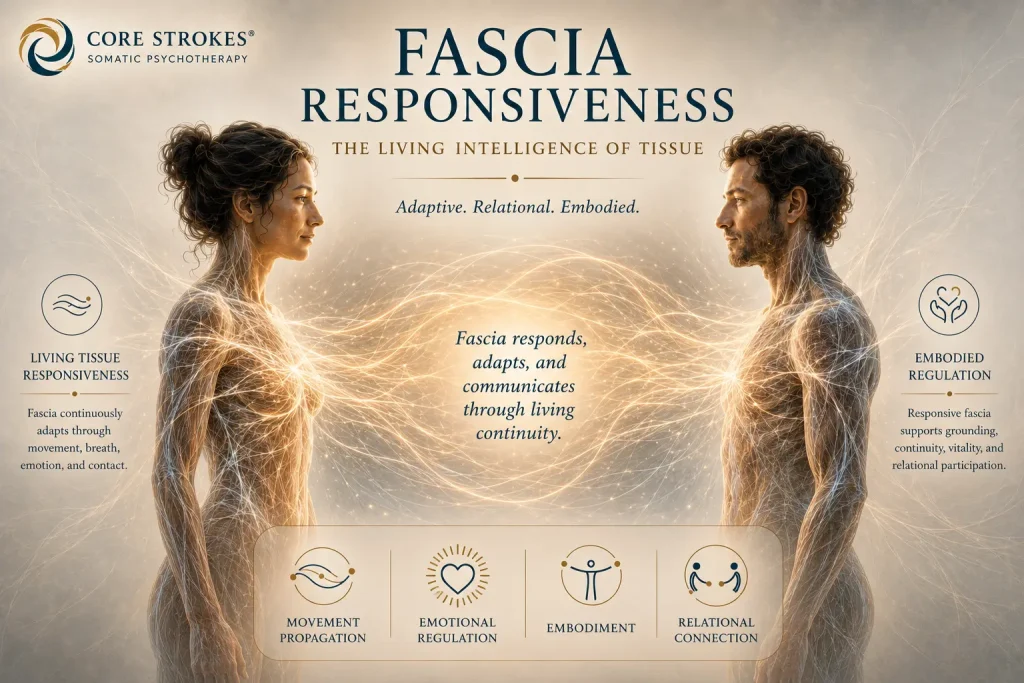
Fasciale responsiviteit verwijst naar het vermogen van het organisme tot levende en adaptieve weefselresponsiviteit binnen lichamelijke, emotionele, energetische en relationele ervaring.
Binnen het Core Strokes®-framework wordt fascia begrepen als een voortdurend responsieve matrix die deelneemt aan bewegingspropagatie, sensatie, ademorganisatie, krachttransmissie, emotionele activatie, energetische continuïteit en belichaamde regulatie.
Fasciale responsiviteit beperkt zich niet enkel tot flexibiliteit.
Het omvat ook het vermogen van het weefsel om te verzachten of te stabiliseren, toe te geven of te ondersteunen, te transmitteren of te bevatten, uit te breiden of samen te trekken, en zich adaptief te reorganiseren in reactie op veranderende interne en externe omstandigheden.
Gezonde fascia blijft dynamisch in plaats van chronisch gefixeerd, ingestort, gefragmenteerd, gepantserd of mechanisch rigide.
Fasciale responsiviteit beïnvloedt daarom rechtstreeks hoe het organisme belichaming, regulatie, emotionele participatie, energetische responsiviteit, relationeel contact en continuïteit van de zelfervaring beleeft.
Why Fascia Responsiveness Matters
Human experience is always embodied through tissue.
Breathing moves through fascial continuity. Emotional activation changes muscular and fascial tone. Movement propagates through myofascial chains. Touch, posture, tension, pressure, and energetic activation are all mediated through living connective tissue organization.
Fascia continuously adapts to experience.
Healthy tissue can absorb and distribute force, respond fluidly to movement, support grounding, transmit sensation, adapt during emotional activation, and reorganize after challenge or stress.
This responsiveness can often be felt in ordinary moments — the body softening during trust, tightening during anticipation, freezing during conflict, or regaining fluidity after emotional release.
When fascial responsiveness becomes chronically restricted, movement and experience often lose adaptability and flow.
The organism may begin organizing around rigidity, contraction, collapse, fragmentation, defensive bracing, diffuse tone, or reduced energetic propagation.
A person may feel chronically tense during contact, emotionally shut down during vulnerability, physically collapsed under stress, or unable to fully settle after activation.
These patterns influence not only posture and movement, but also emotional regulation, breathing continuity, relational participation, energetic responsiveness, and the organism’s overall sense of aliveness.
Within Core Strokes®, many forms of suffering are therefore understood partly as disturbances in living tissue responsiveness throughout the organism.
Fascia Responsiveness and the Body
Fascial responsiveness can often be observed directly through the body.
Healthy tissue tends to feel alive, adaptable, connected, and responsive under contact and movement. Breathing propagates more continuously through the organism. Movement distributes rather than becoming trapped in isolated areas. Emotional activation can move without immediately producing collapse, rigidity, or fragmentation.
A responsive organism often shows continuity of movement, adaptability under pressure, fluid transitions between activation and settling, grounded posture without rigidity, and increasing capacity for embodied emotional expression.
Fascial responsiveness can also be sensed in simple experiences — the elasticity of movement while walking, the body’s response to touch, the ability to soften without collapsing, the capacity to remain grounded during emotional activation, or the fluid propagation of breath through the torso and pelvis.
When responsiveness becomes restricted, the body frequently reorganizes defensively.
Tissue may harden chronically, lose elasticity, collapse under pressure, fragment in responsiveness, or remain continuously activated without sufficient settling.
Movement may become mechanically controlled, diffuse, frozen, inhibited, or disconnected from embodied feeling. Breathing may lose continuity. Emotional expression may become restricted or overwhelming. Activation may fail to propagate coherently throughout the organism.
Within Core Strokes®, fascia is therefore understood not merely as structure, but as a living participant in embodied organization and therapeutic transformation.
Healthy Fascial Responsiveness
Healthy fascial responsiveness supports increasing adaptability, regulation, movement propagation, embodied vitality, grounding, and emotional participation.
Responsive fascia allows the organism to remain flexible without losing structure, grounded without becoming rigid, emotionally available without collapse, and activated without fragmentation.
A person with healthy fascial responsiveness may gradually feel more capable of moving fluidly, breathing fully during activation, adapting under stress, expressing emotion without overwhelming disorganization, receiving touch without defensive contraction, and remaining grounded during relational contact.
The body often reflects this directly.
Movement becomes more continuous and integrated. Tissue remains responsive rather than chronically armored or collapsed. Breathing propagates more fully through the organism. Emotional expression becomes increasingly embodied and metabolizable.
Healthy fascial responsiveness does not imply endless softness or unrestricted openness.
Responsive tissue also stabilizes, supports, contains, and protects when necessary.
Within Core Strokes®, health involves flexible adaptability rather than chronic rigidity, collapse, or defensive fixation.
Disturbances of Fascial Responsiveness
Disturbances in fascial responsiveness may emerge through trauma, chronic stress, injury, developmental disruption, emotional overwhelm, repetitive defensive organization, relational instability, or prolonged autonomic dysregulation.
These disturbances may organize in different directions.
Some organisms develop chronic rigidity and armoring. Tissue becomes dense, fixed, overcontrolled, or resistant to movement, emotional activation, and energetic propagation.
Others organize around collapse or diffuse tone. Tissue loses support, responsiveness, elasticity, and coherent propagation under pressure.
A person may notice this as chronic tightness during emotional contact, loss of grounding under stress, difficulty softening during intimacy, diffuse fatigue, physical numbness, or inability to feel fully present within parts of the body.
In other cases, responsiveness becomes fragmented. Certain regions remain highly defended while others become excessively permeable, activated, disconnected, or unstable.
A person may feel physically present in some areas of the body while remaining numb, frozen, tense, collapsed, or emotionally disconnected in others.
Over time, these tissue organizations may shape posture, movement patterns, breathing continuity, emotional regulation, relational responsiveness, energetic organization, and continuity of self-experience.
Within Core Strokes®, these patterns are understood not as isolated muscular problems, but as embodied organizational adaptations expressed through the living fascial matrix.
Fascia Responsiveness and the Fascia Texture Typology™
Within the Core Strokes® framework, the Fascia Texture Typology™ describes recurring patterns of tissue organization and responsiveness throughout the organism.
Different textures reflect different relationships between support and yielding, rigidity and adaptability, continuity and fragmentation, activation and settling, permeability and containment.
For example, dense or armored textures may reflect chronic protective contraction, diffuse or collapsed textures may reflect reduced support and containment, fragmented textures may reflect interrupted propagation and discontinuity, while responsive textures support increasing adaptability, vitality, grounding, and embodied participation.
The Fascia Texture Typology™ therefore functions partly as a map of organismic responsiveness expressed through tissue organization.
Fascia Responsiveness and Therapeutic Transformation
Within Core Strokes®, therapeutic transformation involves gradual restoration of living tissue responsiveness throughout the organism.
This process may involve restoring breath continuity, increasing movement propagation, supporting grounding, softening chronic armoring, strengthening collapsed organization, improving autonomic regulation, and developing increasing capacity for embodied emotional participation.
As fascial responsiveness increases, the organism often becomes more capable of fluid movement, emotional metabolization, grounded activation, relational participation, energetic continuity, and embodied aliveness.
People frequently report feeling more present within their bodies, more emotionally connected during contact, more capable of softening without collapse, and more able to adapt during stress without losing grounding or continuity.
Breathing may deepen. Movement becomes less defended. Emotional activation becomes increasingly tolerable and integrated. The body develops greater capacity to adapt without losing coherence.
Within Core Strokes®, therapeutic transformation therefore involves not merely releasing tension, but restoring adaptive responsiveness throughout the living organism.
Fascia Responsiveness and Soul Coherence
As fascial responsiveness becomes increasingly coherent and integrated, the organism may gradually experience greater continuity between sensation, movement, breath, emotional life, energetic participation, and embodied presence.
The body often begins feeling less mechanically defended and increasingly alive from within.
A person may experience greater ease while moving, increased capacity to remain emotionally present during contact, deeper grounding during activation, and greater fluidity between feeling, movement, breath, and expression.
Movement becomes more fluid and authentic. Emotional experience becomes more metabolizable. Breathing gains continuity and depth. The organism develops increasing capacity to remain grounded, responsive, emotionally available, and embodied during participation in life.
In this sense, fascial responsiveness contributes directly to the emergence of Soul Coherence — the organism’s capacity to inhabit life with increasing integrity, vitality, responsiveness, embodiment, and meaningful participation.
Relational Field and the Energetic Breath Cycle™
Within the Energetic Breath Cycle™, relational participation develops progressively through safety, receptivity, exploration, emotional expression, surrender, and embodied contact.
Disturbances within early relational fields may interrupt these developmental capacities, shaping defensive organization, emotional regulation, energetic participation, and continuity of self-experience.
Therapeutic transformation therefore involves gradually restoring increasing capacity for embodied relational participation throughout the organism.
In Summary
Within Core Strokes®, the relational field refers to the living embodied space of emotional, energetic, autonomic, and experiential exchange that emerges between organisms in contact.
The relational field continuously shapes regulation, embodiment, emotional organization, defensive adaptation, energetic participation, and continuity of self-experience.
Healthy relational fields support increasing safety, flexibility, emotional continuity, differentiation, and embodied participation.
Disturbances within the relational field may contribute to defensive organization, fragmentation, emotional instability, withdrawal, hyperadaptation, collapse, or chronic relational dysregulation.
Therapeutic transformation therefore unfolds not only within the individual organism, but within the quality of relational participation itself.
As relational coherence deepens, the organism becomes increasingly capable of grounded presence, emotional flexibility, intimacy, authenticity, vitality, and meaningful participation in life.
The relational field forms one of the foundational organizing principles underlying the Core Strokes® framework.
Explore Related Core Strokes® Concepts
→ The Organisation of Embodied Participation
The phenomenological foundation of Core Strokes®, describing how continuity, coherence, permeability, metabolisation, adaptive organisation, and relational geometry organise embodied life.
→ Defensive Organisation
A protective form of Adaptive Organisation in which participation becomes organised around experienced or anticipated threat, overwhelm, disruption, or loss of continuity.
→ Living Participation Observation System™ (LPOS™)
The observational methodology through which embodied and relational expressions are described before provisional organisational interpretations are developed.
→ Relational Field and Relational Geometry
The Relational Field is the embodied space of interaction. Relational Geometry describes how proximity, distance, boundaries, orientation, reciprocity, and differentiation are organised within it.
→ Energetic Breath Cycle™
A developmental map describing how breathing organises grounding, activation, emotional expression, surrender, and restoration throughout the organism.
→ Fascia Texture Typology™
A phenomenological framework for describing recurring tactile configurations and considering their possible organisational significance without treating them as diagnoses, personality types, or records of developmental history.
→ Neurofascial Encoding™
A proposed research framework exploring possible relationships among repeated participation, neural plasticity, behaviour, physiological regulation, movement, mechanical loading, and connective-tissue remodelling.
→ Neurofascial Transformation Process™
The therapeutic process through which breathing, fascia, movement, therapeutic touch and relational participation can contribute to embodied reorganisation and therapeutic transformation.
→ Therapeutic Touch
An embodied and relational practice guided by consent, clinical judgement, perceptual attention, and responsiveness rather than by mechanical intervention or predetermined interpretation.
→ Character Structures
A framework for exploring recurring developmental organisations of bodily, emotional, behavioural, and relational participation without reducing people to fixed types.
→ Soul Organisation, Soul Coherence, and Soul Textures ™
Interrelated dimensions of Core Strokes® concerned with authenticity, meaning, inner resonance, embodied presence, and relational participation. Soul Organisation names the wider qualitative domain; Soul Coherence describes increasing integrity among dimensions of experience; Soul Textures™ describe qualities of coherent participation; and Shadow Soul Textures™ describe qualitative expressions of protective, constrained, fragmented, or compensatory Adaptive Organisation.
These principles can also be explored directly through experiential practice within:
Closing Invitation
The relational field is explored experientially throughout Core Strokes® workshops, trainings, and therapeutic practice.
Through breath, movement, fascia-oriented work, emotional process, energetic activation, therapeutic touch, and relational presence, participants gradually begin recognizing how deeply human experience is shaped within embodied relational participation.
Within Core Strokes®, healing does not occur through technique alone, but through the gradual emergence of safer, more coherent, embodied, and emotionally responsive relational fields.
As relational participation deepens, many people discover increasing capacity to remain present during intimacy, grounded during vulnerability, emotionally open without collapse, and connected without losing continuity of self.
Breathing often becomes more continuous. Emotional expression becomes more authentic. The body becomes more responsive and alive within contact.
Relationship gradually becomes less organized around defense and more organized around presence, mutuality, participation, and embodied aliveness.
In this sense, therapeutic transformation involves not merely changing internal states, but rediscovering the organism’s capacity to participate relationally in life with increasing coherence, embodiment, flexibility, and authenticity.