Co-Regulation in Core Strokes®
Regulation Through Embodied Relationship
Co-Regulation — Core Definition
Co-regulation refers to the organism’s capacity to regulate emotional, physiological, energetic, and relational experience through embodied interaction with others.
Within the Core Strokes® framework, co-regulation unfolds through dynamic exchanges of breath, fascia, posture, movement, nervous system responsiveness, emotional expression, energetic tone, and relational presence within the therapeutic and relational field.
Co-regulation supports safety, continuity, emotional regulation, embodied participation, and the organism’s unfolding capacity for therapeutic transformation.
Introduction
Human beings do not regulate in isolation.
From the beginning of life, breathing rhythms, emotional states, nervous system activation, posture, movement, and relational participation develop through interaction with others.
An infant gradually learns safety, soothing, activation, expression, and recovery through repeated experiences of embodied relational contact. Voice tone, touch, gaze, breathing rhythm, emotional responsiveness, and physical holding all contribute to how the organism learns to regulate itself within relationship.
Within the Core Strokes® framework, this relational process is described as co-regulation.
Co-regulation refers not only to nervous system calming, but to the organism’s broader capacity to organize emotional experience, energetic activation, breath, fascia, movement, and relational participation within a shared relational field.
In this sense, co-regulation is understood as a living process of embodied participation between organisms.
Co-Regulation as an Organismic Process
Within Core Strokes®, co-regulation is understood as a whole-organism phenomenon.
Human beings continuously influence one another through subtle exchanges involving breathing rhythms, muscular tone, fascial responsiveness, posture, emotional expression, energetic activation, movement impulses, vocal tone, gaze, and relational orientation.
These processes often unfold automatically and beneath conscious awareness.
A calm and grounded presence may gradually soften defensive activation. An emotionally attuned voice may support breathing continuity. Respectful touch may increase grounding and embodied awareness. Emotional unpredictability or relational tension may increase vigilance, contraction, collapse, or defensive adaptation.
Co-regulation therefore involves far more than verbal reassurance alone.
The entire organism participates continuously within the relational field.
Developmental Foundations of Co-Regulation
The capacity for self-regulation develops through repeated experiences of co-regulation.
When caregivers respond consistently and attunedly to the child’s emotional and physiological states, the organism gradually develops increasing capacity for emotional continuity, grounding, flexibility, differentiation, and embodied participation.
Breathing rhythms become more stable. Emotional activation becomes increasingly tolerable. The body develops greater continuity between sensation, movement, feeling, and expression.
When relational environments become chronically overwhelming, intrusive, inconsistent, emotionally unavailable, or dysregulating, the organism may instead develop defensive forms of regulation organized around vigilance, collapse, withdrawal, overadaptation, emotional inhibition, fragmentation, or chronic activation.
These relational experiences become embedded within posture, breath patterns, fascial organization, nervous system regulation, emotional responsiveness, and patterns of relational participation.
Within Core Strokes®, co-regulation therefore forms one of the central developmental foundations underlying emotional regulation and embodied organization.
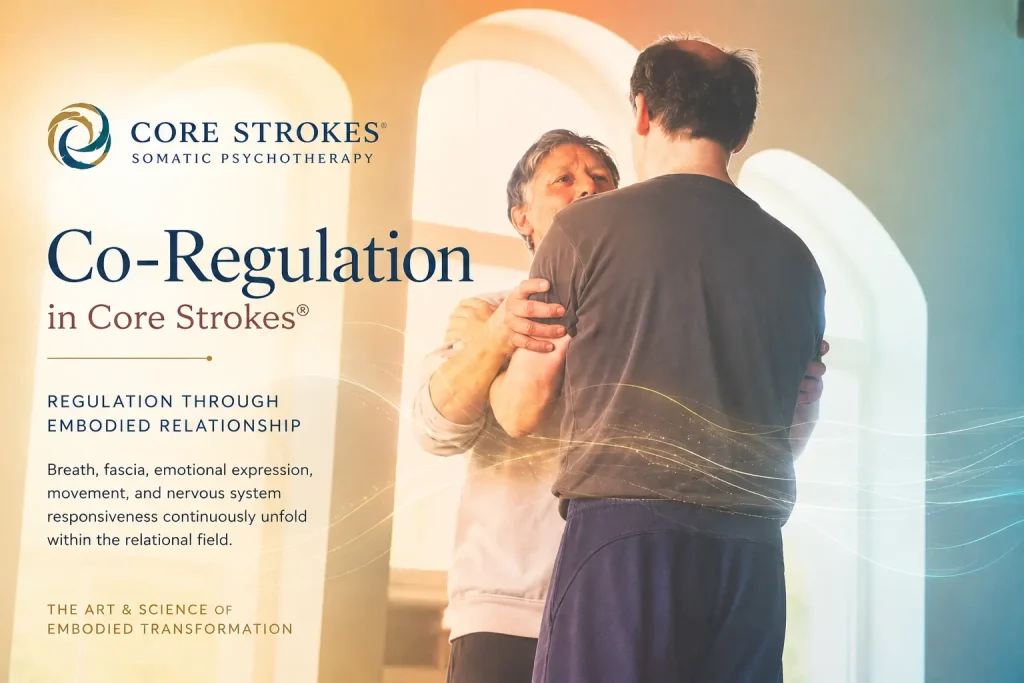
Co-Regulation and the Body
Co-regulation is always embodied.
Breathing rhythms often begin synchronizing during safe relational contact. Muscular and fascial tension may soften through emotionally attuned interaction. Movement patterns, posture, gaze, voice tone, energetic activation, and emotional expression continuously influence how the organism experiences safety and participation within relationship.
The body therefore functions as a relational system rather than an isolated structure.
Within Core Strokes®, practitioners learn to observe how co-regulatory processes become visible through:
- breathing continuity or interruption
- shifts in fascial responsiveness
- muscular holding or softening
- changes in posture and movement
- emotional expression
- nervous system activation
- energetic tone and relational orientation
These signals provide important information about how the organism is organizing itself within the relational field.
Co-Regulation in Somatic Psychotherapy
Within somatic psychotherapy, co-regulation becomes one of the primary conditions supporting therapeutic transformation.
The practitioner’s embodied presence influences the client’s capacity to remain grounded, emotionally open, regulated, and connected during processes of activation, vulnerability, and expression.
Through therapeutic presence, relational attunement, pacing, touch, breath awareness, and embodied responsiveness, the therapeutic relationship gradually becomes a safer environment for emotional and physiological reorganization.
Within Core Strokes®, co-regulation does not imply dependency or emotional fusion.
Rather, it supports the organism’s increasing capacity for self-regulation, differentiation, flexibility, emotional continuity, and embodied participation within relationship.
The therapeutic field therefore becomes a living environment through which previously restricted forms of participation may gradually emerge.
Disturbances in Co-Regulation
When co-regulation becomes unreliable, overwhelming, intrusive, or chronically dysregulated, the organism often develops protective survival organizations.
Some individuals become hypervigilant to subtle relational cues and emotional shifts. Others withdraw from emotional contact altogether. Some organize around collapse, emotional inhibition, chronic self-reliance, compulsive caretaking, or relational overadaptation.
Over time, the organism may begin associating relationship itself with instability, unpredictability, engulfment, shame, fragmentation, or emotional overwhelm.
These patterns may later appear through:
- breath restriction
- chronic muscular holding
- fascial rigidity or collapse
- emotional dysregulation
- defensive withdrawal
- hyperactivation
- relational fear or dependency
- difficulties with emotional expression or intimacy
Within Core Strokes®, such patterns are understood not as personal failure, but as adaptive survival organizations shaped through earlier relational experiences.
Co-Regulation and Therapeutic Transformation
Within Core Strokes®, therapeutic transformation unfolds through increasing continuity between regulation, embodiment, emotional experience, relational participation, and organismic responsiveness.
As co-regulation becomes increasingly stable within the therapeutic field, the organism may gradually develop greater tolerance for emotional expression, vulnerability, activation, intimacy, and embodied contact.
Breathing often becomes more continuous. Fascial responsiveness becomes more dynamic and alive. Emotional experience becomes increasingly metabolizable rather than overwhelming or defended.
The organism gradually develops greater capacity to remain present during activation without collapsing, fragmenting, dissociating, or organizing primarily around chronic protection.
Co-regulation therefore supports the emergence of greater vitality, authenticity, flexibility, emotional continuity, and relational participation.
Conclusion — Regulation Through Relationship
Within Core Strokes®, co-regulation is understood as a living process of embodied relational participation.
Human beings continuously influence one another through breath, fascia, posture, movement, emotional expression, energetic tone, nervous system responsiveness, and relational presence.
The organism develops the capacity for regulation not in isolation, but through repeated experiences of embodied relational contact.
Within somatic psychotherapy, co-regulation supports the conditions through which emotional continuity, embodied awareness, therapeutic transformation, and relational participation can gradually emerge.
In this sense, co-regulation forms one of the central organizing principles underlying the Core Strokes® framework.
The Core Strokes® Framework
Core Strokes® integrates breath, fascia, relational presence, developmental psychology, and phenomenological observation into a unified framework of embodied organization and somatic psychotherapy.
Explore related dimensions of the framework:
→ Therapeutic Presence in Core Strokes®
→ Relational Attunement in Core Strokes®
→ Relational Field in Core Strokes®
→ Neurofascial Transformation Process™
Closing Invitation
Co-regulation is explored experientially throughout Core Strokes® workshops, trainings, and therapeutic practice.
Participants gradually develop increasing awareness of how breathing rhythms, emotional states, fascial responsiveness, nervous system activation, posture, movement, and relational presence continuously shape embodied experience within relationship.
Through embodied participation, therapeutic presence, and relational awareness, practitioners learn how regulation and transformation emerge not only within the individual organism, but through the living processes of relational connection itself.
Frequently Asked Questions
“Core Strokes® emerged through decades of clinical, developmental, and phenomenological exploration into the organization of embodied participation.”